rile*books

Search books

Search books by title, author, publisher, keywords...

Cover of A Journal of Militant Sound Inquiry – Vol. 1 – Naming the Moment

Rab-Rab Press

A Journal of Militant Sound Inquiry – Vol. 1 – Naming the Moment

Ultra-red

€17.00

For their thirtieth anniversary, Ulta-red, the international sound art and popular education collective is releasing the first volume of Ulta-red: A Journal of Militant Sound Inquiry, investigating movement-based listening practices that take the forms of militant inquiry and political education.

In the words of Ultra-red, "No movement without listening!"
The initial issue of Ulta-red examines "conjunctural analysis," or "naming the moment," as a practice of collective inquiry. The issue begins with conversations with three popular educators in North America who, in the 1990s, developed a body of literature meant to guide radical groups through an inquiry into what Stuart Hall once called, the history of the present.

It includes a discussion with Toronto-based activist Chris Cavanaugh who participated in numerous conjunctural analysis efforts in political movements across Canada. In 2000, Cavanaugh helped start the Catalyst Project as a center for working-class and leftist education.

The next interview features Mary Zerkel, a Chicago-based organizer and artist who produced the seminal text, Coyuntural Analysis: Critical Thinking for Meaningful Action in 1997. Zerkel talks about the relationship between her organizing work in local anti-racist and anti-imperialist struggles as well as her involvement in numerous political art collectives in Chicago.

The journal also features an extended conversation with Gustavo Castro Soto in San Cristobal de las Casas, Chiapas, Mexico. Castro Soto is known internationally as the last person to have been with Honduran indigenous activist Berta Cáceres when she was assassinated by paramilitaries in 2016. Recently known for his anti-extractivist efforts in Central America, Castro Soto was part of a team in the late 1990s that produced a ten-volume series of booklets guiding people through the history and political praxis of conjunctural analysis, Metodología de Análisis de Coyuntura.

The Ulta-red journal connects local struggles across contexts, publishing dispatches from ongoing militant investigations in London, Los Angeles, and in prisons in the U.S. South. The journal also introduces reflections on the problems of militant sound inquiry through poetry, book responses, letters, and visual art.

The journal is edited by Dont Rhine in collaboration with David Albright and Christina Sanchez Juarez. It includes contributions by Tony Carfello, Janna Graham, Museo de la Palabra y la Imagen, Chris Jones, Karla, Elliot Perkins, Daniela Lieja Quintanar, and Robert Sember.

Ultra-red is an international sound art and popular education collective with twelve members based in Los Angeles, New York, Berlin, and multiple locations in the UK.

Activist art has come to signify a particular emphasis on appropriated aesthetic forms whose political content does the work of both cultural analysis and cultural action. The art collaboration Ultra-red propose a political-aesthetic project that reverses this model. If we understand organizing as the formal practices that build relationships out of which people compose an analysis and strategic actions, how might art contribute to and challenge those very processes? How might those processes already constitute aesthetic forms?

In the worlds of sound art and modern electronic music, Ultra-red pursue a fragile but dynamic exchange between art and political organizing. Founded in 1994 by two AIDS activists, Ultra-red have over the years expanded to include artists, researchers and organisers from different social movements including the struggles of migration, anti-racism, participatory community development, and the politics of HIV/AIDS.

Collectively, the group have produced radio broadcasts, performances, recordings, installations, texts and public space actions (ps/o). Exploring acoustic space as enunciative of social relations, Ultra-red take up the acoustic mapping of contested spaces and histories utilising sound-based research (termed Militant Sound Investigations) that directly engage the organizing and analyses of political struggles.

Language: English

recommendations

Cover of Rab-Rab, Issue 5

Rab-Rab Press

Rab-Rab, Issue 5

Rab-Rab

Periodicals €27.00

The fifth issue of Rab-Rab: Journal of Political and Formal Inquiries in Art includes stories about nation traitors, fierce masses, socialist women struggles, love-forms, psychedelic counter-revolutionaries, workers unions, Brecht fiddlers, jazz surrealism, Soviet trains, and anti-fascism.

Among the contributors to the fifth issue are Anna Thew, Yehuda Safran, Peter Gidal, Cana Bilir-Meier, David Black, Marjo Liukkonen, Alejandro Pedregal, Peter Hallward, Minna Henriksson, and Jyrki Siukonen.

It has also two extensive dossiers. One dedicated to Franklin Rosemont is presented by Joe Feinberg and is introducing some unpublished and difficult to find texts parallel with writings of T-Bone Slim and Joe Hill. The other dossier on Robert Linhart is presented by Tevfik Rada, and it includes a translation of a chapter from Linhart's book on productivism, an article against Western bourgeois dissidents, and an interview with him.

Cover of About Narration – Materials, Comments, Interventions

Rab-Rab Press

About Narration – Materials, Comments, Interventions

Ingemo Engström, Harun Farocki

Published in collaboration with Harun Farocki Institut, this book unpacks About Narration [Erzählen], a 1975 essay film directed by Ingemo Engström and Harun Farocki.

Edited and introduced by Sezgin Boynik and Tom Holert, this book focuses on About Narration [Erzählen] directed by Ingemo Engström and Harun Farocki.
It includes the film's script alongside the historical documents related to its making and Farocki's previously unpublished theoretical and programmatic essay on the film. The publication also includes a retrospective essay by Ingemo Engström on the film's political and artistic background.

Volker Pantenburg's detailed elaboration of the conditions of its making, alongside Boynik and Holert's concluding remarks, further contextualizes the film. The interview with Cathy Porter on Larisa Reisner, a heroine of About Narration, gives an overview of the life of a militant writer who inspired Engström and Farocki.

Edited and introduced by Sezgin Boynik and Tom Holert.

Cover of Wanting Something Completely Different – 111 Vignettes of Left-Wing Figures, Themes, Films, and Writers

Rab-Rab Press

Wanting Something Completely Different – 111 Vignettes of Left-Wing Figures, Themes, Films, and Writers

Jairus Banaji

Non-fiction €20.00

A collection (montage) of biographies and themes written by Jairus Banaji.
Wanting Something Completely Different discusses a range of political figures, themes, directors and writers in a series of brief, evocative descriptions ('vignettes') aimed at laying out a vision of a modern, cosmopolitan left that can think creatively about the world we live in. The political figures include both thinkers and activists from a wide range of backgrounds—from Frantz Fanon and the Palestinian novelist Ghassan Kanafani to the theologian Dietrich Bonhoeffer and the murdered Russian journalist Anna Politkovskaya. The themes range equally widely from the death of Walter Benjamin (reconstructed here from a remarkable documentary on the same theme) and the slaying of Pasolini to the work of British Marxist Perry Anderson, or the corrupt nature of India's leading corporate groups, or the outstanding contributions of Italian and U.S. Black feminists to feminist theory. And under the rubrics which discuss film and literature, there is the same striving for diversity and depth.

The vignettes collected in this Rab-Rab book first circulated on Facebook over some seven years or more and are reproduced here with a new introduction and extensive bibliographical references and notes.

Jairus Banaji is a historian and revolutionary Marxist activist. He received the Isaac and Tamara Deutscher Memorial Prize in 2011. His academic work has ranged widely across sources and languages, with major books on Late Antiquity and commercial capitalism as well as numerous papers and articles.

Cover of Iliazda at the Birthday Party – Autobiographical Lecture, 1922

Rab-Rab Press

Iliazda at the Birthday Party – Autobiographical Lecture, 1922

Iliazda

The English translation of Zdanevich's Dadaist autobiographical lecture in Paris in 1922, where he adopts the name Iliazda. In this entertaining lecture, the achievements of the avant-garde is presented as a combination of zaum, polymorphous sexuality, aleatory forms and scatological interpretation of culture.

The second volume of the bie bao series presents a eulogy entitled Iliazda at the Birthday Party, a pseudo-autobiographical lecture delivered by Ilya Zdanevich in Paris in 1922. It reports on Zdanevich's artistic and political adventures up until then. Along with an autobiography full of self-admiration, in this lecture Zdanevich gives an interpretation of his zaum dramas inspired by Freudianism, and humorously describes a colourful image of the Russian microcosm in Montparnasse. 

Additionally, this second volume also includes Iliazd's letter to Ardengo Soffici from 1964, where one can read, in the most unambiguous terms, about Zdanevich's positions against war, imperialism, and all forms of nationalism. Subtitled 50 Years of Russian Futurism, the letter to Soffici presents us with an altogether new Zdanevich—a "fellow traveller" in both leftist and avant-garde circles. As well as the extended introduction and extensive annotations, the texts are further contextualised with Johanna Drucker's visual presentation of the birth of the Iliazd cult.

The bie bao series will include eight publications, covering many layers of Zdanevich's rich theoretical and artistic output. Each volume consists of a bio-bibliographical introduction, a commentary, a translation with annotations, and artistic intervention.

Iliazd (Ilya Zdanevich, 1894-1975) was a Russian poet, designer, typographer, theoretician, art critic, and publisher, close to the avant-garde circles and one of the promoters of Futurism in Russia, author of a poetic work, drama written in zaum abstract poetic trans-sense or "transrational" language, and novels.

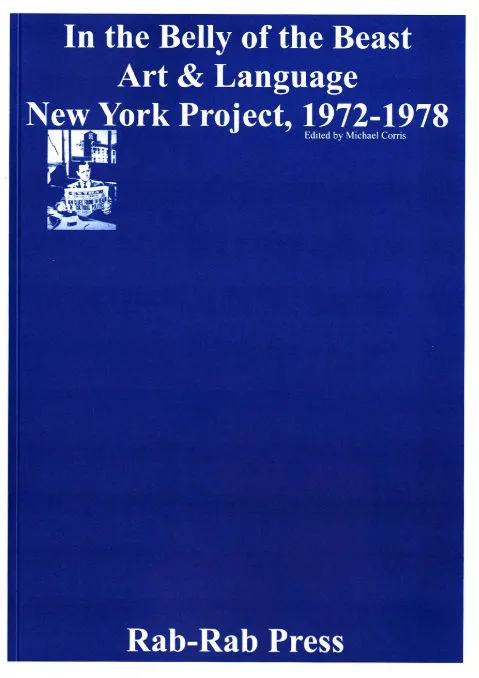
Cover of Biting the Hand – Traces of Resistance in the Art & Language diaspora

Rab-Rab Press

Biting the Hand – Traces of Resistance in the Art & Language diaspora

Paul Wood

€30.00

Extensive survey of the politically outward-looking Conceptualism emerging from Art & Language in the UK. Especially considering its critique of the norms of Modernist art practices in contemporary art, particularly practices of art education.

Edited, compiled and introduced by Paul Wood, Biting the Hand: Traces of Resistance in the Art & Language diaspora is about a dissident formation of artists active in the UK in the 1970s and 80s.

The book tells the story of artists engaging with a critique of then-contemporary modernist art education, who have embarked on a series of theoretical investigations which became increasingly politicised under the pressures of an evolving social crisis. Increased racism, unemployment and attacks on the organised working class all raised questions about how a critical art might respond.

By the late 1970s, these radical artists, mostly in the orbit of the Art & Language group, were producing posters and leaflets for a wide range of left-wing causes, as well as analyses of the politics of art and design education and the role of cultural ideology in maintaining consensus. In the 1980s, as Thatcherism tightened its grip, those involved went their separate ways into areas as diverse as media work, trade unionism, health and education.

Biting the Hand has three parts: a retrospective introduction setting the formation in its historical context, and two annotated documentary sections presenting examples of the work as both text and image, written and edited by Paul Wood.

It also includes a foreword by Sezgin Boynik, publisher, and an afterword by Ann Stephen, curator and art historian, further expanding on the book's subject.

For many years Paul Wood worked for the Art History Department of the Open University. His publications from that period include Conceptual Art (2000), Western Art and the Wider World (2013), and the four-volume anthology Art in Theory (1990-2020), co-edited with Charles Harrison and others.

Edited, compiled and introduced by Paul Wood.
Foreword by Sezgin Boynik; afterword by Ann Stephen.

Cover of Someone Who Isn't Me

Rose Books

Someone Who Isn't Me

Geoff Rickly

Fiction €22.00

Geoff Rickly’s debut novel Someone Who Isn’t Me is a feverish journey through the psyche of someone who no longer recognizes himself. 

When Geoff hears that a drug called ibogaine might be able to save him from his heroin addiction, he goes to a clinic in Mexico to confront the darkest and most destructive versions of himself. In this modern reimagining of the Divine Comedy, survival lurks in the darkest corners of Geoff’s brain, asking, will he make it? Can anyone?

Cover of Livre d'images sans images (LP)

Varamo Press

Livre d'images sans images (LP)

Mette Edvardsen, Iben Edvardsen

Performance €23.00

Livre d’images sans images by Mette Edvardsen & Iben Edvardsen borrows its title from a book by H.C. Andersen, also referred to as The Moon Chronicler. The book follows a conversation between a painter and the Moon, where the Moon describes to the painter what she sees on her journey around the world every evening, telling the painter to paint what she describes. “This conversation, as in the now obsolete meaning of the word (‘a place where one lives or dwells’), was the starting point for our work. Using the weather report as dramaturgy, (‘the moon did not show up every evening, sometimes a cloud came in between’), we have created and collected materials from our conversations in the form of recordings, text, voice, drawings, references, found images, loose connections, inspirations and imaginations, in the order they came to us. They are at the same time sources and traces, material and support for new imaginations or events to come.” The work consists of three different media: vinyl, paper and live performance. 

Mette Edvardsen is a choreographer and performer eager to explore the performing arts as a practice and situation, also in relation to other media such as books and writing. This work is in collaboration with her daughter, Iben Edvardsen.

Published by Xing & Varamo Press
XONG collection – artist records XX10 (2023)
First edition, September 2023
Recorded and edited by Mette Edvardsen & Iben Edvardsen
Format white 12’ vinyl LP in cardboard sleeve
Released in a numbered edition of 300 copies, including collector’s edition of 25 copies, each accompanied by a unique poster hand drawn with black marker by Mette Edvardsen & Iben Edvardsen, 59,4 x 84 cm, folded, signed by the artists

Cover of Blank Forms #07 – The Cowboy's Dreams of Home

Blank Forms

Blank Forms #07 – The Cowboy's Dreams of Home

Joe Bucciero, Lawrence Kumpf

The seventh entry in an ongoing series of anthologies, this book features rare poems alongside new essays and interviews that engage the artists and themes explored elsewhere in Blank Forms' public programming.

Where most of prior entries, including Aspirations of Madness (2020), Intelligent Life (2019), and Music From The World Tomorrow (2018), have foregrounded little-seen or newly translated archival materials, this iteration privileges new texts produced specifically for the publication. These include an in-depth retrospective interview with the idiosyncratic Texan singer-songwriter and visual artist Terry Allen conducted by ICA Philadelphia chief curator Anthony Elms; a conversation between multidisciplinary writers—and longtime friends—Thulani Davis and Jessica Hagedorn on the occasion of Davis's latest poetry collection, Nothing but the Music, recently published by Blank Forms Editions; a recent discussion between composer Sarah Hennies and cellist Judith Hamann about their recent collaboration, which is included on Hamann's Music for Cello and Humming; and a conversation with composer-performers Tashi Wada and Charles Curtis, on the heels of a recent compilation of Curtis's work, Performances & Recordings 1998– 2018, produced by Wada. Each of these interviews shed light on the particularities of the artists' careers and methods in terms both formal and casual, practical and theoretical. 

In addition to these dialogues, this book features new critical reflections on three artists whose work Blank Forms has presented: the legendary jazz percussionist and healer Milford Graves, by Ciarán Finlayson; English multimedia artist Graham Lambkin and his beguiling 2011 album Amateur Doubles, by Alan Licht; and the UK-based experimental music trio Still House Plants, by Joe Bucciero. These articles mine historical, social, and theoretical contexts, filling gaps in the existing literature on the given artist-subjects. New and archival poems and writing about poetry complement these interviews and essays, including rare texts by Davis, Hagedorn, and René Daumal—the latter translated by Louise Landes Levi—and a suite of Auto-Mythological writings commissioned from Chicago-based composer and musician Angel Bat Dawid.