Books
Books
in random order

Mother Tongue Magazine
In celebration of February 21st, International Mother Language Day, we’re happy to present our new yearly magazine: μητρική γλώσσα (Mitrikí Glóssa) / Lingua Maternal / (Leşono Emhoyo) ܠܫܢܐ ܐܡܗܝܐ / Anadil / Mother Tongue.
Our first issue gathers three mother languages within Turkey and their dialects : Anatolian Greek, Ladino and Syriac. With an interest in everyday life, personal memories and cultural production, Mother Tongue Magazine brings together people who work and produce in these languages along with contributors who speak them, are learning them or never had the chance to learn them, embracing plurality over standardisation. Given the discourse surrounding the survival of these mother tongues, we are especially delighted to have received contributions by so many young people that are striving to keep them alive!
With contributions by: Lukas Aktaş, Nesi Altaras, Nektaria Αnastasiadou, Syrian Cassette Archives, Dilara Lüle Baklacıoğlu, Onur Çimen, Alp Etensel, Atra Givarkes, Fayrouz Library, The Pontian Library, Sara Jajou, Isla Hanna Karademir-Khoury, Iokasti Kyriaki Zografou Mantzakidou, Melisa Yağmur Saydı, Münir Tireli, Lîs Yayınevi, Beni Yorohan
Design / Illustration: Bilge Emir

Time has fallen asleep in the afternoon sunshine
Appendix #3: Orality
Victoria Pérez Royo, Léa Poiré and 1 more
Time has fallen asleep in the afternoon sunshine Appendix #3 Orality includes contributions by Simon Asencio, Bruno De Wachter, Peter Szendy, Clara Amaral, Itziar Okariz, Jude Joseph, Léa Poiré and Mette Edvardsen.
Time has The Appendixes #1–4 is an editorial series by Mette Edvardsen, Léa Poiré and Victoria Pérez Royo that developed out of the project Time has fallen asleep in the afternoon sunshine. For a two-year residency at Les Laboratoires d’Aubervilliers* (2022–23), they came together as a small work group, shaping the work process, hosting presentation formats and making this publication series on paper as four cahiers.
The cahiers comprise a collection of commissioned texts and contributions created for this context, selected documents and traces from work sessions and encounters organized during their residency, texts read together and republished for this occasion, a collection of references, notes in progress, unfinished thoughts and loose fragments – on paper, between pages.
The Appendixes are organized around four themes: (1) The gesture of writing, (2) How to organize a library, (3) Orality and (4) Translation. In addition to being published on paper, the editorial series also consisted of other formats of presentations, exchanges and meetings organized as workshops, fieldwork, performances, conferences, collective readings and oral publications, taking place during their residency at Les Laboratoires d’Aubervilliers and in the vicinity.
The Appendixes is the work that continues, material that adds on, some of it perhaps too long or too detailed, unfit or unfinished. The four themes that their research is formulated around originate in specific experiences and questions from the practices of Time has fallen asleep in the afternoon sunshine (2010 – ongoing), and also the large publication on the project ‘A book on reading, writing, memory and forgetting in a library of living books’ (2019). The research was both a means of exploring these themes in greater depth and also of bringing them into contact with other artists and researchers working on similar or related subjects. The Appendixes offered them both the contexts and the pretexts for things to happen (in time, in space, on paper).
The Appendixes #1–4, published in these cahiers, do not present an overview or a summary of all of the activities and presentations that took place during the two years at Les Laboratoires d’Aubervilliers. What these cahiers offer is a space in which to hold some thoughts together and to share them in this form. It is one more step along the way, extending the research and work already begun and that will now continue.

More Than Chilli
Chilli is one of the most popular food ingredients in contemporary China, and symbolic of modernisation. More Than Chilli goes beyond its trendy façade to explore Chongqing, known for its tradition of spicy food. From the perspective as a local, Rossy Liu reflects on her own personal memories associated with chilli. A combination of fragmented scenes, objects, dialogues, movements and sounds are drawn on to unravel the locality of culinary identity. While chilli has become a ubiquitous flavour in today's global society, the book emphasises the hidden intimacy that still exists between Chongqing locals and their unfiltered connection to chilli.

A Room of One's Own
In A Room of One's Own, Virginia Woolf imagines that Shakespeare had a sister—a sister equal to Shakespeare in talent, and equal in genius, but whose legacy is radically different. This imaginary woman never writes a word and dies by her own hand, her genius unexpressed. If only she had found the means to create, argues Woolf, she would have reached the same heights as her immortal sibling.
In this classic essay, Woolf takes on the establishment, using her gift of language to dissect the world around her and give voice to those who are without. Her message is a simple one: women must have a steady income and a room of their own in order to have the freedom to create.
With a Foreword by Mary Gordon

Unreal Sex
An anthology of queer erotic sci-fi, fantasy, and horror.
In these ten stories, everything is sex: walls, wax, the past, your future, your neighbours, hankies, candles, circuit boards, petri dishes, scrap metal – and language itself. Conjuring experiences for which there are no words, our amazing queer authors generate new tongues from the heat of their communing with a wild variety of lifeforms.
From Diriye Osman’s spiritualised Peckham to Jem Nash’s time-travelling trans multiverse, these stories transport you to new ways of being and feeling. In a word, it’s CruiserShimmeringLipophilicNeckingerCircuitGirlboss.
Whether you get horny from aliens, ghosts, robots, utopia, possession, ritual, or the completely surreal, there’s a story here for you. But why stop at one when you can taste pleasure in each and every one?
Featuring stories from: Gracie Beswick, Swithun Cooper, Rachel Dawson, Rien Gray, Vivien Holmes, Jem Nash, Diriye Osman, Alison Rumfitt, Nicks Walker & Anna Walsh.
Published November 2021.

I will pay to make it bigger
You wake up in the footwell of a mid-sized hatchback somewhere on a highway in outer Bangkok. You compile neurotic spreadsheets of the best ‘party destinations’ in Europe, whilst your work emails pile up without ever being read. You quit your job. You launch a banal start-up. You grieve for a past relationship. You stare endlessly at the waves coming in from a beach in Koh Pha Ngan. You vape intensely. You spend money on feelings, on the performance of your own persona, whilst you observe yourself with a detached sense of horror.
i will pay to make it bigger is a novella, by poet and artist Ahren Warner, in which ‘you’ are the main character. Through text and image – autofiction, docufiction, and just plain fiction – you work your way through a tangle of preoccupations: from what it means to buy enjoyment, to the fragile construction of your own self as a cultural product.
i will pay to make it bigger is also a photobook, a collection of images produced whilst living in Thai ‘party hostels’. Although these photographs might seem to exist as the documentation of intimate or ecstatic moments, they are in fact quite painstakingly, and artificially, constructed: composited and manipulated from multiple still frames of film footage to produce images that advertise the calculated artifice of their own hedonism, emotion and seemingly raw experience.
With a Coda by Hana K. Ohnewehr, commissioned by Yu’an Huang

Pfeil Magazine #19 – Rest
There is no pause without prior exertion, and this issue of the magazine explores rest and all its associated contexts and contradictions. Amidst increasing environmental pollution, a tenuous global political climate, and a performance-oriented society demanding ever greater productivity, the balance between rest and labour becomes skewed. Pausing carries the risk of falling behind, but this risk can be mitigated by knowing when to rest. This issue examines rest as activity and as resistance. It questions how the individual body, in cohesion with a community, can generate weight through relaxation and distribute it.
Contributors: Asma Ben Slama, Camila Cañeque, Christiane Blattmann, Eileen Myles, Federico Tosi, Gelare Khoshgozaran, Hanne Loreck, Hans-Christian Dany, Hyemin Yang, Ingrid Jäger, Jenni Bohn, Jochen Lempert, Julia Schulze Darup, Mariona Berenguer, Matthias Schubert, Mikołaj Sobczak, Mirene Arsanios, Nat Raha, Nicholas Grafia, Niclas Riepshoff, Omar Hahad, Sarah Drath, Stacy Skolnik, Thomas Laprade, Vir Andres Hera
Within the format of a magazine, each page of Pfeil represents the floor, walls, or ceiling which together create an imagined room displaying a printed exhibition. Each issue is dedicated to a specific word, and artists are invited and given space to work on and with this term, and to construct or deconstruct the architecture around it. Combined, the contributions transform into an organic display surrounding the leitmotif.

Mucus in my Pineal Gland
Mucus in My Pineal Gland is the debut collection of New York-based artist and writer Juliana Huxtable (born 1987). Gathering poems, performance scripts and essays, this startling volume expands Huxtable's critique of gender, sexuality, politics, whiteness and history while establishing her as a singular poetic voice.
Juliana Huxtable is a New York City-based writer, performer, and artist. Her work has been featured in numerous publications, including Artforum, Candy, Tropical Cream, and Mousse. She was included in the 2015 New Museum Triennial, curated by Ryan Trecartin and Lauren Cornell.
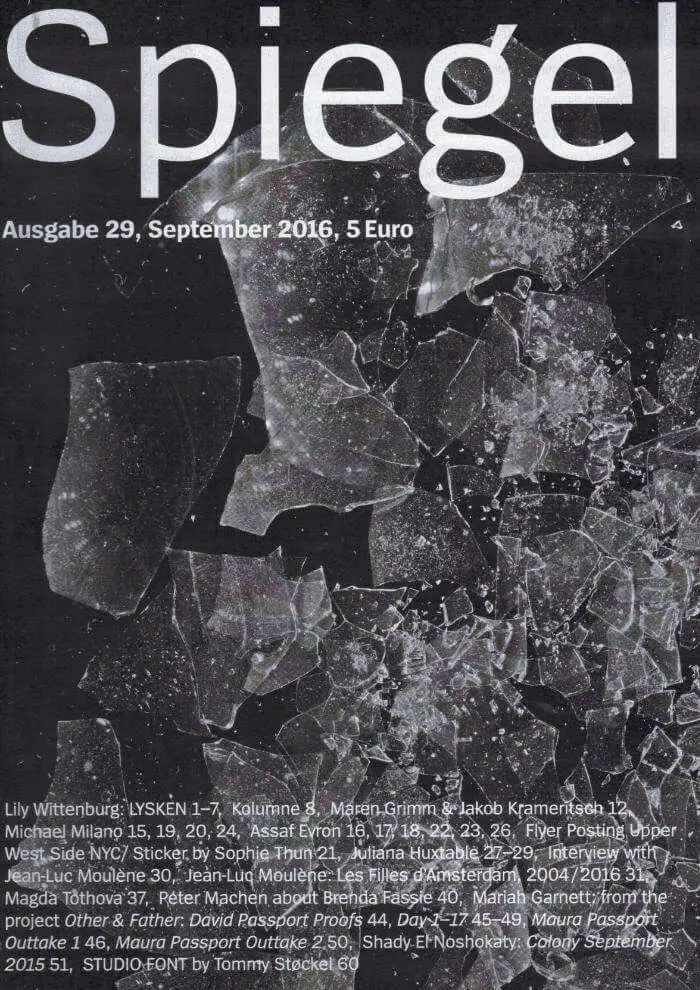
ztscript 29 : Spiegel
This issue uses the font designed for german news magazine Spiegel by amazing Lucas de Groot. The color poster is part of the full print of the series “Les Filles d’Amsterdam” by photographer Jean-Luc Moulène. It is the first time this series is printed in book form and in an exclusive interview the artist tells the story of that work.
Contributors: Lily Wittenburg, Maren Grimm & Jakob Krameritsch, Michael Milano, Assaf-Evron, Sophie Thun, Juliana Huxtable, Interview with Jean-Luc Moulène, poster by Jean-Luc Moulène, Magda Tóthová, Peter Machen on Brenda Fassie, Mariah Garnett, Shady El NoshokatyTommy Støckel

Livre d'images sans images (LP)
Mette Edvardsen, Iben Edvardsen
Livre d’images sans images by Mette Edvardsen & Iben Edvardsen borrows its title from a book by H.C. Andersen, also referred to as The Moon Chronicler. The book follows a conversation between a painter and the Moon, where the Moon describes to the painter what she sees on her journey around the world every evening, telling the painter to paint what she describes. “This conversation, as in the now obsolete meaning of the word (‘a place where one lives or dwells’), was the starting point for our work. Using the weather report as dramaturgy, (‘the moon did not show up every evening, sometimes a cloud came in between’), we have created and collected materials from our conversations in the form of recordings, text, voice, drawings, references, found images, loose connections, inspirations and imaginations, in the order they came to us. They are at the same time sources and traces, material and support for new imaginations or events to come.” The work consists of three different media: vinyl, paper and live performance.
Mette Edvardsen is a choreographer and performer eager to explore the performing arts as a practice and situation, also in relation to other media such as books and writing. This work is in collaboration with her daughter, Iben Edvardsen.
Published by Xing & Varamo Press
XONG collection – artist records XX10 (2023)
First edition, September 2023
Recorded and edited by Mette Edvardsen & Iben Edvardsen
Format white 12’ vinyl LP in cardboard sleeve
Released in a numbered edition of 300 copies, including collector’s edition of 25 copies, each accompanied by a unique poster hand drawn with black marker by Mette Edvardsen & Iben Edvardsen, 59,4 x 84 cm, folded, signed by the artists

Slipping on Fragmented Shapes
First monograph devoted to the playful, explosive and colorful paintings of the Iranian artist, featuring extensive illustrations along with a selection of drawings and preparatory studies that reveal the methods behind Hoda Kashiha's compositions, which are often constructed like collages, in which multiple layers intersect, cut-out shapes emerge, and images evolve through a combination of hand-drawing and digital manipulation.
Published following the exhibition I'm Here, I'm Not Here at Passerelle Centre d'Art Contemporain, Brest, in 2022, Hoda Kashiha's first solo public exhibition in Europe.
Developing a distinctive form of pop painting that moves freely between uninhibited Cubism and a cartoon-like visual language, Iranian artist Hoda Kashiha (born 1986 in Tehran) produces works that appear playful at first glance but reveal darker, more enigmatic, and deeply symbolic layers upon closer examination. Humour is a recurring strategy in her practice—one that fosters intimacy with viewers while enabling her to address serious and sensitive questions rooted in the social context and political climate of her home country. Her paintings also engage universal concerns, including gender relations and the place of women in society. For Kashiha, her protagonists become activists without ever speaking: they assert their differences openly and remain steadfastly optimistic. With her exuberant use of forms and colour, Kashiha creates an explosive blend of genres in which Picasso seems to drift into the world of Minecraft, joyfully dismantling the conventions of the past.
Text by Lilian Davis; conversation between Loïc Le Gall and Hoda Kashiha.

Ten Non-Binary Hertz – Going Virile
This publication brings together a text by Dagmar Dirkx and reproductions of Ot Lemmens' installation Going Virile.
Prior to starting to work on their public installation Going Virile, two of the eight display windows were vandalized and cracked. Having intended to work around the idea of passing in a trans-masculine context, Ot turned their gaze to the relationship of masculinity to violence, questioning the reproduction of ideas around masculinity through transmasculine embodiment. They designed and screenprinted 6 patterns of which a few are reproduced in this publication.
During that process they invited Dagmar Dirkx to experiment with writing a text in parallel to their work. The text Ten Non-Binary Hertz arose from a conversation between the Dagmar and Ot about trans-masculinity in relation to desire, violence and the idea of passing.
Text by Dagmar Dirkx
Translation by Titane Michiels
Design by Ot Lemmens
Made possible by VGC Brussel and Nadine vzw

Dear Friend Catalogue 2019-2022
Dear Friend is a monthly letter format publication covering design events, issues, and ideas. This publication distributed via snail mail is initiated by Sandra Nuut and Ott Kagovere.
The publication edited by Sandra Nuut & Ott Kagovere features all the letters from the Dear Friend publishing project, which they initiated at the Graphic Design Department of the Estonian Academy of Arts in 2018. The book includes contributions by Singapore-based design writer Justin Zhuang, designer and writer Else Lagerspetz, and artist Lieven Lahaye. The book is designed by Ott Kagovere and published by Lugemik and Estonian Academy of Arts.
Texts by Justin Zhuang, Lieven Lahaye, Else Lagerspetz
Letters written by Alicia Ajayi, Stuart Bertolotti-Bailey, Claudia Doms, Nell Donkers, Maarin Ektermann, Rosen Eveleigh, Maryam Fanni, Saara Hannus, Eik Hermann, Paul John, Maria Juur, Ott Kagovere, Maarja Kangro, Arja Karhumaa, Kristina Ketola Bore, Nicole Killian, Rachel Kinbar, Tuomas Kortteinen, Keiu Krikmann, Kadri Laas, Else Lagerspetz, Lieven Lahaye, James Langdon, Jungmyung Lee, Kai Lobjakas, Michelle Millar Fisher, Maria Muuk, Sheere Ng, Sandra Nuut, Laura Pappa, Jack Self, Indrek Sirkel, Paul Soulellis, Triin Tamm, Laura Toots, Alice Twemlow, Loore Viires, Sean Yendrys, Justin Zhuang

Clara Istlerová: a Life Among Letters
Anežka Minaříková, Clara Istlerová
Clara Istlerová: A Life Among Letters is the first publication in the United States to delve into the design landscape of the former Czechoslovakia through the lens of Czech designer Clara Istlerová (born 1944). A trailblazer in her field, Istlerová was one of the few women in the male-dominated field of Czech typography. This publication introduces readers to Istlerová’s renowned book designs, particularly highlighting the analog processes she utilized to create one of the most influential books on Czech architecture, Švácha, Rostislav. From Modernity to Functionalism (Odeon, 1985).
The publication features an intimate interview with Istlerová conducted by editor Anežka Minaříková, accompanied by work from Istlerová’s personal archive alongside discussions detailing her creative process. Offering a vivid portrayal of an era where design was a tangible, labor-intensive endeavor carried out in close collaboration with typesetters and printers, the publication unveils the Czech design narrative of the twentieth century to English-speaking readers, highlighting Istlerová’s lasting impact and central role.
Design by Anežka Minaříková and Marek Nedelka

Els Dietvorst E.D. (2010–2014)
This publication presents a survey of the work of Els Dietvorst from 2010 to 2014. This is also the period in which she left Brussels to live in a village on the south-east coast of Ireland, where she focused on projects such as The Black Lamb. The audio piece One was killed for beauty, another one was shot, the two others died naturally is included on an audio CD.
Els Dietvorst E.D. (2010–2014), Rolf Quaghebeur, Eva Wittocx, Katleen Weyts, Els Dietvorst, Brussels, 2014.

Dreaming in the Fault Zone: A Poetics of Healing
A virtuosic inquiry into the forms and uses of healing, from ancient and modern medicine to contemporary literature, ecology, and protest.
In the era of the “chronic acute” long predating COVID-19, Eleni Stecopoulos set out to investigate the imagination, aesthetics, and ideology of healing—its mysteries and mystifications, its many channels and codes. Fusing lyric inquiry with cultural criticism, Dreaming in the Fault Zone explores art’s treatment of our conditions at a time of both increased cynicism about healing and longing for it. Stecopoulos talks to physicians, poets, psychotherapists, disability activists, ethnographers, spiritual seekers; curates performances and takes part in community rituals; documents pilgrimages and visits therapeutic landscapes. Whether writing about the poet H.D.’s psychoanalysis with Freud or madness and apartheid in Bessie Head’s novel A Question of Power, the salve of demagogues or a global alliance of people with contested illnesses, Stecopoulos confronts the poetics and politics of affliction, empathy, memory, and survival. Weaving together esoteric scenes and everyday practice, with flashes of humor, these essays travel in a space of impasse and unending experiment.

Viscose 02: Clothes
Issue 2 inverts issue 1’s focus on the immaterial notion of style to instead explore the most material of fashion’s building blocks: clothes Clothes are literally everywhere and cite complicated systems of production, distribution, and exchange on their paths around the world. Still, they never fully reveal their journey or destination, and may often signify little else than their own commodity status, the total genericness of the fashion product.
Bringing together a wide range of artists, thinkers, and writers, the issue sets out to explore clothes as a signifier at once empty and over-burdened: as expressions of desires, people and places, as palimpsests for capitalist production cycles and histories of dressed bodies, and even, as nondescript material debris. While not necessarily foregoing an analysis of the fashion system, we hope to develop a form of fashion criticism that begins – and perhaps ends – with the single garment, that takes the everyday use of clothing objects as an intellectual starting point.
What knowledge can we gather from the studying of fashion objects, be they material or immaterial? What is the difference between clothes and fashion? And to which extent is even “fashion” ever successfully signified by things?
with contributions by:
Shanzhai Lyric, David Lieske, Bakri Bakhit, Dena Yago, Matthew Linde, Burke Battelle & Ada O’Higgins, Davide Stucchi, Taylore Scarabelli, Mahoro Seward, Jordan Richman, Giorgi Gago Gagoshidze, Hito Steyerl, & Milos Trakilović, Laura Gardner, Avena Gallagher, Alex Esculapio, Elise by Olsen and Jeppe Ugelvig

Planning prévisionnel Printemps
This publication presents research conducted by visual artist and choreographer Clarissa Bauman over two years, in the frame of the exerce MA in choreography and performance (National Choreographic Center of Montpellier / Occitanie). Here, writing becomes movement, a weaving of words, gestures, images, and drawings that rub against each other in a dialogue articulated from page to page.
"The choreography of small, overlooked gestures from moments of boredom, letting loose, detours. The finger sliding along the table, the arm coinciding with the back of this wooden chair. The coincidence of a gesture with an image, and the instantaneous disparition of this image in the body, as it transforms into the sketch of another movement. Contours, strokes, perspective lines, everything sinuous, asking at what moment does the image appear, emerge, and then become undone? The impossibility, within the body, of an image being fixed, still, one. (…) At this point in the writing, I perceive text less as a desire to organise, sediment, or give form to something, whatever it might be, but rather as a desire to find the outlines of connections between materials left hanging in the room I share with them, the tight space around the table, the images pinned to the walls in front of and behind me, the markings layered, scratched, or sketched in notebooks, the pages from books insistently revisited these last months, the memories that wane, escape, or insinuate themselves between these spaces. Developing a strategy for distracted observation."
Contributions by Anne Kerzerho, Christian Rizzo, Rostan Chentouf, Alix de Morant, Laurent Pichaud, Myrto Katsiki, Jocelyn Cottencin.

Pages 11 - Stage So Near So Far
Nasrin Tabatabai, Babak Afrassiabi
The new issue consists of 8 plays and performance texts by Iranian women writers living in or outside Iran. Whether based on actual experience, fictional, or drawn from archives, these texts deal in one way or another with the question of the stage. They produce a contested space of performance that is inevitably linked to the performer's body, whose thresholds are stretched and contracted into potentially new forms of staging. The authors in this issue place their writing in performative relation to the specific historical and sociopolitical conditions in which they live and work. In many ways, the writings interrogate the politics that delineate the stage itself.
The authors in this special issue are: Nasim Ahmadpour, Nil (Alista) Aghaee, Naghmeh Manavi, Athena Farrokhzad, Nazanin Sanatkar, Azade Shahmiri, Zahra Mohseni and Naghmeh Samini.

The New Television: Video After Television
Rachel Churner, Rebecca Cleman and 1 more
On the rich history of video art and its enduring relevance to today's artistic and critical practices.
The New Television delves into the rich history of video art, reexamining the pivotal Open Circuits conference held at MoMA in 1974 and exploring its enduring relevance to today's artistic and critical practices. Open Circuits was an important event in establishing video art in American museums and articulated a range of conflicting teloses for the medium, some which materialized (like local cable television) and others that remain unrealized. The conference proceedings were published in 1977 as The New Television: A Public/Private Art, and the radical design of the book reflected the conference's utopian aims.
This two-part publication includes a facsimile of the long-out-of-print conference proceedings and new essays and discussions by over a dozen scholars and artists. The new scholarly texts and previously unpublished archival documents in The New Television illuminate the network of institutional histories of video art, consider global televisual contexts and alternative critical approaches, and examine contemporary video art and its continued relevance from new perspectives.
Rachel Churner is the director of the Carolee Schneemann Foundation. She is also an art critic and editor, whose writings have appeared in Artforum and October magazine, among other publications. She was a recipient of the 2018 Creative Capital/Andy Warhol Foundation Arts Writers Grant and is the editor of multiple books, including Jacqueline Humphries: jHΩ1:) (2022); Yvonne Rainer: Revisions (no place press, 2020), Hans Haacke (MIT Press, 2015), and two volumes of writings by film historian Annette Michelson (MIT Press, 2017 and 2020). Churner is a faculty member at Eugene Lang College at The New School, New York.
Rebecca Cleman is Executive Director of Electronic Arts Intermix (EAI) and a writer. She has programmed screenings and special projects for such venues as the International House Philadelphia; the Museum of Art and Design, Anthology Film Archives, and Andrea Rosen Gallery, New York City; and the Julia Stoschek Collection, Germany; and organized or co-organized many events for EAI, including a panel discussion on the films of David Wojnarowicz and a conversation between Hilton Als and The Wooster Group's director and co-founder Elizabeth LeCompte.
Tyler Maxin is curator at Blank Forms. He was previously the Communications and Special Projects Associate at Electronic Arts Intermix (EAI). His writing has appeared in publications including Artforum, BOMB, and Film Comment.

Weaknesses
Afternoon Editions no. 2: text and drawings by Chrysa Parkinson titled Weaknesses. Between January and March 2019 Time has fallen asleep in the afternoon sunshine was presented as a solo-exhibition at Index Foundation in Stockholm. During this period Chrysa Parkinson was invited as a guest writer for Afternoon Editions. Weaknesses is a leap in memory.

CUNY Center for the Humanities
Lost & Found: The CUNY Poetics Document Initiative, Series IV
From a never before seen manuscript of poems by Harlem Renaissance poet Helene Johnson to a treasure trove of Adrienne Rich's teaching materials from City College, this new series overturns all expectations. We have brought you facsimile reproductions and variorum editions, notes, storyboards, memos, screenplays, letters and of course, poetry from all around America. Building cultural history from the ground up, Series IV provides a completely different vantage point from which to further explore our literary heritage. LOST & FOUND: THE CUNY POETICS DOCUMENT INITIATIVE SERIES IV consists of eight beautifully printed chapbooks (600 pages in all), featuring rare and unpublished texts, including late work by Harlem Renaissance poet Helene Johnson, Adrienne Rich's teaching materials, a newly discovered film script by Edward Dorn, the formative correspondence of Pauline Kael & Robert Duncan, and a facsimile reproduction of Vincent Ferrini's 1946 Tidal Wave: Poems of the Great Strikes.
SERIES IV includes:
Edward Dorn: Abilene! Abilene! (Parts I & II) (ed. Kyle Waugh)
Vincent Ferrini: Before Gloucester (eds. Ammiel Alcalay & Kate Tarlow Morgan)
Helene Johnson: After the Harlem Renaissance (ed. Emily Rosamond Claman)
Pauline Kael & Robert Duncan: Selected Letters 1945-1946 (PARTS I & II) (ed. Bradley Lubin)
Adrienne Rich: Teaching at CUNY, 1968-1974 (Parts I & II) (eds. Iemanjá Brown, Stefania Heim, erica kaufman, Kristin Moriah, Conor Tomás Reed, Talia Shalev & Wendy Tronrud)

It Was Like Watching
Dear ____,
I happened to look for a while out of “my” window on the 17th floor Palliativstation of the Wiener Allgemeinen Krankenhauses last night, where an enormous orange moon was hanging about, consorting with a lick of dark cloud, near to the tiny gaggle of skyscrapers. I didn’t have much to say for myself and so it just sort of looked back at me.
Every day friends and well-wishers come here and as always I want to run to my room and read a book until they’ve left but for the first time in my life my room is also the room they want to visit, and so I can’t. I wrote down yesterday as best as I could the words of my last long conversation with Marina: there might be more, but the words are running away from her now, which only makes you realise how small and insignificant they are, fleeing from something (from someone) who remains exactly who they were even in their absence: like dust falling from the sun.
*
A voyage in the insight which comes as a kiss and follows as a curse, made after you ran out of things to say.——first halting efforts at mutual understanding——love letters from twelve years ago. journal entries from fifteen years before lick at the edges like flames. Opaque coloured shadows, projected in three dimensions——of a——future that——has. never ceased to exist and which——Doesn’t——.——.——arrive to speak about their fears.—— Beginning with a naked bathroom selfie.
An attempt to live nonjudgmentally and without fear, against the desire to be something other than who you were, as a basic form of class hatred, a fear of the common and of everything that happens there, near speechlessness, trailing off, only sometimes coming back to life again, shame dies so that everything else can be saved, and everything else remains present against the background of this absence, beneath the harsh overhead light, as you pull on the pathetic, unassuming string of the pullcord.
Dedicated to one person, written by one another. “Poems written by / different poets / are my nakedness.”

Sore 3
Mathilde Heuliez, Lisa Lagova and 1 more
Sore is a serial anthology that brings together authors whose writing practices oscillate between the genres of diary keeping and fiction. For the second issue of Sore, ten contributors – both authors and visual artists – were invited to collectively develop their work through a series of informal critiques over the course of five months.
With contributions by Adriana Lasheras Mabanta, Billy Morgan, Damien Troadec, Kate Tyndall, Kea Bolenz, Inka Hilsenbek, Milo Christie, Louis Mason