Periodicals
Periodicals

BOMB 176 / Summer 2026
INTERVIEWS Dave Eggers by Jim James Jun Kaneko by Mark Mack Lotus L. Kang by Lara Mimosa Montes Reverend Joyce McDonald by Katherine Cheairs Rodney McMillian by Dave McKenzie Ruth Ozeki by Hannah Tinti Samora Pinderhughes by Jason Moran Debra Priestly by Nancy Grossman Elaine Reichek by Sabrina Gschwandtner
FICTION Isabelle Fang, Yuri Herrera, Claire Vaye Watkins
NONFICTION Shaan Sachdev
POETRY Adedayo Agarau, Elena Alexander, Kelsey Day
PORTFOLIO Shraddha Ramani and William Villalongo
COMIC Margaret Barry
EDITOR’S CHOICE Reflections on new works from Horse Lords, Valeria Luiselli, Nicolás Pereda, Julian Radlmaier, and Paul Yoon and a monograph on Theresa Hak Kyung Cha
On the cover: Detail of Rodney McMillian, shaft, 2021–22, latex, acrylic, Flashe, ink, and paper on canvas, six panels, 80 × 4 feet diameter. Photo by Jason Mandella. Courtesy of the artist, Vielmetter Los Angeles, and Petzel, New York City.
BOMB Magazine is a quarterly of artists in conversation begun in 1981 in New York. BOMB publishes interviews across disciplines like visual art, literature, performance, music, dance, film, and is founded on mission of delivering the artist's voice. Publishing print seasonally, BOMB also publishes interviews, flash fiction, studio visits, excerpts, and essays five times a week on our website.
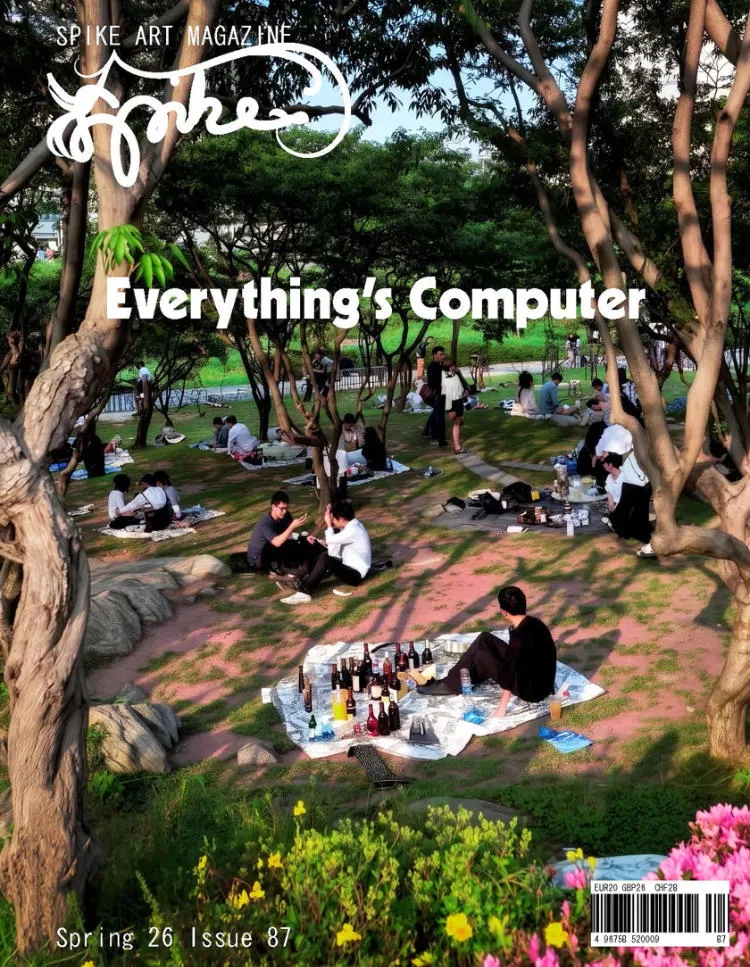
Spike #87 – Everything's Computer
Art in the digital age.
Go on, admit it. There's no longer a meaningful distinction between "real life" and life online, up to and including sitting around in the park. So why shouldn't art reflect the furious, melancholic, psychedelic sensation that, even when we make our screens dark, we've all been permanently logged on? A new era deserves new aesthetics, but also fables, values, and protocols. Everything is interwoven. Everything's computer.
Featuring Brian Droitcour on lore and NFTs; Marek Poliks & Roberto Alonso Trillo on exocapitalism; the godmother of internet girlhood, Ann Hirsch; locating the tech-feminist to tech-fascist spectrum with Anan Fries; Anika Meier on the post-artist; a visual essay by Ruba Al-Sweel & Al Hassan Elwan (POSTPOSTPOST); a defense of useless images by Gideon Jacobs; the second life of memes by Dena Yago; a prophecy of a neo-oral age by Günseli Yalcinkaya; a primer on internet cinema with Dana Dawud; Gary Zhexi Zhang's guide to Shenzhen, "China's Silicon Valley"; and the never-miss backpage from Tea Hačić-Vlahović: "Underground communities prevail against odds. Like rats and nuclear bombs." Plus! Our new lifestyle section, LIFEMAXXING.

Postmortem issue 1
Marina Mardas, François Peyroux and 1 more
How can we define and document our present?
Postmortem is a sensitive yet critical metaphor for a world suspended between collapse and reinvention—a diary of the now. Drawing together writers and artists from Europe and the SWANA region, this issue locates areas of tension that define our era. Far from a mere dialogue between regions, it exposes the inner and outer fractures of Western hegemony, unearthing shared emotions.
From reclaiming histories and narratives in the Arab world to deconstructing digital spaces as arenas of control and resistance—even exposing systemic exclusions embedded in blood donation policies—contributors reveal these tensions as a fertile terrain for dialogue and reflection.
Through critical essays, narrative writing, poetry, interviews, and contemporary art, the concept of Postmortem unfolds an in-between state where death and rebirth occur simultaneously. Across three interwoven chapters—Metaconnexion, Dissociation, and Fragmentation—the issue engages radically with body politics, othering, post-orientalism, surveillance, decoloniality, freedom, and resistance.
Both a chronicle and a hybrid object where text, design, and image interact, Postmortem archives a world in flux. Rather than prognosticate, it dissects the present as the essential site for reimagining our future.
Contributors : Sara El-Jazara, François Peyroux, Nadine Makarem, Soukaina Melhaoui, Louise Mervelet, Manon Schaefle, Marina Mardas, Irina Breitenstein, Amer Al-Dakar

Heatwave #2
In an era when many “radical” theorists were seeking out the peaceable expression of politics in “everyday utopias,” Joshua Clover stressed that politics was always, at root, a fiery confrontation with the powers that be. To these ends, he not only helped bring together a new generation of young communists but also pushed them to engage directly with the rising tide of class conflict, understanding full well that the street and the shopfloor are the true classrooms of the partisan.
Heatwave is, in a sense, an attempt to embody this spirit at a larger scale. Like Joshua, we hope to serve as an engine of engagement, linking our readers to their own history and to one another. Like Joshua, we adopt a principle of ecumenicism, refusing the false dividing lines inherited from the long dissolution of the last global communist movement. At the same time, like Joshua, we also insist on a theoretically rigorous approach that invokes the real complexity of revolutionary theory and history, actively seeks evidence for its claims, and engages in good faith with opposing positions. And, like Joshua, we maintain that the partisan project is inherently incendiary, requiring confrontation with the rulers of the world, rather than gradualist compromise or secessionist retreat. Finally, communism requires an unambiguous commitment to internationalism. Although our project is currently anglophone, we recognize that elaborating a partisan politics requires learning from the self-activity of the dispossessed at the global scale.
The name "Heatwave" echoes that of an old Situationist magazine ("Britain's most incandescent journal" of 1966), but with added urgency in an era where every summer is the hottest on record. While the statistical certainty of catastrophe is inescapable, "revolt" names many species of conflagration, including that peculiar variety we call communism. We must sift through the ashes to find it.

Efemmera Reissue #7: Cassandra Radical Feminist Nurses Newsletter
A reissue of the 1982 inaugural Cassandra Radical Feminist Nurses Newsletter: founding members explain their interests, intentions, and goals, and invite other nurses to join them.
Introductory text by Peggy Chinn, founding member, and also co-author of Peace & Power: A Handbook of Feminist Process.
The Alder & Frankia Efemmera Reissue series amplifies, graphically reinterprets, and shares historic feminist ephemera. What ideas, strategies, and tactics from the past can we inherit to bring forth a feminist future?

BRICKS FROM THE KILN #8
Matthew Stuart, Andrew Walsh-Lister
This eighth instalment of BFTK is on letters and letters. It takes the double meaning of this word as its point of dispatch, inviting recipients to think through and respond to — directly and indirectly — ideas around correspondence, addressing and alphabets. What it means to be in correspondence with somebody, the initiation and continuation of this communicative exchange and what happens when it is severed or lost. How to write directly towards a you, to you; to a particular reader, object, locale. The volume is littered with letters. There are letters about letters, letters to letters, letters that crease, fold, tear and rip, letters that are sent and lost, found and read. There are letters that pile up, their combinations arranged and rearranged to form comprehensive linguistic logics, and there are letters that are simply letters. Contributions sit in eight-page signatures, of which there are twenty-six in total. Of the eight hundred bound copies, twenty-six are left unbound, returned to discrete correspondence, loose abécédaire units for exchange — letters to be leafed through and addressed once more.
PLEASE TAKE A LOOK AT YOUR
SHADOW IN THAT MIRROR
Chang Yuchen
(pp.1–8, A)
BESTIARY FOR A NON-GENETIC DESCENDANT
Bhanu Kapil
(pp.9–16, B)
THROW STUFF AWAY
Hannah Regel
(pp.17–24, C)
THE MOON HATH XXX DAYS:
LETTERS FOR LETTERS
Helen Marten
(pp.25–32, D)
WHAT DOES THE LOSS FEEL LIKE?
Meg Miller
(pp.33–48, E, F)
LIGHT UP THE A
Kate Briggs
(pp.49–56, G)
THE POSTCODE CONNECTION
Rebecca Ross
(pp.57–72, H, I)
(LETTER) TO S… LABYRINTH-CORTEX
Michèle Métail, trans. Thea Petrou
(pp.73–80, J)
RACKETY CORRESPONDENCES /
A CORRESPONDING RACKET
Nisha Ramayya
(pp.81–96, K, L)
THE COIN OF THE REALM
Lucie Elven
(pp.97–104, M)
UNFOLDING FOLDED FANTASIES:
A CORRESPONDENCE WITH THE SEATED SCRIBE
Fatema Abdoolcarim
(pp.105–112, N)
DEAR DEAREST DEAR MOTHER
Alice Butler
(pp.113–120, O)
/ DON’T BOTHER THE CREASE
Tice Cin
(pp.121–128, P)
FEELING LETTERS, SEEING BLUE
Gemma Blackshaw
(pp.129–144, Q, R)
LINES OF GRACE AND DISGRACE
Francis Haselden
(pp.145–152, S)
AN ABC OF MIMICRY
Jeffrey Stuker & Jan Tumlir
(pp.153–176, T, U, V)
ADDRESS
Céline Mathieu
(pp.177–184, W)
MY VOICE FOLDS YOU
Thea Petrou
(pp.185–192, X)
A LONG DISTANCE LULLABY
Vibeke Mascini
(pp.193–200, Y)
DEBT OF GOLD CAN BE PAID OFF,
DEBT OF KINDNESS IS CARRIED OVER DEATH
Chang Yuchen
(pp.201–208, Z)
LETTERS ON LETTERS
FROM LETTERS ON LETTERS
Matthew Stuart
(covers)

Pfeil Magazine #19 – Rest
There is no pause without prior exertion, and this issue of the magazine explores rest and all its associated contexts and contradictions. Amidst increasing environmental pollution, a tenuous global political climate, and a performance-oriented society demanding ever greater productivity, the balance between rest and labour becomes skewed. Pausing carries the risk of falling behind, but this risk can be mitigated by knowing when to rest. This issue examines rest as activity and as resistance. It questions how the individual body, in cohesion with a community, can generate weight through relaxation and distribute it.
Contributors: Asma Ben Slama, Camila Cañeque, Christiane Blattmann, Eileen Myles, Federico Tosi, Gelare Khoshgozaran, Hanne Loreck, Hans-Christian Dany, Hyemin Yang, Ingrid Jäger, Jenni Bohn, Jochen Lempert, Julia Schulze Darup, Mariona Berenguer, Matthias Schubert, Mikołaj Sobczak, Mirene Arsanios, Nat Raha, Nicholas Grafia, Niclas Riepshoff, Omar Hahad, Sarah Drath, Stacy Skolnik, Thomas Laprade, Vir Andres Hera
Within the format of a magazine, each page of Pfeil represents the floor, walls, or ceiling which together create an imagined room displaying a printed exhibition. Each issue is dedicated to a specific word, and artists are invited and given space to work on and with this term, and to construct or deconstruct the architecture around it. Combined, the contributions transform into an organic display surrounding the leitmotif.

Mother Tongue Magazine
In celebration of February 21st, International Mother Language Day, we’re happy to present our new yearly magazine: μητρική γλώσσα (Mitrikí Glóssa) / Lingua Maternal / (Leşono Emhoyo) ܠܫܢܐ ܐܡܗܝܐ / Anadil / Mother Tongue.
Our first issue gathers three mother languages within Turkey and their dialects : Anatolian Greek, Ladino and Syriac. With an interest in everyday life, personal memories and cultural production, Mother Tongue Magazine brings together people who work and produce in these languages along with contributors who speak them, are learning them or never had the chance to learn them, embracing plurality over standardisation. Given the discourse surrounding the survival of these mother tongues, we are especially delighted to have received contributions by so many young people that are striving to keep them alive!
With contributions by: Lukas Aktaş, Nesi Altaras, Nektaria Αnastasiadou, Syrian Cassette Archives, Dilara Lüle Baklacıoğlu, Onur Çimen, Alp Etensel, Atra Givarkes, Fayrouz Library, The Pontian Library, Sara Jajou, Isla Hanna Karademir-Khoury, Iokasti Kyriaki Zografou Mantzakidou, Melisa Yağmur Saydı, Münir Tireli, Lîs Yayınevi, Beni Yorohan
Design / Illustration: Bilge Emir

Issue 8: Garden Tools
More than a mere extension of the hands, the garden tool is what helps the gardener materialise their vision. Much like the painter’s brush and the sculptor’s chisel – without it, one would be helpless. This issue of Pleasant Place dives into the world of garden tools, the essential, the practical, and the beautiful.
Including:
Instruments of Care – An introduction by Norbert Peeters with some philosophical remarks on garden tools.
Wardens of Good – A visual essay of the wonderful objects of Garden and Wood, a business selling vintage garden tools and ephemera.
Trusted Tools – Gardeners like Piet Oudolf and Jonny Bruce talk about their favourite tools that are illustrated in detail by artist Floris Tilanus.
Passing the Trowel – A visit to Sneeboer, the Netherlands most famous garden tool company, where the trowel has been passed down for four generations.
Toolmorrow – Artists are challenged to create new types of garden tools, for lazy gardening, stylish gardening and collective gardening.
Cover by Lou-Lou van Staaveren
Inside cover by José Quintanar
Centrefold miniatures by Zilan Zhao
Graphic design is by fanfare
Concept and editing by Guus Kaandorp, Floor Kortman and Lou-Lou van Staaveren

Pleasant Place 3: Compost
Allow us to introduce to you, the meaning of life, Compost Almighty.
Including:
“I’m orange peels, I’m coffee grounds, I’m wisdom” – Marjory the Trash Heap tells the future
Compost: An introduction – what, why and how to compost, with illustrations by Noa Zuidervaart
Comfrey Cocktail – make your own Comfrey Feed
Worms are great and this is why – an ode to worms by Joline van Berkestijn with images by Jaap Scheeren
What to do with a whole lot of poo – Ton Hilhorst and Savitri Groag from Artis, the Amsterdam zoo, about their compost-system that thrives on elephant poo
Digital Compost – composting in Minecraft, the biggest videogame in the world
A set of garden miniatures by Hanna Something
The cover and inside cover are by Lou-Lou van Staaveren and Guus Kaandorp and graphic design is by fanfare

Issue #9: Companions
Irene de Craen, Katia Krupennikova
The editorial/imaginative centre of the ninth issue of Errant Journal is located in the regions that have experienced Russian imperial aggression from where it makes connections across times, geographies, and ontologies to explore the radical potential of companionship. Companionship is understood not as agreement, but as a shared responsibility across unequal histories. It means not being full without the other. While forms of imperial and colonial violence might differ in places and through times, the issue recognizes how colonial mechanisms are sustained, how they present themselves as if they were past while shapeshifting and continuing in new forms and places in the present. By bringing these contexts in relation, this issue aims to show how certain borders, biases, clichés, and power structures travel, mutate, and shape both human and non-human lives and landscapes. Ultimately, companionship is about prioritizing life and about insisting that no oppression is singular.
This issue is a concept by and co-edited with Katia Krupennikova.
Contributors: Adriana Arroyo, Keto Gorgadze, Andreas Kalkun, Chung Kai Lee, Samira Makki, Ana Mikadze, Petrică Mogoș, Fabienne Rachmadiev, Vaim Sarv, Victoria Soyan Peemot, Czyka Tumaliuan, Iryna Zamuruieva, Irene de Craen, Katia Krupennikova

Tripwire 23 - Work/Anti-work
Work/Anti-work issue with writing by Nat Raha /. lisa minerva luxx /Ghayath Almadhoun, trans. Catherine Cobham / Jacqui Germain / Jazra Khaleed, trans. Peter Constantine / Finn Finneran / Cait O’Kane / Rebecca Kosick / Lara Durback Skye /Lotta Thießen / William Rowe / Danny Hayward / Rona Lorimer / Zoe Beloff / Jike Ayou, trans. Yě Yě / Miguel de Vallester, trans. Erasmo Pantoja / Lucas Martínez / ko ko thett / Hung Q. Tu / Raymond de Borja / etaïnn zwer, trans. Ilan A.L.S. Erikson Weisbrod / Annie Raab on Taylor Portela / Rachael Guynn Wilson on Lyn Hejinian / Will Rowe on Danny Hayward / Chloe Watlington on Joshua Clover.

Issue 11 — Winter/ Spring 2026
The Anarchist Review of Books publishes intelligent, non-academic writing with an anti-authoritarian perspective. We are dedicated to transforming society through literature and through open, incisive critique of the media, politics, history, art and writing that shape our world.
Cover image: Green Organic by Narsiso Martinez

Mouvement #128
How the right wing is ruining culture, part II; in Sicily, humanitarian flotillas bound for Gaza are on the US Army's radar; Alice Diop and the Black Venus; Iraqi singer Sajda Obeid unites the country; theater according to Sylvain Creuzevault; the British left reveals fascism...
Founded in 1995, Mouvement is a French “indisciplinary cultural magazine”, published quaterly.

Mouvement #129
The new “left-wing Catholics”; education under Trump and the American brain drain; theater, porn, and bullfighting with Lorraine de Sagazan; an X-ray journey with the nuclear nomads; soccer, Gen Z, and algorithmic governance in Morocco; Pedro Rhino, cinema at the end of the neocolonial mirage...
Founded in 1995, Mouvement is a French “indisciplinary cultural magazine”, published quaterly.

BUTT 38
Slide into spring with our mega-stimulating 38th issue.
Hop in the jacuzzi with Italiano chart-topper Mahmood. Read the hustling tell-all with Ashland Mines aka deejay Bobby Beethovan. Zip to queer futures with internet-doll sensation @StarAmerasu. Go behind-the-scenes of some of the biggest French content creators with photographer @RaphaelChatelain. There’s hairy art from China, trans love affairs, cottaging evidence for court, d*ck arrangements, ladyboy activism, and so much more.
Plus, a back section of smutty poetry submitted to us by our talented readers, and a visit to our favorite local cruise bar on BUTT’s 25th anniversary. At 152 pages, it’s sure to satisfy size queens all around the world.

BUTT 37
Lots of straight-talking in BUTT no. 37. Catch Édouard Louis shot by Nan Goldin, Bruce LaBruce meeting Omar Apollo, real talk with Brazilian deputy Erika Hilton and dirty talk with Martin Margiela and Jean Paul Gaultier. Plus a lesbian threeway, Bogotá’s sauna/museum, cocks in sock and oh so much more. Bangers only.

A Dance Mag - Issue 05: Flow
Issue 05, Flow, moves like water through rupture and release. Guided by the I-Ching, we drift into synesthetic rope rituals in Germany, spiral through Taijiquan in Canada, sway in sacred dances under Ethiopian stars, and lose ourselves in the rapture of Krishna Vandana. Here, flow is both a political current and a state of surrender. From Gabriel Semerene's meditations on faith and protest across Gaza and Brazil to Nerda Khara's navigation of societal constraints in Pakistan, these pieces explore how movement becomes both resistance and surrender. Tejaswini Loundo ponders flow states in Indian classical philosophy while Erika Mattio finds unity in the sacred dances of Lalibela. Shanny Rann discovers spirit in Taijiquan's slow power, Antje Brockmüller maps synesthesia through rope flow, and Anna Chwialkowska questions ghosts’ choreography. Each piece paired with its own hexagram, creating a map of emergence and dissolution. Maria Harfouche's photography dissolves structure into motion where edges blur and time becomes fluid, capturing the moment when form gives way to flowing energy.
A Dance Mag is an independent magazine that looks at the world through the lens of dance. It transcends differences, distances, and disciplines to tell the stories of people from all over the world, who are dancing their lives and giving their bodies a voice.

A Dance Mag - Issue 04: Structure
Issue 04, Structure, traces the scaffolding of our lives, seen and unseen. We travel from the palaces of Versailles to the basements of Russian resistance, from origami folds to mechanized labor, from cosmic geometry to the twitch of a stimming hand. These are the choreographies that hold us, train us, divide us, and sometimes set us free. This issue moves through power's choreography with Vinícius Portella tracing repression from TikTok algorithms to Candomblé persecution, Sasha Portyannikova documenting dance as survival under Russian authoritarianism, and Ellen Jeffrey revealing how stimming becomes its own radical dance practice. Mariam Ala-Rashi finds cosmic alignment in contortion while Michael O'Connor explores the body as origami, structure folded into self. Katja Vaghi contrasts baroque precision with contemporary chaos, and Nathaniel Moore exposes the market forces shaping European dance. Cover and insert artist, Maria Harfouche, captures structure through double-exposed analog photography and layered compositions that reveal how moments build upon each other.
A Dance Mag is an independent magazine that looks at the world through the lens of dance. It transcends differences, distances, and disciplines to tell the stories of people from all over the world, who are dancing their lives and giving their bodies a voice.

Safar Issue 9: Protests
"Journal Safar's 9th issue is Protests. To protest is a fundamental human act against injustice. It takes many forms: the defiant act of existing, the organized resistance of multitudes, armed struggles, and the disruption of systems through speech, action, and refusal in person, in prints and slogans online, or on the streets. Some forms of protest require symbols, flags, and specific attire, while others are carried out through non-verbal communication, secret dissemination, and ideological discipline. Yet all of them need cultural carriers–our bodies, our stories, and our marks to hold what can be remembered and learned from. Whether explicit or invisible, in communities or in solitude, this issue explores why we protest, and how, in the hopes of sparking solace, solidarity, and action.
In this issue: Maya Saikali sits down with Gérard Paris-Clavel, a co-founder of the pioneering Grapus Collective, to talk political image-making and the life of the image. Gérard delves into his own work and where it survives, “I don’t do exhibitions, I do demonstrations.” An illustrated Toolkit for Actions by Palestine Action makes direct action tactics accessible to anyone ready to confront the international system complicit in the Palestinian genocide. Two conversations by Maya Moumne: with Adbusters Magazine founder Kalle Lasn on the power of artists in revolutions, and with Ahmad Swaid, editor of Dazed MENA and former Editor-in-Chief of GQ Middle East, on censorship, identity, and building new cultural platforms across the region. While Audrey Tseng and Chong Gu write on Red Canary Song, a grassroots collective of Asian and migrant sex workers, massage workers, and allies of the Asian diaspora, that resist policing through notions of homemaking.
These highlights sit alongside stellar contributions by Alina Lupu, Ahmad Zaghmouri, Muhannad Hariri, Elias Erkan, Bettina Nagler, Rasha Dakkak, Yaa Adae, and Nihal ElAasar. And for the first time: another magazine inside this magazine: Design Drafts #3, a collaboration with Nieuwe Instituut, on protest and design with contributions by Tala Abdalhadi, Myriam Amri, Shruti Hussain, Candice Jensen, and Alice Wan on the theme of protest and design."

ISSUE TWO Traces
MARG1N is an annual Southeast Asian film magazine by writers, filmmakers, and artists. Our second issue honors memories and gazes that drift through Singapore and Vietnam. Through essays, visual scripts, archives, and more, TRACES unearths the flotsam, jetsam, and derelict that churns throughout or beneath today’s cinematic currents.
Traces are fragmentary by nature. You can never deduce a comprehensive view from a trace. Traces gesture, shock, defy, and aspire toward a greater truth than their whole existence. In some way, a film is also a collection of traces, with the hope of invoking in its viewers a sense of wonder and resonance that makes us pause, perhaps rewatch, and rethink certain rigidities. The writings that we have worked with in this issue embody that generative power of traces.
Contributors (In Order of Appearance)
Tracey Toh, Bert Ackley (vinatapes), Daryl Cheong, Lananh Chu, Nguyễn Trinh Thi, Tan Pin Pin, Đỗ Văn Hoàng, Yeo Siew Hua, Lena Vu , Mai Huyền Chi, Hugo Hamon, Mark Chua, Lam Lishuen, Looi Wan Ping, Sasha Han, Dan N.Tran, Alex Lee, Nguyên Lê, The Yang One, Linh Duong, Ton-Nu Nguyen, An Trần, Grace Song, Krystalle Teh, and Dương Mạnh Hùng
Featured Filmmakers
Toh Hun Ping, Tranh Anh Hung, Nhu Quynh, Dang Nhat Minh, Ho Tzu Nyen, Daniel Hui, Min-Wei Ting, Tony Bui, Truong Minh Quy, Nguyen Vu Tru, Trinh Thi Minh Ha
Editor-in-chief: Savunthara Seng
Managing editor: Alyssandra Maxine
Guest editor: Dương Mạnh Hùng
https://marg1n.com/

Issue № 6 - Winter–Spring 2026 / SENSING BODIES
Coming back to the body is rarely tranquil. Often it is turbulent, interrupting dominant narratives and entrenched meanings. It is the upset of being alive, and awake to it.
The fourteen texts in this new issue do not shy away from that turbulence. There is joy and there is pleasure, there is shame, pain, and liberation... Each text addresses this dense experience from a singular perspective, yet together they explore what emerges and becomes possible when sense-making and making sense(s) are re-anchored in the sensing practices of the body.
With texts by Valérie Hug, Marco Antonini, cassiane c. pfund, Elodie Olson-Coons, Ines Marita Schärer, Bernadette Kolonko, Jo Bahdo, Lotta Beckers, Melanie Jame Wolf, Samuel Brzeski, Madeleine Kaye, Nora Longatti, Rosanna Puyol Boralevi, Larissa Clement-Belhacel
editorial team: Delphine Chapuis Schmitz, Nicole Bachmann, Robert Steinberger, and Shelby Lee Stuart as invited editor

Errant Journal 7: Embodying Resistance
The seventh issue of Errant Journal is guest edited by Ghiwa Sayegh and aims to interrogate the role of the body in strategies of resistance from below. Taking Palestine as a starting point, the ongoing genocide committed by Israel and other colonial powers and the people’s continued struggle for liberation inform the issue’s thinking and praxis. From this political standpoint, it explores the ways in which bodies – that are sexualized, criminalized, racialized, crip – have been able to divert and subvert in order to fight back. To resist from the body is what crip theory tells us is a matter of need. It is a body that no longer fears deviation, specifically because of how cheap our lives are considered and how dangerous our futures are treated. It is about finding community and kinship when we are told we are alone.
Contributors:
Myriam Amri, Lama Abou Kharroub, yasamin ghalehnoie, Keto Gorgadze, Johanna Hedva, Samia Henni, MaxX • ماكس, Ada Maricia Patterson, Ghiwa Sayegh, Nikita Sena, Mridula Sharma

Viscose 02: Clothes
Issue 2 inverts issue 1’s focus on the immaterial notion of style to instead explore the most material of fashion’s building blocks: clothes Clothes are literally everywhere and cite complicated systems of production, distribution, and exchange on their paths around the world. Still, they never fully reveal their journey or destination, and may often signify little else than their own commodity status, the total genericness of the fashion product.
Bringing together a wide range of artists, thinkers, and writers, the issue sets out to explore clothes as a signifier at once empty and over-burdened: as expressions of desires, people and places, as palimpsests for capitalist production cycles and histories of dressed bodies, and even, as nondescript material debris. While not necessarily foregoing an analysis of the fashion system, we hope to develop a form of fashion criticism that begins – and perhaps ends – with the single garment, that takes the everyday use of clothing objects as an intellectual starting point.
What knowledge can we gather from the studying of fashion objects, be they material or immaterial? What is the difference between clothes and fashion? And to which extent is even “fashion” ever successfully signified by things?
with contributions by:
Shanzhai Lyric, David Lieske, Bakri Bakhit, Dena Yago, Matthew Linde, Burke Battelle & Ada O’Higgins, Davide Stucchi, Taylore Scarabelli, Mahoro Seward, Jordan Richman, Giorgi Gago Gagoshidze, Hito Steyerl, & Milos Trakilović, Laura Gardner, Avena Gallagher, Alex Esculapio, Elise by Olsen and Jeppe Ugelvig