Artists' Books
Artists' Books
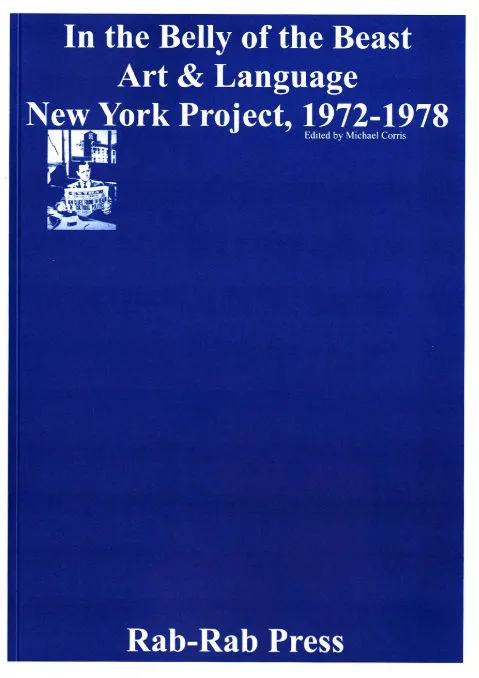
In the Belly of the Beast – Art & Language New York Project 1972-1978
Edited by Michael Corris, the expanded edition of In the Belly of the Beast: Art & Language New York Project 1972-1978 is a survey of the tumultuous years of the political Conceptualism in the mid-seventies New York.
Artists have always experimented with politics, either by organizing themselves or uniting in support of a broader political movement. Today, "activist art" is taught in universities, supported by foundations, and featured in museums and international exhibitions. Is this the only possible way?
In the Belly of the Beast tells a different story, of the work of politically engaged artists and the conflicts they experienced. It is the history of artists wishing to continue working within the boundaries of the artworld and those who were intent on establishing new ideological and class relationships with activists to build a political party.
During the 1970s in New York, the Art & Language collective pioneered institutional critique; published a Marxist-influenced journal; agitated against racism and sexism in museums; challenged the cultural imperialism of international exhibitions; and forged a framework for a socialist organization of artists. This new edition includes previously unpublished documents illuminating the contradictions and disputes that lay at the center of the organization and practices of Art & Language and left-wing groups, such as the Anti-Imperialist Cultural Union and the Artists' Meeting for Cultural Change, mobilizing artists in New York at the time.
The new and expanded edition of In the Belly of the Beast features an extensive interview with Michael Corris, who annotated a collection of previously unavailable documents from the period, including manuscripts, pamphlets, transcripts, and letters.
Art & Language is the name of a group of English artists who choose to work collectively, and the title of a magazine that they founded in 1968. Proposing a critical analysis of the relations between art, society, and politics, Art & Language marks, even in its name, the importance of the “textual turning point” in the 1960s.
Since 1976, Art & Language's project has continued, through Mel Ramsden and Michael Baldwin, with the literary and theoretical collaboration of Charles Harrison. Working with very varied mediums, from painting to rock, these co-founders of Conceptual art remain, even today, attached to observing the consequences of what they themselves call the “depressing collapse of modernism.”
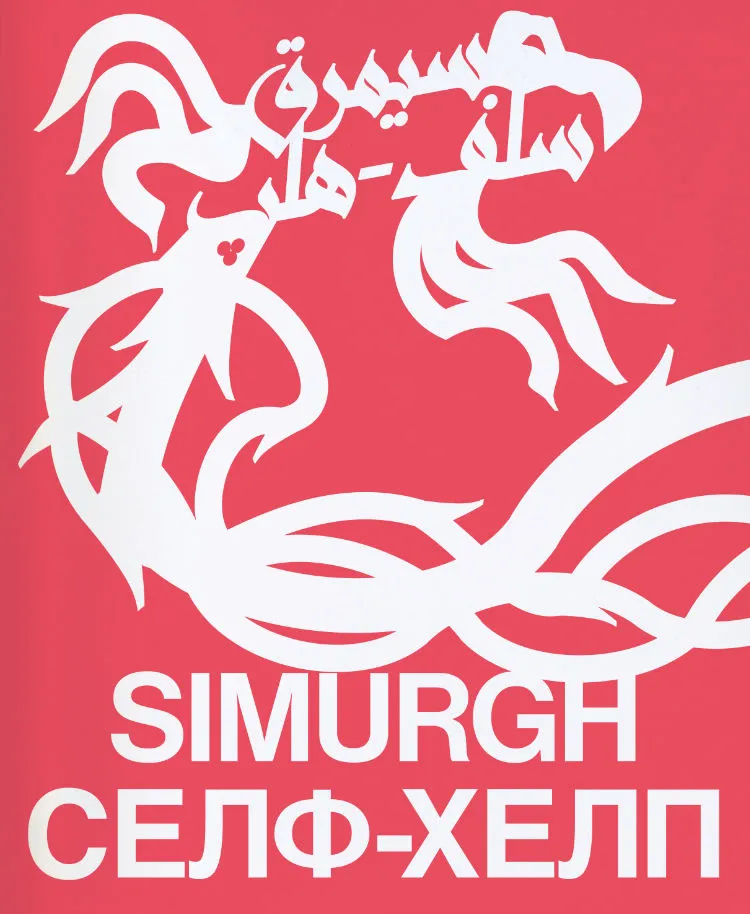
Simurgh Self-Help
The 2025 Ringier annual report (artist's book).
Since 1998, Ringier, the Swiss-based global media company, has traditionally commissioned an artist to design its annual report. Publisher Michael Ringier and curator Beatrix Ruf initiated this series as a means of reinforcing the links between art and the activities of the company.
For the 2025 edition, Slavs and Tatars' Simurgh Self-Help revisits Marcel Broodthaers' seminal work Musée d'Art Moderne: Département des Aigles (1968–1972), replacing or "translating" the eagle—a symbol of power and empire that is used to challenge our understanding of authority and value—with the Simurgh, a mythical bird found across the Turkic-Persianate world. Whilst the eagle is often associated with nation-states and masculinity, the Simurgh is decidedly transnational, metaphysical, and flamboyant, if not gender-fluid.
Much like the collective's geographic remit—between the former Berlin Wall and the Great Wall of China—this publication attempts to shift our focus elsewhere, eastwards, to regions which too often fall through the cracks of historiography and art history. If modern and contemporary art institutions in Broodthaers' time were largely situated between the Rhineland and Northeast United States, the multipolarity of today's art world is a fait accompli: with biennials in Uzbekistan and museums in Kazakhstan, amongst others, rivalling the traditional centers of power.
Once too a sacred bird—accompanying Zeus, for example—the eagle has, over the past two millennia, undergone a thorough profanation: a brawny, secular flex of nationalism. It would be remiss not to see the parallels in the world of media: print itself and the act of reading, once an activity for the few and anointed, has undergone a similar dynamic of democratization over the past several centuries and, especially in recent years with the internet, a vulgarization which would make medieval Church elders wag their shriveled fingers at us in an I-told-you-so meme meant for the ages. This profanation has challenged the very institution of media and the narratives it disseminates, much as important works of institutional critique challenged contemporary art in the 1970s and beyond—akin to Slavs and Tatars' genre-bending mix of high and low, East and West, sacred and profane does today.
Slavs and Tatars' (founded 2006) extensive publishing activity—some 15 books in 20 years—has treated subjects as diverse as alphabet politics, Uighur literary culture, political satire in the Muslim world, and German anti-Enlightenment thinkers. Alongside sculptures, textile works, installations, sound pieces, and even a brick-and-mortar Pickle Bar in Berlin, the collective's books have cleared new paths for contemporary discourse via a wholly idiosyncratic form of knowledge production that draws on popular culture, spiritual and esoteric traditions, oral histories, modern myths, as well as scholarly research.
Slavs and Tatars is a faction of polemics and intimacies devoted to an area east of the former Berlin Wall and west of the Great Wall of China known as Eurasia. The collective's work spans several media, disciplines, and a broad spectrum of cultural registers (high and low) focusing on an oft-forgotten sphere of influence between Slavs, Caucasians and Central Asians.
Slavs and Tatars has published Kidnapping Mountains (Book Works, 2009), a celebration of complexity in the Caucasus, Love Me, Love Me Not: Changed Names (onestar press, 2010) and are currently preparing solo engagements at Vienna's Secession, Museum of Modern Art, New York and Künstlerhaus Stuttgart.

Eselsohren Dog Ears
"The impossible takes a little longer. [pen scribbling]"
Presented at Kransen in Borgerhout, 1—3 March 2024, with an exhibition titled Dog Ears and a remote reading by fellow-Stockholmian artist Dave Allen.

Katalog 2
Assembled and copied by Jan Matthé at Permeke Library Antwerp, September—October 2022. Edited at Kransen, printed in Borgerhout in an edition of 200, bound by De Wrikker in Berchem. Released on the occasion of Permeke draait door met Risiko Press, Sunday 27 November 2022 at Permeke Library, with readings and performances by Tina Schott, Jóhanna Kristbjörg Sigurðardóttir, Stefanie Alexandra, Sis Matthé, Ria Pacquée, Jan Matthé, Clodagh Kinsella and Roman Hiele. Thanks to Christel Kumpen for the invitation, Allon McKaye for the Saturday and Toni Matthé for the unicorn with a heartshaped tail.

Calculations
Ines Cox is an artist living between the Nièvre department in central-eastern France and Antwerp. This book consists of some 300 obsessive pages of her handwritten calculations—76% of which are actually true.
Cover by Bonni Cox, back cover by Toni Matthé. Printed in Borgerhout, bound by Gazelle in Deurne. Supported by Centre de la Paresse and Flanders—State of the Art. First presented at Kransen, 23.11.2024. Edition of 100.

Marlie Mul
Marlie Mul (b. 1980 in Utrecht, the Netherlands; lives and works in Brussels) is characterized by a strong material awareness, spatial thinking, and an ongoing engagement with conditions of labor, systems of value, and forms of collectivity. Her practice foregrounds a sustained interest in sculptural concerns, direct engagement with materials, and processes of layering, transformation, meaning and re-meaning across multiple levels of articulation. Central to this is a continuous process of familiarizing herself and working with new materials and practices, which are repeatedly extracted from their conventional contexts and expanded into new bodies of work. These are, in turn, accompanied and reframed by other materials as well as by more social formats of production and presentation.
The first comprehensive monograph on Marlie Mul’s work is published on the occasion of her solo exhibition Das Budget (2025) at Kunsthaus Glarus. It offers a comprehensive chronological overview of key bodies of work from the early 2000s to the present and, through a richly illustrated index, unfolds a complex structure of contexts, collaborations, and modes of production. The publication includes new contributions by Annie Goodner, Lili Reynaud-Dewar and Frank Wasser, a dialogue between the artist and the editor, as well as numerous reprints of texts that have accompanied Mul’s work over the years, including writings by the artist herself.

Wanderlust
Soufiane Ababri's sketchbooks.
Soufiane Ababri (b. 1985, Rabat) is a Moroccan artist based in France. His protean work (drawings, installations, performances) explores questions of gender, homosexuality, racism and colonialism.

Carroll Dunham: Drawing Sculpture
Drawing has long been foundational to American painter Carroll Dunham's (born 1949) practice. In this collection of recent, never-before-shown works, we witness Dunham thinking about sculpture through a series of drawings produced over the course of a year. A sampling of his drawings across time offers a chart of his artistic evolution; the 80 drawings presented here are distinctive to a new page within that history. Spurred by a desire to explore the saggy, open-frame cubic boxes that he found himself doodling along the edges of a new series of paintings, Dunham began drawing fantasies of sculpture as a respite whenever he needed a break from working on the paintings. This turned into an ongoing practice that lasted until it unexpectedly segued into a material investigation with the making of sculpture in real space. Offering intimate access to Dunham's process, this book is the first to document his thinking about spatial relationships, presentation and materials for sculptures that don't exist.
Carroll Dunham has developed an extensive oeuvre since the late 1970s in painting, drawing, and printmaking. His work has been the subject of numerous solo exhibitions, most recently a drawing retrospective at the Art Institute of Chicago (2026), and presented in group exhibitions at institutions in the United States and abroad. He lives and works in Connecticut.

Crassiers, une chronologie des luttes stéphanoises
"Ces deux collines jumelles sont pour moi des contre-monuments : un héritage industriel délaissé, en friche, conservant une puissance symbolique et politique. Les messages et les crassiers sont indissociables."
La première partie de cette édition est une collecte d'images intégrant des messages sur les crassiers (1948-2024). Ces images ont été récupérées principalement sur internet, complétées par un appel à collecte public sur les réseaux sociaux, ainsi que par la distribution de flyers et le collage d'affiches. Les images sont rassemblées chronologiquement et chaque message est recontextualisé dans son événement politique. La seconde partie présente les crassiers jumeaux en croisant plusieurs perspectives ; historique, géologique, urbaine, écologique et politique. Enfin je définis les crassiers en tant qu'outils et supports tactiques d'affichage public. Ce travail a abouti à cette première impression en janvier 2025.
Cette édition continuera à se développer au fil du temps grâce à des rééditions régulières, intégrant des messages découverts ou récemment apparus.

Terminal Boundaries and A natural water course diverted reduced or displaced
Made in 1969 but never published, Terminal Boundaries is an artist book by Lawrence Weiner, a sculptor whose medium was language. The manuscript for the publication, which was recently brought to light, contains two related bodies of work represented as typewritten statements on paper that Weiner pasted to the pages of a small composition notebook. The book’s absence from Weiner’s oeuvre plagued him as it marked a terminus of his relationship to the physical construction of his artworks, and illustrated the principle of “specific” and “general” which he applied to his art.
Created from a standard notebook purchased in a stationery store, the manuscript is two books in one: Terminal Boundaries and A natural watercourse diverted reduced or displaced. A tête-bêche with two front covers, the book can begin from either cover by turning it upside down.
Weiner was a traveler by nature and the materials he refers to in these works are those that one can encounter on a road trip. The artist was traveling across Europe when this manuscript was composed. Struck by the tumultuous times and the critical illuminations about the climate from the Club of Rome discussions, the works in this book are in Weiner’s words, “concerned with the relationship of natural resources in relation to human beings.” Distinct from his contemporaries associated with the Land Art movement, in Terminal Boundaries and A natural water course diverted reduced or displaced, Weiner constructs his landscape interventions in language—the specific and/or general act and the location are stated—offering the reader/viewer the opportunity to consider each work’s existence, to build it in their mind’s eye. One can only wonder what Weiner did to divert, reduce, or displace a natural water course in Saltsrumen, Norway, the location of the world’s strongest maelstrom, or in nearby Bodø at the site of Svartisen glacier. A work in Terminal Boundaries titled The joining of France Germany and Switzerland by rope demonstrates the geopolitical perspective of Weiner’s land art. Requiring physical and mental borders to be transgressed in performing this work; how and where could this happen?
Terminal Boundaries finds Weiner just off the cusp of his decision to make art that lived centered in language, emphasizing the viewer’s responsibility to engage with it to make it whole. The book marks a crucial inflection point in the artist’s practice, defining his direction to make work that “attempts to present something to people that is not just about me,” but about materials and the world we find ourselves in here and now.

Les Goddesses/Hemlock Forest
This book is based on two related projects that take form as text, photography and film. Les Goddesses (2011) collapses the lives of Davey and her five sisters with those of the daughters of Mary Wollstonecraft, the 18th-century feminist writer and activist. Hemlock Forest (2016) weaves references to Wollstonecraft, Chantal Akerman and Karl Ove Knausgaard with her own family stories. During the making of Hemlock Forest, Akerman took her own life. Her death soon engulfed Davey's awareness, prompting a broader exploration of Akerman's and her own biographies, amid more universal themes of compulsion, artistic production, life and its passing.
Texts by Moyra Davey and an introduction by Aveek Sen
Design by Filiep Tacq

fierce pussy
This eponymously titled publication by fierce pussy brings together thirty-nine of the legendary art collective’s posters, from works made in the urgent early days of the AIDS crisis to present-day advocacy for Queer and Trans rights. In keeping with fierce pussy’s activism in public spaces, the publication is designed to allow readers to tear out any of the posters to share, wheatpaste, scan, photocopy, and distribute or to easily open the book to any page to hang it on a wall. Combining calls for political and social action, proud reclamations of derogatory language, and pointed questions, the posters in fierce pussy address pressing sociopolitical issues in the group’s distinctive voice.
Emerging during a decade steeped in the AIDS crisis and LGBTQ+ activism, fierce pussy brought Queer identity directly into the streets in a manner characterized by the urgency of those years. In recent years they have expanded to also present their work in galleries and museums, while continuing to intervene in the public space, always working with an economy of means and a collective ethos of inclusion and solidarity.
This publication was originally published by Printed Matter in 2008 to coincide with a retrospective exhibition of the collective’s work. This new expanded edition includes twenty-five additional posters.
fierce pussy is an art collective formed in New York City in 1991. Originally composed of a fluid and often-shifting cadre of dykes, the collective was active through 1994. In 2008, the four core founding members Nancy Brooks Brody (1962–2023), Joy Episalla, Zoe Leonard, and Carrie Yamaoka began working together again. Adamantly low-tech and low-budget, fierce pussy has always relied on modest resources: old typewriters, found photographs, and their own baby pictures. In the early days, much of the work was produced using materials and resources they had on hand and the equipment at their day jobs. This publication exemplifies the ethos of the group—to share their work and messaging with the masses.
Managing Editor: Jules Spector
Designers: Garrick Gott and Bryce Wilner

The Twofold Commitment
At once an artist's book and an interview collection by Vietnamese filmmaker, writer and feminist and postcolonial theorist Trinh T. Minh-ha (born 1952), The Twofold Commitment centers on Trinh's 2015 feature film Forgetting Vietnam, which takes up one of the myths surrounding the creation of Vietnam: a fight between two dragons whose intertwined bodies fell into the South China Sea and formed Vietnam's curving, S-shaped coastline. Commemorating the 40th anniversary of the end of the war, the film draws inspiration from ancient legend to stage an ongoing contemporary conversation between land and water, creating a third space, another way, for historical and cultural re-memory.
This book features the film's lyrical, essayistic script, along with rhythmically distributed movie stills. Expanding on this central focus is a series of conversations between the filmmaker and critics and film and sound studies scholars dating from 2016 to 2022, amplified by an index identifying key concepts and ideas in the artist's work.

Hosted by Red Dust
Partie sur les sites de la dernière briqueterie artisanale de Riemst et de la recyclerie de briques d'Alexander van Mosselaer, Juliet Mérie en ramène un récit poétique qui explore notre rapport à la matière vivante et questonne le cours de la vie.
Loin d'être un documentaire, ses photographies créent un rapport ambigu entre la perception des espaces visités et l'allégorie qui s'installe. La possière se soulève pour dévoiler les lieux de vie et de mort des briques qui dessinent le paysage belge.

Alphabet Soup
"Alphabet Soup" collects the sayings of two multilingual girls as written down by their poet father. As their Turkish-German-Russian-American family moves from New York to Berlin, the girls communicate in a witty and colorful language of their own, effortlessly mixing words of different origin. Does who we are determine the way we speak — or is it the other way around? Alphabet Soup shows us the girls’ language as it changes, letting us witness their metamorphoses from toddlers to teenagers.
With an essay and poems by the author.
A co-publication with Rab-Rab Press (Helsinki).

Praise House
Building on the notion of ‘praise,’ Adama Delphine Fawundu frames this book as a celebration of life. She honors the stories whispered to her by her mother; she adorns her body in her grandmother’s textile work; she elevates the memory of various named and unnamed Black women of the diaspora and documents the iconic small Civil War era styled white wooded praise house on a patch of land off the side of a road in South Carolina not far from Beaufort creating an intimate body of work of color photography of an interconnected history.
This book about female figures—grandmothers, mothers, daughters, artists, caregivers, storytellers, and cooks—explores a range of emotions that consume us about family life and history. It is both an art book
and a memoir. Viewing it brings us face to face with known and unknown cultures and introduces us to various art practices shared, taught, and learned through the African diasporic traditions. Fawundu connects to the self through history, joy, and beauty and offers the reader ways to navigate fear based on migration and loss. It is a gift, too, as it allows us to imagine alongside the artist.
Adama Delphine Fawundu is an artist based in Brooklyn, NY of Mende, Bubi, and Krim descent.
Through photography, video, textile-based sculptural forms, and performance, she creates embodied entities inspired by Indigenous knowledge systems and spiritual retentions across time and space. She co-authored the book MFON: Women Photographers of the African Diaspora. She is an Assistant Professor of Visual Arts at Columbia University.
Edited by Chiara Figone
Contributions by Mistura Allison, Berette S Macaulay, Niama Sandy, Bonaventure Soh Bejeng Ndikung, Deborah Willis

Tina Girouard: Sign-In
From the 1970s until her death, Louisiana-born artist Tina Girouard (1946–2020) was a dedicated experimental artist, collaborator and art worker. Alongside her individual creative endeavors, she nurtured and was a part of numerous influential artist communities and organizations in New York, Louisiana and Haiti, including the Anarchitecture Group, the interdisciplinary cohort of 112 Greene Street, the restaurant Food, the Kitchen, P.S. 1 and the Festival International de la Louisiane. Her acts of upkeep, including domestic labor traditionally associated with “women’s work,” blurred the boundaries between artmaking and what she called life-making. Sign-In is the first comprehensive monograph on her interdisciplinary oeuvre. It gathers documentation of her work in video, performance, drawing, textile, wall works and installation, tracing Girouard’s practice and legacy across genres and geographies.
Edited by Andrea Andersson with Jordan Amirkhani
With new essays by Andrea Andersson, Jordan Amirkhani, Anaïs Duplan, Pamela M. Lee, Aruna D’Souza, and Lumi Tan

KW Institute for Contemporary Art
Germaine Kruip: Works 1999-2017
Over the past two decades, artist Germaine Kruip has steadily developed a practice, which merges time, space and perception. Like an anthropological stage director, she investigates, simplifies and presents her observations in a subtle manner often through architectural interventions. In each of these interventions, she changes a location into a stage, with the audience as actors in a play of substantive absence. By doing so, she activates both physical and mental awareness.
This publication presents an overview of the Kruip’s practice since 1999, two years prior to her engagement with the art context. Presenting over 40 works, the publication reflects on three periods in the artist’s practice, each accompanied by an essay contributed by Anna Gritz, Eva Wittocx and Stephanie Bailey. The idea of a catalogue raisonné came out of a conversation that followed Kruip’s ambitious project Geometry of the Scattering, which was presented at de Oude Kerk in Amsterdam in 2015 – 2016.

KW Institute for Contemporary Art
Pia Arke
Pia Arke, Ros Carter and 1 more
Pia Arke (1958–2007) was a Greenlandic Inuk and Danish artist, writer and photographer. She is known for her self-portraits and landscape photographs of Kalaallit Nunaat (Greenland), as well as for her paintings, collages, performative film works and writing. Arke strove to make visible the silence that surrounded the colonial history and complex political and cultural relationship between Greenland and Denmark.
This publication accompanies the first international exhibitions of Arke’s work outside of Greenland and the Nordic countries, happening over the course of 2024 at John Hansard Gallery in Southampton (UK) and at KW Institute for Contemporary Art in Berlin (DE). It reflects on Arke’s ideas and legacy in a wider international context and aims to demonstrate how the work she made and the ideas she expressed connect with current discourse and contemporary thinking.
Texts by Krist Gruijthuijsen, Woodrow Kernohan, Ros Carter, Alice Maude-Roxby, Mette Sandbye, Tiara Roxanne, Sofie Krogh Christensen, Nivi Christensen, Siri Paulsen, Trinh T. Minh-ha

Verlag der Buchhandlung Walther König
in the coherence, we weep
“in the coherence, we weep is both an artist book and an exhibition. The project is about the critical potential of incoherencies. It is an attempt to map methodology across media, while welcoming glitches that allow for moments of critical self-reflection and knowledge production. Developed in parallel, the book and exhibition critically reflect on each other’s approaches. It looks at strategies for how text can be alive and vibrant across various architectural contexts as well as those used in the artist’s family archive, particularly annotation, redaction, indexing, blurring, and learning through reading and writing.” - KW Institute for Contemporary Art
“Multilayering was in that sense an important aspect, which got translated with the material and the design by choosing papers with differents gradients of transparency, as well as interfering and overlapping text layouts. We also designed the cover with a blue scratch off drawing on top of another artwork, so every book might change a bit over time depending on the use. This reflects the artist‘s idea of including the audience and an ever changing oeuvre, where the relation between pieces become important too.” - Studio Pandan
Texts by Dr. Christina Landbrecht, Krist Gruijthuijsen, Sofie Krogh Christensen, Chang Yuchen, Ladi'Sasha Jones
This artist book is published on the occasion of Kameelah Janan Rasheed’s Schering Stiftung Award for Artistic Research 2022 solo exhibition at KW Institute for Contemporary Art (2023).

Midnight Mass Press & Heretic House
WITCHES
A collection of portraits by original riot grrrl, filmmaker, and zine queen, G.B. Jones. All of them witches – from the silverscreen, woodlands, and the streets.
Featuring provocative essays by Caroline Azar, Paul P., Leafshimmer, Jenna Danchuk, Blake Baron Ray, and Scott Treleaven – each exploring how witches have been perceived, presented, and portrayed in popular culture. “Realer than real, stranger than fiction.”
PRAISE FOR G.B. JONES WITCHES
Witches by G.B. Jones is a summoning spell posing as a book, a paper potion like the potion Nicky gives Gillian in Bell, Book and Candle. It draws me to it and to what’s in it, Jones’ divine drawings of the witches we both worship, the witches of TV and film and true life. I go to it gladly. I go to it gayly. I pore over it and prize it and purr like Pyewacket.
— Derek McCormack, author of Castle Faggot
G.B. Jones is the original Foxy Genius. Her zines, drawings, music, and Super 8 films inspired both the Queer zine explosion and the Riot Grrrl movement of the 90s. Witches sees G.B. once again crafting her magic.
— Kathleen Hanna, singer, writer, artist, and front-woman of the bands Bikini Kill and Le Tigre
With her illustrated procession of witches, post-punk icon G.B. Jones acts as medium to a dazzling diversity of disrupters from across screen history, as well as a pantheon of real-life hellraisers, from Sybil Leek and Rosaleen Norton to Vali Myers and beyond – all woven through with astute commentary by a host of countercultural collaborators. A captivating book; I was certainly under its spell.
— Kier-La Janisse, author of House of Psychotic Women

Recto verso – An Anthology of Works and Writings by Asier Mendizabal
A comprehensive retrospective of the Spanish artist's work, covering his major exhibitions (Manifesta, Reina Sofia, MACBA, Raven Row, etc.) and including all of his texts published as fanzines over a period of twenty years, a new critical essay by Kim West, and a wide-ranging conversation.
Conceived as a compilation of works and writings of the last two decades, this book is structured as an alternating succession of four different registers: four recurrent modes. A long-form interview, a series of questions from different collaborators, documentation of a selection of projects, and a compilation of the facsimilia of the brochures published by the author since 2008. The aim of this concatenation of recurring sections is to delay the linear progression suggested by the narrative of a compilation, by the apparent causal string of decisions, ideas, references and works displayed as an accumulative "biography" of the artist's practice. However, this being a bound book, the suggestion of an interwoven relation between all the works, regardless of when, where or how they were made, must submit to the order locked by the sewn spine of its signatures, the folder of bound pages that forms each section of a book.
Designed by Filiep Tacq, the book includes an essay by Kim West and a long-form interview by Beatriz Herráez, punctuated by questions from Filiep Tacq, Lisa Tan, Jon Mikel Euba, Antonio Menchen, Alex Valijani, Johanna Gustafsson Fürst, Itziar Okariz, Olatz Otalora, Antonia Majaca, Pablo Lafuente and Koenraad Dedobbeleer.

A Psalm for the Third Wind
Book: 11.7 × 18 cm
Book and Glove: 13.5 × 31.5 cm
Presented in a monster glove
Three broken halves of one god walk a city that wants them dead
Their bodies speak in static hunger and rust
Something follows breathing through their mouths
Read it Bleed from it
In A Psalm for the Third Wind, a film script written from 3 perspectives, Damien Troadec is aiming to address in parallel narrative the struggle of having multiples inner voices and the danger of following their distinct desires. One question is raised without any light at the end of the tunnel, confronting the reader to a conflict : THE COMFORT OF MISERY OR THE PAIN OF CHANGE ?

Verlag der Buchhandlung Walther König
Treatise of a Coat
Featuring coloured pencil, watercolour, ink, airbrush, acrylic and graphite, alongside other more unusual media like sand, silicone or olive oil, this book is a sumptuous, visual document of Marten's drawing and painting practice on paper. Designed as an unruly "artist's book", Treatise of a Coat has multiple physical and linguistic folds. The title is a forcing of the homonymic similarities of coat: the literal jacket that is unfurled to expose the naked and unruly shame of human forms; the fur or hair of an animal; the verb-function of to coat, with its intentional building up of visual desire - the acts of lacquering, spreading, enclosing, flooding, directing, or husking that line and colour expedite when creating an image. The constituent materiality of this book is designed with the physicality of making a work on paper in mind.