seeing another
seeing another
Monographs in our collection

Screensaver Error
Nº 49 / October 2022
In her work, Lisa Vlaemminck explores the boundaries of painting, creating an exciting, vibrating and disorienting universe. In her images, she questions very classical phenomena in painting, such as the landscape and the still life, by freezing them behind semi-transparent layers of paint. We catch a glimpse that feels familiar, but soon find that nothing is what it seems. Vlaemminck’s work oscillates between the microscopic and the interstellar, as well as the amorphous spaces in between. Image, material, shape, texture and form mutate into compositional playgrounds floating in a newly created universe where different laws and rules apply.
The book “Screensaver Error” is conceived as a symmetrical, folded stack of sheets with images of Lisa’s paintings and collages.
At the heart of the book is the sixty-metre long, worm-shaped textile sculpture, which runs like a stream through the book for many pages.
Dominique De Groen wrote an electrically charged shimmering poem tailored to the work. The introductory text was written by Simon Delobel.
In KIOSK, Lisa Vlaemminck presents a series of new paintings and a sixty-metre long textile sculpture that will occupy the various exhibition spaces. For the design of the fabric, Lisa worked patterns that form a long colour gradient.
At the end of the exhibition, the sculpture, Meat A Morph Hose, will be cut into 35 separate, new sculptures that will be offered as artworks at € 350 each. Each work is a part of the colour gradient and has a unique print. The proceeds will finance the book. Details: Printed cotton, latex spaghetti filling, the ends are closed with climbing rope
40 cm diameter x 130cmA signed copy of the book will also be delivered together with the work.
The sculptures can be collected from KIOSK at the book-launch: Sat. 26 November
The artist is reprented by gallery rodolphe janssen

sawing a plank is like going for a walk
sawing a plank is like going for a walk by Kato Six (b. 1986) is published on the occasion of Kato’s solo exhibition at M Leuven this autumn. This book encapsulates 10 years of her quest as an artist.
The work of Kato Six (b. 1986) balances between abstract and figurative art. She works on different themes which she develops into series or ensembles. Architecture, design, domesticity and utensils all act as important references. Starting there, she uses recognisable and everyday materials such as MDF, stone, plastic or textiles. Kato wants to question certain affinities and let the viewer look at familiar objects or images from a different perspective. As a viewer, you feel connected to the object or image but the actual meaning or function no longer applies.
Some of my works refer to the domestic, especially the most recent ones, such as ‘Carpet Beater Carpet’ and ‘Striped Knitwear’. The invisible work done by “housewives”, but also by workers or maintenance staff, is certainly one of the themes addressed in ‘Carpet Beater Carpet’. The above works are textile works, created with so-called “soft skills”. In the arts, these “soft skills” are often attributed to female artists — women often being assigned a certain medium.
— Kato Six in conversation with Eva Wittocx in “sawing a plank is like going for a walk”
With texts by Phillip Van den Bossche, Filarowska and a conversation between Eva Wittocx and the artist (NL/EN)
Nº 48 / October 2022

Pattern Nor Painting
The motifs produced during time-intensive dyeing processes – which uses indigo, urine, and extracts of natural waste materials – are neither conventional fabric nor lace patterns, and they have only a distant relationship to batik painting. Yet, they are simulations and portraits of both.
Pattern Nor Painting starts in a batik Workshop in Bantul, Indonesia where an artist reconnects with her blank canvas and the batik techniques she learned from an artist in Serekunda, the Gambia many years ago. As documented in this publication Van Hoorebeke’s installations and performances deftly combine unique textiles and ceramics with production-chain goods, ranging from car parts to strawberry jam. Engaging with ages-old traditions of batik production for present-day communities and settings, her work embodies ancient craft, story-telling, time, female thinking, and above all, a connection to the natural world.

William Scott
Covering the past thirty years of William Scott's practice, this monograph offers the largest comprehensive selection of paintings, drawings, masks and architectural models, as well as an unique insight on his creative and transformative approach.
Published on the occasion of Malmö Konsthall William Scott's exhibition at Mälmo Konsthall en 2022.
William Scott (born 1962 in San Francisco) has developed his own artistic practice while working at Creative Growth, an art center in Oakland where people with development disabilities are given the opportunity to work and advance creatively as artists. Combining image and text, his colourful paintings tie in stylistically with current popular culture. Scott's vividly graphic and highly detailed paintings, drawings, and sculptures explore the intersections of community, cultural memory, faith, and science fiction. "Rebirth" is a constant subject for the artist, who reimagines the social topography of his native San Francisco as well as new, interstellar organizations. His portraits depict family members and neighbors, and celebrate Black actors, musicians, and civil rights leaders. For Scott, painting is a transformative as well as a documentary tool; a way to re-craft his personal narrative and even undertake extraordinary acts.
Edited by Nicola Wright
Texts by Carson Cole Arthur, Nana Biamah-Ofosu, Helen Delaney, Tom di Maria, Simona Dumitriu, Nathan Hamelberg, Kathleen Henderson, Matthew Higgs, William Scott, Nicola Wright

The All Night Movie
Created by Mary Heilmann in 1999, The All Night Movie beautifully wraps a memoir inside of a monograph, creating an artist book in which each page is designed as though it were a painting. The artist delicately utilizes color, text, candid photographs, reproductions of paintings, and song lyrics that unfold seamlessly to create an immersive visual experience. Heilmann has described the book as “the story of my life, told in words, painted images and photographs.”
Across eight chapters, Heilmann recounts her life, from childhood in California through New York in the 1990s, providing intimate insight into the development of her work, friendships, and formative life experiences. Snapshots by the artist and others provide a portrait of Heilmann’s evolving artistic community, which included Gordon Matta-Clark, Pat Hearn, Dicky Landry, Jack Pierson, Keith Sonnier, Pat Steir, William Wegman, and Jackie Winsor, among others. And this is just the first half of the book. Included with the artist’s memoir is an essay by Jutta Koether and a survey of paintings from 1972-1999. This highly revered and extremely scarce publication was co-designed with Mark Magill and is reproduced here as a facsimile edition. The All Night Movie was originally published by Hauser & Wirth and Offizin Verlag.
Mary Heilmann was born in San Francisco in 1940. She studied at the University of California at Santa Barbara, San Francisco State University and the University of California at Berkeley before moving to New York in 1968. Heilmann began her career creating sculpture before quickly pivoting into abstract painting once on the East Coast, experimenting with bright colors and unusual geometries that bridge two-dimensional and three-dimensional elements. She has been the recipient of the Anonymous Was a Woman Foundation Award as well as a Guggenheim Foundation award.

Anna Oppermann: Drawings
Surreal, psychedelic riffs on domestic objects from a trailblazing feminist artist.
From her beginning in the mid-1960s through the early '70s, German artist Anna Oppermann (1940-1993) - best known for her encyclopedic, immersive installations - created an astonishing series of surreal, almost psychedelic drawings that quietly explode the private space of the home, and her experience within it. These early drawings contribute to a feminist reentering of spheres traditionally associated with women, casting everyday objects as symbolic, consequential protagonists: houseplants sprawl to take over the picture plane, windows and mirrors provide views into other worlds and tables display drawings that themselves open out into new domestic scenes. By placing her own body—her knees, arms, the back of her head—as reference points in the work, Oppermann emphasizes the gendered realms of the home and the relationships that we form to our private spaces.
This volume gathers these drawings and early installations in an English-language publication for the first time.

“If It's For The People, It Needs To Be Beautiful,” She Said
Accompanying a series of solo collaborations in 2020, this publication offers the first comprehensive and global perspective on Jeremiah Day's work as an artist, performer, researcher and teacher. As it details Day's specific works and evolution between visual and performing arts and between political reflection and engagement the result also serves as sourcebook for the legacy of the intersection between dance and the visual arts of the 1960s and 70's and the models of cultural practice emerging from the work of Hannah Arendt.
In his work, the Berlin-based American artist Jeremiah Day (born 1974 in Plymouth) re-examines recent political struggles and conflicts, revealing their subjective contexts and traces. To do this, he has developed a narrative and choreographic form in which personal and political realities intermingle, thus offering a thoroughly singular vision of these at times forgotten moments of history.
The distinctive feature of his method lies in a transversal approach. As a student of and regular collaborator with Simone Forti, one of the pioneers of Post-Modern Dance, he has turned performance into a now central and structure-providing practice. Since 2014, Jeremiah Day has in effect presented many performances, which contain movement, improvisation, photography and the spoken word, in order to broach universal historical and political subjects, but within an intimate and incarnated context.

Morceaux choisis – A Monograph
Morceaux choisis is the first seminal overview of Saâdane Afif's artistic practices. The publication features 48 exhibitions or performances organized in 28 separate sections, covering a period of 14 years.
Starting with Melancholic Beat at Museum Folkwang, Essen in 2004 and leading up to the recent exhibition Musiques pour tuyauterie, at mor charpentier, Paris in 2018, the monograph considers the format of the exhibition as Saâdane Afif's medium, through which his work takes form and can be read.
Each one of the figuring exhibitions form an individual booklet: the pages with full color reproductions of the individual works and installation views are inserted within four additional pages providing the exhibition's title, description, details and captions.
These 28 booklets form the body of the publication. The exhibition texts have been written by Lily Matras and Yasmine d'O. They are accompanied by an interview of Saâdane Afif by Lili Reynaud-Dewar, two critical texts by Zoë Gray and Jörn Schafaff, an index of the exhibited works and an index of Afif 's released books and records.
Saâdane Afif (born 1970 in Vendôme, France) creates installations made up of unexpected encounters between objects. These creations, of uncertain status, oscillate between function and symbol, between art and design, and provoke shifts of meaning that engage a reflection on today's industrial society.

Untitled
Sasha Phyars-Burgess’ first monograph, Untitled. Spanning three bodies of work, this 200-plus page monograph includes poems by Ser Alida and Aurora Masum-Javed, a conversation between Sasha Phyars-Burgess, Juliana Huxtable and Carolyn Lazard, and essay by Bill Gaskins. Designed by Studio Lin.
As recipient of the second annual Capricious Photo Award, Sasha is a vital, emerging voice in contemporary photography, engaging the charged line between documentary and fine art. Her work ranges from affecting studies on diaspora, family and place to revolving social phenomenons in which energy, beauty and power meet.
The second annual jury panel was helmed by Capricious Founder and Publisher Sophie Mörner and Associate Publisher Anika Sabin alongside Lauren Cornell, Katherine Hubbard, JOFF, Matt Keegan, Guadalupe Rosales, Ka-Man Tse, and Lyndsy Welgos.

Reynaldo Rivera
Lauren Mackler, Hedi El Kholti
Throughout the 1980s and 1990s, Reynaldo Rivera took personal photos of the Los Angeles that he lived in and knew: a world of cheap rent, house parties, subversive fashion, underground bands, and a handful of Latino gay and transvestite bars: Mugi’s, The Silverlake Lounge, and La Plaza. Most of these bars are long closed and many of the performers have died. But in Rivera’s photographs, these men and women live on in a silvery landscape of makeshift old-style cinematic glamour, a fabulous flight from unacceptable reality.
As a teenager, Rivera took refuge in used bookstores and thrift stores, where he discovered old photo books of Mexican film stars and the work of Lisette Model, Brassai, and Bresson. Inspired, he bought a camera and began photographing people at his hotel. In 1981 he moved to Echo Park and began taking photos for the LA Weekly.
This book is an ensemble of almost 200 images selected by Hedi El Kholti and Lauren Mackler spanning more than two decades in Los Angeles and Mexico. The book also includes Luis Bauz’s story, “Tatiana,” about one of the subjects of these photographs; a critical essay on Rivera’s work by Chris Kraus; and a novella-length conversation between Rivera and his friend and contemporary Vaginal Davis about their lives, work, fantasies, and collective histories.
Edited by Hedi El Kholti and Lauren Mackler
With Luis Bauz, Vaginal Davis and Chris Kraus

Jupiter: Andreas Sell ‘Life Performance’
Jupiter is the monograph of the artist Andreas Sell by the curator Joel Mu and the outcome of their collaboration. It includes a selection of Andreas’ work of the last fifteen years, an essay in five parts by Joel and a poem by Alice Heyward. Andreas’ work often coincides with his life story, composing both a material and immaterial narration. Joel shares biographical and autobiographical stories in his writing about Andreas’ work. The narratives intertwine.
Personal experiences, memories and relationships take shape with matter, images and words trying to make sense of the world—its social conditions and politics, other people and life itself.
Jupiter is about Andreas Sell’s ‘Life Performance’ as the title of the book suggests; it explores life performance from the constant position of a foreigner, from a viewpoint on the side. Andreas and Joel reflect on identities and challenge categorization; they seek for a more inclusive sense of belonging and defend the multiplicity of oneness. Jupiter also defies categorization; it is a monograph, but also a biography, an autobiography, a catalogue, an artist book, a diary, a collective work on one person’s work. — Text by Galini Noti

Foundlings
Foundlings, a video film, was shot near Wexford, in the south east of Ireland where she grew up. This visual poem without a particular narrative and full of autobiographical elements is set at a very slowed down pace. Floating images and heavy voices are central to the associative strategy that is at work here. The images allow one to listen to a hypnotic voice, while at the same time allowing the eyes to wander... to daydream... to travel over drawn out time. The images are country images, images of repetitive calm, the kind of calm one finds between awake and asleep. The speed of the sea sets the pace, regular yet irregular. The images are inhabited by people who cannot speak. Who are busy doing nothing, except passing time. Silent brothers and sisters of the sea.
The soundsculpture Unsaid, a joint work by Orla Barry and Portuguese artist Rui Chafes (1964), is very opposite to the film. The film is full of open spaces and bright colours. The sculpture is black, closed and claustrophobic and on top of that it is housed in a narrow tower five meters tall. The visitor has to take place on a rather unconventional chair and put his head in a closed off sphere, surrounding himself by darkness and leaving him with his own heartbeat. A voice addresses the visitor directly on highly intimate terms. The seating is hard and uncomfortable. One has to be strong to experience this piece that is a perpetual struggle between body and mind.
At the occassion of Barry’s show argos editions published Foundlings, a combined artist book and catalogue that can be ordered through argos. The book includes a DVD.
Orla Barry (1969) is an artist who centres her practice on language, written and spoken. Her work is strongly poetic and lyrical, crossing a wide variety of media. Barry was born in Ireland, and the rhythm of her phraseology, the pictorial and narrative vernacular on which she draws, somehow evokes her homeland’s topography, climate and literary heritage. At argos the artist presented two new works.

If UR Reading This It's 2 Late
The first monograph on the work of artist Tony Cokes, creating a visual cartography of a body of moving image work that spans twenty years.
Tony Cokes's video works are eviscerating critiques and affective art works, bringing together color theory, sound, music, and texts, and quoting a polyphony of voices including Aretha Franklin, Mark Fisher, David Bowie, Public Enemy, and Donald Trump. Combining political and social commentary with cultural theory and a critique of capitalism, Cokes's works viscerally confront the social condition, particularly the prejudices and threats suffered by black subjects. This book is the first monograph on his practice, creating a visual cartography of a body of work that spans twenty years.
It features four critical pathways into Cokes's decades-long practice, with essays contributed by notable academics, and conversations between Cokes and artist Kerry Tribe. Cokes's work deals with mediation and distribution, and the book itself becomes another conduit for the dissemination of theory, critique, and counter-narrative—a process that Cokes so powerfully engages in as an artist.
This book accompanies Cokes's solo exhibition, If UR Reading This It's 2 Late: Vol. 1–3, across three international art institutions: Goldsmiths Centre for Contemporary Art, London; Carpenter Center for the Visual Arts, Harvard University; and ARGOS centre for audiovisual arts, Brussels.

Oslo National Academy of the Arts
Segunda Vez: How Masotta Was Repeated
Publication documenting the research made by Dora García for a video project on Oscar Masotta, pioneer of Lacanian psychoanalysis in Latin America and influential art critic.
It features a selection of Masotta's writings as well as contextual essays on his work.Segunda Vez is an art research project centered on the figure of Oscar Masotta (Buenos Aires, 1930, Barcelona, 1979), an author of groundbreaking texts about the Happening, art, and dematerialization, a pioneer of Lacanian psychoanalysis in the Spanish-speaking world, and a happenista. The project has yielded a full-length and four medium-length films by Dora García, two Cahiers documenting the research, and this book. Segunda Vez: How Masotta Was Repeated offers a selection of Masotta's writings, including his early study of Argentinean author Roberto Arlt, as well as texts that contextualize Masotta's thought and broaden the reach of his reflections on the intersections between performance and psychoanalysis, art and politics.
Edited by Emiliano Battista.
Texts by Dora García, Oscar Masotta, Roberto Bolaño, Jorge Jinkis, Inés Katzenstein, Ana Longoni, Emiliano Battista, Aaron Schuster, Julio Cortázar.
English edition
13,5 x 21 cm (hardcover)
320 pages (color & b/w ill.)

Piles of Bricks / Piles de briques
‘Piles of Bricks / Piles de briques’ by Bie Michels presents the working proces of her project ‘Bricks in Madagascar’. This project consists of two films, ‘La couleur de la brique’ and ‘Ingahy Kama’, the installation ‘Circular construction versus human body—referring to Toshikatsu Endo’, which she showed in Madagascar (October 2017) and Argos Brussels (May 2018), and the performance ‘Piles of bricks (working process)’, on which she will work 8 weeks before the book presentation and which will be performed at that moment.
Besides images and stills, five writers deliver a contribution in their own working field related to the project: Hobisoa Raininoro (Art assistent and former director of CRAAM (Centre de Ressources des Arts Actuels de Madagascar, MG), Rafolo Andrianaivoarivony (Professor History University of Antanarivo, MG), Petra Van Brabandt (Doctor philosophy Sint Lucas Antwerp, B), Gwyn Campbell (Professor History Mc Gill University, CA) and Nanne op ‘t Ende (writer, NL)
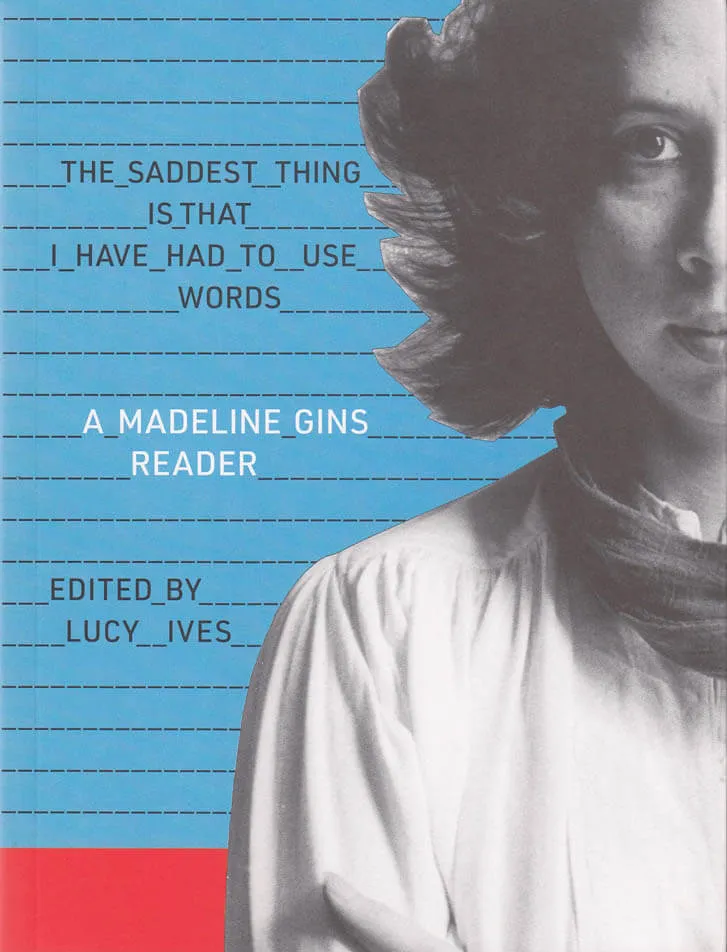
The Saddest Thing Is That I Have Had to Use Words: A Madeline Gins Reader
Poet, philosopher, speculative architect and transdisciplinary artist, Madeline Gins is well known for her collaborations with her husband, the artist Arakawa, on the experimental architectural project Reversible Destiny, in which they sought to arrest mortality by transforming the built environment. Yet, her own writings — in the form of poetry, essays, experimental prose and philosophical inquiries — represent her most visionary and transformative work. Like Gertrude Stein before her, Gins transfigures grammar and liberates words. Like her contemporaries in conceptual art, her writing is attuned to the energized, collaborative space between reader and page.
The Saddest Thing Is That I Have Had to Use Words: A Madeline Gins Reader is a revelatory anthology, edited and with an introduction by the writer and critic Lucy Ives. It brings never-before-published poems and essays together with a complete facsimile reproduction of Gins' 1969 masterpiece, WORD RAIN (or A Discursive Introduction to the Intimate Philosophical Investigations of G, R, E, T, A, G, A, R, B, O, It Says), along with substantial excerpts from her two later books What the President Will Say and Do!! (1984) and Helen Keller or Arakawa (1994). Long out of print or unpublished, Gins' poems and prose form a powerful corpus of experimental literature, one which is sure to upend existing narratives of American poetics at the close of the 20th century.
Edited by Lucy Ives.

Aftershow
A monograph / artists' book that engages with the recent film installations of Pauline Boudry / Renate Lorenz. Installation shots, research material, scripts, and film stills give an insight into the artists' investigation of performance in film and their dense net of references to experimental film, the history of photography, sound, and underground (drag) performances.
The book's title alludes to an interest in opaque events that are belated, left backstage or off-screen. A number of (fictitious) letters to friends and collaborators such as Sharon Hayes, Yvonne Rainer, Ginger Brooks-Takahashi, and Jack Smith place the work of Boudry & Lorenz in a context of debates around temporalities, activism, the archival, decolonizing practices, and queer histories. Published following the exhibition “Patriarchal Poetry” at the Badischer Kunstverein, September 27– November 24, 2013.

University of California Press
Covered in Time and History: The Films of Ana Mendieta
The book includes Mendieta's first published comprehensive filmography resulting from three years of collaborative research conducted by the Estate of Ana Mendieta and the University of Minnesota as well as original essays by John Perreault, Michael Rush, Rachel Weiss, Lynn Lukkas, Raquel Cecilia Mendieta, and Laura Wertheim Joseph.
The first book-length treatment of Mendieta's moving-image practice, Covered in Time and History aims to locate her films centrally within her larger oeuvre and at the forefront of the multidisciplinary shifts that characterized visual arts practice during the 1970s.