rile*books

Search books

Search books by title, author, publisher, keywords...

Cover of Screensaver Error

Posture Editions

Screensaver Error

Lisa Vlaemminck

€38.00

Nº 49 / October 2022

In her work, Lisa Vlaemminck explores the boundaries of painting, creating an exciting, vibrating and disorienting universe. In her images, she questions very classical phenomena in painting, such as the landscape and the still life, by freezing them behind semi-transparent layers of paint. We catch a glimpse that feels familiar, but soon find that nothing is what it seems. Vlaemminck’s work oscillates between the microscopic and the interstellar, as well as the amorphous spaces in between. Image, material, shape, texture and form mutate into compositional playgrounds floating in a newly created universe where different laws and rules apply.

The book “Screensaver Error” is conceived as a symmetrical, folded stack of sheets with images of Lisa’s paintings and collages.
At the heart of the book is the sixty-metre long, worm-shaped textile sculpture, which runs like a stream through the book for many pages.
Dominique De Groen wrote an electrically charged shimmering poem tailored to the work. The introductory text was written by Simon Delobel.

In KIOSK, Lisa Vlaemminck presents a series of new paintings and a sixty-metre long textile sculpture that will occupy the various exhibition spaces. For the design of the fabric, Lisa worked patterns that form a long colour gradient.

At the end of the exhibition, the sculpture, Meat A Morph Hose, will be cut into 35 separate, new sculptures that will be offered as artworks at € 350 each. Each work is a part of the colour gradient and has a unique print. The proceeds will finance the book. Details: Printed cotton, latex spaghetti filling, the ends are closed with climbing rope
40 cm diameter x 130cmA signed copy of the book will also be delivered together with the work.
The sculptures can be collected from KIOSK at the book-launch: Sat. 26 November

The artist is reprented by gallery rodolphe janssen

Published in 2022 ┊ 160 pages ┊ Language: English

recommendations

Cover of sawing a plank is like going for a walk

Posture Editions

sawing a plank is like going for a walk

Kato Six

With texts by Phillip Van den Bossche, Filarowska and a conversation between Eva Wittocx and the artist (NL/EN)


Nº 48 / October 2022

sawing a plank is like going for a walk by Kato Six (b. 1986) is published on the occasion of Kato’s solo exhibition at M Leuven this autumn. This book encapsulates 10 years of her quest as an artist.


The work of Kato Six (b. 1986) balances between abstract and figurative art. She works on different themes which she develops into series or ensembles. Architecture, design, domesticity and utensils all act as important references. Starting there, she uses recognisable and everyday materials such as MDF, stone, plastic or textiles.
Kato wants to question certain affinities and let the viewer look at familiar objects or images from a different perspective. As a viewer, you feel connected to the object or image but the actual meaning or function no longer applies.

Some of my works refer to the domestic, especially the most recent ones, such as ‘Carpet Beater Carpet’ and ‘Striped Knitwear’. The invisible work done by “housewives”, but also by workers or maintenance staff, is certainly one of the themes addressed in ‘Carpet Beater Carpet’. The above works are textile works, created with so-called “soft skills”. In the arts, these “soft skills” are often attributed to female artists — women often being assigned a certain medium.
Kato Six in conversation with Eva Wittocx in “sawing a plank is like going for a walk”

Cover of Slangen

het balanseer

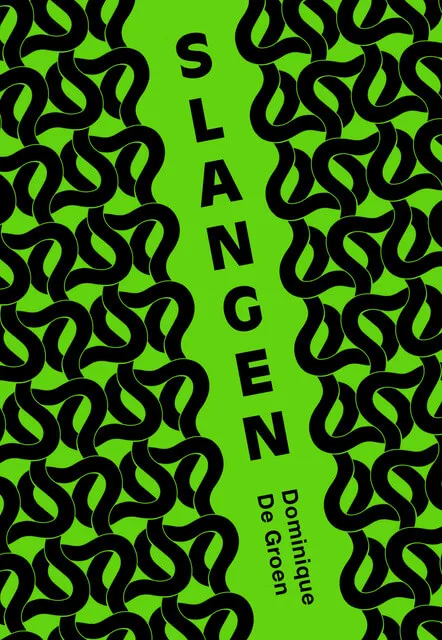
Slangen

Dominique De Groen

Poetry €19.50

Slangen krioelen in de sarcofaag van het heden, in de krochten van de popcultuur, in de mummie van de natuur, in wondes en rot vlees, in artificiële woestijnen en op geoliede dad bods. Ze wentelen zich rond beursgrafieken, raken verstrengeld met wurgende algoritmes, orkestreren een trage ondergrondse revolutie. Een meisje snijdt zich aan een nepdiamanten piramide en werpt haar slangenvel van zich af.

Dominique De Groen is schrijver en beeldend kunstenaar. Ze publiceerde de dichtbundels Shop Girl (2017), Sticky Drama (2019) en offerlam (2020). Ze werd genomineerd voor de Poëziedebuutprijs Aan Zee 2018, de Herman de Coninckprijs 2020 en de Fintroliteratuurprijs 2021 en won de Frans Vogel Poëzieprijs 2019 en de Fintropublieksprijs 2021.

Cover of Rêveries du promeneur solitaire

Time has fallen asleep in the afternoon sunshine

Rêveries du promeneur solitaire

Sarah Ludi

For the project Time has fallen asleep in the afternoon sunshine a group of people/ performers memorize a book of their choice. Together they form a library collection consisting of living books. After years of learning by heart and reciting for readers, some of the books have now been written down from memory to create new editions, versions resulting from this process. This book is one of those books, chosen by one person, learned by heart and recited many times, and now written down again from memory. This edition is not a re-edition of the original text. It is a re-writing of the text after the process of reading, memorizing and reciting, with all the alterations that might have occured in the course of this process.

Cover of Sforzando - Pastels 2020 - 2022

Goswell Road

Sforzando - Pastels 2020 - 2022

David West

At midday, March 17th, 2020, Macron’s government decided to place France in suspended animation. Total confinement. The first in a series of strict debilitating lockdowns to combat the spiralling Covid-19 pandemic. This first confinement lasted 55 days. It ended on 11th May 2020. The first part of a dramatic trilogy.

One month in, in April 2020, David West picked up a box of pastels that used to belong to his mother. He had had them for many years but never used them. New to the medium, locked in his Paris studio, he sets himself to the task. Naturally, violence ensues. Folk horror. Animals are disembowelled. Faceless sexualised female bodies perform. Screaming faces educate. Covered figures stand motionless. Shadows. Hooded beings populate. Stabbing, scratching, fading, softening, sforzando. Crescendo. Schadenfreude.

Occasional respite comes when West ventures outside - andante - but the externalised screaming pushes him back in. Hagazussa. Ghosts from West’s past, real and unreal, appear and disappear, figures and shapes, compositional arcs, a slimy snaking emerald hand parts the waves for colour to gush forth a new language verde fosforescente, worm purple, rosa shocking, vermillion, cobalt, ultra-black.

This book reproduces a small selection of some 300 works, in chronological order, in an attempt to document time, evolution, revolt, epiphany and joy. Joy in colour, horror, form, symphony, and finally, West’s visions of a new utopia. Marcato. Decrescendo.

Softcover (21cm x 29.7cm)
100 Pages
50 copies
Signed and numbered by David West

Cover of Play-White

K. Verlag

Play-White

Bianca Baldi

Photography €24.00

The racist term "play-white" comes from the apartheid era, when it connoted a black or mixed race person who lived as a white person: “So and so is a play-white.” South African artist Bianca Baldi draws from studies of biomimicry and her own family history, as well as literary precedents—such as Nella Larsen’s novel Passing (1929)—to reflect on racial passing and the instability of racial identities. Play-White alternates between layers of visualization and moments of discretion in order to explore questions of presence and evasion beyond their representation in black and white.

With contributions by Bianca Baldi, Mika Conradie, Shoniqua Roach, Amy Watson, and others; design by Katharina Tauer & Wolfgang Hückel in collaboration with K. Verlag.

Published 2021

Cover of ztscript  29 : Spiegel

ztscript

ztscript 29 : Spiegel

ztscript

This issue uses the font designed for german news magazine Spiegel by amazing Lucas de Groot. The color poster is part of the full print of the series “Les Filles d’Amsterdam” by photographer Jean-Luc Moulène. It is the first time this series is printed in book form and in an exclusive interview the artist tells the story of that work.

Contributors: Lily Wittenburg, Maren Grimm & Jakob Krameritsch, Michael Milano, Assaf-Evron, Sophie Thun, Juliana Huxtable, Interview with Jean-Luc Moulène, poster by Jean-Luc Moulène, Magda Tóthová, Peter Machen on Brenda Fassie, Mariah Garnett, Shady El NoshokatyTommy Støckel

Cover of The Century of Artists' Books

Granary Books

The Century of Artists' Books

Johanna Drucker

Johanna Drucker's The Century of Artists' Books is the seminal full-length study of the development of artists' books as a twentieth-century art form. By situating artists' books within the context of mainstream developments in the visual arts, Drucker raises critical and theoretical issues as well as providing a historical overview of the medium. Within its pages, she explores more than two hundred individual books in relation to their structure, form, and conceptualization. This latest edition of the book features a new preface by Drucker and includes an introduction by New York Times senior art critic Holland Cotter.