Books
Books
published in 2018

NXS #3 Viral Bodies
NXS issue #3 Viral Bodies investigates the changing concepts of gender and identity norms in the digital space, and open the discussion to many possible speculations and to their real world implications.
Kicking off the issue with a starting piece by Reba Maybury, over 20 fellow contributors explore social conventions, share intimate moments and experiences of pain, love, hate and fear. They delve into authenticity in the non-human sphere, they code accidental bigotry on the internet. Science fiction writer Alan Dean Foster blurs the lines of reality, transmitting what is real and what not in a dystopian society. Political art critic Penny Rafferty unravels the minds of tech giants while artistic researcher Addie Wagenknecht questions the diffusing lines between virtual technology and working bodies in reality.

Re-Enchanting the World
In this edited collection of work spanning more than 20 years, Silvia Federici provides a detailed history and critique of the politics of the commons from a feminist perspective. In her clear and combative voice, Federici provides readers with an analysis of some of the key issues in contemporary thinking on this subject. Drawing on rich historical research, she maps the connections between the previous forms of enclosure that occurred with the birth of capitalism and the destruction of the commons and the "new enclosures" at the heart of the present phase of global capitalist accumulation.
Considering the commons from a feminist perspective, this collection argues that women and reproductive work are crucial to both our economic survival and the construction of a world free from the capitalist hierarchies. Federici is clear that the commons should not be understood as happy islands in a sea of exploitative relations—but rather autonomous spaces from which to challenge the existing organization of life and labor.

Evidentiary Bodies
Bringing together both known and previously unseen works of film and video, installations, works on paper, and material from her archive, this volume addresses critical themes that appear throughout Hammer's work, including sensation and intimacy, lesbian representation, and the maintenance of illness, in addition to exploring the artist's relationship to experimental queer cinema, feminist history, and environmental activism. Featuring a wide range of responses, from personal anecdotes to academic analysis and poetic interpretation, this volume highlights the resonating impact of Hammer's artistic narrative across cinema studies, art history, queer theory, and feminist thought.

Anthology of Failure
GenderFail: An Anthology On Failure is the first in a series of publications that look into various concepts of failure from the perspectives of artists, activists, writers, and curators. The failures discussed in this publication come from various different places - from personal, political, institutional, and collective sources. Each participant was invited to contribute a work surrounding failure - especially as it pertains to their own experiences - to expand upon topics of ableism, mental health, passing, whiteness, colonization, police brutality and other illustrations of failure put onto us by dominant culture. This resulting collection might fail to articulate a cohesive interpretation of something as complex as failure, but will hopefully incite a collective consciousness that is as messy as it is thought provoking.
Contributions by: Manuel Arturo, Abreu, American Artist, Sasha Costanza-Chock, Demian DinéYazhi, Johanna Hedva, Nicole Killian, Andrea Liu, Be Oakley, Nate Pyper, Sable Elyse smith, Alok Vaid-Menon, Augustine Zegers.
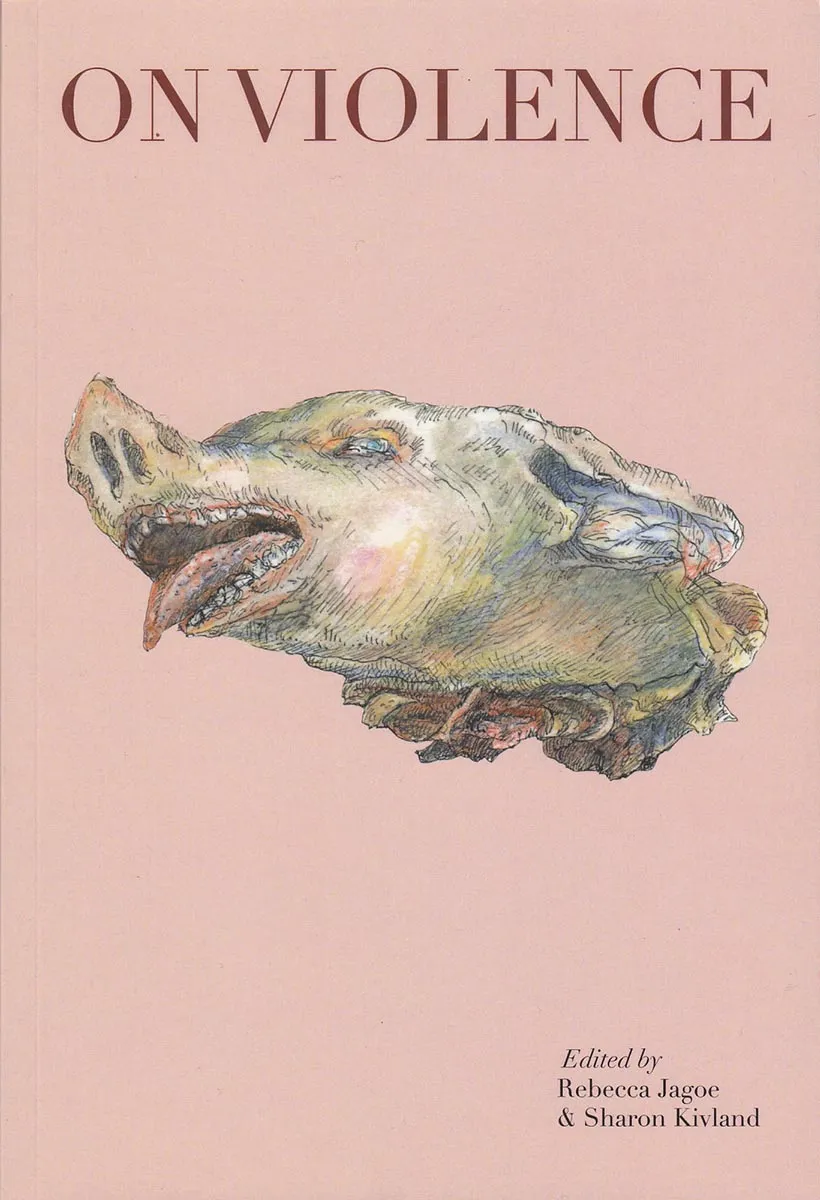
On Violence
Violence is in language and violence is language. The violence of language stratifies voices into those that matter and those that do not, using ideas of appropriate form and structure as its weaponry. It claims propriety and politeness are the correct mode of address, when urgency and anger are what is needed. Where languages intersect, hierarchies of language become means for domination and colonization, for othering, suppression, negation, and obliteration. The demand for a correctness of grammar, the refusal to see what is seen as incorrect, the dismissal of vernacular in favour of the homogenised tongue: all are violent. The narrative of history is a narrative of violence. The contributions herein refuse this narrative. They explore how violence permeates and performs in language, how language may be seized, taken back to be used against the overwhelming force of structural and institutional violence that passes as acceptable or normal. Violence may be a force for rupture, for refusal, for dissent, for the herstories that refuse to cohere into a dominant narrative.
Contributors: Travis Alabanza, Katherine Angel, Skye Arundhati-Thomas, Mieke Bal, Janani Balasubramanian, Elena Bajo, Jordan Baseman, Emma Bolland, Pavel Büchler, Paul Buck,Kirsten Cooke, Jih-Fie Cheng, John Cunningham, Andy Fisher, Caspar Heinemann, Jakob Kolding, Candice Lin, Rudy Loewe, Nick Mwaluko, Vanessa Place, Katharina Poos, Tai Shani, Linda Stupart, Benjamin Swaim, Jonathan Trayner, Jala Wahid, Isobel Wohl, Sarah Wood
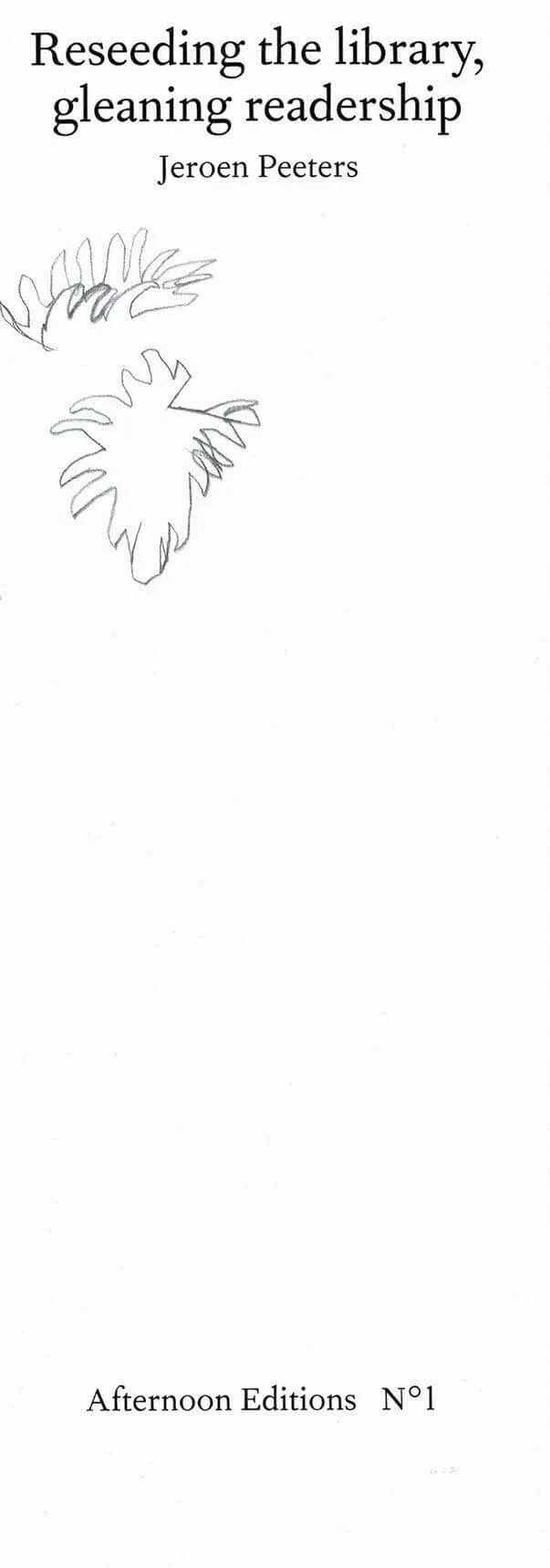
Reseeding the library, gleaning readership
Afternoon Editions no. 1: an essay by Jeroen Peeters titled Reseeding the library, gleaning readership. In May 2017, Time has fallen asleep in the afternoon sunshine settled during three weeks in the Ravenstein Gallery in Brussels as part of the Kunstenfestivaldesarts. Invited as a writer in residence, Jeroen Peeters visited the library of living books on a daily basis and recorded his observations by hand in a notebook, which formed the basis for Afternoon Edition #1. Reseeding the library, gleaning readership is an essay on the seed library, on the dispersion of literature through wind, water and animals, on biodiversity and commoning at the heart of readership. On the cover a drawing by Wouter Krokaert of a Philodendron Xanadu. Published May 2018.

A Handbook of Disappointed Fate
A HANDBOOK OF DISAPPOINTED FATE highlights a decade of Anne Boyer's interrogative writing on poetry, death, love, lambs, and other impossible questions.
"The essays in this book model the poet’s no: they refuse to make things easy when they aren’t, preserving the messy difficulty of cancer, of poverty, of staying alive under capitalism." - Julia Bosson

To Become Two
To Become Two: Propositions for Feminist Collective Practice offers a narrative of artist Alex Martinis Roe’s research into a genealogy of feminist political practices in Europe and Australia from the seventies until today.
These practices include those of the Milan Women’s Bookstore co-operative; Psychanalyse et Politique, Paris; Gender Studies (formerly Women’s Studies) at Utrecht University; a network in Sydney including people involved in the Sydney Filmmakers Co-operative, Feminist Film Workers, Working Papers Collective, and the Department of General Philosophy at Sydney University; and Duoda – Women’s Research Centre and Ca la Dona, a women’s documentation centre and encounter space in Barcelona.
Drawing from their practices and experiences, Martinis Roe’s research forms a proposal for a transgenerational approach to feminist politics. This is further developed as a practical handbook of twenty new propositions for feminist collective practice, which were formed in collaboration with a network of contributors through experiments with these historical practices.

Talking To Women
With an introduction by Ali Smith and a new afterword by Nell Dunn.
In 1964, Nell Dunn spoke to nine of her friends over a bottle of wine about sex, work, money, babies, freedom and love. The novelist Ann Quin says she appears to be a 'singular girl, singular and single’ but questions the use she makes of her freedom. The Pop artist Pauline Boty reveals she married 'the first man I could talk very freely to’ ten days after meeting him. Kathy Collier, who worked with Dunn in a Battersea sweet factory, talks about what it takes to 'get out’ of a life that isn’t fulfilling. Edna O’Brien tells us about the time she inadvertently stole a brown georgette scarf and the lesson she took from it: 'Morality is not the same thing as abstinence.’

Dining with Humpty Dumpty
Mistress Rebecca is approached by a 34-year-old Tory who works in a corporate field of creativity with a feeding fetish. Such mundanity is outrageous – until he declares himself as a female supremacist. Over the period of two evenings and one afternoon in three different chain restaurants in central London, Mistress Rebecca explores Humpty Dumpty’s beliefs then pushed his adoration of humiliation and his facade of female empowerment to its limits.

Skinned Detouched
Skinned and Detouched, a pair of artists books, are a portal to a single performative stage in the industrial production of two large scale sculptures, one of which is on show at Large Glass. The books, including writing by Jennifer Boyd, photography by Thierry Bal and design by Europa, imaginatively document the multiple embodiments and disembodiments involved in one moment in the production of the two works.

Texts that shouldn't be read out loud

Cancelled
TEXTS BY MARLIE MUL, LINDA STUPART AND GEORGIA HORGAN. DESIGN BY MAXIMAGE.

Que Faire
In Que Faire? a group of local amateur actors focuses on the exchangeable power of spoken word and its transformative nature. The group searches desperately for ideas, they look for a way to save their jobs through the use of language. They go to group therapy, they lock themselves in the writer’s room and they live their collective unemployment in an empty studio of the former Company. In QueFaire? the power of the collective works as a lonely psycothic voice. The city of Noisy-le-Sec where I have lived for 7 months becomes the ground of this fiction and integrates the inhabitants as actors, the activity and the municipal places of the city, gathering and re-inventing the notions of inspiration and creativity at work.
Authors and contributors: Liv Schulman, in collaboration with Alain Farrès, Dominique Martin, Thomas Brehamet-Godet, Gaëtan Alepee, Nathanaëlle Puaud, Emilie Renard, Zoe Charles, Alban Legass, Régine Besenval, Nadège Souillard et Marjolaine Calipel.
Text in French.
Graphic Design: Roxanne Maillet

Positions of the Sun
The second work in Belladonna* Collaborative’s Germinal Texts series, Lyn Hejinian’s Positions of the Sun is a book of twenty-six interlocking “essays with characters” that explores the mid-2000s financial “crisis” through the movements and daily lives of a wide-ranging cast of characters located in the Bay Area.
In Positions, Hejinian plays the bricoleur, bringing together whatever’s needed in her to approach to the subject—whether the paratactic tactics of poetry, scholarship’s critical patchwork, or dramatis personae set in time that evokes but frustrates narrative.
Earlier iterations of essays 4, 14, and 17 appeared in Belladonna*’s Elders Series #5, edited by Jennifer Scappettone with work by Etel Adnan, Lyn Hejinian, and Jennifer Scappettone.

How To Become (...)
How to become a soft corpse recomposed in light fabric ou comment laisser les cadavres saigner de la porte du placard, comment anti-citer comme la reine de chicane les yeux couverts de cuir, comment s’écrit Madame X, comment s’échoïser dans le trou noir de l’identité – qui PARLE quand on parle?

Black Lesbians—We Are the Revolution!
Sinister Wisdom 107: Black Lesbians—We Are the Revolution! lifts up the voices of African-American lesbians for us all to hear, see, and know. The creative work in Sinister Wisdom 107: Black Lesbians—We Are the Revolution! gathers together new writing by an array of emerging and established black lesbian and queer women writers. Sinister Wisdom 107 invites us all as readers, thinkers, activists, and cultural workers to engage in meaningful and productive ways with the voices and works of African-American lesbians as they write and imagine new worlds.
Behind the Issue
A Conversation with Black Lesbian Poet JP Howard at AfterEllen.com
Talkin’ About a Revolution: JP Howard on Raising Her Fist—and Queer Women’s Voices
Creative Work By
Pamela Sneed
Charan P. Morris
Nikkya Hargrove
Vanesa Evers
Omotara James
Renée Bess
Cheryl Boyce-Taylor
Arisa White
Cheryl Clarke
Ifalade TaShia Asanti
Linda Bellos
And more!

Hot Spots: Creating Lesbian Space in the South
Sinister Wisdom 109: Hot Spots explores the Southern spaces where lesbians gathered and organized during the past forty years. The ways that lesbians came together during the 1970s, 1980s, and 1990s were many and varied. There was no social media, no high-speed communication. Lesbians relied on the US Post Office, telephones, and face-to-face contact. Public advertising such as newspaper ads, flyers, and leaflets had to be done carefully and discreetly. Learning about events of the past gives templates by which to formulate and support activism in the present and future. Oppression, restriction, discrimination, and disempowerment can take many forms, some more insidious than others, and activism can be especially difficult when one is a member of a despised and criminalized minority. Sometimes, the most we can do is be ourselves and live the truth in our lives.
This issue of Sinister Wisdom, fourth in a series of special issues covering lesbian-feminist activism in the late twentieth-century South, focuses on lesbian gathering places and ways that lesbians created community while continuing activism.