rile*books

Search books

Search books by title, author, publisher, keywords...

Cover of Hot Spots: Creating Lesbian Space in the South

Sinister Wisdom

Hot Spots: Creating Lesbian Space in the South

Sinister Wisdom

€7.00

Sinister Wisdom 109: Hot Spots explores the Southern spaces where lesbians gathered and organized during the past forty years. The ways that lesbians came together during the 1970s, 1980s, and 1990s were many and varied. There was no social media, no high-speed communication. Lesbians relied on the US Post Office, telephones, and face-to-face contact. Public advertising such as newspaper ads, flyers, and leaflets had to be done carefully and discreetly. Learning about events of the past gives templates by which to formulate and support activism in the present and future. Oppression, restriction, discrimination, and disempowerment can take many forms, some more insidious than others, and activism can be especially difficult when one is a member of a despised and criminalized minority. Sometimes, the most we can do is be ourselves and live the truth in our lives.

This issue of Sinister Wisdom, fourth in a series of special issues covering lesbian-feminist activism in the late twentieth-century South, focuses on lesbian gathering places and ways that lesbians created community while continuing activism.

Language: English

recommendations

Cover of Sister Love: The Letters of Audre Lorde and Pat Parker 1974-1989

Sinister Wisdom

Sister Love: The Letters of Audre Lorde and Pat Parker 1974-1989

Julie R. Enszer

Poets Audre Lorde and Pat Parker first met in 1969; they began exchanging letters regularly five years later. Over the next fifteen years, Lorde and Parker shared ideas, advice, and confidences through the mail. They sent each other handwritten and typewritten letters and postcards often with inserted items including articles, money, and video tapes.

Sister Love: The Letters of Audre Lorde and Pat Parker 1974-1989 gathers this correspondence for readers to eavesdrop on Lorde and Parker. They discuss their work as writers as well as intimate details of their lives, including periods when each lived with cancer. Sister Love is a rare opportunity to glimpse inside the minds and friendship of two great twentieth century poets.

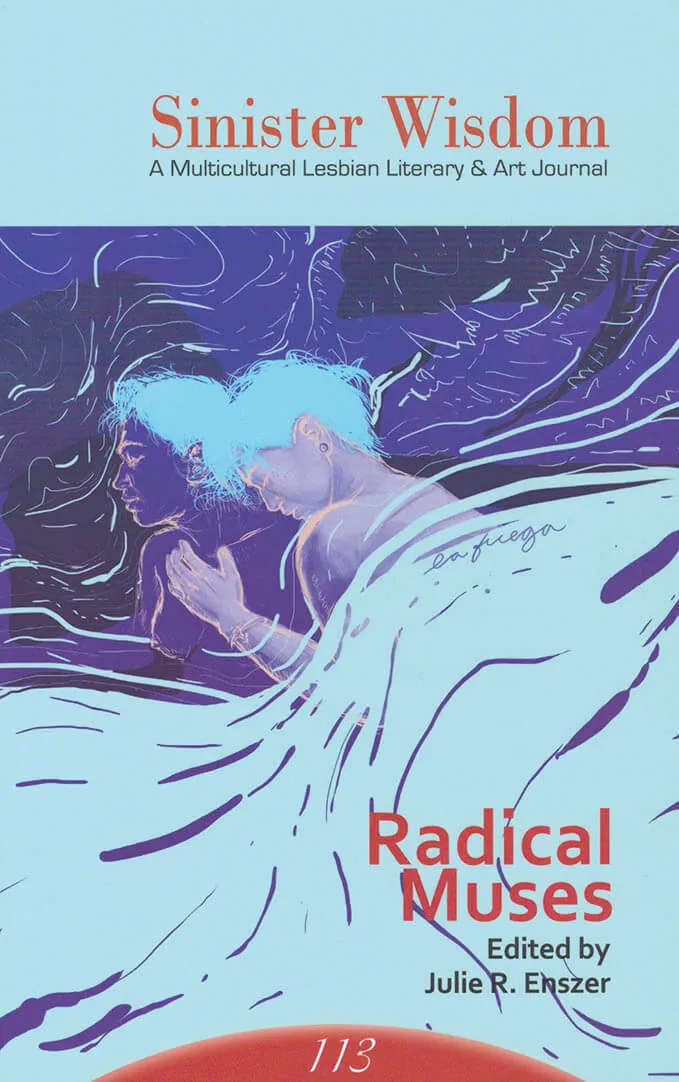
Cover of Radical Muses (Sinister Wisdom nr. 113)

Sinister Wisdom

Radical Muses (Sinister Wisdom nr. 113)

Julie R. Enszer

Sinister Wisdom 113: Radical Muses features an eclectic array of contemporary poetry, prose, and art by lesbians from around the world, including new work by: Andrea Assaf, Tara Shea Burke, Cheryl Clarke, Marina Chirkova, Estela González, Barbara Haas, Nancy E. Lake, Vi Khi Nao, H. Ní Aódagaín and much more!

Cover of Celebrating the Michigan Womyn's Music Festival

Sinister Wisdom

Celebrating the Michigan Womyn's Music Festival

Sinister Wisdom

Sinister Wisdom 103: Celebrating the Michigan Womyn's Music Festival honors the forty-year legacy of the Michigan Womyn’s Music Festival (1976–2015). Sinister Wisdom 103: Celebrating the Michigan Womyn's Music Festival celebrates this embodiment of radical feminist separatist collaboration, transformational self-defined autonomous spaces, a commitment to sisterhood and matriarchal culture, and a musical city sprung from the earth for one week in the woods.

A collective of five womyn each with a deep connection to Fest operated by consensus to create this issue. Striving to represent a range of womyn’s voices, values, traditions, and experiences of Fest, the collective highlighted what Fest has meant to generations of womyn, documented its chronology, and bore witness to the power of this community. Sinister Wisdom 103: Celebrating the Michigan Womyn's Music Festival includes womyn from multiple races, geographies, sexualities, generations, and gender and other social identities. Just as Fest brought together womyn from various backgrounds, our collection includes a range of artistic experience, from seasoned authors and photographers to those womyn new to publishing.
Sinister Wisdom 103: Celebrating the Michigan Womyn's Music Festival remembers the transformations, possibilities, and hopes for spaces cultivating the ongoing empowerment of womyn.

Cover of ztscript 33 : Lisa Fittko

ztscript

ztscript 33 : Lisa Fittko

ztscript

Typeface by Bea Schlingelhoff, from the Project "Women against Hitler"

Eric Bell & Kristoffer Frick: Rainbow Rope, 2017 1, Crystal Table (II), 2017 2, 63, Platonic Solid, 2018 64, Kolumne 3, Sara MacKillop: WC2N 4, 10, 15, 24, California Cannabis Legalization 9, Letzte Ausgabe der Spartakusbriefe, Oktober 1918 11, Delia Gonzales 16-21, Cordula Daus 22, Christina Irrgang 25, Eric Ellingsen 26, Hugo Canoilas: L’ô 29, 30, 35-38, Sadie Plant 31, Markus Krottendorfer: aus der Serie TERMINAL, 2017 32, Kate Rich: Feral Trade 39, Julia Knass 44, Walter Hetzer: World Trade Center 1972 46, Lidl, Wiedner Hauptstraße 15, Wien (ehemals Generali Foundation, gebaut 1993-95, Architektur Jabornegg & Pálffy) 50, One Hour and a Half in the Life of Ztscrpt 62-52

Cover of HOOT nr. 9 — Moyra Davey & Sophie T. Lvoff

GUFO

HOOT nr. 9 — Moyra Davey & Sophie T. Lvoff

Sophie T. Lvoff, Moyra Davey

Periodicals €12.00

The 9th HOOT pops up for the winter 2022-23, but the conception of this issue started well over a year ago at our beloved Plage Avant (Traduttore, traditore’s studio, Marseille). 

We met Sophie T. Lvoff at many openings and art related events in Marseille these last few years, having a practice that appears mainly as photography, Gufo got curious about all the processes that she uses which involve sound, installation, writing… and more. She welcomed us in her studio of the city of Marseille where she recently settled.

We found out about the “trompe-l’œil” of this iconic checkered table, witnessed the installations of translucid and colored objects evolving on the sunny wall, and looked through her photographic chamber it’s called a large-format camera, but this is funny… For this issue, Sophie suggested to interview another artist, Moyra Davey, who also works in photography and writing, and appeared to have shared experiences too.

The topics of everyday life, intimacy that images embody in both their works, take another dimension as soon as their thoughts, voices and writing expand and express the entirety of their gestures.

This issue is the first interview between two native English-speaking artists, who have ties to the French language from childhood.

The penpals are the main characters of that encounter where we are very welcome to join in their very generous conversations. This is only an excerpt of a long and well referenced correspondence.

Cover of Pages 9 - Seep

Pages Magazine

Pages 9 - Seep

Babak Afrassiabi, Nasrin Tabatabai

Periodicals €12.00

This issue of Pages assumes seep as a post archival mode: in the Merriam-Webster dictionary the verb 'seep' is translated as follows: to flow or pass slowly through fine pores or small openings, to enter or penetrate slowly, to become diffused or spread.

The biology or politics of seeping is like that of raw petroleum oozing at natural oil seeps. Unlike refined oil which has sponsored modernization and its aligned archives, crude oil pours beyond historical purpose and defies structural elevations. It instead disfigures the ground through which it dubiously spreads.

Seeping is a posthumous affair. It is the gradual leaking of a long withdrawn interior. Like the bleeding of a punctured corpse, when the pumping of the heart has stopped, when the body is lifeless and apathetic to any 'hail', yet continuing to bleed. Seep as archive is an eternally post-apocalyptic expansion, retraction, deviation, subtraction, or simply the arrival of (non-)things.

With contributions by:

- Mariam Motamedi Fraser / Geo-Archive
- Richard Goldstein / Dennis Oppenheim's Dilemma: Should he Sell Art to the Shah?
- Babak Afrassiabi, Nasrin Tabatabai / Contemporary Hole / Unfilmable 
/ Seep
- Saleh Najafi / Wounds of Archive¹
- Mark von Schlegell / The Artist Abstract #6
- Nima Parzham / The underground
- Adam Kleinman / Vanished Theories
- Suzanne Treister / Algorithm
- Alexi Kukuljevic / The Dissolute Subject
- Matts Leiderstam / Andy Warhol, Suicide (Purple Jumping Man), 1963
- Eugene Thacker / Black Infinity; or, Oil Discovers Humans
- Vivian Ziherl, Natasha Ginwala / Infrastructural Suspensions: Global Spanning, Atmospheric Seepage and Measures of the Undecidable

Cover of TYPP #8 — Blind Spot

Sint-Lucas School of Arts Antwerp

TYPP #8 — Blind Spot

Zeynep Kubat

Periodicals €12.00

The human eye is designed with a flaw that is common to all other vertebrates: we have a blind spot, the punctum caecum, a small patch on the inside of our boisterous orbs of vision with no photoreceptors. A blind spot can also be psychological or social. We tend to be biased towards situations or people we cannot fully ‘see through’. How can we enlighten our blind spots? What kind of artistic practices can inspire new readings of history, art, music, or even politics?

With contributions by Bent Vande Sompele, Pierre-Antoine Vettorello & Stella Nyanchama Okemwa, and Haseeb Ahmed.  Design by Ward Heirwegh. Chief Editor: Zeynep Kubat. Editorial Board: Mekhitar Garabedian, Caroline Dumalin, Saskia Van der Gucht, Paul Hendrikse.