Books
Books

Another Sun
Françoise Vergès, Mayra A. Rodríguez Castro
Waiting at Martinique Aimé Césaire International Airport, in the city of Le Lamentin, Mayra A. Rodríguez Castro browses the airport kiosk. Alongside books by Césaire, it offers titles by Frantz Fanon, Maryse Condé and Patrick Chamoiseau. She picks up a copy of Nègre je suis, nègre je resterai, a conversation between Françoise Vergès and Césaire published in 2005, and embarks. In Another Sun, Rodríguez Castro and Vergès revisit that seminal conversation, resulting in an eclectic text shaped by ongoing struggles.
In 2005, Françoise Vergès published a book with Aimé Césaire, in which she recorded – three years before his death – powerful remarks by the poet, as incisive and combative as ever, yet imbued, as always, with the universal humanism to which he had remained committed throughout his life. It is fortunate that, drawing inspiration from this interview, Another Sun allows us to hear, in their intertwining, the voices of Césaire and Vergès herself, conveying a message of emancipation and fraternity/sorority that our world needs to hear today. —Souleymane Bachir Diagne
With poems by Danielle Legros Georges, Wole Soyinka, Ishion Hutchinson, Clarisse Baleja Saïdi, Aimé Césaire and Jean Érian Samson.

October
What do we carry from one year to the next? What remains after devastation, and what, despite everything, takes root again?
October in Lebanon is heavy with memory. The euphoria of the 2019 revolution feels far away, its anniversaries marked by crisis, war and the genocide in Gaza.
Across multiple Octobers, Nur Turkmani meditates on rupture, transformation and the quiet undoing and remaking of relationships during collective catastrophe. Part archive, part love letter, her debut poetry collection holds the ordinary and the extraordinary in the same breath, spanning balconies and border towns, fig trees and songs for friends, autumn light and the instinct to flee.
Formally spare and emotionally saturated, October refuses both numbness and spectacle. These poems ask what it means to survive the world and still long for it; and how we hold what’s disappearing, or changing too quickly to make sense of.

The Hajar Book of Rage
Rage is not just a feeling—it’s fuel.
The Hajar Book of Rage ignites the first spark in the elements anthology series, harnessing the primordial force of fire as a fury that destroys and transforms. Bringing together fiction, poetry and essays by writers of colour, this Fire-themed collection delves into the fierce, animating power of rage as a catalyst for revolutionary change.
Here, rage teaches. It reveals what we’re fighting against and what we’re fighting for. It mobilises us into action, rouses our ideals and refuses to let us compromise. And it is unruly and consuming—a blaze that resists containment.
This is a searing tribute to the fires of anger that fuel our resistance and burn down the worlds that cannot hold us.
The Hajar Book of Rage is the first book in elements, a series by Hajar Press on the politically transformative power of Fire, Earth, Water and Air.

COOP. A Novelette
On work and words, and how they contort the world.
Lena is a part-time bookseller in a bougie design studio in Oxford Circus. In between minimum-wage work under a politically hostile boss and strained communications with her parents, her days are shaped by a fraught relationship with food, ambiguous experiments in creative writing, and mounting pressure to find a ‘proper’ postgraduate job.
In taut, pocket-sized vignettes, COOP reveals a suffocating lattice of language that makes up a precarious London life. But as each word of her story unravels, Lena discovers interstices between them—to find autonomy and escape.

One hundred and six EROTIC short stories
To be erotic is to be alive. In this collection of erotic short stories, desire and imagination meet in stairwells, apartments, bars and glances that linger just a little longer. Commissioned for and first published in Extra Extra magazine, these unique stories range from vibrant encounters of mere minutes to hours of simmering tension.
Carefully curated and unapologetic in its imagination, it’s an invitation into a literary space shaped by lust and longing.
One Hundred and six erotic short stories contains erotic stories by Obe Alkema, Karin Amatmoekrim, Mischa Andriessen, Sarah Arnolds, Simone Atangana Bekono, Gerbrand Bakker, Maria Barnas, Leonieke Baerwaldt, Persis Bekkering, Abdelkader Benali, Hannah van Binsbergen, Marion Bloem, Fiep van Bodegom, Daan Borrel, Charlotte van den Broeck, Saskia de Coster, Eelco Couvreur, Daniël Dee, Nikki Dekker, Maxime Garcia Diaz, Don Duyns, Rob van Essen, Edwin Fagel, Mira Feticu, Moya De Feyter, Andy Fierens, Gamal Fouad, Johan Fretz, Steff Geelen, Maureen Ghazal, Arnon Grunberg, Esha Guy Hadjadj, Thomas Heerma van Voss, Mariken Heitman, Tom Hofland, Philip Huff, Auke Hulst, Nicole Kaandorp, Asha Karami, Maite Karssenberg, Mensje van Keulen, Emy Koopman, Falun Ellie Koos, Willemijn Kranendonk, Selin Kuşçu, Rachida Lamrabet, Jordi Lammers, Wietske Leenders, Sandro van der Leeuw, Sun Li, Gilles van der Loo, Hannah Chris Lomans, Alma Mathijsen, Kiriko Mechanicus, Jens Meijen, Lars Meijer, Carmien Michels, Kaweh Modiri, Roelof ten Napel, Richard de Nooy, Joost Oomen, Jamal Ouariachi, Iduna Paalman, Gustaaf Peek, Elvis Peeters, Froukje van der Ploeg, Marja Pruis, Julius Reynders, Hannah Roels, Astrid H. Roemer, Martin Rombouts, Daniël Rovers, Alfred Schaffer, Marijke Schermer, Koen Sels, Vamba Sherif, Frank Siera, Louise Souvagie, Yentl van Stokkum, Florence Tonk, Elfie Tromp, Joost Vandecasteele, Dominique van Varsseveld, Annelies Verbeke, Peter Verhelst, Wytske Versteeg, Daniël Vis, Dirk Vis, Sven Vitse, Maria Vlaar, Marwin Vos, Nadia de Vries, Niña Weijers, Han van Wieringen, Romy Day Winkel, Maartje Wortel, Pete Wu, Kira Wuck, Mia You, and Ivo Victoria

Issue 8: Garden Tools
More than a mere extension of the hands, the garden tool is what helps the gardener materialise their vision. Much like the painter’s brush and the sculptor’s chisel – without it, one would be helpless. This issue of Pleasant Place dives into the world of garden tools, the essential, the practical, and the beautiful.
Including:
Instruments of Care – An introduction by Norbert Peeters with some philosophical remarks on garden tools.
Wardens of Good – A visual essay of the wonderful objects of Garden and Wood, a business selling vintage garden tools and ephemera.
Trusted Tools – Gardeners like Piet Oudolf and Jonny Bruce talk about their favourite tools that are illustrated in detail by artist Floris Tilanus.
Passing the Trowel – A visit to Sneeboer, the Netherlands most famous garden tool company, where the trowel has been passed down for four generations.
Toolmorrow – Artists are challenged to create new types of garden tools, for lazy gardening, stylish gardening and collective gardening.
Cover by Lou-Lou van Staaveren
Inside cover by José Quintanar
Centrefold miniatures by Zilan Zhao
Graphic design is by fanfare
Concept and editing by Guus Kaandorp, Floor Kortman and Lou-Lou van Staaveren

Pleasant Place 3: Compost
Allow us to introduce to you, the meaning of life, Compost Almighty.
Including:
“I’m orange peels, I’m coffee grounds, I’m wisdom” – Marjory the Trash Heap tells the future
Compost: An introduction – what, why and how to compost, with illustrations by Noa Zuidervaart
Comfrey Cocktail – make your own Comfrey Feed
Worms are great and this is why – an ode to worms by Joline van Berkestijn with images by Jaap Scheeren
What to do with a whole lot of poo – Ton Hilhorst and Savitri Groag from Artis, the Amsterdam zoo, about their compost-system that thrives on elephant poo
Digital Compost – composting in Minecraft, the biggest videogame in the world
A set of garden miniatures by Hanna Something
The cover and inside cover are by Lou-Lou van Staaveren and Guus Kaandorp and graphic design is by fanfare

Issue #9: Companions
Irene de Craen, Katia Krupennikova
The editorial/imaginative centre of the ninth issue of Errant Journal is located in the regions that have experienced Russian imperial aggression from where it makes connections across times, geographies, and ontologies to explore the radical potential of companionship. Companionship is understood not as agreement, but as a shared responsibility across unequal histories. It means not being full without the other. While forms of imperial and colonial violence might differ in places and through times, the issue recognizes how colonial mechanisms are sustained, how they present themselves as if they were past while shapeshifting and continuing in new forms and places in the present. By bringing these contexts in relation, this issue aims to show how certain borders, biases, clichés, and power structures travel, mutate, and shape both human and non-human lives and landscapes. Ultimately, companionship is about prioritizing life and about insisting that no oppression is singular.
This issue is a concept by and co-edited with Katia Krupennikova.
Contributors: Adriana Arroyo, Keto Gorgadze, Andreas Kalkun, Chung Kai Lee, Samira Makki, Ana Mikadze, Petrică Mogoș, Fabienne Rachmadiev, Vaim Sarv, Victoria Soyan Peemot, Czyka Tumaliuan, Iryna Zamuruieva, Irene de Craen, Katia Krupennikova

Goblinhood - en mode gobelin !
Enfin la traduction en français du best-seller de Jen Calleja, qui sera présente pour une lecture croisée. Repassez vos capes et astiquez vos chaînettes.
La figure du gobelin est espiègle, marginale, répugnante et fascinante et le mode gobelin peut être envisagé comme un mode de vie à part entière.
Jen Calleja, depuis son obsession pour les objets verts et les marionettes, ses souvenirs familiaux, son rapport au corps et au dégoût de soi, au chagrin, au sexe et au deuil, propose avec malice une pensée hybride entre essai, auto-fiction, poésie et théorie de la gobelinité.
En chacunx de nous, suggère-t-elle, sommeille un gobelin qu’il est temps de libérer.

Vrai travail
Le Collectif Occasionnel a organisé en Suisse deux expositions qui présentaient les oeuvres de personnes à la fois artistes et travailleureuses du sexe. Cet ouvrage prolonge leur travail en proposant des textes et des entretiens avec des Tds ou des alliéxes. Permettant l’auto-représentation des personnes interrogées, les entretiens mettent en lumière la pluralité des pratique du travail du sexe, mais aussi l’importance de construire des solidarités travailleuses, des outils pour défaire les stigmates et des perspectives de luttes intersectionnelles.

Affiliation
Mira Mattar, Judith Abensour and 1 more
Affiliation, de Mira Mattar, autrice londonienne issue de la diaspora palestinienne, explore des thèmes tels que le genre, la famille, la religion, la guerre, l’écologie, le colonialisme et l’amour, en lien avec des lieux comme la Jordanie, le Liban, la Palestine et le Royaume-Uni. Interrogeant nos affiliations personnelles et collectives, et la manière dont les systèmes de pouvoir influencent nos désirs et nos identités, le livre s’ouvre sur quatre Lettres d’Amman qui propulsent le texte poétique dans le mouvement du monde et attestent de la dynamique de l’exil palestinien, où l’éclatement, l’effacement et l’appropriation se mêlent avec les effets contemporains de la mondialisation.
La deuxième partie du livre, intitulée Affiliation (pour mon père) est un long poème rétrospectif qui court sur une trentaine de pages. L’écriture à la première personne de Mira Mattar met en tension des contextes politiques, domestiques, intimes, économiques où se déploient des affiliations coloniales, capitalistes, patriarcales, nationalistes. Elle en restitue les violents processus internes, passant du refus de se soumettre à l’impossible échappée. Dans Affiliation, on fait l’expérience d’être en dehors: en dehors de son corps, en dehors d’un pays, en dehors d’une pièce. Il n’y a aucune position stable, et le sujet se construit dans un éclatement constant. Peu de livres articulent aussi finement expérimentation formelle et nécessité de l’expression verbale. Affiliation est un flux de langage dont on peut sentir l’urgence à chaque vers.

Heights of Macchu Picchu
Pablo Neruda’s Alturas de Macchu Picchu is a poem that distrusts solitary authority even as it passes through a single voice, moving from the lyric “I” toward a collective utterance grounded in labor, history, and shared breath.
Producing the first collaborative translation of Alturas de Macchu Picchu is not incidental but consonant with its deepest claims. Attentive to Neruda’s unique lyric pressure, this new English version resists the tradition of singular, authoritative renderings by allowing meaning, rhythm, and decision to emerge through dialogue and negotiation.
In this way, the translation does not merely transmit Neruda’s poem but enacts its insistence that voice is a collective achievement, not a solitary possession.

Midnight Mass Press & Heretic House
WITCHES
A collection of portraits by original riot grrrl, filmmaker, and zine queen, G.B. Jones. All of them witches – from the silverscreen, woodlands, and the streets.
Featuring provocative essays by Caroline Azar, Paul P., Leafshimmer, Jenna Danchuk, Blake Baron Ray, and Scott Treleaven – each exploring how witches have been perceived, presented, and portrayed in popular culture. “Realer than real, stranger than fiction.”
PRAISE FOR G.B. JONES WITCHES
Witches by G.B. Jones is a summoning spell posing as a book, a paper potion like the potion Nicky gives Gillian in Bell, Book and Candle. It draws me to it and to what’s in it, Jones’ divine drawings of the witches we both worship, the witches of TV and film and true life. I go to it gladly. I go to it gayly. I pore over it and prize it and purr like Pyewacket.
— Derek McCormack, author of Castle Faggot
G.B. Jones is the original Foxy Genius. Her zines, drawings, music, and Super 8 films inspired both the Queer zine explosion and the Riot Grrrl movement of the 90s. Witches sees G.B. once again crafting her magic.
— Kathleen Hanna, singer, writer, artist, and front-woman of the bands Bikini Kill and Le Tigre
With her illustrated procession of witches, post-punk icon G.B. Jones acts as medium to a dazzling diversity of disrupters from across screen history, as well as a pantheon of real-life hellraisers, from Sybil Leek and Rosaleen Norton to Vali Myers and beyond – all woven through with astute commentary by a host of countercultural collaborators. A captivating book; I was certainly under its spell.
— Kier-La Janisse, author of House of Psychotic Women

Not A Cookbook
TBW Books is proud to announce the release of Not a Cookbook, the debut book by Canadian filmmaker and artist Robby Reis.
At first glance, Not a Cookbook appears to be just what its title implies—but beneath the surface lies a layered, collage-style portrait of a restaurant and the family that holds it together. Centered on Resto Palme, a Caribbean restaurant in Montreal run by married duo Lee-Anne Millaire Lafleur and Ralph Alerte, the book offers a deeply personal and provocative exploration of kitchen culture, where food becomes a lens through which to examine family, friendship, labor, and resistance.
A longtime friend of the family, Reis takes an embedded, nonlinear approach to storytelling. Through photographs, texts, and contributions from customers and staff, Not a Cookbook captures not just the daily challenges of running a family business, but also the peripheral stories—of racism, activism, and the emotional labor required to build and protect something shared and sacred.
Despite its name, Not a Cookbook does offer some treasured family recipes—however, when it comes to a few key ingredients that make a certain sauce so special, Alerte leaves us simply with, “sorry blood, I can’t give it away.” The result is a new model for the cookbook: a radical kitchen guide rooted in community, resilience, and love. Less about what’s on the plate, and more about everything that makes the plate possible.

Steak Zine
Steak Zine is the new issue of Cake Zine. Cake Zine is a literary print magazine exploring art, history, and pop culture through food.
For this pocket-sized special issue, Cake Zine is setting off into carnivorous territory. Serving up 208 pages of non-fiction and fiction exploring the cultural impact of red meat, including:
The last days of Acropolis, Portland’s beloved strip club-steakhouse, by Sophia June
A profile on the women going viral by eating raw meat online by Ella Quittner
A night at a fictionalized steakhouse kaleidoscoped through the roles of maître d’, bartender, server, chef, and guest, by Leah Abrams, Isle McElroy, Lillian Fishman, Stephanie Wambugu, and Hannah Kingsley-Ma
Examinations of the enduring escapism of Outback Steakhouse and Fogo de Chão by Ruby Robina Saha and Adam Dalva
A trip through Nebraska to trace how historic stockyard closures in the late 1990s have affected those serving up beef in the Beef State, by Jamal Dauda
A wistful look back at a romance fueled by ribeye and red leather booths, by Emma Specter
NDA-risking testimony from a lab tech at a plant-based food start up who went from vegetarian to carnivore in the noble name of research, by AUTHOR REDACTED
Tracing the roots and uncertain future of Hong Kong’s sizzling steak by Madeline Leung Coleman
Plus the steak heists prompting retailers to put meat behind lock and key, the body horror of cannibalist cinema, revisiting molecular gastronomy’s embrace of meat glue, the social tensions behind ordering well-done meat, the trauma of growing up on an Australian cattle ranch, and much more.

Good Looking Pomes
"Joseph Matick is a former poet, now bird. He flies over pastures and eats chemtrails as his karmic sentence for spending so many years without flying. (You still have time, kids). Remarkably, he wrote this book in Paris with Jack before his transformation into Frank 0' Hara for the front cover. This book is dedicated to his father and his son. And to all the gum chewing geniuses of the lower canal. He wrote this in the 9éme and was inspired by baseball, flowers, and getting money so as not to die. These are his simplest and most penetrating words."
KATE FOR AVEC JACK VERA INTL
Joseph Matick is an American poet and filmmaker based in Paris. He grew up on a farm in small-town America, moved to Chicago, and eventually to Paris, where he stayed. He studied at the Jack Kerouac School of Disembodied Poetics at Naropa University — of which he has said: “that place ripped the rug from under my feet” — and has been writing ever since. He is the author of four books: three published by Far West Press — The Baba Books (New American Babble, Post Meridiem Seasick Fuzz, Animal My Soul), Cherry Wagon, and Good Looking Pomes (March 31, 2026). His work appears in King Kong Magazine and is held in the collection of the American Library in Paris.
Translated to English for the first time.

Transchool: Volume 2
Transchool: Volume 2 is an anthology featuring the multifaceted work — poetry, fiction, nonfiction, screenplays, genre-defying writing — by the second class of Transchool creative writers and their mentors, including Amos Mac, Cameron Awkward-Rich, Sylan Oswald, and torrin a. greathouse, with introduction letters from Chase Strangio and Kyle Lasky of @Transanta, Drew Denny, and Ren Heintz. Allies in Arts founded Transchool to empower the voices of trans and nonbinary writers ages 18-25. This volume of the Transchool anthology includes work that was created by these writers in June, 2024.
“These are the crevices that these writers have found and put to words while much of the world tries to turn us into a soundbite cliché, an emulsified reduction of what cannot be contained. There is a glow to each of these writers, and to the worlds they are bringing us towards.” – Dr. Ren Heintz
Contributors:
Chase Strangio
Kyle Lasky
Ren Heintz
Park Walters
J. Martel
Cassandra R. Flowers
Jo(rdan) Snow
Cameron Awkward-Rich
E.F. Tate
KB
Amos Mac
CL
R. David
Shea S. Davis
Sal Kang
torrin a. greathouse
Elijah Bendiner
Sylvan Oswald
Quinlan Owens
D. Ezra
Shoshana Katz
Dominic Emerson Wing

For the Love of Cookie Mueller
For the Love of Cookie Mueller attempts to capture some of our favorite aspects of Cookie Mueller, mostly her good humor and absurdity. A girl who just stumbled onto wildness, Cookie became a counter cultural icon, a writer, a mother, a victim of Governmental negligence but she never let a thing get her down. Cookie Mueller is a guru of the 20th century. In today’s era of war and political instability, her writing feels more important today than ever. This is for hardcore Cookie fans and novices alike.

Crue
L’Île-de-France a été engloutie. Submergée par de l’eau liquide. C’est à peu près tout ce que l’on sait. Crue est un long poème construit sur un rythme ternaire, une suite de tercets libres entrecoupés de symboles typographiques étranges dont la signification exacte semble avoir été perdue dans l’inondation. Il y a dans le va-et-vient soutenu du texte comme dans celui de la mer, ses gestes répétés, toujours successifs, quelque chose de l’automation ; l’acceptation sans révolte d’une nouvelle nature sous-marine hybride, plus uniquement humaine, à la langue noyée, gorgée de néologismes, méthodique, néanmoins sentimentale. Car ici la cruauté sinistre de la nature fait écho aux émotions du narrateur. Le paysage-état d’âme est désolé, apocalyptique mais comme résigné, nu. Crue sonde les abysses de la civilisation et des comportements humains. Peut-être un des textes les plus personnels de Théo Robine-Langlois.
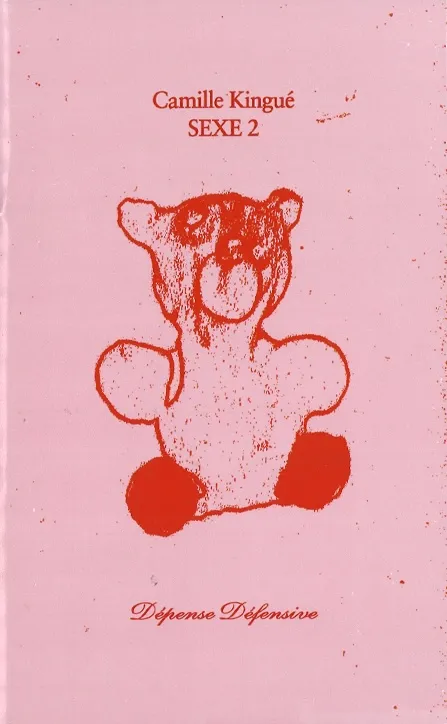
Sexe 2
Confession sur le désir (l’action et l’objet du), les liens de mutualité et de résistance, Sexe 2 alterne prose et versification en 27 fragments numérotés à l’adresse plus ou moins dure, plus ou moins sincère, plus ou moins formulée car plus ou moins éloignée du Toi et du Je. Camille Kingué s’attache à révéler, à voir quelque chose à travers son image réelle et virtuelle, agrandie et rétrécie, droite et renversée, déployant une recherche des principes de l’amour (l’amour comme amour, pourquoi est ce qu’il y a de l’amour) où la métaphysique et la compréhension de soi – donc de l’autre – n’ont jamais été aussi sexy.
Claire Star Finch, dans la magnifique préface qu’iel signe au début de l’ouvrage, écrit : « Après avoir lu tous les livres de Kingué, je ne sais pas si je crois en “l’amour”, que ce soit en tant que substantif absolu ou en tant que proto-résidu de tout ce que “le sexe” peut signifier. Mais je crois définitivement qu’il faut l’écrire. » Définitivement.

Could It Be Love
Greer Lankton’s iconic and startling doll sculptures as we have never seen them before: through her own eyes.
Magic Hour Press is proud to present the first monograph on the trans visionary artist Greer Lankton (1958–96), whose lifelike doll sculptures shocked 1980s New York. Lankton’s dolls, which she began making as a child and produced obsessively until her death at age 38, were a means to explore her fraught relationship with the human body. In the book’s 100 photographs, all shot by Lankton herself, these figures take on a life of their own, kvetching at a party, strolling along a beach, or lounging on a stoop in the East Village. Among this extraordinary cast of oddballs—usually femme, often freakish, always radiating a glamorous confidence—we find characters of Lankton’s own invention alongside well-known icons such as Divine, Coco Chanel, Andy Warhol and even Lankton herself.
Born in 1958 to a Presbyterian minister in Michigan, Greer Lankton moved to New York in 1978 and became a rising star of the downtown scene. There, her deviant elegance was immortalized in photographs by Peter Hujar, David Armstrong, and Lankton’s close friend Nan Goldin, who described her as “one of the luminaries of the East Village renaissance: beautiful, glamorous, wild and hysterically funny.”
Edited by Francis Schichtel, Jordan Weitzman and Nan Goldin
Text by Hilton Als

Intifadas
A subversive collection about Palestinian resistance, liberation and art.
Written across Palestine and its diaspora—from Gaza and the West Bank to the United States—Intifadas is a subtly transgressive poetry collection about uprising in its many forms—in art, politics, and in our most personal relationships. Whether by dumping black paint on a park where a tank and fighter jet commemorate a war, or by trying to rescue a moth trapped in a garage, the defiant and resilient voices in this collection subvert traditional narratives of loss. Furious, tender, and darkly funny, Intifadas asks what art can do in the face of catastrophe, and answers with poems that refuse easy consolations.

SAPPHO TERROR
Maura Modeya’s SAPPHO TERROR is a book haunted—by empire, by sleeplessness, by Sappho herself. In it, queerness becomes both the agent of terror and its object. “I want to be consumed. I want to disappear twice.” Extending the experiments of Mayer, Lonidier, and Stein, Modeya’s poems are as much about desire as they are about violence. They let us in on a secret: “Logic sometimes is so disgusting.” At once delirious and hyperalert, performance and document of a performance, SAPPHO TERROR disrupts the routines of everyday life from within. “Tending to the eros of writing something down.”
A fist is something that blooms inside a lover, a hand held up in revolutionary camaraderie, and the weapon of bare-knuckle combat. In Maura Modeya’s SAPPHO TERROR, the poet probes, in a language that possesses an addictive deliquescence, the body as policy and the devotional as daily, where intimacy is all at once risked, tenderized, and disciplined. We begin in a space of betweenness—between street and bed, between conquest and abandon—and are then submerged into tidal pools of sleeplessness where the poet is overtaken, exquisitely, by forces beyond themselves. Sculpted into vigilant word-reliquaries, these poems exalt the femi-themme of the night while holding fast to danger. Inside this edge-space lives the chasm—the danger that lives in the distance from one edge to another—where sex, politics, and liminal states of consciousness collide, exposing how power is enforced, negotiated, and sometimes utterly undone through the body. —Valerie Hsiung
In SAPPHO TERROR Maura Modeya drifts with eros between the “war intestine,” and a restless dreamscape where desire demands disorientation and the rapture of invasion teeters in tension between queer love and the horrors of militaristic and domestic terrorism. Modeya offers us a vulnerable and familiar sorrow: “Why when I want to speak of love, violence surfaces?” In communion with Sappho’s fragments—those invocations of desire intensified by their historical devastation—Modeya’s poems project that eros is to want is to risk.
Leaning into the “deathless language” of queer love, Modeya allows herself to be haunted by the unreasonable logic of eros and finds herself caught between an insomnia that threatens the poet’s coherence of self, and a sleep that risks waking to the repulsive logics adorning our daily violences.In striking and visceral exhaustion, this book performs the desire of possession—by a lover, by language, by loss. SAPPHO TERROR brings us into the poet’s rapture, one that is profoundly balanced between the paradoxical and perilous forces of eros. —Serena Chopra
What arises out of sleeplessness? In SAPPHO TERROR, all boundaries fall away into ritual. There is a permeability, an eros, a freedom from all structures and institutions, even from our own self. Our human guardrails fall away to a place where we forget the boots on our necks, that our money buys weapons for the state, or even that we are separate unique beings. Is it wrong to forget, or is it a healing? Perhaps both. Modeya says that in sleeplessness, “to submit means to surrender into what is wanted so badly.” In the face of terror, our letting go is a kind of purity. It tells us we can travel beyond repression, not to escape, but to reach the most natural state of our being, even before survival. It is a reminder of life. —Samuel Ace
Maura Modeya’s SAPPHO TERROR takes back Plato’s Cave for the dykes. In these poems eros’ shadows reign sovereign: language is chained and casts haptic forms onto Modeya’s bedroom wall lit by Sappho’s famous fires. These poems join her chorus of “You Burn Me” with the desperate velocity only the insomniac knows. Modeya’s verse is exquisite and relentless, creaking out of the dead of night, bargaining for the possibility of touch. An assembly of aching towardness, SAPPHO TERROR is part elegy, part manifesto, part love letter that sabotages the war intestines we live in order to undivide us from our desire. —Rosie Stockton

Recto verso – An Anthology of Works and Writings by Asier Mendizabal
A comprehensive retrospective of the Spanish artist's work, covering his major exhibitions (Manifesta, Reina Sofia, MACBA, Raven Row, etc.) and including all of his texts published as fanzines over a period of twenty years, a new critical essay by Kim West, and a wide-ranging conversation.
Conceived as a compilation of works and writings of the last two decades, this book is structured as an alternating succession of four different registers: four recurrent modes. A long-form interview, a series of questions from different collaborators, documentation of a selection of projects, and a compilation of the facsimilia of the brochures published by the author since 2008. The aim of this concatenation of recurring sections is to delay the linear progression suggested by the narrative of a compilation, by the apparent causal string of decisions, ideas, references and works displayed as an accumulative "biography" of the artist's practice. However, this being a bound book, the suggestion of an interwoven relation between all the works, regardless of when, where or how they were made, must submit to the order locked by the sewn spine of its signatures, the folder of bound pages that forms each section of a book.
Designed by Filiep Tacq, the book includes an essay by Kim West and a long-form interview by Beatriz Herráez, punctuated by questions from Filiep Tacq, Lisa Tan, Jon Mikel Euba, Antonio Menchen, Alex Valijani, Johanna Gustafsson Fürst, Itziar Okariz, Olatz Otalora, Antonia Majaca, Pablo Lafuente and Koenraad Dedobbeleer.