Books
Books
Paperback

Schismatics
Schismatics consists of 10 short stories, in a fictitious way dealing with forgotten historical personas. Among them, artist Goda Palekaitė includes Mary Anning –– an amateur discoverer of dinosaurs, Emanuel Swedenborg –– a mystic who empirically explored the architecture of heaven, and Essad Bey –– a Jewish-Muslim writer and orientalist. Here their lives are revived and balance between the lines of history and story.
The book fuses elements of fiction, academic writing, and artistic research, and intertwines with rumors, forgeries, and inventions. Previously, its characters and narratives have already appeared in Palekaitė’s performances and installations, which are presented in the middle of this bilingual edition. In the introductory essay, Valerio Del Baglivo analyses the author’s exploration of facts and fiction, the mechanisms of knowledge production, and the trans-chronological perception of time. At the end of the book, Monika Lipšic ‘Riddle’ reflects on a ‘schismatic poetics’.
Goda Palekaitė is a contemporary artist and researcher whose work combines visual, literary, performative, and anthropological practices. Exploring the politics of historical narratives, the agency of dreams and collective imagination, and social conditions of creativity, her work evolves around long-term projects that manifest as performances, scenographies, installations, and texts. Her performances, solo and group shows are being presented internationally. In 2019 Goda Palekaitė received The Golden Stage Cross and the Young Artist’s Prize for her artistic contributions across disciplines.
Published September 2020

DUB
Dub: Finding Ceremony takes inspiration from theorist Sylvia Wynter, dub poetry, and ocean life to offer a catalog of possible methods for remembering, healing, listening, and living otherwise.
"In DUB Alexis Pauline Gumbs continues with the third book in her poetry series, the first two books being Spill, inspired by Hortense Spillers, and M Archive, inspired by Jacqui Alexander. Whereas Spill deals with the contemporary afterlives of slavery and M Archive describes the post-dated evidence of our imminent apocalypse, DUB destroys Gumbs' own origin story, as she questions the assumptions and histories she has held onto most of her life. This text, through engagement with Sylvia Wynter's rigor, reinvents language outside of personal histories.
DUB is organized into topical sections, where spacious prose poems animate the voice of an underwater chorus in ceremonies that flow into one another. Beginning a daily writing practice, Gumbs wrote DUB based on moments of emphasis in Sylvia Wynter's essays (and one interview over several decades).
This book is influenced by the promiscuity and prolificity of dub music, the confrontational home-grown intimacy of dub poetry, and the descendants of this work. Dub uses the impact of repetition and the incantatory power of the spoken broken word. Gumbs uses dub to emphasize that Sylvia Wynter learned every colonial language and came to the conclusion that the ways of thinking that made colonialism and slavery imaginable were constructed over time and heretical to the ways of thinking that came before them; and so it must be possible to construct ways to understand life and place differently now as well.
Gumbs goes back to the origin stories that precede her and turns the blood into paint, emphasizing that "then" is also "now" through the broken and intense voices of ancestors. Inspired by Wynter's heretical poetic action against our deepest beliefs, DUB is an artifact and tool for breath retraining and interspecies ancestral listening.
Throughout the text, listening includes speakers who have never been considered human: whales and algae. Gumbs is attentive to kindred beyond taxonomy, questioning kinship loyalty, and suggests that our perceived survival needs are responses to a story we made up and told ourselves was written by our genes, a story that can be changed. This book will be of interest to scholars of African-American studies, diaspora studies, feminism, queer theory, English, creative writing and poetry"

Women in Concrete Poetry: 1959-1979
Mónica de la Torre, Alex Balgiu
An expansive anthology focused on concrete poetry written by women in the groundbreaking movement’s early history. It features 50 writers and artists from Europe, Japan, Latin America, and the United States selected by editors Alex Balgiu and Mónica de la Torre.
Women in Concrete Poetry: 1959-1979 takes as its point of departure Materializzazione del linguaggio—the groundbreaking exhibition of visual and concrete poetry by women curated by Italian feminist artist Mirella Bentivoglio for the Venice Biennale in 1978. Through this exhibition and others she curated, Bentivoglio traced constellations of women artists working at the intersection of the verbal and visual who sought to “reactivate the atrophied tools of communication” and liberate words from the conventions of genre, gender, and the strictures of the patriarchy and normative syntax.
The works in this volume evolved from previous manifestations of concrete poetry as defined in foundational manifestos by Öyvind Fahlström, Eugen Gomringer, and the Brazilian Noigandres Group. While some works are easily recognized as concrete poetry, as documented in canonical anthologies edited by Mary Ellen Solt and Emmett Williams in the late ’60s, it also features expansive, serial works that are overtly feminist and often trouble legibility. Women in Concrete Poetry: 1959-1979 revisits the figures in Bentivoglio’s orbit and includes works by women practicing in other milieus in the United States, Eastern Europe, and South America who were similarly concerned with activating the visual and sonic properties of language and experimenting with poetry’s spatial syntax.
Artists and writers include Lenora de Barros, Ana Bella Geiger, and Mira Schendel from Brazil; Mirella Bentivoglio, Tomaso Binga, Liliana Landi, Anna Oberto, and Giovanna Sandri from Italy; Amanda Berenguer from Uruguay; Suzanne Bernard and Ilse Garnier from France; Blanca Calparsoro from Spain; Paula Claire and Jennifer Pike from the UK; Betty Danon from Turkey; Mirtha Dermisache from Argentina; Bohumila Grögerová from the Czech Republic; Ana Hatherly and Salette Tavares from Portugal; Madeline Gins, Mary Ellen Solt, Susan Howe, Liliane Lijn, and Rosmarie Waldrop from the US; Irma Blank and Ruth Wolf-Rehfeldt from Germany; Chima Sunada from Japan; and Katalin Ladik and Bogdanka Poznanović from the former Yugoslavia.

Homophone Dictionary
Homophone Dictionary was originally a file that is compiled by the now 96-year-old former schoolteacher Susan Nixon. She has build up many collections throughout her life, almost all of them exist out of objects, except one: after her retirement she compiled a word document that by now exist out of almost 1000 homophones; two, or more words that you pronounce similar but have a different meaning, often the spelling is also different.
The document is structured as a dictionary and the homophones are illustrated with examples that are based on autobiographical information. The structure of Homophone Dictionary also refers to speech therapy exercises and concrete poetry.
“As a student nurse learning medical terminology, I became fascinated with understanding the roots of words. When I had a young family, words were a principal source of entertainment: it was not unusual for one of the children to slip from their chair at the dinner table and fetch a dictionary in order to settle a dispute or satisfy someone’s curiosity. Then I became a teacher and brought this love of words into the classroom. My habit of word collecting became the children’s habit – my pupils became ‘word-lovers’ and ‘list-makers.’
I casually collected homophones for years. When introducing homophones into the classroom, the kids found definitions dull; the typical reaction was, ‘Yes, but give me a sentence using the word!’ and this idea emerged: a book of sentences demonstrating the meanings of homophone pairs or sets.”
Offset print
20,4 × 12,4 cm
edition of 500

one long continuous line or a thought that dissolves into the distance
A short text or a long line written by Mette Edvardsen for Etcetera magazine (June 2018) on an invitation to elaborate on her approach to text, writing and speech from a choreographic point of view. Held by a cardboard cover, the text is here published on its own as a very slim book.

Moments Before The Wind
Moments Before the Wind is a heterogeneous collection of notes on scenography that offers a glimpse into the poetics and artistic practice of Jozef Wouters. These reflections on space, scenography, art making and institutional critique have developed over the years as they were written out loud in various contexts. Now settling on the page among built and unbuilt spaces, they’re an invitation to the reader to think along or against, and think up space for oneself. Edited by Jeroen Peeters; graphic design by Filiep Tacq.
Jozef Wouters is a scenographer and theatre maker based in Brussels, who develops work in collaboration with his Decoratelier. Decoratelier is also a workplace for set designers and artists, and provides room for cross-disciplinary ventures and social experiment.

Foundlings
Foundlings, a video film, was shot near Wexford, in the south east of Ireland where she grew up. This visual poem without a particular narrative and full of autobiographical elements is set at a very slowed down pace. Floating images and heavy voices are central to the associative strategy that is at work here. The images allow one to listen to a hypnotic voice, while at the same time allowing the eyes to wander... to daydream... to travel over drawn out time. The images are country images, images of repetitive calm, the kind of calm one finds between awake and asleep. The speed of the sea sets the pace, regular yet irregular. The images are inhabited by people who cannot speak. Who are busy doing nothing, except passing time. Silent brothers and sisters of the sea.
The soundsculpture Unsaid, a joint work by Orla Barry and Portuguese artist Rui Chafes (1964), is very opposite to the film. The film is full of open spaces and bright colours. The sculpture is black, closed and claustrophobic and on top of that it is housed in a narrow tower five meters tall. The visitor has to take place on a rather unconventional chair and put his head in a closed off sphere, surrounding himself by darkness and leaving him with his own heartbeat. A voice addresses the visitor directly on highly intimate terms. The seating is hard and uncomfortable. One has to be strong to experience this piece that is a perpetual struggle between body and mind.
At the occassion of Barry’s show argos editions published Foundlings, a combined artist book and catalogue that can be ordered through argos. The book includes a DVD.
Orla Barry (1969) is an artist who centres her practice on language, written and spoken. Her work is strongly poetic and lyrical, crossing a wide variety of media. Barry was born in Ireland, and the rhythm of her phraseology, the pictorial and narrative vernacular on which she draws, somehow evokes her homeland’s topography, climate and literary heritage. At argos the artist presented two new works.

Le Chauffage — Issue #1
Le Chauffage (french for “The Heater”) is an artist-run publication based in Brussels. It is conceived as a cross-continental, community oriented platform. Bringing together the work and writing of artists / friends from different cities, Le Chauffage intends to spark discussions and fuel casual forms of critical discourse.

Els Dietvorst E.D. (2010–2014)
This publication presents a survey of the work of Els Dietvorst from 2010 to 2014. This is also the period in which she left Brussels to live in a village on the south-east coast of Ireland, where she focused on projects such as The Black Lamb. The audio piece One was killed for beauty, another one was shot, the two others died naturally is included on an audio CD.
Els Dietvorst E.D. (2010–2014), Rolf Quaghebeur, Eva Wittocx, Katleen Weyts, Els Dietvorst, Brussels, 2014.

Actors and Extras
Thomas Trummer, Paul Willemsen
The publication Actors & Extras appears following the exhibition of the same name at Argos. Five authors highlight the theme of characterisation from various angles. Georges Didi-Huberman’s contribution People exposed, People as Extras explores how cinema represents the masses. Sven Lütticken highlights the performance tradition in the visual arts in relation to the producing of subjectivity. On the basis of the classic cinema, in Figures of the Extra, Paul Willemsen composes a typology of the extra and subsequently gives attention to the aberrant status of the extra in modern cinema and contemporary art.
Thomas Trummer’s Volonté Générale. Extras in Film and Democracy questions the responsibility of the anonymous individual. With The Passing Actor: Sketch of a Renaissance Jean-Louis Comolli analyses how the concept of acting in a documentary has a different interpretation than in a fiction film. The last part of the publication describes the selected works in the exhibition.
Texts by: Clemens von Wedemeyer, João Onofre, Mark Lewis, Mike Figgis, Jeremy Deller, Irina Botea, Christian Jankowski, Aernout Mik, Krassimir Terziev, Julika Rudelius

If UR Reading This It's 2 Late
The first monograph on the work of artist Tony Cokes, creating a visual cartography of a body of moving image work that spans twenty years.
Tony Cokes's video works are eviscerating critiques and affective art works, bringing together color theory, sound, music, and texts, and quoting a polyphony of voices including Aretha Franklin, Mark Fisher, David Bowie, Public Enemy, and Donald Trump. Combining political and social commentary with cultural theory and a critique of capitalism, Cokes's works viscerally confront the social condition, particularly the prejudices and threats suffered by black subjects. This book is the first monograph on his practice, creating a visual cartography of a body of work that spans twenty years.
It features four critical pathways into Cokes's decades-long practice, with essays contributed by notable academics, and conversations between Cokes and artist Kerry Tribe. Cokes's work deals with mediation and distribution, and the book itself becomes another conduit for the dissemination of theory, critique, and counter-narrative—a process that Cokes so powerfully engages in as an artist.
This book accompanies Cokes's solo exhibition, If UR Reading This It's 2 Late: Vol. 1–3, across three international art institutions: Goldsmiths Centre for Contemporary Art, London; Carpenter Center for the Visual Arts, Harvard University; and ARGOS centre for audiovisual arts, Brussels.

exit ambition
Exit Ambition is a catalogue of practices, documents, videos, and other projects - virtual & actual. The book operates as an incomplete index of a series of installations, instructions, anti-plays, performance scores, descriptions, etc.
Jake Reber lives and works in Buffalo, NY, where he co-curates hystericallyreal.com.

Salvage 8: Comrades, this is madness
The Salvage Editorial Collective on the Covid-19 crisis.
Including: ‘Mothering Against the World' by Sophie Lewis on ‘Momrades’, ‘The Bushes’ a new fiction by China Miéville, ‘Hookers and Other Angels’ photography from Juno Mac, ‘Prepared for the Worst’ by Richard Seymour on Disaster Nationalism, ‘Welfare State Populism and the “Left-Behind Left”’ by Kevin Ochieng Okoth, ‘A Glimmer of a Shell of a Husk’ by Maya Osborne; ‘The Phallic Road to Socialism’ by Sebastian Budgen; A newly translated interview with Daniel Guérin, ‘Nationalism After Coronavirus’ by Sivamohan Valluvan, ‘Striking in Striking Times: Capitalism’s Coronavirus Crisis’ by Gregor Gall, ‘Getting Dressed for a Pandemic’ by Camila Valle, ‘Out of the Iron Lung: A Miasma Theory of Coronavirus’ by Matthew Broomfield.
Poetry by Nisha Ramayya, this issue’s featured poet, and an interview with her conducted by Salvage poetry editor, Caitlín Doherty. Plus the return of the Salvage Editorial Collective perspectives pamphlet, and a postcard.
Salvage is a bi-annual journal of revolutionary arts and letters. Salvage is written by and for the desolated Left, by and for those sick of capitalism and its planetary death-drive, implacably opposed to the fascist reflux and all ‘national’ solutions to our crisis, committed to radical change, guarded against the encroachments of ‘woke’ capitalism and its sadistic dramaphagy, and impatient with the Left’s bad faith and bullshit.

F.R. David - Very Good
F.R.DAVID is a typographical journal, dealing with the organisation of reading and writing in contemporary art practises. The 19th issue, “very good*” is edited with Paul Abbott. Like music, the issue’s “theme” is better off unaccounted for, and up in the air, like a flock of birds (creatures who feature heavily), circling around performance, listening bodies, given time, and loving relations.
The nineteenth issue of ‘F.R.DAVID’ is edited by Will Holder and Paula Abbott, and will serve as a reader for “We can still see the horizon (and it’s curved)”, a summer residency in Scotland led by the editors. It includes a surprising array of contributions from writer Jorge Luis Borges, journalist and writer Italo Calvino, composer Hugo Cole, literary critic and theorist Barbara Herrnstein Smith, percussionist Milford Graves, philosopher Michel Serres, novelist and essayist Wilson Harris, poet Bernadette Mayer, composer and music theorist Harry Partch, pianist and poet Cecil Taylor, and several others.

We Both Laughed in Pleasure
Drawn from Lou Sullivan’s meticulously kept journals, this landmark book records the life of arguably the first publicly gay trans man to medically transition.
We Both Laughed In Pleasure: The Selected Diaries of Lou Sullivan narrates the inner life of a gay trans man moving through the shifting social, political, and medical mores of the second half of the 20th century. Sullivan kept comprehensive journals from age eleven until his AIDS-related death at thirty-nine. Sensual, lascivious, challenging, quotidian and poetic, the diaries complicate and disrupt normative trans narratives. Entries from twenty-four diaries reveal Sullivan’s self-articulation and the complexity of a fascinating and courageous figure.
Edited by: Ellis Martin and Zach Ozma
Introduction by: Susan Stryker

Wretched Strangers
In response to surges of violent British nationalism and political paranoia around borders, and to related social and ethical crises, JT Welsch and Ágnes Lehóczky have assembled an anthology to mark the vital contribution of non-UK-born writers to this country’s poetry culture. Wretched Strangers brings together innovative writing from around the globe, celebrating the irreducible diversity such work brings to ‘British’ poetry. While documenting the challenges faced by writers from elsewhere, these pieces offer hopeful re-conceptions of ‘shared foreignness’ as Lila Matsumoto describes it, and the ‘peculiar state of exiled human,’ in Fawzi Karim’s words.
The book is published by Boiler House Press to commemorate the anniversary of the June 2016 EU Referendum and in solidarity through struggles ongoing and to come. Proceeds will be donated to charities fighting for the rights of refugees.
Alireza Abiz • Astrid Alben • Tim Atkins • Andre Bagoo • Veronica Barnsley • Khairani Barokka • Leire Barrera-Medrano • Katherine E. Bash • Áine Belton • Caroline Bergvall • Sujata Bhatt • Rachel Blau DuPlessis • Fióna Bolger • Ben Borek • Andrea Brady • Serena Braida • Wilson Bueno • James Byrne • Kimberly Campanello • J.R. Carpenter • Mary Jean Chan • che • Matthew Cheeseman • Iris Colomb • Giovanna Coppola • Anne Laure Coxam • Sara Crangle • Emily Critchley • Ailbhe Darcy • Nia Davies • Tim Dooley • Benjamin Dorey • Angelina D’Roza • Katherine Ebury • Dan Eltringham • Ruth Fainlight • Kit Fan • León Felipe • Alicia Fernández • Veronica Fibisan • Steven J Fowler • Livia Franchini • Ulli Freer • Anastasia Freygang • Kit Fryatt • Monika Genova • Geoff Gilbert • Peter Gizzi • Chris Gutkind • Cory Hanafin • Edmund Hardy • David Herd • Jeff Hilson • Áilbhe Hines • Alex Houen • Anthony Howell • Nasser Hussain • Zainab Ismail • Maria Jastrzębska • Lisa Jeschke • Evan Jones • Loma Sylvana Jones • Maria Kardel • Fawzi Karim • Kapka Kassabova • Özgecan Kesici • Mimi Khalvati • Robert Kiely • Michael Kindellan • Igor Klikovac • Ágnes Lehóczky • Éireann Lorsung • Patrick Loughnane • John McAuliffe • Aodán McCardle • Niall McDevitt • Luke McMullan • Christodoulos Makris • Ethel Maqeda • Lila Matsumoto • Luna Montenegro • Stephen Mooney • Ghazal Mosadeq • Erín Moure • Vivek Narayanan • Cristina Navazo-Eguía Newton • Alice Notley • Terry O’Connor • Wanda O’Connor • Gizem Okulu • Claire Orchard • Daniele Pantano • Astra Papachristodoulou • Fani Papageorgiou • Richard Parker • Sandeep Parmar • Albert Pellicer • Pascale Petit • Adam Piette • Jèssica Pujol Duran • Alonso Quesada • Ariadne Radi Cor • Nat Raha • Nisha Ramayya • Peter Robinson • William Rowe • Lisa Samuels • Jaya Savige • Ana Seferovic • Sophie Seita • Seni Seneviratne • Timea Sipos • Zoë Skoulding • Irene Solà • Samuel Solomon • Agnieszka Studzinska • James Sutherland-Smith • George Szirtes • Rebecca Tamás • Harriet Tarlo • Shirin Teifouri • Virna Teixeira • David Toms • Sara Torres • Kinga Toth • Claire Trévien • David Troupes • Arto Vaun • Juha Virtanen • J. T. Welsch • David Wheatley • Elżbieta Wójcik-Leese • Jennifer Wong • Isaac Xubín • Jane Yeh

a queer anthology of wilderness
Featuring Zoe Leonard, Eileen Myles, Jimmy DeSana, Princess Julia, Olivia Laing, Simon Costin, Timothy Thornton, Mary Manning and many more. Published 2020.

The Orphans of Tar – A Speculative Opera
Julien de Smet, Vanessa Müller and 1 more
Contributions by: Julien de Smet, Ronny Heiremans, Heike Langsdorf, Vanessa Müller, Filip Van Dingenen, Stijn Van Dorpe, Clémentine Vaultier, Katleen Vermeir.
The books included in the series Choreography as Conditioning are rooted in a cycle of work sessions entitled CASC at KASK, in which students work together with invited guests. They explore the notions of choreography, understood as ways of organizing subjects in their surroundings, and conditioning in both art-making and society-making. Where, how, and by whom are things organized and what kind of landscapes of experience are made (im)possible by the practices we enact and encounter?
The Orphans of Tar – A Speculative Opera answers the question posed in the second book by transforming life into voices and presenting possible mindsets through co-authoring a factual fiction. As such, it constitutes a mental space in which fictitious characters find an almost disturbing expansion of their thoughts. Accordingly, the book can be considered as an allegory of human thoughts as (possible) actions: what could happen becomes what does happen. For better and worse.
October 2019

Piles of Bricks / Piles de briques
‘Piles of Bricks / Piles de briques’ by Bie Michels presents the working proces of her project ‘Bricks in Madagascar’. This project consists of two films, ‘La couleur de la brique’ and ‘Ingahy Kama’, the installation ‘Circular construction versus human body—referring to Toshikatsu Endo’, which she showed in Madagascar (October 2017) and Argos Brussels (May 2018), and the performance ‘Piles of bricks (working process)’, on which she will work 8 weeks before the book presentation and which will be performed at that moment.
Besides images and stills, five writers deliver a contribution in their own working field related to the project: Hobisoa Raininoro (Art assistent and former director of CRAAM (Centre de Ressources des Arts Actuels de Madagascar, MG), Rafolo Andrianaivoarivony (Professor History University of Antanarivo, MG), Petra Van Brabandt (Doctor philosophy Sint Lucas Antwerp, B), Gwyn Campbell (Professor History Mc Gill University, CA) and Nanne op ‘t Ende (writer, NL)
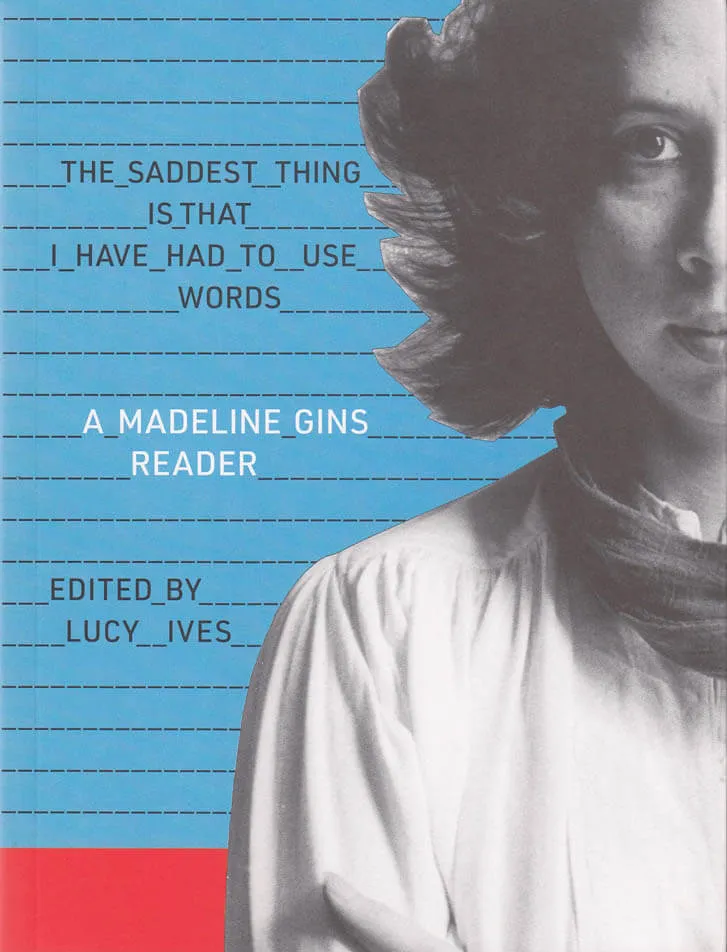
The Saddest Thing Is That I Have Had to Use Words: A Madeline Gins Reader
Poet, philosopher, speculative architect and transdisciplinary artist, Madeline Gins is well known for her collaborations with her husband, the artist Arakawa, on the experimental architectural project Reversible Destiny, in which they sought to arrest mortality by transforming the built environment. Yet, her own writings — in the form of poetry, essays, experimental prose and philosophical inquiries — represent her most visionary and transformative work. Like Gertrude Stein before her, Gins transfigures grammar and liberates words. Like her contemporaries in conceptual art, her writing is attuned to the energized, collaborative space between reader and page.
The Saddest Thing Is That I Have Had to Use Words: A Madeline Gins Reader is a revelatory anthology, edited and with an introduction by the writer and critic Lucy Ives. It brings never-before-published poems and essays together with a complete facsimile reproduction of Gins' 1969 masterpiece, WORD RAIN (or A Discursive Introduction to the Intimate Philosophical Investigations of G, R, E, T, A, G, A, R, B, O, It Says), along with substantial excerpts from her two later books What the President Will Say and Do!! (1984) and Helen Keller or Arakawa (1994). Long out of print or unpublished, Gins' poems and prose form a powerful corpus of experimental literature, one which is sure to upend existing narratives of American poetics at the close of the 20th century.
Edited by Lucy Ives.
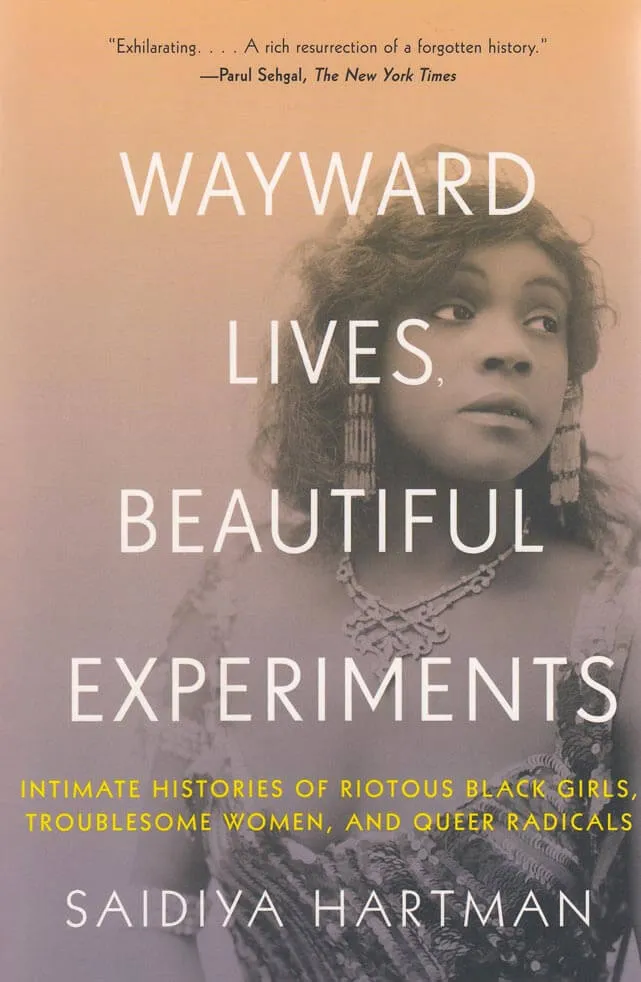
Wayward Lives, Beautiful Experiments
Wayward Lives, Beautiful Experiments examines the revolution of black intimate life that unfolded in Philadelphia and New York at the beginning of the twentieth century. In wrestling with the question of what a free life is, many young black women created forms of intimacy and kinship indifferent to the dictates of respectability and outside the bounds of law. They cleaved to and cast off lovers, exchanged sex to subsist, and revised the meaning of marriage. Longing and desire fueled their experiments in how to live. They refused to labor like slaves or to accept degrading conditions of work. Here, for the first time, these women are credited with shaping a cultural movement that transformed the urban landscape. Through a melding of history and literary imagination, Wayward Lives, Beautiful Experiments recovers these women's radical aspirations and insurgent desires.
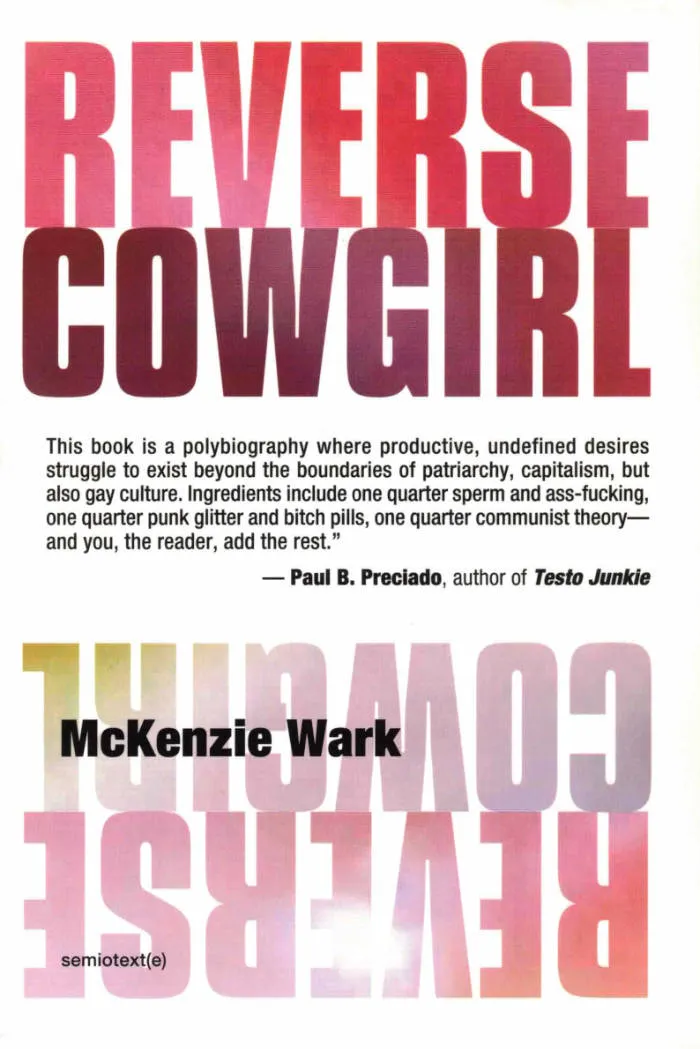
Reverse Cowgirl
McKenzie Wark invents a new genre for another gender: not a memoir but an auto-ethnography of the opacity of the self.
Another genre for another gender.
What if you were trans and didn't know it? What if there were some hole in your life and you didn't even know it was there? What if you went through life not knowing why you only felt at home in your body at peak moments of drugs and sex? What if you expended your days avoiding an absence, a hole in being? Reverse Cowgirl is not exactly a memoir. The author doesn't, in the end, have any answers as to who she really is or was, although maybe she figures out what she could become.
Traveling from Sydney in the 1980s to New York today, Reverse Cowgirl is a comedy of errors, chronicling the author's failed attempts at being gay and at being straight across the shifting political and media landscapes of the late twentieth century. Finding that the established narratives of being transgender don't seem to apply to her, Wark borrows from the genres of autofiction, fictocriticism, and new narrative to create a writing practice that can discover the form of a life outside existing accounts of trans experience: an auto-ethnography of the opacity of the self.

Matters of Feminist Practice
Matters of Feminist Practice, edited by Poupeh Missaghi and Karla Kelsey, brings together scholars, writers, poets, and artists of different identities and backgrounds to confer on the urgent topic of “feminist practice” through seven topics: the body, the quotidian, hybridity, language, documentation, environment, and conflict.
In the twenty-five scholarly and creative-critical pieces included in our introductory volume, each contributor brings unique visions, insights, approaches, voices, and forms to launch the conversation, which will continue to unfold online at mfpjournal.com.
Contributors to the inaugural issue include: Alexis Almeida, Mary-Kim Arnold, Mildred Barya, Teresa Carmody, Julie Carr, Serena Chopra, Caroline Crumpacker, Lynne DeSilva-Johnson, Marcella Durand, Jennifer Firestone, Yanara Friedland, Carla Harryman, Madhu Kaza, Petra Kuppers, Jean Lee, Rachel Levitsky, Megan Madden, Saretta Morgan, Lida Nosrati, Adrienne Perry, Frances Richard, Kat Savino, Celina Su, and Rachael Guynn Wilson.