Books
Books
Paperback

BRICKS FROM THE KILN #7
Matthew Stuart, Harriet Moore and 1 more
Guest edited by artist Helen Marten and literary agent Harriet Moore with Matthew Stuart, this volume of the journal considers what it means for a publication to be an allegorical container. A simple box in which to gather multiple things, an economical set of permutations — rational in one sense, yet defiantly flexible to move. Contributors were approached with an open invitation; some explored the multiplicities of containing or containers, while others filled the printed vessel with their own ongoing preoccupations. The following pages perform as envelope, bag, shell, net, fold, alarm, letter and instruction. There are holes to disappear within; smoke to knot and wind; shadows to unfold — a context that takes in and binds, finding new kinships from unforeseen proximities.
THE FIRE FLOWERS AND THE FLOWER LIGHTS UP –
Lucy Mercer
(spine)
WE SHALL GREET THE MOON AGAIN
Walter Price
(front cover)
BACK PAGES OF ALGIERS DIARIES 2018
Lydia Ourahmane
(inside front & inside back cover)
AN INTRODUCTION TO / NOTES ON / INSTRUCTION FOR THE FRONT NOVEL
Eliza Barry Callahan
(pp.1–16)
SATURDAY MORNING
Kathryn Scanlan
(pp.25–29)
KILLDEER
Jason Schwartz
(pp.33–38)
ALARMS AND EXCURSIONS
Rosmarie Waldrop
(pp.45–61)
"THE BATHROOM"
Najwa Barakat
(pp.67–76)
ARMY ROLLS, A CIRCUMSCRIPTION
Roy Claire Potter
(pp.81–91)
CONCHOMANIA
Felix Bernstein
(pp.95–109)
O-POEM
Line-Gry Hørup
(pp.113–129)
THIS MUSCLE
Cally Spooner
(pp.133–153)
STERLING PARK IN THE DARK
Susan Howe
(pp.159–179)
COCONUTTERY
Mathelinda Nabugodi
(pp.183–193)
YOUR SELF CONFIDENT BABY
Aurelia Guo
(pp.197–206)
BIOGRAPHY OF A NET: HOLDING A VOLUME
Daisy Hildyard
(pp.211–225)
A GUIDE TO THE POETRY OF LI HO
Eliot Weinberger
(pp.229–235)
WOMEN SMOKING
Charline von Heyl
(throughout & p.239)
INFRATHIN
Marcel Duchamp
(throughout & p.239)
THE MAZED WORLD
Rachael Allen
(bookmark insert)
UNTITLED
Helen Marten
(back cover)

Hemisferio Cuir: an anthology of young Queer Latin American Poetry.
Edited and selected by the brilliant Leo Boix and with poems in Spanish and English from across Latin America. There’s more than 30 poets featured, covering poems about what it is to be queer in contemporary Latin America. These poems cover gender, sexuality, politics, nature, and everything in between.

Book of Mutter
Book of Mutter is a tender and disquieting meditation on the ability of writing, photography, and memory to embrace shadows while in the throes — and dead calm — of grief. It is both primal and sculpted, shaped by the author’s searching, indexical impulse to inventory family apocrypha in the wake of a mother’s death. The text spirals out into a fractured anatomy of melancholy that includes critical reflections on the likes of Roland Barthes, Louise Bourgeois, Henry Darger, Theresa Hak Kyung Cha, Peter Handke, and others. Zambreno has modelled the book’s formless form on Bourgeois’s Cells sculptures – at once channelling the volatility of autobiography, pain, and childhood, yet hemmed by a solemn sense of entering ritualistic or sacred space.
Neither memoir, essay, nor poetry, Book of Mutter is an uncategorisable text that draws upon a repertoire of genres to write into and against silence. It is a haunted text, an accumulative archive of myth and memory that seeks its own undoing, driven by crossed desires to resurrect and exorcise the past.

Appendix Project
Written in the course of the year following the publication of Book of Mutter, and inspired by the lectures of Roland Barthes, Anne Carson, and Jorge Luis Borges, Appendix Project collects eleven talks and essays. These surprising and moving performances, underscored by the sleeplessness of the first year of their child’s life, contain their dazzling thinking through the work of On Kawara, Roland Barthes, W.G. Sebald, Bhanu Kapil, Walter Benjamin, Theresa Hak Kyung Cha, Marguerite Duras, Marlene Dumas, Louise Bourgeois, Doris Salcedo, Jenny Holzer, and more.

Slant Nr. 1
Slant is a mail art project and a publishing house. It invites artists, designers, writers and poets to express themselves through a common theme every two weeks. it has poetry as its beacon of reflection, keeping in mind that sometimes we must tell the truth slant in order to see our reality depicted.
First edition, approx. 240pp. 4-colors riso printed.
20 x 25,5cm, 200 copies. Coptic hand-made binding.
Softcover printed wraps. French and English texts.

Prepositions
Prepositions enacts a distinction between what language says and what it does. A catalogue of exercises, interviews, essays and creative explorations, this workbook-compendium invites the reader to investigate how we practise empathy, understanding, and contact, by learning and teaching all at once. Building on the archive of Montez Press Radio show Tongue and Cheek, and featuring work from a stellar cast of previous participants in the broader project, Prepositions asks us what active and embodied participation really means, not just in teaching, but across a whole life.
This book will change your body—and your mind. Prepositions is a set of bite-sized propositions for being and thinking otherwise. Put it under your tongue and see what happens.
— Leah Pires
This compendium of witty exercises, moving personal reflections, curious propositions, and carefully selected graphics invites readers to explore what it means to inhabit a book. It is the product of many hands, a polyphonic choir, filled with immense care and a deep sense of friendship. As one feels its weight, moves around it, folds its pages, breaths with it, or reads it out aloud, one begins to wonder: what does the book need to be completed?
Prepositions—inscribed in the tradition of works as disparate as Robert Filliou’s Teaching and Learning as Performing Arts and CAConrad’s poetry rituals—is an exercise of radical pedagogy and readership. Everyone who enters this book becomes part of its contents.
— Alice Centamore

Import – Export, Friperie
This book brings together a selection of photographs by artist Mekhitar Garabedian, documenting the warehouse of his late father’s company, Melantex, which exported second-hand clothing from Belgium to the Middle East, Asia, and Africa. The images inspired a one-year sculptural intervention by Garabedian, commissioned by the Antwerp Public Art Collection.
Import—Export, Friperie tells a compelling personal and collective story of how displacement can be turned into economic livelihood while creating connections between old and new homes, languages, and textiles.
The photographs are accompanied by an in-depth conversation between Garabedian and curator Samuel Saelemakers about the relationship between photography and sculpture, public representation, and diasporic thinking.

Confidences / Production
Acting like an academic endpoint, cuneiform everything.
Conlan Eliseu is a vampire and an out-of-vogue fashion stylist who takes a job as an advisor at the Gatlin Finishing School, a three-year vocational program for talented teens in a theatre town. Human teen Doeke Schreyer wants to be a star and isn’t afraid of hard work. He just can’t seem to get it. Will his corporeal charms help him exceed the curse on his name, inherited from his adoptive parents?
Confidences / Production deals with the process of keeping the past alive, whether as image or restaging. It is the fourth instalment in Ivan Cheng’s Confidences series, which uses the figure of the vampire as shorthand for cultural movement. Following Confidences / Baseline, Confidences / Majority, and Confidences / Oracle, this new episode contains excerpts or elements from scripts by the artist, as well as documents and reflections on the tradition and transmission of theatre.
Ivan Cheng (b. 1991, Sydney) produces films, objects, paintings and publications as anchors for the staging of complex and precarious spectacles. His background as a performer and musician form the basis for his using performance as a critical medium and questioning publics and accessibility. He holds an MFA in Critical Studies from Sandberg Instituut. His performances, works and writings have been recently presented at Hartwig Art Foundation, Amsterdam; Lafayette Anticipations, Paris; galerie Édouard Montassut, Paris; Villa Imperiale, Pesaro; OCTO, Marseille; Volksbühne Roter Salon, Berlin; gta Exhibitions, Zurich; and Mind Eater Festival, Oslo. In 2017 he initiated the project space bologna.cc in Amsterdam.
Confidences / Production is published in collaboration with Monash University Museum of Art | MUMA, Naarm/Melbourne, in conjunction with the presentation of the project, Ivan Cheng: NP in September 2024.

Unconscious/Television
This book stems from the author’s discontents with Lacanian Psychoanalysis, by drawing from psychoanalysts like Félix Guattari and Sándor Ferenczi, as well as authors like Viveiro DeCastro, and Thomas Lamarre, to whom the book is dedicated.
As Lucas Ferraço Nassif elaborates on the possibility of a multiplicitous Unconscious, or rather, a mass of many Unconscious(es), he attempts here to fold the book itself into the text, to make the organisation of the physical book itself a part of the elaboration.
This 2nd Edition comes with a few editorial changes, and a slightly different design approach. It is being presented now with a suite of endorsements from a group of exciting writers and researchers, including Persis Bekkering, Thomas Lamarre, and Yuchen Li. Much of the first edition is preserved, and an extra text has been added, written by the editor as a part of the lecture at Ifilnova. There has been a focus on making this book more accessible, so we have reworked the design of this edition in Black & White.
The Unconscious is Semiotic, not Linguistic, and it only jumps out when you read between the lines. Do you remember, back in 1997, when 600 kids had epileptic shocks whilst watching Television—the Pokémon Shock? This might sound strange at first, but Lucas Ferraço Nassif theorises that, contrary to the claim that this was caused by oscillations of blue and red light alone, it could have been caused by microperceptions and intensities within narrative. As Porygon takes Ash and friends into the digital world, the immanence of unconscious assemblages drags viewers in, too.
Such is the haptic and imagetic nature of this book. Using several design and editorial strategies, and a particular mode of writing, the author attempts to elaborate on their work on the Unconscious by recreating a similar possibility—where book, language and reader collapse into a composition, an assemblage or a haecceity. Unconsciousness operates as the multiplanar compositions of Japanese Anime do, so this book has been organized accordingly—different texts, different temporalities, different voices—and like the Japanese concept of Ma (negative space), or even like CoreCore, something jumps out of the breaks, the gaps in between the layers, and therein lies, for this book, a departure point for elaborating on not just one, but many, Unconscious(es).

Risking the Self. Philosophy, Tai Chi and Psychedelics
A philosopher’s path towards embodiment through Tai Chi and psychedelics.
This book proposes different forms of embodiment that are not necessarily leading to production of subjectivity or territorialized identities but rather putting the “self” at risk allowing us to be emancipated from the mandatory illusion of self-realization. This can be facilitated by a daily commitment with a set of body altering practices that disjoint us from the ordinary accustomed experience of reality and provide us access to “other” layers of the real. These practices grant access to the primary control centers of the body that regulate frequencies of energy and consciousness in a deeper way and enable the body to unfold in different dimensional spaces of experience: rendering sensible the multi-layered energetic body.

My Kevin, My Paris
In the fall of 2017, Obe Alkema got acquainted with the American poet Kevin Killian, first at the New Narrative conference at UC Berkeley, then at the Poets & Critics Symposium in Paris that was all about his poetry. A year and a half later, Alkema traveled back to Paris, this time as a participant of a writing residency. He was there to research the landscape of memory, but more than he expected and initially realized, Kevin’s death the previous month (June 2019) affected his return. Besides inevitable, mourning and remembering became obsessions for Alkema, as he shows in ‘My Kevin, Our Paris’, a memoir about Kevin Killian (1952–2019), but especially about his Kevin and their Paris.

Forgetful Secretary
After diagnosis, the fact was that Austin Gross lived in his home country. He sat on the porch squinting like a potato and it was a comforting thing to imagine: rock-climbing with a blindfold. ‘Can swim, eyes open,’ he jotted and covered his eyes again. Sun, centrifuge, prognosis, bird-listening. The collision shaped genres like tectonic ripples. Windows open, a story while forgetting. ‘I am a memory eater.’
Aras was furloughed from prison that summer. Five years before, she’d missed their movie plan, and the fact was that since then, she lived in her home country. Furlough, Aras wrote, was ‘no-time.’ They investigated the situation together.
Austin Gross is an essayist and collaborator in elliptical orbit. His home discipline is philosophy and language English, on one condition: having left home. Trans-disciplinarity gives us a chance to be hosts and guests.

Festival
The festival is a space of communion and celebration, a romanticized collision of bodies, music and magic. The revolution will look like a festival, we’ve been told by philosophers, writers, artists, and marketers. But the festival is also, of course, the space of formalizing ideology, ritualizing the consumption and violence that propels existing structures of power.
This poetry collection views the migrant, female body as both the glorified and martyred totem of the festival-of-all-festivals we call globalization. Drawing from sources such as Sigmund Freud, James George Frazer, H.D., the Situationist International, seventeenth century narratives of Dutch sailors shipwrecked on the Korean peninsula, the rise of K-pop and the “Korean Wave,” and a zoo-breaking gorilla named Bokito, Festival features kaleidoscopic poetic sequences aiming to show that if anything universal is to be found in lyric poetry’s “I,” it is the result of centuries-long entanglements and contaminations, and of the bodies made to bear these exchanges, to give birth to this century’s globalized subject.
“FESTIVAL is an ode to both beauty and misery. Mia You’s ingenious poetry will have you laughing through your tears. Do NOT miss out!”
— Yael van der Wouden
"She reanimates the form-of-life which is a poem with a feminist skepticism, without foreclosing her robustly idealist commitment to poetry’s continuance"
— Lisa Robertson
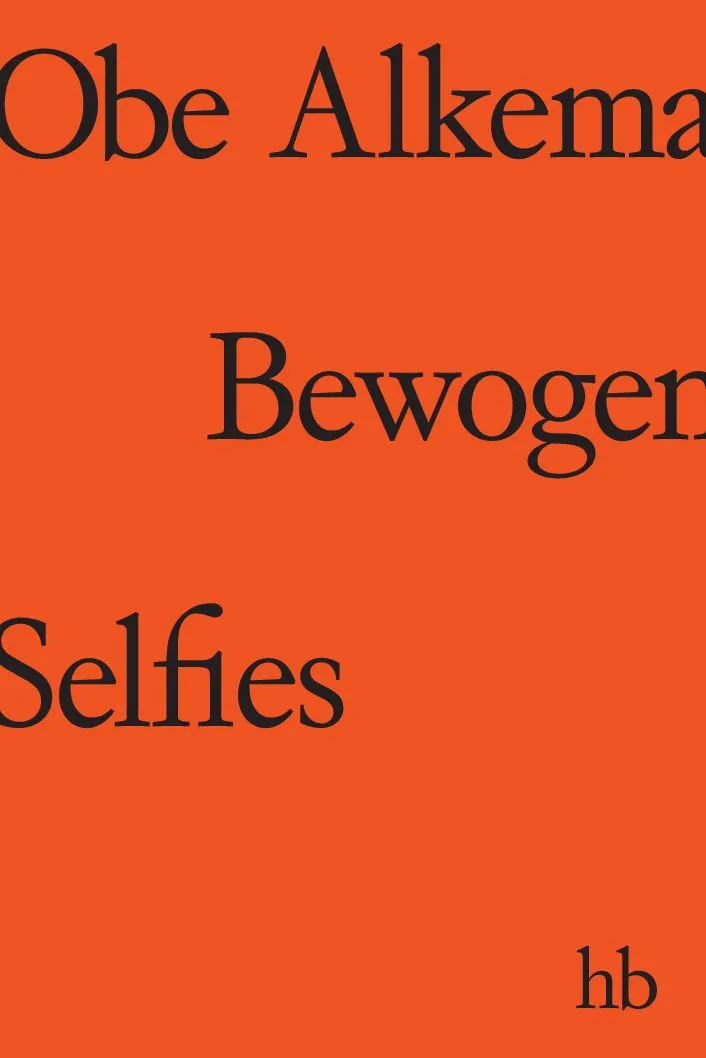
Bewogen selfies
In Bewogen selfies onderzoekt Obe Alkema de verhouding tussen landschap en herinnering. Wat treft hij aan bij terugkeer naar belangrijke plaatsen uit zijn geheugen? Wat herinnert hij zich niet, maar Google wel? Is er een gedenkschrift te puren uit zijn metadata?
Memoires, rechtstreeks verteld en met omwegen, uit eerste hand en van horen zeggen. Archieven en herinneringen eisen spreektijd, houden het niet meer droog of worden tot spreken gebracht. Wat hebben ze eigenlijk te melden? Ze lopen helemaal leeg, net als Alkema zelf. Een leven zoals zovele, poedelnaakt en geretoucheerd, vol zin en onzin.

Mountainish
Zsuzsanna Gahse, Katy Derbyshire
A narrator and her dog are criss-crossing the Swiss Alps. She travels with friends who share her interest in food, languages and their topographical contexts. They collect colours, even look for colourlessness, and develop the idea of a walk-in diary, a vain attempt to archive their observations, encompassing portraits, descriptions and ruminations on mountains, hotels, people, language, food, flora and fauna.
Gradually, other mountains appear in their observations and memories, as do the mountains of literature and art. Mountains may be sites of fear and awe, of narrow-mindedness, racism and ever-looming collapse; Alpine lodges may be places of hospitality, retreat and unexpected encounters; of nature under threat.
In 515 notes, Zsuzsanna Gahse unfolds a finely woven interplay between her six characters while giving us a vivid panorama of mountain worlds, a multi-layered typology of all things mountainish.

I have brought you a severed hand
Ghayath Almadhoun, Catherine Cobham
Fluid and unselfconscious, Ghayath Almadhoun writes love poems in the shape of nightmares: I have brought you a severed hand is a surreal mix of absurd humour, heteroerotic lust and dead seriousness. Caught between two exiles, the one inherited from his Palestinian father and the one he chose and lives, Almadhoun attempts to explain water and tame hope.
This book never misses the defiant beat of an exile’s haunted footing across wars, seas and memory. Almadhoun turns the genocidal logic of colonialism upside down, emptying out the crumbs of humanity and civilisation. —Don Mee Choi
Almadhoun uses every possible means of silence to make the total devastation palpable. —Alfred Schaffer
Many poets attempt to traverse the gulf between the experience of tragedy and the ability to relay its magnitude to anyone else. But few living have done it with such flourish, such sustained passion and formal precision as Ghayath Almadhoun. —Kaveh Akbar
Ghayath Almadhoun (born 1979, Damascus) is a Syrian-Palestinian poet who moved to Sweden in 2008. He has published five collections of poetry in Arabic, the latest being Adrenalin (Almutawassit, 2017) and I have brought you a severed hand (Almutawassit, 2024). In 2017, Adrenalin was translated into English by Catherine Cobham and published by Action Books. In 2023, Almadhoun curated, edited and translated the poetry anthology Kontinentaldrift: Das Arabische Europa (Verlag Das Wunderhorn and Haus für Poesie), which includes thirty-one Arabic poets living in Europe. The English translation of I have brought you a severed hand is published simultaneously by Divided in the UK and Europe and by Action Books in the USA. Almadhoun currently lives between Berlin and Stockholm. His work has been translated into nearly thirty languages.
Catherine Cobham taught Arabic language and literature at the University of St Andrews, Scotland, for many years and was head of the department of Arabic and Persian from 2011 until 2021. She has translated the work of a number of Arab writers, including poetry by Adonis, Mahmoud Darwish, Ghayath Almadhoun, Tammam Hunaidy and Nouri al-Jarrah, and novels and short stories by Yusuf Idris, Naguib Mahfouz, Hanan al-Shaykh, Fuad al-Takarli and Jamal Saeed. She has written articles in academic journals and co-written with Fabio Caiani The Iraqi Novel: Key Writers, Key Texts (Edinburgh University Press, 2013).

Pleasureis Amiracle
A book of poems written out of a depressive episode, in which a devotional approach to music and desire reestablishes communication between the poet's body and the world.
In pleasureis amiracle, the poems invoke the lyric and refuse it, moving between time and sound—words re-connect and re-cohere, resisting separation and challenging readers to feel their way to meaning. Perception becomes a many-limbed entanglement from which the reader is never let go. Music is both divine and accessible, a sublimation of everyday movements into an erotics of sensation.
An experiment in form as much as content, it asks what can be cured by music, what is trans about desire, and how can one allow the body to feel what the mind sees, or vice versa.

About Narration – Materials, Comments, Interventions
Ingemo Engström, Harun Farocki
Published in collaboration with Harun Farocki Institut, this book unpacks About Narration [Erzählen], a 1975 essay film directed by Ingemo Engström and Harun Farocki.
Edited and introduced by Sezgin Boynik and Tom Holert, this book focuses on About Narration [Erzählen] directed by Ingemo Engström and Harun Farocki.
It includes the film's script alongside the historical documents related to its making and Farocki's previously unpublished theoretical and programmatic essay on the film. The publication also includes a retrospective essay by Ingemo Engström on the film's political and artistic background.
Volker Pantenburg's detailed elaboration of the conditions of its making, alongside Boynik and Holert's concluding remarks, further contextualizes the film. The interview with Cathy Porter on Larisa Reisner, a heroine of About Narration, gives an overview of the life of a militant writer who inspired Engström and Farocki.
Edited and introduced by Sezgin Boynik and Tom Holert.

Lentil Space – Recipes from Artists' Homes
A compilation of recipes from the Arab world that were presented by artists for Mophradat's online cooking show Lentil Space.
Adapted from its namesake online program produced by Mophradat, co-curated by Mai Abu ElDahab and Reem Shilleh, from 2021 to 2023, this book is a celebration of the varied cuisine of the Arab world and its relationship with inherited food practices and the cultures of cooking and talking about food.
With contributions by Adam HajYahia and Haitham Haddad, Deena Abdelwahed, Laila Hida with Amine Lahrach, Mohamed Abdelkarim with Abla elBahrawy, Nadah El Shazly, amongst many others, this cookbook includes recipes chosen and prepared by the artists in an intimate setting coupled with stories both personal and about their art practice.

Ripcord
A novel about escape and connection, class, sex, and queer intimacy in the American Midwest.
The oldest story: an insider pretends to be an outsider and receives praise for his empathy and imagination and intelligence. Maybe some asshole even says bravery. An outsider pretends to be an insider, is exposed as a fraud, a liar, and burned to the ground.
In Ripcord, Nate Lippens continues his meditations on escape and connection, class, sex, and intimacy. Stuck in Milwaukee, the narrator cobbles together a living by bartending and catering weddings, enmeshed in a semiaffair with a younger, married man. Cruising apps while tallying his youthful romantic failures, he fantasizes about disappearance but finds both solace and frustration in his friendships with Charlie, an aging punk who was prominent in the 1990s Chicago queercore scene, and Greer, a painter who never broke through but continues making work.

German Theater 2010–2022
Calla Henkel and Max Pitegoff: German Theater 2010–2022 is the first monograph on the work of the artist duo Calla Henkel (b. 1988, Minneapolis, MN) and Max Pitegoff (b. 1987, Buffalo, NY). Their manifold practices play out, live test, and fictionalize the mechanisms that shape creative communities. Chronicling over a decade of production in Berlin, the book is organized around the influential bar and theater spaces they ran there: Times Bar (2011–12), New Theater (2013–15), Grüner Salon at the Volksbühne (2017–18), and TV Bar (2019–22), and includes an interview with curator Fabrice Stroun and essays by David Bussel and Patrick Armstrong. Henkel and Pitegoff's photographs, plays, writing, and films address the complexity of collective action, painting a deadpan picture of the social and economic systems that sustain communal exchanges and their eminently fragile autonomy.
Edited by Fabrice Stroun
Design by Dan Solbach

Agitated Air: Poems After Ibn Arabi
Born in Murcia in 1165, Ibn Arabi was a prolific Muslim philosopher and poet. He travelled extensively before settling in Damascus, where he died in 1240. Tarjuman al-Ashwaq, or The Interpreter of Desires, is a cycle of sixty-one Arabic poems. They speak of loss and bewilderment, a spiritual and sensual yearning for the divine, and a hunger for communion in which near and far collapse.
Agitated Air is a correspondence in poems between Istanbul and Cape Town, following the wake of The Interpreter of Desires. Collaborating at a distance, Yasmine Seale and Robin Moger work in close counterpoint, making separate translations of each poem, exchanging them, then writing new poems in response to what they receive. The process continues until they are exhausted, and then a new chain begins.
Translated and re-translated, these poems fray and eddy and, their themes of intimacy across distance made various, sing back and forth, circling and never landing. Absence and approach, knowing and unknowing, failure and repetition: Ibn Arabi’s cycle of ecstatic love shimmers with turbulence. Seale and Moger move into and against these contending drifts, finding in the play of dissatisfaction and endurance a prompt for new poetry.

The Land of All Time
The latest collection from prolific American poet Clark Coolidge, who has often been associated with the Language School and the New York School but has truly forged a unique style. A life-long jazz drummer, his poems can be approached as improvisational compositions with strange arrangements of words, statements, and sounds that are vibrant, frequently hilarious, and jarring. His upended syntax and surprising associations reflect a world awash in information; an advanced civilization dealing with ever more rapid change. His poems are explorations into the possibilities of language. This kind of work could, serendipitously, lead to new patterns of thinking, new definitions, new meanings, perhaps even new ways of dealing with old problems.

An Anarchist Playbook. Radical Translation Workshop
Cristina Viti, Jacob McGuinn and 2 more
The Conspiracy of Equals (1796) is often hailed as the first revolution against a revolutionary state. Even if the conspirators were soon found out and put on trial, their ideas of radical equality and liberty shaped future generations of revolutionaries worldwide. An Anarchist Playbook—the first publication in Tenement’s new imprint, No University Press—gathers together many of the key documents from their trial across a myriad forms, with a number of these texts appearing herein in their first English-language translation.
Assembled in the Playbook are the last words of Gracchus Babeuf, the leader of the conspiracy and a radical proponent of the abolition of private property, and of his fellow conspirator Augustin Darthé, as they faced the guillotine. We’ve a letter, written in the popular idiom of the sans-culottes, that urges the common soldier to rebel; the score and lyrics of a street song that names the new class enemy: the wealthy bourgeoisie who have profited from the revolution; a first-time English translation of ‘The Last Judgement of All Kings’—an extraordinary one-act play by Sylvain Maréchal, the unofficial poet of the Conspiracy, that was performed to considerable acclaim in Year II of the Revolution (and that the Workshop is in the process of adapting for contemporary audiences).
Many of these texts were never published in their own time, and form a part of the testament left behind by Philippe Buonarroti, a leading conspirator who inspired new generations of revolutionaries across Europe over the course of the nineteenth and early twentieth centuries. Among the best known works included is the Manifesto of Equals, long considered a founding text of social, communist and anarchist revolutions. The Playbook presents a translation of the Manifesto alongside other key texts by the conspirators, reconstructing the richness and variety of revolutionary communication that informs the editorship, shape, and scope of this volume.