Translations
Translations

Nine Ways to Cry
Cecilia Pavón, Jacob Steinberg
Cecilia Pavón has been a defining figure of the Argentine cultural scene since the 1990s. She is the author of over 10 volumes of poetry, 3 short story collections, and an anthology of blog posts, and was co-founder of the legendary art gallery and publishing press Belleza y Felicidad. Nine Ways to Cry collects Cecilia Pavón’s complete poetry published from 1999 to 2012 in one bilingual volume for the first time, including A Hotel With My Name, Licorice Candies, and other beloved classics.
Prefaced by a loving foreword from contemporary US poet Dorothea Lasky, this collection serves as the definitive introduction to the poetry of a living legend. She currently lives in Buenos Aires.

Thomas the Obscure
Maurice Blanchot, Robert Lamberton
Before Sartre, before Beckett, before Robbe-Grillet, Maurice Blanchot created the new novel, the ultimate post-modern fiction. Written between 1932 and 1940, Blanchot's first novel, here brilliantly translated by Robert Lamberton, contains all the remarkable aspects of his famous and perplexing invention, the ontological narrative—a tale whose subject is the nature of being itself. This paradoxical work discovers being in the absence of being, mystery in the absence of mystery, both to be searched for limitlessly. As Blanchot launches this endless search in his own masterful way, he transforms the possibilities of the novel. First issued in English in 1973 in a limited edition, this re-issue includes an illuminating essay on translation by Lamberton.

Unfit
Ariana Harwicz, Jessie Mendez Sayer
A bracing novel that asks how far we would go for the ones we love—and what we would do to destroy the ones we hate.
Lisa has lost custody of her young twin boys. Caught between the French legal system’s sluggish bureaucracy and her sinister, scheming in-laws, she’s alone and lost, an Argentine migrant in rural France picking grapes for a pittance, only allowed to see her children in supervised visits once a month. Scapegoated and outcast, destitute and desperate, Lisa decides to take radical action: early one morning, she sneaks into her in-laws’ farmhouse, takes back her children, sets the barn ablaze, and makes her escape.
What follows is a white-knuckled road trip that explores human beings pushed to the edge. Clearly, Lisa is not in her right mind, and as Harwicz deftly mingles a chorus of contradictory voices into her very unreliable narration, the reader comes to regard the protagonist with an unsettling mixture of sympathy and suspicion. Written in savage, chiseled prose, Unfit shoots off, a gripping chase that questions all our assumptions—and points out our hypocrisies— about motherhood, custody rights, love, violence, anti-semitism, and migration. The latest novel by the acclaimed author of Die, My Love (soon to be adapted to a film starring Jennifer Lawrence), Unfit is addictively terrifying, savagely sophisticated, and shockingly brilliant.
Translated from Spanish by Jessie Mendez Sayer
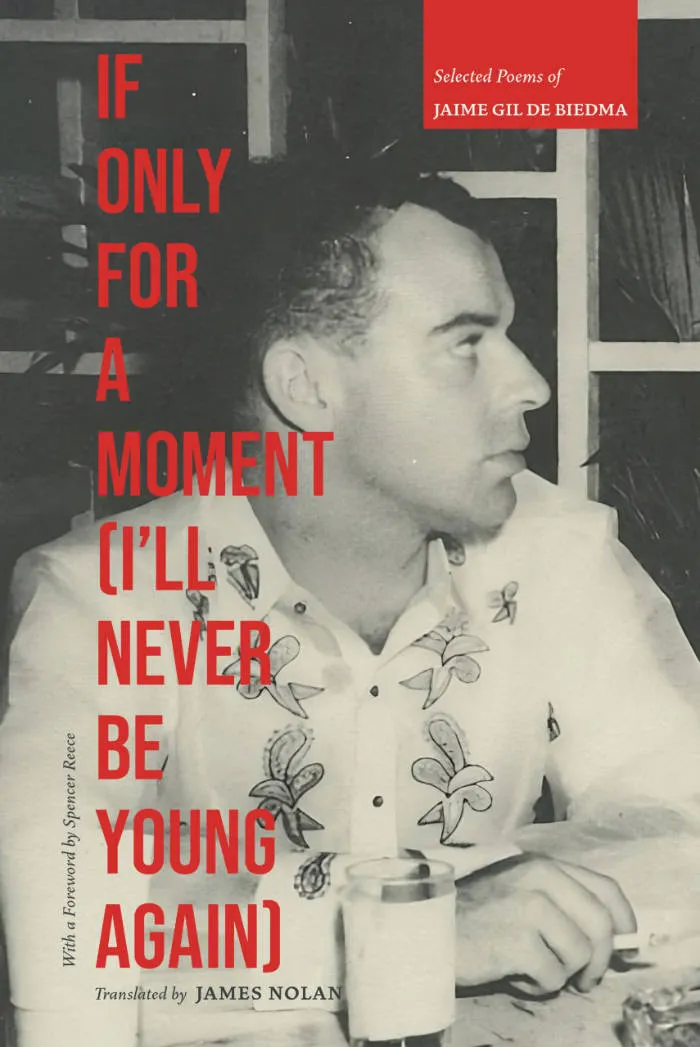
If Only For a Moment (I’ll Never Be Young Again)
Jaime Gil de Biedma, James Nolan
Jaime Gil de Biedma is the most original and influential among the poets known as the ‘50’s Generation in Spain, and is considered the greatest Spanish poet to emerge in the second half of the 20th century. His life and literary career were bracketed almost entirely by the rise and fall of Generalissimo Francisco Franco, notorious for the suppression of literature. Born in 1929, Gil de Biedma was six years old when García Lorca was murdered in Granada at the outbreak of the Civil War, and his collected poems, Las personas del verbo, first appeared in 1975, the year Franco died. What is surprising is that Gil de Biedma was a leftist, homosexual poet from the Catalan capitol, Barcelona – all of Franco’s favorite things – who not only published books of autobiographical poetry in Spain but was known as a poet of social conscience as well as erotic lyricism. Like other Spanish poets of his time, he chose his words carefully. Gil de Biedma died of AIDS in 1990.
If Only For a Moment (I’ll Never Be Young Again) consists of an extensive bilingual selection of Gil de Biedma’s poetry, including all of his most well-known work. The book additionally consists of a Foreword by Spencer Reece, Jaime Gil de Biedma’s short essay “I wanted to be the poem,” and two different essays on Gil de Biedma and the art of translation by James Nolan, the volume’s translator.

Death Sentence
This long awaited reprint of a book about which John Hollander wrote: “A masterful version of one of the most remarkable novels in any language since World War II,” is the story of the narrator’s relations with two women, one terminally ill, the other found motionless by him in a darkened room after a bomb explosion has separated them. “Through more than 40 years, the French writer Maurice Blanchot has produced an astonishing body of fiction and criticism,” writes Gilbert Sorrentino in the New York Review of Books, and John Updike in The New Yorker: “Blanchot’s prose gives an impression, like Henry James, of carrying meanings so fragile they might crumble in transit.”
Translated from the French by Lydia Davis.

Flood Tide
In moderate physical decline, and with an immoderate weed habit, the novelist Dunja Anko returns home to the Adriatic coast to play detective and solve the mystery of her brother’s death. The going is arduous, the people inscrutable; her old friends have had years to forget – or to convince themselves they don’t remember. Dunja must contend with desire and disgust, curiosity and fear, as she begins to doubt her reasons for returning. Elegantly plotted, funny and self-reflexive, Flood Tide is a psychologically deft exploration of the trauma wrought by human limitation and indecision.
"A dazzling mix of narrative styles (even genres), a linguistic rollercoaster, and a book that demands both close attention and literary sensibility . . . The reader is hooked." — Boštjan Videmšek
"Mysterious, precise and haunting, Flood Tide suggests that every homecoming is a return to a crime scene." — Chris Kraus
Ana Schnabl (b. 1985) is a Slovenian writer and editor. She writes for several Slovenian media outlets and is a monthly columnist for the Guardian. Her collection of short stories Razvezani (Beletrina, 2017) met with critical acclaim and won the Best Debut Award at the Slovenian Book Fair, followed by the Edo Budiša Award in Croatia; the collection has been translated into German and Serbian. Three years later Schnabl published her first novel Masterpiece (Mojstrovina, Beletrina, 2020). She toured Europe with the English, German and Serbian translations of the book, which included a residence in the Museumsquartier in Vienna, the Literarisches Colloquium Berlin, and the first European Writer’s Festival in London. The novel was given favourable reviews and mentions in numerous Austrian, German and English media, and was longlisted for the Dublin Literary Award. Her second novel Flood Tide (Plima, Beletrina, 2022) was nominated for the Slovenian Kresnik Award. Her third novel September (Beletrina, 2024) won the Kresnik Award in 2025.
Rawley Grau has been translating literary works from Slovenian for over twenty years, including by such first-rate novelists as Dušan Šarotar, Mojca Kumerdej, Sebastijan Pregelj, Gabriela Babnik and Vlado Žabot. Six of his translations have been longlisted for the Dublin Literary Award, while his translations of Šarotar’s Panorama and Billiards at the Hotel Dobray were shortlisted for the Oxford-Weidenfeld Translation Prize. He has also translated poetry by Miljana Cunta, Miklavž Komelj, Janez Ramoveš and Tomaž Šalamun, among others. In 2021, he received the prestigious Lavrin Diploma from the Association of Slovenian Literary Translators. Translations from other languages include A Science Not for the Earth: Selected Poems and Letters by the Russian poet Yevgeny Baratynsky, which received the AATSEEL prize for best scholarly translation, and, co-translated with Christina E. Kramer, The Long Coming of the Fire: Selected Poems by the modernist poet Aco Šopov, which won the 2025 International Dragi Award for best translation from Macedonian. Originally from Baltimore, Maryland, he has lived in Ljubljana since the early 2000s.

Under The Sea
Taking the shape of an accordion-folded A3 poster, “Under The Sea” investigates the political economy of global internet infrastructures, whose material reality has temporarily become visible during fibre optic network expansion works in The Hague and other Dutch cities.
As internet users, we spend a lot of time underwater. Contrary to popular belief, satellites play a negligible role in beaming our intimate messages, cat footage and work emails across the globe.
99% of all intercontinental internet traffic travels through one of over 550 fibre optic cables criss-crossing our oceans. Despite its scale, complexity and many interlinkages with global systems of power, this network of cables and landing points commonly remains invisible.
Printing: Risograph, Stencilwerck Den Haag; English text and Photography: Livio Liechti; Dutch translation: Minke Havelaar; Design: Apsara Flury.
Edition of 250. Co-funded by Oxfam Novib.

Katrin – The Tale of a Young Writer
Unica Zürn, Louis Bazalgette Zanetti
A partly autobiographical novel that the German surrealist artist and author Unica Zürn (1916-1970) wrote for her ten-year-old daughter in 1953, although it would never be published in her lifetime. This is the first translation of the tale from German into English.
Unica Zürn tells the story of fifteen-year-old motherless Katrin, an aspiring writer, who lives with her father, also a writer. The novel is set in an imaginary world, a metropolis called Linit, split into three levels: Oberstadt (Hightown), Mittelstadt (Middletown) and Unterstadt (Lowtown), overlooked by a Volcano where the artists live and crossed by the river Emil. Presented as a book for children, apparently written for her own daughter (named Katrin), Katrin also draws on the personal biography of Zürn herself, in terms of her relationship with her father and the city of Berlin after WWII, and her experience with people on the margins of a society characterised by great tensions.
About Unica Zürn
Nora Berta "Unika" Ruth Zürn, originally known as Ruth, was born on 6 July 1916 in Berlin. Raised in Berlin, Zürn had a contentious relationship with her mother, while she idolized her absent father. While at school she published her first short stories in magazines for young people, and in 1933 she began to work at the UFA film studios in Berlin (acronym for Universum-Film Aktiengesellschaft, a major German film company producing and distributing motion pictures from 1917 until the end of the Nazi era). In 1942 she married and had two children, Katrin and Christian. Shortly after, she lost the custody of her children. For the next few years she survived by writing short stories for newspapers and radio plays. After the war, she became part of the Bohemian group of Berlin and began to call herself Unika (after her aunt Unika Pudor). She frequented the artistic milieu revolving around the DADA-surrealist cabaret Die Badewanne ("The Bathtub"). In 1953, Zürn met the artist Hans Bellmer, best known for his disassembled dolls in unconventional poses directed at the cult of the perfect body then prominent in Germany, and became his muse. They lived together in Paris for many years, albeit in a conflictual relationship. Zürn concentrated on producing poetic anagrams supplemented by drawings, thus developing her own multidimensional surreal style. From the late 1950s, she suffered from forms of anxiety, later diagnosed as schizophrenia, and produced a wealth of remarkable textual and visual material while in psychiatric institutions across Germany and France. From 1956 to 1964, Zürn had four solo exhibitions of her drawings, and her work was included in the Exposition Internationale du Surréalisme. The exploration of the unconscious dimension would increasingly lose its liberating, positive aspect and turn into a fixation on a narrow space, one in which the self is tormented by distressing visions. Her psychological difficulties inspired much of her writing, especially Der Mann im Jasmin (The Man of Jasmine, published in English in 1971). Other published texts by Zürn include Hexentexte (1954) and Dunkler Frühling (Dark Spring, 1967). Zürn died on 19 October 1970 in Paris, throwing herself from the sixth floor.

Bourgeois Coldness
Bourgeois coldness refers to an affective strategy that offers an explanation for how self-preservation works. Bourgeois coldness is one of the most advanced affective and aesthetic forms of preserving the structure of the colonial status quo. It creates an affective shelter in the world, unencroached upon by the immediate consequences of its many catastrophes. It functions like air conditioning – a complex technology which reliably stabilises the climate until those inside consider it natural. Bourgeois spaces – institutional and affective – stay cool and pleasant. But outside it’s burning.
Canonical critical theory by Adorno and Horkheimer enters a dialogue with Black studies through Hartman and Moten.
Foregrounding affect, this timely book provides an inestimable philosophical argument for the centrality of Blackness in critical examinations of capitalism’s violence. —Denise Ferreira da Silva
Elegant and erudite in equal measure, this book will stand as a landmark diagnosis of the practices of denial in our time. —Andreas Malm

Girlbeast
Highly acclaimed in Denmark, Girlbeast is a fearless, unsettling, and poetic reimagining of the Lolita narrative, where power shifts unpredictably, and desire and coercion become indistinguishable. In a world that fetishises girlhood, it asks whether a girl be blamed for internalising the roles imposed upon her? Can she wield her youth as power in a system designed to render her powerless?
With sharp, fast-paced prose and an addictive plot, Cecilie Lind crafts a daring examination of female agency, sexuality, and the complexities of consent. The novel evokes the idea of the girl as animal – a creature conditioned to be both docile pet and wild beast, torn between submission and rebellion, innocence and desire.
Brave, provocative, and unflinching, Girlbeast is a gripping, vital novel for our times.
WINNER OF THE 2023 DANISH CRITICS PRIZE, SHORTLISTED FOR THE DR NOVEL PRIZE, MONTANA’S LITERATURE PRIZE & THE JYLLANDS-POSTEN FICTION PRIZE
Cecilie Lind (b. 1991) studied at Forfatterskolen (The Danish Academy of Creative Writing), and debuted in 2010 with The Wolf Ate My Eyeliner. Lind’s breakthrough in Denmark came with the publication of the highly acclaimed book-length poem My Child, which was shortlisted for the 2020 Critic’s Prize and the Politiken’s Literary Award. She was awarded The Native Language Prize in 2020, and Girlbeast won the Danish Critics Prize in 2023. Lind’s most recent novel, Bristefærdig (Ripe), was published to critical acclaim in 2025.
Hazel Evans (b. 1994) is an artist, writer and literary translator based near Aarhus, Denmark. She was the 2022/23 emerging translator for Danish to English at the National Centre for Writing, and her debut translation, Into a Star by Puk Qvortrup, was published by Hamish Hamilton. In 2024, she received The Inger and Jens Bruun Translation Prize for her translation of Rasmus Daugbjerg’s Troll, forthcoming from Penguin Press.

Eternal Current Events: Early Writings
Chris Marker, Jackson B. Smith
Before making his first films in the 1950s, Chris Marker was a regular contributor to the Paris-based magazine Esprit from 1946 to 1952. Unbound by genre or form, Marker's pieces range from short stories, essays, poems, and reviews to fabricated reportage and invented news affairs, all gemmed with the hallmarks of his style: a blurring of reality and imagination, a wry sense of humor, a sustained political engagement, and, of course, a limitless curiosity for animal life.
Eternal current events marks the first time these exemplary works are available in English, published in an adapted facsimile of the original periodical. In these short selections, what one encounters is less a past life before his turn toward cinema than a preamble to his celebrated body of work. Moving images did not replace Marker’s production as a writer but were incorporated into it. Before the “imaginary films” there were “imaginary current events”; before the travels through time in La Jetée there was a bulletin rethinking the psychogeography of the around-the-world trip; and before the musings on a Japanese temple consecrated to cats in Sans Soleil, there was a summary report on the theological implications of the 1952 Parisian Cat Fair. Marker did not just begin his career as a writer, he remained one throughout his life.

I My Feet
Gerhard Rühm, Rosmarie Waldrop
Gerhard Rühm is a radical experimenter, a restless explorer of traditions and genres, atomizing their elements in order to recompose them with conceptual precision and a multiplicity of compositional techniques. He has worked with music and visual art, but basically the world is language for Rühm, the dictionary its body, and the alphabet its backbone.
Gerhard Rühm was born in Vienna in 1930. He began by studying composition and Oriental music, but came to devote most of his energy to literature, esp. concrete poetry. His aim has been nothing less than making language an aesthetic medium on a par with music and visual art.
Rühm is also known for his editions of Baroque and Expressionist poets. His prizes include the “Grosse Österreichische Staatspreis” (1991) and the “Hörspielpreis der Kriegsblinden” (1983). From 1972-95 he taught at the Hamburg Academy of Fine Arts. He now lives in Cologne.
“Orgy, for R. means semantic excess and turbulence, the coitus of words outside their usual use.”—Mittelbayerische Zeitung
“The almost constructivist compositions derive their solidity from the musical use of rhyme, assonance , alliteration and rhythmic figures, and not least through song- and sonata elements.” — Klaus Peter Dencker, Nürnberger Nachrichten
Rosmarie Waldrop's most recent books of poetry are Blindsight (New Directions) and Love, Like Pronouns (Omnidawn). She has translated Edmond Jabès (her memoir, Lavish Absence: Recalling and Rereading Edmond Jabès was published by Wesleyan University Press in 2002), Jacques Roubaud, Emmanuel Hocquard, and, from the German, Friederike Mayröcker, Elke Erb, Oskar Pastior.

Not One Day
A tour de force of experimental queer feminist writing, Not One Day is renowned Oulipo member Anne Garréta's intimate exploration of the delicate connection between memory, fantasy, love, and desire. Garréta, author of the acclaimed genderless love story Sphinx and experimental novel In Concrete, vows to write every day about a woman from her past. With exquisite elegance, she revisits bygone loves and lusts, capturing memories of her past relationships in a captivating, erotic composition of momentary interactions and lasting impressions, of longing and of loss.
Anne Garréta, author of the groundbreaking novel Sphinx (Deep Vellum, 2015), is a member of the renowned Oulipo literary group. Not One Day won the Prix Médicis in 2002, recognizing Garréta as an author “whose fame does not yet match their talent.” Garréta is also the author of In Concrete, translated by Emma Ramadan (Deep Vellum, 2021).
Emma Ramadan is a literary translator of poetry and prose from France, the Middle East, and North Africa. She is the recipient of a Fulbright, an NEA Translation Fellowship, a PEN/Heim grant, and the 2018 Albertine Prize. Her translations for Deep Vellum include Anne Garréta’s Sphinx and In Concrete, Fouad Laroui's The Curious Case of Dassoukine's Trousers, and Brice Matthieussent's Revenge of the Translator.

đừng giấu cơn điên / don’t hide the madness
Nhã Thuyên’s đừng giấu cơn điên / don’t hide the madness contains eight poems excerpted from the forthcoming book vị nước (taste of water). To read this work is to be wrenched out of oneself and into the opening and closing world of language: a world in equal parts vegetal, liquid, human, stone, at once bordered river and open sea, enclosed maze and open field; a labyrinth, but a labyrinth of the utmost clarity; a rising or collapsing building made of words that’s not a ‘dwelling’ so much as a refusal to dwell, which is its loneliness and bereftness and consolation and strength, all at once. “Steps here pulled forth by some line of poetry out of time”, such work “fabricate[s] a bed out of sea, build[s] a house out of tremendous immensity”. It’s the result of a lifelong investigation of the Vietnamese language, deep, joyous, scrupulous and sometimes painful; of a lifelong investigation of the whole deep field of history and time as it’s lived deep within the person and in the field beyond the personal that poetic language affords us. This is a realm, not of simple freedom, but of the struggle for the fullest record and the fullest measure towards which a poet can strive. Don’t hide the madness. Don’t be at peace. [D.G.]
NHÃ THUYÊN secludedly anchors herself to Hà Nội, Việt Nam and totters between languages. She has authored several books in Vietnamese and/or in English translations, including viết (writing) (2008), rìa vực (edge of the abyss) (2011), từ thở, những người lạ (words breathe, creatures of elsewhere) (2015), and bất\ \tuẫn: những hiện diện [tự-] vắng trong thơ Việt (un\ \martyred: [self-] vanishing presences in Vietnamese poetry) (2019). Her next book of poetry vị nước (taste of water) is waiting to see the moon. She has been unearthing her notebooks and rubbing her words in Berlin as a 2023 DAAD Artists-in-Berlin fellow, and learning to quietly speak up with care.
KAITLIN REES is a translator, editor, and public school teacher based in New York City. She translates from the Vietnamese of Nhã Thuyên, with whom she co-founded AJAR, the small bilingual journal-press that organizes an occasional poetry festival. Her translations include moon fevers (Tilted Axis, 2019), words breathe, creatures of elsewhere (Vagabond Press, 2016), and the forthcoming book of poetry taste of water.

Name
Name, the third novel in Constance Debré’s acclaimed trilogy, is at once a manifesto, an ecstatic poem, and a political pamphlet. By rejecting the notion of given identity, her narrator approaches the heart of the radical emptiness that the earlier books were pursuing.
Newly single, and having recently come out as a lesbian, the narrator of Debré’s first two novels embarked on a monastic regime of exercise, sex, and writing. Using the facts of her own life as impersonal “material” for literature, Playboy and Love Me Tender epitomized what Debré (after Thomas Bernhard) has called “antiautobiography.” They introduced French and American readers to her fiercely spare prose, distilled from influences as disparate as Saint Augustine, Albert Camus, and Guillaume Dustan. “Minimalist and at times even desolate,” wrote the New York Review of Books, these works defied “the expectations of personal growth that animate much feminist literature.”
Name is Debré’s most intense novel yet. Set partly in the narrator’s childhood, it rejects Proustian notions of “regaining” the past. Instead, its narrator seeks a state of profound disownment: “We have to get rid of the idea of origins, once and for all, I’m not holding on to the corpses. … Being free has nothing to do with that clutter, with having suffered or not, being free is the void.” To achieve true freedom, she dares to enter this “void”—that is, dares to accept the pain, loss, and violence of life. Brilliant and searing, Name affirms and extends Debré’s radical project.

“The Misery of Love” & other essays from 'Social Disease'
From 1972 to 1974, the anonymous writers of Social Disease offered groundbreaking, incisive, and sweeping critiques of social relationships through the lens of Situationism. Arguing that true revolution — the kind of complete and irreversible revolution longed for in the wake of such revolutionary moments as the May 1968 student uprisings and the 1969 Stonewall riots— would change every aspect of society, it was clear that affective relationships — how we love, how we feel pleasure— would necessarily be changed as well, and thus deserved examination as much as the traditional questions of labor or politics. The voices in the essays speak with urgency, and do not compromise in their expression. Beyond the theoretical insights of the text, the emotional truth of history comes through in the spaces of contradiction, and allusions to intercommunity conflicts. These essays were written without constraints for an immediate audience of comrades and peers; with this translation of the collection, that audience now includes us.
"Translating from the French, Mar Stratford's MISERE DU L'AMOUR captures the urgency, passion, and drama of 1970s gay leftism. MISERE DU L'AMOUR asks questions that persist: what does a better world look like? What is the true nature of love? Can we fuck and suck our way to liberation?The questions asked by F.H.A.R in the 1970s have a relevance to today's discourse that Stratford's translation animates. Tell your friends, your lovers, and your haters." —Brendan Williams-Childs
"The Misery of Love" & Other Essays From Social Disease / “Misère de l'amour” & autres textes de le flèau social. Bound with staples. Covers printed on Mohawk off-white cardstock, with front cover image hand colored with pencil and marker. Interiors printed on bright white French text weight paper. Printed and assembled in "Kingston, New York,” the unceded and occupied lands of the Haudenosaunee, Mohican, Munsee Lenape, and Schaghticoke tribes.
Designed by The Aliens.

The Book of Skies
Leslie Kaplan, Jennifer Pap and 1 more
The Book of Skies, like its predecessor Excess-The Factory, emerged from poet Leslie Kaplan's experience participating in the national strike and social revolution of ’68 in France. Early in ‘68 Kaplan, like others, left her studies in order to take on factory work, as an aspect of revolutionary practice. Excess—the Factory, puts the factory experience strikingly on the page in sparse and original language. The Book of Skies takes place in the period just after the ‘68 events as the central speaker now observes the places, landscapes, and people surrounding and relying on factory production in French cities, small and large. As the poem’s speaker moves from site to site, she finds possibility within the social spaces of the market, the street, the café, and even the factory itself. While class and gendered violence threaten to shut down hopes for freedom and renewal, the sky, as reality and as figure, functions as an aperture, drawing our attention upward and outward, even or especially when domestic and work-spaces are most violent or suffocating.
From the beginning of her career, French poet, playwright, and novelist Leslie Kaplan has been an important writer of the French left. She has published over twenty books in all three genres, many of which have been translated into German, Swedish, Spanish, Danish, Norwegian, and now, English. Her first book, L'exces l’usine (1982), gained the attention of writers such as Marguerite Duras and Maurice Blanchot, and became an important book for the ‘68 generation. In 2018, Commune Editions published Excess—The Factory, translated by Julie Carr and Jennifer Pap. This was the book’s first translation into English, though it had been translated into five other languages.

Sentimental Doubts
Teresa Wilms Montt, Jessica Sequeira
Sentimental Doubts, here translated into English for the first time by Jessica Sequeira, was iconic Chilean writer Teresa Wilms Montt’ s first book. It was originally published in 1917, in Buenos Aires, after the author had left an entire life behind her in Santiago: her husband, her parents, the convent where she’d been confined for supposedly committing adultery, and her two daughters, whom she was forbidden from seeing.
In this work, she communicates her “inquietudes”: the racing heart, the muttering mind, the explosion of doubts.
Wilms Montt subverts the religious charge of doubt to turn pain into eroticism, sadness into seduction, doubt into assertion, and there is a great beauty to be found in this restlessness and impressionistic shifting, these temporary glimmers of light on water.
Teresa Wilms Montt was born on September 8, 1893 in Viña del Mar, Chile, into an elite, well-connected family. Her first book, Inquietudes sentimentales, consisted of fifty poems with surrealist features, while her second, Los tres cantos, explored eroticism and spirituality. Both books enjoyed great success in Argentine intellectual circles. In 1918, she moved to Madrid, where she published two works widely recognized by Spanish literary critics: In the Stillness of Marble and Anuarí. Upon returning to Buenos Aires in 1919, she published her fifth book, Cuentos para hombres que todavía son niños. She died in 1921, in Paris, from an overdose of Veronal.
About the Translator: Jessica Sequeira was born in San Jose, California in 1989, and currently lives in Santiago de Chile. Her works include the novel A Furious Oyster (Dostoyevsky Wannabe), and the collection of essays Other Paradises: Poetic Approaches to Thinking in a Technological Age (Zero).
Her translations include Bernardo Couto Castillo' s Asphodels (Snuggly Books, 2020), Enrique Gómez Carrillo' s Sentimental Stories (Snuggly Books, 2019), Rafaela Contreras' s The Turquoise Ring and Other Stories (Snuggly Books, 2019), Adolfo Couve’ s When I Think of My Missing Head (Snuggly Books, 2018), and Liliana Colanzi’ s Our Dead World (Dalkey Archive).

Phantom Pain Wings
Kim Hyesoon is an iconic figure in feminist poetry. In her new collection, she depicts the memory of war trauma and the collective grief of parting through what she calls an ‘I-do-bird-sequence’. Through intensely rhythmic lines marked by visual puns and words that crash together and then fly away as one, Kim mixes traditional folklore and mythology with contemporary psychodramatic realities as she taps into a cremation ceremony, the legacies of Rimbaud and Yi Sang, a film by Agnès Varda, Francis Bacon’s portrait of Pope Innocent X, cyclones, a princess trapped in a hospital, and more. A simultaneity of voices and identities rises and falls, existing and exiting on their delayed wings of pain.
Winner of the 2024 National Book Critics Circle Award for Poetry (USA)
2024 Poetry Book Society Translation Choice

In the Presence of Absence
By one of the most transcendent poets of this generation, a remarkable collection of prose poems that explores themes of love, pain, isolation, and connection. In this self-eulogy written in the final years of Mahmoud Darwish's life, Palestine becomes a metaphor for the injustice and pain of our contemporary moment.
Mahmoud Darwish (1941-2008) was one of the most acclaimed poets in the Arab world. His poetry collections include Why Did You Leave the Horse Alone? and A River Dies of Thirst (Archipelago Books). In 2001 Darwish was awarded the Lannan Cultural Freedom Prize.

New York Temps
Composé à la fois de récits personnels, de citations et de collages provenant notamment du New York Times, New York Temps suggère une discontinuité des états intérieurs, accentuée par la multiplicité des orateur.ices : les voix se succèdent à elles-mêmes, sont à chaque moment ce qu’elles n’étaient pas celui d’avant, apprenantes et à l’écoute de tout ce qui n’est pas elles. À travers des questions d’intertextualité et de sampling en poésie, le texte porte en lui une violence immanente – rendue plus intérieure, faite sienne –, une gêne, non seulement ressentie, mais aussi imposée, comme une protestation.
Titre original : NYT. Publié pour la première fois chez Gauss PDF en 2018. Traduit de l’anglais par Salomé Burstein.
Aurelia Guo est écrivaine et chercheuse à Londres. Elle est également l’autrice de World of Interiors (Divided Publishing, 2022).

The Spiritual Hunt
A long lost poem purportedly by Rimbaud is finally made available in English.
Referenced only in a few letters of Paul Verlaine, The Spiritual Hunt is Arthur Rimbaud's forgotten masterwork, a poem in five parts that explored the mystic philosophy that guided the young poet's heart and hand. Considered lost for years, a typewritten manuscript appeared in Paris in the late 1920s, circulating around a close-knit group of booksellers, poets, and playwrights. Yet it wasn't until 1949 that Mercure de France took the initiative to publish the unauthenticated galley and unleashed a literary controversy that shook France. Sides were drawn, with Andre Breton leading the charge of forgery, calling the work an utter hoax, and others defending it as legitimate and an essential key to understanding Rimbaud and his work. Bookstores were raided for copies, critics were skewered in journals, and tempers flared on radio and in print, but no conclusive judgement could be drawn and Mercure de France withdrew the work from publication and pulped all the copies they could find.
Now, seventy-five years after its initial imbroglio, The Spiritual Hunt is available in English for the first time with a facsimile letterpress edition of the original. Featuring Pascal Pia's original introduction along with an edifying afterword by translator Emine Ersoy.

Sarahland
Sarahland est un ouvrage de fiction américain contemporain qui se découpe en dix nouvelles, toutes reliées par les personnages de Sarahs et leurs parcours initiatiques à la fin de l’adolescence. Sam Cohen, autrice queer et juive, déploie un univers drôle et piquant autour des notions d’identité, de transition, de transformation, d’émancipation et d’apprentissage. Au fil d’histoires inventives, l’autrice explore la manière dont les narratifs qui nous sont assignés, les récits traditionnels, les identités qui nous pré-existent, sont dépassables. Elle construit alors avec ses personnages — presque toutes prénommées Sarah — de nouvelles histoires pour leurs passés ou leurs futurs, de nouvelles façon d’aimer la terre et ceux qui la peuplent, de nouvelles possibilités de vie en soi. Dans le refus pour chaque Sarah d’adhérer à un récit unique et uniformisant, l’autrice propose un lieu potentiellement meilleur pour nous toustes, un espace narratif qui n’exige aucune fixation de soi, aucune injonction consumériste, aucun compromis corporel: un lieu appelé Sarahland.
Née à Detroit aux États-unis, Sam Cohen vit et travaille actuellement à Los Angeles. Elle est une autrice de fiction dont les romans explorent des thèmes à l’intersection du féminisme, des études queers, et des pensées juives. Après avoir publié dans différentes anthologies et revues littéraires (Queer Flora, Fauna, and Funga, Weird Sister Collection, etc.), elle publie en 2021 Sarahland, un recueil de nouvelles. Elle enseigne l’écriture à l’université en tant que professeur d’écriture créative. Elle a été nommée et à gagné à de nombreux prix littéraires, notamment le ALMA Award (Best Jewish Story Collection of 2021), le Jewish Women’s Archive Book List, le Golden Poppy Award in Fiction (finaliste) ou encore le Chautauqua Janus Prize. Elle est en cours d’écriture de son prochain livre.

Mountainish
Zsuzsanna Gahse, Katy Derbyshire
A narrator and her dog are criss-crossing the Swiss Alps. She travels with friends who share her interest in food, languages and their topographical contexts. They collect colours, even look for colourlessness, and develop the idea of a walk-in diary, a vain attempt to archive their observations, encompassing portraits, descriptions and ruminations on mountains, hotels, people, language, food, flora and fauna.
Gradually, other mountains appear in their observations and memories, as do the mountains of literature and art. Mountains may be sites of fear and awe, of narrow-mindedness, racism and ever-looming collapse; Alpine lodges may be places of hospitality, retreat and unexpected encounters; of nature under threat.
In 515 notes, Zsuzsanna Gahse unfolds a finely woven interplay between her six characters while giving us a vivid panorama of mountain worlds, a multi-layered typology of all things mountainish.