Non-fiction
Non-fiction

A Cosmology of Bliss – OEI #112-113
OEI #112–113: A Cosmology of Bliss concerns Bliss (aka Blissymbols or Semantography) — an unspoken language made of countless little geometric symbols, many resembling the things they point to, others remaining more mysterious. Charles K. Bliss (1897–1985) began the project in 1942 while a stateless refugee in the Shanghai International Settlement, and who, after emigrating to the Australian beach town of Coogee, worked on it for the rest of his life. After 30 years of obscurity, the language was picked up as a communication system for nonverbal children in a small hospital school in Canada, with great promise. This, however, led to acrimony between its creator and its first genuine users, who sought to amend it for their needs—an event which Charles likened to ‘a new Babel of symbols’.
A Cosmology of Bliss reconsiders the histories, forms, and dreams of Bliss and its many contributors. It includes a new picaresque biography of Charles, the chemical engineer, wounded refugee, and amateur semanticist; essays that draw out affinities and resistances, such as with the history of 20c Australian poetry and experimental pedagogy; unpublished material from Bliss’s manuscripts and correspondences, including an extensive selection of the barely-published Blissymbols Picture Book—Charles’s final work; and commissions by some thirty artists and poets who put the symbols to new and unruly use. Together they seek to lodge Bliss into the history of Australian visual art and poetry as a remarkable exception. Against received accounts of a failed auxiliary language or an outmoded therapeutic aid, A Cosmology of Bliss is the first study to insist that Bliss is a poetic project. Taken as such, the symbols begin to speak—silently—of a world of lucky faults, chemical grammars, speechless inscriptions, and untenable, incandescent loves.
with Dr. Charles K. Bliss & his devoted coworkers: Javant Biarujia, Claire Bliss, Christopher Brennan, Melinda Bufton, Alexis Carrel, Brendan Casey, Justin Clark, Mitchel Cumming, Gabriel Curtin, Jesse Darling, Douglas Everingham, Michael Farrell, Elisa Gabbert, Samantha Gorman, Agatha Gothe-Snape, Sam de Groot, Gail Hastings, Julian Huxley, Martin Johnston, Alfred Korzybski, Ruark Lewis, Aodhan Madden, Ern Malley, Rowan McNaught, Shirley McNaughton, Tom Melick, Quenton Miller, Robert Milne, Anthony O’Donnell, Ouyang Yu, Victoria Perin, Oscar Perry, π.O., Lisa Radford, Oliver Reiser, Bertrand Russell, Mark von Schlegell, Imogen Stidworthy, Brian Stride, Ella Sutherland, Sam Szoke-Burke, Elisa Taber, Peter Tyndall, Lucy Van, Ania Walwicz, Margaret Woodward, Tim Woodward, Tom Wright, Xu Bing, Jarrod Zlatic, etc.

Fiction Non Fiction – Volume 2
Fiction Non Fiction is a series of readers that pairs voices in literary criticism with the material histories of labor, gender, and race. Each volume proposes a close-reading of fictitious and theoretical works to explore how identity politics have been narrativized by liberal institutions across space and time.
Volume II, published on the occasion of Belas Artes, Bruno Zhu’s exhibition at CAM – Centro de Arte Moderna Gulbenkian, Lisbon, is anchored by the centrality of how one looks. Ranging from domestic scenes in the female-owned prazos of Zambezi Valley, the trade of Indian calico, the 19th century British Nonconformist campaign in Southern Tswana, and accounts of Chinese workers by writer Eça de Queiroz, this reader surveys the role of dress in colonial and postcolonial contexts.
Featuring contributions by Jean Comaroff, Simon Gikandi, Stuart Hall, Kate Haulman, Eugénia Rodrigues, Regina A. Root, Victoria L. Rovine, and José Carvalho Vanzelli, Volume II addresses how fashion facilitated idealized images of the Other to serve the unity of the colonial topos.

What is highly unlikely but not impossible?
Jeanne Gerrity, Diego Villalobos
What is highly unlikely but not impossible? is informed by themes found in the work of Hiwa K, such as statehood, war, migration, belonging, the effects of neoliberalism and colonialism, home as a concept, language, and the myth of the individual artist. The compendium ranges freely across mediums, drawing together experimental poetry, science fiction, photography, memoir, academic essays, art historical texts, and more. Contributions include a short story by Benjamin Labatut, an excerpt from a lecture by Achille Mbembe, and drawings by Hajra Waheed. Like previous editions in the series, this book brings together a range of voices and mediums to consider some of the most pressing issues of our time.
Contributions by Omar El Akkad, Havin Al-Sîndy, Yto Barrada, Dionne Brand, Deena Chalabi, Nidhal Chamekh, Theresa Hak Kyung Cha, Ursula K. Le Guin, Raven Chacon and Candice Hopkins, Brian Karl, Hiwa K, Benjamin Labatut, Quinn Latimer, Henri Lefebvre, Mazyar Lotfalian, Peter L. Manuel, Achille Mbembe, Fred Moten, Gabriel Orozco, Jacques Rancière, Man Ray, Rijin Sahakian, Solmaz Sharif, Tiffany Sia, Julietta Singh, Rayyane Tabet, Anton Vidokle, Hajra Waheed

Get Rid of Meaning: A Journal of Interdisciplinary Writing #4
Get Rid of Meaning: A Journal of Interdisciplinary Writing is a biannual periodical by Sticky Fingers Publishing, exploring how and where meaning is produced, maintained and distributed. Through its first three issues, Get Rid of Meaning has become a site for interrogating the material conditions and affective systems of meaning-making, and strategies for surviving an intentionally nonsensical political landscape, through experimental non-fiction. This fourth issue builds on this by uncovering forms and methods of fugitive knowledge, from the heat of the land and the vibrations of the night, to the stoney rumblings of rivers and rock.
Featuring contributions from Alberto Álvarez, e v, Florence Hannah Evans, Lucy Petersen, Mark Sauter, mars k margetson & teresa amrita braggs.
LOOK HERE FOR: BLOOD BOILING, WHAT DEBT DOES, SEEING PURPLE, A PING-PONG BALL BENEATH THE RUBBLE, PSYCHOPOLITICS, ALIEN GOO, A ROD UP YOUR ASS, STONE SUMMONING FORTH, A MIRACLE, & THE BEGINNING OF THE END.

Les liens qui empêchent: L'homophobie familiale et ses conséquences
Dans Les liens qui empêchent, Sarah Schulman analyse la reproduction de l’homophobie au sein du cercle familial, quand bien même ce dernier devrait être le lieu du développement et de l’épanouissement de chacun·e.
En s’appuyant aussi bien sur des théories sociologiques que sur des témoignages individuels, l’autrice décortique les mécanismes qui conduisent les familles à exclure certains de leurs membres. Bien que l’homosexualité soit de plus en plus représentée dans les médias et dans la culture populaire, Sarah Schulman montre en quoi celle-ci est souvent caricaturée et pathologisée. Ainsi, cette visibilisation ne s’accompagne pas nécessairement d’une meilleure acceptation des personnes homosexuelles dans le cercle familial.
Virulent plaidoyer visant à faire de l’homophobie une question de société qui ne serait plus uniquement reléguée à la sphère privée, Sarah Schulman offre ici des pistes permettant de mettre un terme à la souffrance endurée par de nombreux·ses homosexuel·les au sein du foyer familial.

Solidarité, entre fantasme et nécessité
Sarah Schulman, fervente militante pour les droits humains, livre dans cet essai une brillante analyse des défis sociaux et psychologiques inhérents à tout mouvement de solidarité. En prenant appui sur plusieurs exemples historiques (lutte pour le droit à l’avortement dans l’Espagne postfranquiste, lutte contre le VIH/sida dans le New York des années 1990, mobilisation contre le génocide à Gaza…) ainsi que sur sa propre expérience de femme queer et juive, l’autrice décortique les rouages de la solidarité et entreprend de questionner les fantasmes qui y sont traditionnellement associés.
En filigrane, cet ouvrage pose une question fondamentale : quelle place pouvons-nous prendre dans un monde de plus en plus polarisé, et comment agir en solidarité avec les populations opprimées à l’échelle mondiale, locale ou individuelle ? L’autrice analyse les conditions nécessaires à tout mouvement de solidarité et montre l’importance de l’écoute active, la nécessité d’intervenir lorsque l’on est confronté à une injustice, la capacité à tolérer l’imperfection, ou encore la reconnaissance du coût moral et social inhérent à toute mobilisation.
En dressant des parallèles entre différents mouvements sociaux, Sarah Schulman met en lumière certaines dynamiques transversales à tout acte de solidarité et montre l’importance de la convergence des luttes dans un contexte mondialisé. Ode à la libération des populations opprimées, cet ouvrage apparaît aujourd’hui indispensable pour quiconque souhaite oeuvrer à la construction d’un monde plus juste.

Twenty Shadows
[Available for preorders. Shipping 26 October.]
Twenty Shadows tells of a man’s spiritual change following the suicide of his son after a long addiction. Haunted by this loss and the unknown desire of his only child, thinking and writing with a new emptiness, he finds a form of expression that was previously impossible.
This singular book brings together the reflections of one of our greatest living philosophers with a father’s grief. —Todd McGowan
Taking its title from Shakespeare’s Richard II—“Each substance of grief hath twenty shadows”—this book follows personal tragedy into the murky place where memory and interpretation become indistinguishable. What lies at its heart is a meditation on the unknowability of the other. —Charlotte Northall
Richard Boothby is right that no amount of intellect curbs the impulses of real experience, but that doesn’t mean you have to remain in a state of ignorance. Composed from the leftovers of terrible, unassimilable events, this book gives us bracing indications of ways to live on in a diminished aftermath. —Justin Clemens
Richard Boothby is professor emeritus of philosophy at Loyola University Maryland. Boothby’s books include Death and Desire: Psychoanalytic Theory in Lacan’s Return to Freud (1991), Freud as Philosopher: Metapsychology after Lacan (2001), Sex on the Couch: What Freud Still Has to Teach Us about Sex and Gender (2006), and Embracing the Void: Rethinking the Origin of the Sacred (2023). He lives in Baltimore.

Mother Media: Hot and Cool Parenting in the Twentieth Century
An essential history for understanding how we mother now, and how motherhood itself became a medium—winner of the Brooke Hindle Award from the Society for the History of Technology.
From the nursery to the prison, from the clinic to the commune, Mother Media tells the story of how we arrived at our contemporary understanding of what a mother is and how understandings of “bad” mothering formed our contemporary panics about “bad” media. In this book, leading historian of psychology Hannah Zeavin examines twentieth-century pediatric, psychological, educational, industrial, and economic norms around mediated mothering and technologized parenting. The book charts the crisis of the family across the twentieth century and the many ingenious attempts to remediate nursemaid and mother via speculative technologies and screen media.
Growing out of her previous award-winning book The Distance Cure, which considered technologized care, the book lays bare the contradictions of techno-parenting and how it relates to conceptions of “maternal fitness,” medical redlining, and surveillance of children, parents, and other caregivers. The author offers narratives of parenting in its extremity (for example, Shaken Baby Syndrome) and its ostensible banality (for example, the Nanny Cam) and how the two are often intertwined. Ultimately, Zeavin grapples with a simple contradiction: technology is seen and judged as harmful in domestic and educational spaces, even as it is a saving grace in the unending labor of raising a family.
Hannah Zeavin is Associate Professor of the History of Science in the Department of History and the Berkeley Center for New Media at UC Berkeley. She is the author of The Distance Cure and Mother Media (MIT Press) and Founding Editor of Parapraxis. In 2021, she cofounded The Psychosocial Foundation.

Art Monsters: Unruly Bodies in Feminist Art
In this dazzlingly original reassessment of women’s stories, bodies, and art, Lauren Elkin—the celebrated author of Flâneuse—explores the ways in which feminist artists have taken up the challenge of their work and how they not only react against the patriarchy but redefine their own aesthetic aims. How do we tell the truth about our experiences as bodies? What is the language, what are the materials, that we need to transcribe them? And what are the unique questions facing those engaged with female bodies, queer bodies, sick bodies, racialized bodies?
Encompassing a rich genealogy of work across the literary and artistic landscape, Elkin makes daring links between disparate points of reference—among them Julia Margaret Cameron’s photography, Kara Walker’s silhouettes, Vanessa Bell’s portraits, Eva Hesse’s rope sculptures, Carolee Schneemann’s body art, Theresa Hak Kyung Cha’s trilingual masterpiece DICTEE—and steps into the tradition of cultural criticism established by Susan Sontag, Hélène Cixous, and Maggie Nelson.
An erudite, potent examination of beauty and excess, sentiment and touch, the personal and the political, the ambiguous and the opaque, Art Monsters is a radical intervention that forces us to consider how the idea of the art monster might transform the way we imagine—and enact—our lives.
Destined to become a new classic . . . Elkin shatters the truisms that have evolved around feminist thought.
—Chris Kraus

Land Keepers
EcoRove’s Land Keepers Reader brings together writers, activists, journalists, farmers, and ecologists from across Bilad al-Sham — Lebanon, Syria, and Palestine — to tell stories of green resistance in the Jabal al-Sheikh ecological zone. Spanning South Lebanon, the occupied Jawlan, and the occupied Galilee, this landscape faces ongoing ecocide, defined as the deliberate destruction of land and ecologies used by the settler-colonial regime to erode livelihoods, cultures, and environments. The Reader highlights these struggles through essays, research and testimonies that show how native communities remain rooted in place, resisting colonial environmental orientalism, greenwashing, and scorched-earth tactics. As part of a wider body of work that includes a documentary film, tapestries, and sculptural pieces, the Reader amplifies indigenous ecological knowledge and envisions regenerative futures for threatened landscapes.
with contributions by Mahdi Sabbagh, Hamza Hamouchene, Public Works, Hussein Chaabane, Hisham Younes, Nadine El-Khoury, Michelle Eid, and Munira Khayyat
From the intro by Ecorove:
"Return, Al’Awda in Arabic, signals the right of return to homeland, a central tenet of the Palestinian struggle. Al’Awda affirms the fundamental historical, legal, collective, and individual right of Palestinians to return to their homeland. But how do we return to the earth after it has been damaged and scorched? In landscapes marked by war, ruins, rubbles, and ecological destruction, can Al’Awda take another form? Can generations of Palestinian diaspora exercise Al’Awda differently? At a time when international legal systems and institutions have failed to secure justice, can return to land be understood beyond legal definitions alone? In times of mass displacement and ecological devastation, Al’Awda may therefore exceed juridical meaning, and live through those who remain on the land and their acts of love, labour, and agriculture."
Each book comes with a 2-color, double-sided risograph-printed bookmark.
Ecorove is Iyad Abou Gaida and Jumanah Abbas.

Traces of Enayat
Cairo, 1963: Enayat al-Zayyat’s suicide becomes a byword for talent tragically cut down, even as Love and Silence, her only novel, languishes unpublished. Four years after al-Zayyat’s death, the novel will be brought out, adapted for film and radio, praised, and then, cursorily, forgotten. For the next three decades it’s as if al-Zayyat never existed.
Yet when poet Iman Mersal stumbles across Love and Silence in the nineties, she is immediately hooked. Who was Enayat? Did the thought of her novel’s rejection really lead to her suicide? Where did this startling voice come from? And why did Love and Silence disappear from literary history? To answer these questions, Mersal traces Enayat’s life, interviews family members and friends, reconstructs the afterlife of Enayat in the media, and tracks down the flats, schools, archaeological institutes, and sanatoriums among which Enayat divided her days. Touching on everything from dubious antidepressants to domestic abuse and divorce law, from rubbish-strewn squats in the City of the Dead to the glamour of golden-age Egyptian cinema, this wide-ranging, unclassifiable masterpiece gives us a remarkable portrait of a woman artist striving to live on her own terms.
Winner of the 2024 James Tait Black Prize – Biography
Longlisted for the 2024 Jan Michalski Prize
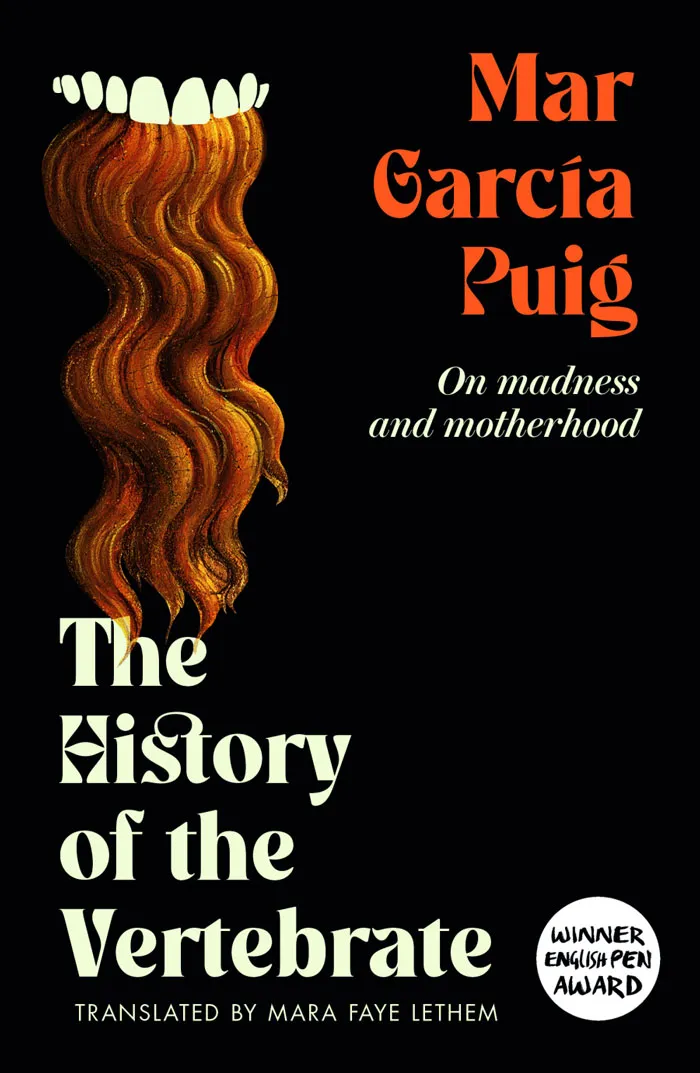
The History of the Vertebrate
Mar García Puig, Mara Faye Lethem
‘On 20 December 2015 I became a mother and I went mad.’
On a single day, Mar García Puig gives birth to twins and becomes elected to the Spanish Parliament as a member of the insurgent left-wing party Podemos. What might have been the best day of her life becomes the start of a terrifying ordeal; García Puig’s grip on reality begins to slip as she grapples with uncertainty, the weight of expectation, and misogyny in both of her new roles.
In defiance of a culture that tells her the problem lies within, García Puig chooses to look outwards, examining the imbrication of madness and motherhood across centuries of science, myth, and politics while dissecting the ways in which women have been pathologized and banished from public life.
At once intimate and epic, The History of the Vertebrate is a searing account of postpartum madness. Moving between memory, culture, and the history of medicine, García Puig transforms her experience into a story about the countless women who have felt that sanity was leaving them, and about the patriarchal forces that have silenced them.
MAR GARCÍA PUIG is an editor and author. From 2015 to 2023 she was a member of the Spanish Congress of Deputies for Podemos, where she served on the Culture Committee and the Equality Committee. Her books include The History of the Vertebrate and This Thing of Darkness.

Feminist Theory. From Margin to Center
Feminist Theory established bell hooks as one of international feminism’s most challenging and influential voices. This edition includes a preface by the author, reflecting on the book’s impact and the development of her ideas since it was first published.
In this beautifully written and carefully argued work, hooks maintains that mainstream feminism’s reliance on white, middle-class, and professional spokeswomen obscures the involvement, leadership, and centrality of women of colour and poor women in the movement for women’s liberation. Hooks argues that feminism’s goal of seeking credibility and acceptance on already existing ground – rather than demanding the lasting and more fundamental transformation of society – has short-changed the movement.
A sweeping examination of the core issues of sexual politics, Feminist Theory argues that contemporary feminists must acknowledge the full complexity and diversity of women’s experience to create a mass movement to end women’s oppression.

University of California Press
Novel Palestine
Palestinian writing imagines the nation, not as a nation-in-waiting but as a living, changing structure that joins people, place, and time into a distinct set of formations. Novel Palestine examines these imaginative structures so that we might move beyond the idea of an incomplete or fragmented reality and speak frankly about the nation that exists and the freedom it seeks. Engaging the writings of Ibrahim Nasrallah, Nora E. H. Parr traces a vocabulary through which Palestine can be discussed as a changing and flexible national network linking people across and within space, time, and community. Through an exploration of the Palestinian literary scene subsequent to its canonical writers, Parr makes the life and work of Nasrallah available to an English-language audience for the first time, offering an intervention in geography while bringing literary theory into conversation with politics and history.
NORA E. H. PARR is a Research Fellow at the University of Birmingham and at the Center for Lebanese Studies. She coedits Middle Eastern Literatures.

The Book of Sleep
Haytham El-Wardany, Robin Moger
What is sleep? How can this most unproductive of human states—metaphorically called death's shadow or considered the very pinnacle of indolence—be envisioned as action and agency? And what do we become in sleep? What happens to the waking selves we understand ourselves to be?
Written in the spring of 2013, as the Egyptian government of President Mohammed Morsi was unraveling in the face of widespread protests, The Book of Sleep is a landmark in contemporary Arabic literature. Drawing on the devices and forms of poetry, philosophical reflection, political analysis, and storytelling, this genre-defying work presents us with an assemblage of fragments that combine and recombine, circling around their central theme but refusing to fall into its gravity.
"My concern was not to create a literary product in the conventional sense, but to try and use literature as a methodology for thinking," El Wardany explains. In this volume, sleep shapes sentences and distorts conventions. Its protean instability throws out memoir and memory, dreams and hallucinatory reverie, Sufi fables and capitalist parables, in the quest to shape a question. The Book of Sleep is a generous and generative attempt to reimagine possibility and hope in a world of stifling dualities and constrictions.

Magic Episodes and Other Synchronicities
Scott Burton, Eduardo Costa and 2 more
Their relationship is forged in charismatic, darting, and deep correspondence: dishy gossip, shop talk, and the auditioning of ideas and shaping of artistic practices."
—Nate Lippens
When Scott Burton (1939–1989) and Eduardo Costa (b. 1940) met in New York City in 1968, they developed a close friendship that lasted until Burton’s death. In letters from the 1970s, they gossiped and shared thoughts about the rapid changes taking place in the art world, queer life, and their work as writers and artists. Burton and Costa’s letters show a vibrant transnational queer artistic friendship and offer a new perspective on the struggle to establish conceptual, critical artistic practices in the Americas. As Costa moved from New York to Buenos Aires to Rio de Janeiro, he and Burton discussed the art communities of North and South America, including Costa’s friend Hélio Oiticica and the lasting influence of Marcel Duchamp. Both artists found the letters to be a source of emotional and intellectual nourishment—as will their readers.

Mud … and the Earth System
Mud … and the Earth System explores groundbreaking research in Earth system sciences and highlights the challenges of communicating these findings to the public.
As once-stable “mudscapes” transform, they become both symptoms and symbols of a rapidly warming planet. This book delves into humanity’s connection to these changes through the study of ancient organic and inorganic compounds that have come alive after millennia. It poses essential questions about what these evolving ‘mud’ compounds reveal about Earth’s deep past and our imminent future.
Born from collaborative research led by artist Rikke Luther at the Interdisciplinary Research of Ocean, Climate and Society (ROCS) at the University of Copenhagen in collaboration with Earth scientist, Professor Katherine Richardson, this publication showcases how artistic practices – such as image-making, conceptual mapping, and filmmaking – enhance scientific representation.
Mud… and the Earth System features commissioned essays from experts in Earth Science, Political Aesthetics, and Molecular Geobiology. The book pairs their insights with compelling artwork, including large-scale maps of emerging ‘mudscapes’ in Svalbard, Iceland, Greenland, and Gotland.
The essays give perspectives on the DNA that is collected and stored in mud, which connects life across timescales as an evolutionary resource framing the interactions of human societies with the extreme complexities of the Earth system. Esther Leslie’s “Mud Crystal and Polar Thinking” sets the scene, followed by Karina K. Sand’s “Death and Life: in Mud: Two Million Years in a Split Second,” and Earth scientist Katherine Richardson’s contribution “A Muddy Diary.”
As Richardson sums up, “Mud is an important medium for storing the archives that describe the history of both life and climate on Earth, and we are only just beginning to understand the fantastic stories that mud can tell.”
Contributions by Esther Leslie, Rikke Luther, Katherine Richardson, Karina Sand

Sustaining the Otherwise
Sustaining the Otherwise is a collaborative research and artistic project about restitution, reparation and transformation taking place in multiple locations over several years. Initiated and conceptualized by researchers and curators Amal Alhaag & Selene Wendt, it offers a space for artists, activists, scholars and writers to be in dialogue and to explore the topic of restitution in relation to both material and immaterial culture, through a program that frames restitution within the context of contemporary art practice.
Edited by Amal Alhaag & Selene Wendt
Featuring an introduction by Amal Alhaag & Selene Wendt as well as provocations, reflections, and essays by Barby Asante, Michael Barrett, Quinsy Gario, Sana Ginwalla, Aude Christel Mgba, Lennon Mhsishi, Ogutu Muraya, in addition to a sonic contribution by Robert Machiri.

CARA Center for Art, Research and Alliances
The Earth, the Fire, the Water, and the Winds
The first publication dedicated to Glissant's art collection and project for a museum of memory-in-transit.
Titled after Édouard Glissant's (1928–2011) anthology, La Terre, le feu, l'eau et les vents (2010), this publication offers a polyphonic extension of the writer's foundational thinking on art to museology, philosophy and poetry. The Museum of Errantry reflects Glissant's conception of the museum itself as an archipelago—a space open to ruptures, disappearances, and reinventions without forced synthesis. The Earth, the Fire, the Water, and the Winds features detailed artist entries, archival fragments and visual documents to illuminate the many relational, diasporic, migratory trajectories that inform Glissant's personal art collection and meditations. The volume also features never-before-published excerpts from L'Abécédaire d'Édouard Glissant (2008), a long-form recorded dialogue between the author and acclaimed Martinican writer Patrick Chamoiseau, as well as a facsimile of Notebook of a Journey on the Nile (1988), a poetic-philosophical travelog composed during a felucca trip through Egypt.
Edited with text by Ana Roman, Paulo Miyada. Foreword by Sylvie Séma Glissant, Mathieu Glissant, Isabelle Vestris, Manuela Moscoso, Anne Louyot. Text by Catalina Bergues, Patrick Chamoiseau, Sabrina Fontenele, Édouard Glissant, Cecília Vilela.

Day Book
Looking at pictures, she was reminded of the lack of time. And anyway, where did all the time go?
In Day Book a woman artist looks at time in an address to quotidian events and their unfolding. Exploring motherhood, unpaid labour, childcare, and the time of the artist, she reads the work of contemporary women filmmakers through the earlier works of filmmakers, writers, and photographers, including Chantal Akerman and Marguerite Duras, Natalia Ginzburg and Christa Wolf, Bertien van Manen and Bernadette Mayer. The inability to capture the accumulation of days emerges—a form without form, day after day after day.

The Wide Road
What would have happened had Thelma and Louise not driven off the cliff but stayed on the road? In Carla Harryman and Lyn Hejinian’s picaresque novella, friendship lives on to follow eros through a polymorphic landscape where their fearless, inquisitive “we” encounters “hunger in two places at once.
The Wide Road is a collaborative investigation of the female body, friendship, writing, community, activism, travel and the nature and possibility of human thinking.
Carla Harryman and Lyn Hejinian, two of the most honored innovators of language, began writing The Wide Road in 1991. Over the following twenty-years, the co-writing occurred in turn by letters, by walking, in cabins, together and apart, and finally together again. The reader of this original and major work will find that it is no longer possible to distinguish who wrote what. Instead, one finds a joyful new feminist voice breaking out new possibilities for the future of writing.
The event of the making-writing of this book is now matched by the event of the making-book object of the book, for which the artist Nancy Blum drew two botanical panels, the fruit and the flower of the strawberry tree. HR Hegnauer, in discussion with editor, Rachel Levitsky and the authors, came up with two designs, and in celebration of the book’s multiple origins, Belladonna* Collaborative printed both!

Verlag der Buchhandlung Walther König
Ian Burn: Collected Writings 1966–1993
Ian Burn has been described as many things: an activist, a trade-unionist, a journalist, an art critic, a curator and an art historian—or, as he once described himself in a moment of self-deprecating alienation, ‘an ex-conceptual artist’. Born in Geelong in 1939, Burn studied painting in Melbourne and went on to live and work in London and New York. Burn moved back to Australia in 1977 and passed away in 1993 at the age of 53. Burn sought to grapple with how art history intersects and engages with contemporary art and political debate, arguing for a decentred view of the world.
His legacy is international and can be seen in retrospective exhibitions as recent as 2022, and his work remains a key touchstone in art history. Edited by Burn’s friend, frequent collaborator and eminent art historian, Dr Ann Stephen, this volume brings together 49 pieces of Burn’s own agile and expansive writings alongside a vast collection of his artworks. The collection concludes with reflections on Burn’s life and work from prominent figures and past collaborators in the form of memorial lectures.
Ian Burn: COLLECTED WRITINGS 1966–1993 is edited by Ann Stephen and designed by Robert Milne, with contributions by Art & Language, Adrian Piper, Paul Wood, Allan Sekula, and Mel Ramsden.

Another Sun
Françoise Vergès, Mayra A. Rodríguez Castro
Waiting at Martinique Aimé Césaire International Airport, in the city of Le Lamentin, Mayra A. Rodríguez Castro browses the airport kiosk. Alongside books by Césaire, it offers titles by Frantz Fanon, Maryse Condé and Patrick Chamoiseau. She picks up a copy of Nègre je suis, nègre je resterai, a conversation between Françoise Vergès and Césaire published in 2005, and embarks. In Another Sun, Rodríguez Castro and Vergès revisit that seminal conversation, resulting in an eclectic text shaped by ongoing struggles.
In 2005, Françoise Vergès published a book with Aimé Césaire, in which she recorded – three years before his death – powerful remarks by the poet, as incisive and combative as ever, yet imbued, as always, with the universal humanism to which he had remained committed throughout his life. It is fortunate that, drawing inspiration from this interview, Another Sun allows us to hear, in their intertwining, the voices of Césaire and Vergès herself, conveying a message of emancipation and fraternity/sorority that our world needs to hear today. —Souleymane Bachir Diagne
With poems by Danielle Legros Georges, Wole Soyinka, Ishion Hutchinson, Clarisse Baleja Saïdi, Aimé Césaire and Jean Érian Samson.

Vrai travail
Le Collectif Occasionnel a organisé en Suisse deux expositions qui présentaient les oeuvres de personnes à la fois artistes et travailleureuses du sexe. Cet ouvrage prolonge leur travail en proposant des textes et des entretiens avec des Tds ou des alliéxes. Permettant l’auto-représentation des personnes interrogées, les entretiens mettent en lumière la pluralité des pratique du travail du sexe, mais aussi l’importance de construire des solidarités travailleuses, des outils pour défaire les stigmates et des perspectives de luttes intersectionnelles.