Monograph
Monograph

Andrei Monastyrski: Elementary Poetry
Russian poet, author, artist and art theorist Andrei Monastyrski (born 1949) is, along with Ilya Kabakov, one of the founders of conceptualism in Russia, and a protagonist of Collective Actions, a group of artists who have organized participatory actions on the outskirts of Moscow since 1976. Though his poetry is less well known, poetry is where he began. After writing in the manner of the Russian modernists (who were newly available to Soviet readers during Khrushchev's thaw), Monastyrski's interest in John Cage and ideas about consciousness from Western and Eastern philosophical traditions led him to conduct experiments with sound, form and the creation of artistic situations involving constructed objects that required viewer engagement to complete. Elementary Poetry collects poems, books and action objects from the '70s and '80s, tracing a genealogy of the art action in poetry.
Published Dec 2019

Jupiter: Andreas Sell ‘Life Performance’
Jupiter is the monograph of the artist Andreas Sell by the curator Joel Mu and the outcome of their collaboration. It includes a selection of Andreas’ work of the last fifteen years, an essay in five parts by Joel and a poem by Alice Heyward. Andreas’ work often coincides with his life story, composing both a material and immaterial narration. Joel shares biographical and autobiographical stories in his writing about Andreas’ work. The narratives intertwine.
Personal experiences, memories and relationships take shape with matter, images and words trying to make sense of the world—its social conditions and politics, other people and life itself.
Jupiter is about Andreas Sell’s ‘Life Performance’ as the title of the book suggests; it explores life performance from the constant position of a foreigner, from a viewpoint on the side. Andreas and Joel reflect on identities and challenge categorization; they seek for a more inclusive sense of belonging and defend the multiplicity of oneness. Jupiter also defies categorization; it is a monograph, but also a biography, an autobiography, a catalogue, an artist book, a diary, a collective work on one person’s work. — Text by Galini Noti

Brush Fires in the Social Landscape
Brush Fires in the Social Landscape began in collaboration with the artist before his death in 1992 and first published in 1994, engaged those who Wojnarowicz would refer to as his tribe or community.
Now, on the twentieth anniversary of Brush Fires, when interest in the artist's work has increased exponentially, Aperture has expanded and redesigned this seminal publication to be even more inclusive. It is the only book that features the breadth of Wojnarowicz's work with photography.
The contributors, from artist and writer friends to the lawyer who represented him in his case against Donald Wildmon and the American Family Association, to the next generation of artists who were influenced by Wojnarowicz's sensibility, together offer a compelling, provocative understanding of the artist and his work.
Contributors include: Vince Aletti, Barry Blinderman, Cynthia Carr, David Cole, Shannon Ebner, Leonard Fink, Karen Finley, Nan Goldin, Félix Guattari, Wade Guyton, Melissa Harris, Elizabeth Hess, Tessa Hughes-Freeland, Peter Hujar, Fran Lebowitz, Lucy R. Lippard (introduction), Sylvère Lotringer, Carlo McCormick, Henrik Olesen, Wendy Olsoff, Adam Putnam, Tom Rauffenbart, James Romberger, Emily Roysdon, Marion Scemama, Gary Schneider, Amy Scholder, Kiki Smith, Andreas Sterzing, Zoe Strauss, Marvin J. Taylor, Lynne Tillman, and Wolfgang Tillmans.

Steve Paxton: Drafting Interior Techniques
This book was published on the occasion of the exhibition Steve Paxton / Drafting Interior Techniques, a retrospective exhibition, in Culturgest, Lisbon, March-July 2019, co-curated by Joao Fiadeiro and Romain Bigé.
American dancer, choreographer and improviser Steve Paxton (b. 1938) has continuously been shaping the face of dance for more than six decades. Starting his dance career in the 1950s, he danced with José Limon and the Cunningham company, contributed to found the Judson Dance Theater and post-modern dance, invented two dance techniques (Contact Improvisation and Material for the Spine), while writing extensively about movement (more than a hundred articles since 1970) and relentlessly performing improvisation around the world.
Drafting Interior Techniques is the first retrospective look taken at his work and legacy. It is built around one of Steve’s obsessive questions: what is my body doing when I am not conscious of it? This question is a mantra through the exhibition, which offers the visitors to wander into the dancer’s workshop, not only to see dance, but to look at movement with the eyes of a dancer.
Contributions: Delfim Sardo, Romain Bigé, João Fiadeiro, Julie Perrin, Daniel Lepkoff, Bojana Cvejić, Alice Godfroy, Nancy Stark Smith, Hubert Godard, André Lepecki Yvonne Rainer, Martin Nachbar, Ramsay Burt, Bebe Miller, Patricia Kuypers.

Riot
Riot is an intellectual biography of artist and filmmaker Isaac Julien (born 1960), looking at key moments in his career and discussing the influences that shaped them. Julien's trail-blazing career has moved across film and art, documentary, biography, narrative film and multi-screen installation, and has drawn on influences as disparate as silent cinema, cultural studies, Chinese myth and pirate radio culture. Riot is the first career-long overview on Julien, situating his work in the context of his personal and intellectual development: the friendships, mentors, night clubs, films, politics, records and the artworks that informed his practice. The backdrop to Julien's own story is a collage of some of the most important political and cultural events of the past 30 years: Thatcherism and the rise of neo-liberalism, the AIDS epidemic, punk rock, social riots, the globalization of the art market and the movement of filmmakers into the gallery.
With Texts by: Giuliana Bruno, Paul Gilroy, Stuart Hall, Bell Hooks, Kobena Mercer, Laura Mulvey and Mark Nash.
Published 2014

Judy Chicago: To Sustain The Vision
Monograph bringing together some fifty works by Judy Chicago and unpublished documents, accompanied by three critical texts by Géraldine Gourbe.
Judy Chicago says she wants to live as long as possible; not to transcend her mortal condition, but to be around as her works successively find recognition. A woman holding out against all odds: such is the image of an artist more a visionary than the pioneer she has so often been described as. Unlike the pioneers, Chicago has never joined the “greats” of the white, modernist, Eurocentric canon. Rather she has avoided this historical snare, urging instead the alternatives of to sustain the vision.
Géraldine Gourbe is a philosopher, author, art critic, and curator.
Published May 2020

Seehearing the Enlightened Failure
This book appears in conjunction with Cecilia Vicuña’s retrospective exhibition at Witte de With in Rotterdam. The comprehensive show highlights the wide-ranging oeuvre of this self-taught Chilean artist, poet, and filmmaker whose work in the 1970s seemed incomprehensible in an environment dominated by performances and urban interventions that drew from a Western perspective of the avant-garde.
The perception that her painting is amateur, intuitive, or non-professional is closely aligned with the kind of creative act that interests her. Vicuña’s cyclical understanding of this very act is conveyed through the return of ideas that do not exist as “final objects” but rather as rehearsals.

Animal - Family - Bad Mood Audience - Sleeping Bad Mood
The first comprehensive monograph on the work of Krõõt Juurak
In the past fifteen years, Krõõt Juurak has developed a series of practices and performances that do not necessarily take place in a theatre or a gallery, at a predictable time or space, but rather come to existence as performative conditions through certain other triggers. This volume is both a record and a performative expansion of Juurak’s practice. Through four themed chapters (Animal, Family, Bad Mood Audience and Sleeping Bad Mood), the publication features a rich array of text-based works, essays, interviews, documentation and ephemera that will provide an insight into Juurak’s singular body of work including Internal Conflict, Sleeping Performance, Autodomestication, Performances for Pets and Bad Mood.
Edited by Galerie / Adriano Wilfert Jensen and Simon Asencio
Text contributions by Krõõt Juurak, Alex Bailey, Kate Strain, Noor Mertens, Suzan D. Polat, Jessica Ullrich, Guendalina Pirelli, Donny Mahonney, Simon Asencio and Adriano Wilfert Jensen.
Published October 2020

Farewell Youth: An Archive 1996-2019
Cap de Ville was a child of the nineties and noughties. The extracts from the works contained in this volume are a personal testament to this time, to his time. He refers to these book-objects as 'psychophores': they contain hair, theeth and bodily fluids, alongside collected objects, talismans, detritus, and personal photographs, all conserved in transparent adhesive tape. His archive covers the years from 1996-2019 (the year the book-objects were assembled) without clear indicators of time passing or time stamps. It remains defiantly out of time.

Blood
Six years in the making, 'BLOOD' is the first comprehensive English translation of the poems of Danish art historian, communist activist, and writer R. Broby-Johansen.
Translated, edited, and designed by Line-Gry Hørup, Broby-Johansen’s poems are accompanied by a series of full colour photographs by Amsterdam photographer Johannes Schwartz, which document the pair’s trip to Brody-Johansen’s recently established archive. So recent, that they were in fact the first to view it. 'BLOOD' was made possible with the support of Stimuleringsfonds and the Danish Arts Foundation.

Love with Obstacles (Amor Rojo)
This is Spanish artist Dora García’s collaborative research on the life and legacy of Alexandra Kollontai (1872–1952), a socialist, activist, feminist, and intellectual. As a Soviet ambassador from 1922 to 1945, she advocated the sexual and social emancipation of women, and implemented many measures women continue to fight for today, such as legalising abortion and protecting women’s rights. Her writings found special resonance in Latin America, where her influence is still felt in contemporary feminist struggles.
The essays “On the Dragon” and “White Bird” are translated into English here for the first time, and are published alongside a selection of poems by Anna Akhmatova.

Foundlings
Foundlings, a video film, was shot near Wexford, in the south east of Ireland where she grew up. This visual poem without a particular narrative and full of autobiographical elements is set at a very slowed down pace. Floating images and heavy voices are central to the associative strategy that is at work here. The images allow one to listen to a hypnotic voice, while at the same time allowing the eyes to wander... to daydream... to travel over drawn out time. The images are country images, images of repetitive calm, the kind of calm one finds between awake and asleep. The speed of the sea sets the pace, regular yet irregular. The images are inhabited by people who cannot speak. Who are busy doing nothing, except passing time. Silent brothers and sisters of the sea.
The soundsculpture Unsaid, a joint work by Orla Barry and Portuguese artist Rui Chafes (1964), is very opposite to the film. The film is full of open spaces and bright colours. The sculpture is black, closed and claustrophobic and on top of that it is housed in a narrow tower five meters tall. The visitor has to take place on a rather unconventional chair and put his head in a closed off sphere, surrounding himself by darkness and leaving him with his own heartbeat. A voice addresses the visitor directly on highly intimate terms. The seating is hard and uncomfortable. One has to be strong to experience this piece that is a perpetual struggle between body and mind.
At the occassion of Barry’s show argos editions published Foundlings, a combined artist book and catalogue that can be ordered through argos. The book includes a DVD.
Orla Barry (1969) is an artist who centres her practice on language, written and spoken. Her work is strongly poetic and lyrical, crossing a wide variety of media. Barry was born in Ireland, and the rhythm of her phraseology, the pictorial and narrative vernacular on which she draws, somehow evokes her homeland’s topography, climate and literary heritage. At argos the artist presented two new works.

Encounters
Encounters. On three films by Manon de Boer, Marine Hugonnier, Sven Augustijnen, George van Dam, Tris Vonna-Michell and Helena Holmberg.
Awarded for the Fernand Baudin Prize 2013

Video's 1972-1981
Published on the occasion of the frame by frame restauration by argos of the videos that visual artist Lili Dujourie made from 1972 to 1981. Essays by Jean Fisher and Dirk Lauwaert, 52 black and white plates of video stills.

Alison Katz
This first comprehensive monograph encompasses the manifold painterly practice of Allison Katz. Gathering together Katz's successive bodies of works since the beginning of the 2010s, the publication includes essays by Oakville Galleries director Frances Loeffler, art critic Kirsty Bell, Canadian poet Lisa Robertson, and The MIT List Visual Arts Center Director Yuri Stone.
Texts by Kirsty Bell, Allison Katz, Frances Loeffler, Lisa Robertson, Yuri Stone, Camilla Wills.

If UR Reading This It's 2 Late
The first monograph on the work of artist Tony Cokes, creating a visual cartography of a body of moving image work that spans twenty years.
Tony Cokes's video works are eviscerating critiques and affective art works, bringing together color theory, sound, music, and texts, and quoting a polyphony of voices including Aretha Franklin, Mark Fisher, David Bowie, Public Enemy, and Donald Trump. Combining political and social commentary with cultural theory and a critique of capitalism, Cokes's works viscerally confront the social condition, particularly the prejudices and threats suffered by black subjects. This book is the first monograph on his practice, creating a visual cartography of a body of work that spans twenty years.
It features four critical pathways into Cokes's decades-long practice, with essays contributed by notable academics, and conversations between Cokes and artist Kerry Tribe. Cokes's work deals with mediation and distribution, and the book itself becomes another conduit for the dissemination of theory, critique, and counter-narrative—a process that Cokes so powerfully engages in as an artist.
This book accompanies Cokes's solo exhibition, If UR Reading This It's 2 Late: Vol. 1–3, across three international art institutions: Goldsmiths Centre for Contemporary Art, London; Carpenter Center for the Visual Arts, Harvard University; and ARGOS centre for audiovisual arts, Brussels.

Nicole Eisenman
Clotilde Viannay, Nicole Eisenman
L'Incroyable is a monographic magazine dedicated to an artist's teenage years and his cultural background. This third issue proposes an immersion into the young years of artist Nicole Eisenman in New York in the 1980s.
Founded in 2015 by artist Clotilde Viannay, L'Incroyable magazine is dedicated to adolescence and retraces the teenage years of a personality, examining the cultural context of his youth.
The magazine is extended by the “Mini” series. Each book immerses itself in the youth of artists through an interview about their teenage years.
Since the 1990s the American artist Nicole Eisenman (born 1965 in Verdun, France, lives and works in New York) has garnered attention with her figurative paintings that, playfully and with great artistic freedom, cross stylistic and compositional elements from the history of art from Renaissance painting to modernism with comics, slapstick, TV culture, pornography, and subcultural image strategies.
Central to Eisenman's oeuvre is a complex, excessive, drawing-based work that comprises all the classical picture genres as well as a wit formulated between the outrageous and the idiotic. Nicole Eisenman's work is an inspired and gleeful deconstruction of conventions in art and society and it questions social models above all by reversing the clichés of female and male roles. It is about power and powerlessness, about art and commerce, consumerism and sex, about the possibilities made available by professionalism and dilettantism, and how artistic success and everyday life are constructed.
At the same time her work deals with the subsequent question of how the individual and she herself as artist and woman can take up a position within these roles. Eisenman's narratives of grotesque reformulations of social orders, or her depictions of human individuality, are always interspersed with possible failure or scenic breakdown: the pictorial content, the painting procedure, and the message contradict each other, and investigate a state of decline in historical as well as current conventions.

Jim Shaw
L'Incroyable is a monographic magazine dedicated to an artist's teenage years and his cultural background. This second issue focuses on Jim Shaw's Californian youth between the late 1950s and the beginning of the 1970s.
34 contributors—including Jim Shaw, Tony Oursler and Cary Loren—discuss childhood, adolescence, being a student in California in the 1970s, Mike Kelley, comic books, drawing, painting, California, the hippies, LSD, Charles Manson, the Vietnam War, Richard Nixon, My Mirage and Oism, Born Again Christians, catechism, transhumanism, cyborgs, Scientology and the Church of Satan, Terrence Malick, the Beat Generation, counter-culture, Gilbert Shelton, Robert Crumb, Janis Joplin and Basil Wolverton, Michigan, Ann Arbor, proto- punk, Destroy All Monsters, MC5, John Sinclair, and Tiki culture.
Works by Mathilde Agius, Joan Braun, Bertrand Dezoteux, Golgotha, groupe CCC – Alice Gavin and Valentin Bigel and École Duperré Paris students, Jérémy Piningre, Jim Shaw, Pierre Vanni.
Founded in 2015 by artist Clotilde Viannay, L'Incroyable magazine is dedicated to adolescence and retraces the teenage years of a personality, examining the cultural context of his youth.
The magazine is extended by the “Mini” series. Each book immerses itself in the youth of artists through an interview about their teenage years.
Jim Shaw (born 1952 in Midland, Michigan, lives and works in Los Angeles) is an atypical figure in the Californian art world, sharing with Paul McCarthy and Mike Kelley a similar desire to produce an immersive visual oeuvre aimed at exploring the dark side of the American psyche.
Texts by Philippe Aronson, Jacques Barbéri and Yves Ramonet, Claire Barliant, Laura Ben Hayoun, Mathieu Buard, Robert Buchard, Laurent Courau, Michel Croce-Spinelli, Michel Parbot, Jill Gasparina, Étienne Greib, Doug Harvey, Yves-Alexandre Jaquier, Cary Loren, Alex Mar, Robert Somma, Philippe Vasset, Clotilde Viannay, interviews with Jim Shaw, Tony Oursler, Cary Loren, Neil Harbisson, Natasha Vita-More, Gilbert Shelton.

Marion Baruch
First comprehensive monograph on Marion Baruch's work. This edition presents a broad span of Baruch's oeuvre, from the 1960s to her recent textile production. It includes three essays—by Fanni Fetzer, Martin Herbert, and Noah Stolz—as well as polyphonic focus texts by curators, friends, and art historians from the artist's circle, all providing compelling insights into her works and methods.

Un-Break My Walls
The first monograph on Christiane Blattmann takes its title from her solo show Un-Break My Walls at Kunsthalle Münster in 2019. Blattmann intricately interweaves, intermeshes, combines, compounds, merges, and processes in her work not only materials but also structures, things, stories, characters. The volume includes extensive illustrations of exhibitions, projects, and works, and a great number of black-and-white images capture the artist’s studio practice. The interactions of materials, along with theoretical and literary references, serve as important points of departure, and the emblematic outcomes involve text and texture as material structure and patterned surface; vivid condensation and entanglement; and invitations to exploration and reflection. The book compiles different elements designed on a series of shifting layers. Texts by Merle Radtke and Chloe Stead and a conversation between Christiane Blattmann and Than Hussein Clark provide insight into Blattmann’s art, complemented by a piece of fiction by Huw Lemmey.
Texts by Merle Radtke, Huw Lemmey, and Chloe Stead, and a conversation between Christiane Blattmann and Than Hussein Clark

Letters to Jill
The reprint of Pati Hill's 1979 book, composed of images and texts by Hill through which she intended to contextualize and explain her working methodology to Jill Kornblee, her New York gallerist.
Published on occasion of Pati Hill's first posthumous solo exhibition at Kunstverein München in 2020.
Pati Hill (1921, Ashland, Kentucky – 2014, Sens, France) left behind an artistic output spanning roughly 60 years and encompassing various disciplines. Untrained as an artist, she began to use the photocopier as an artistic tool in the early 1970s and continued to do so until her death, leaving behind an extensive oeuvre that explores the relationship between image and text. In addition to this comprehensive body of xerographic work, she published four novels, a memoir, several short stories, artists books, and poetry. Drawing also became an essential part of her practice.
By using the copier—a machine that was stereotypically linked to secretarial work and thus to feminized labor—to trace everyday objects such as a comb, a carefully folded pair of men's trousers, or a child's toy, Hill developed an artistic practice that programmatically translated invisible domestic labor into a visual and public language. Through her use of this reproductive apparatus, she created a model of artistic production that critically opposes the convention of individual expression as well as the supposed neutrality of technologically produced images.

Oslo National Academy of the Arts
Segunda Vez: How Masotta Was Repeated
Publication documenting the research made by Dora García for a video project on Oscar Masotta, pioneer of Lacanian psychoanalysis in Latin America and influential art critic.
It features a selection of Masotta's writings as well as contextual essays on his work.Segunda Vez is an art research project centered on the figure of Oscar Masotta (Buenos Aires, 1930, Barcelona, 1979), an author of groundbreaking texts about the Happening, art, and dematerialization, a pioneer of Lacanian psychoanalysis in the Spanish-speaking world, and a happenista. The project has yielded a full-length and four medium-length films by Dora García, two Cahiers documenting the research, and this book. Segunda Vez: How Masotta Was Repeated offers a selection of Masotta's writings, including his early study of Argentinean author Roberto Arlt, as well as texts that contextualize Masotta's thought and broaden the reach of his reflections on the intersections between performance and psychoanalysis, art and politics.
Edited by Emiliano Battista.
Texts by Dora García, Oscar Masotta, Roberto Bolaño, Jorge Jinkis, Inés Katzenstein, Ana Longoni, Emiliano Battista, Aaron Schuster, Julio Cortázar.
English edition
13,5 x 21 cm (hardcover)
320 pages (color & b/w ill.)

Piles of Bricks / Piles de briques
‘Piles of Bricks / Piles de briques’ by Bie Michels presents the working proces of her project ‘Bricks in Madagascar’. This project consists of two films, ‘La couleur de la brique’ and ‘Ingahy Kama’, the installation ‘Circular construction versus human body—referring to Toshikatsu Endo’, which she showed in Madagascar (October 2017) and Argos Brussels (May 2018), and the performance ‘Piles of bricks (working process)’, on which she will work 8 weeks before the book presentation and which will be performed at that moment.
Besides images and stills, five writers deliver a contribution in their own working field related to the project: Hobisoa Raininoro (Art assistent and former director of CRAAM (Centre de Ressources des Arts Actuels de Madagascar, MG), Rafolo Andrianaivoarivony (Professor History University of Antanarivo, MG), Petra Van Brabandt (Doctor philosophy Sint Lucas Antwerp, B), Gwyn Campbell (Professor History Mc Gill University, CA) and Nanne op ‘t Ende (writer, NL)
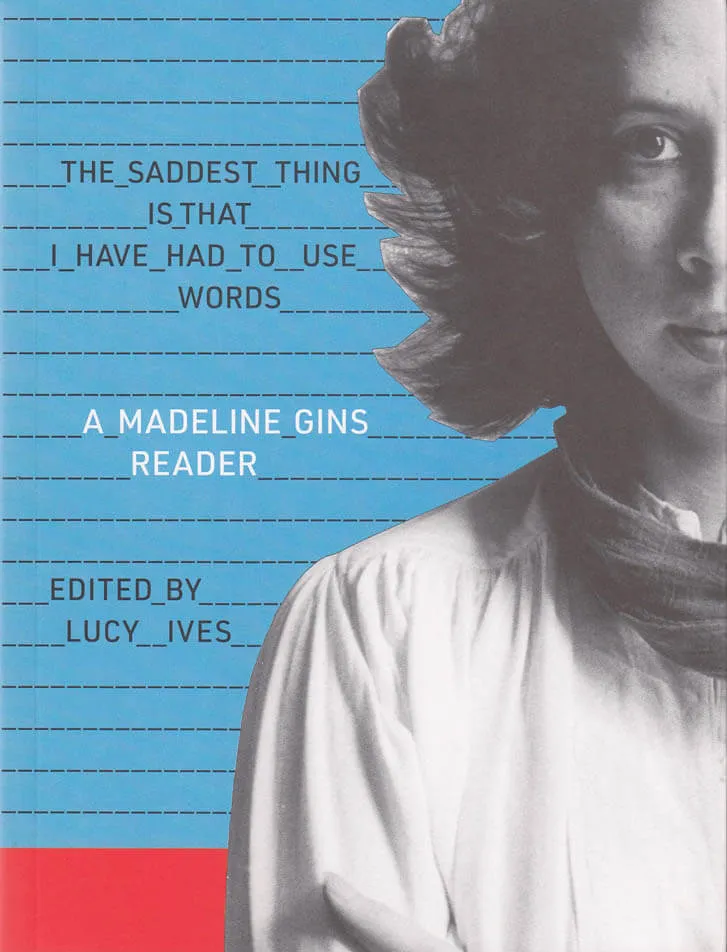
The Saddest Thing Is That I Have Had to Use Words: A Madeline Gins Reader
Poet, philosopher, speculative architect and transdisciplinary artist, Madeline Gins is well known for her collaborations with her husband, the artist Arakawa, on the experimental architectural project Reversible Destiny, in which they sought to arrest mortality by transforming the built environment. Yet, her own writings — in the form of poetry, essays, experimental prose and philosophical inquiries — represent her most visionary and transformative work. Like Gertrude Stein before her, Gins transfigures grammar and liberates words. Like her contemporaries in conceptual art, her writing is attuned to the energized, collaborative space between reader and page.
The Saddest Thing Is That I Have Had to Use Words: A Madeline Gins Reader is a revelatory anthology, edited and with an introduction by the writer and critic Lucy Ives. It brings never-before-published poems and essays together with a complete facsimile reproduction of Gins' 1969 masterpiece, WORD RAIN (or A Discursive Introduction to the Intimate Philosophical Investigations of G, R, E, T, A, G, A, R, B, O, It Says), along with substantial excerpts from her two later books What the President Will Say and Do!! (1984) and Helen Keller or Arakawa (1994). Long out of print or unpublished, Gins' poems and prose form a powerful corpus of experimental literature, one which is sure to upend existing narratives of American poetics at the close of the 20th century.
Edited by Lucy Ives.