rile*books

Search books

Search books by title, author, publisher, keywords...

Cover of Collected Interviews 1990–2018

Verlag der Buchhandlung Walther König

Collected Interviews 1990–2018

Andrea Fraser

€30.00

This substantial archive offers an ideal point of entry into the work and reception of Los Angeles–based performance artist and writer Andrea Fraser (born 1965). The interview format provides particular insight into Fraser's self-positioning as a central aspect of her practice. By presenting the artist's voice as mediated through various interlocutors (ranging from professional peers to popular media), Collected Interviews, 1990–2018 uniquely contextualizes Fraser's practice in the artistic and institutional fields in which she intervenes.

Language: English

recommendations

Cover of Ian Burn: Collected Writings 1966–1993

Verlag der Buchhandlung Walther König

Ian Burn: Collected Writings 1966–1993

Ian Burn

Anthology €40.00

Ian Burn has been described as many things: an activist, a trade-unionist, a journalist, an art critic, a curator and an art historian—or, as he once described himself in a moment of self-deprecating alienation, ‘an ex-conceptual artist’. Born in Geelong in 1939, Burn studied painting in Melbourne and went on to live and work in London and New York. Burn moved back to Australia in 1977 and passed away in 1993 at the age of 53. Burn sought to grapple with how art history intersects and engages with contemporary art and political debate, arguing for a decentred view of the world. 

His legacy is international and can be seen in retrospective exhibitions as recent as 2022, and his work remains a key touchstone in art history. Edited by Burn’s friend, frequent collaborator and eminent art historian, Dr Ann Stephen, this volume brings together 49 pieces of Burn’s own agile and expansive writings alongside a vast collection of his artworks. The collection concludes with reflections on Burn’s life and work from prominent figures and past collaborators in the form of memorial lectures.

Ian Burn: COLLECTED WRITINGS 1966–1993 is edited by Ann Stephen and designed by Robert Milne, with contributions by Art & Language, Adrian Piper, Paul Wood, Allan Sekula, and Mel Ramsden.

Cover of Unlawful Assembly

Verlag der Buchhandlung Walther König

Unlawful Assembly

Lucy McKenzie, Alan Michael

A collection of interrelated short stories by Lucy McKenzie and Alan Michael. First published in private limited edition, it was intended as a cheap holiday read to titillate and entertain summer visitors to the Mediterranean island of Stromboli, and as a piece of site-specific work; the location of the action and the place in which it is read being the same.

The visual art subsequently generated by Unlawful Assembly includes work by Josephine Pryde, with whom the artists collaborated to produce this second edition’s cover image.

Cover of Movement Notation

Verlag der Buchhandlung Walther König

Movement Notation

Noa Eshkol, Abraham Wachmann

Eshkol and Wachmann focused dance on its basic element: the movement of the human body. They treated the different parts of the body as separate instruments, similar to the musical instruments of an orchestra–each with its own rules for the movements to be performed. This new edition of the 1958 publication is supplemented by contributions from Eshkol’s companions and further archive material, which contextualizes and supplements the history of the 'EWMN’s‘ origins and embeds it in contemporary discourses on dance and movement. 

The publication is published in the context of the performance 'Pause: The Noa Eshkol Chamber Dance Group‘ at KW Institute for Contemporary Art (August 2023), as well as the exhibition 'Noa Eshkol: No Time to Dance‘ at the Georg Kolbe Museum (15 March–25 August 2024). The new edition was developed together with the 'Noa Eshkol Foundation for Movement Notation‘.

Cover of Cologne art fair 1977

Verlag der Buchhandlung Walther König

Cologne art fair 1977

Michael Krebber, Jack Smith

Jack Smith presented his performance Irrational Landlordism of Bagdad as part of the Cologne Art Fair fringe in the summer of 1977. Many other events were documented photographically and can now be found in the Cologne Art Fair archives - not so Smith's performance.

This book shows him in his fair stall and during his performance for the first time. The pictures are perfect documents of a completely eccentric transaction by this pioneering director and performance artist.

Cover of in the coherence, we weep

Verlag der Buchhandlung Walther König

in the coherence, we weep

Kameelah Janan Rasheed

“in the coherence, we weep is both an artist book and an exhibition. The project is about the critical potential of incoherencies. It is an attempt to map methodology across media, while welcoming glitches that allow for moments of critical self-reflection and knowledge production. Developed in parallel, the book and exhibition critically reflect on each other’s approaches. It looks at strategies for how text can be alive and vibrant across various architectural contexts as well as those used in the artist’s family archive, particularly annotation, redaction, indexing, blurring, and learning through reading and writing.” - KW Institute for Contemporary Art

“Multilayering was in that sense an important aspect, which got translated with the material and the design by choosing papers with differents gradients of transparency, as well as interfering and overlapping text layouts. We also designed the cover with a blue scratch off drawing on top of another artwork, so every book might change a bit over time depending on the use. This reflects the artist‘s idea of including the audience and an ever changing oeuvre, where the relation between pieces become important too.” - Studio Pandan

Texts by Dr. Christina Landbrecht, Krist Gruijthuijsen, Sofie Krogh Christensen, Chang Yuchen, Ladi'Sasha Jones

This artist book is published on the occasion of Kameelah Janan Rasheed’s Schering Stiftung Award for Artistic Research 2022 solo exhibition at KW Institute for Contemporary Art (2023).

Cover of Initiales #05 — Andrea Fraser

École nationale supérieure des beaux-arts de Lyon

Initiales #05 — Andrea Fraser

Claire Moulène, Emmanuel Tibloux

Periodicals €15.00

Le cinquième numéro de la revue d'art et de recherche « rétro-prospective » est consacré à l'artiste et performeuse Andrea Fraser, figure clé de l'art des années 1990 et 2000 et du courant de la « critique institutionnelle » (une monographie complétée par une grande enquête sur l'espace critique réalisée auprès d'une cinquantaine d'artistes, critiques et philosophes internationaux).

Avec contributions de Kader Attia, Eva Barto, Sophie Bonnet-Pourpet, Marie de Brugerolle, Gregory Buchert, Daniel Buren, Marie Canet, Gregory Castéra, Inès Champey, Thierry Chancogne, Claire Fontaine, François Cusset, Judith Deschamps, Paul Devautour, Philippe Durand, Joao Enxuto & Erica Love, Andrea Fraser, Nicolas Frespech, Dora García, Romain Grateau, Emmanuel Guez, Thomas Hirschhorn, Aliocha Imhoff & Kantuta Quirós, Béatrice Josse, Franck Larcade, Ju Huyn Lee, Sven Lütticken, Fabrice Mabime, Bartomeu Mari, Chus Martínez, Gwenael Morin, Claire Moulène, Jean-Luc Moulène, Yan Moulier Boutang, Vincent Normand, François Pain, Gerald Petit, Anne Querrien, Thierry Raspail, Sinziana Ravini, Delphine Reist & Laurent Faulon, Christophe de Rohan Chabot, Phillippe Roux, Jean-Baptiste Sauvage, Thomas Schlesser, Ida Soulard, Fabien Steichen, Michel Surya, Emmanuel Tibloux, Vier 5, Ulf Wuggenig, Italo Zuffi.

Cover of Adagio For Color Fields

Goswell Road

Adagio For Color Fields

Chris Korda

Monograph €35.00

Chris Korda (b.1962) is an American antinatalist activist, techno musician, software developer, multimedia artist and founder of the Church of Euthanasia. For the past 30 years, her work has spanned avant-garde performance, happenings, culture- jamming, photography, video, audio and so much more - though her work as an engineer, coder and software developer remains less known to the general public.

This book posits that her software and coding work are linked to her more well-known activist and music work, informing and reforming each other for over 30 years, inhabiting up until now parallel timelines that have been closening over the decades, honing in on a common creative goal: to reveal her as she should be revered, as an Inventor-Artist.

“Any outcome is inevitably shaped by the tools used to achieve it. In industrial civilization, most people use the same standardized tools and therefore achieve similarly standardized outcomes. But imagine discovering a tool for making tools. The outcomes are now limited only by toolmaking skills. This is how computer programming changed my life.”

She refers to her generative artworks, audio and visual, as kinetic sculptures. Working in collaboration with her algorithms, she does not use the machine as a ‘servant’ but rather:

“I invite them into the creative space as equals. They have abilities that I don’t have, and I also have abilities that they don’t have, so we complement each other. They supply speed and precision, I supply desire and intuition, and what emerges is greater than the sum of the parts.”

Thus, on the occasion of the exhibition of the same name, we dedicate this book to Korda’s generative audio-visual synesthetic work 'Adagio For Color Fields' (2023) - a piece that breaks the silence - using it as a lens to bring into focus Korda’s work as an innovative Inventor-Artist.

Cover of Ezio Gribaudo - The Weight of the Concrete

Grazer Kunstverein

Ezio Gribaudo - The Weight of the Concrete

Lilou Vidal, Tom Engels and 1 more

The Weight of the Concrete explores the legacy of the Turinese artist and publisher Ezio Gribaudo (1929–2022), examining his multifaceted oeuvre at the confluence of image and language. This publication, named after Il Peso del Concreto (1968)—a seminal work that featured Gribaudo’s early graphic creations alongside an anthology of concrete poetry edited by the poet Adriano Spatola (1941–88)—places Gribaudo’s work in conversation with approximately forty artists and poets from different generations, all of whom similarly engage with explorations of text, form, and visual expression.

Reflecting the editorial premise of Il Peso del Concreto, The Weight of the Concrete revisits the influential anthology, including archive material that documents its production, and reimagines it, pairing Gribaudo’s graphic work with a new selection of historical and contemporary concrete and experimental poetry.

At the heart of the volume is Gribaudo’s emblematic Logogrifi series, developed from the 1960s onward. The Logogrifi reveal his deep engagement with the art of bookmaking and fascination with industrial printing processes, relief matrices, typefaces, and language games.

In this new edition, the editors take the opportunity to revisit Gribaudo’s pioneering work, examining previously overlooked dimensions—gendered, geographical, and technological—and exploring contemporary associations beyond the original context. The book also includes essays that elucidate the poetic and political interplay between image, language, and materiality.

This publication is released following Ezio Gribaudo – The Weight of the Concrete, an exhibition held at the Grazer Kunstverein in Graz, Austria (2023–24), and at the Museion—Museum of Modern and Contemporary Art in Bolzano-Bozen, Italy (2024).

Edited by Tom Engels and Lilou Vidal
Published by Axis Axis and Grazer Kunstverein

Contributions by Anni Albers, Mirella Bentivoglio, Tomaso Binga, Irma Blank, Al Cartio, Paula Claire, CAConrad, Natalie Czech, Betty Danon, Constance DeJong, Mirtha Dermisache, Johanna Drucker, Bryana Fritz, Ilse Garnier, Liliane Giraudon, Susan Howe, Alison Knowles, Katalin Ladik, Liliane Lijn, Hanne Lippard, Sara Magenheimer, Françoise Mairey, Nadia Marcus, Giulia Niccolai, Alice Notley, Ewa Partum, sadé powell, N. H. Pritchard, Cia Rinne, Neide Dias de Sá, Giovanna Sandri, Mary Ellen Solt, Alice Theobald, Colleen Thibaudeau, Patrizia Vicinelli, Pascal Vonlanthen, Hannah Weiner, and Ruth Wolf-Rehfeldt

Essays by Alex Balgiu, Tom Engels, Nadia Marcus, Luca Lo Pinto, Mónica de la Torre, and Lilou Vidal

Cover of A Dance Mag - Issue 05: Flow

Dance Lit

A Dance Mag - Issue 05: Flow

Jana Al Obeidyine

Periodicals €19.00

Issue 05, Flow, moves like water through rupture and release. Guided by the I-Ching, we drift into synesthetic rope rituals in Germany, spiral through Taijiquan in Canada, sway in sacred dances under Ethiopian stars, and lose ourselves in the rapture of Krishna Vandana. Here, flow is both a political current and a state of surrender. From Gabriel Semerene's meditations on faith and protest across Gaza and Brazil to Nerda Khara's navigation of societal constraints in Pakistan, these pieces explore how movement becomes both resistance and surrender. Tejaswini Loundo ponders flow states in Indian classical philosophy while Erika Mattio finds unity in the sacred dances of Lalibela. Shanny Rann discovers spirit in Taijiquan's slow power, Antje Brockmüller maps synesthesia through rope flow, and Anna Chwialkowska questions ghosts’ choreography. Each piece paired with its own hexagram, creating a map of emergence and dissolution. Maria Harfouche's photography dissolves structure into motion where edges blur and time becomes fluid, capturing the moment when form gives way to flowing energy.

A Dance Mag is an independent magazine that looks at the world through the lens of dance. It transcends differences, distances, and disciplines to tell the stories of people from all over the world, who are dancing their lives and giving their bodies a voice. 

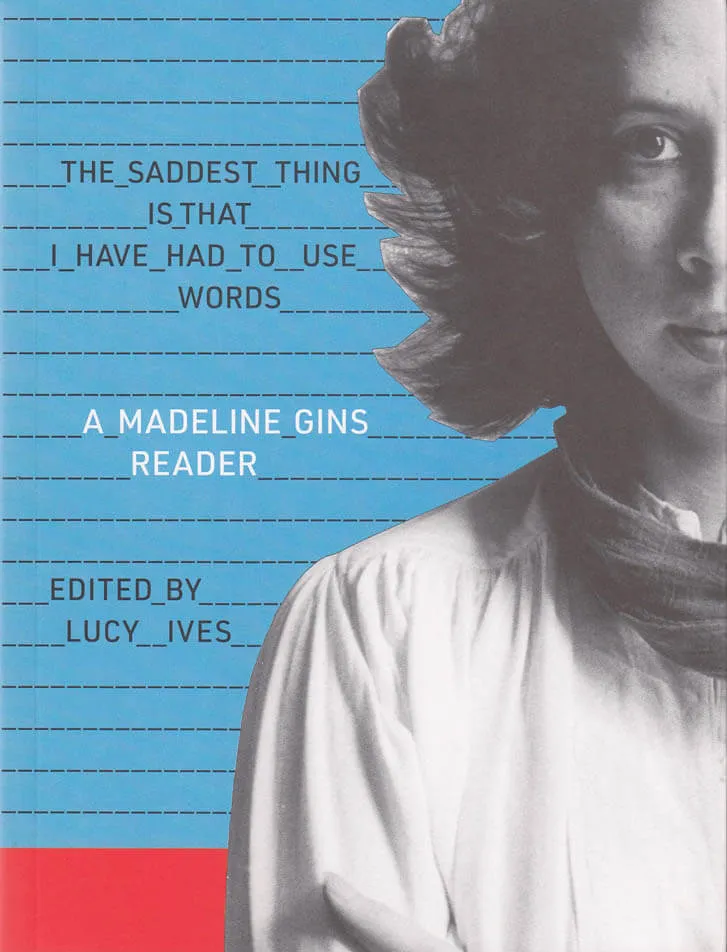
Cover of The Saddest Thing Is That I Have Had to Use Words: A Madeline Gins Reader

Siglio Press

The Saddest Thing Is That I Have Had to Use Words: A Madeline Gins Reader

Madeline Gins

Poetry €28.00

Poet, philosopher, speculative architect and transdisciplinary artist, Madeline Gins is well known for her collaborations with her husband, the artist Arakawa, on the experimental architectural project Reversible Destiny, in which they sought to arrest mortality by transforming the built environment. Yet, her own writings — in the form of poetry, essays, experimental prose and philosophical inquiries — represent her most visionary and transformative work. Like Gertrude Stein before her, Gins transfigures grammar and liberates words. Like her contemporaries in conceptual art, her writing is attuned to the energized, collaborative space between reader and page.

The Saddest Thing Is That I Have Had to Use Words: A Madeline Gins Reader is a revelatory anthology, edited and with an introduction by the writer and critic Lucy Ives. It brings never-before-published poems and essays together with a complete facsimile reproduction of Gins' 1969 masterpiece, WORD RAIN (or A Discursive Introduction to the Intimate Philosophical Investigations of G, R, E, T, A, G, A, R, B, O, It Says), along with substantial excerpts from her two later books What the President Will Say and Do!! (1984) and Helen Keller or Arakawa (1994). Long out of print or unpublished, Gins' poems and prose form a powerful corpus of experimental literature, one which is sure to upend existing narratives of American poetics at the close of the 20th century.

Edited by Lucy Ives. 

Cover of Maquillage as Meditation: Carmelo Bene and the Undead

If I Can't Dance

Maquillage as Meditation: Carmelo Bene and the Undead

Sara Giannini

Performance €20.00

Partly a script, partly a personal voyage into the psyche of diseducation, this book happens, has happened and will happen on the 31st of October in a place called ‘The Palace of Melancholy’. In this temporal and spatial loop, the figure of Italian actor, author, director, philosopher, and public persona Carmelo Bene is summoned to hopefully be dismissed once and for all. Bene is looked at by the author reluctantly and yet resolutely through inner voices of dissent, shame and rebellion. He is imagined in gatherings that didn’t happen and read through an epistemology of contradiction. In Giannini’s company and support, Snejanka Mihaylova, Jacopo Miliani, and Arnisa Zeqo probe the walls of the Palace, looking for an exit.