Local Angels
Local Angels

The Interjection Calendar 005
Emily Pope, Christiane Blattmann
For the Interjection Calendar each month Montez Press invites an artist, a writer, a poet or a doer of some sorts to say things. All 12 pieces have introspection and reflection in common. They are a subjective overview of writing in the expanded field of contemporary art and writing in the year 2019. This is the Interjection Calendar 2019, the fifth collection in this series.
With contributions by sabrina soyer, Lisa Robertson, Hatty Nestor, Adrianna Whittingham, Sondria, Claudia Pagès, Laetitia Paviani, Bella Milroy, Georgina Tyson, Son Kit, Alix Jean Vollum, Rene Matic and bleubaglife.
Find the last 12 PDF's on montezpress.com.

the project
the project - a project about love and intimacy. 'It is a method that touches on (or rather, crashes into) some (artistic) ‘taboo’s’, surrounding the ways in which the autobiographical, one’s intimate life and those who partake in that, can and ought to be dealt with within one’s artistic work. She ‘gets away with it’ and I think the reason for that is that she doesn’t try to spare herself or seek a safety zone, nor does she shun her artistic, author’s responsibility: she is constantly both in the middle of the sticky hot soup in which she is cooking her research and she doing the stirring, the spicing and the serving.' - Philippine Hoegen

The Floor Is Uneven. Does It Slope?
In 1987, artist and poet Madeline Gins (1941–2014) and her partner, painter Arakawa (1936–2010), formed the Architectural Body Research Foundation (later to become the Reversible Destiny Foundation)—an architectural office pursuing the radical conviction that architecture would provide humanity with the necessary tools and training to overcome death. Their wide variety of theories investigated how a person might interact with their environment, and how that environment might condition and enhance the body to increase its capabilities—through a constant undoing and unsettling of subject formation. Taking the work and writings of Madeline Gins and Arakawa as a broad provocation, The Floor Is Uneven. Does It Slope? aims to swallow and masticate the duo’s thought into a new sort of pulp: a collective fan fiction work. Less a book about Gins and Arakawa than a book after them, it tries to seed their work to various fans—writers and makers indebted to the duo’s thinking or suspected to be enthralled by it.
Contributors speak about Gins and Arakawa through the language of their own practice, through academia, poetry, essays, photography, experimental writing, and fiction—thinking about what Gins and Arakawa might mean to their individual fields.
Texts by Henry Andersen, Lila Athanasiadou, Ben Thorp Brown, Lucas Crawford, Bryana Fritz, Laura Herman, Daisuke Kosugi, Joyelle McSweeney, Simone C. Niquille, Andros Zins-Browne.

Enn Gramaten
Luke Williams, Natasha Soobramanien
A cautionary tale of academic privilege and misadventure in Diego Garcia via a Kreole translation, and parallel live chat.
Dialecty, conceived by Maria Fusco with The Common Guild, considers the uses of vernacular forms of speech and writing, exploring how dialect words, grammar and syntax challenge and improve traditional orthodoxies of critical writing.

Disappearing Curtains
This book sees the re-emergence of the seminal 1970s magazine Curtainsedited by British artist/writer, Paul Buck.
With its early promotion of French writers such as Georges Bataille, Maurice Blanchot, Jacques Derrida, Jean-Pierre Faye and Edmond Jabès, Curtains’ re-appearance arrives after an exhibition at Focal Point Gallery in 2012 that was recreated from an earlier 1992 work at Cabinet Gallery around the concept of ‘disappearing’.
The invited contributions come from thirteen artists with whom the editor has engaged over the years. In addition, Buck has returned to pull threads from the earlier editions of his magazine to explore ideas with writers encountered in the intervening years, making all appear in a consolidated grouping as a final gesture, one that refuses to disappear.
Contributions include those by: Kathy Acker, Susan Hiller, Liane Lang, Lucy McKenzie, Richard Prince, Miroslav Tichy, Sophie von Hellermann, and many others.

A Family in Brussels
Filmmaker Chantal Akerman presents A Family in Brussels, a fictional stream-of-consciousness text encompassing multiple subjectivities and laced with autobiographical references. This is the first English-language publication of the work, which Akerman wrote and first performed as a monologue in Paris and Brussels. The accompanying recording documents the theatrical reading that took place at the Dia Center for the Arts, New York, in October 2001. The listener can hear Akerman's singular voice as she muses on familial relations, communication, closeness, and distance.

Jolly Rogers
Jolly Rogers is a collection of Peter Wächtler's latest short texts, written in preparation of his two solo exhibitions at Bergen Kunsthall and Kunsthalle Zürich (both 2019), and combined with a nearly complete collection of the artist's drawings and prints from recent years.
The texts operate like vignettes to a larger story, and the images as unreliable illustrations to the narrative. However, the larger story never really is revealed. Each individual text, each single work, articulates itself by means of an intense focus. It is as if we were suspended in a continual zooming motion, as if the artist and author wanted to tell and show it all. But alas, such is life under the microscope: always larger-than-life, but at the wrong scale at a time driven by individual interests, self-optimization, and egos that stage themselves simultaneously as victims and disruptors.
Peter Wächtler works in a variety of media: bronze, ceramics, drawings and video. But in many ways “stories” could be described as his main artistic material. His works often evoke a narration, with animals or human figures in animated states. They are made in ways that use and adapt elements of fiction and folklore, relating to specific traditions and common tales, and materialize the ways of telling a story as much as the story itself.
Born 1979 in Hannover, Peter Wächtler lives and works in Brussels and Berlin.

Where is Cinema
This book is compiled of portraits of film initiatives from around the world, interwoven with conversations with adventurers who have rebooted movie theatres or built them up from the ground in the hope that it can be an inspiring compendium for future cinema builders, filmmakers, film curators and film lovers.
Anouk De Clercq in conversation with Verena von Stackelberg, Ana López Ortego and Daniel Bejarano, Ilona Jurkonytė and Ugnė Marija Andrijauskaitė, Adam Pugh, Thomas Liu and Silja Espolin Johnson, Erika Balsom, Beatrice Gibson, María Palacios Cruz and Ben Rivers, Heather Lane and Mia Ferm.
The author is an artist and filmmaker based in Brussels and Berlin. In her work, she explores the potential of audiovisual language to create possible worlds. She is affiliated as an artistic researcher to the School of Arts University College Ghent, and a founding member of Cinema Nova, Monokino and Auguste Orts.

Engagement Arts Zine 2
Contributors: Anissa Boujdaini, Anna Muchin, Chloe Chignell, Ilse Ghekiere, Justine Serlat, Kevin Fay, Nancy, Sebastian Kann, Shadow Cabinet and Elsa B Mason.
Editors: Chloe Chignell, Daisy Phillips, Eline, Jacopo Buccino and Justine Serlat.
December 2019

Job Interviews
“The ritual of the job interview can be considered as a courtship that’s conditioned by protocols that ask for a quite particular display: with social relations as material, a dance of conformity, the attempted imagining and echoing of expectations.”
This anthology of commissioned writing includes contributions by Nadim Abbas, Howie Chen, Heman Chong, Matthew Dickman, Jason Dodge, Angie Keefer, Holly Pester, Natasha Soobramanien, Marina Vishmidt, and Jonas Žakaitis.
Edited and illustrated by Chris Evans, and co-published with Para Site, Hong Kong.

My Mother Laughs
Chantal Akerman, Daniella Shreir
In 2013, the filmmaker Chantal Akerman's mother was dying. She flew back from New York to Brussels to care for her, and between dressing her, feeding her and putting her to bed, she wrote. She wrote about her childhood, the escape her mother made from Auschwitz but didn't talk about, the difficulty of loving her girlfriend, C., her fear of what she would do when her mother did die. Among these imperfectly perfect fragments of writing about her life, she placed stills from her films. My Mother Laughs is both the distillation of the themes Akerman pursued throughout her creative life, and a version of the simplest and most complicated love story of all: that between a mother and a daughter.
With an introduction by Eileen Myles and afterword by Frances Morgan.

Time has fallen asleep in the afternoon sunshine
Runa Borch Skolseg, Victoria Pérez Royo and 2 more
A book on reading, writing, memory and forgetting in a library of living books.
This publication documents a project inspired by Bradbury's Fahrenheit 451, in which performers memorize a book to form a collection of living books to be read in libraries by visitors. The publication brings together eighteen text contributions from artists and theoreticians, and a visual essay.
The project Time has fallen asleep in the afternoon sunshine starts as a group of people who dedicate themselves to memorizing a book of their choice. Together they form a library collection consisting of living books. The “books” pass their time in libraries reading, memorizing, talking to each other, going for walks outside, prepared to be read by a visitor. The readings take place as intimate one-to-one encounters where the “book” recites its content to the reader. Over time the project grew into a library collection of more than eighty living books in twelve different languages across Europe and beyond. The project developed into a bookshop, a publishing house and an exhibition format, and hosted workshops, lectures and talks and, eventually, a book.
The publication brings together eighteen text contributions from artists and theoreticians with a varying degree of proximity to the project. Their reflections touch on memory and forgetting; on the practice of learning by heart and its corporeality; on reading, re-reading, reading aloud, reading for oneself and for others; on writing, re-writing and translating; on invisible and impossible literatures; on alternative temporalities and their respective economies; on archives, libraries, bodies and other sites for conservation; on the problems of authorship and originality; on immateriality and its discontents; on the equivocal borders between reality and fiction; and on the strange and unforeseeable dynamics of people and stories coming together, disseminating and unexpectedly crossing paths again. The second part of the book is a visual essay that documents the processes of memorizing, reading and re-writing.
Contributions by: Mette Edvardsen, Kristien Van Den Brande, Johan Sonnenschein, Bruno De Wachter, Lizzie Thompson, Sébastien Hendrickx, Victoria Pérez Royo, Jon Refsdal Moe, Bojana Cvejić, Melanie Fieldseth, Jeroen Peeters, Lara Khalidi, Emiliano Battista, Thomaz Bîrzan, Susanne Christensen, Olivia Fairweather and Laurence Rassel.

Retrospective
Retrospective is a comedy-science-fiction novelette about “faggotry” and the art world; depicting a retour-au-passé in contemporary painting and waving to some of the most beautiful homosexuals on Earth. Flaunting otherness, the alert reader can follow a clerk of The Land of Sculptures whilst he encounters the pretty faces of The Painter, The Foreign Painter, The Tyrolese Painter and other people doing art and drugs.
Retrospective includes “Thumbs-Up”, a superficial analysis of the normalisation of gayness; “Why Homos Are Better”, a masterpiece of investigative journalism in two parts, that originally appeared in Agony 2 (circa 1988–93), a zine edited by B. Boofy and William Bonifay; a drawing by Jurgen Ots; a photograph by César Segarra; and a poem by Lars Laumann.
Alberto García del Castillo writes genre fiction and nonfiction about communities and queer, performs his own and other people's writings, and collaborates in multiple configurations. He has published his writing in Girls Like Us, co-edited Midpoint (Théophile's Papers, 2016) and his two novels Merman (2017) and Retrospective (2014) were published by Shelter Press. Alongside Marnie Slater, is co-curator of Buenos Tiempos, Int.

Die Toilette
Marnie Slater, Louise Menzies and 1 more

Same Old (new book)
Same old (new book), featuring some cut up drawings because sometimes you just gotta. ~6x9cm ~400p , Glued by hand with shiny cover.
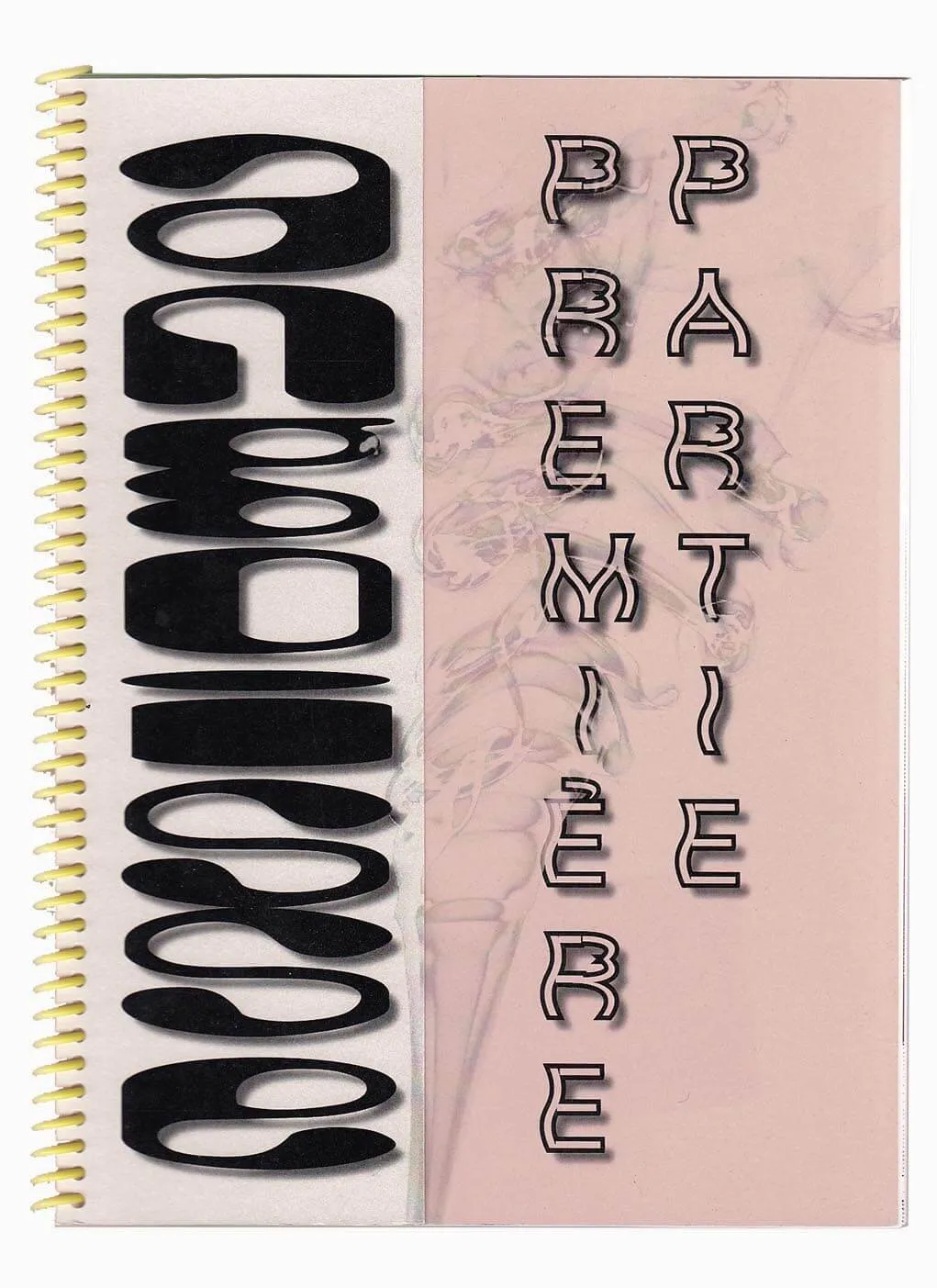
Angoisse: Première Partie
Angoisse: Première Partie departs from the original script written for and used during its performance. The publication was then adapted listening to the sound recording and expanded with transcriptions of interactions, gestures and actions. Special edition w silk-printed handkerchiefs to weep on and wipe off those cold sweats. Graphic design, Roxanne Maillet.
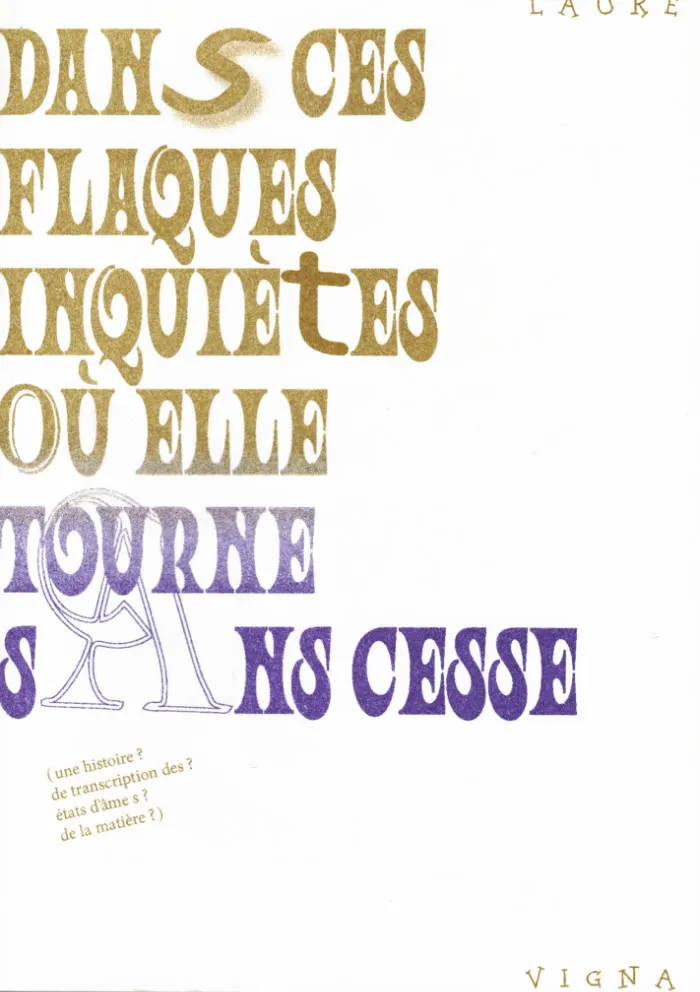
In These Worried Puddles / Dans ces flaques inquiètes
This bilingual edition in two booklets (French/English) brings together short texts and narratives by Laure Vigna, accompanied by notes from news media and scientific articles. Several narrators, with more or less abstract identities alternately representing materials, sculptural forms, or the author, seem to speak under the effect of their emotional states.
Sharing the same spaces of action and words, they merge throughout the text, forming only one physical body at the end. In a collaborative effort between Laure Vigna and graphic designer Roxanne Maillet, the publication reveals research conducted on typography and letters as body, receptacles, and spaces.
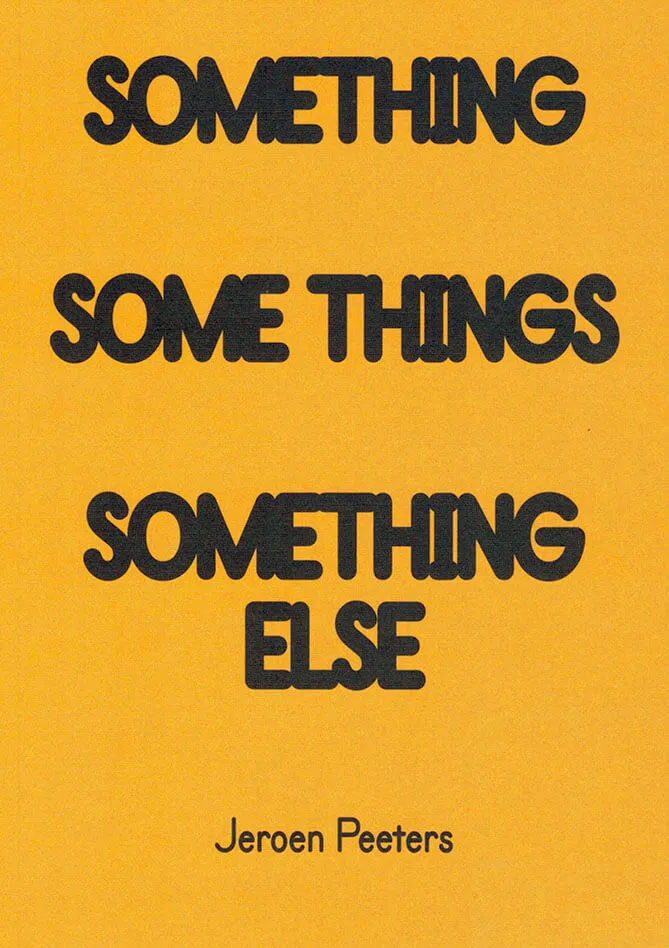
Something Some Things Something Else
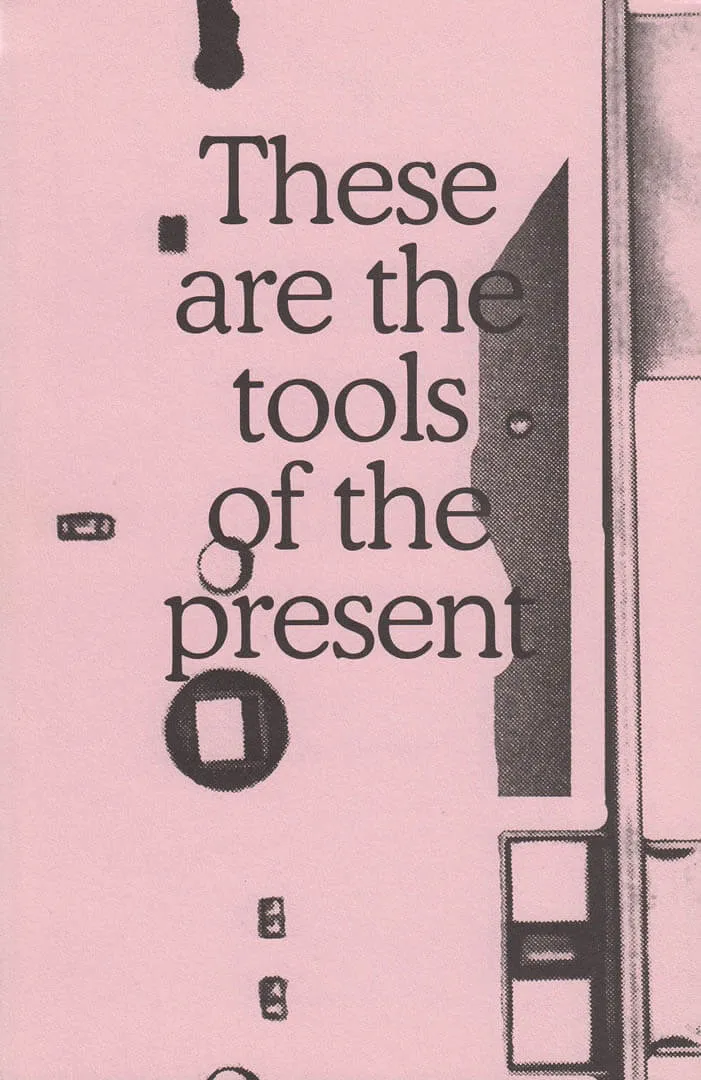
These are the tools of the present
Mai Abu ElDahab, November Paynter and 1 more
This publication comprises a series of interviews with contemporary artists, musicians, and writers who are in dialogue with Beirut and Cairo. While not purporting to be an overview of the art scenes in these cities, this book begins to draw a picture of how artists think about what it means to be active in the contexts of these cities. It offers insight into the circumstances that structured these artists’ stories, and the often accidental influences that have shaped how their practices have developed.
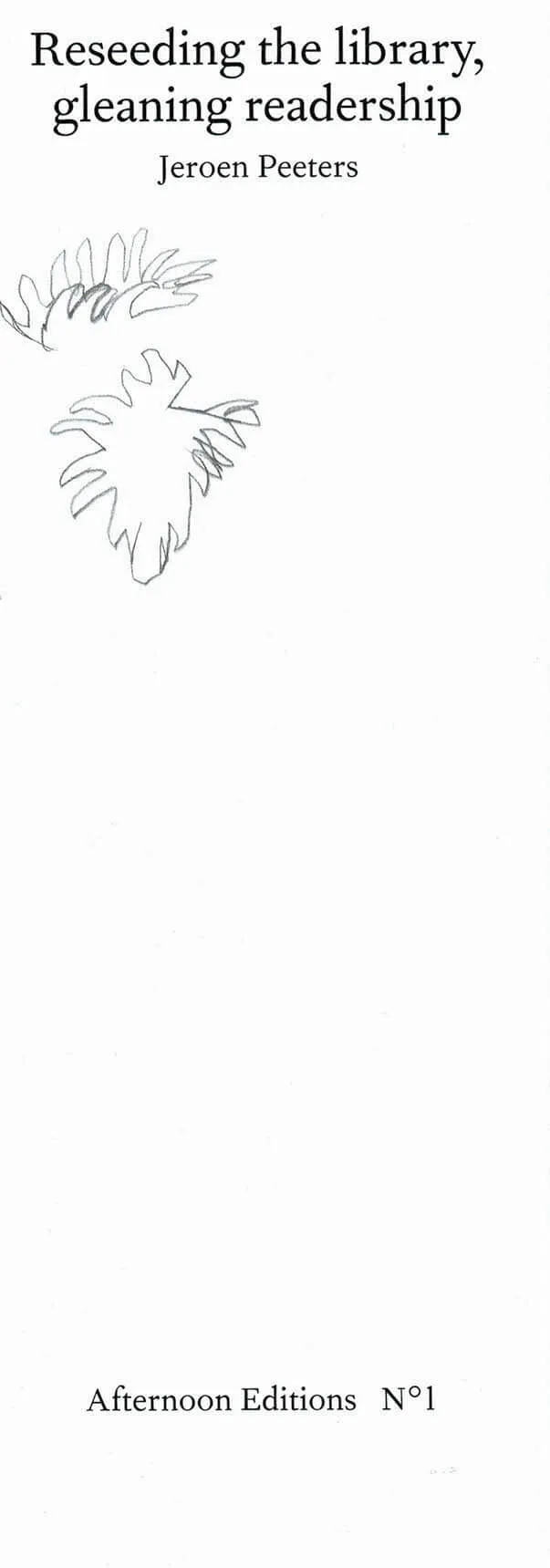
Reseeding the library, gleaning readership
Afternoon Editions no. 1: an essay by Jeroen Peeters titled Reseeding the library, gleaning readership. In May 2017, Time has fallen asleep in the afternoon sunshine settled during three weeks in the Ravenstein Gallery in Brussels as part of the Kunstenfestivaldesarts. Invited as a writer in residence, Jeroen Peeters visited the library of living books on a daily basis and recorded his observations by hand in a notebook, which formed the basis for Afternoon Edition #1. Reseeding the library, gleaning readership is an essay on the seed library, on the dispersion of literature through wind, water and animals, on biodiversity and commoning at the heart of readership. On the cover a drawing by Wouter Krokaert of a Philodendron Xanadu. Published May 2018.
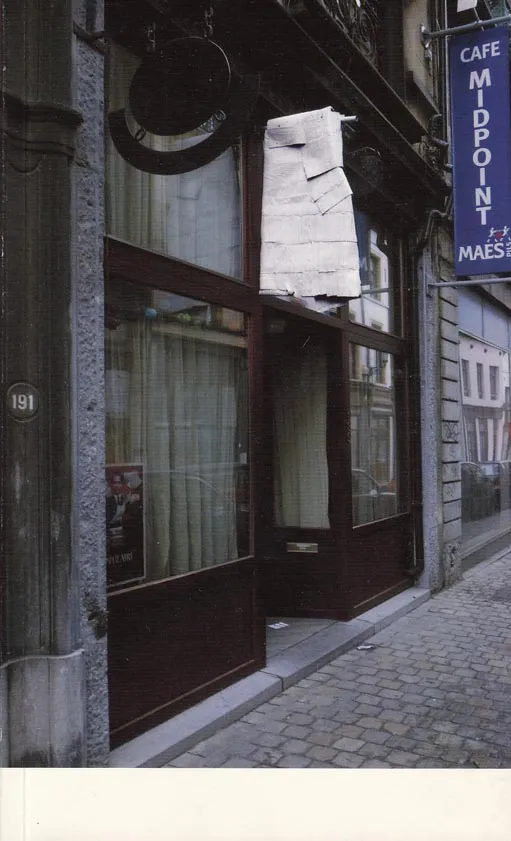
Midpoint Cafe
Various
This book portrays a slice of the history of Midpoint Café and Bar in Brussels from 2011 until today, through interviews with one of its owners and a few of the regulars.
Midpoint is a book of interviews with Fatma Arar, Nick Bastis, Carles Congost, Gro Gravås, Jean-Paul Jacquet, Lars Laumann, Stefanie Snoeck, Harald Thys and Margot Vanheusden.
Edited by Laure Charles, Alberto García del Castillo, Louise Osieka and Marnie Slater.

Time has fallen asleep in the afternoon sunshine
I am a Cat by Sōseki Natsume
For the project Time has fallen asleep in the afternoon sunshine a group of people/ performers memorize a book of their choice. Together they form a library collection consisting of living books. After years of learning by heart and reciting for readers, some of the books have now been written down from memory to create new editions, versions resulting from this process. This book is one of those books, chosen by one person, learned by heart and recited many times, and now written down again from memory. This edition is not a re-edition of the original text. It is a re-writing of the text after the process of reading, memorizing and reciting, with all the alterations that might have occured in the course of this process.

Not Not Nothing
This publication brings together the texts from the pieces Black (2011), No Title (2014), We to be (2015) and oslo (2017) created and performed by Mette Edvardsen. These pieces have been developed using language as material, looking into the relationship between writing and speaking, between language and voice. Mette Edvardsen is working on the verge of the visible, considering choreography as writing.

Persona
PERSONA is the second magazine in a series in response to a series of meetings of female artists entitled "A conversation to know if there is a conversation to be had" held in New York, Amsterdam, Berlin and London in 2010-11. The first journal LABOUR, addressed the question of women's work, and used the lens of the feminist critique of unpaid labour to look at the contemporary condition of the artist. PERSONA as a jumping off point looks at the condition of self-presentation for the contemporary artist, but in an expansive manner encompasses discussions on embarrassment, refusal, interiority and identification.
Contributors: Rita McBride, Celine Condorelli, Avery Gordon, Isla Leaver-Yap, Eva Kenny, Melissa Gordon, Marina Vishmidt, Josephine Pryde, Sabeth Buchmann, Chris Kraus, Audrey Reynolds, Elisabeth Subrin, Alison Carr, Karolin Meunier, Sue Tate, Nadia Hebson, Jen Liu, Da