Choreography
Choreography

Notes on Choreography
On the occasion of Merce Cunningham's centennial comes this edition of his classic and long-out-of-print artist's book Changes: Notes on Choreography, first published in 1968 by Dick Higgins' Something Else Press. The book presents a revealing exposition of Cunningham's compositional process by way of his working notebooks, containing in-progress notations of individual dances with extensive speculations about the choreographic and artistic problems he was facing.
Illustrated with over 170 photographs and printed in color and black and white, the book was described by its original publisher as "the most comprehensive book on choreography to emerge from the new dance ... [which] will come to stand with Eisenstein's and Stanislavsky's classics on the artistic process." By the time these notebooks were published, Cunningham had already led the Merce Cunningham Dance Company for 15 years, and had collaborated with Cage and others on milestones such as Variations V (1966) and RainForest (1968), the latter with Andy Warhol, David Tudor and Jasper Johns.
Along with his essay collection Dancing in Space and Time (1978), Changes is one of the most significant publications on Cunningham's enduring contributions to dance, which developed through collaboration with John Cage to incorporate formal innovation with regard to chance, silence and stillness.

Choreography as Conditioning: Practicing Futures through Voicing
Tawny Andersen, Heike Langsdorf
The books included in the series Choreography as Conditioning are rooted in a cycle of work sessions entitled CASC at KASK, in which students work together with invited guests. They explore the notions of choreography, understood as ways of organizing subjects in their surroundings, and conditioning in both art-making and society-making. Where, how, and by whom are things organized and what kind of landscapes of experience are made (im)possible by the practices we enact and encounter?
Practicing Futures through Voicing, the second book in this series, connects with the first book’s concern with how practices destabilize and (re)constitute the concept of conditioning. It does so by questioning how to process life in a way that allows us to create volume, take space, and find our (tone of) voice—first in our immediate surroundings and, through this, in the world as it struggles and moves toward ongoing futures.
October 2019

Thinking Conditioning through Practice
The books included in the series Choreography as Conditioning are rooted in a cycle of work sessions entitled CASC at KASK, in which students work together with invited guests. They explore the notions of choreography, understood as ways of organizing subjects in their surroundings, and conditioning in both art-making and society-making. Where, how, and by whom are things organized and what kind of landscapes of experience are made (im)possible by the practices we enact and encounter?
Thinking Conditioning through Practice, the first book in this series, addresses the question of how these practices destabilize and (re)constitute the concept of conditioning through six writing processes performed by Alex Arteaga, Julia Barrios de la Mora, Julien Bruneau, Laetitia Gendre & Miram Rohde, Heike Langsdorf and Kristof Van Baarle.
June 2018

The Orphans of Tar – A Speculative Opera
Julien de Smet, Vanessa Müller and 1 more
Contributions by: Julien de Smet, Ronny Heiremans, Heike Langsdorf, Vanessa Müller, Filip Van Dingenen, Stijn Van Dorpe, Clémentine Vaultier, Katleen Vermeir.
The books included in the series Choreography as Conditioning are rooted in a cycle of work sessions entitled CASC at KASK, in which students work together with invited guests. They explore the notions of choreography, understood as ways of organizing subjects in their surroundings, and conditioning in both art-making and society-making. Where, how, and by whom are things organized and what kind of landscapes of experience are made (im)possible by the practices we enact and encounter?
The Orphans of Tar – A Speculative Opera answers the question posed in the second book by transforming life into voices and presenting possible mindsets through co-authoring a factual fiction. As such, it constitutes a mental space in which fictitious characters find an almost disturbing expansion of their thoughts. Accordingly, the book can be considered as an allegory of human thoughts as (possible) actions: what could happen becomes what does happen. For better and worse.
October 2019

Le geste mineur
In this book Erin Manning extends her previous inquiries into the politics of movement to the concept of the minor gesture. The minor gesture, although it may pass almost unperceived, transforms the field of relations. More than a chance variation, less than a volition, it requires rethinking common assumptions about human agency and political action. To embrace the minor gesture's power to fashion relations, its capacity to open new modes of experience and manners of expression, is to challenge the ways in which the neurotypical image of the human devalues alternative ways of being moved by and moving through the world—in particular what Manning terms "autistic perception." Drawing on Deleuze and Guattari's schizoanalysis and Whitehead's speculative pragmatism, Manning's far-reaching analyses range from fashion to depression to the writings of autistics, in each case affirming the neurodiversity of the minor and the alternative politics it gestures toward. (The texts in this book are in French only.)
Translated from English by Aline Wiame (original title: The Minor Gesture, Duke University Press, 2016).

Selected Writings, 1998–2015
A single black-and white photograph taken by Babette Mangolte has come to epitomize New York’s downtown art scene of the 1970s. The dancers performing Trisha Brown’s Roof Piece characterize perfectly the wild spirit of the time. Choreographed as an echo of movement unfolding across SoHo’s rooftops, the dancers mimed the chimneys, water towers, and fire escapes which surrounded them across that skyline. Influenced early on by Dziga Vertov’s Man with a Movie Camera and the work of Stan Brakhage and Jonas Mekas, Mangolte began studies in 1964 at the renowned École nationale de la photographie et de la cinematographie in Paris, one of the school’s first female students. In 1970, having become disillusioned with the film scene in France, Mangolte moved to New York and became involved in the avant-garde film and dance milieus of the Kitchen and the Anthology Film Archives.
Selected Writings, 1998–2015 is a collection of texts by Mangolte in which she reflects on her practice as a photographer and filmmaker and her collaborative work with filmmakers, artists, dancers, and choreographers. She provides insights into the techniques and methods she created as well as her relationships with notable collaborators such as Marina Abramović, Chantal Akerman, Trisha Brown, and Yvonne Rainer.
Copublished with Kunsthalle Wien on the occasion of the exhibition “Babette Mangolte: I = Eye.”

Time has fallen asleep in the afternoon sunshine
Runa Borch Skolseg, Victoria Pérez Royo and 2 more
A book on reading, writing, memory and forgetting in a library of living books.
This publication documents a project inspired by Bradbury's Fahrenheit 451, in which performers memorize a book to form a collection of living books to be read in libraries by visitors. The publication brings together eighteen text contributions from artists and theoreticians, and a visual essay.
The project Time has fallen asleep in the afternoon sunshine starts as a group of people who dedicate themselves to memorizing a book of their choice. Together they form a library collection consisting of living books. The “books” pass their time in libraries reading, memorizing, talking to each other, going for walks outside, prepared to be read by a visitor. The readings take place as intimate one-to-one encounters where the “book” recites its content to the reader. Over time the project grew into a library collection of more than eighty living books in twelve different languages across Europe and beyond. The project developed into a bookshop, a publishing house and an exhibition format, and hosted workshops, lectures and talks and, eventually, a book.
The publication brings together eighteen text contributions from artists and theoreticians with a varying degree of proximity to the project. Their reflections touch on memory and forgetting; on the practice of learning by heart and its corporeality; on reading, re-reading, reading aloud, reading for oneself and for others; on writing, re-writing and translating; on invisible and impossible literatures; on alternative temporalities and their respective economies; on archives, libraries, bodies and other sites for conservation; on the problems of authorship and originality; on immateriality and its discontents; on the equivocal borders between reality and fiction; and on the strange and unforeseeable dynamics of people and stories coming together, disseminating and unexpectedly crossing paths again. The second part of the book is a visual essay that documents the processes of memorizing, reading and re-writing.
Contributions by: Mette Edvardsen, Kristien Van Den Brande, Johan Sonnenschein, Bruno De Wachter, Lizzie Thompson, Sébastien Hendrickx, Victoria Pérez Royo, Jon Refsdal Moe, Bojana Cvejić, Melanie Fieldseth, Jeroen Peeters, Lara Khalidi, Emiliano Battista, Thomaz Bîrzan, Susanne Christensen, Olivia Fairweather and Laurence Rassel.

The Poeticians

The Wind Escorts The Sky
The Wind Escorts The Sky (Weld 2017) is the second part of Pontus Pettersson’s project Poetic Procedures. The project and performance looks into the relation between dance and poetry and how these practices can unfold in the situation of a dance class and with the case of The wind Escorts The Sky; a stage performance. This is the publication that came out of that practice.

Writing Wounds to Heal


Economy as Intimacy (vol.1)
A series of choreopoems by Eric Peter. Published at the occasion of 'Assemblages of Intimacy' a group exhibition in a Tale of a Tub, Rotterdam in 2018.
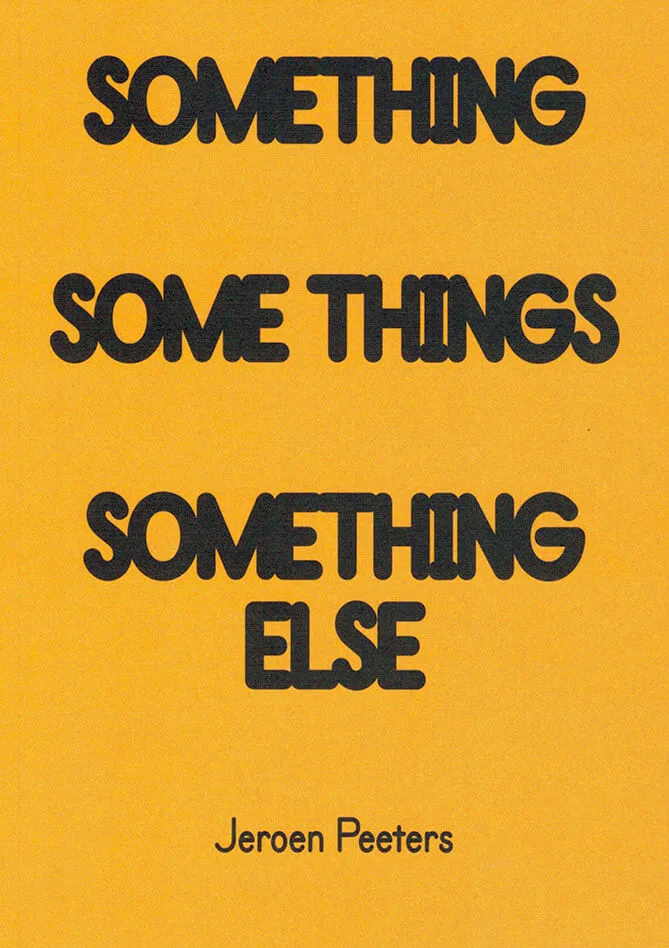
Something Some Things Something Else

Time has fallen asleep in the afternoon sunshine
I am Four Quartets by T.S Elliot
For the project Time has fallen asleep in the afternoon sunshine a group of people/ performers memorize a book of their choice. Together they form a library collection consisting of living books. After years of learning by heart and reciting for readers, some of the books have now been written down from memory to create new editions, versions resulting from this process. This book is one of those books, chosen by one person, learned by heart and recited many times, and now written down again from memory. This edition is not a re-edition of the original text. It is a re-writing of the text after the process of reading, memorizing and reciting, with all the alterations that might have occured in the course of this process.
www.timehasfallenasleepintheafternoonsunshine.be

Not Not Nothing
This publication brings together the texts from the pieces Black (2011), No Title (2014), We to be (2015) and oslo (2017) created and performed by Mette Edvardsen. These pieces have been developed using language as material, looking into the relationship between writing and speaking, between language and voice. Mette Edvardsen is working on the verge of the visible, considering choreography as writing.

Still Life 4
STILL LIFE is an online and printed zine about relationships and configurations in which one person is still while others are not. Or where one person is passive and others are active. It’s about how we put ourselves in other people’s hands. Or how we are put in other people’s hands. It’s about care and power and vulnerability and agency. And other things not so clearly named. It’s about the different kinds of knowledge that people have about their own and other people’s bodies. And the kind of philosophical and political understandings woven into that knowledge.

Still Life 3
STILL LIFE is an online and printed zine about relationships and configurations in which one person is still while others are not. It’s about care and power and vulnerability and agency. And other things not so clearly named. It’s about the different kinds of knowledge that people have about their own and other people’s bodies. https://stilllifemag.org

Spectacle #1 #2 #3
Spectacles is a research by Sara Manente starting from the distance between language and experience, specifically the experience of dance and performance.
Contains Spectacle #1 #2 #3 + the script of spectacle #4.

This Container (Ed. 6)
This Container is an open host for texts and documents that come through and alongside choreographic thinking. It’s a recipe, but not for eating; a sequel to everything up until now; horizontal tourism; many feminists’ elegy; opinions weakened with time; an inaudible lesbian opera; a future ballet manifesto; dances and desires; cheating discipline; purposely misplaced; only poems; statements and speculations; a diagram for artistic research; and an incomplete encyclopaedia of random knowledge and dear dances. This Container takes shape according to its content, without organising through prominent narratives or figures, this container wants to weave, leaving holes and threads between the forms of writing.
With
Deborah Birch
Jennifer Boyd
Oda Brekke
Chloe Chignell
Sven Dehens
Alle Dicu
Ruta Dumciute
Irina Gheorghe
Anya Kravchenko
Maia Means
Zoë Poluch
P0$$E
Ellen Soderhult
Jul/Aug 2018
More info at www.thiscontainer.com

Poetry Collection
Chloe Chignell, Lili M. Rampre
This publication is a collection of poems written through a method called Transtexting. Transtexting explores the body’s implication in poetic production positioning the body and its movement as a listening aid, acting as a filter; a net capturing words, syntax and sounds.

Koreografi
Koreografi / Choreography is a magazine initiated and edited by Solveig Styve Holte, Runa Borch Skolseg and Ann-Christin Berg Kongsness. The magazine consists of texts written by Nordic artists within the field of dance and choreography.