Books
Books
in random order

Short Talks
In Anne Carson's Short Talks the reader is bombarded with short prose poems that resound with the fullness of meditations on lyric sermons, riddle-poems that consist only of answers, Lou Reed meets Claude Monet and converts to Zen, the pure hilarious ache of ontology. SHORT TALKS, the first book-length collection by this accomplished, original voice, is elegiac, perceptive, and droll.
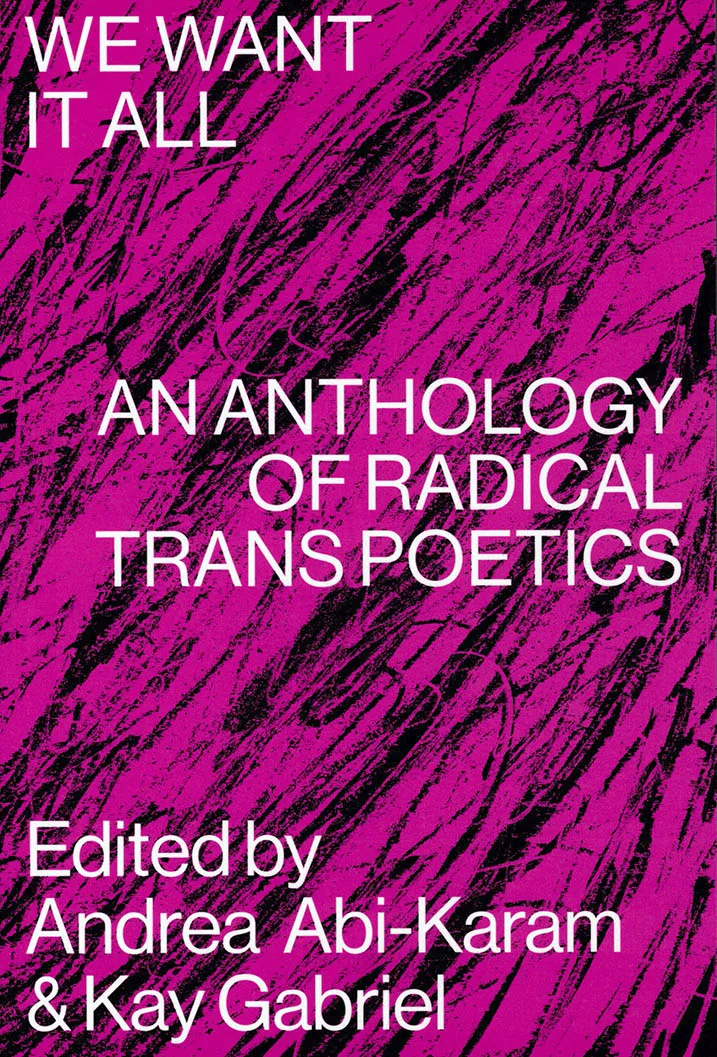
We Want It All: An Anthology of Radical Transpoetics
An anthology of formally inventive writing by trans poets against capital and empire.
With texts by: Andrea Abi-Karam, New York City Sam Ace, South Hadley, MA Bahaar Ahsan, Berkeley, CA jasper avery, Philadelphia, PA Ari Banias, Berkeley, CA Jo Barchi, Chicago, IL Joss Barton, St. Louis, MO Levi Bentley, Philadelphia, PA Jessica Bet, Baltimore, MA Rocket Caleshu, Los Angeles, CA Ching-in Chen, Seattle, WA listen chen, Vancouver, BC Faye Chevalier, Philadelphia, PA Cody-Rose Clevidence, Arkansas Miles Collins-Sibley, Easthampton, MA Valentine Conaty, New York City CA Conrad, Philadelphia, PA Jimmy Cooper, Rochester, MI Maxe Crandall, Oakland, CA José Díaz, Boston, MA Aaron El Sabrout, New Mexico Ian Khara Ellasante, Lewiston, ME Caelan Ernest, New York City, NY NM Esc, San Diego, CA joshua jennifer espinoza, Los Angeles, CA Logan February, Ibadan, Nigeria Ray Filar, Brighton, UK Nora Collen Fulton, Montreal, Canada Kay Gabriel, New York City Callie Gardner, Cardiff, Wales Jesi Gaston, Chicago, IL Harry Josephine Giles, Edinburgh, Scotland Aeon Ginsberg, Baltimore, MD Caspar Heinemann, Berlin, Germany Kamden Hilliard, Greenville, SC Stephen Ira, New York City Cyrée Jarelle Johnson, New York City Peach Kander, New York City Jayson Keery, Western, MA Evan Kleekamp, Los Angeles, CA Noah LeBien, New York City Ty Little, Richmond, VA Zavé Martohardjono, New York City Amy Marvin, Philadelphia, PA Natalie Mesnard, New York City Bianca Rae Messinger, Iowa City, IA Liam O'Brien, New York City Xandria Phillips, Madison, WI Rowan Powell, Santa Cruz, CA Nat Raha, Edinburgh, Scotland Holly Raymond, Philadelphia, PA Jackie S, New York City Trish Salah, Toronto, Canada Raquel Salas Rivera, Philadelphia, PA Mai Schwartz, New York City Kashif Sharma-Patel, London, UK Julian Talamantez Brolaski, Oakland, CA Charles Theonia, New York City Jamie Townsend, Oakland, CA Nora Treatbaby Laurel Uziell, London, UK Rachel Franklin Wood, Boulder, CO Clara Zornado Akasha-Mitra xtian w. and Anaïs Duplan, NYC.
Kay Gabriel is a poet and essayist. She's the author of Elegy Department Spring / Candy Sonnets 1 (BOAAT Press, 2017), the recipient of fellowships from Lambda Literary and the Poetry Project, and recently completed her PhD at Princeton University.
Andrea Abi-Karam is an arab-american genderqueer punk poet-performer cyborg, writing on the art of killing bros, the intricacies of cyborg bodies, trauma & delayed healing. Their chapbook, THE AFTERMATH (Commune Editions), attempts to queer Fanon's vision of how poetry fails to inspire revolution. Andrea's first book, EXTRATRANSMISSION (Kelsey Street Press, 2019), is a poetic critique of the U.S. military's role in the War on Terror.

The Difficulties
If there is a centre around which the language of this pamphlet circulates, then it is Palestine. As this centre, Palestine enables a transformative power that persistently and steadfastly turns repression and silencing into solidarity. Essay-fiction, prose poetry, radical philosophy, speculative nonfiction — this uncategorizable collection of texts brings militant inquiry to each utterance, each narrative turn, in acts of transnational and transhistorical becoming.

Season of the Swamp
New Orleans, 1853. A young Zapotec exile from Mexico named Benito Juárez disembarks at a fetid port city at the edge of a swamp. Years later, he will become the first indigenous head of state in the postcolonial Americas, but now he is as anonymous and invisible as any other migrant to the roiling and alluring city.
Accompanied by a small group of fellow exiles who plot their return and hoped-for victory over the Mexican dictatorship, Juárez immerses himself in the city, which absorbs him like a sponge. He and his compatriots work odd jobs, fall victim to the cons and confusions of a strange young nation, succumb to the hallucinations of yellow fever, and fall in love with the music and food all around them. But unavoidable, too, is the stark trade in human beings.
With the extraordinary linguistic play and love of popular forms that have characterized all of Herrera’s fiction, Season of the Swamp is a magnificent work of speculative history, a love letter to the city of New Orleans and its polyglot culture, and a cautionary statement that informs our understanding of the world we live in.

The Premise of a Better Life
An artist's book by New York-based author and artist Sam Pulitzer (born 1984), The Premise of a Better Life combines photographs with ethical and existential questions addressed to the viewer, in an allegory of the contemporary condition. These photographs of everyday things, ambiguous details, nondescript landscapes and cityscapes were mostly taken in New York, although the city appears as the pale reflection of a model city.
Each picture is accompanied by a question: "Can you afford yourself?" "Are you waiting for a moment that just won't come?" "If you knew then what you know now, would it make a difference?" "Do you trust happiness?" The montages offer a complex, personal, at times satirical image of the present age.
An original essay by Pulitzer unfolds the project's philosophical and political issues, notably discussing a key reference for the project, Ernst Bloch's The Principle of Hope.

Deep Listening
Deep Listening is a practice created by composer Pauline Oliveros in order to enhance her own as well as other's listening skills. She teaches this practice worldwide in workshops, retreats and in her ground breaking Deep Listening classes at Rensselaer Polytechnic Institute and Mills College. Deep Listening practice is accessible to anyone with an interest in listening. Undergraduates with no musical training benefit from the practices and successfully engage in creative sound projects. Many report life changing effects from participating in the Deep Listening classes and retreats.

Poster Edition (bundle)
4 poèmes-affiches, format A3, impriméx en risographie au studio Colorama (Berlin), sur papiers variés, tirage à 150 exemplaires
«GASOLINE, Apocalypse 1998», «the category is: phone sex», «zona nudista», «(fête) sentimental-e-s» : étés d'apocalypse, émojis banane, cruising transocéanique, SMS en short, sales coeurs, baraques à frissons et grand-huit sentimental... ces poèmes courent toustes ~ à genoux, à nu ou en solex ~ après la question du désir, après l'amour aussi, avec une tendre obsession
Design graphique signé Auriane Preud’homme, Enz@ Le Garrec, Roxanne Maillet & Martha Salimbeni, avec des dessins de Gaëlle Loth

This Is Not a Memoir
What do you call a memoir that isn’t? In This Is Not a Memoir, Janette Parris incisively narrates a journey through lost high street landmarks of East and South London in a series of detailed artworks blending map, archive and anecdote with deadpan humour. Part graphic novel, part recollection, and accompanied by an in-conversation between Janette Parris and Gilane Tawadros, this is an intimate exploration of what it means to have ownership of public space, from Wimpy to Woolworth’s via Canning Town. And somewhere in the gaps, in absent moments caught gazing at the sky or a kerbside, an impression of a life emerges–or is that just what she wants you to think?
“This book by Janette Parris tells a deflationary yet expressive coming-of-age story in the East End of London. While it may seem fun and superficial, its considerable power lies in how it moves through memories and moments in a witty and light-footed way presented as a roman-à-clef. This Is Not a Memoir is particular in the way it conjures a world of the 1970s and 1980s that is lost to most of London, yet still resonates with what it means to grow up as a working class young woman who ends up at art school and becomes an artist. It is a brave book to make, but one that will be remembered.”
— Rachel Garfield, artist, Professor of Fine Art at the Royal College of Art and author of Experimental Filmmaking and Punk: Feminist Audio Visual Culture in the 1970s and 1980s (2021)
Janette Parris is an artist who investigates the contemporary urban experience, using narrative, humour and popular formats including soap opera, stand-up comedy, musical theatre, pop mu-sic, cartoons, comics and animation. Parris has exhibited widely nationally and internationally for 25 years at spaces including TATE, The New Art Gallery Walsall, ICA, Kunsthaus Zürich, Hay-ward Gallery Touring, Art on the Underground and Royal Academy of Arts.

Love, Leda
Newly discovered in the author’s archives and published for the first time in the UK in 2023, this portrait of queer, working class London drifts from coffee shop to house party, in search of the next tryst.
Leda is lost. He spends his days steeped in ennui, watching the hours pass, waiting for the night to arrive. Trysts in the rubble of a bombsite follow hours spent in bed with near strangers, as Leda seeks out intimacy in unlikely places. Semi-homeless and estranged from his family of origin, he relies on the support of his chosen one: a community of older gay men and divorced women who feed and clothe him, gently encouraging him to find a foothold in a society which excludes him at every turn. And then there is Daniel, a buttoned-up man of the Lord, for whom Leda nurses an unrequited obsession—one which sends him spiraling into self-destruction. Pre-dating the British Sexual Offences Act of 1967, Love, Leda was first published in 2023 in the UK. This long lost novel is a portrait of London’s Soho that is now lost, an important document of queer working-class life from a voice long overlooked.

The New Television: Video After Television
Rachel Churner, Rebecca Cleman and 1 more
On the rich history of video art and its enduring relevance to today's artistic and critical practices.
The New Television delves into the rich history of video art, reexamining the pivotal Open Circuits conference held at MoMA in 1974 and exploring its enduring relevance to today's artistic and critical practices. Open Circuits was an important event in establishing video art in American museums and articulated a range of conflicting teloses for the medium, some which materialized (like local cable television) and others that remain unrealized. The conference proceedings were published in 1977 as The New Television: A Public/Private Art, and the radical design of the book reflected the conference's utopian aims.
This two-part publication includes a facsimile of the long-out-of-print conference proceedings and new essays and discussions by over a dozen scholars and artists. The new scholarly texts and previously unpublished archival documents in The New Television illuminate the network of institutional histories of video art, consider global televisual contexts and alternative critical approaches, and examine contemporary video art and its continued relevance from new perspectives.
Rachel Churner is the director of the Carolee Schneemann Foundation. She is also an art critic and editor, whose writings have appeared in Artforum and October magazine, among other publications. She was a recipient of the 2018 Creative Capital/Andy Warhol Foundation Arts Writers Grant and is the editor of multiple books, including Jacqueline Humphries: jHΩ1:) (2022); Yvonne Rainer: Revisions (no place press, 2020), Hans Haacke (MIT Press, 2015), and two volumes of writings by film historian Annette Michelson (MIT Press, 2017 and 2020). Churner is a faculty member at Eugene Lang College at The New School, New York.
Rebecca Cleman is Executive Director of Electronic Arts Intermix (EAI) and a writer. She has programmed screenings and special projects for such venues as the International House Philadelphia; the Museum of Art and Design, Anthology Film Archives, and Andrea Rosen Gallery, New York City; and the Julia Stoschek Collection, Germany; and organized or co-organized many events for EAI, including a panel discussion on the films of David Wojnarowicz and a conversation between Hilton Als and The Wooster Group's director and co-founder Elizabeth LeCompte.
Tyler Maxin is curator at Blank Forms. He was previously the Communications and Special Projects Associate at Electronic Arts Intermix (EAI). His writing has appeared in publications including Artforum, BOMB, and Film Comment.

Hechtmappen bieden geen soelaas
Hechtmappen bieden geen soelaas is wat overbleef na een vakantiejob waarbij de taakinhoud vooral bestond uit het verwijderen van nietjes uit verouderde documenten. Deze weken waren de bron voor fascinaties voor ongemakkelijke stiltes, gesprekken in liften, de diefstal van fluorescerende pennen en een ontplofte ventilator.

After Words: Visual and Experimental Poetry in Little Magazines and Small Presses, 1960–2025
This book offers a visual and thematic journey through avant-garde, concrete, visual, and experimental poetics as they appeared in ephemeral little magazines and small press publications from the 1960s onward. This book serves as an exhibition catalog for After Words: Visual and Experimental Poetry in Little Magazines and Small Presses, 1960–2025 from April 23rd to July 26, 2025, at The Grolier Club exhibition in New York City.
Small presses include: 7 Flowers Press, Agentzia, Anabasis, Asylum’s Press, Ayizan Press, Beach Books Texts & Documents, Beau Geste Press, blewointmentpress, Burning Press, C Press, Chax Press, Coach House Press, Edition Hansjörg Mayer, Edizioni Geiger, Expanded Media Editions, Fleye Press, Goliard Press, Grabhorn-Hoyem, Granary Books, Druckwerk, Hawk’s Well Press, Heiner Friedrich, The Hermetic Press, Hermetic Gallery, John Martin, Joseph Melzer Verlag, Kickshaws, Kontexts Publications, Letter Edged in Black Press, Luna Bisonte Productions, Membrane Press, Milano: East 128, New Wilderness Foundation, Nietzsche’s Brolly, Nova News, Open Book, Openings Press, PANic Press, Phenomenon Press, Poltroon Press, Renegade Press, Roaring Fork Press, Scorribanda Productions, Seedorn Verlag, Seripress, Siglio Press, Station Hill, Tarasque Press, Tetrad Press, Visual Poetry Workshop National Poetry Society of London, Wild Hawthorn Press, and Xexoxial Editions.
Little magazines include: “before your very eyes!”, A: An Envelope Magazine of Visual Poetry, Abracadabra, Alcheringa, Anti-Isolation, Approches, AQ, Assembling, Blank Tape, Bulletin From Nothing, Cenizas, Diagonal Cero, E pod, Fruit Cup, Ganglia, Geiger, Gnaoua, Industrial Sabotage, Interstate, Journeyman, Kaldron, Klacto 23, Kontakte, Kontexts, Kroklok, L=A=N=G=U=A=G=E, Libellus, Life Begins with Love, Lines, Lost and Found Times, Lost Paper, Mini, New Wilderness Letter, Pages, Poor.Old.Tired.Horse., Rawz, Revue OU, Rhinozeros, Sammelband Futura, Schmuck, Shi Shi: Concrete & Visual Poetry, Signal, Soft Need, Sondern, Spanish Fleye, Stereo Headphones, Taproot Reviews, The Acts: The Shelf Life, The Difficulties, The Improbable, The Insect Trust Gazette, The Marrahwanna Quarterly, The San Francisco Earthquake, The Subtle Journal of Raw Coinage, Toothpick Lisbon & the Orcas Islands, Unarmed: Adventurous Poetry Journal, UNI/vers(;), WhiteWalls, Xerolage, and xtant.

Having a party (hope you will be there)
"Having a party (hope you will be there)", is a catalogue of an exhibition organized by Mickael Marman and D&TLG at CFAlive in Milan with artists from the black European diaspora, including original contributions, photos of the show, as well as a brand new intro text by Olamiju Fajemisin.

Wretched Strangers
In response to surges of violent British nationalism and political paranoia around borders, and to related social and ethical crises, JT Welsch and Ágnes Lehóczky have assembled an anthology to mark the vital contribution of non-UK-born writers to this country’s poetry culture. Wretched Strangers brings together innovative writing from around the globe, celebrating the irreducible diversity such work brings to ‘British’ poetry. While documenting the challenges faced by writers from elsewhere, these pieces offer hopeful re-conceptions of ‘shared foreignness’ as Lila Matsumoto describes it, and the ‘peculiar state of exiled human,’ in Fawzi Karim’s words.
The book is published by Boiler House Press to commemorate the anniversary of the June 2016 EU Referendum and in solidarity through struggles ongoing and to come. Proceeds will be donated to charities fighting for the rights of refugees.
Alireza Abiz • Astrid Alben • Tim Atkins • Andre Bagoo • Veronica Barnsley • Khairani Barokka • Leire Barrera-Medrano • Katherine E. Bash • Áine Belton • Caroline Bergvall • Sujata Bhatt • Rachel Blau DuPlessis • Fióna Bolger • Ben Borek • Andrea Brady • Serena Braida • Wilson Bueno • James Byrne • Kimberly Campanello • J.R. Carpenter • Mary Jean Chan • che • Matthew Cheeseman • Iris Colomb • Giovanna Coppola • Anne Laure Coxam • Sara Crangle • Emily Critchley • Ailbhe Darcy • Nia Davies • Tim Dooley • Benjamin Dorey • Angelina D’Roza • Katherine Ebury • Dan Eltringham • Ruth Fainlight • Kit Fan • León Felipe • Alicia Fernández • Veronica Fibisan • Steven J Fowler • Livia Franchini • Ulli Freer • Anastasia Freygang • Kit Fryatt • Monika Genova • Geoff Gilbert • Peter Gizzi • Chris Gutkind • Cory Hanafin • Edmund Hardy • David Herd • Jeff Hilson • Áilbhe Hines • Alex Houen • Anthony Howell • Nasser Hussain • Zainab Ismail • Maria Jastrzębska • Lisa Jeschke • Evan Jones • Loma Sylvana Jones • Maria Kardel • Fawzi Karim • Kapka Kassabova • Özgecan Kesici • Mimi Khalvati • Robert Kiely • Michael Kindellan • Igor Klikovac • Ágnes Lehóczky • Éireann Lorsung • Patrick Loughnane • John McAuliffe • Aodán McCardle • Niall McDevitt • Luke McMullan • Christodoulos Makris • Ethel Maqeda • Lila Matsumoto • Luna Montenegro • Stephen Mooney • Ghazal Mosadeq • Erín Moure • Vivek Narayanan • Cristina Navazo-Eguía Newton • Alice Notley • Terry O’Connor • Wanda O’Connor • Gizem Okulu • Claire Orchard • Daniele Pantano • Astra Papachristodoulou • Fani Papageorgiou • Richard Parker • Sandeep Parmar • Albert Pellicer • Pascale Petit • Adam Piette • Jèssica Pujol Duran • Alonso Quesada • Ariadne Radi Cor • Nat Raha • Nisha Ramayya • Peter Robinson • William Rowe • Lisa Samuels • Jaya Savige • Ana Seferovic • Sophie Seita • Seni Seneviratne • Timea Sipos • Zoë Skoulding • Irene Solà • Samuel Solomon • Agnieszka Studzinska • James Sutherland-Smith • George Szirtes • Rebecca Tamás • Harriet Tarlo • Shirin Teifouri • Virna Teixeira • David Toms • Sara Torres • Kinga Toth • Claire Trévien • David Troupes • Arto Vaun • Juha Virtanen • J. T. Welsch • David Wheatley • Elżbieta Wójcik-Leese • Jennifer Wong • Isaac Xubín • Jane Yeh

Inch Aeons
Inch Aeons is a meditation on the form of meaning, the nature of nature, and the locality of tradition in an over-wired-world.
Here, award-winning poet Nuala Archer adopts, breaks and recreates the limits of haiku, evoking moments of collision and convergence, from "Beyond Conception- / Without Regeneration- / Big Bang's Leave let Be" to "Am-Is-Are-Was-Were- / Has-Have-Had-Do-Does-Did-Shall- / Should-Can-Could-Will-Would-."
Poet Juliet Patterson calls Inch Aeons "a complex and wondrous book," while poet Pam Ore says the poems are "like starlight, resonat[ing] with the brightness of an original violence, cooling-healing and coalescing into the word."
Published as part of the TrenchArt Casements series, Inch Aeons includes inside illustrations by Japanese artist Tamzo and visual art (back cover) by American artist Molly Corey.
Nuala Archer is the author of Whale on the Line, Two Women, Two Shores (with Medbh McGuckian), PAN/AMA, and From a Mobile Home. She served as the primary English-language editor for University Over the Abyss: The Story Behind 520 Lecturers & 2,430 Lectures in Kz Theresienstadt 1942-1944. In 1995 she survived a catastrophic car accident; recovering in Jerusalem, she enrolled in a theatre degree program at the School of Visual Theatre. Archer continues to perform with the Jerusalem Theatre Company at festivals around the world, including in Auschwitz, London, Dublin, New Delhi, Bangalore, Seoul and Kagoshima. She is an Associate Professor at Cleveland State University.

== #2 (edition)
First launched in 2012, and published by mfc michèle didier (micheledidier.com), == is a small-run arts publication, edited by Matt Keegan. ==#2, 2015, is designed by Su Barber and published in an edition of 500 by Capricious Publishing. Barber and Keegan worked together on North Drive Press (northdrivepress.com) between 2005-2010, and this publication shares a variety of traits with NDP.
==#2 is a non-thematic arts publication contained in a box with a 96-page bound volume featuring artist-to-artist interviews, texts, and transcriptions. Six loose multiples are also included.
Contributors include: Sam Anderson, Uri Aran, Fia Backström, Darren Bader, Judith Barry, Stefania Bortolami, Daniel Bozhkov, Milano Chow, Anna Craycroft, Lucky DeBellevue, Cristina Delgado, Haytham El-Wardany, Jake Ewert, Vincent Fecteau, Corrine Fitzpatrick, Harrell Fletcher, Rachel Foullon, Aurélien Froment, Kenny Greenberg, Calla Henkel, Leslie Hewitt, Jaya Howey, Adelita Husni-Bey, Iman Issa, Ruba Katrib, Jill Magid, Jo Nigoghossian, Aaron Peck, Max Pitegoff, David Placek, Olivia Plender, Lisa Robertson, Andrew Russeth, Amy Sillman, Diane Simpson, Greg Parma Smith, Jessica Stockholder, Martine Syms, and Anicka Yi.

Woman Journal Vol. 6: Back in Shape
Do we always have to be nice, kind and communicate respectfully? Wouldn't it sometimes be better to change our tone, to use force or even violence? We often want to act in a spirit of “care” and benevolence, but how do we know if we're really being altruistic and sympathetic? Vol.5 asks the question: Nice?
With contributions from :
Muf architecture/art, Mélanie Mazet, Bui Quy Son, Paul-Antoine Lucas, Armelle Breuil, Annabelle Vaillant, Napsugár Trömböczky, Alessandro Di Egidio,
Elsa Muller, Clara Lenoir, Léo Jacqmin, Clem Koren, Pola Noury, Grève cœur and Cassiane C. Pfund
This publication is edited by the Woman Cave collective founded by Leticia Chanliau and Chloé Macary-Carney.
318 black & white pages, brown cover
Micro edition of 700, printed in Aubervilliers by Isiprint.

Beauty Kit
BEAUTY KIT – AN ECO-EROGENOUS ART PROJECT by Isabel Burr Raty with contributions by Kristin Rogghe, Elke Van Campenhout, Gosie Vervloessem, Pablo Diartinez and Tim Vets, is an experimental catalog summarizing Isabel Burr Raty’s research on conceptualizing and manufacturing eco-erogenous para-pharmaceutical products. It tells the story of the BKFF, a mobile farm where she and other females harvest their orgasmic juices to produce beauty bio-products, used for treatments in the BK Spa, critically discussed in the BK Focus Group and moving forward into becoming a village, where every-body harvests each other. The catalog comes with contributing text, “Harvesting bodies – The Farm as Paradox” by Elle/Elke Van Campenhout, and other reflections on the project.
Isabel Burr Raty is a Belgian-Chilean artist, filmmaker, and Media Art History teacher in ERG (École de Recherche Graphique), living between Brussels and Amsterdam. She is currently developing her second feature film, about the colonial impact on Easter Island, and creating live art and new media installations that queer production understandings, such as the Beauty Kit Project. Her works have been shown internationally.

Tell Them I Said No
This collection of essays by Martin Herbert considers various artists who have withdrawn from the art world or adopted an antagonistic position toward its mechanisms (essays on Lutz Bacher, Stanley Brouwn, Christopher D'Arcangelo, Trisha Donnelly, David Hammons, Agnes Martin, Cady Noland, Laurie Parsons, Charlotte Posenenske, and Albert York).
A large part of the artist's role in today's professionalized art system is being present. Providing a counterargument to this concept of self-marketing, Herbert examines the nature of retreat, whether in protest, as a deliberate conceptual act, or out of necessity. By illuminating these motives, Tell Them I Said No offers a unique perspective on where and how the needs of the artist and the needs of the art world diverge.
2nd edition (2025).

London-rose — Beauty Will Save the World
The story of failure asks one question only: What do people who lose do next? “Let the best one win.” War is one way. The other way is religion. Let me at the stakes. It’s so much a matter of patience. No fury, beyond all reason, no sequence broken, but diverted. Nothing seems to cooperate when you lose control. Blue becomes violet. Bend your head to the blank. The solution is so simple: don’t identify yourself with your description of yourself.
"It feels we aren’t reading prose but language that oscillates between liturgy and prayer." — Eugene Lim

The Word for World: The Maps of Ursula K. Le Guin
When Ursula K. Le Guin started writing a new story, she would begin by drawing a map. The Word for World presents a selection of these images by the celebrated author, many of which have never been published before, to consider how her imaginary worlds enable us to re-envision our own.
Le Guin’s maps offer journeys of consciousness beyond conventional cartography, from the Rorschach-like archipelagos of Earthsea to the talismanic maps of Always Coming Home. Rather than remaining within known terrain, they open up paradigms of knowledge, exemplified by the map’s edges and how a map is read, made and re-made, together. The Word for World brings her maps together with poems, stories, interviews, recipes and essays by contributors from a variety of perspectives to enquire into the relationship between worlds and how they are represented and imagined.
Contributors: Federico Campagna, Theo Downes-Le Guin, Daniel Heath Justice, Bhanu Kapil, Canisia Lubrin, Una McCormack, David Naimon, Nisha Ramayya, Shoshone Collective, Standard Deviation, Marilyn Strathern.
Co-published by Spiral House and AA Publications to coincide with an exhibition of Ursula K. Le Guin’s maps at the Architectural Association, London, opening on 10 October 2025.
”One of the literary greats of the 20th century.” Margaret Atwood

Le Chauffage — Issue #2
Francesca Percival, Felix Rapp and 1 more
Le Chauffage (french for “The Heater”) is an artist-run publication based in Brussels and Vancouver. It is conceived as a cross-continental, community oriented platform. Le Chauffage brings together the work and writing of artists / friends from different cities with the intent to spark discussion and fuel casual forms of critical discourse.
The second issue of Le Chauffage contains photographs and texts, photographs of text, photographs as text and vice versa. Loosely thinking through the format of The Photo Essay celebrated by John Szarkowski in an eponymously titled exhibition at MoMA in 1965, this issue considers some of the artistic possibilities that can be found in such an archaic and historically male-dominated form.
Many of the contributions that make up this second issue are not photo essays per se. But each one of them considers the printed page as a space in its own right. The magazine becomes an interior where words and images entertain a malleable and distinctly porous relationship. At times, it is also a space where artists and writers from different cities were invited to meet and collaborate. And since interest in other people is also an interest in yourself, it is always unclear who is really transforming who?
Contributions by: Bob Cain & Linda Miller, Moyra Davey, Laurie Kang, Niklas Taleb, Madeleine Paré & Diane Severin Nguyen, Josephine Pryde, Slow Reading Club, Ken Lum, Isaac Thomas, Vijai Maia Patchineelam, Artun Alaska Arasli & Graeme Wahn, Stephen Waddell, Maya Beaudry & Chloe Chignell, Lisa Robertson, groana melendez, Victoria Antoinette Megens and Will Holder.
Editors: Emile Rubino and Felix Rapp
Co-Editor: Francesca Percival
Design: Francesca Percival and Felix Rapp
Cover Design: Francesca Percival
Printed by: Cassochrome, Belgium
Edition of 350