Books
Books
in random order

Insula
Insula est un roman d’anticipation aussi intime que spéculatif qui mêle autofiction, confession intime, esthétique queer, jeu vidéo, et une formidable vision apocalyptique du monde contemporain. Insula (île, en latin), c’est d’abord le nom d’un jeu clandestin de réalité augmentée d’un nouveau genre : il suffit d’ingérer une pilule stupéfiante et illégale pour accéder à la simulation. Théo, le narrateur, en apprend l’existence lors d’une fête de cruising queer, au sommet d’un immeuble désaffecté du centre de Londres, dans une atmosphère d’apocalypse. Un garçon s’effondre à ses pieds quelques minutes après avoir consommé la substance, et pleure des larmes de sperme. Mais Théo doit tout interrompre pour se rendre au chevet de son père mourant, dans un hôpital parisien. C’est le moment de la dernière nuit, du dernier souffle et des derniers aveux. Le mot insula revient, cette fois dans la bouche des médecins, pour désigner une partie flottante du cerveau ravagée par la maladie, comme une île qu’on a dans la tête. Alors que les médias annoncent la disparition de plusieurs personnes qui auraient pris une pilule d’insula, l’étau se resserre sur Théo qui se résout à son tour à prendre un cachet prohibé avec l’intuition que les avatars ne sont que des fantômes, et qu’il pourra ainsi retrouver son père dans l’autre monde.
Ce roman aux accents dantesques (vision d’un enfer digital qui n’est que le double du monde réel), entre vertige technologique et exploration du désir, est marqué par la pensée critique du réel et la pop culture (Final Fantasy, Kanye West). Il ouvre un univers parallèle pour raconter l’histoire d’une traversée intime, convoquer des époques, des territoires et des identités multiples, dans une seule et même histoire qui navigue entre témoignage et fantasme. Dystopie, histoire d’amour et de fantômes, enquête et cauchemar, Insula est un portail entre plusieurs dimensions, le vrai et le faux, le réel et le digital, la vie et la mort.

My Kevin, My Paris
In the fall of 2017, Obe Alkema got acquainted with the American poet Kevin Killian, first at the New Narrative conference at UC Berkeley, then at the Poets & Critics Symposium in Paris that was all about his poetry. A year and a half later, Alkema traveled back to Paris, this time as a participant of a writing residency. He was there to research the landscape of memory, but more than he expected and initially realized, Kevin’s death the previous month (June 2019) affected his return. Besides inevitable, mourning and remembering became obsessions for Alkema, as he shows in ‘My Kevin, Our Paris’, a memoir about Kevin Killian (1952–2019), but especially about his Kevin and their Paris.

Document
Amelia Rosselli, Roberta Antognini and 1 more
The pivotal 1976 work of one of Italy's most significant post-war voices asks how poetry can document lived experience while dialoguing with the Petrarchan sonnet tradition. Long fascinated by the classical sonnet as an ideal model, Rosselli took on the Petrarchan structure of a canzoniere—a text in which meaning is generated by sequence—to contain the flood of 175 poems for her third collection. Speaking of Document, Rosselli said: “It was hard work; those who do not write poetry cannot imagine to what lengths poets go in order to compose, even if they barely scrape by, and even if it’s still the case that poetry is either inspired or worthless.” This “hard work” conveyed the pain, intensity, and turmoil of her existence and of our own violent chaotic times. Originally published in 1976, Document is the last of her major collections to be translated into English.
I think the great anti-fascist poet Amelia Rosselli has always been in a "lockdown" mode of existence. Document documents Rosselli's internal well, an echo chamber-she orchestrates the signals of global turmoil of war, violence, class struggle, religion, consumerism, financial capitalism. Nothing goes amiss inside her chamber. Rosselli’s oblique, taut, and mocking entries pile up relentlessly—they make up an anti-fascist soliloquy that also echoes the "lockdown" of our current troubled era. — DON MEE CHOI
Amelia Rosselli is one of the towering poets of the twentieth century, so we owe immense gratitude to Roberta Antognini & Deborah Woodard for bringing Documento, Rosselli’s third book, to an anglophone public in full for the first time, in a sharp translation with helpful notes. Less overtly biting and difficult than Rosselli’s previous work-at least at first-these barbed lyrics will initiate new readers into her mind-bending oeuvre. As she writes at the start, "in the end I wrote beautiful things, all of them / for you." Yes: that means you. — BARRY SCHWABSKY

Other Forms of Presence
When he was prevented from guiding a writing workshop, Quim Pujol resorted to collecting exercises for the participants to work with by themselves, either alone or in small groups. These exercises, suggestions and scores draw on a wide variety of sources, such as poetry, experimental literature, dance, popular performance practices, visual art and all kinds of text populating everyday life. Now expanded into a book, they are invitations to read, write and daydream, to ‘complicate our relationship to language’ and imagine texts in multiple guises. Potential literatures that give pause, redirect the attention or, at times, simply ‘produce a comforting doodle in the volatile palimpsest of human flesh’.
Quim Pujol is an experimental artist and curator working at the crossroads of language and live arts.

Sambac Beneath Unlikely Skies
Tender yet brutal vignettes on a girlhood in Gaza, Palestine, filled with honey and warmth.
Winner of the Creative Award in the 2022 Palestine Book Awards.
Chosen as a 2021 Book of the Year by The White Review, Middle East Eye & The New Arab.
Sambac Beneath Unlikely Skies is written for those who had to leave—collected remembrances of a childhood in Gaza by a woman far from Palestine’s sun and sea. Overindulgent, chaotic and sentimental, Heba Hayek’s narrator struggles to navigate life in colder, unfamiliar worlds. She holds tightly to memories of home, hoping they will lead back to her sisters and mothers.
With brilliance and grace, Hayek’s vignettes explore the methods of survival nurtured by Palestinian women in the face of colonial occupation and patriarchy—the power of community care, and of loving what’s not meant to be loved. Her reflections reveal the intimate magnificence and quiet devastation of everyday life: a family drive on the shore, waxing for the first time with aunties, or peeling figs while waiting at a checkpoint.
Heba Hayek is a London-based, Gaza-raised Palestinian author, creative and facilitator. She completed an MFA in Creative Writing at Miami University, Ohio, and studied for an MA in Social Anthropology at SOAS University of London.
Heba’s first book, Sambac Beneath Unlikely Skies, won the Creative Award in the 2022 Palestine Book Awards and was chosen as a 2021 Book of the Year by The White Review, Middle East Eye and The New Arab.

The Tiniest Muzzle Sings Songs of Freedom
Taking readers from suburban carports to wintry Russian novels, from summer tomato gardens to the sublime interiors of presleep thoughts, Magdalena Zurawski's poems anchor the complexities of our interconnected world in the singularity of the human experience. Balancing artistic experimentation with earnest expression, achingly real detail with dazzling prismatic abstraction, humor with frustration, light with dark, she offers a book of great human depth that is to be carried around, opened to anywhere, and encountered.
Magdalena Zurawski is the author of the novel The Bruise, which won the Ronald Sukenick Award from FC2 in 2008 and a LAMBDA literary award in 2009, and the collection of poems Companion Animal, which was published by Litmus Press in 2015 and won a Norma Faber First Book Award from the Poetry Society of America. She attended Brown University where she studied with poets Rosmarie and Keith Waldrop, C.D. Wright, and Peter Gizzi. She has lived in Berlin, New York, Philadelphia, San Francisco, and Durham, NC where she ran the Minor American Reading Series. She is currently Assistant Professor of English and Creative Writing at the University of Georgia.
Published April 2019

Jangal
Ana Pi, Léna Araguas and 2 more
Jangal est un ouvrage collectif avec la participation d’Ana Pi, Julien Creuzet, Léna Araguas et Éva Barois De Caevel. Il a été conçu lors de l’exposition « Cet ailleurs, qui rejaillit en moi, lorsque je suis là (…) » de Julien Creuzet à la galerie NaMiMa de l’École nationale supérieure d’art et de design de Nancy.

Ezio Gribaudo - The Weight of the Concrete
Lilou Vidal, Tom Engels and 1 more
The Weight of the Concrete explores the legacy of the Turinese artist and publisher Ezio Gribaudo (1929–2022), examining his multifaceted oeuvre at the confluence of image and language. This publication, named after Il Peso del Concreto (1968)—a seminal work that featured Gribaudo’s early graphic creations alongside an anthology of concrete poetry edited by the poet Adriano Spatola (1941–88)—places Gribaudo’s work in conversation with approximately forty artists and poets from different generations, all of whom similarly engage with explorations of text, form, and visual expression.
Reflecting the editorial premise of Il Peso del Concreto, The Weight of the Concrete revisits the influential anthology, including archive material that documents its production, and reimagines it, pairing Gribaudo’s graphic work with a new selection of historical and contemporary concrete and experimental poetry.
At the heart of the volume is Gribaudo’s emblematic Logogrifi series, developed from the 1960s onward. The Logogrifi reveal his deep engagement with the art of bookmaking and fascination with industrial printing processes, relief matrices, typefaces, and language games.
In this new edition, the editors take the opportunity to revisit Gribaudo’s pioneering work, examining previously overlooked dimensions—gendered, geographical, and technological—and exploring contemporary associations beyond the original context. The book also includes essays that elucidate the poetic and political interplay between image, language, and materiality.
This publication is released following Ezio Gribaudo – The Weight of the Concrete, an exhibition held at the Grazer Kunstverein in Graz, Austria (2023–24), and at the Museion—Museum of Modern and Contemporary Art in Bolzano-Bozen, Italy (2024).
Edited by Tom Engels and Lilou Vidal
Published by Axis Axis and Grazer Kunstverein
Contributions by Anni Albers, Mirella Bentivoglio, Tomaso Binga, Irma Blank, Al Cartio, Paula Claire, CAConrad, Natalie Czech, Betty Danon, Constance DeJong, Mirtha Dermisache, Johanna Drucker, Bryana Fritz, Ilse Garnier, Liliane Giraudon, Susan Howe, Alison Knowles, Katalin Ladik, Liliane Lijn, Hanne Lippard, Sara Magenheimer, Françoise Mairey, Nadia Marcus, Giulia Niccolai, Alice Notley, Ewa Partum, sadé powell, N. H. Pritchard, Cia Rinne, Neide Dias de Sá, Giovanna Sandri, Mary Ellen Solt, Alice Theobald, Colleen Thibaudeau, Patrizia Vicinelli, Pascal Vonlanthen, Hannah Weiner, and Ruth Wolf-Rehfeldt
Essays by Alex Balgiu, Tom Engels, Nadia Marcus, Luca Lo Pinto, Mónica de la Torre, and Lilou Vidal

The Vertical Interrogation of Strangers
The Vertical Interrogation of Strangers blends the narratives of the travelog and the coming of age novel. It is written by a young Indian woman whose travels take her between homes in two countries, India and England, and through parts of the United States. These short pieces reveal new ways of belonging in the world and possibilities for an art grounded in a localized cosmopolitan culture.
Bhanu Kapil has written three full-length prose/poetry works, THE VERTICAL INTERROGATION OF STRANGERS (Kelsey Street Press, 2001), INCUBATION: A SPACE FOR MONSTERS (Leon Works, 2006), and HUMANIMAL [A PROJECT FOR FUTURE CHILDREN] (Kelsey Street Press, 2009). Born in the UK to Indian parents, Bhanu lives in Colorado, where she teaches in The Jack Kerouac School of Disembodied Poetics at Naropa University.
Published 2001

Mucus in my Pineal Gland
Mucus in My Pineal Gland is the debut collection of New York-based artist and writer Juliana Huxtable (born 1987). Gathering poems, performance scripts and essays, this startling volume expands Huxtable's critique of gender, sexuality, politics, whiteness and history while establishing her as a singular poetic voice.
Juliana Huxtable is a New York City-based writer, performer, and artist. Her work has been featured in numerous publications, including Artforum, Candy, Tropical Cream, and Mousse. She was included in the 2015 New Museum Triennial, curated by Ryan Trecartin and Lauren Cornell.

T (poem)
T is a long poem in multiple parts and its author's second book. “The two genders are YES and NO, so you stutter or else shut up forever”.
From the Afterword: "Between 2017-2018 I was involved in a trial with a group of TERFs after a scuffle emerged during a counter protest against a ‘debate’ about sex-based rights in light of proposed reforms to the Gender Recognition Act which would have made trans people’s lives marginally easier. Luckily I wasn’t actually in the dock, but I appeared to give evidence, and for everyone involved it was a humiliating ordeal as we were doxxed, harrassed online and in real life, while the relentless media campaign which ensued took a toll on the entire trans community. The caricaturesque reduction of a complex interrelation of political positions, epistemologies, traumas and personal grievances into two ‘sides’ ultimately worked to further the persecution of trans people, but nevertheless highlighted a social logic on whose terms the so called debate was forced to appear: sex was pitted against gender (or more revealingly ‘gender identity’), objective biology against subjective ‘self-identification’, nature against culture, or perhaps, first nature against second nature."
What does a poet say (what does anyone say), when placed on the stand, how answer the binary logics forced like a cage in the legally-grounded violence which splittingly interrogates solidarity, the splitting invocation of law? In answer, T spreads across the page as if desperately finding a form for speech acts forced into a garrotted tick-box, a witness stand, video evidence, Nature’s originary disguise as history or vice versa, wrapped inside ‘common sense’ as a pronominal shroud, in the policing of body, speech, and every fungible fibre of being. The author writes: “I want the whole text to be a kind of horrific inorganic body with awkward parts, both to replay at the level of form some of the critiques of organicist thinking with reference to nature that the poem tries to articulate, and also, more glibly, to be somewhat like a trans body, awkwardly fitting together with some parts undercutting others”. An extended enquiry into Materialism and its material (fleshed) stakes, driven through the heart and to the heart of things, T sees lyric poem shudder to line-broken essay to fragment of play to citational drop; in tight compression sprawling, a poem whose argument is necessary and necessarily incomplete, poetry can do thinking, this thinking we do outside and within it, sprung trap, open and closing door.

All My Dead Jesters
All My Dead Jesters is an assembly of select poems previously published in de Vries’ first two English language collections—Dark Hour and I Failed to Swoon (Dostoyevsky Wannabe, 2018 and 2021 respectively). These old works have been lightly revised for republication, and are paired with poems drawn from a manuscript-in-process to institute an autotelic kaleidoscope of some ten years worth of work in verse.
De Vries’ poems are spare, terse and epigrammatical—a barroom Bashō—dedicated to the glimmer of a compact glance; the chance, glamour and negative capability of a passing thought; and the slow drip of liquid crystal as colours our present. All My Dead Jesters is a torch song for our ‘poor subjectivity,’ a slow dance with sour times, a ‘[steering] away from [the] gratuitous provocation’ that litters our contemporary outlook. ‘Her competence as a poet lies in her ability to translate visceral vulnerability’ for the page (The Kelvingrove Review / University of Glasgow), as she patchworks a heroic ‘poetry without [a] hero, a blanket leaving you colder somehow, [...] the map of a world we like to think we know’ [CA Conrad].

Psalmist Kaput
Through the harsh noise of reality, a signal appears. At first faint, but slowly, as we approach, it grows louder, more defined. Aerial photographs depict odd structures and garbled sounds, blurred images of decaying media, alien architecture. It calls out your name.
Psalmist Kaput lures the reader into a misama of fragmented speech, disembodied voices, deteriortating thresholds, and lo-res nightmares. Fusing text and image, it is a work undefinable and wholly its own.
Enter the exclusion zone, witness its monuments, and if you're able, find your way back out again. "Soon we will all be submerged."

Night Philosophy
Night Philosophy is collected around the figure of the child, the figure of the child not just as a little person under the tutelage of adults, but also the submerged one, who knows, who is without power, who doesn’t matter. The book proposes a minor politics that disperses all concentrations of power. Fanny Howe chronicles the weak and persistent, those who never assimilate at the cost of having another group to dominate. She explores the dynamics of the child as victim in a desensitized era, when transgression is the zeitgeist and the victim–perpetrator model controls citizens.
With an afterword by Chris Kraus.

F.R. David - what I mean is—
F.R.DAVID is a typographical journal, dealing with the organisation of reading and writing in contemporary art practises. “what I mean is—” the 16th issue, edited by Will Holder.

Mousse #93
Andrew Berardini on Artificial Intelligence; Pepón Osorio; Arash Nassiri; Gloria E. Anzaldúa; Marcela Guerrero speaks with C. Ondine Chavoya; Daisy Lafarge; Dani Blanga Gubbay; Davide Stucchi speaks with Alex Bennett; Luca Lo Pinto on Hanuman Editions; Reynaldo Rivera & Abdellah Taïa; Jungle Books...
This issue comes with different covers, randomly distributed.

Wages For Wages Against – Volume 4 – Be There When and Where – Art and Anti-ableism
The fourth volume of a new series of publications by the collective Wages For Wages Against, acting for better work conditions in the visual arts and against all forms of discrimination, on the topics of accessibility in the arts and ableism.
Wages For Wages Against has been doing pioneering work for the fair remuneration of artists in Switzerland since 2017. It is committed to social and economic justice for all artists. This volume brings together texts by artists who create spaces—fields of possibility. Texts that seek to amplify moments of struggle and negotiation. Texts that speak of interdependence, trauma and adaptations. Texts driven by a desire and a sense of urgency to address the accessibility of spaces where art is created and experienced.
Wages For Wages Against (WFWA, wfwa.ch) is a a militant collective and a campaign for the fair remuneration of artists in Switzerland, better work conditions, and an alternative economy of the arts.
Edited by Wages For Wages Against.
Contributions by Michaëla Danjé, Quiplash, Park MacArthur, Lari Medawar & Ostensible, Sabrina Röthlisberger Belkacem.

Time has fallen asleep in the afternoon sunshine
Seltsame Sterne starren zur Erde
For the project Time has fallen asleep in the afternoon sunshine a group of people/ performers memorize a book of their choice. Together they form a library collection consisting of living books. After years of learning by heart and reciting for readers, some of the books have now been written down from memory to create new editions, versions resulting from this process. This book is one of those books, chosen by one person, learned by heart and recited many times, and now written down again from memory. This edition is not a re-edition of the original text. It is a re-writing of the text after the process of reading, memorizing and reciting, with all the alterations that might have occured in the course of this process.
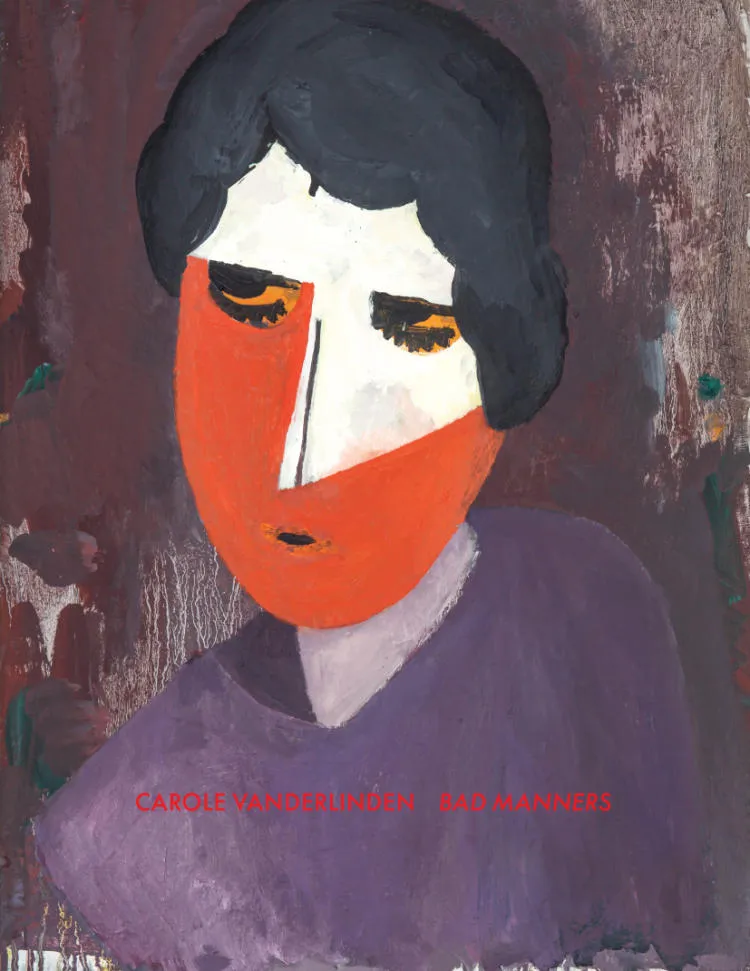
Bad Manners
Carole Vanderlinden's first monograp covers over a decade of the artist's practice. It gathers close to 200 paintings and works on paper, alongside texts by Belgian novelist Jean-Philippe Toussaint, essays by curators Ann Hoste, Ory Dessau, and Hans den Hartog Jager, as well as a conversation between musician and composer Joëlle Léandre and Vanderlinden.
Born 1973 in Brussels, Carole Vanderlinden has been developing a highly improvisational, rich artistic practice since the mid-1990s. While her work is primarily focused on painting (often using thick, hand-mixed oil paints), it regularly encompasses drawing, watercolor, collage, and small objects. Vanderlinden's practice is famously unhampered by the constraints of a single style. Her work nimbly blurs the line between figuration and abstraction, reacting intuitively to the rhythm, color, and possibilities of her medium rather than adhering to a single signature aesthetic.

As If They Had A Spirit: the practice of Pontus Pettersson
As If They Had A Spirit is the first comprehensive monograph of artist Pontus Pettersson. Using drawing and narration, the book expands on Pettersson’s sculptural, poetic and choreographic practice through the accounts and fabulations of long term collaborators. As If They Had A Spirit centers the acts of re-membering, re-telling and re-tracing as situated methods for documenting and studying the protracted and evolving nature of process-based artistic practices.
Recounted and drawn by Linnea Hansander, Robert, Malmborg, Diana Orving, Karina Sarkissova, Sandra Lolax, Stina Nyberg, Anna Koch, Peter Mills, Anna Efraimsson and Galerie (Simon Asencio & Adriano Wilfert Jensen)
Edited and redrawn by Galerie (Simon Asencio & Adriano Wilfert Jensen)
Editing assistance Izabella Borzecka
Published by Galerie, Int
Co-publisher & Distibribution: PAM, Stockholm
As If They Had A Spirit was made possible with generous support by the Swedish Arts Council, Weld, MDT and PAM

Agitated Air: Poems After Ibn Arabi
Born in Murcia in 1165, Ibn Arabi was a prolific Muslim philosopher and poet. He travelled extensively before settling in Damascus, where he died in 1240. Tarjuman al-Ashwaq, or The Interpreter of Desires, is a cycle of sixty-one Arabic poems. They speak of loss and bewilderment, a spiritual and sensual yearning for the divine, and a hunger for communion in which near and far collapse.
Agitated Air is a correspondence in poems between Istanbul and Cape Town, following the wake of The Interpreter of Desires. Collaborating at a distance, Yasmine Seale and Robin Moger work in close counterpoint, making separate translations of each poem, exchanging them, then writing new poems in response to what they receive. The process continues until they are exhausted, and then a new chain begins.
Translated and re-translated, these poems fray and eddy and, their themes of intimacy across distance made various, sing back and forth, circling and never landing. Absence and approach, knowing and unknowing, failure and repetition: Ibn Arabi’s cycle of ecstatic love shimmers with turbulence. Seale and Moger move into and against these contending drifts, finding in the play of dissatisfaction and endurance a prompt for new poetry.

No.4: Learning Within, Learning Without
Januar Rianto, Almer Mikhail and 1 more
There is no one-size-fits-all approach to design. It is as much a practice as it is a methodology or way of thinking, a multifaceted discipline that moves with society’s progression. Throughout the creative process behind every design, learnings happen. Designers learn to adapt, adjusting their positions relative to the context. This volume spotlights self-organised, spontaneous, sporadic, and informal educational initiatives within the realm of creative practices, both historical and contemporary. The initiatives presented here show that any attempt to control a narrative and limit it to a single understanding risks stifling potential innovations that might arise from unexpected origins.
Featuring contributions from Amanda Ariawan, Andriew Budiman, Carlos Romo-Melgar, Chabib Duto Hapsoro, Czar Kristoff J.P., Filippo Sciascia, Fiorent Fernisia, Gideon Kong, Jacob Lindgren, Jeremy Sharma, Keni K. Soeriaatmadja, Limestone Books, Livian Aurel V. Purwanto, Mac Andre Arboleda, Nishkra, Prananda L. Malasan, R.A. Dita Saraswati, Reza Afisina, Rouzel Waworuntu Saad, Savira Aristi, Trevor Embury, and Virliany Rizqia Putri.

The Tenant
The Tenant is a monographic critical essay by Marie Canet. It is the first text to directly address the connections between McKenzie’s work, pornography, and special effects. The title refers to the way the artist moves through different periods and aesthetic spaces, appropriating their codes in order to construct new visual fictions. The book is infused with post-#MeToo feminist thinking, alternative uses of biography, reflections on the art world, and contemporary debates surrounding appropriation, embodiment, and the status of the artwork.
McKenzie and Canet worked with each other for over eight years, on projects like Atelier E.B: Passer-by catalogue, published on the occasion of the Fondation Galeries Lafayette exhibition, or the book Pervert or Detective, a conversation between Lucy McKenzie and artist Reba Maybury. This collaboration now culminated in an exhibition and a book: Plastic Newspaper (presented at CRAC Sète in March 2026) and Lucy McKenzie, The Tenant.
Texts by Marie Canet and Lucy McKenzie
Translations: Catherine Petit & Paul Buck (Marie Canet), Juliette Desorgues (Lucy McKenzie)
Published in connection with the exhibition Lucy McKenzie, Plastic Newspaper, at Crac Occitanie, Centre régional d‘art contemporain Occitanie/Pyrénées-Méditerranée à Sète, 21.03.-06.09.26

Zoë Lund: Poems
Stephanie LaCava, Zoë Lund and 1 more
Poems presents four unpublished poems by American writer and actress Zoë Lund (1962–1999), written in the 1980s. An incandescent voice emerges, revealing the might, sincerity, and precision of her expression, as well as her vulnerability and defiance in the face of death. This is the first publication dedicated to her work.
Translated into French by Stephanie LaCava and Manon Lutanie, and presented in a bilingual volume (English, French), the poems are introduced by Stephanie LaCava, who retraces their genesis and examines the personality of their author:
"She is unsure of her identity, but hints at certain proclivities: action as the only true form of activism (sustained readiness to strike); a taste for contradictory characters (strength exists where there is also cowardice); romance. [...] Uninterested in mute beauty, Lund wanted to write and produce her own projects. In a news clipping from 1983, titled 'Young Political Filmmaker Shooting at Mount Holyoke,' there is a striking picture of Lund 'working on a film about the radicalization of a young woman,' per the caption. The article talks of her 'uncompromising idealism' and feelings about the naïveté of both American liberals and leftists.
Three years later, in 1986, 'Touchstone Levity' was written, and [...], the same year, "Opium Wars." The latter speaks to Lund's interest in drugs (she had a taste for heroin and would die of heart failure at thirty-seven)."
Printed offset in Italy on a matte, natural paper, stapled, the book also features black-and-white pictures of Lund taken in Paris by the filmmaker, critic, and activist Édouard de Laurot, then the author's partner, in the early 1980s. It's striking to see her in Paris on these images, smoking and posing in front of the Eiffel Tower, disheveled in a nightclub, caught on camera at a shooting range, at such a young age—when we know she would die in Paris fifteen years later. It seemed right to choose these images to accompany the poems, which were written in the same decade, and in the context of this French-American publication.