Books
Books
in random order

Crue
L’Île-de-France a été engloutie. Submergée par de l’eau liquide. C’est à peu près tout ce que l’on sait. Crue est un long poème construit sur un rythme ternaire, une suite de tercets libres entrecoupés de symboles typographiques étranges dont la signification exacte semble avoir été perdue dans l’inondation. Il y a dans le va-et-vient soutenu du texte comme dans celui de la mer, ses gestes répétés, toujours successifs, quelque chose de l’automation ; l’acceptation sans révolte d’une nouvelle nature sous-marine hybride, plus uniquement humaine, à la langue noyée, gorgée de néologismes, méthodique, néanmoins sentimentale. Car ici la cruauté sinistre de la nature fait écho aux émotions du narrateur. Le paysage-état d’âme est désolé, apocalyptique mais comme résigné, nu. Crue sonde les abysses de la civilisation et des comportements humains. Peut-être un des textes les plus personnels de Théo Robine-Langlois.

The Subtle Rules The Dense
Moulded from clay, between 2021 and 2023, The subtle rules the dense is a series of ceramic chest plates, by the artist Phoebe Collings-James. Inspired by Makonde and Yoruba body masks and Roman muscle cuirasses, the sculptures explore the interplay between ritualistic objects’ violent histories and their contemporary presentation as fetishistic ornaments. This publication brings together responses to the series from artists SERAFINE1369 and Rehana Zaman and geographer Professor Kathryn Yusoff; exploring layered references to tarot, Shakespeare and post-colonial theory; probing the materiality and extractive politics of geology; and reflecting the plural multifaceted nature of Collings-James’ practice.
A series by Phoebe Collings-James
With Texts by Serafine1369, Rehana Zaman, Kathryn Yussof.

Essays
Poetry as both a form and genre has many possibilities to exist within; however, poetry too often is burdened by the imperative to have an argument and a set of imagery and meanings that are preconceived and placed within the poem. In this way, poetry gets conflated with writing a thesis or project, and the poet simply the presenter of perfectly argued language. When poets attempt to bridge the gap between genres and write within the contemporary essay form, they are tasked to construct perfect arguments there as well and avoid the associative and aesthetic logic that makes poems important. The term essay itself was coined by Michel de Montaigne in the 1500s — it comes from the French word essai, which means to test or experiment with what one knows as a learning tool, and is in partial opposition to the terms we use to discuss the essay now
ESSAYS calls on thinkers and writers to move beyond this linear thinking into the realm of what an essay by someone like Montaigne might do. His essays do as they say they will—they test out ideas, they are unafraid to get messy in their execution, they are brave enough to go forward into the uncharted waters. In them, it’s completely beside the point to get back to where they started, let alone where they’d say they would go. They are simply beside the point. It’s true.
ESSAYS, edited by Dorothea Lasky, is a book of essays on the essay, which enact and query these directives. The volume collects essays by poets Ariel Goldberg, Ken Chen, Wayne Koestenbaum, Tracie Morris, Anaïs Duplan, Raquel Salas Rivera, Brandon Shimoda, Cecilia Vicuña, Fred Moten, and Mónica de la Torre.
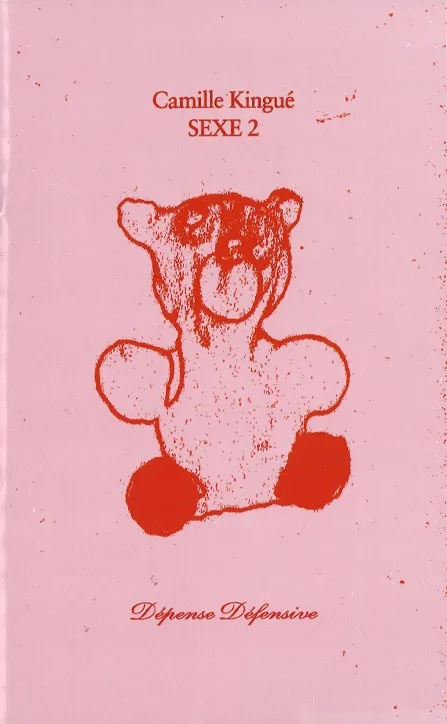
Sexe 2
Confession sur le désir (l’action et l’objet du), les liens de mutualité et de résistance, Sexe 2 alterne prose et versification en 27 fragments numérotés à l’adresse plus ou moins dure, plus ou moins sincère, plus ou moins formulée car plus ou moins éloignée du Toi et du Je. Camille Kingué s’attache à révéler, à voir quelque chose à travers son image réelle et virtuelle, agrandie et rétrécie, droite et renversée, déployant une recherche des principes de l’amour (l’amour comme amour, pourquoi est ce qu’il y a de l’amour) où la métaphysique et la compréhension de soi – donc de l’autre – n’ont jamais été aussi sexy.
Claire Star Finch, dans la magnifique préface qu’iel signe au début de l’ouvrage, écrit : « Après avoir lu tous les livres de Kingué, je ne sais pas si je crois en “l’amour”, que ce soit en tant que substantif absolu ou en tant que proto-résidu de tout ce que “le sexe” peut signifier. Mais je crois définitivement qu’il faut l’écrire. » Définitivement.

A Series Of Attempts #3: Loving Women aka Le Poney
"We didn’t have anything & we hadn’t seen much. So, naturally we understood less & felt owed something. We weren’t entirely wrong, though. It was 2011."
Part archival remix, part recruitment manual, this pamphlet’s cast of BAD HORSEY GIRLS will teach you how to neigh, dance and flirt until the vampires come home. A Series of Attempts #3 opens with Jordan/_Hell’s new manifesto ☆ LOVING WOMEN ★, that takes the Nomadic Sisters 1976 publication by the same name as a departure point. From here, ★ LE PONEY ☆ then follows a string of lesbian ponies through a dimensional split. A dimensional split that looks suspiciously like the L.A./Parisian+ queer scene… (͠≖~≖ ͡ )
About the author:
Jordan/_ Hell is a Black trans(2s) artist, writer, & scholar. Hell is the author of CONSTANT VIOLINS (Arcadia Missa, 2021) & AUTOLINGO DIDACTICA (Monitor Press, 2023), amount others. Hell’s writing has been internationally published in multiple languages in press, interdisciplinary projects, & exhibitions by Kunstverein Grafschaft Bentheim (DE), Arcadia Missa Gallery & Publishing (UK), Monitor Books (UK), Real Review (UK), Soft Opening (UK), Mousse Magazine (DE), 032c (DE), Rosie’s Disobedient Press (UK), Sticky Fingers Publishing (UK), The Bittersweet Review (UK), Pratt Institute’s The Felt (US), & others. Hell studied at Hochschule für Bildende Künste–Städelschule (DE) & Cooper Union School of Art (US). Currently, Hell is a doctoral candidate in the School of the Arts at Queen Mary University of London.

Robida 11 - on orchards
The eleventh issue of Robida magazine, is collection of essays, photographic explorations, visual narratives, art projects, and poetic texts all centered on the orchard as landscape and fruit trees as powerful metaphors and living archives of stories and memories.
Robida is a situated, multilingual cultural magazine published by Robida collective. Each issue explores a topic connected and generated by Topolò/Topolove, the village on the border between Italy and Slovenia where the collective is based.
The chosen topic is thrown into the world and interpreted by people who have never been to Topolò. What people send back after the open call is not only a contribution to the exploration of a defined theme but also a new interpretational tool to explore the collective’s relation to Topolò.
CONTRIBUTORS
Alessandra Saviotti, Alja Piry, Aljaž Škrlep, Alessandra Faccini, Anastasia Kolas, Andrea Martinelli, Andreina Trusgnach, Angelica Calabrese, antonisotzu, Antônio Frederico Lasalvia, Cassidy McLeod McKenna, Companion–Platform, Danijel Losic, Derek Scott Russell, Dora Ciccone, Eda Aslan, Elena Braida, Elena Rucli, Emmy Elvira Wassén, ERBA, Francesca Farris, Francesca Battaglia, Francesca Lucchitta, Giovanni Aloi, Giulia Bertuletti, Gregor Božič, Greta Biondi, ife collective, Jana Kiesser, Jannete Mark, jean ni, Jennifer Shin, Jessica Hollis, Jip van Steenis, Julina Vanille Bezold, Kristína Mičová, Lalie Thébault Maviel, Laura Savina, Lina v. Jaruntowski, Lindsay Buchman, Luca Vettori, Luca Battista, Ludovica Battista, Luigi Coppola, Luisa Gastaldo, Maria Elena Vecchio, Marta Pagliuca Pelacani, Martina Havlová, Martina Motta, Mia Frances LaRocca, Michael Marder, Nataša Kramberger, Ola Korbańska, Paolo Bosca, Rachele Daminelli, Rosie Ellison-Balaam, Sasha Arutyunova, Serena Abbondanza, Silvia Mascheroni, Stephanie Rebonati-Cannizzo, Teresa Carretta, Terry Cueball, Vesna Liponik, Victoria King, Vida Rucli, Vittoria Rubini
Languages: English (mainly), Italian, Slovene, French, German + local, minoritarian lan(d)guages and dialects from the regions of Benečija, Valchiavenna, Abruzzi, Bari, su Logudoru, Corsica, Gorenjska, Cetuna and the White Carpatians region.

Experiments in Imagining Otherwise
This is a book of failure and mistakes; it begins with what is stolen from us and proposes only an invitation to imagine.
In these playful written experiments, Lola Olufemi navigates the space between what is and what could be. Weaving together fragmentary reflections in prose and poetry, this is an exploration of the possibility of living differently, grounded in black feminist scholarship and political organising.
Olufemi shows that the horizon is not an immaterial state we gesture toward. Instead, propelled by the motion of thinking against and beyond, we must invent the future now and never let go of the otherwise.
Lola Olufemi is a black feminist writer and CREAM/Stuart Hall Foundation researcher from London. Her work focuses on the uses of the feminist imagination and its relationship to futurity, political demands and imaginative-revolutionary potential. She is the author of Experiments in Imagining Otherwise and Feminism, Interrupted: Disrupting Power, the co-author of A FLY Girl’s Guide to University, and a member of ‘bare minimum’, an interdisciplinary anti-work arts collective.

Working Museum
"In Spring and All, William Carlos Williams figures imagination as the springing off point to greater connection with the world and its gentle motions. ‘It is spring,’ he writes: ‘life again begins to assume its normal appearance as of “today.” Only the imagination is undeceived.’ Embracing the haecceity of the everyday and allowing the imagination to make silent and surprising connections are ways to withhold the deceptiveness of relying on old habits of thinking and writing.
Ziddy Ibn Sharam’s Working Museum begins with another quotation from Spring and All: ‘There is not confusion – only difficulties’, and the sequence offers delicate, poetical examinations how the confusions and frustrations of interpersonal communication are beneficent difficulties to be embraced and considered in gentle depth. This is a gorgeous sequence of poems, offering generous, gracious and graceful glimpses of a family’s birthday pilgrimage to Amberley Museum and Heritage Centre in Sussex. Working Museum is a tour de force of delicate poetry of feelings and feeling through feelings in a world of wordless connections and contacts, navigating the liminal but intimately understood spaces between two brothers and their family. In these poems,
Sharam is trying to be still in language, as smiles, touches and profound intimacies are exchanged. Observing and being in his brother’s presence during this special time of spring, Sharam re-learns to experience, to become ‘plugged’ in, as he writes, to new ‘switchboards’ of sensation, thought and poetic possibility. The ‘old machines’ of mental expectation and habit are, in the presence of his other-sensing brother, found wanting for the appreciation of his ‘intellect just as it is’. Here, Sharam learns to ‘do things minimally’ and to revel in the ‘seismic proportions’ of the apparently mundane. Sharam and his readers are offered a space to share in a brother’s beautifully vivid world and are privileged to witness a profound, ‘beginning, // again." - Gareth Farmer

Tricyclist
The love child of The L Word and Brontez Purnell’s 100 Boyfriends, with a disaffected flair all its own.
It’s San Francisco in the early aughts, and Howie Song is floundering. His failed projects—as a professional ballet dancer, as a boyfriend, as a friend—have left him forever the “third wheel.” But maybe he likes it that way? Leaping wildly between lovers, centuries, and an ever-changing cultural landscape, Howie might just feel most himself in the fracture.
Delicious, poetic, and delightfully pornographic, Tricyclist is an ode to the “abnormal angles” of people and art. As Howie overcomes his own ambivalences—in large part thanks to two suitors, and a circle of supporters who happen to be lesbians—Joon Oluchi Lee portrays, with his signature flamboyance, all of life’s joys, pitfalls, and pirouettes.
Joon Oluchi Lee is one of my favorite writers. A quick-change artist with a blazing intellect, he startles with his wicked wit and mix of rawness and sophistication. In Tricyclist, vexed, sexed, and indexed types orbit the narrator Howie Song, offering all kinds of distractions and attractions. Identity is a flipbook of possibilities, malleable in a way that excites and also threatens dissolution (which is maybe a relief). Raunch, philosophical asides, and a scavenger hunt for connection and love are all propelled by Lee’s masterful maverick style and brilliant humor. - Nate Lippens
Across lush hangouts with friends and hookups with lovers, Joon Oluchi Lee’s Tricyclist paints shimmering portraits of the most beautiful blouses and bars and bodies laid bare alongside our hopelessly alluring narrator. Through Howie’s careening sex drives and death drives, sensuality is everything, and with Lee’s keen attunement to life’s viscera, Tricyclist aches gorgeously. What a rhapsodic balm to my 2026. - Benedict Nguyễn
Tricyclist is a sex-forward, strikingly original story of queer life in San Francisco that feels so fresh it left my fingers wet. Joon Oluchi Lee’s eye is as sharp as his prose, rendering characters and scenarios with gossipy frankness. Kinetic and true and hyper-alive. - Michelle Tea

How to Sleep Faster 1
How to Sleep Faster is published as part of the collaborative discussion that form the critical direction of the gallery. and sits alongside the first two exhibitions – Sleep Faster (February), and How to Carve Totem Poles (March). It has been put together as an open ended continuation of this dialogue through which we seek to understand the contradictions / complexities that define and form our experience, existence and participation in a contemporary digital-analogue creative environment.
Arcadia Missa Publications; Rozsa Farkas, Tom Clark, Jammie Nicholas, Laura Farley (eds).

Deer Book/Libro Venado
Inspired initially by Jerome Rothenberg’s translation Flower World Variations, which Cecilia Vicuña first encountered in 1985, Deer Book brings together nearly forty years of the artist’s poetry, “poethical” translations, and drawings related to cosmologies and mythologies surrounding the deer, and sacrificial dance in cultures around the world.
Woven like one of her quipu installations, Vicuña’s texts—which include original compositions in Spanish as well as English translations by Daniel Borzutzky—become meditations on translation, not just of the sacred nature of this animal but on how our understandings of ceremony and ritual are transformed, by this ongoing process. Taken as inspiration rather than conundrum, the impossibility of translation opens up poetic possibilities for Vicuña as she continues her lifelong exploration into the nature of communication across eras and distant lands, languages and shared symbols within Indigenous spiritualities.

a slight cast down at the edges of the lips
“a slight cast down at the edges of the lips brings together work from the last decade of Katherine Hubbard’s prolific practice, which intertwines analogue photography, writing, and live performance. Reproductions of exhibited prints, a selection of new photographs, and images created from within her performances are gathered here, along with four of the artist’s original written works. This publication marks the first occasion for Hubbard’s photographs and writings-for-performance to exist on the same scale, that of the book.”
— co-editor, Corrine Fitzpatrick
The book is accompanied by a poster with a full-scale detail reproduction of Katherine Hubbard's rip stop weave artwork, printed on glossy tissue paper.
Additional contributions by Zoe Leonard, Mónica de la Torre, Elisabeth Sherman, and Lynne Tillman. Edited by Corrine Fitzpatrick and Lara Mimosa Montes.

Archive Dora Diamant #07
A collection of photographs from the archives of the icon of underground and alternative Parisian nights Dora Diamant.
A self-taught photographer, Dora Diamant has left thousands of photos. The Dora Diamant Association, custodian of this archive, and Éditions L'Amazone have joined forces to bring them to life by devoting a series of publications to them. Each volume of the Dora Diamant Archive was created by a different person and is the result of a subjective selection and arrangement specific to its author.
Figurehead of the Parisian underground and queer nights, photographer, DJ, multimedia and polymorphic artist, Dora Diamant was the daughter of Pascal Doury.
Selected by Yamil Farah and Mélanie Matranga.

I have brought you a severed hand
Ghayath Almadhoun, Catherine Cobham
Fluid and unselfconscious, Ghayath Almadhoun writes love poems in the shape of nightmares: I have brought you a severed hand is a surreal mix of absurd humour, heteroerotic lust and dead seriousness. Caught between two exiles, the one inherited from his Palestinian father and the one he chose and lives, Almadhoun attempts to explain water and tame hope.
This book never misses the defiant beat of an exile’s haunted footing across wars, seas and memory. Almadhoun turns the genocidal logic of colonialism upside down, emptying out the crumbs of humanity and civilisation. —Don Mee Choi
Almadhoun uses every possible means of silence to make the total devastation palpable. —Alfred Schaffer
Many poets attempt to traverse the gulf between the experience of tragedy and the ability to relay its magnitude to anyone else. But few living have done it with such flourish, such sustained passion and formal precision as Ghayath Almadhoun. —Kaveh Akbar
Ghayath Almadhoun (born 1979, Damascus) is a Syrian-Palestinian poet who moved to Sweden in 2008. He has published five collections of poetry in Arabic, the latest being Adrenalin (Almutawassit, 2017) and I have brought you a severed hand (Almutawassit, 2024). In 2017, Adrenalin was translated into English by Catherine Cobham and published by Action Books. In 2023, Almadhoun curated, edited and translated the poetry anthology Kontinentaldrift: Das Arabische Europa (Verlag Das Wunderhorn and Haus für Poesie), which includes thirty-one Arabic poets living in Europe. The English translation of I have brought you a severed hand is published simultaneously by Divided in the UK and Europe and by Action Books in the USA. Almadhoun currently lives between Berlin and Stockholm. His work has been translated into nearly thirty languages.
Catherine Cobham taught Arabic language and literature at the University of St Andrews, Scotland, for many years and was head of the department of Arabic and Persian from 2011 until 2021. She has translated the work of a number of Arab writers, including poetry by Adonis, Mahmoud Darwish, Ghayath Almadhoun, Tammam Hunaidy and Nouri al-Jarrah, and novels and short stories by Yusuf Idris, Naguib Mahfouz, Hanan al-Shaykh, Fuad al-Takarli and Jamal Saeed. She has written articles in academic journals and co-written with Fabio Caiani The Iraqi Novel: Key Writers, Key Texts (Edinburgh University Press, 2013).

Heart Lamp
In the twelve stories of Heart Lamp, Banu Mushtaq exquisitely captures the everyday lives of women and girls in Muslim communities in southern India. Published originally in the Kannada language between 1990 and 2023, praised for their dry and gentle humour, these portraits of family and community tensions testify to Mushtaq’s years as a journalist and lawyer, in which she tirelessly championed women’s rights and protested all forms of caste and religious oppression. Written in a style at once witty, vivid, colloquial, moving and excoriating, it’s in her characters – the sparky children, the audacious grandmothers, the buffoonish maulvis and thug brothers, the oft-hapless husbands, and the mothers above all, surviving their feelings at great cost – that Mushtaq emerges as an astonishing writer and observer of human nature, building disconcerting emotional heights out of a rich spoken style. Her opus has garnered both censure from conservative quarters as well India’s most prestigious literary awards; this is a collection sure to be read for years to come.
Winner of the 2025 International Booker Prize.

Selected Poems
Pat Parker, SaraEllen Strongman
'Her Black Woman’s voice rings true and deep and gentle, with an iron echo. It is merciless and vulnerable and far ranging.' —Audre Lorde
Alongside her invaluable contributions to social justice, Pat Parker (1944-1989) wrote five collections of poetry during her lifetime and is widely recognised as one of the leading African-American, lesbian-feminist voices of the 20th Century.
Selected Poems collects her most loved works into an accessible volume, introducing new readers to Parker's fire for justice, tenderness, and vision for the world.
This is the first time Pat Parker's poetry has been published in the United Kingdom.
Readers interested in Pat Parker’s life may also enjoy The Letters of Audre Lorde and Pat Parker 1974–1989, an archival work documenting their intimate friendship and important work as activist-poets.

Solidaires!!!
Solidaires est un syndicat de lutte et de transformation sociale qui défend les travailleuses et travailleurs de France.
Cet ouvrage réunit une sélection de plus de 70 visuels créés par la graphiste Anaïs Enjalbert et des militant·e·s pour l'Union syndicale Solidaires.
Ce livre est une archive sélective de visuels dont les slogans accompagnent des valeurs et des pratiques émancipatrices allant du féminisme à l’antiracisme, de l’internationalisme à l’anti fascisme, de la lutte contre les lgbtphobies à celle contre le validisme. Ils soutiennent la lutte contre le capitalisme et pour les services publics.
Format 14 x 19,5 cm
Conception graphique: Magali Brueder

Girl On Girl: Stories
What happens when you peak in high school, or maybe earlier, or maybe not at all? When you hate your friends, or love them too much? When the warmth of nostalgia starts to slowly poison you? In Girl on Girl, Emily Costa explores desperation and loneliness, screen obsession, and casual cruelty as characters—mostly women and girls—struggle to be seen.

Nothing at All
An atmospheric rumination on gendered violence, cosmic collapse, and colonialism.
From deep inside a black hole, comes Nothing at All—the space where everything collapses: form, genre, gender, and being. Olivia Tapiero’s poetic and essayistic fragments overflow with lyric beauty as they explore how colonialism, illness, and desire intertwine amidst personal and collective suffering. Generations, geographies, and desires mingle, contaminating one another in these anarchic, insubordinate texts. Here, the written word disrupts foundations and nations, claiming its own survival.
Olivia Tapiero is a writer, translator and musician. She is the author Les murs (Robert-Cliche Award, Prix Senghor finalist), Espaces (2012), Chairs (2019), Phototaxie / Phototaxis (Nightboat Books, 2017 / 2021, Lambda Literary Awards finalist), and Rien du tout (2021, Grand Prix du livre de Montréal Finalist, Governor General’s Literary Awards finalist). She is editor-in-chief for the literary magazine Moebius, and has contributed poems and essays to various publications in Canada, France, and Korea. She has also translated works of contemporary authors such as Roxane Gay, Anne Boyer and Billy-Ray Belcourt. She lives between Marseille and Montréal.
Foreword by Anne Boyer.

The Vertical Interrogation of Strangers
The Vertical Interrogation of Strangers blends the narratives of the travelog and the coming of age novel. It is written by a young Indian woman whose travels take her between homes in two countries, India and England, and through parts of the United States. These short pieces reveal new ways of belonging in the world and possibilities for an art grounded in a localized cosmopolitan culture.
Bhanu Kapil has written three full-length prose/poetry works, THE VERTICAL INTERROGATION OF STRANGERS (Kelsey Street Press, 2001), INCUBATION: A SPACE FOR MONSTERS (Leon Works, 2006), and HUMANIMAL [A PROJECT FOR FUTURE CHILDREN] (Kelsey Street Press, 2009). Born in the UK to Indian parents, Bhanu lives in Colorado, where she teaches in The Jack Kerouac School of Disembodied Poetics at Naropa University.
Published 2001

New Address II. Stereotypical Artist
What is an artists’ life made of? From the home to the studio, from the studio to the gallery, from one exhibition to the next, from one place to another – a suite of moves and a list of addresses. Tobias Kaspar’s work sheds light on the ambivalent position of the artist, taken in a web of social and economic relations: in the second volume of New Address, he uses the tone of the diary, combined with the code of the moodboard, to document the side aspects of the life of a “stereotypical artist.”
The book gathers black & white photographs taken between 2018 and 2024, during the installation or the opening of exhibitions; at performances, dinners, parties; in different homes and rooms Kaspar has been living in; and in the course of daily activities. Contrary to an exhibition catalogue, projects by the artist such as his line of jeans, or his series of bronze sculptures made from disposable packaging, are thus shown “in the middle of affairs.”
An additional booklet opens with a short essay by artist Mikael Brkic, reflecting on the “behind the scenes” logics, followed by a letter penned by writer Leif Randt, and a text in which curator Kari Rittenbach discusses Tobias Kaspar’s work in relation to the economics and aesthetics of display and fashion. It concludes with a list of artworks in the order as they appear in the main book.
Published with the support of Erna und Curt Burgauer Stiftung, Pro Helvetia, Kultur Stadt Zürich.

Slip-Syncs Collapse and Strange Unrealities in the films of Sogo/Gakuryu Ishii
You can talk about Ishii and music and you can talk about Ishii and sound. I want to talk about both. I want to talk about him as a node in a network of musicians and bands that starts with punk but spider webs out to ensnare post-punk industrial and ambient music with a brief free jazz cameo. I also want to talk about the way he uses sound rhythm and silence. This is not just about soundtrack. A soundtrack tends towards telling you something about what’s happening. Soundtracks tell you what to feel whether there is dread or romance or sadness in a scene. Not so for Ishii. For Ishii a soundtrack stands alone is a bed and is a moment but it doesn’t tell you how to feel. It is in Ishii's hands dislocation silencing or distortion of the cause-effect connection between the punch thrown and the punch landing between moving image and the sound that constructs the conceits of the cinema. "He attempted to find a visual equivalent to punk music," wrote critic Tom Mes. "A way to express the same philosophy and spirit with a camera instead of a guitar.”
— Jennifer Lucy Allan
This is the 3rd publication in the Echoes of Dissent series, devoted to the politics of the soundtrack.

Girlbeast
Highly acclaimed in Denmark, Girlbeast is a fearless, unsettling, and poetic reimagining of the Lolita narrative, where power shifts unpredictably, and desire and coercion become indistinguishable. In a world that fetishises girlhood, it asks whether a girl be blamed for internalising the roles imposed upon her? Can she wield her youth as power in a system designed to render her powerless?
With sharp, fast-paced prose and an addictive plot, Cecilie Lind crafts a daring examination of female agency, sexuality, and the complexities of consent. The novel evokes the idea of the girl as animal – a creature conditioned to be both docile pet and wild beast, torn between submission and rebellion, innocence and desire.
Brave, provocative, and unflinching, Girlbeast is a gripping, vital novel for our times.
WINNER OF THE 2023 DANISH CRITICS PRIZE, SHORTLISTED FOR THE DR NOVEL PRIZE, MONTANA’S LITERATURE PRIZE & THE JYLLANDS-POSTEN FICTION PRIZE
Cecilie Lind (b. 1991) studied at Forfatterskolen (The Danish Academy of Creative Writing), and debuted in 2010 with The Wolf Ate My Eyeliner. Lind’s breakthrough in Denmark came with the publication of the highly acclaimed book-length poem My Child, which was shortlisted for the 2020 Critic’s Prize and the Politiken’s Literary Award. She was awarded The Native Language Prize in 2020, and Girlbeast won the Danish Critics Prize in 2023. Lind’s most recent novel, Bristefærdig (Ripe), was published to critical acclaim in 2025.
Hazel Evans (b. 1994) is an artist, writer and literary translator based near Aarhus, Denmark. She was the 2022/23 emerging translator for Danish to English at the National Centre for Writing, and her debut translation, Into a Star by Puk Qvortrup, was published by Hamish Hamilton. In 2024, she received The Inger and Jens Bruun Translation Prize for her translation of Rasmus Daugbjerg’s Troll, forthcoming from Penguin Press.

Enthusiasm
{ENTHUSIASM} is the 7th poetry collection by poet, artist, curator and vanguardist SJ Fowler. It follows highly-acclaimed collections including The Rottweiler's guide to the Dog Owner and Enemies: the selected collaborations of SJ Fowler. The book's 81 poems are intended as individual pieces in their own right, but are interlinked by subjects including battle and violence, infants and infancy, religion, economy and population, the self, modernity, and the past.