Books
Books
in random order

UNIVERSAL PRODUCT CODE
"Like the Elizabeth Bishop painting “Interior with Extension Cord,” Kelly Clare’s helical, light-filled Universal Product Code delicately traces a bewildering infrastructure. This incantatory song, “busy in green,” points its reader to the disturbing beauty in stripey checksum barcodes, to arrays of imported figs at the grocer, to words like cloud or lime that now mean too much. Humorous, musical, perspicacious, this chapbook rocks."
- Katherine Gibbel, April 2026
Includes 3 poems by Dre Roelandt.
Published as part of Paraphernalia and Addenda 2.2 of Tabloid Publications.

Lentil Space – Recipes from Artists' Homes
A compilation of recipes from the Arab world that were presented by artists for Mophradat's online cooking show Lentil Space.
Adapted from its namesake online program produced by Mophradat, co-curated by Mai Abu ElDahab and Reem Shilleh, from 2021 to 2023, this book is a celebration of the varied cuisine of the Arab world and its relationship with inherited food practices and the cultures of cooking and talking about food.
With contributions by Adam HajYahia and Haitham Haddad, Deena Abdelwahed, Laila Hida with Amine Lahrach, Mohamed Abdelkarim with Abla elBahrawy, Nadah El Shazly, amongst many others, this cookbook includes recipes chosen and prepared by the artists in an intimate setting coupled with stories both personal and about their art practice.

Basta Now (Expanded Edition)
Basta Now - Women, Trans & Non-binary in Experimental Music is a non-academic essay by French poet, novelist and music enthusiast Fanny Chiarello. It’s also the first book to be published by Permanent Draft, an all-female record label and micro-press founded by Chiarello & musician Valentina Magaletti, dedicated to promoting contemporary female, non-binary and transgender artists.
Basta Now is essentially a huge (yet admittedly not definitive) overview of 3867 womxn in the global experimental sound & music scene. It’s been written in playful and compelling prose and stylishly presented with photos, illustrations, and discographies.
Now in its expanded edition, the book includes 80 more pages and an additional 1496 names than the first edition, extended lists and discographies, and updated chapters – especially Wild Things, All-Stars and Madame Bricolage. “This book has nothing against men, it’s just not about them” (Fanny Chiarello)

Earth, Fire, Water
Born in Beirut, Ali Cherri lives and works between Beirut and Paris. He belongs to this generation of Lebanese artists born during the civil war whose work has been strongly affected by this context of instability.
Through an introduction by the artist, 4 essays and an interview, this first monograph reveals the political, aesthetic and dreamlike dimensions of a work that the artist has been developing for over fifteen years. Ali Cherri's interdisciplinary work explores the myths and classifications of ancient worlds and contemporary societies

A Map to the Door of No Return: Notes to Belonging
A Map to the Door of No Return is a timely book that explores the relevance and nature of identity and belonging in a culturally diverse and rapidly changing world. It is an insightful, sensitive and poetic book of discovery. Drawing on cartography, travels, narratives of childhood in the Caribbean, journeys across the Canadian landscape, African ancestry, histories, politics, philosophies and literature, Dionne Brand sketches the shifting borders of home and nation, the connection to place in Canada and the world beyond.
The title, A Map to the Door of No Return, refers to both a place in imagination and a point in history — the Middle Passage. The quest for identity and place has profound meaning and resonance in an age of heterogenous identities. In this exquisitely written and thought-provoking new work, Dionne Brand creates a map of her own art.

saké blue. Selected Writings
Can critical thinking spring from both a fortune cookie and Jacques Lacan’s most obscure seminar footnote? Estelle Hoy says yes. In saké blue, overpriced cheesecakes are the starting point for an essay on art writing; shoplifting in Berlin opens to a reflection on the economies of activist practices; fiction allows us to discuss the legacy of institutional critique, queer mélanges, or quiet melancholy. To her, the story of art becomes more nuanced in light of lyrics by Arthur Russell, the posthumous sorrow of Sylvia Plath, or a poem by Yvonne Rainer.
saké blue gathers critical essays, art reviews, and poetic fiction. Written in dialogue with the work of Martine Syms, Marlene Dumas, Hervé Guibert, or Camille Henrot, these texts combine the subjective and analytic, addressing power relations and the force of affect. Hoy spares nothing—and no one, exposing cultural clichés and urgent political issues through fast-paced acerbity. She advocates the work of women artists, mocks stereotypes, questions myths, and champions desire, sadness, and boredom. Simultaneously beautiful, lyrical, and cutthroat, her writing echoes to the reader like l’esprit d’escalier—we think of the perfect reply just a little too late.
“Estelle Hoy practises philosophy as an unsettled but deeply committed query into existing together. She reads, she looks, she writes, to find out something essential about the future and living for it.”
—Lisa Robertson, author of The Baudelaire Fractal
“Estelle Hoy's prose slap and bite, saké blue is a sharp pleasure to read.”
—Calla Henkel, author of Scrap
“Hoy’s renditions of all-too familiar scenes are made more visceral than life with sparkling prose and a sly attention to life’s many shifting values that feels more than appropriate for anyone truly interested in art.”
—Natasha Stagg, author of Artless
Edited by Antonia Carrara
With an introduction by Lisa Robertson

Incubation: a space for monsters
New edition of this long out of-print classic of diasporic literature, featuring a forward by Eunsong Kim, an afterword by Emgee Dufresne, and new endnotes by Bhanu Kapil.
Incubation: a space for monsters is a formally innovative, hybrid-genre book that incorporates poetry and prose. Set in a shifting narrative environment, where human bodies, characters, and text are neither one thing nor another, this fragmentary-diaristic text journeys through the spaces in-between. Originally published in America in 2006 by Leon Works, and out of print for the last seven years, this is the first time this seminal text has been available in the UK.
Following protagonist Laloo – Cyborg, girl, mother, child, immigrant, settler – on a roadtrip through American landscapes, genre styles, and form, Incubation creates radical space for what is ‘monstrous’. Appropriating iconic American tropes, and the structure of Jack Kerouac’s On the Road, Incubation explores the challenges faced by immigrants in attaining such notions of freedom in so hostile an environment. In this fragmentary document there is a celebration in the cobbling together of lives; global in scope, with an intimate focus on interior voice, this landmark text evidences the early innovations and talents of this T.S. Eliot prizewinning author.

Selected Writings of Gertrude Stein
This collection, a retrospective exhibit of the work of a woman who created a unique place for herself in the world of letters, contains a sample of practically every period and every manner in Gertrude Stein’s career. It includes The Autobiography of Alice B. Toklas in its entirety; selected passages from The Making of Americans; "Melanctha"from Three Lives; portraits of the painters Cezanne, Matisse, and Picasso; Tender Buttons; the opera Four Saints in Three Acts; and poem, plays, lectures, articles, sketches, and a generous portion of her famous book on the Occupation of France, Wars I Have Seen.

Mouvement #129
The new “left-wing Catholics”; education under Trump and the American brain drain; theater, porn, and bullfighting with Lorraine de Sagazan; an X-ray journey with the nuclear nomads; soccer, Gen Z, and algorithmic governance in Morocco; Pedro Rhino, cinema at the end of the neocolonial mirage...
Founded in 1995, Mouvement is a French “indisciplinary cultural magazine”, published quaterly.

Luna
"Luna" (2021) is a graphic novel by Artist and illustrator Anat Martkovich, developed in collaboration with artist and illustrator Haithem Haddad. It was self published, with support by the Pais Foundation for the Arts.
The novel follows two days in the life of a family, and at its center is a dramatic event which drastically affects the lives of the family members.
The story develops in an a-linear and fantastic fashion, and attempts to present the impossible reality of violence within and outside the home.
The book is comprised of detailed black and white illustrations, with very little text accompanying them.
The little text alternated between different languages: Russian, Hebrew, Arabic, English and Hebrew sign language, depicting a complex and multi layer urban existence. The story is open to the reader's interpretation, though it is firmly set in a mundane everyday reality it opens up and presents us with fantastic possibilities of existence.

Dawn Noon Dusk Midnight
Caroline Rayner, Miri Karraker
Book as record, collaborative act of thought; anticipatory, complimentary — book as object, Victorian puzzle purse — translation as unweaving, unmaking: the topography of a conversation as a relief map reflecting the immediacy of reading "interior" and "exterior" thought in mediated time.
Dawn Noon Dusk Midnight, Miri Karraker & Caroline Rayner. ISBN 979-8-9899037-2-6 69pp. 5.5" x 5.5", saddle stapled. Covers printed on French Insulation Pink stock, interiors printed on Mohawk off white text weight felt textured paper. Printed and assembled in "Kingston, New York,” the unceded and occupied lands of the Haudenosaunee, Mohican, Munsee Lenape, and Schaghticoke tribes. First printing, edition of 200. Designed by The Aliens.

Le Sacrifice comme acte poétique
Angélica Liddell, Christilla Vasserot
Mise en scène, écriture – pièces de théâtre, poésie, récits, journaux – et présence sur scène : tout est lié chez Angélica Liddell. L’art et la vie, la fiction et la biographie, la création poétique et la réflexion théorique entretiennent les uns avec les autres des liens évidents et complexes. Ce volume inclut une série de textes qui, depuis une perspective théorique, éclairent en partie la pratique théâtrale de leur auteur, contribuant à la construction d’une poétique toujours inachevée, basée sur une expérience vitale.
Dans cet essai recueillant douze conférences et entretiens, Angélica Liddell évoque la création artistique ainsi que son processus dramaturgique très organique et très violent car « la violence poétique est nécessaire pour combattre la violence réelle ».
-
Direction, writing—plays, poetry, stories, journals—and stage presence: everything is interconnected in Angélica Liddell’s work. Art and life, fiction and biography, poetic creation and theoretical reflection maintain obvious yet complex connections with one another. This volume includes a series of texts that, from a theoretical perspective, shed light on the author’s theatrical practice, contributing to the construction of an ever-unfinished poetics rooted in lived experience.
In this essay, which brings together twelve lectures and interviews, Angélica Liddell discusses artistic creation as well as her highly organic and violent dramaturgical process, for “poetic violence is necessary to combat real violence.”

The Difficulties
If there is a centre around which the language of this pamphlet circulates, then it is Palestine. As this centre, Palestine enables a transformative power that persistently and steadfastly turns repression and silencing into solidarity. Essay-fiction, prose poetry, radical philosophy, speculative nonfiction — this uncategorizable collection of texts brings militant inquiry to each utterance, each narrative turn, in acts of transnational and transhistorical becoming.

The Weight of the Earth
Audio journals that document Wojnarowicz's turbulent attempts to understand his anxieties and passions, and tracking his thoughts as they develop in real time.
"In these moments I hate language. I hate what words are like, I hate the idea of putting these preformed gestures on the tip of my tongue, or through my lips, or through the inside of my mouth, forming sounds to approximate something that's like a cyclone, or something that's like a flood, or something that's like a weather system that's out of control, that's dangerous, or alarming.... It just seems like sounds that have been uttered back and forth maybe now over centuries. And it always boils down to the same meaning within those sounds, unless you're more intense uttering them, or you precede them or accompany them with certain forms of violence."
—from The Weight of the Earth
Artist, writer, and activist David Wojnarowicz (1954-1992) was an important figure in the downtown New York art scene. His art was preoccupied with sex, death, violence, and the limitations of language. At the height of the AIDS epidemic, Wojnarowicz began keeping audio journals, returning to a practice he'd begun in his youth.The Weight of the Earth presents transcripts of these tapes, documenting Wojnarowicz's turbulent attempts to understand his anxieties and passions, and tracking his thoughts as they develop in real time.
In these taped diaries, Wojnarowicz talks about his frustrations with the art world, recounts his dreams, and describes his rage, fear, and confusion about his HIV diagnosis. Primarily spanning the years 1987 and 1989, recorded as Wojnarowicz took solitary road trips around the United States or ruminated in his New York loft, the audio journals are an intimate and affecting record of an artist facing death. By turns despairing, funny, exalted, and angry, this volume covers a period largely missing from Wojnarowicz's written journals, providing us with an essential new record of a singular American voice.

KW Institute for Contemporary Art
Germaine Kruip: Works 1999-2017
Over the past two decades, artist Germaine Kruip has steadily developed a practice, which merges time, space and perception. Like an anthropological stage director, she investigates, simplifies and presents her observations in a subtle manner often through architectural interventions. In each of these interventions, she changes a location into a stage, with the audience as actors in a play of substantive absence. By doing so, she activates both physical and mental awareness.
This publication presents an overview of the Kruip’s practice since 1999, two years prior to her engagement with the art context. Presenting over 40 works, the publication reflects on three periods in the artist’s practice, each accompanied by an essay contributed by Anna Gritz, Eva Wittocx and Stephanie Bailey. The idea of a catalogue raisonné came out of a conversation that followed Kruip’s ambitious project Geometry of the Scattering, which was presented at de Oude Kerk in Amsterdam in 2015 – 2016.

Dear Friend Catalogue 2019-2022
Dear Friend is a monthly letter format publication covering design events, issues, and ideas. This publication distributed via snail mail is initiated by Sandra Nuut and Ott Kagovere.
The publication edited by Sandra Nuut & Ott Kagovere features all the letters from the Dear Friend publishing project, which they initiated at the Graphic Design Department of the Estonian Academy of Arts in 2018. The book includes contributions by Singapore-based design writer Justin Zhuang, designer and writer Else Lagerspetz, and artist Lieven Lahaye. The book is designed by Ott Kagovere and published by Lugemik and Estonian Academy of Arts.
Texts by Justin Zhuang, Lieven Lahaye, Else Lagerspetz
Letters written by Alicia Ajayi, Stuart Bertolotti-Bailey, Claudia Doms, Nell Donkers, Maarin Ektermann, Rosen Eveleigh, Maryam Fanni, Saara Hannus, Eik Hermann, Paul John, Maria Juur, Ott Kagovere, Maarja Kangro, Arja Karhumaa, Kristina Ketola Bore, Nicole Killian, Rachel Kinbar, Tuomas Kortteinen, Keiu Krikmann, Kadri Laas, Else Lagerspetz, Lieven Lahaye, James Langdon, Jungmyung Lee, Kai Lobjakas, Michelle Millar Fisher, Maria Muuk, Sheere Ng, Sandra Nuut, Laura Pappa, Jack Self, Indrek Sirkel, Paul Soulellis, Triin Tamm, Laura Toots, Alice Twemlow, Loore Viires, Sean Yendrys, Justin Zhuang

next move in mirror world
Published in conjunction with the first major U.S. museum show of Joan Jonas’s art in nearly fifteen years, this monograph features new scholarship on her multimedia installations and performance practice from the early 1970s to the present. Inspired by the format of a reader, it breaks new ground by contextualizing and expanding understandings of Jonas’s body of work through three thematic approaches: the critical notions of gender, being and otherness; the politics of landscape and ecology; and new conceptions of medium specificity and un-specificity. Richly illustrated, with never-before-published sketches and drawings, the volume includes an interview with the late Douglas Crimp and Jonas’s personal reflection on their enduring friendship.
Edited by Barbara Clausen and Kristin Poor with Kelly Kivland, with an introduction by Clausen; essays by Clausen, Adrienne Edwards, André Lepecki, Poor, and Jeannine Tang; interview with Douglas Crimp; writings by Joan Jonas; conversation between Heather Davis, Joan Jonas, and Zoe Todd; and coda by Kivland

After Institutions
The current crisis of museums and the future of Institutional Critique.
Faced with waning state support, declining revenue, and forced entrepreneurialism, museums have become a threatened public space. Simultaneously, they have assumed the role of institutional arbiter in issues of social justice and accountability. The canon of Institutional Critique has responded to the social embeddedness of art institutions by looking at the inner workings of such organizations. In After Institutions, Karen Archey expands the definition of Institutional Critique to develop a broader understanding of contemporary art's sociopolitical entanglements, looking beyond what cultural institutions were to what they are and what they might become.
Karen Archey is curator of contemporary art at the Stedelijk Museum Amsterdam. She is a 2015 Creative Capital | Warhol Foundation Arts Writers Grant recipient for short-form writing. Since joining the Stedelijk Museum in April 2017, Archey has organized solo exhibitions by artists Rineke Dijkstra, Stefan Tcherepnin, Catherine Christer Hennix, Steffani Jemison, Metahaven, Jeff Preiss, Charlie Prodger, and Hito Steyerl. She has written numerous catalogue essays and is a contributor to several art publications, including Artforum and Frieze.

Survival Is a Promise: The Eternal Life of Audre Lorde
A bold, innovative biography that offers a new understanding of the life, work, and enduring impact of Audre Lorde.
We remember Audre Lorde as an iconic writer, a quotable teacher whose words and face grace T-shirts, nonprofit annual reports, and campus diversity-center walls. But even those who are inspired by Lorde's teachings on "the creative power of difference" may be missing something fundamental about her life and work, and what they can mean for us today.
Lorde's understanding of survival was not simply about getting through to the other side of oppression or being resilient in the face of cancer. It was about the total stakes of what it means to be in relationship with a planet in transformation. Possibly the focus on Lorde's quotable essays, to the neglect of her complex poems, has led us to ignore her deep engagement with the natural world, the planetary dynamics of geology, meteorology, and biology. For her, ecological images are not simply metaphors but rather literal guides to how to be of earth on earth, and how to survive—to live the ethics that a Black feminist lesbian warrior poetics demands.In Survival Is a Promise, Alexis Pauline Gumbs, the first researcher to explore the full depths of Lorde's manuscript archives, illuminates the eternal life of Lorde. Her life and work become more than a sound bite; they become a cosmic force, teaching us the grand contingency of life together on earth.
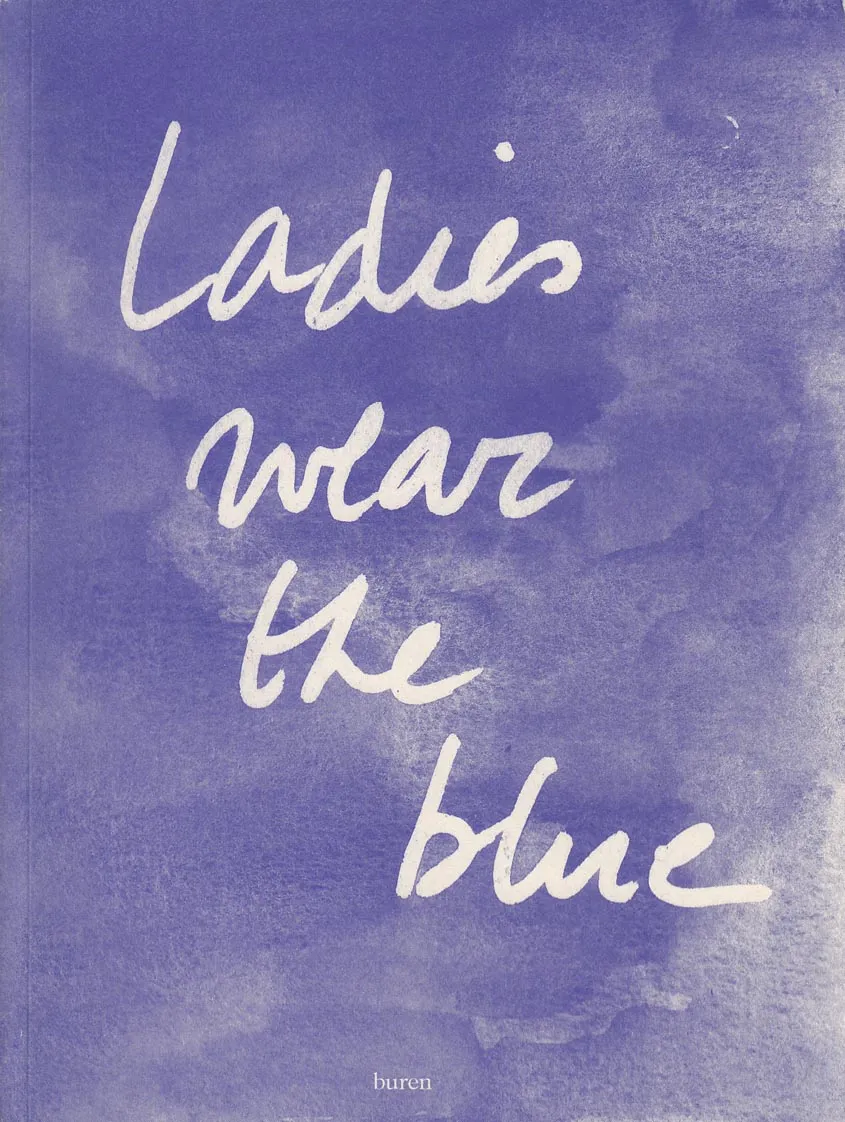
Ladies Wear the Blue
Ladies wear the blue is a collection of watercolour drawings by the hand of Melissa Mabesoone and Oshin Albrecht. The blue watercolours portray women from different moments in time. The adjacent texts describe these women's existence, roles, desires or ideosyncrasies deriving from the 'blue' in their lives. From the first female police officers and Alices all around, to Courtney Love's blue baby dolls and the girl with the blue tattoo Olive Oatman, this publication is an ode to women venturing into the world, and a way to continue telling their herstories.

Darryl
Darryl Cook is a cuckold, and that’s exactly how he likes it. He has an inheritance that spares him from work, a manageable and seemingly consequence-free drug habit, and a lovely wife called Mindy who’s generally game for anything—and for as much of it as she can get. But after an accidental overdose and some serious oversharing, Darryl’s world begins to crack up. Tormented by what seems to be the secret truth in sex, and less assured of that secret’s form, Darryl steps into what used to be called real life . . . Darryl is a disarmingly funny and unabashedly intelligent look at a community of people parsing masculinity, marriage, sex (and love) on their own terms.
Underneath the sharp satire and hilarious sexual irreverence this is a deadly serious book: a brilliant novel of a seeker, like The Pilgrim’s Progress refracted by queer internet culture. —Torrey Peters
Ess is what I might call a burgeoning cult literary figure, armed with an unmistakable lyric deadpan and a taste for provocative subject matter. — Stephen Ira, Poetry Project
What Darryl is looking for is a crisis of sufficient severity that it will cause him to feel real to himself. — Dominic Fox, Review 31

Shakespeare and Ethics
Shakespeare’s plays are full of philosophical ideas, but they are rarely examined systematically. In this pamphlet philosopher Colin McGinn analyzes the plays to distill Shakespeare’s ideas about ethics. McGinn concludes that the “plays are about good and evil,” and that Shakespeare is “a great moral psychologist,” who expertly stages how his characters are defined by their moral qualities (their naturalistic virtues and vices).

The Performative Word
First monograph dedicated to the American artist, poet, and activist John Giorno, this publication introduces some of the many ways Giorno wove poetry into all aspects of daily life—by putting words on the wall, on the performance stage, on LP vinyl records, or on the telephone, in the context of the iconic Dial-A-Poem, one of his most celebrated works. A wide range of archival documents, images, and ephemera also form an intimate portrait of Giorno as an activist, performer, Buddhist practitioner, collaborator, and friend.
Published on the occasion of the eponymous retrospective exhibition at the MAMbo - Museo d'Arte Moderna di Bologna, in 2026.
Emerging from the New York downtown scene of the 1960s, John Giorno (1936–2019) developed a singular artistic voice at the crossroads of poetry, performance, painting, and political activism over the course of more than six decades. By bringing the written word off the page and into performance, technology, and visual art, Giorno consistently challenged disciplinary boundaries and advanced a radical vision of language as central to human expression. Though often positioned at the margins of multiple downtown scenes—the Beats, Andy Warhol's Factory, punk music, queer counterculture, anti-war activism—he was in fact an influential presence within all of them, operating as a conduit between coexisting cultural communities. His collaborators included Robert Rauschenberg, William S. Burroughs, Laurie Anderson, Anne Waldman, Allen Ginsberg, and Ugo Rondinone, among many others.

Alice Notley, Live in Seattle
Entirely comprised of poems contained in her latest collection, 2016’s Certain Magical Acts, Live in Seattle elucidates why Alice Notley is one of the world’s most revered poets, the recipient of the Los Angeles TimesBook Award, the Griffin Prize, the Shelley Memorial Award, the Lenore Marshall Prize, and the Poetry Foundation’s Ruth Lilly Prize. “I am alive outside written memory” is how one of the speakers of Notley’s poem “Voices” puts it and listening to the poet read her work live, in front of an entranced audience, serves to detail the intangibility of sound vis-à-vis language.
Live in Seattle also includes excerpts of the onstage conversation Notley had with Seattle poets John Marshall, Christine Deavel and Rebecca Hoogs. Among other topics, the talk revolves around concepts of success, what it means to write a female poetry circa 2017, and the importance of always creating from a position of disobedience.
As part of Seattle Arts & Lectures’ Poetry Series, Live in Seattle was recorded at McCaw Hall in Seattle, Washington on Wednesday, April 5th, 2017 and mastered and engineered by Gus Elg at Sky Onion in Portland, Oregon in the Summer of 2017.
Purchase of Live in Seattle includes a 11×11 insert of Notley’s poem “FOUND WORK (lost lace),” as well as a download card for the entire album. Live in Seattle can also be found digitally on Spotify and Bandcamp. The record itself is not black but clear.