Books
Books
in random order

That's Me!
David Hoyle (b.1962, Blackpool, United Kingdom) is a performance and visual artist. His work over the last 30+ years has referenced gender, politics, identity, mental health issues and the ongoing fight for equality.
Hoyle came to prominence in the ‘90s as The Divine David, a kind of anti-drag queen whose lacerating social commentary – targeting both bourgeois Britain and the materialistic-hedonistic gay scene, which he called, “the biggest suicide cult in history” – was offset by breathtaking instances of self-recrimination and even self-harm. Following a couple of outré late-night Channel 4 TV shows and a part in the movie Velvet Goldmine, directed by Todd Haynes, Hoyle killed off The Divine David, during a spectacular show at the Streatham International Ice Arena in 2000 and retreated to Manchester for “a period of reflection”.
He returned to television screens in 2005 in Chris Morris’ Nathan Barley, then began performing live again, under his own name. Hoyle’s biting satire, bravura costumes, wicked comic timing, and compelling charisma remained intact.
Hoyle is also a prolific painter often painting in his live shows. His paintings are deeply personal, and tackle the same themes as his performances, incorporating domestic waste, flyers, newspapers, magazines, wrapping paper, and more, which reinforce his disdain for the ruling-class bourgeoisie.
This is the first book dedicated to Hoyle’s paintings, offering an edited selection of works made between 2010 and 2022. At Hoyle’s request, all of the works are published undated: thus, emphasising their timelessness, timeliness, relevance, and urgency to the desperate age in which we now find ourselves!

Les Diaboliques Parlures
Les Diaboliques Parlures rassemble trois textes qui nous font découvrir une voix contemporaine majeure de la poésie et du théâtre queer. Ces œuvres, à la croisée du poétique, du politique et de l’intime, explorent le désir, la vulnérabilité, la marginalité et l’identité masculine et queer.
L’Ardeur déploie une langue brûlante pour interroger le désir, la passion et la communauté des outsiders, transformant l’ardeur en force vitale et émancipatrice.
One Night at the Golden Bar offre une écriture intimiste où le romantisme kitsch devient vecteur de poésie et de réflexion sur la vulnérabilité, l’amour et la monstruosité de l’humain.
Analphabet, quant à lui, questionne le langage, l’expression et les limites de la communication, confrontant le lecteur à la puissance de la langue et à sa capacité à révéler l’identité.

The Rambling Figures of Mani Kaul
Arindam Sen, Stoffel Debuysere
Published on the occasion of the program Soft Notes on A Sharp Scale — The Rambling Figures of Mani Kaul, produced as part of the Courtisane festival 2018, as well as the associated Mani Kaul programme organized by the Essay Film Festival 2018, in collaboration with the Otolith Group.

Elika Hedayat
First monograph of the Franco-Iranian artist.
This monographic catalogue looks back over the first 15 years of work by Iranian artist Elika Hedayat through more than 110 reproductions. Two of these are on a 1:1 scale, and a detailed set offers a comparison of the dimensions of the works in relation to each other.
Françoise Docquiert introduces the issues at stake in her practice with an essay, complemented by an interview with Joana P.R. Neves.
"Elika is a Parisian-Iranian artist. This cultural blend is slightly ironic though very significant, as it nourishes her artistic work and practice. Inspired by her childhood, her life, and the violence in her native country, she makes films, videos, and drawings always filled with beauty, scathing humour and cruelty." - Annette Messager
Born 1979 in Tehran, Elika Hedayat lives and works between Paris and Tehran. Arriving in France in 2004, she was admitted to the École Nationale Supérieure des Beaux-Arts in Paris in Annette Messager's studio, from wich she graduated with the Jury's congratulations in 2008.
For her works, Elika Hedyat often uses testimonies and experimental documentaries stage in a dreamlike and imaginary universe. Her stories are contemporary and her characters are real. All of her works revisits historical references, transferring them to the field of personnal experience, mainly using the various possibilities of her repertoire as a narrative document and memory retrieval tool. Reality, memory and imagination come together in a personal story under different forms : drawing, video, documentary, painting and performance.
Text by Françoise Docquiert.
Interview with Elika Hedayat by Joana P. R. Neves.

Comeback Death
Comeback Death, Jennifer Soong's third book, weaves its registers of what Soong names as "dread, gender, sarcasm, sublimation of pain, fruit, ambition, and fecundity" through an English which is not only polyvocal but uncannily porous. Its languages (English, Russian, German, ancient Greek) underscore a perverse pastoral range that somehow bridges Oxford, New Jersey, and Lesbos. With a ferocity both musical and analytic, Soong's third book offers an unprecedented set of tonalities for immense architectures of feeling.
"In Comeback Death, Jennifer Soong dramatizes one of the key problems of our time, and indeed any time, which is how to reorganize the (negative) affects structuring intersubjectivity and thus conditioning our capacity to act in a common interest among others."—Thom Donovan

À perte de mère – Sur les routes atlantiques de l'esclavage
Saidiya Hartman traces the history of the Atlantic slave trade by recounting a journey she took along a slave route in Ghana. Following the trail of captives from the hinterland to the Atlantic coast, she reckons with the blank slate of her own genealogy and vividly dramatizes the effects of slavery on three centuries of African and African American history.
Saidiya Hartman, professor of English and comparative literature at Columbia University, is a scholar of African American literature and cultural history.
Preface by Maboula Soumahoro.
Translated from the English (American) by Maboula Soumahoro (original title: Lose Your Mother. A Journey Along The Atlantic Slave Route, Farrar, Straus and Giroux, 2007).

The Swarm
A shape-shifting, metaphysical thriller where sensorial, sexual, and revolutionary impulses are aligned for the purpose for anarcho-transcendent-communal escape, The Swarm circles around a sundry of anomalous and dead beings who plot their way out of Hungarian fascist rule in the thermal baths of Budapest.
Based in Berlin, Dalia Neis is a writer, filmmaker, and lyricist and vocalist for Dali Muru & The Polyphonic Swarm. Previous publications include Zephyrian Spools: An Essay, a Wind (Knives, Forks & Spoons), and Hercules Road (Ma Bibliothèque).

Mousse #92
Regions surface often in this issue—across arts, tales, and gatherings of individuals and meanings—as a possibility to bypass the borders of nation-states and the meta-geographies of colonial modernity.
Slavs and Tatars; Hera Chan on Stephanie Comilang; Stephanie Bailey on Ho Tzu Nyen; Drifting into the Atmospheric by Sohrab Mohebbi; Lauren Cook contributes nine newly commissioned note-like fiction pieces; Asad Raza on Édouard Glissant; Mira Dayal in conversation with Shanzhai Lyric, TJ Shin, and jina valentine; Temporary Communities, Four Points on Radically Public Institutions by Elvira Dyangani Ose; A Signature Truer Than the Name by Dani Blanga Gubbay; tidbits: Ruoru Mou by Amy Jones; Virginia Ariu by Brit Barton; Bagus Pandega by Harry Burke; Ceidra Moon Murphy by Alex Bennett; Oshay Green by Ikechúkwú Onyewuenyi; Shafei Xia in conversation with Danielle Shang; books by Christian Rattemeyer; Guest Design: Lamm & Kirch.
This issue comes with different covers, randomly distributed.
Mousse is a bimonthly contemporary art magazine. Established in 2006, Mousse contains interviews, conversations, and essays by some of the most important figures in international criticism, visual arts, and curating today, alternated with a series of distinctive articles in a unique tabloid format.

Salvation
Salvation is a previously-unpublished artist book by Jimmy DeSana that he conceptualized shortly before his death in 1990. The publication contains 44 of the artist’s late photographic abstractions that quietly and poetically meditate on loss, death, and nothingness. Depicted within the works are images of relics, body parts, flowers, and fruits that DeSana altered using collage and darkroom manipulations to create pictures that are both intimate and other-worldly. Salvation provides a nuanced and sophisticated counterpoint to the prevailing work around HIV/AIDS at the time, which tended to favor bold political statements.
Variations of many of the works in this book were first presented at DeSana’s last show with Pat Hearn Gallery in 1988. Shortly thereafter, the artist began assembling a maquette of Salvation, using black and white images as place holders for the color works that he intended to comprise the final layout of the publication. Sadly, he was unable to fully realize Salvation in his lifetime, but on his deathbed, he dictated instructions to his longtime friend Laurie Simmons for completing the work; instructions which she noted on each page of the single-copy maquette. With these notes, Simmons was able to match extant slides and sequencing. Simmons’ studio chose color gels from DeSana’s archive for each corresponding black and white image in the assembly of the publication. Thankfully, due to this recuperative work, Salvation—long-considered to be DeSana’s last major work—is now available for the first time, with every step taken to honor and embody DeSana’s original vision.
Jimmy DeSana (1949-1990) grew up in Atlanta, GA, and received his bachelor’s degree from the Georgia State University in 1972 before relocating to New York’s East Village in the early 1970s. Recent solo and two-person exhibitions include The Sodomite Invasion: Experimentation, Politics and Sexuality in the work of Jimmy DeSana and Marlon T. Riggs, Griffin Art Projects, Vancouver, Canada, 2020, and Remainders, Pioneer Works, Brooklyn, NY, 2016. DeSana’s work can be found in numerous public collections including the Institute of Contemporary Art, Boston, MA; Metropolitan Museum of Art, New York; Museum of Contemporary Art, Chicago, IL; Museum of Fine Arts, Houston, TX; Museum of Modern Art, New York, NY; and the Whitney Museum of American Art, New York, NY, among others. A major retrospective of DeSana’s work was exhibited at the Brooklyn Museum, New York, in 2022, accompanied by a catalogue co-published by the Brooklyn Museum and DelMonico Books.

Theory of the Voice and Dream
Liliana Ponce , Michael Martin Shea
Obsessing on the relationship between creation and absence, Argentine poet Liliana Ponce presents an unsettling meditation on body, language, and self. For the first time in English, this edition brings together Ponce’s serial poems from the closing years of the twentieth century, the widely anthologized Theory of the Voice and Dream and Fudekara, a shorter sequence written in response to a Japanese calligraphy course. In these major works, Ponce questions the nature of writing itself, of how to write when to write today is an emptiness, or when mouth and voice cannot find each other. Breaking with Argentine poetic conventions, Ponce charts a new model for poesis—oneiric, embodied, and urgent. As she says, I write so I don’t have to speak, so I don’t have to watch.
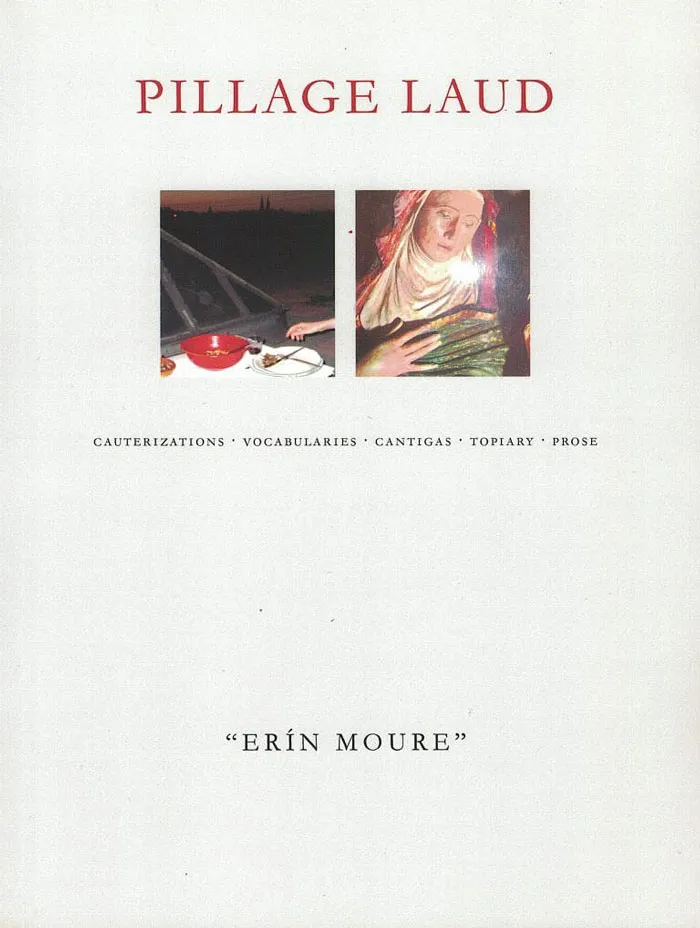
Pillage Laud
First published in 1999 in an edition of 300 perfectbound copies and 26 spiralbound copies lettered A-Z and signed, Pillage Laud is a lost cult item that now returns to print. As the 1999 edition announced, Pillage Laud selects from pages of computer-generated sentences to produce lesbian sex poems (cauterizations, vocabularies, cantigas, topiary and prose) by pulling through certain found vocabularies, relying on context: boy plug vagina library fate tool doctrine bath discipline belt beds pioneer book ambition finger fist flow.
It used MacProse, a freeware designed by American poet and jazz musician Charles O. Hartman as a generator of random sentences based on syntax and lexicon instructions internal to the program; the program worked on Apple systems prior to OSX and is now in the dustbins of computer history. In 1999, the news was shocking: Moure’s poems are written by a computer. In 2011, now that everyone is a computer, the book can be read anew.

Early Works
Early Works collects Alice Notley’s first four out of print poetry collections, along with 80 pages of previously uncollected material. A must have for any Notley fan. Includes original collection cover artwork by Philip Guston, Philip Whalen and George Schneeman, among others.
From editor Nick Sturm’s “Introduction” to Early Works:
In the author’s note that begins Grave of Light: New and Selected Poems 1970-2005, Alice Notley writes, “My publishing history is awkward and untidy, though colorful and even beautiful.” I have always been enamored of this sentence, which reminds us that an array of dispersed and varying publishing contexts are the original sites that give shape to such a book’s form. It is also something of an invitation into that color and untidiness, a prompt to become more curious about the awkwardness and beauty of Notley’s publishing history. This book, Early Works, accounts for a significant portion of that history by bringing back into print the complete versions of her first four books, a little-known 22-poem sonnet sequence, and a large selection of early uncollected poems gathered from little magazines. In doing so, Early Works joins an important set of recent volumes that put Notley’s earlier poetry back into circulation, including Manhattan Luck (Hearts Desire, 2014), which collects four long poems written between 1978 and 1984, and Songs for the Unborn Second Baby, originally published by United Artists in 1979 and reissued in a facsimile edition by London-based Distance No Object in 2021. Each in their own way, and especially taken together, these books continue to confirm that, as Ted Berrigan writes in The Poetry Project Newsletter in 1981, “Alice Notley is even better than anyone has yet said she is.”

Sonic Meditations
Pauline Oliveros (1932-2016) Pauline Oliveros' life as a composer, performer and humanitarian was about opening her own and others' sensibilities to the universe and facets of sounds. Her career spanned fifty years of boundary dissolving music making. In the '50s she was part of a circle of iconoclastic composers, artists, poets gathered together in San Francisco. In the 1960's she influenced American music profoundly through her inclusive work with improvisation, meditation, electronic music, myth and ritual.
She founded 'Deep Listening(R), ' which came from her childhood fascination with sounds and from her works in concert music with composition, improvisation and electro-acoustics. She described Deep Listening as a way of listening in every possible way to everything possible to hear no matter what you are doing. Such intense listening includes the sounds of daily life, of nature, of one's own thoughts as well as musical sounds. 'Deep Listening is my life practice, ' Oliveros explained, simply. Oliveros founded Deep Listening Institute, formerly Pauline Oliveros Foundation, now the Center For Deep Listening at Rensselaer, NY. Her creative work is currently disseminated through Pauline Oliveros Publications and the Ministry of Maåt, Inc

ROT
ROT is a publication reflecting the research “Wicked technology/Wild fermentation,” by Sara Manente that focuses on forms and practice of fermentation as ways to rethink bodies and their making. This glossy magazine performs research, aiming to infect the reader, and questioning how to spread, publish, and help the work survive.
Sara Manente is a performance artist, dance maker and researcher born in Italy and living in Brussels. She is interested in narrowing the distance between the performer, the audience, and the work. Her research starts from a dance practice that problematizes perception, translation, and ways of doing. Her work comes out in hybrid forms: book launch, 3Dfilm, written text, interview, choreographic piece, workshop, telepathic experience, collaboration, et al.

Chapel Road
Louis Paul Boon, Adrienne Dixon
A meta-textual matryoshka doll of a novel from a renowned voice in Flemish literature.
The twisting narrative of Louis Paul Boon's 1953 masterpiece follows a young girl named Ondine and her brother Valeer, born into poverty at the turn of the century in the industrial city of Aalst, Belgium. Ondine's coming of age is interwoven with a reworking of the medieval fable of Reynard the Fox, as well as a metanarrative in which an author named Louis Paul Boon and his colorful group of friends discuss the writing of a novel named Chapel Road, debating how best to present Ondine's story.
Groundbreaking among post-war Dutch literature for its postmodern structure and irreverent, dialect-studded use of language, Boon's allegory of the rise and fall of socialism in Flanders presents his theory of the novel as a type of "illegal writing" where digressions are far more important than a carefully constructed plot.
Introduction by Chad W. Post
Louis Paul Boon (1912-1979) started out as a house painter but went on to become the author of a large and rich oeuvre spanning several genres: from the compelling historical epics he composed later in life to his sharp, witty work as a newspaper columnist and his tongue-in-cheek, scabrous novels. Boon is one of the most important writers of Flemish literature in the twentieth century, a keen observer of society, the individual and the interplay between them.
Adrienne Dixon is a translator of Dutch and Flemish literature.
Chad W. Post is the founder and publisher of Open Letter Books. He is also the editorial director of Dalkey Archive Press, where he was formerly the associate director. Over the course of his career, he founded the Translation Database, the Best Translated Book Awards, multiple literary podcasts (Two Month Review, Three Percent), the Three Percent website, and currently writes two newsletters: The Three Percent Problem, and Mining the Dalkey Archive. He is also the author of The Three Percent Problem: Rants and Responses on Publishing, Translation, and the Future of Reading. His articles and book reviews have appeared in a range of publications. In 2018 he received the Words Without Borders Ottaway Award for the Promotion of International Literature.

Death Industrial Complex
Candice Wuehle’s Death Industrial Complex is a meditation on the cultural obsession with the bodies of dead women and an occult invocation of the artist Francesca Woodman. Like Woodman’s photographs with their long exposures and blurred lenses, this book is haunted and haunting, hazy yet devastatingly precise. These are poems as possessions, gothic ekphrases, dialogues with the dead, biography and anti-biography, a stunning act of “cryptobeauty.”

Chile Chico et le quartier Versailles
Chile Chico et le quartier Versailles, c'est une exploration qui inventorie, interroge et révèle les mémoires invisibles en listes et en collections. Une mémoire qui ne soffre pas en bloc, qui résiste, se fragmente, se transforme. A travers cette archive collaborative, nous avons voulu capter ces va-et-vient ď'un passé qui dialogue avec le présent, des images qui oscillent entre Vintime et le collectif.
Le point de départ de cette fabrique visuelle, c'est lexil des Chilien.nes, débarqué.es dans les années 70, qui se tissent une nouvelle vie sur le sol de Neder-Over-Heembeek, dans le quartier Versailles à Bruxelles. Ces trajectoires, arrachées à un ailleurs, s'ancrent dans des espaces rêvés comme de transit pour devenir des lieux d 'appartenance, où lexil se mue et les racines finissent par se déployer. A ces récits se greffent d'autres histoires, d'autres trajectoires. Un quartier comme un carrefour, ou les individualités se rencontrent, où les vies se croisent et s'allient.

And most of all I would miss
Picture a pencil curved, implausibly, parabolically. An implement bending back on itself (core straining) so as to be drawing the surest line, even as its eraser-end is simultaneously rubbing that graphite out. What remains almost never was: mark as memorial to foreclosure. Examined from a certain angle, the un-line flickers in and out of thereness. On registration, it lives, it goes forth. Sub rosa, it knows never to clear its throat. It has learnt to calibrate its signature; it can evade infra-red. Propelling itself through the narrowest channels, it proceeds with resolve, flayingly. Mattar’s And most of all I would miss the shadows of the tree’s own leaves cast upon its trunk by the orange streetlight in the sweet blue darks of spring is taut as writing can be. The tone she makes sound is singular and desperately (gloriously) intent.
- Sarah Hayden
Piercing and lucid in its exposition of atmospheric violence and total erasure, Mira Mattar gets to the grain of how the languages of selfhood, mediated but also inhibited by the force of the ‘un-universal’, become complicit in forming the sovereign imperative to self-determination, ‘oh arrogant ambition / to transform / you & keep myself / plumed’, through the reproduction of a ‘contested field / of meaning’, one both marked by the lure and ruse of psychic stability as the real fantasy of occupation, and immanent to concrete, unknown modes of personal resistance and collective recovery thread like a ‘rope / in a knot in a line / of knots’, an inherited ‘excess of memory / mostly portal.’ Mattar carefully gleans in its undecidability, given over to moments of precarious decision without ties or duplicity.
- James Goodwin

Moon Mirrored Indivisible
Multilayered lyric poems that resist systems of power and foster intimacy.
An inheritor of lineages marked by colonial and gendered violence, Farid Matuk approaches the musical capacities of verse not as mere excitation or decoration, but as forms that reclaim pleasure and presence. Entering the sonic constellations of Moon Mirrored Indivisible, the reader finds relief from nesting layers of containment that systems of power impose on our bodies and imaginations. In this hall of historical mirrors, fictions of identity are refracted, reflected, and multiplied into a vast field of possibilities. Matuk’s meditations on place and power offer experiments in self-understanding, moving through expansive conversations between a lyric “I” and others, including poets, the speaker’s partner, ancestors, and the reader, and creating spaces for strange intimacy. Each of the book’s four sections of poems builds on the other to ask how we might form a collective—a people—not founded in orthodoxies of originality but in the mutual work of mirroring one another.

Ethical Portraits: In Search Of Representational Justice
Ethical Portraits investigates the representation of the incarcerated in the U.S. criminal justice system. Through interviews, creative non-fiction, and cultural theory, Hatty Nestor deconstructs a range of different prison portraiture.
Prisons systematically dehumanise the imprisoned. Visualised through mugshots and surveillance recordings, the incarcerated lose control of their own image and identity. The criminal justice system in the United States does not only carry out so-called justice in ways that compound inequality, it also minimises the possibility for empathetic encounters with those who are most marginalised. It is therefore urgent to understand how prisoners are portrayed by the carceral state and how this might be countered or recuperated. How can understanding the visual representation of prisoners help us confront the invisible forms of power in the American prison system? Ethical Portraits investigates the representation of the incarcerated in the United States criminal justice system, and the state's failure to represent those incarcerated humanely.
Through wide-ranging interviews and creative nonfiction, Hatty Nestor deconstructs the different roles of prison portraiture, such as in courtroom sketches, DNA profiling, and the incarceration of Chelsea Manning. Includes a foreword by Jackie Wang.
Hatty Nestor is a cultural critic and writer, published in Frieze, The Times Literary Supplement, The White Review and many other publications. She is currently completing a PhD at Birkbeck, University of London.

La même en pire
La même en pire est un roman d’amour enchâssé dans un roman noir, un huis clos dans lequel les confessions de chacune deviennent le procès des autres. Elles sont toutes coupables, toutes victimes, toutes témoins, toutes innocentes de ce qui est arrivé à Madison. Et qu’est-ce qui est arrivé ?
Madison a disparu, Madison a été assassinée, Madison s’est suicidée. Huit femmes se retrouvent dans un appartement et reviennent sur ce qui les avait rassemblées des années auparavant : une maison délabrée que Madison louait et dans laquelle elle avait installé des caméras pour streamer H24 et monétiser son existence. Elles avaient toutes vécu dans cette maison et avaient toutes fini par la déserter. Sophie la poète mariée au terroriste, Cécile la détective privée, Hilary la bourgeoise militante, Lola l’adolescente tiktokeuse muette, Alexandra l’entrepreneuse, Eva la mauvaise mère, Kamila la mère aimante, et la narratrice.
Préface : Lou-Andréa Benzacar

Maa Ka Maaya Ka Ca A Yere Kono – 13th Edition of the Rencontres de Bamako - African Biennale of Photography
Bonaventure Soh Bejeng Ndikung
The catalogue of the 13th edition of the Rencontres de Bamako - African Biennale of Photography, focusing on multiplicity, difference, becoming, and heritage.
The dominant narrative in this "globalized world" is, incidentally, that of singularity—of universalism, of single identities, of singular cultures, of insular political systems. With this narrative, however, comes an illusory sense of stability and stasis; identities seem inalterable, cultures are immutable, political systems prove uneasy in the face of change. Thus, in sustaining this pervasive discourse, there has been a great loss of multiplicity, of fragmentation, of process and change, and not least of complex notions of humanity and equally complex narratives.
In decentering this year's biennale On Multiplicity, Difference, Becoming, and Heritage, General Director Cheick Diallo, Artistic Director Bonaventure Soh Bejeng Ndikung, and the curatorial team—Akinbode Akinbiyi (artist and independent curator), Meriem Berrada (Artistic Director, MACAAL, Marrakech), Tandazani Dhlakama (Assistant Curator, Zeitz MOCAA, Cape Town, South Africa), and Liz Ikiriko (artist and Assistant Curator, Art Gallery of York University, Toronto)—of the Bamako Encounters pay a powerful tribute to the spaces in between, to that which defies definition, to phases of transition, to being this and that or neither and both, to becoming, and to difference and divergence in all their shades. Accordingly, Amadou Hampâté Bâ's statement (Aspects de la civilisation africaine, Éditions Présence Africaine, 1972) presiding over the manifestation, Maa ka Maaya ka ca a yere kono,translates to, "the persons of the person are multiple in the person."
A key tool for negotiating the processual and shifting nature of multiplicity lies in storytelling. It is the central medium through which humanity points the lens on itself and launches an attempt at self-understanding and reflection, and the breadth of answers given throughout history testifies to the congenial nature of storytelling and multiplicity. Moreover, the stories we tell not only negotiate who we are but also expose underlying currents of who we will become in the future. This is the concern lying at the heart of the 13th edition of the Bamako Encounters—the stories we tell, the multiple facets of humanity we accommodate, notions of processuality, becoming in being, embracing identities that are layered, fragmented, and divergent, and the multifarious ways of being in the world, whether enacted or imagined. It should be emphasized that this does not apply only to questions of personal identity. On the contrary, it is a bold affirmation of transformation and transition, of becoming in an emphatic sense, and is thus equally significant for state politics. It also rings true for questions of heritage/patrimony. Embracing the kaleidoscopic legacy of our multiple heritages means to open them up and liberate the term "patrimony" from its etymological roots (the Latin patrimonium means "the heritage of the father"), imagining in its place an inclusive concept of matrimony.
Thus, in this 13th edition of the Bamako Encounters with the title Maa ka Maaya ka ca a yere kono, artists, curators, scholars, activists, and people of all walks of life are invited to reflect collectively on these multiplicities of being and differences, on expanding beyond the notion of a single being, and on embracing compound, layered and fragmented identities as much as layered, complex, non-linear understandings of space(s) and time(s).
Published following the 13th edition of the Rencontres de Bamako - African Biennale of Photography, in Bamako, Mali, in 2022.
With Saïd Afifi, Ixmucané Aguilar, Baff Akoto, Annie-Marie Akussah, Américo Hunguana, Daoud Aoulad-Syad, Leo Asemota, Myriam Omar Awadi, Salih Basheer, Shiraz Bayjoo, Amina Benbouchta, Hakim Benchekroun, Maria Magdalena Campos Pons, Rehema Chachage, Ulier Costa-Santos, Adama Delphine Fawundu, Fatoumata Diabaté, Aicha Diallo, Amsatou Diallo, Anna Binta Diallo, Mélissa Oummou Diallo, Nene Aïssatou Diallo, Binta Diaw, Adji Dieye, Imane Djamil, Sènami Donoumassou, Abdessamad El Montassir, Fairouz El Tom, Luvuyo Equiano Nyawose, Raisa Galofre, Raisa Galofre, Joy Gregory, Gherdai Hassell, Thembinkosi Hlatshwayo, Letitia Huckaby, Anique Jordan, Gladys Kalechini, Hamedine Kane, Atiyyah Khan, Gulshan Khan, Seif Kousmate, Mohammed Laouli, Maya Louhichi, Mallory Lowe Mpoka, Nourhan Maayouf, Marie-Claire Messouma Manlanbien, Botembe Moseka Maïté, Louisa Marajo, Clarita Maria, Billie McTernan, Mónica de Miranda, Arsène Mpiana Monkwe, Sethembile Msezane, Ebti Nabag, Elijah Ndoumbe, Lucia Nhamo, Samuel Nja Kwa, Nyancho NwaNri, Jo Ractcliffe, Adee Roberson, Fethi Sahraoui, Muhammad Salah, Neville Starling, Eve Tagny, René Tavares, Sackitey Tesa, Helena Uambembe, David Uzochukwu, Sofia Yala, Timothy Yanick Hunter.

YouYou Group – A li'nuage
Handmade artist's book combining drawings, photographs, and archival materials. This publication reflects on the YouYou Group's ten-year journey and its evolving relationship with space. It marks a transitional moment from the group's long-term engagement with public space toward a growing understanding of spatiality and collective presence.
YouYou Group is a Belgian choir that specializes in what is known in Arabic as zaghareed. This trilling cry is used by women at weddings and festive occasions, but also at funerals. Youyou is the French name for zaghareed. Depending on the regional origin, it is also called kululu, tsahalulim, or irrintzi. It is a long, shrill tone that is modulated (by the throat, glottis, or rapid tongue movements) and can be heard from far away. Brussels artist Myriam Van Imschoot was one of the founders of this singing group.

KW Institute for Contemporary Art
Pia Arke
Pia Arke, Ros Carter and 1 more
Pia Arke (1958–2007) was a Greenlandic Inuk and Danish artist, writer and photographer. She is known for her self-portraits and landscape photographs of Kalaallit Nunaat (Greenland), as well as for her paintings, collages, performative film works and writing. Arke strove to make visible the silence that surrounded the colonial history and complex political and cultural relationship between Greenland and Denmark.
This publication accompanies the first international exhibitions of Arke’s work outside of Greenland and the Nordic countries, happening over the course of 2024 at John Hansard Gallery in Southampton (UK) and at KW Institute for Contemporary Art in Berlin (DE). It reflects on Arke’s ideas and legacy in a wider international context and aims to demonstrate how the work she made and the ideas she expressed connect with current discourse and contemporary thinking.
Texts by Krist Gruijthuijsen, Woodrow Kernohan, Ros Carter, Alice Maude-Roxby, Mette Sandbye, Tiara Roxanne, Sofie Krogh Christensen, Nivi Christensen, Siri Paulsen, Trinh T. Minh-ha