rile*books

Search books

Search books by title, author, publisher, keywords...

Cover of Sonic Meditations

Self-Published

Sonic Meditations

Pauline Oliveros

€20.00

Pauline Oliveros (1932-2016) Pauline Oliveros' life as a composer, performer and humanitarian was about opening her own and others' sensibilities to the universe and facets of sounds. Her career spanned fifty years of boundary dissolving music making. In the '50s she was part of a circle of iconoclastic composers, artists, poets gathered together in San Francisco. In the 1960's she influenced American music profoundly through her inclusive work with improvisation, meditation, electronic music, myth and ritual.

She founded 'Deep Listening(R), ' which came from her childhood fascination with sounds and from her works in concert music with composition, improvisation and electro-acoustics. She described Deep Listening as a way of listening in every possible way to everything possible to hear no matter what you are doing. Such intense listening includes the sounds of daily life, of nature, of one's own thoughts as well as musical sounds. 'Deep Listening is my life practice, ' Oliveros explained, simply. Oliveros founded Deep Listening Institute, formerly Pauline Oliveros Foundation, now the Center For Deep Listening at Rensselaer, NY. Her creative work is currently disseminated through Pauline Oliveros Publications and the Ministry of Maåt, Inc

Published in 2022 ┊ 52 pages ┊ Language: English

recommendations

Cover of Foraging Fireflies

Self-Published

Foraging Fireflies

Ecology €35.00

Foraging Fireflies is a publication rooted in archiving, memory, and refusal amid ongoing violence and erasure in Palestine. Through personal stories, recipes, and reflections on foraging, farming and land-based knowledge, it insists on the presence of Palestinian lives, histories, and enduring connections to the land.

Gathering voices across generations, the publication documents practices of care, sustenance, and resistance—countering dispossession, greenwashing and colonial narratives. In a moment of attempted annihilation, preserving memory and knowledge becomes an act of defiance, continuity, and hope.

The publication naturally gives priority to Arabic in the design, allowing it to fully spread on the page, while English appears on narrower pages at the end of each contribution, unfolding like a booklet. The magazine is organized into four color-coded sections, each comprising multiple contributions that open with a full-page illustration by Aude Aboul-Nasr, portraying the land and its keepers. Printed in risograph, the colors gain a rich, vibrant texture. The publication also includes a poster and two postcards.

Creative Direction: SuperMelon | Besma Ben Said
Graphic Design: Chiara Vincenti Zakhia
Illustration: Aude Aboul-Nasr

Cover of Honey Volume 2

Self-Published

Honey Volume 2

Mars Dietz, Opashona Ghosh and 1 more

Zines €15.00

HONEY is a zine meditating on the experiences of friendship. 

Volume 2 was edited by Mars Dietz, Opashona Ghosh and Dylan Spencer-Davidson—each inviting contributions from friends. 

Following vol. 1’s optimism about the underappreciated potentials of friendship, vol. 2 marks a noticeable turn towards friendship's messier sides. Letters to deceased friends, childhood social complexities, unrealised sexual desire, pushback against the overfetishisation of queer kinship, and more. 

Contributions from Azul De Monte, Ana Božičević, D Mortimer, Adriana Disman, Pelumi Adejumo, Iggy Robinson, Clay AD, To Doan, Edward Herring, marum, Lou Drago, Aisha Mirza, Iga Świeściak, Roya Amirsoleymani, George Lynch, Emily Pope and Kari Rosenfeld. 

Original artworks by Opashona Ghosh and Iga Świeściak, and featuring artworks by Azul De Monte and Emily Pope. 

Riso printed on recycled paper with Pagemasters (London).

Cover of Revolutionary Tofu

Self-Published

Revolutionary Tofu

Wu Qin

Zines €15.00

Revolutionary Tofu. Transnational Flows in the Making of Chinese Anarchism, through the clue of soy, attempts to resurface the historical threads of Chinese anarchy in the early 20th century and the transnational flow in the making of it, weaves between France and China, from Manchukuo to São Paulo. Revolutionaries from different regions encountered one another in various historical moments, quietly opening up an alternative path that history might have taken. 

The story was first published in 44 Monthly (September 2022) in China , revised, translated and printed in Berlin in 2024.

Written by Wu Qin                             
Designed by IfA
Published by Tofu Stand (Tofulogy 001)

Cover of Swamp, City, Forest

Self-Published

Swamp, City, Forest

Valentina Bianchi

Zines €7.00

This zine is the result of the research residency "Plotting with the archive" that took place at Komplot between September 2025 and January 2026. The publication contains a subjective timeline of Komplot — its strategies, relations and projects — with the aim of organising them and at the same time speculating on possible future developments. The material was produced during a collective workshop in which the archive was explored and activated.

Cover of Notes on a life not lived

Self-Published

Notes on a life not lived

Despina Vassiliadou

Poetry €30.00

This publication is based on a project by Despina Vassiliadou that ran from 2015-16. It presents a collection of photographs taken during the period, accompanied by fictional short stories.

Cover of Walking from Scores

Les Presses du Reel

Walking from Scores

Elena Biserna

An anthology of text and graphic scores to be used while walking, from Fluxus to the critical works of current artists, through the tradition of experimental musicand performance, gathered and presented by Elena Biserna.

Walking from Scores is a hundred or so collection of non site-specific protocols, instructions and textual and graphic scores centred on walking, listening and playing sound in urban environment. It explores the relationship between art and the everyday, the dynamics of sound and listening in various environments and the (porous) frontiers between artists and audiences. It starts with two premises: an interest in walking envisaged as a relational practice and tactic enabling us to read and rewrite space; an interpretation of scores understood as open invitations and catalysers of action in the tradition of Fluxus event scores.

With scores and texts by Peter Ablinger, Milan Adamčiak, G. Douglas Barrett, Elena Biserna, Blank Noise, George Brecht, Cornelius Cardew, Stephen Chase, Giuseppe Chiari, Seth Cluett, Philip Corner, Viv Corringham, Bill Dietz, Amy Dignam, David Dunn, Haytham El-Wardany, Esther Ferrer, Simone Forti, Francesco Gagliardi, Jérôme Giller, Oliver Ginger, Anna & Lawrence Halprin, David Helbich, Dick Higgins, Christopher Hobbs, Jérôme Joy, katrinem, Debbie Kent, Bengt af Klintberg, James Klopfleisch, Milan Knížák, Alison Knowles, Takehisa Kosugi, Jirí Kovanda, Anne Leilehua Lanzilotti, Bob Lens, Ligia Lewis, Alvin Lucier, Walter Marchetti, Larry Miller, iLAND/Jennifer Monson, Max Neuhaus, Alisa Oleva, Pauline Oliveros, Yoko Ono, Open City & Emma Cocker, Nam June Paik, Michael Parsons, Ben Patterson, Cesare Pietroiusti, Mathias Poisson, Anna Raimondo, Pheobe riley Law, Jez riley French, Paul Sharits, Mieko Shiomi, Mark So, Standards, Nicolas Tardy, Davide Tidoni, Ultra-red, Isolde Venrooy, Carole Weber, Manfred Werder, Franziska Windisch, Ben Vautier, La Monte Young.

Elena Biserna is a scholar and independent curator based in Marseille, France. She is associate researcher at PRI SM (AMU / CNRS) and TEAMeD (Université Paris 8). Her interests are focused on listening and on contextual, "situated" art practices in relationship with urban dynamics, sociocultural processes, the public and political sphere. Her writings have appeared in several publications. As a curator, she has collaborated with different organisations and presented her projects internationally.

Cover of Deep Listening

iUniverse

Deep Listening

Pauline Oliveros

Performance €16.00

Deep Listening is a practice created by composer Pauline Oliveros in order to enhance her own as well as other's listening skills. She teaches this practice worldwide in workshops, retreats and in her ground breaking Deep Listening classes at Rensselaer Polytechnic Institute and Mills College. Deep Listening practice is accessible to anyone with an interest in listening. Undergraduates with no musical training benefit from the practices and successfully engage in creative sound projects. Many report life changing effects from participating in the Deep Listening classes and retreats.

Cover of Bodies of Sound: Becoming a Feminist Ear

Silver Press

Bodies of Sound: Becoming a Feminist Ear

Sarah Shin, Irene Revell

Fiction €20.00

‘I am concerned with the power of sound! and what it can do to the body and the mind,’ wrote composer Pauline Oliveros. In the body, histories and politics come together with sound and listening, memory and feeling. Bodies of Sound offers a resonant exploration of feminist sonic cultures and radical listening in over fifty contributions. In this book of echoes, a variety of forms – from essays to text scores to art, fiction and memoir – speak across gender, ways of knowing, witnessing, sounding and voicing, translation, displacement, violence and peace.

With contributions from: 

Sara Ahmed, Ximena Alarcón, Svetlana Alexievich, Ain Bailey & Frances Morgan, Anna Barham, Xenia Benivolski, Leanne Betasamosake Simpson & Kite, Elena Biserna, Karen Barad & Black Quantum Futurism, Anne Bourne, Daniela Cascella, Theresa Hak Kyung Cha, Maria Chávez, Don Mee Choi, Carson Cole Arthur, Petero Kalulé & AM Kanngieser, Lindsay Cooper, Julia Eckhardt, Lucia Farinati & Claudia Firth, Ella Finer, Annie Goh, Louise Gray, Christina Hazboun, Johanna Hedva, Sarah Hennies, Tomoko Hojo, IONE, Lee Ingleton, Hannah Catherine Jones, Christine Sun Kim, Nat Lall, Cathy Lane, Jeanne Lee & Lona Foote, Marysia Lewandowska, Annea Lockwood & Jennifer Lucy Allan, Cannach MacBride, Elaine Mitchener & Hannah Kendall, Alison O'Daniel, Naomi Okabe, Pauline Oliveros, Daphne Oram, Gascia Ouzounian, Holly Pester, Roy Claire Potter, Anna Raimondo, Tara Rodgers, Aura Satz & Barbara London, Shortwave Collective, Sisters of the Order of Celestial Nephology, Sop, Syma Tariq, Marie Thompson, Trinh T. Minh-ha & Stoffel Debuysere, Salomé Voegelin

Cover of Better Do It Now before You Die Later: Sonny Simmons with Marc Chaloin

Blank Forms

Better Do It Now before You Die Later: Sonny Simmons with Marc Chaloin

Sonny Simmons, Marc Chaloin

Though his years in the New York free-jazz scene of the sixties cemented his reputation as "one of the most forceful and convincing composers and soloists in his field," saxophonist Sonny Simmons (1933–2021) was nearly forgotten by the '80s, which found him broke, heavily dependent on drugs and alcohol, and separated from his wife and kids. "I played on the streets from 1980 to 1994, 365 days a year," Simmons tells jazz historian and biographer Marc Chaloin. "I would go to North Beach, and I'd sleep in the park. The word got around town that Sonny is a junkie, really strung out."

The resurrection of Simmons' career―upon the release of his critically acclaimed Ancient Ritual (Qwest Records) in 1994―has become a modern legend of the genre. In the last two decades of his musical career, Simmons broke through to a new echelon of recognition, joining the pantheon of great innovators and masters of the music. But to this day he remains an undersung figure. Here, in the first ever book dedicated to his life, Simmons recounts his childhood in the backwoods of Louisiana, his adolescence in the burgeoning Bay Area jazz scene and his star-studded life in New York playing alongside the greats.

Cover of Stalled Death Train

Spunk Editions

Stalled Death Train

Evan Kennedy

A dark-humored poet’s novel of cruising, contempt, and database crawling, Stalled Death Train rumbles through the death of David Bowie in 2016 to shake apart its narrator’s sense of self. Nick, a burned out office worker and late-Bowie fanatic, spends his days mourning his fallen star, left to decipher the legacy and lyrics of a singular pop icon whose excesses did not cease, even after his greatest moments had passed. Meanwhile, Nick must solve the mystery of why his boyfriend has begun to self-amputate as a form of autonomously upgrading his dimensions—or at least call tech support before he uploads himself to the cloud.

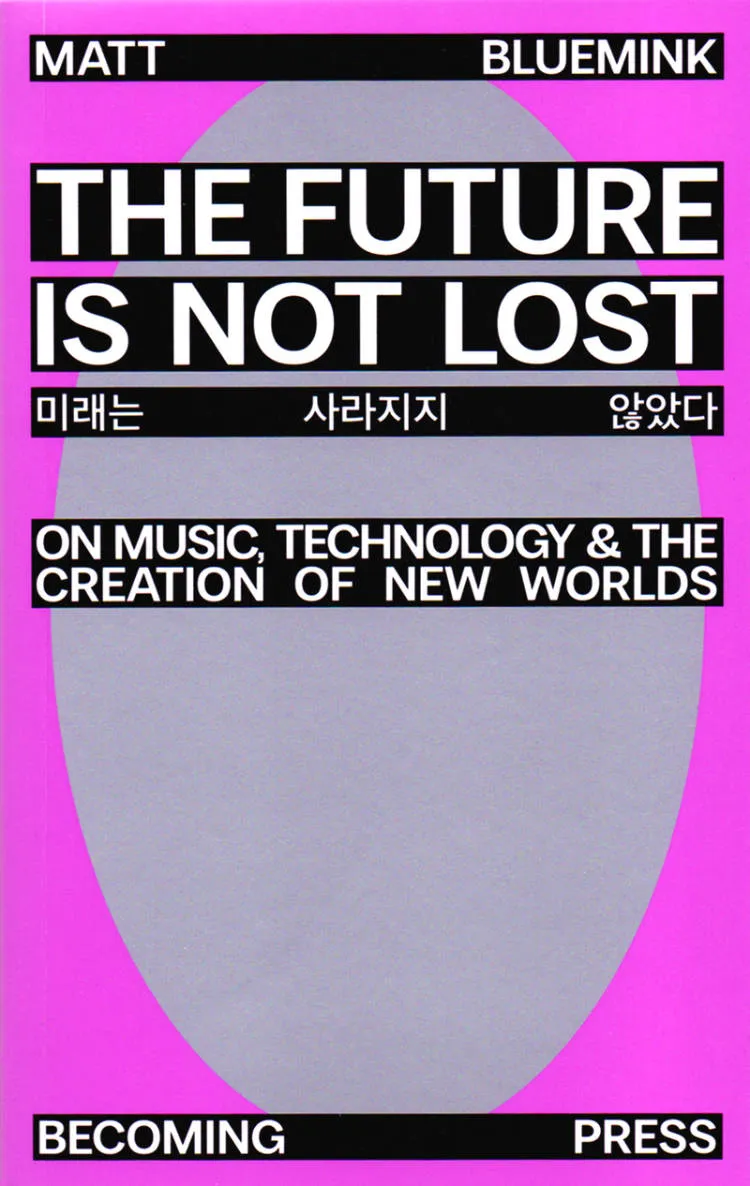
Cover of The Future is not Lost: On Music, Technology, and the Creation of New Worlds

becoming press

The Future is not Lost: On Music, Technology, and the Creation of New Worlds

Matt Bluemink, Alessandro Sbordoni

Non-fiction €16.00

Mark Fisher taught a generation to hear the future's disappearance in contemporary music, as if the rhythm of the world was synchronised to the periodic flowering of new creative forms. His diagnosis was devastating: stagnation in music was akin to a venous insufficiency, or worse, some kind of nuclear winter that would ward off the spring for endless generations to come. 

Drawing on musicians like SOPHIE, Arca and Iglooghost, Matt Bluemink declares that the future is not lost; it still speaks to us through music. If Fisher’s Hauntology — dwelling on ghosts of the past — is the logic of depression, then Bluemink’s Anti-Hauntology posits a logic of hope where voices from the future continue to guide the development of the present. 

Island-hopping through Stiegler's philosophy of technics, Simondon's theory of individuation, and the spatial imaginaries of cyberpunk and solarpunk, Bluemink builds a theoretical framework equal to the times — one that takes seriously our capacity to, not only diagnose the world, but remake it. In order to create a new future we must re-imagine our relationship with music, with technology, and with culture. The world of tomorrow is a blank canvas; an open book. New beginnings are always possible. 

Matt Bluemink is the founder and editor-in-chief of Blue Labyrinths online magazine. His research is focused on the relationship between the philosophy of technology, media theory and urbanism. He also writes on contemporary music, literature, and digital culture. 

Cover of Silence: Lectures and Writings

Wesleyan

Silence: Lectures and Writings

John Cage

Essays €27.00

Silence: Lectures and Writings is a book by American experimental composer John Cage (1912–1992), first published in 1961 by Wesleyan University Press. Silence is a collection of essays and lectures Cage wrote during the period from 1939 to 1961.

Most of the works are preceded by a short commentary on their origins, some have an afterword provided. Several works feature unorthodox methods of presentation and/or composition. "The Future of Music: Credo" juxtaposes paragraphs of two different texts. The text of the first part of "Composition as Process" is presented in four columns, the text of "Erik Satie" in two. "45' for a Speaker" is similar to Cage's "time length" compositions: it provides detailed instructions for the speaker as to exactly when a particular sentence or a phrase should be said. "Where Are We Going? and What Are We Doing?" is presented in several types of typeface to better reflect the concept of the lecture, which was originally presented as four tapes running simultaneously. "Indeterminacy" is a collection of various anecdotes and short stories taken from life or books Cage read: the concept is to tell one story per minute, and to achieve the speaker has to either speed up or slow down, depending on the length of the story.