Books
Books
in random order

Birthday
Bridget Mullen is the ruler of an unruly roost. Between 2021 and 2023, she gave birth to forty-seven paintings, each twelve-by-nine inches: kin ugly and cute, monstrous, fleshy, repulsive, droopy-eyed, and sneering as they cross the universal threshold into the no less frightening world that awaits. Birthday reunites Mullen's uncanny litter alongside a conversation between the artist and Lucas Blalock.
The paintings in New York-based artist Bridget Mullen's Birthday series utilize two distinct parameters to guide the creation of the iterative works: a vertical orientation at an intimate scale of 12 x 9 inches and a visualization of perhaps the ultimate creative act—the moment of birth. Through this consistent scale and thematic hyper focus, the artist employs endless formal variations in composition, color, and paint application. The result is a series of paintings that share a common structure yet champion individuality.
Contrasting colors provoke a visible tension, one that is at times compressed and, in other moments, elastic. Suddenly, abstract shapes come into focus as human anatomies, capable of expressing emotion. Undulating lines of various thicknesses and layered colors squeeze together, revealing peculiar faces and gestures that emerge from a central point. The repetition of thin lines creates a visual stutter of pigment, alluding to the passage of time or rapid movement.
The works in Birthday build on Mullen's practice, combining color, decisive mark-making, intuition, and experimentation to conjure psychedelic configurations. Sculptural dimensionality and flatness, representation and abstraction, and solidity and fluidity, serve not as dichotomies within these works, but as two complementary halves of a whole. Together, the forms and figures of the Birthday series are imbued with a sense of life, pregnant with agency and potential.

TRANSMISSIONS: Radio Essays on Edges, Crossings and Narrowcasting Borderlands
Transmissions: Radio Essays on Edges, Crossings and Narrowcasting Borderlands gathers radio essays—created as part of Robida Collective’s project Radio drugega/The Other Radio—which reveal that to speak of “the border” is never to speak of a single line. There are political borders, conceptual borders, bodily borders; carnivalesque borders, where order collapses into play; linguistic and cultural borders, where words slip between languages and where accents become geographies; archival borders, separating memory from forgetting; borders of abandonment, where life and death enter into a dialectical ballet; economic borders, drawn by property, ownership, enclosure; borders of matter, space and time; acoustic borders, where the voice meets noise and incomprehensibility; cosmic borders, where meteors cross the thin edge of air; ecological borders, porous and breathing, where one species touches another. These are some of the borders this book speaks of – lines that do not divide but resonate, that hold together separation and proximity, distance and relation. Together, these essays form a cartography of friction but also affinity, reminding us that to erase all borders is to erase the very conditions of encounter – and that meaning often emerges not at the centre, but at the edges where worlds meet.
With texts by:
Agnes Cameron, Ajda Bračič, Aljaž Škrlep, Antônio Frederico Lasalvia, Giorgia Maurovich, Jack Bardwell, Kate Donovan, Kat Macdonald, Lijuan Klassen, Luca Vettori, Michael Marder, Moritz Gansen, Olya Korsun, Petra Filagrana, Urška Savič.

Adrenalin
Adrenalin is Syrian-born, Stockholm-based Palestinian poet Ghayath Almadhoun’s first collection to be published in English. This sinuous translation by Catherine Cobham comprises poems that span years and continents, that circulate between cities, ideas, lovers, places of refuge, war zones, time zones, histories. Here is a vital, relentless, intertextual voice that refuses arrest by sentimentality, that pursues the poetry coursing underneath the poetry.

Toffe. édition générale : système de production d'actions graphiques
toffe. édition générale
publication issue de reproduction générale,
système de production d'actions graphiques
développé en trois temps :
projection générale
dispositif multi-écran, pour la chaufferie
galerie de l'école supérieure des arts décoratifs de strasbourg
du 14 février au 23 mars 2003
présentation, édition générale
école nationale supérieure des beaux-arts d'alger
du 24 mai 2003
exposition, occurrence récente
diffusion, édition générale
galerie madé, paris
du 12 mai au 5 juin 2003

The Pepsi Cola Addict
The legendary lost novel in which fourteen-year-old Preston Wildey-King must choose between his all-consuming passion for Pepsi Cola and his love for schoolmate Peggy.
"He walked into the turbulent super market. There were people everywhere. His eyes swept over the shelves and stabilised on a large stack of Pepsi-colas. He could almost experience the cool fizzy liquid descending his parched throat."
Written by June-Alison Gibbons when she was only 16, The Pepsi Cola Addict is considered one of the great works of twentieth-century outsider literature. More than just a literary curiosity, however, this tale of a teenager whose passion for a well-known cola drink threatens to ruin his life is the uniquely vivid expression of a young woman trying to make sense of the confusing, often brutal world she in which found herself.
Published in 1982 by a vanity press who took £800 from its young author and gave her only a single book in return, it's thought that fewer than ten original copies still exist in the world.
Shortly after its publication, June-Alison and her sister Jennifer would become infamous as "The Silent Twins" and find themselves cruelly incarcerated for over a decade in Broadmoor Hospital. This author-approved edition makes June-Alison Gibbon's remarkable vision widely available for the first time.

Destination: Tashkent – Experiences of Cinematic Internationalism
The legacy and posterity of the Tashkent Festival for Asian, African and Latin American Cinema, which was held between 1968 and 1988 in Uzbekistan.
Between 1968 and 1988, the Tashkent Festival of Asian, African, and — from 1976 onwards — Latin American Cinema was held in Tashkent, Uzbekistan. As an exercise in soft power and a response to anti-colonial movements and the socio-political upheaval of the late 1960s, the festival grew into a unique gathering for film professionals and became an important platform for South-South solidarity that went beyond the cinema halls of Tashkent. In essays and conversations by researchers, film-makers, and organizers of contemporary film festivals, the Destination: Tashkent Reader reappraises the original festival's programming, while also looking critically at its legacy. From the vantage point of Berlin-based diasporas of Asia, Africa, and Latin America, the reader also investigates how such practices of encounters and collaboration resonate within the film scenes of these three continents today.
Contributions by Cana Bilir-Meier, Souleymane Cissé, Pascale Fakhry, Zach Ramon Fitzpatrick, Sophie Genske, Timur Karpov, Ali Khamraev, Valeriya Kim, Carlos Kong, Bonaventure Soh Bejeng Ndikung, Maren Niemeyer Jacqueline Nsiah, Furqat Palvan-Zade, Marie Helene Pereira, Elena Razlogova, Aykan Safoğlu, Masha Salazkina, Alex Moussa Sawadogo, Can Sungu, Echo Xuedan Tang, Sarnt Utamachote.

Painting Photographs
TBW Books is pleased to announce the publication of Painting Photographs, a new book by Creative Growth Art Center artist Alice Wong. Wong's bold interpretation of vintage vernacular photographs breathes new life into family album kitsch and cliché shots of plants and landscapes, transforming them into a hyper-color plane of vivid abstraction. Using paint markers to enhance and obscure the formal qualities of appropriated imagery, Wong's hand brings energy to each underlying image, recalibrating the viewer's eye and sparking appreciation for otherwise still compositions. With fluid mark-making and a striking approach to color-blocking, Wong's craft merges with the photographic process to create work that feels at once of times past and completely contemporary.
Creative Growth Art Center is the oldest and largest nonprofit art studio for artists with developmental disabilities in the United States. Since 1974, Creative Growth has played a significant role in increasing public interest in the artistic capabilities and achievements of people with disabilities, providing a professional studio environment for artistic development, gallery exhibition and representation.

The Hut
Oswell Blakeston (1907–1985), though one of the great British masters of short horror and supernatural fiction, has never before had these tales collected. Here, for the first time, the bulk of his output in the genre is brought together, including numerous extremely hard to find pieces. Added to this are two appendices, the subject of which is the artist and occultist Austin Osman Spare (1886-1956), who Blakeston was closely associated with.
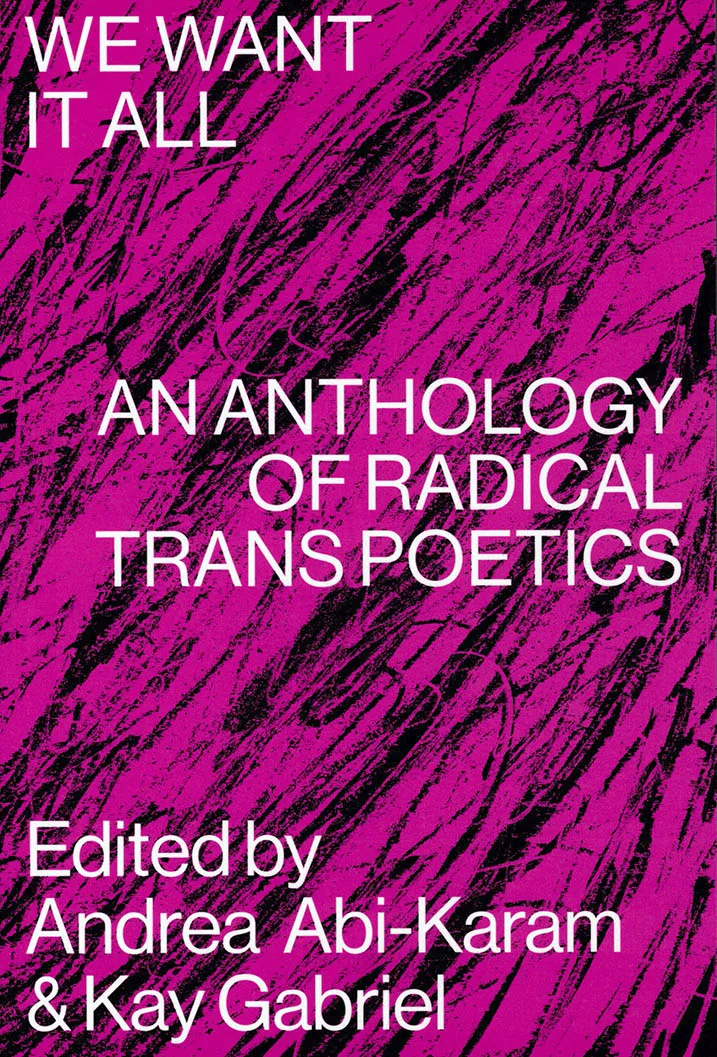
We Want It All: An Anthology of Radical Transpoetics
An anthology of formally inventive writing by trans poets against capital and empire.
With texts by: Andrea Abi-Karam, New York City Sam Ace, South Hadley, MA Bahaar Ahsan, Berkeley, CA jasper avery, Philadelphia, PA Ari Banias, Berkeley, CA Jo Barchi, Chicago, IL Joss Barton, St. Louis, MO Levi Bentley, Philadelphia, PA Jessica Bet, Baltimore, MA Rocket Caleshu, Los Angeles, CA Ching-in Chen, Seattle, WA listen chen, Vancouver, BC Faye Chevalier, Philadelphia, PA Cody-Rose Clevidence, Arkansas Miles Collins-Sibley, Easthampton, MA Valentine Conaty, New York City CA Conrad, Philadelphia, PA Jimmy Cooper, Rochester, MI Maxe Crandall, Oakland, CA José Díaz, Boston, MA Aaron El Sabrout, New Mexico Ian Khara Ellasante, Lewiston, ME Caelan Ernest, New York City, NY NM Esc, San Diego, CA joshua jennifer espinoza, Los Angeles, CA Logan February, Ibadan, Nigeria Ray Filar, Brighton, UK Nora Collen Fulton, Montreal, Canada Kay Gabriel, New York City Callie Gardner, Cardiff, Wales Jesi Gaston, Chicago, IL Harry Josephine Giles, Edinburgh, Scotland Aeon Ginsberg, Baltimore, MD Caspar Heinemann, Berlin, Germany Kamden Hilliard, Greenville, SC Stephen Ira, New York City Cyrée Jarelle Johnson, New York City Peach Kander, New York City Jayson Keery, Western, MA Evan Kleekamp, Los Angeles, CA Noah LeBien, New York City Ty Little, Richmond, VA Zavé Martohardjono, New York City Amy Marvin, Philadelphia, PA Natalie Mesnard, New York City Bianca Rae Messinger, Iowa City, IA Liam O'Brien, New York City Xandria Phillips, Madison, WI Rowan Powell, Santa Cruz, CA Nat Raha, Edinburgh, Scotland Holly Raymond, Philadelphia, PA Jackie S, New York City Trish Salah, Toronto, Canada Raquel Salas Rivera, Philadelphia, PA Mai Schwartz, New York City Kashif Sharma-Patel, London, UK Julian Talamantez Brolaski, Oakland, CA Charles Theonia, New York City Jamie Townsend, Oakland, CA Nora Treatbaby Laurel Uziell, London, UK Rachel Franklin Wood, Boulder, CO Clara Zornado Akasha-Mitra xtian w. and Anaïs Duplan, NYC.
Kay Gabriel is a poet and essayist. She's the author of Elegy Department Spring / Candy Sonnets 1 (BOAAT Press, 2017), the recipient of fellowships from Lambda Literary and the Poetry Project, and recently completed her PhD at Princeton University.
Andrea Abi-Karam is an arab-american genderqueer punk poet-performer cyborg, writing on the art of killing bros, the intricacies of cyborg bodies, trauma & delayed healing. Their chapbook, THE AFTERMATH (Commune Editions), attempts to queer Fanon's vision of how poetry fails to inspire revolution. Andrea's first book, EXTRATRANSMISSION (Kelsey Street Press, 2019), is a poetic critique of the U.S. military's role in the War on Terror.

Where Will My Mouth Lead Me – New York Diary
The artist's travel diary in New York.
Where will my mouth lead me? This question arises already in the first days of Hamza Halloubi's residency in New York. It characterises his diary entries from August to November 2024. He observes the art world, comments on cultural and political events and thinks about writers and artists who have long intrigued him and what his body and their ideas are doing in this city–and what this city does not do to him and them: David Hammons, Edward Saïd, Mohamed Choukri, Félix González-Torres… How they also appear like ghosts in his work. Hamza Halloubi approaches the viewer of his visual work, and here also the reader, as a social and political presence. In addition to his diary and image fragments from his films and exhibitions, this pocket book also includes two interviews with the artist.
Hamza Halloubi (born 1982 in Tangier, Morocco, lives and works between Brussels, Tangier, and Amsterdam) is a multi-disciplinary artist with a focus on video and painting.

Shakespeare and Ethics
Shakespeare’s plays are full of philosophical ideas, but they are rarely examined systematically. In this pamphlet philosopher Colin McGinn analyzes the plays to distill Shakespeare’s ideas about ethics. McGinn concludes that the “plays are about good and evil,” and that Shakespeare is “a great moral psychologist,” who expertly stages how his characters are defined by their moral qualities (their naturalistic virtues and vices).

The (Incomplete) Cosmic Catalogue
Mapping constellations between five specific pre-colonial cosmological examples extending from the Sahel to the Horn of Africa, this work reframes cosmology as a multi-dimensional and scalable practice of situated technologies and embodied cartographies. The resulting publication which was produced during the Jan van Eyck residency is a culmination of several years of research and exploration into precolonial cosmologies and spatial orders rooted in the African Sahel extending to the Horn of Africa.
The (Incomplete) Cosmic Catalogue is an output of a research project that was initially commissioned by the Canadian Centre for Architecture as part of the multi-disciplinary research fellowship, The Digita Now: Architecture and Intersectionality in 2022.

The Difficulties
If there is a centre around which the language of this pamphlet circulates, then it is Palestine. As this centre, Palestine enables a transformative power that persistently and steadfastly turns repression and silencing into solidarity. Essay-fiction, prose poetry, radical philosophy, speculative nonfiction — this uncategorizable collection of texts brings militant inquiry to each utterance, each narrative turn, in acts of transnational and transhistorical becoming.
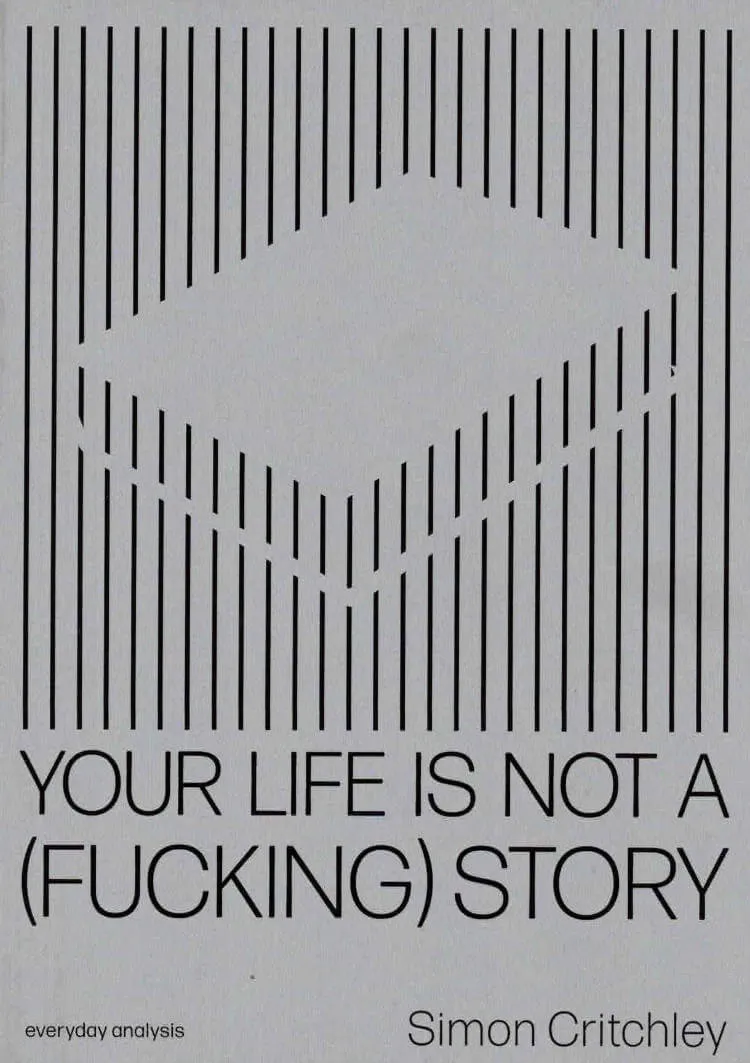
Your Life Is Not A (Fucking) Story
In this new collected edition of his recent articles, Simon Critchley - one of the most important living philosophers - takes us through his reflections on death, questions of doubt and reason, the legacy of David Bowie, the nature of fear and empathy in a broken society and a critique of narrative identity - among other things. YOUR LIFE IS NOT A STORY explores the contemporary world and its psychological impact on us, offering us a way to see our situation different and resist its tricks and contrivances.

Small Prints
This artist’s publication contains a sequence of unique letterpress monoprints, made by Dutch graphic designer Karel Martens between 2014 and 2022. The prints, which are both highly geometric and brightly coloured, are reproduced in the book at their actual size. Textual elements accent the various abstract shapes and repetitions on almost every page. ‘Small Prints’ is available in two different cover versions, which itself is the result of a printing experiment. By printing the contents of the book in three layers on a single print sheet, which was then cut and folded, variations in the cover emerged.

The Obscene Madame D
Nathanaël, Hilda Hilst and 1 more
A wickedly funny work of depraved genius by one of Brazil’s most radical twentieth-century writers; imagine the Marquis de Sade as written by Clarice Lispecter.
An electrifying masterpiece by one of modern Brazilian literature’s most significant and controversial writers, Hilda Hilst takes us into the disorder and beauty of a mind restlessly testing its own limits.
Every month I ingested the body of God, not in the way one swallows green peas or agrostis, or swallows swords, I ingested the body of God the way people do when they know they are swallowing the More, the All, the Incommensurable, for not believing in finitude I would lose myself in absolute infinity…
The Obscene Madame D tells the story of Hillé, a sixty-year-old woman who has decided to abandon conventional life and spend the rest of her days in contemplation in a recess under the stairs. There, she is haunted by the perplexity of her recently deceased lover, Ehud, who cannot understand her rejection of common sense, sex and a simple life in favour of metaphysical speculations that he considers delusional and vain.
In a stream-of-consciousness monologue that’s part James Joyce, part Clarice Lispector, and part de Sade, Hillé speaks of her search for spiritual fulfilment from a space of dereliction, as she searches for answers to great questions of life, death and the relationship between body and soul.
Translated by Nathanaël and Rachel Gontijo Araujo

All My Dead Jesters
All My Dead Jesters is an assembly of select poems previously published in de Vries’ first two English language collections—Dark Hour and I Failed to Swoon (Dostoyevsky Wannabe, 2018 and 2021 respectively). These old works have been lightly revised for republication, and are paired with poems drawn from a manuscript-in-process to institute an autotelic kaleidoscope of some ten years worth of work in verse.
De Vries’ poems are spare, terse and epigrammatical—a barroom Bashō—dedicated to the glimmer of a compact glance; the chance, glamour and negative capability of a passing thought; and the slow drip of liquid crystal as colours our present. All My Dead Jesters is a torch song for our ‘poor subjectivity,’ a slow dance with sour times, a ‘[steering] away from [the] gratuitous provocation’ that litters our contemporary outlook. ‘Her competence as a poet lies in her ability to translate visceral vulnerability’ for the page (The Kelvingrove Review / University of Glasgow), as she patchworks a heroic ‘poetry without [a] hero, a blanket leaving you colder somehow, [...] the map of a world we like to think we know’ [CA Conrad].

KAMERA CAHIER N° 10
A special edition issue curated, designed and published by AVARIE, Paris and Labor Neunzehn, Berlin. It accompanies KAMERA SERIES, while it is an independent and valuable object to collect. The central idea that informs and directs the booklets’ montage is the interplay between the concepts of addition and subtraction. This is achieved by unveiling a missing image in the screening or an unreleased second from an artist's film, expanded to 24 pages. Additionally, each booklet contains a piece directly removed from the show.
The editing establishes a dialogue between film frames and performed writings derived from texts, scripts, storyboards, and notes. The KAMERA exhibition is consequently extended into a physical space—the book—allowing for its widespread dissemination, complementing and contrasting with its potential online occurrence.
KAMERA SERIES is a screening program of experimental films, video art works and printed matter taking place in a former GDR building in Berlin. Each event showcases a retrospective of selected films by an artist and a small exhibition of his/her publications or works on paper over a span of 4 days.
KAMERA centers on fostering a critical dialogue between different film formats and artists’ books. Through its regular occurrence, it aspires to create a space for community exchanges about contemporary image-making. KAMERA is a series conceived and curated by Labor Neunzehn and AVARIE.
Fascinated by the intersection of visual art and cinema, Helga Fanderl’s short poetic films evoke intense and sensitive experiences of the real world. Using a small hand-held super 8 camera, she creates filmic responses to her perceptions, weaving together imagery and emotions in dense, rhythmic patterns solely through in-camera editing. She presents silent films in the form of ‘compositions’, crafting unique programs for site-specific personal projections and transforming spaces into temporary cinemas.

The Lesbian Avenger Handbook
Launched in New York City, in 1992, the Lesbian Avengers rejected the picket line and ordinary demo for media-savvy, nonviolent direct action.
They were superheroes arriving "to make the world safe for baby dykes everywhere;" warriors with capes and shields doing a line dance; dykes "Lusting for Power," pushing a giant bed float down Sixth Avenue in New York (with lesbians on it); nationally-ambitious Avengers eating fire in front of a hostile White House; lovers reuniting a statue of Alice B. Toklas with Gertrude Stein, then waltzing in the snow in Bryant Park. And homos who shamelessly chanted, "Ten percent is not enough, recruit, recruit, recruit."
Originally published in 1993, Homocom edition 2021

Works from the Collection of Holly Van Houten
Werkplaats Typografie presents a catalog of Works from the Collection of Holly van Houten. Spanning multiple decades and personally selected from around the world, the collection includes over a thousand items that memorialize the life of this candidly private, bohemian connoisseur. Carefully examined by our specialists, a curated selection of rarities, antiquities, oddities, and works of art is available in this catalog, which accompanied an exclusive auction held during Printed Matter’s LA Art Book Fair in May 2025 in Los Angeles, Van Houten’s beloved city.
Project by: WT Year 25 & Year 26 for LA PMABF led by Hannes Drißner, Lisa Lagova, Nuno Beijinho
Designer: Hannes Drißner, Lisa Lagova, Nuno Beijinho. Objects photographed by Augustinas Milkus and Jordi de Vetten

Mousse #92
Regions surface often in this issue—across arts, tales, and gatherings of individuals and meanings—as a possibility to bypass the borders of nation-states and the meta-geographies of colonial modernity.
Slavs and Tatars; Hera Chan on Stephanie Comilang; Stephanie Bailey on Ho Tzu Nyen; Drifting into the Atmospheric by Sohrab Mohebbi; Lauren Cook contributes nine newly commissioned note-like fiction pieces; Asad Raza on Édouard Glissant; Mira Dayal in conversation with Shanzhai Lyric, TJ Shin, and jina valentine; Temporary Communities, Four Points on Radically Public Institutions by Elvira Dyangani Ose; A Signature Truer Than the Name by Dani Blanga Gubbay; tidbits: Ruoru Mou by Amy Jones; Virginia Ariu by Brit Barton; Bagus Pandega by Harry Burke; Ceidra Moon Murphy by Alex Bennett; Oshay Green by Ikechúkwú Onyewuenyi; Shafei Xia in conversation with Danielle Shang; books by Christian Rattemeyer; Guest Design: Lamm & Kirch.
This issue comes with different covers, randomly distributed.
Mousse is a bimonthly contemporary art magazine. Established in 2006, Mousse contains interviews, conversations, and essays by some of the most important figures in international criticism, visual arts, and curating today, alternated with a series of distinctive articles in a unique tabloid format.
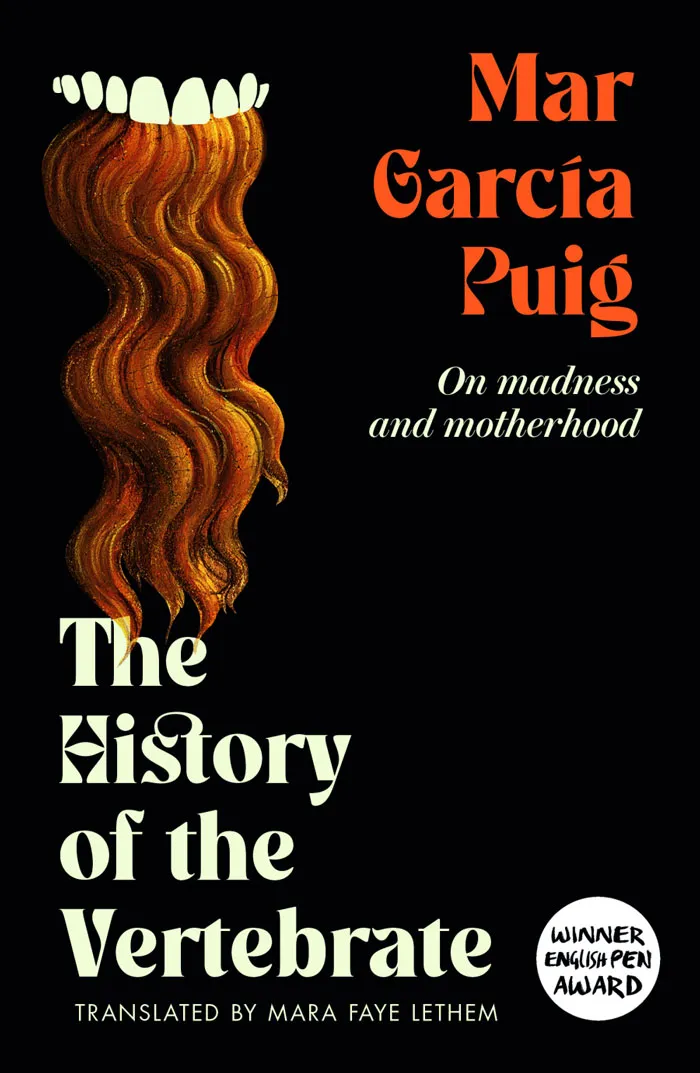
The History of the Vertebrate
Mar García Puig, Mara Faye Lethem
‘On 20 December 2015 I became a mother and I went mad.’
On a single day, Mar García Puig gives birth to twins and becomes elected to the Spanish Parliament as a member of the insurgent left-wing party Podemos. What might have been the best day of her life becomes the start of a terrifying ordeal; García Puig’s grip on reality begins to slip as she grapples with uncertainty, the weight of expectation, and misogyny in both of her new roles.
In defiance of a culture that tells her the problem lies within, García Puig chooses to look outwards, examining the imbrication of madness and motherhood across centuries of science, myth, and politics while dissecting the ways in which women have been pathologized and banished from public life.
At once intimate and epic, The History of the Vertebrate is a searing account of postpartum madness. Moving between memory, culture, and the history of medicine, García Puig transforms her experience into a story about the countless women who have felt that sanity was leaving them, and about the patriarchal forces that have silenced them.
MAR GARCÍA PUIG is an editor and author. From 2015 to 2023 she was a member of the Spanish Congress of Deputies for Podemos, where she served on the Culture Committee and the Equality Committee. Her books include The History of the Vertebrate and This Thing of Darkness.

Koreografi
Koreografi / Choreography is a magazine initiated and edited by Solveig Styve Holte, Runa Borch Skolseg and Ann-Christin Berg Kongsness. The magazine consists of texts written by Nordic artists within the field of dance and choreography.

The Haitian Chronicles
The Haitian Chronicles is a graphic and brutal history of the Haitian Revolution told across three plays. It is the final work by the influential and groundbreaking playwright Douglas Turner Ward (1930-2021) and the first play of his to be published in several decades. Though much of his earlier work has been short one-act satires, The Haitian Chronicles takes place across three long plays: The Rise of Toussaint L'Ouverture, The Fall of Toussaint L'Ouverture, and the one-man drama, Dessalines.
The Haitian Chronicles is an example of Ward's political commitment to satirizing, dramatizing, and revealing the structures of white supremacy throughout the history of this so-called civilization. His first play, Star of Liberty, written at 19 years of age, was based the life of Nat Turner and the slave revolt he led. With The Haitian Chronicles, Ward returns to armed Black rebellion, taking as its subject matter the first and only slave revolt to successfully establish a free state. It is a self-consciously ambitious work of astounding narrative and theatrical scope, featuring over 80 speaking roles and logistically demanding production design. The narrative onslaught chronicling the disgusting brutality of colonial French society and the bloody force it took to overthrow it overwhelms the reader and challenges one to question the structures on which society is built and the violence it continues to perpetuate.
Ward was one of the central, driving forces of the Black Theater movement in the United States. After moving to New York in 1948, he became immersed in the radical political scene in Harlem, writing for The Daily Worker, and studying as an actor. He served as understudy to Sidney Poitier in A Raisin in the Sun, and began a long friendship with fellow actor Robert Hooks. In 1966, Hooks helped produce Ward’s double bill Happy Ending / Day of Absence. Following the success of these plays, Ward was asked to write an editorial for the New York Times in 1966. His article, titled "American Theatre: For Whites Only?", surveyed the ubiquitous, stifling racism of the American theatre and was widely circulated, earning Ward further recognition for his political and theatrical work. With funding from the Ford Foundation, Ward and Hooks, together with Gerald Krone, founded the Negro Ensemble Company (NEC) in 1967. Writing and directing for the NEC over the next several decades, Ward worked with icons such as Paul Carter Harrison, Gus Edwards, Leslie Lee, Errol Hill, Charles Fuller, Derek Walcott and Wole Soyinka. He directed dozens of plays throughout his career including Song of the Lusitanian Bogey, The River Niger and Pulitzer Prize-winning A Soldier’s Play. Ward continued to write until his death in 2021– The Haitian Chronicles is the result of over four decades of work, a superb series of plays by an inimitable writer and artist.
Boo-Hooray proudly placed the Douglas Turner Ward Archive at Emory University’s Stuart A. Rose Manuscript, Archives and Rare Book Library in 2017. The Archive includes many working drafts of the numerous plays Ward directed and wrote, manuscript materials, and correspondence with other icons of the Black Arts.
The Haitian Chronicles was a winner of the AIGA 50 Books & 50 Cover Award for the work of book designer Martha Ormiston.