Books
Books
in random order

L'Empire Noir
Après une campagne militaire fulgurante, l’organisation secrète du redoutable Dr Belsidus a chassé les puissances occupantes du sol africain et s’est rendue maitre de l’ensemble du continent, unifié pour la première fois en un gigantesque empire. L’expansion a démarré et l’édification d’une civilisation d’un genre inédit est en marche. Mais les nations européennes, après s’être fait la guerre, s’apprêtent à revenir. Une course s’engage entre l’Internationale noire et les appétits impérialistes : sabotages, espionnage, guerre technologique ou bactériologique, les héros et héroïnes de L’Internationale noire né reculeront devant rien pour sauvegarder cette indépendance acquise de haute lutte.
Dans ce second volet du roman-feuilleton qui fit la réputation de G. Schuyler, retrouvez les nouvelles aventures de nos personnages, dorénavant contraints à une lutte géopolitique d’une ampleur inégalée, pour garantir à leur Empire noir un avenir radieux !
George Samuel Schuyler, 1895–1977, fut un essayiste, journaliste et romancier de première importance dans le monde culturel africain-américain de l’entre-deux-guerres. Il reste connu pour la férocité de ses critiques. Il est l’auteur d’un seul roman, Black No More, traduit en France en 2016 et d’un essai romancé dénonçant la traite au Liberia, produit de son enquête de terrain dans le pays. Proche des courants socialistes jusqu’à la Seconde Guerre mondiale, il prendra un virage nettement réactionnaire par la suite, tout en demeurant dans les mémoires de toute une génération d’écrivains, tels qu’Ishmael Reed ou Samuel Delany.

Playboy
The prequel to Love Me Tender, narrating Debré's transformation from affluent career woman to broke single lesbian and writer.
I see all her beauty, I see the beauty of women. I see my own body, new. I tell myself there are so many things that are possible.
First published in France in 2018, Playboy is the first volume of Constance Debré's renowned autobiographical trilogy that describes her decision, at age forty-three, to abandon her marriage, her legal career, and her bourgeois Parisian life to become a lesbian and a writer.
The novel unfolds in a series of short, sharp vignettes. The narrator's descriptions of her first female lovers—a married woman fifteen years older than her, a model ten years her junior—are punctuated by encounters with her ex-husband, her father, and her son.
As Debré recently told Granta: “It was a bit like Saint Augustine and his conversion. In the same week, I had sex with a girl and I had the feeling that I could write. I had this incredible feeling that I could catch things, that life was there to be caught.”
Looking at the world through fresh eyes, the narrator of Playboy questions everything that once lay beneath the surface of her well-managed life. Laconic, aggressive, and radically truthful, she examines gender and marriage, selfishness and sacrifice, money and family, even the privilege inherent in her downward mobility.
Writing her way toward her own liberation, Debré chronicles the process that made her one of the most brilliant, important French writers today.


London-rose — Beauty Will Save the World
The story of failure asks one question only: What do people who lose do next? “Let the best one win.” War is one way. The other way is religion. Let me at the stakes. It’s so much a matter of patience. No fury, beyond all reason, no sequence broken, but diverted. Nothing seems to cooperate when you lose control. Blue becomes violet. Bend your head to the blank. The solution is so simple: don’t identify yourself with your description of yourself.
"It feels we aren’t reading prose but language that oscillates between liturgy and prayer." — Eugene Lim

Charismatic Spirals
Charismatic Spirals is for an America circa 2024, where poetry—the art of developing new means of speaking—has never been of such artistic, technological and political consequences.
An archetypal outsider, Will Alexander released his first poetry collection aged forty-four while working at the Los Angeles Lakers' ticket office. Three decades on, he has ascended to the legendary status of the city's great living surrealist, existing, as Eliot Weinberger wrote, in a state of "imaginal hyperdrive," with forty such collections to his name.
Operating at the edge of language, Alexander deploys words in a way that feels prophetic—human psyches synthesize with technological artifacts; atoms and archetypes collide; bodies are vacated, voices are newly incarnated. His America—like Glissant's—is multinational and—like Coover and Spiegelman's—multivalent and symbolically unstable. That is to say, he belongs to an America circa 2024, where poetry—the art of developing new means of speaking—has never been of such artistic, technological, and political consequence.
In doing so, Alexander draws from a vast array of influences, from luminaries like Aimé Césaire, Bob Kaufman, Andre Breton, Antonin Artaud, and Philip Lamantia, to holistic visions such as Sri Aurobindo's Integral Yoga, the Mayan numerical system, and Cheikh Anta Diop's perspectives on ancient Egypt. In a preview of Charismatic Spirals in the New York Times, Anne Boyer captured the essence of his work: "visionary poetry [that] achieves its effect through sound, not image...Cadence [that] can shatter us, set the world ablaze."
Read it syllabically, surf it quickly—there is no single way to approach this work.
Will Alexander (born 1948 in Los Angeles) is an African-American artist, philosopher, poet, novelist, essayist and pianist.

And Death Shall Have No Dominion / Killing ‘The Mother’
Victoria Guerrero-Peirano, Honora Spicer
And death shall have no dominion / Killing ‘The Mother’ charts death inside healthcare bureaucracy through brutal, surreal and fragmentary poetic prose, grappling with the capitalist devastation of systems of social care and how writing might enact forms of conception in the face of such conditions. Victoria Guerrero-Peirano has been recognized as one of the most singular and powerful voices of contemporary Peruvian poetry.

Working Through Objects
The text by Hiller navigates the boundaries between art, anthropology and psychoanalysis in relation to her installation at the Freud Museum in 1994 titled At the Freud Museum. Accompanying images included throughout from Book Works UK archive, the commissioner of the artwork and talks that this text is edited from.

Worms #8 'The Elements Issue'
In this special edition, double-cover issue of Worms, we bring you not one, but two cover stars. The indelible Tyson Yunkaporta and the iconic Anne Waldman adorn both sides of Worms 8 which can also be thought of as ‘The Elements Issue’. It was dreamt up in a dreary and grey August in London, while the rest of the world suffered through the hottest days on record. As we witnessed, and continue to witness, such climate catastrophe, we turned to the literature we love to help us understand, to challenge us, and to offer us some comfort.
The issue is split into four sections—earth, fire, air and water—but its roots and webs push beyond what we typically think of as ‘the natural’: tales from the kitchen from Rebecca May Johnson and Slutty Cheff, reflections on gardening and colonialism, writer's block and clogged pipes, how to blow up pipelines with Andreas Malm, grief and writing, recovery and nature with Octavia Bright, social mobility with Isabel Waidner, the wide range of issues raised by the underrepresentation of First Nations people in literature with Evelyn Araluen and much, much more.
We hope that this issue can be a flame of hope, inspiration, or something that simply sustains in such turbulent times.
Featuring
Tyson Yunkaporta, Isabel Waidner , Jamaica Kincaid, Melissa Broder , Evelyn Araluen, Bruce Pascoe, Octavia Bright, Nora Treatbaby , Nerea Calvillo , Anne Waldman , Alexis Pauline Gumbs , Léuli Eshrāghi, Madeline Cash , Andreas Malm, Rebecca May Johnson
Contributors
Stella Murphy , Ben Redhead, Phoenix Yemi, Sam Moore, Devils Claws, Pierce Eldridge, Manon Mikolaitis, Caitlin McLoughlin, Isabel MacCarthy, Elodie Saint-Louis , Nettle Grellier, Amelia Abraham, Ryan Pfluger, Rose Higham-Stainton , Emma Crabtree, Ignota, Lydia Luke, Chloe Sheppard , Clem MacLeod , Carolyne Loreé Teston , Emma Cohen, Olive Couri, Raheela Suleman , No Land , Jacqueline Ennis-Cole , Sufia Ikbal-Doucet, Rhett Hammerton, Zara Joan Miller , Kate Morgan , Bug Shepherd-Barron, Zoe Freilich , Slutty Cheff , Clemmie Bache , Violet Conroy , Sarah White , Jemima Skala , Stephanie Francis-Shanahan

BFTK — Issue 4: On Translation, Transmission & Transposition
Andrew Walsh‐Lister, Matthew Stuart and 2 more
Bricks from the Kiln is an irregular journal edited by Andrew Lister and Matthew Stuart, sometimes with guest editors, that presents graphic design and typography as disciplines activated by and through other disciplines and lenses such as language, archives, collage, and more. It borrows its title from the glossary notes of Ret Marut’s "Der Ziegelbrenner," which was the ‘size, shape and colour of a brick’, and ran for 13 issues between 1917 and 1921.
The latest installment, "#4: On Translation, Transmission & Transposition," was published as an event (and now) a publication, with events at London College of Communication, Burley Fisher Books & Pig Rock bothy, Socttish National Gallery of Modern Art, and Inga (in November, 2019).
GREENING
Helen Marten
(front / back flaps)
JOY & HAPPINESS, FIDELITY
& INTIMACY IN TRANSLATION
Sophie Collins
(pp.4–13)
PLANETARY TRANSLATION
Don Mee Choi
(pp.15–19)
TRANSLATION AND A LIPOGRAM:
OR, ON FORMS OF AGAIN-WRITING
AND NO- (OR NOT THAT-) WRITING
Kate Briggs
(pp.23–33)
UNHOMING (1 of 4):
FOLLOWING HÖLDERLIN’S ‘HEIMAT’
Phil Baber
(pp.35–47)
SNOW WHITE AND THE WHITE
OF THE HUMAN EYEBALLS
Joyce Dixon
(pp.51–62)
ALTAMIRALTAMIRALTAMIRA
Florian Roithmayr
(pp.65–116)
LEVEL UP, LEVEL DOWN
Jen Calleja
(pp.119–124)
TRANS.MISSION [A.DIALOGUE]:
A JAVASCRIPT FOR THREE VOICES
J.R. Carpenter
(pp.127–134)
THE MECHANISATION OF ART
Edgar Wind
(glosses / annotations / insertions by
Natalie Ferris & Bryony Quinn)
(pp.137–144)
UNHOMING (2 of 4)
Phil Baber
(p.147)
COMMISSION FOR A NOIR MOVIE
B IN THE BAY OF BISCAY
Rebecca Collins
(pp.151–157)
UNHOMING (3 of 4)
Phil Baber
(pp.150–162)
EVERY CONTACT LEAVES A TRACE;
TRANSCRIBING OSTEON
Naomi Pearce
(pp.165–170)
HOW DOES A WORK END?
Karen Di Franco
(pp.173–193)
METONYMY Op.1 & Op.2
James Bulley
(pp.197–201)
AFRIKAN ALPHABETS EXTENDED
Saki Mafundikwa
(pp.204–207)
SUSAN HILLER: 1983
Natalie Ferris
(pp.209–217)
EVERY TELLING HAS A TALING /
EVERY STORY HAS AN ENDING
Matthew Stuart
(pp.220–233)
GRAPHIC PROPRIOCEPTION
James Langdon
(pp.235–254)
UNHOMING (4 of 4)
Phil Baber
(pp.257–263)
TUNNELLING AND AGGREGATING
FOR DESIGN RESEARCH
Bryony Quinn (text) &
Peter Nencini (images)
(pp.265–272)
LET IT PERCOLATE:
A MANIFESTO FOR READING
Sophie Seita
(pp.275–280)
288 pgs, 22.4 × 17 cm, Softcover, 2020

From The Prop To The Inside
FROM THE PROP TO THE INSIDE gathers texts on the concept of the prop—as object, requisite and support—on stage and in the exhibition space. The starting points of this book are objects and installations of the artist Michaela Schweighofer, which deal with the stage as a platform and the sculpture as a prop.
The authors are friends: artists, critics and curators whom she has invited to write a text at the interface of their and her practice. The contributions within take on multiple forms; letters, essays and interviews—they are intended to create a theoretical-subjective anthology that makes visible the phenomena of the private as symptoms of the structural, as well as to provide a direct insight into contemporary artistic creation.
Text: Juliane Bischoff, Veronika Eberhart, Cornelia Lein, Cathrin Mayer, Gianna Virgina Prein, Agnieszka Roguski, Juliane Saupe, Michaela Schweighofer & Chloe Stead

I Want
I Want reviews the eponymous duo's double-projection film installation examining issues of gender, sexuality and performativity—and inspired by the words of punk poetess Kathy Acker and convicted whistle-blower Chelsea Manning. This publication documents the major film installation I Want (2015) by collaborative artists Pauline Boudry and Renate Lorenz, which was presented at their 2015 solo exhibitions at Kunsthalle Zürich and Nottingham Contemporary.
The double-projection film installation is based on a script that borrows texts from American punk-poet Kathy Acker (1947-1997), as well as chats and materials by convicted whistle-blower Chelsea Manning that speak of her reasons for revealing nearly one million secret military and diplomatic documents through WikiLeaks, at the same time exposing her transgender identity to her superiors.
Through poetic gestures of appropriation and recombination, Boudry and Lorenz examine issues around gender, sexuality, the performance of identity, and the nature of collaboration. Alongside generous color documentation, written contributions by Gregg Bordowitz, Laura Guy, Dean Spade, and Craig Willse unpack and reflect upon both the historical context and contemporary significance of this multivalent work.

les petites histoires
Sam Buouffandeau, S. M. Drogo and 2 more
les petites histoires sont quatre courtes fictions contemporaines. Entre le lonely langoureux New York des années deux mille, le pont poétique et capricieux de Louis 2 de Bavière, l'histoire vraie de Sandy Stone dans les seventies et la satire cinglante et drôle d'une galerie d'art, ces livres sont de brefs univers vivants et curieux.
En 2025, quatre petites histoires sont racontées par quatre auteurices dans quatre livres : L'effondrement du pont de Sam Bouffandeau ; The Gallery de S. M. Drogo ; Exit de Juli Le Nahelec; «Que faire de Sandy Stone?» de Mia Trabalon.
L'édition des petites histoires a été imaginée par Élise Comte, Chloé Delchini, Perrine Estienne, Gabriel René Franjou, Justine Gensse, Bastien Hauser, et Cyprien Muth. Ce collectif d'éditeurices est né à Bruxelles, où les petites histoires ont été imprimées, chez Graphius.
La maquette, réalisée par Chloé Delchini, à été composée avec Otto, une typographie dessinée par Sam de Groot et Laura Opsomer Mironov, chez Dinamo Typefaces.

Another Room to Live In: 15 Contemporary Arab Poets
Another Room to Live In is an archive of encounter: a multilingual conversation between fifteen poet-translators, connected through friendship, correspondence, and cross-diasporic gatherings. With work in English, Arabic, and French, the collection moves beyond both language and nation-state, investing instead in transcontinental dreamspaces. Here, translation practices collaboratively transform the poems and reflect the poets’ own experiences of “living” in multiple languages. Complicating any flat conception of identity, the poems presented here seek to revisit and challenge foundational narratives, to rework mythologies, and to do all this through a cross-generational process of translation as poetic communion.
Contributors include: Etel Adnan, Hoda Adra, Sinan Antoon, Mirene Arsanios, Omar Berrada, Sara Elkamel, Safaa Fathy, Soukaina Habiballah, Marilyn Hacker, Golan Haji, Kadhim Jihad Hassan, Pierre Joris, Mona Kareem, Souad Labbize, Rachida Madani, Alisha Mascarenhas, Iman Mersal, Aya Nabih, Sarah Riggs, Yasmine Seale, Cole Swensen, Habib Tengour, and Sam Wilder.

A4 review N°2
Chloé Delchini, Justine Gensse and 2 more
Founded in 2023, A4 is a poetry review which showcases and explores contemporary writings practices. Run by Littérature Supersport collective, the object is seen as the extension of their events. The review takes the form of 4 postcards which, when placed side-by-side, form an A4-sheet. A light (even precarious) format for literature that slips into the back pocket of pants and hangs on fridge doors. Each issue features unpublished texts by 4 authors. Wrapped in colors, A4 is distributed by post and available in good bookshops, in Brussels, Liège, Paris and Marseille.
This second issue presents texts by : Chloé Delchini, Justine Gensse, Simon Johannin and Jérôme Poloczek.
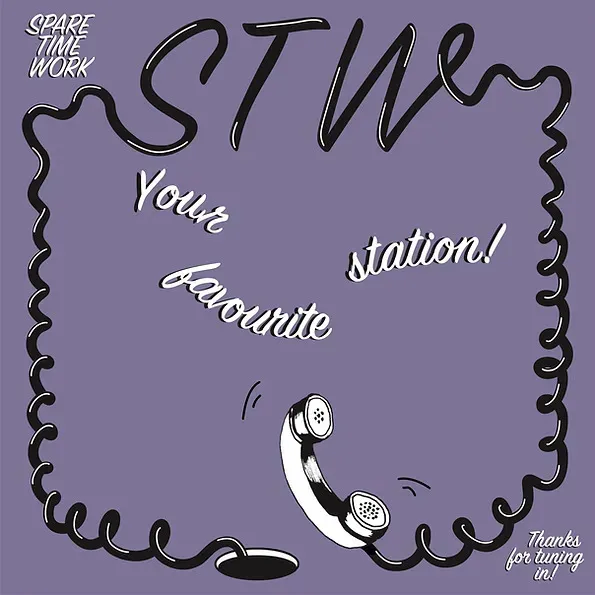
STW, your favourite station!
STW, your favourite station! functioneert als een radioprogramma. Een boek dat lyrisch proza uitzendt van We make stuff up for a living (een CV medley) tot COMPUTER_SONG, een ceremoniële quiz met Adult Hood & Young als protagonisten, een grillige anekdote van iemand die zich ergert aan een Call Service, en meer! Thanks for tuning in!

SMALLTOWNNOVELLA
Ronald M. Schernikau, Lucy Jones
An homage and reimagining of the classic German Bildungsroman, Schernikau paid tribute to the form even as he challenged stylistic, sexual, and political conventions. Written in all lower-case, SMALLTOWNNOVELLA is a brilliant stream-of-consciousness narrative that follows b, a teenager navigating politics and queer desire in a small, West German town. When b—who is interested in communism and knitting—falls in love with leif, a popular jock, b’s life at school is very predictably upended.
“A mighty, slender record of the provocative intelligence of a queer teenage mind.” —Eliot Duncan
Ronald M. Schernikau was born in 1960 in Magdeburg, East Germany and grew up in Hanover, West Germany. After completing his Abitur in 1980, he moved to West Berlin and studied German literature, philosophy, and psychology. In 1986, he started studying at the Institut für Literatur Johannes R. Becher (German Institute for Literature) in Leipzig, GDR. In 1989 he obtained GDR citizenship and relocated to Berlin. He worked as a dramaturge, and in radio and TV until his death in 1991. His publications include Kleinstadtnovelle (Small-Town Novella, 1980); Die Tage in L. (The Days in L., 1989); Legende (Legends, 1999); Königin im Dreck (Queen in the Dirt, 2009); and Irene Binz. Die Befragung (Irene Binz. The Interview, 2010).
Lucy Jones is a British translator and writer based in Berlin. She is the translator of Brigitte Reimann’s Siblings, (Penguin Modern Classics), Anke Stelling’s Higher Ground (Scribe) and Annemarie Schwarzenbach’s Lyric Novella (Seagull Books), among others. Her translations and book reviews have appeared in Asymptote, Words Without Borders and CulturMag. She is the runner-up for the Society of Author’s Schlegel-Tieck Prize in 2023.
PRAISE
“This slender book is a fierce account of queer teenage imagination: provocative, haughty, coy, insolent, and wild. As angsty as it is intelligent, Schernikau’s prose also feels protective and sweet. SMALLTOWNNOVELLA is the book, the friend, I wish I had in high school.” —Eliot Duncan
“…an earnest, seemingly offhand account of a brilliant young man growing up in a small town and realizing that his queerness and his communist politics will come to structure his life. (…) the first of Schernikau’s many attempts to lay out a gay politics that would open him to the world rather than fating him to a specific lot within it: an identity politics not constructed to elaborate and defend a single perspective, but one that sought to locate the self within a broader movement to transform society." —Ben Miller & Nicholas Courtman, LARB

Pleasureis Amiracle
A book of poems written out of a depressive episode, in which a devotional approach to music and desire reestablishes communication between the poet's body and the world.
In pleasureis amiracle, the poems invoke the lyric and refuse it, moving between time and sound—words re-connect and re-cohere, resisting separation and challenging readers to feel their way to meaning. Perception becomes a many-limbed entanglement from which the reader is never let go. Music is both divine and accessible, a sublimation of everyday movements into an erotics of sensation.
An experiment in form as much as content, it asks what can be cured by music, what is trans about desire, and how can one allow the body to feel what the mind sees, or vice versa.

Jill Johnston in Motion
Performer, activist, and writer Jill Johnston was a major queer presence in the history of dance and 1970s feminism. She was the first critic to identify postmodernism’s arrival in American dance and was a fierce advocate for the importance of lesbians within feminism. In Jill Johnston in Motion, Clare Croft tracks Johnston’s entwined innovations and contributions to dance and art criticism and activism. She examines Johnston’s journalism and criticism—in particular her Village Voice columns published between 1960 and 1980—and her books of memoir and biography. At the same time, Croft attends to Johnston’s appearances as both dancer and audience member and her physical and often spectacular participation at feminist protests. By bringing together Johnston’s criticism and activism, her writing and her physicality, Croft emphasizes the effect that the arts, particularly dance, had on Johnston’s feminist thinking in the 1970s and traces lesbian feminism’s roots in avant-garde art practice.

An Apartment on Uranus
A “dissident of the gender-sex binary system” reflects on gender transitioning and political and cultural transitions in technoscientific capitalism.
Uranus, the frozen giant, is the coldest planet in the solar system as well as a deity in Greek mythology. It is also the inspiration for uranism, a concept coined by the writer Karl Heinrich Ulrich in 1864 to define the “third sex” and the rights of those who “love differently.” Following Ulrich, Paul B. Preciado dreams of an apartment on Uranus where he might live beyond existing power, gender and racial strictures invented by modernity. “My trans condition is a new form of uranism,” he writes. “I am not a man. I am not a woman. I am not heterosexual. I am not homosexual. I am not bisexual. I am a dissident of the gender-sex binary system. I am the multiplicity of the cosmos trapped in a binary political and epistemological system, shouting in front of you. I am a uranist confined inside the limits of technoscientific capitalism.”
This book recounts Preciado's transformation from Beatriz into Paul B., but it is not only an account of gender transitioning. Preciado also considers political, cultural, and sexual transition, reflecting on issues that range from the rise of neo-fascism in Europe to the technological appropriation of the uterus, from the harassment of trans children to the role museums might play in the cultural revolution to come.

About Ed
A moving story about love, AIDS, grief, and memory by one of the most adventurous writers to come out of San Francisco's LGBTQ+ scene.
Bob Glück met Ed Aulerich-Sugai in 1970. Ed was an aspiring artist; Bob wanted to write. They were young men in San Francisco at the high tide of sexual liberation and soon, and for eight years, they were lovers, after which they were friends. Ed was an explorer in the realms of sex. He was beautiful, fragile, exasperating, serious, unassuaged. In 1994 he died of HIV. His dream notebooks became a touchstone for this book, which Glück has been working on for some two decades, while also making his name as a proponent of New Narrative writing and as one of America's most unusual, venturesome, and lyrical authors. About Ed is about Ed, who remains, as our dead do, both familiar and unknowable, faraway and close. It is about Bob too.
The book is a hybrid, at once fiction and fact, like memory, and it takes in many things through tales of political activism and domestic comedy and fury to questions of art and love and experiences of longing and horror. The book also shifts in register, from the delicate to the analytic, to funny and explicit and heartbroken. It begins in the San Francisco of the early 1980s, when Ed and Bob have been broken up for a while. aIds is spreading, but Ed has yet to receive his diagnosis. It follows him backward through his life with Bob in the 1970s and forward through the harrowing particulars of death. It holds on to him and explores his art. It ends in his dreams.

How to speak dead
A meditative reflection on language and its loss.
How does one language inherit another? Defeat, erase or live through another? How to speak dead is Walid Sadek's meditative reflection on language, dead or victorious. At heart, beyond defeat and victory, it is a reflection on how one can approach a speaking that is of neither a living language nor a dead one. A speaking that knows loss and knows it is woven into every uttered word, every spoken sentence. A loss that becomes syntax.
"There, where the battle is lost and won and where, after the hurly-burly is done, we may approach a speaking that is of neither a living language nor a dead one. A speaking that knows loss and knows it is woven into every uttered word, every spoken sentence. A loss that becomes syntax."
Walid Sadek
Walid Sadek (born 1966 in Beirut) is a Lebanese artist and writer. He is a professor at the Department of Fine Arts and Art History of the American University of Beirut.

Citizens of the Cosmos
This book on the films of Anton Vidokle features essays and conversations by theorists, curators, and artists exploring the themes of technological immortality and resurrection informed by Cosmist philosophy.
Citizens of the Cosmos examines the artist Anton Vidokle's films and the Cosmist philosophy underpinning them. It features essays and conversations with Vidokle by seminal contemporary theorists, curators, and artists: Franco "Bifo" Berardi, Keti Chukhrov, Liam Gillick, Boris Groys, Daniel Muzyczuk, Miguel Amado and Georgia Perkins, Elizabeth Povinelli, and Raqs Media Collective. This is the first book to survey Vidokle's Cosmism-related filmic output, begun in 2014, and includes full scripts from the films.
The book's contributors speculate on Vidokle's Cosmist conceptions of technological immortality, utopian resurrection, museology, and space travel, grappling with how these ideas embroil or crystallize contemporary theories, practices, and technologies: atmospheric manipulation, cryonics, biopolitics, extraplanetary prospecting, geo-engineering, transhumanism, genetics.
Franco "Bifo" Berardi disagrees with the Cosmist conjecture of death as a flaw in the conception of the human being. Elizabeth Povinelli digests the life-nonlife mattering of dust through relationships to and from the human and more-than-human ancestors to come.
Boris Groys contemplates the gravitational forces between Cosmism and communism according to cosmic and social orders, grounded as they are in the laws of both physics and socialist politics. Keti Chukhrov considers the formation of thinking through madness, dying, and reasoning according to Cosmist philosophical and religious debates and beliefs.
Raqs Media Collective and Anton Vidokle discuss different cultures of death, finitude, and rituals. Miguel Amado and Georgia Perkins examine the in-betweeness of the categories of life and death through the designs of terraforming vehicles navigating interplanetary space travel.
Daniel Muzyczuk investigates Vidokle's interests in the context of the history of the collection at the Muzeum Sztuki in Łódź, while Liam Gillick and Anton Vidokle converse about filmmaking references and methods, from voiceover narrative to editing processes.
Edited by Miguel Amado. Contributions by Franco "Bifo" Berardi, Keti Chukhrov, Raqs Media Collective, Liam Gillick, Boris Groys, Daniel Muzyczuk, Miguel Amado and Georgia Perkins, Elizabeth A. Povinelli.

Basta Now (Expanded Edition)
Basta Now - Women, Trans & Non-binary in Experimental Music is a non-academic essay by French poet, novelist and music enthusiast Fanny Chiarello. It’s also the first book to be published by Permanent Draft, an all-female record label and micro-press founded by Chiarello & musician Valentina Magaletti, dedicated to promoting contemporary female, non-binary and transgender artists.
Basta Now is essentially a huge (yet admittedly not definitive) overview of 3867 womxn in the global experimental sound & music scene. It’s been written in playful and compelling prose and stylishly presented with photos, illustrations, and discographies.
Now in its expanded edition, the book includes 80 more pages and an additional 1496 names than the first edition, extended lists and discographies, and updated chapters – especially Wild Things, All-Stars and Madame Bricolage. “This book has nothing against men, it’s just not about them” (Fanny Chiarello)

Weaknesses
Afternoon Editions no. 2: text and drawings by Chrysa Parkinson titled Weaknesses. Between January and March 2019 Time has fallen asleep in the afternoon sunshine was presented as a solo-exhibition at Index Foundation in Stockholm. During this period Chrysa Parkinson was invited as a guest writer for Afternoon Editions. Weaknesses is a leap in memory.