Books
Books
in random order

Protoplasmic Flow
One of artist Jenna Sutela's regular collaborators, Physarum polycephalum, is often referred to as a natural computer. This yellow, ‘many-headed’ slime mold is an ancient, decentralized, autonomous organism that processes data without a nervous system, operating via communities of coordinated nuclei that demonstrate advanced spatial intelligence. If the slime mold cannot find the resources it needs, it hibernates until better conditions arise; theoretically, it is immortal. Over the years, Sutela has, for example, ingested the slime mold in her performances as a form of artificial intelligence, letting its hive-like behavior program her own.
Sutela's work for Samara reactivates this line of work, delivering co-existence with the slime mold to people's homes in the form of a dried sample of Physarum polycephalum as well as related performative instructions. Inside the box, the audience receives everything necessary to grow slime mold at home, and witness the behaviour of this fascinating organism. With the set of performative instructions, Jenna Sutela proposes the ways of co-existing and engaging with Physarum polycephalum.
Jenna Sutela works with words, sounds, and other living media, such as Bacillus subtilis nattō bacteria and the “many-headed” slime mold Physarum polycephalum. Her audiovisual pieces, sculptures, and performances seek to identify and react to precarious social and material moments, often in relation to technology. Sutela's work has been presented at museums and art contexts internationally, including Guggenheim Bilbao, Moderna Museet, and Serpentine Galleries. She is a Visiting Artist at The MIT Center for Art, Science & Technology (CAST) in 2019-21.
Protoplasmic Flow contains everything required to activate the slime mold in a location of your choosing.
Duration: take all the time that you need
Language: Instructions are in English and Italian.

The First Jasmines
East Pakistan, 1971. On their way to visit their mother, two sisters, Lucky and Jamila, are captured by Pakistani soldiers and thrown into a world of horror.
Locked in a room in an unknown village-turned-camp by the river, the women look through a lone barred window onto white jasmines blooming day and night. Meanwhile, around the camp, deadly guerrilla fighters from the Bengali Mukti Bahini gather to take back territory from the Pakistan Army.
As Bangladesh crowns painfully into the world, Lucky and Jamila must choose between heartbreak and secrecy to return from an unspoken violence.
Saima Begum is a British-Bangladeshi writer based in North London. She won the MFest Short Story Competition in 2021. The First Jasmines is her first novel.

ZILCH
In banana boxes, Maxime Le Bon collects and stores a lot of documents in a jumble. Most of them are printed, cut out from newspapers, magazines, old publications, erratas and other fragments of texts. Added to this are drawings that he improvises - some of them torn or stained that he don't want to display or throw away. This collection of heterogeneous items is then being rearranged and slipped into plastic pockets where he stores them. Unstable and in constant change, this improbable archive grows with the years. It sedimented layers of experiences and constitutes this heterogeneous deposit from which can emerge all sorts of fragmentary narratives and accidental arrangements. The publication ZILCH brings together a selection of images from this extensive archive.

Profusione
A comprehensive overview of the unique work of the Italian artist born in 1931 and "discovered" late on the international scene, with numerous texts and an interview.
Published after the eponymous exhibition at Consortium Museum, Dijon, April 26th – September 8th 2024.
Born in Naples, Italy, in 1931, Isabella Ducrot is a young artist with a young career. Like many women of her generation, she moved into art after raising her children. Her formative years were marked by continuous travels with her late husband, during which they amassed hundreds of Persian miniatures and rare antique textiles of many kinds.
Contributions by Franck Gautherot & Seungduk Kim, Verena Lueken, Tobias Pils, Tschabalala Self, Andrea Viliani, Miranda Fengyuan Zhang.

On the Benefits of Friendship
Isabelle Graw reflects on the purposes and struggles of friendship in competitive social milieus.
By focusing on her own social milieu—the art world—Graw demonstrates how friendships are neither totally disinterested nor reduceable to their use. Written in the intimate form of a fictional diary, this book laments useful friendships while praising true friendship in all its forms. For Graw, friendship is an existential necessity—if only because it points to how we relate to and depend on others. Friendship, she finds, is as important as the air we breathe—with it, we are able to fully live.
"On the Benefits of Friendship strangely calls to mind the fictional schoolboy-diary format Robert Walser staged to deliver his first novel. Aware of its own performance while successfully assuming its desired voice, Graw's diaristic story is a clever vehicle for social critique of utility friendships."
— Stephanie LaCava, author of I Fear My Pain Interests You
"Isabelle Graw has written the Elective Affinities for the twenty-first century, as a feminist novel and a dysfunctional family portrait set in the contemporary art world."
— Violaine Huisman, author of The Book of Mother
Isabelle Graw is Professor for Art Theory and Art History at Staatliche Hochschule für Bildende Künste (Städelschule), Frankfurt am Main, where she co-founded the Institute of Art Criticism. She is an art critic and co-founder ofTexte zur Kunst in Berlin.

Festival
The festival is a space of communion and celebration, a romanticized collision of bodies, music and magic. The revolution will look like a festival, we’ve been told by philosophers, writers, artists, and marketers. But the festival is also, of course, the space of formalizing ideology, ritualizing the consumption and violence that propels existing structures of power.
This poetry collection views the migrant, female body as both the glorified and martyred totem of the festival-of-all-festivals we call globalization. Drawing from sources such as Sigmund Freud, James George Frazer, H.D., the Situationist International, seventeenth century narratives of Dutch sailors shipwrecked on the Korean peninsula, the rise of K-pop and the “Korean Wave,” and a zoo-breaking gorilla named Bokito, Festival features kaleidoscopic poetic sequences aiming to show that if anything universal is to be found in lyric poetry’s “I,” it is the result of centuries-long entanglements and contaminations, and of the bodies made to bear these exchanges, to give birth to this century’s globalized subject.
“FESTIVAL is an ode to both beauty and misery. Mia You’s ingenious poetry will have you laughing through your tears. Do NOT miss out!”
— Yael van der Wouden
"She reanimates the form-of-life which is a poem with a feminist skepticism, without foreclosing her robustly idealist commitment to poetry’s continuance"
— Lisa Robertson

Jeu des Arbres
Op 28 mei 2025 tekenden 500 mensen hun favoriete boom in het Josaphatpark in Brussel. Deze 52 uitgelote tekeningen vormen nu samen een kaartspel.
Le 28 mai 2025, 500 personnes ont dessiné leur arbre préféré dans le parc Josaphat à Bruxelles. Ces 52 dessins tirés au sort constituent désormais un jeu de cartes.
Découvrir la collection complet:
https://een-twee.be/tous-les-arbres-1

Working Through Objects
The text by Hiller navigates the boundaries between art, anthropology and psychoanalysis in relation to her installation at the Freud Museum in 1994 titled At the Freud Museum. Accompanying images included throughout from Book Works UK archive, the commissioner of the artwork and talks that this text is edited from.

My Mother Laughs
Chantal Akerman, Daniella Shreir
In 2013, the filmmaker Chantal Akerman's mother was dying. She flew back from New York to Brussels to care for her, and between dressing her, feeding her and putting her to bed, she wrote. She wrote about her childhood, the escape her mother made from Auschwitz but didn't talk about, the difficulty of loving her girlfriend, C., her fear of what she would do when her mother did die. Among these imperfectly perfect fragments of writing about her life, she placed stills from her films. My Mother Laughs is both the distillation of the themes Akerman pursued throughout her creative life, and a version of the simplest and most complicated love story of all: that between a mother and a daughter.
With an introduction by Eileen Myles and afterword by Frances Morgan.

Sounds Naughty
In this psychoanalytic pamphlet, Croatian philosopher Karlo Pavlović analyses the perversions of the day. Considering the topic of ASMR, a key example of what he calls the generalised deployment of subtle pornography, of depictions of sexuality "in gloves", he argues that society today should be understood through the blue balls phenomenon. This concept, developed playfully by Pavlović, explains that we are all perverts taking the logic of the drive to its extreme; if the whole point of the drive is not to attain its object, but rather, to circle around it, the perverse subject (as the subject of the present times) has, in fact, no problems with this whatsoever.
Karlo Pavlović is completing his PhD in Philosophy at The University of Ljubljana, supervised by Alenka Zupančič.

Mon musée de la Cocaïne
L’or et la cocaïne sont les deux matériaux bruts de Mon musée de la Cocaïne. C’est au cours de leur transformation et raffinement que ces deux substances ramènent avec elles une histoire de l’oppression et de l’esclavage.
Dans ce livre, l’anthropologue australien Michael Taussig prend comme point de départ la proposition de bâtir un musée de la Cocaïne (qui serait l’image reflétée du musée de l’Or de la Banque de la République à Bogotá) et dresse un portrait sans concession de la vie des mineurs afro-colombiens aspirés dans le monde dangereux de la production de cocaïne au fin fond de la forêt tropicale, sur la côte pacifique de la Colombie. Il décrit la violence, la pauvreté, mais aussi les croyances qui surgissent des marais envahis de mangroves et des rivières tropicales qui, pendant plus de cinq cent ans, ont attiré, ruiné et décontenancé Amérindiens, orpailleurs, conquistadors et pirates, esclaves africains, ingénieurs russes et guérilleros marxistes.
Mon musée de la Cocaïne se présente comme un assemblage éclectique d’histoires et d’anecdotes, présenté comme autant de salles d’un hypothétique musée de la Cocaïne, au sein desquelles le lecteur est invité à déambuler, en croisant des références qui vont de Charles Dickens à Franz Kafka en passant par la poésie de Seamus Heaney.
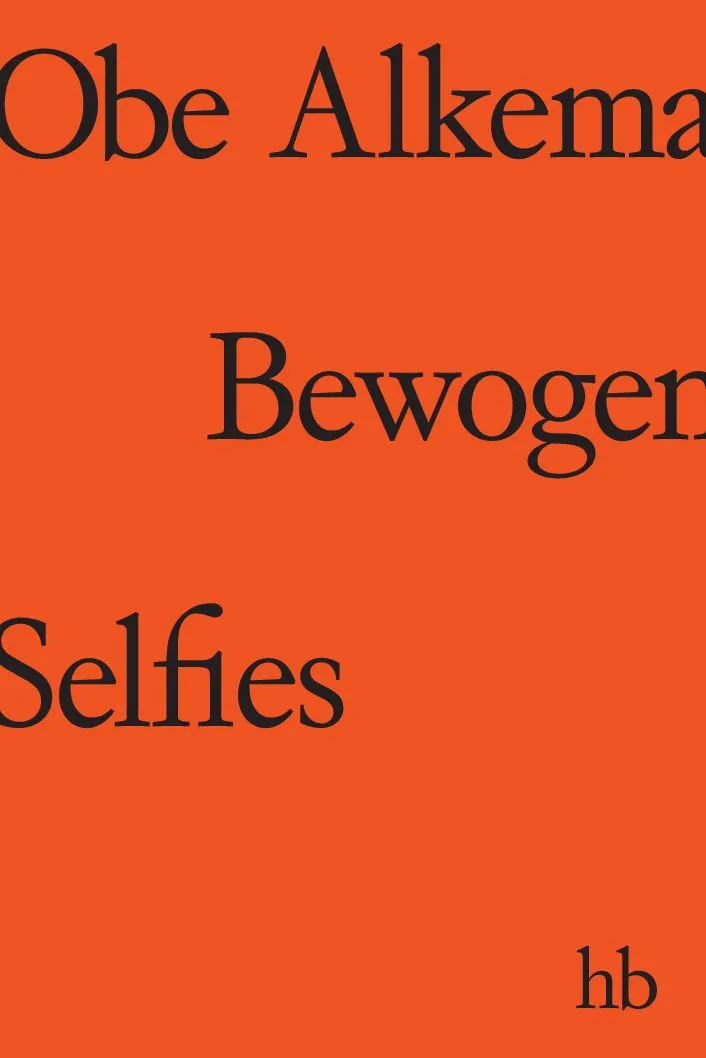
Bewogen selfies
In Bewogen selfies onderzoekt Obe Alkema de verhouding tussen landschap en herinnering. Wat treft hij aan bij terugkeer naar belangrijke plaatsen uit zijn geheugen? Wat herinnert hij zich niet, maar Google wel? Is er een gedenkschrift te puren uit zijn metadata?
Memoires, rechtstreeks verteld en met omwegen, uit eerste hand en van horen zeggen. Archieven en herinneringen eisen spreektijd, houden het niet meer droog of worden tot spreken gebracht. Wat hebben ze eigenlijk te melden? Ze lopen helemaal leeg, net als Alkema zelf. Een leven zoals zovele, poedelnaakt en geretoucheerd, vol zin en onzin.

Ban En Banlieue
Bhanu Kapil's 'Ban en Banlieue' follows a brown (black) girl as she walks home from school in the first moments of a riot. An April night in London, in 1979, is the axis of this startling work of overlapping arcs and varying approaches. By the end of the night, Ban moves into an incarnate and untethered presence, becoming all matter - soot, meat, diesel oil and force - as she loops the city with the energy of global weather. Derived from performances in India, England and throughout the U.S., 'Ban en Banlieue' is written at the limit of somatic and civic aims.

The Dogs
In Noah Ross's new book THE DOGS, Ross opens the question of authority and possession in what he deems an illicit act of translation. THE DOGS may begin with Herve Guibert's Les Chiens, but through multiple reiterations of translation, Guibert's text ultimately meets Ross to celebrate, among other sources, Marie de France, Teen Wolf, Auden, and Dom Orejudos in establishing a unique pack of hungry werewolves. You know what happens when werewolves get together: the play can get a little rough. THE DOGS empowers these snarls and yips, growls and howls, on the level of the sentence in translation as much as the embodied erotogenic zones of the body.

Steering The Craft
A Twenty-First-Century Guide to Sailing the Sea of Story.
With an introduction by Theo Downes-Le Guin, Karen Joy Fowler, Molly Gloss and Kelly Link.
Steering the Craft is Ursula K. Le Guin’s carrier bag of the tools of a writer’s craft: how – and why – to write. From the sound of language to tenses to point of view, Le Guin offers a comprehensive and generous guide to the fundamental components of narrative, illustrating her incisive analysis with examples from some of her favourite writers. Revised and updated for the twenty-first century, this handbook includes exercises that the writer can do alone or in a group.

The Hundreds
Kathleen Stewart, Laurent Berlant
In The Hundreds Lauren Berlant and Kathleen Stewart speculate on writing, affect, politics, and attention to processes of world-making.
The experiment of the one hundred word constraint, each piece is one hundred or multiples of one hundred words long, amplifies the resonance of things that are happening in atmospheres, rhythms of encounter, and scenes that shift the social and conceptual ground.
What's an encounter with anything once it's seen as an incitement to composition? What's a concept or a theory if they're no longer seen as a truth effect, but a training in absorption, attention, and framing?
The Hundreds includes four indexes in which Andrew Causey, Susan Lepselter, Fred Moten, and Stephen Muecke each respond with their own compositional, conceptual, and formal staging of the worlds of the book.

HOOT nr. 3 — Kamilé Krasauskaité
Gufo, Clément Faydit and 1 more
Last year, on a summer night in Marseille, someone, within all the hungry people I am meeting during my dinners, specifically set her attention on my projects. Later during the fall I received a call from Austė ZDANČIŪTĖ, the cultural attache at the Lithuanian embassy in France, who introduced me to Kamilè Krasauskaitè. Since that fall, we kept on exchanging and making future plans in France where she would have a residency. The more we chatted, the closest we began. Kamilè is a almost-thirty-years-old Lithuanian artist that has been including sourdough bread in her work and builds a poetic and mesmerising world around that dimension of food, fermentation, senses, environment, rituals...Through our communication I decided to share that encounter that we managed to welcome in Marseille. We kneaded some bread together, shared it in a forest of Marseillais sunflowers, walked the streets, met people, questioned and compared artists' lives in Europe. This issue might be an excerpt of all the long conversations we had, it was hot and sunny in Marseille, it was in June.

Stars at Midday –نجوم الضُهر
Stars at Midday –نجوم الضُهر is a personal diary in which the artist and filmmaker Noor Abed compiles visual and poetic notes from the production phase of her film A Night We Held Between, filmed in Palestine in 2023 with family and friends.
Like the film, the book interweaves narrative fragments, song and diaristic observations, creating a fusion of natural and composed sequences of movement, of documentary and fictional elements.
Through a choreography of bodies, sites, stories, and temporalities, Abed’s work prompts contemplation on the manifestations of social action and resistance in everyday life.

Blade Pitch Control Unit
Blade Pitch Control Unit is a gathering of Sean Bonney’s work in poetry between 2000-2005. It collects together all the work from his previous pamphlets that he still feels is valid, plus a number of previously unpublished pieces.
The presentation of this work in a single volume makes clear the scope of his project as a psychogeographic/historical exploration of the possibilities of political verse that would seek to obliterate the pitfalls of simple protest or the expression of easily assimilable opinions.
The work moves from psychogeographical registerings of Greenwich and the Isle of Dogs at the time of the Millennium Dome, through excavations of the ghosts of millennial heresies still present in contemporary London, and into a charting of the effects of official mendacity on the psyche of any individual citizen who knows that all private experience is collective.
The events of recent history play a major role, sometimes obliquely, sometimes less so, but Bonney refuses to allow his voice to be merely an outraged commentary on contemporary woes. Instead, he presents a poetry that makes clear that the protestor is also culpable, but equally a poetry that understands that only through a registering of this position can a way out be found.
For Bonney, a poem is typically a highly rhythmic (or arrhythmic) object that seeks through maximum density to communicate a dialectical relationship with the cosmos, and to explore the faultlines of official history and urbanism through which possibilities of liberation can be traced.

New Ancient Words
New Ancient Words is the first translation of Ellen Lima Wassu's poetry into English. A trilingual edition between her native Tupi indigenous language of the land of Pindorama, now Brazil, Portuguese, and English, this collection offers a wider readership her resistant yet intimate poetry, which flows seamlessly between her relational woes, a decolonial voice, and an animated playfulness with words and imagery. In her poems, history is an unstable landscape, where the personal, the mythical, and the natural are ever entwined and ever shifting in meaning.
Ellen Lima Wassu is a multiartist, freshwater fish, perplexed human, apartment gardener, and more beast than person. Born in Rio de Janeiro, she is Indigenous to the Wassu Cocal people (Alagoas, Brazil) and currently lives in Portugal, where she is pursuing a PhD, developing artistic practices, teaching courses, giving lectures, and working as an activist. In addition to contributing to literary magazines and anthologies, she has published ybykûatiara um livro de terra (Urutau, 2023) and ixé ygara voltando pra ’y’kûá (Urutau, 2021). Her practice weaves together art, poetry, performance, activism, critique, counter-colonial studies, essayistic writing, good encounters, river baths, listening sessions, and conversations with flowers.
Translation by Isadora Neves Marques and Alice dos Reis, revised by Marta Espiridião

Ghostly Matters: Haunting and the Sociological Imagination
Drawing on a range of sources, including the fiction of Toni Morrison and Luisa Valenzuela (He Who Searches), Avery Gordon demonstrates that past or haunting social forces control present life in different and more complicated ways than most social analysts presume. Written with a power to match its subject, Ghostly Matters has advanced the way we look at the complex intersections of race, gender, and class as they traverse our lives in sharp relief and shadowy manifestations.
“Ghostly Matters immediately establishes Avery Gordon as a leader among her generation of social and cultural theorists in all fields. The sheer beauty of her language enhances an intellectual brilliance so daunting that some readers will mark the day they first read this book. One must go back many more years than most of us can remember to find a more important book.” —Charles Lemert

Eros the Bittersweet: An Essay
Anne Carson's remarkable first book about the paradoxical nature of romantic love. Since it was first published, Eros the Bittersweet, Anne Carson's lyrical meditation on love in ancient Greek literature and philosophy, has established itself as a favorite among an unusually broad audience, including classicists, essayists, poets, and general readers.
Beginning with the poet Sappho's invention of the word "bittersweet" to describe Eros, Carson's original and beautifully written book is a wide-ranging reflection on the conflicted nature of romantic love, which is both "miserable" and "one of the greatest pleasures we have."

Love Belongs to Those Who Do the Feeling: New & Selected Poems (1966-2006)
An exciting collection of new and selected poetry by Judy Grahn. The book contains selections from Judy's entire body of poetic work from The Work of a Common Woman, The Queen of Wands and The Queen of Swords, to new poems written between 1997 and 2008.
Judy's poetry is rangy and provocative. It has been written at the heart of so many of the important social movements of the last forty years that the proper word is foundational.

Weaknesses
Afternoon Editions no. 2: text and drawings by Chrysa Parkinson titled Weaknesses. Between January and March 2019 Time has fallen asleep in the afternoon sunshine was presented as a solo-exhibition at Index Foundation in Stockholm. During this period Chrysa Parkinson was invited as a guest writer for Afternoon Editions. Weaknesses is a leap in memory.