Books
Books
in random order

Correspondences de Appel 1975–2025
This volume brings together 50 years of correspondence from the archive of de Appel contemporary arts centre in Amsterdam. In tracing a relational and affective history of the institution, each piece offers a glimpse into the artistic projects and programmes de Appel has commissioned and championed; the cultural shifts and careers it has nurtured; the celebrations and struggles it has weathered; and the collaborations and friendships sparked along the way. The book gathers materials from more than 100 voices, with paper and digital exchanges covering an intricate web of people, places, and events, ultimately coalescing into what can be perceived as the unified work of an institution.
Includes a light-blue satin Ribbon by Alison Knowles.

I will pay to make it bigger
You wake up in the footwell of a mid-sized hatchback somewhere on a highway in outer Bangkok. You compile neurotic spreadsheets of the best ‘party destinations’ in Europe, whilst your work emails pile up without ever being read. You quit your job. You launch a banal start-up. You grieve for a past relationship. You stare endlessly at the waves coming in from a beach in Koh Pha Ngan. You vape intensely. You spend money on feelings, on the performance of your own persona, whilst you observe yourself with a detached sense of horror.
i will pay to make it bigger is a novella, by poet and artist Ahren Warner, in which ‘you’ are the main character. Through text and image – autofiction, docufiction, and just plain fiction – you work your way through a tangle of preoccupations: from what it means to buy enjoyment, to the fragile construction of your own self as a cultural product.
i will pay to make it bigger is also a photobook, a collection of images produced whilst living in Thai ‘party hostels’. Although these photographs might seem to exist as the documentation of intimate or ecstatic moments, they are in fact quite painstakingly, and artificially, constructed: composited and manipulated from multiple still frames of film footage to produce images that advertise the calculated artifice of their own hedonism, emotion and seemingly raw experience.
With a Coda by Hana K. Ohnewehr, commissioned by Yu’an Huang

Barge Life: On Jean Vigo's L'Atalante
How to live together in cramped quarters? How to create a microcosm against hostile surroundings? In Barge Life, Florian Deroo tackles these questions by looking at a mythical classic of French cinema: Jean Vigo’s 1934 film L’Atalante. A work brimming with the energies of surrealism and anarchism, L’Atalante follows a young couple, two shipmates, and a clowder of cats who dwell in the belly of a river barge. Deroo offers a wide-ranging essay on the film, revealing how it lovingly delineates a small group that withdraws from the rhythms of modern life to establish a different kind of existence elsewhere. In L’Atalante’s most riveting moments, the river barge becomes a vehicle for a powerful fantasy: a supple and mobile collective life, lived in sensuous interdependence.
Combining film criticism, philosophy, and biography, Deroo’s Barge Life reconsiders an important forerunner to the French New Wave and the early death of its director. Drawing readers into the intimately cramped living spaces of L’Atalante, Deroo explores the allure of retreating into a self-sufficient shelter, along with its intractable problems.

How to see palace pillars as if they were palm trees
Hussein Nasseraddine, Ben Koerber
For so it happens that when the poets speak, objects appear closer to their own shadows. The poet's mouth fills up with horses and marble, and his verses start to shine like rivers. These rivers then turn back to flow through the very palace he is depicting. The poet's own words begin to weigh down on him, as though he were holding up a palace with his palms. Then he travels, and the palace is obliterated. Countries and nations change, and naught remains but what the poets had seen. Of what the poets had seen, naught remains but its image in anthologies. And when the libraries have been flooded or burned to the ground, nothing but the commentaries on those anthologies are left, and all that one finds in these commentaries is that which was appropriated and wrought a thousand times over.
Hussein Nassereddine is a multidisciplinary artist. His work in installation, writing, video and performance originates from a practice around language that builds fragile monuments - some verbal, some sonic, some tactile - rooted in collective histories and resources of poetry, ruins, construction and image-making.
Translated from Arabic by Ben Koerber.

Against Morality
A manifesto against the current moralizing trend in the arts.
Should art be determined by political ideals? In recent decades art institutions have sought to embody liberal values of universal equality and social justice. This move toward greater inclusivity has borne witness to a countervailing trend: artworks are increasingly scrutinized for their political implications, and artists must take care not to transgress particular moral fault lines.
Examining contemporary exhibitions as well as works of art and film, and the broader cultural reactions to them, Rosanna McLaughlin investigates the consequences of this moralizing approach to creative work. She invites us to rethink the connection between political values and art—and to ask whether a relationship between them should exist at all. In arguing against morality in the arts, McLaughlin lays the groundwork for a more expansive concept of difference in twenty-first-century art making.
"What if ambivalences were seen as productive, and not a danger to erase? Would we not begin to know ourselves better? What is it that we are so afraid of finding out? Art is a testing ground for ideas, a means of reaching. What a shame, if we use the space it offers to destroy it entirely."
Rosanna McLaughlin is a writer based in East Sussex and the author of Double-Tracking: Studies in Duplicity (2019) and Sinkhole (2023). Her writing on art and culture has featured in ArtReview, Frieze, Granta, The Guardian, and The White Review, among other publications. Between 2021 and 2023 she was co-editor of The White Review.

Shakespeare and Ethics
Shakespeare’s plays are full of philosophical ideas, but they are rarely examined systematically. In this pamphlet philosopher Colin McGinn analyzes the plays to distill Shakespeare’s ideas about ethics. McGinn concludes that the “plays are about good and evil,” and that Shakespeare is “a great moral psychologist,” who expertly stages how his characters are defined by their moral qualities (their naturalistic virtues and vices).

Épopées Célestes / Epopee celesti
Gustavo Giacosa, Barbara Safarova
A veritable panorama of Art Brut at an international level, through 180 works selected from Bruno Decharme's collection.
Art brut has never ceased to shake up the history of art and nourish minds resistant to norms as it questions classic notions of art and creation as well as those relating to the normal and the pathological. But who are they, these artists of a special kind, witnesses to another world, strangers to stylistic trends and influences? They stay—or are kept—away from the culture of fine art as well as the codes and places that constitute it such as schools, academies, museums, art fairs, etc.
Featuring A.C.M., Noviadi Angkasapura, Anselme Boix-Vives, Marie Bodson, Giovanni Bosco, Gustavo Enrique Buongermini, Aloïse Corbaz, Fleury-Joseph Crépin, Egidio Cuniberti, Henry Darger, Fernand Desmoulin, Janko Domsic, Dong-Hyun Kim, Jaime Fernandes, Eugen Gabritschevsky, Pietro Ghizzardi, Madge Gill, Paul Goesch, Jorge Alberto Hernández Cadi, Paul Humphrey, Zdeněk Košek, Joseph Lambert, Gustave Pierre Marie Le Goarant de Tromelin, Augustin Lesage, Pascal Leyder, Alexander Pavlovitch Lobanov, Ramon Losa, Dwight Mackintosh, Lázaro Antonio Martínez Durán, Mettraux, Edmund Monsiel, John Bunion Murray, Iwona Mysera, Koji Nishioka, Masao Obata, Jean Perdrizet, M. Pierron, Photographies Spirites, Miloslava Ratzingerová, Marco Raugel, Achilles G. Rizzoli, Leopold Strobl, Harald Stoffers, Mose Tolliver, Melvin Way, Scottie Wilson, Adolf Wölfli, Anna Zemánková, Carlo Zinelli, Unica Zürn.

Crystal Pantomime
Recognized as a poet, less so as a visual artist […] Mina Loy also wrote in the style of Crystal Pantomime, a text from one hundred years ago [c. 1915] describing a ballet in prose. The writing evokes images with which actual theater effects can only interfere. It projects in the mind as onto a screen. But this restless writing does more than that, shifting registers and unfolded in equal parts fairy tale description, precise impossible stage directions, notes for impossible costumes and sets, guidelines for impossible choreography, and a glancing archeology of personal association, opinion, art historical commentary, and psychoanalysis, all floating in suspension, all shading into poetry, and with this manner of overflowing every frame defining its poetics. — Matthew Goulish
This first standalone edition of Crystal Pantomime opens with a biographical introduction by Mina Loy’s literary executor—poet Roger Conover—originally published in Eliot Weinberger’s journal Montemora in 1981, as well as a dramaturgical introduction by Matthew Goulish of Chicago performance group Every house has a door, originally prepared as opening remarks to Every house’s reading of Loy’s Pantomime at the Arts Club of Chicago in spring of 2024. In tandem these supplementary texts begin to frame what is a rather strange and singular sketch for a work never realized.

BFTK #6: Tentative — Incomplete — Inconsistent
Andrew Walsh‐Lister, Matthew Stuart
This instalment of Bricks from the Kiln doubles as issue #6 of the journal and as an exhibition catalogue for the thematic show ‘BFTK#6: Tentative — Incomplete — Inconsistent: A Catalogue of the Disappeared, Destroyed, Lost or Otherwise Inaccessible’. Presenting objects, artworks, artefacts, models, events and animals that no-longer — or never did — exist in physical form, the exhibition explores themes of death, destruction and reincarnation, examining persisting interests in notions of ephemerality and permanence, memory and record, preservation and erasure, creation and reconstruction.
How do we remember and memorialise? How is space given to the unrecorded? How do we experience the out of reach, concealed, unseen, undiscovered? How can the dematerialised be materialised again, through the mediation of writing, image and sound?
THE ALMOST HORSE
Helen Marten
(inside front / back cover)
‘STILL IN ALL HEARTS, IN ALL BELLIES, IN ALL TOES’:
A BELATED REVIEW OF FESTIVAL DE FORT BOYARD
Matthew Stuart & Andrew Walsh-Lister
(pp.6–8)
EDDYSTONE
Rachael Allen
(pp.11–18)
TO MAKE THE STONE STONY
Emily LaBarge
(pp.21–26)
WHEREFORE AM I NOW?
Lucy Mercer
(pp.29–40)
WESTON: THE TOWN THAT WAS, AND THEN WASN’T
Crystal Bennes
(pp.43–52)
NOTES TO ACCOMPANY VIOLENT INNOCENCE (2019)
Will Harris
(pp.55–64)
GHOST, POCKETS, TRACES, NECESSARY CLOUDS
Matthew Stuart
(pp.66–69)
CONNECTIVITY OF TOUCHING
Ali Na & Mindy Seu in conversation
(pp.71–76)
PEARL
Rose Higham-Stainton
(pp.79–84)
NOTES FROM NEW MEXICO
Jennifer Hodgson
(pp.87–98)
THE MOOG OF AHMEDABAD
Paul Purgas
(pp.101–108)
IN WHICH DECIBELLA ESCAPES AUDITION
Sarah Hayden
(pp.111–122)
D.C.B.: A PARTIAL RETROSPECTIVE
Juliet Jacques
(pp.125–136)
PINBALL REMAINS: ON THE PINBALL ISSUE OF THE SITUATIONIST TIMES
Ellef Prestsæter
(pp.139–150)
TOMB III – CADMIUM (2021)
Gilbert Again
(pp.152–154)
NON-DESCRIPT ANIMAL
David Hering
(pp.157–161)
Cover & Bookmark artwork by Helen Marten

My Kevin, My Paris
In the fall of 2017, Obe Alkema got acquainted with the American poet Kevin Killian, first at the New Narrative conference at UC Berkeley, then at the Poets & Critics Symposium in Paris that was all about his poetry. A year and a half later, Alkema traveled back to Paris, this time as a participant of a writing residency. He was there to research the landscape of memory, but more than he expected and initially realized, Kevin’s death the previous month (June 2019) affected his return. Besides inevitable, mourning and remembering became obsessions for Alkema, as he shows in ‘My Kevin, Our Paris’, a memoir about Kevin Killian (1952–2019), but especially about his Kevin and their Paris.

Cunt Norton
In CUNT NORTON, the sequel to her unforgettable CUNT UPS, Dodie Bellamy "cunts" The Norton Anthology of Poetry (1975 edition), setting her text-ravenous cut-ups loose to devour the canonical voices of English literature. The texts that emerge from this sexual-linguistic encounter are monstrous, beautiful, unashamed: 33 erotic love poems ("the greatest fuck poem in the English language," according to Ariana Reines) that lust after the very aesthetic they resist. "These patriarchal voices that threatened to erase me—of course I love them as well," Bellamy writes. Even as CUNT NORTON dismembers the history of English poetry, "cunting" Chaucer and Shakespeare, Emerson and Lowell, it simultaneously allows new sexual members to arise and fill in the gaps, transforming the secret into the explicit, the classically beautiful into the wonderfully grotesque. Bellamy's cunted texts breathe life into literary "masters" with joy, honesty, hilarity, and insatiable passion.

Almond Blossoms and Beyond
Mahmoud Darwish, Mohammad Shaheen
The first English translation of recent poetry by the late Mahmoud Darwish, the most important Palestinian contemporary poet.
Almond Blossoms and Beyond is one of the last collections of poetry that Mahmoud Darwish left to the world. Composed of brief lyric poems and the magnificent sustained Exile cycle, Almond Blossoms holds an important place in Darwish’s unparalleled oeuvre. It distills his late style, in which, though the specter of death looms and weddings turn to funerals, he threads the pulses and fragilities and beauties of life into the lines of his poems. Their liveliness is his own response to the collection’s final call to bid “Farewell / Farewell, to the poetry of pain.”
Mahmoud Darwish, born in 1941 in the village of al-Birweh, Palestine, was the author of over two dozen volumes of poetry and prose. When he died in the summer of 2008, he was mourned throughout the world as a voice of the Palestinian people—author of their official declaration of independence and, most importantly, a poet of the highest invention and beauty. Mohammad Shaheen is a professor of English at the University of Jordan. Amro Naddy has worked as an editor at the Virginia Quarterly Review. He teaches at the King’s Academy in Amman, Jordan.

That's Me!
David Hoyle (b.1962, Blackpool, United Kingdom) is a performance and visual artist. His work over the last 30+ years has referenced gender, politics, identity, mental health issues and the ongoing fight for equality.
Hoyle came to prominence in the ‘90s as The Divine David, a kind of anti-drag queen whose lacerating social commentary – targeting both bourgeois Britain and the materialistic-hedonistic gay scene, which he called, “the biggest suicide cult in history” – was offset by breathtaking instances of self-recrimination and even self-harm. Following a couple of outré late-night Channel 4 TV shows and a part in the movie Velvet Goldmine, directed by Todd Haynes, Hoyle killed off The Divine David, during a spectacular show at the Streatham International Ice Arena in 2000 and retreated to Manchester for “a period of reflection”.
He returned to television screens in 2005 in Chris Morris’ Nathan Barley, then began performing live again, under his own name. Hoyle’s biting satire, bravura costumes, wicked comic timing, and compelling charisma remained intact.
Hoyle is also a prolific painter often painting in his live shows. His paintings are deeply personal, and tackle the same themes as his performances, incorporating domestic waste, flyers, newspapers, magazines, wrapping paper, and more, which reinforce his disdain for the ruling-class bourgeoisie.
This is the first book dedicated to Hoyle’s paintings, offering an edited selection of works made between 2010 and 2022. At Hoyle’s request, all of the works are published undated: thus, emphasising their timelessness, timeliness, relevance, and urgency to the desperate age in which we now find ourselves!

Some Monologues
Working at the nexus of performance, art writing, and fiction, Tyler Coburn creates monologues that explore how the “I” is marked in speech. His myriad topics—alternate history, legal personhood, digital labor, and resonant frequency, to name a few—defy straightforward modes of presentation, often insisting on site-specificity and social intimacy at the expense of conventional documentation.
Some Monologues collects, for the first time, the scripts of Coburn’s work from the past fifteen years, many of which have not previously been published. Accompanying them are texts by eleven artists, writers, curators, and scholars who experienced these performances firsthand, collaborated in their making, conversed with the artist about them, or share an interest in the subjects they engage. Written in theoretical, poetic, and autobiographical registers, these contributions offer new perspectives on the monologue as an expansive and relational form.
Introduction by Elvia Wilk. Contributions by Yu Araki, A.E. Benenson, Mashinka Firunts Hakopian, Sven Lütticken, Kameelah Janan Rasheed, Spyros Papapetros, Camille Richert, Théo Robine-Langlois, Ian Wallace, and Michelle Wun Ting Wong.
Tyler’s scripts refuse to fix an authorial voice; instead, they make the conditions of authorship itself their subject. Blurring the boundaries between fiction and document, the human and the bureaucratic, the self and its doubles, his work thinks through systems from the inside, often using language as both architecture and trap. In their precision and porousness, I recognize a shared pursuit: how to locate agency within constraint, and how to turn the administrative or the technological into a site of intimacy. — Jill Magid
In Tyler Coburn’s Some Monologues, a binary that remains constitutive for the ideological continuity of modern life, in all its colonial and capital forms, is undone: digital vs. physical. In troubling that chasm, Coburn plays out the repercussions of these ideologies of anthropomorphic naturalism, guiding us through their resonances, doubles, codings, and relays. But he also renders himself as the relay of these transferences, in the process expanding art’s premodern calling: to exist as an invocation. Reification suddenly appears as what is situated between embodiment and disembodiment, with both potentially destabilized. Some Monologues, the book, is this destabilization’s ideal format: as much documentation, an echo, of Coburn’s works through their scripts, as it is an instruction manual for denaturalizing our sense/s. — Kerstin Stakemeier
Tyler Coburn is an artist, writer, and professor based in New York. He received a 2024 Andy Warhol Foundation Arts Writers Grant, and his writing has appeared in ArtReview, BOMB, C Magazine, Dis, e-flux journal, frieze, LEAP, Metropolis M, Mousse, and Rhizome. Coburn is the author of four books: I’m that angel (self-published, 2012), Robots Building Robots (CCA Glasgow, 2013), Richard Roe (Sternberg, 2019), and Solitary (Sternberg and Art Sonje Center, 2022). He has presented artwork at such venues as Centre Pompidou, Paris; Bergen Kunsthall; Hayward Gallery, London; Para Site, Hong Kong; and Kunstverein Munich.

The Letters of Mina Harker
In Dodie Bellamy's imagined "sequel" to Bram Stoker's fin de siècle masterpiece Dracula, Van Helsing's plain Jane secretarial adjunct, Mina Harker, is recast as a sexual, independent woman living in San Francisco in the 1980s. The vampire Mina Harker, who possesses the body of author Dodie Bellamy, confesses the most intimate details of her relationships with four vastly different men through past letters. Simultaneously, a plague is let loose in San Francisco-the plague of AIDS.
Bigger-than-life, half goddess, half Bette Davis, Mina sends letter after letter to friends and co-conspirators, holding her reader captive through a display of illusion and longing. Juggling quivering vulnerability on one hand and gossip on the other, Mina spoofs and consumes and spews back up demented reembodiments of trash media and high theory alike. It's all fodder for her ravenous libido and "a messy ambiguous place where pathology meets pleasure." Sensuous and captivating, The Letters of Mina Harker describes one woman's struggles finding the right words to explain her desires and fears without confining herself to one identity.

Archive Dora Diamant #07
A collection of photographs from the archives of the icon of underground and alternative Parisian nights Dora Diamant.
A self-taught photographer, Dora Diamant has left thousands of photos. The Dora Diamant Association, custodian of this archive, and Éditions L'Amazone have joined forces to bring them to life by devoting a series of publications to them. Each volume of the Dora Diamant Archive was created by a different person and is the result of a subjective selection and arrangement specific to its author.
Figurehead of the Parisian underground and queer nights, photographer, DJ, multimedia and polymorphic artist, Dora Diamant was the daughter of Pascal Doury.
Selected by Yamil Farah and Mélanie Matranga.

LllOovVee - Forbid me my love
It is right and necessary to be speaking with strangers. There are islands, backroads and cliffs of wet inked worded sea ridgelines where aodán McCardle’s work emerges concrete and lyric as a chant of delicately provoking permutations. forbid me my love, the first part of this beautiful book, is poetry as poiesis or making. By means of a series of concrete meditations, McCardle takes us where he, or perhaps the words themselves, unknit, erase, appear and disappear. Wor(l)ds of the size of terrorist and bomb are subject to a system of alterations that end up shooting lovebombs from the page as if love could become an error in the system. The second part of the book, LllOovVee, starts closer to verse. Reading it, one can almost hear aodán’s delicate Irish voice, but any easy reading gets explosively interrupted by the scanned handwritten, scribbled and scratched lines that open another set of permutations, one about what is behind us, how to be there here and what is it to be there then now, in the making, in the ear and in the eye with this revealing poetry.
- Martín Gubbins
Aodán McCardle is a performance poet, artist, & tattooist. In this book he combines all three artistic expressions into a performance. These poems are audacious. A poetic trajectory worthy of reading aloud.

Care Work
Leah Lakshmi Piepzna-Samarasinha
Lambda Literary Award winning poet and essayist and long-time disability justice advocate Leah Piepzna-Samarasinha writes passionately and personally about disability justice in her latest book of essays. Discussing subjects such as the creation of care webs, collective access, and radically accessible spaces, she also imparts her own survivor skills and wisdom based on her years of activist work, empowering the disabled - in particular, those in queer and/or BIPOC communities - and granting them the necessary tools by which they can imagine a future where no one is left behind.

Sonic Meditations
Pauline Oliveros (1932-2016) Pauline Oliveros' life as a composer, performer and humanitarian was about opening her own and others' sensibilities to the universe and facets of sounds. Her career spanned fifty years of boundary dissolving music making. In the '50s she was part of a circle of iconoclastic composers, artists, poets gathered together in San Francisco. In the 1960's she influenced American music profoundly through her inclusive work with improvisation, meditation, electronic music, myth and ritual.
She founded 'Deep Listening(R), ' which came from her childhood fascination with sounds and from her works in concert music with composition, improvisation and electro-acoustics. She described Deep Listening as a way of listening in every possible way to everything possible to hear no matter what you are doing. Such intense listening includes the sounds of daily life, of nature, of one's own thoughts as well as musical sounds. 'Deep Listening is my life practice, ' Oliveros explained, simply. Oliveros founded Deep Listening Institute, formerly Pauline Oliveros Foundation, now the Center For Deep Listening at Rensselaer, NY. Her creative work is currently disseminated through Pauline Oliveros Publications and the Ministry of Maåt, Inc

Tony Cokes Edition
On the occasion of Tony Cokes' solo-exhibition, ARGOS produced a unique purple t-shirt with silver lettering. 100% cotton; 180 grams. Silkscreen by Bootlegz in Brussels.
Available in XL (XS, S, M and L are sold out)
Edition of 100

Film X Autochthonous Struggles Today
Nicole Brenez, Jonathan Larcher and 2 more
First global exploration of contemporary forms of filmmaking from political and cultural self-determination movements of Autochthonous communities and peoples.
Film X Autochthonous Struggles Today brings together for the first time filmmakers, activists, film curators, and scholars who share a common interest in filmmaking practices that emerge from and participate in the various situations of struggle that the Autochthonous/Indigenous/Native/Aboriginal/First Nations peoples and communities are involved in worldwide.
Starting with the Edison Studio's 1894 short films Buffalo Dance and Sioux Ghost Dance, representations of Autochthonous peoples have been part of cinema right from its inception. The vast majority of these representations, however, have not been produced by nor for Autochthonous peoples. In the wake of political and cultural self-determination movements of the 1960s and 1970s, and with the gradual democratization and accessibility of the tools of moving-image making, Autochthonous communities have displaced and renewed cinema's forms and means of production, increasingly reclaiming their right for self-representation by way of film and video.
Along with the vibrant forms of moving images arising from within the communities, close to their existential political concerns, filmmaking has also become a potent tool in Autochthonous struggles. This book answers the need to take a global look at the diverse ways of filmmaking that fight for land rights and against environmental injustice (Brazil, Morocco, Taiwan, USA), that resist neocolonial domination, economic and political exploitation (Japan, Philippines), that offer a counterpoint during low intensity or drawn-out armed conflicts (Colombia, Mexico), that invent strategies of counter information and representation (Australia, Canada, Russia, Samoa), and that strive for visibility.
Contributions by Myrla Baldonado, Mayaw Biho, Nadir Bouhmouch, Ricardo Matos Cabo, Carolina Canguçu, Amaranta Cesar, Karrabing Film Collective, Rupert Cox, Nicolas Défossé, Etienne De France, Sophie Gergaud, John Gianvito, David Harper, Aurélie Journée-Duez, Blackhouse Lowe, Caroline San Martin, Laura Langa Martínez, Isael Maxakali, Sueli Maxakali, Dan Taulapapa Mcmullin, Chie Mikami, Francisco Vázquez Mota, Omar Moujane, Marie Pierre-Bouthier, Perrine Poupin, Ariel Arango Prada, Beatriz Rodovalho, Roberto Romero, Jonathan Sims, Mercedes Vicente, Jamahke Welsh.
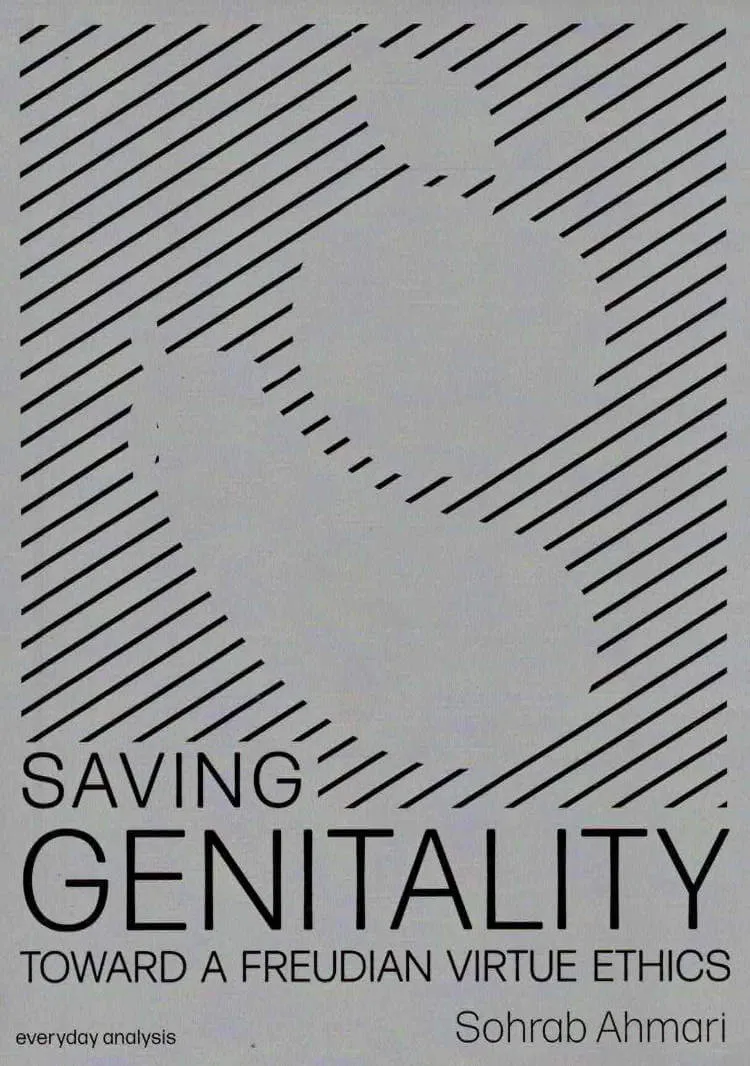
Saving Genitality: Toward A Freudian Virtue Ethics
Western societies have dismantled many of the prohibitions that ringfenced errant sexual drives in Freud’s time. The psychoanalytic project describes people caught between two fundamental and contradictory principles: One a relentless sexual drive, the libido; the other our species’ collective need for social order and harmony. Part of this harmony, for true Freudians, is embedded in the binary mutuality of men’s and women’s bodies, which remains indispensable for society to reproduce itself, even in our sexually liberated age. In this essay, Ahmari revisits the idea of ‘genitality’ arguing that perhaps the "heteronormative" orthodox Freudians were right about some things after all.

Give Piss A Chance
A collection of notes, pictures, social media posts, about the legendary “Piss Goblin” who is / was (?) active in the Berghain bathrooms. This edition – handmade by Cutt Press – beautifully + playfully embodies its subject, as orange plasticky sheets are interspersed in between the text pages, and marble paper half-covers shimmer, in an evocation of golden torrents . . .
Give Piss a Chance. A Williing Suspension of Consequences was first published in the context of the For Real exhibition at DAADGalerie, Berlin, in 2025.

Enthusiasm
{ENTHUSIASM} is the 7th poetry collection by poet, artist, curator and vanguardist SJ Fowler. It follows highly-acclaimed collections including The Rottweiler's guide to the Dog Owner and Enemies: the selected collaborations of SJ Fowler. The book's 81 poems are intended as individual pieces in their own right, but are interlinked by subjects including battle and violence, infants and infancy, religion, economy and population, the self, modernity, and the past.