rile*books

Search books

Search books by title, author, publisher, keywords...

Cover of Tina Girouard: Sign-In

Dancing Foxes Press

Tina Girouard: Sign-In

Tina Girouard

€45.00

From the 1970s until her death, Louisiana-born artist Tina Girouard (1946–2020) was a dedicated experimental artist, collaborator and art worker. Alongside her individual creative endeavors, she nurtured and was a part of numerous influential artist communities and organizations in New York, Louisiana and Haiti, including the Anarchitecture Group, the interdisciplinary cohort of 112 Greene Street, the restaurant Food, the Kitchen, P.S. 1 and the Festival International de la Louisiane. Her acts of upkeep, including domestic labor traditionally associated with “women’s work,” blurred the boundaries between artmaking and what she called life-making. Sign-In is the first comprehensive monograph on her interdisciplinary oeuvre. It gathers documentation of her work in video, performance, drawing, textile, wall works and installation, tracing Girouard’s practice and legacy across genres and geographies.

Edited by Andrea Andersson with Jordan Amirkhani
With new essays by Andrea Andersson, Jordan Amirkhani, Anaïs Duplan, Pamela M. Lee, Aruna D’Souza, and Lumi Tan

Published in 2025 ┊ 385 pages ┊ Language: English

recommendations

Cover of Andrea Geyer: Dance in a Future with All Present

Dancing Foxes Press

Andrea Geyer: Dance in a Future with All Present

Andrea Geyer

Performance €30.00

This most substantive monograph yet published on the work of German-born, New York–based multimedia artist Andrea Geyer focuses on her recent explorations of the marginalized yet pivotal role that women have played in the formulation of American modernism, tracing and honoring the ephemeral acts, initiatives, and stories that shaped it. Featuring full-color images of Geyer’s artworks and research materials, including documents, found photographs, and previously unpublished photographs by the artist, Dance in a Future with All Present offers insight into Geyer’s art and the multiple histories of modernism.

Includes texts by Matthew Jeffrey Abrams, Andrianna Campbell, Juli Carson, Barbara Clausen, Lynne Cooke, Dean Daderko, Saisha Grayson, Sharon Hayes, Megan Heuer, Danielle A. Jackson, Alhena Katsof, Kristan Kennedy, Thomas J. Lax, Ralph Lemon, André Lepecki, Renate Lorenz, Josiah McElheny, Fred Moten, Kristin Poor, Yvonne Rainer, Gabriela Rangel, Jeannine Tang, and Soyoung Yoon.

Copublished with Portland Institute of Contemporary Art in 2019.
Edited by Alhena Katsof, Karen Kelly, and Barbara Schroeder. 
Design by Dante Carlos.

Cover of Transmissions

Dancing Foxes Press

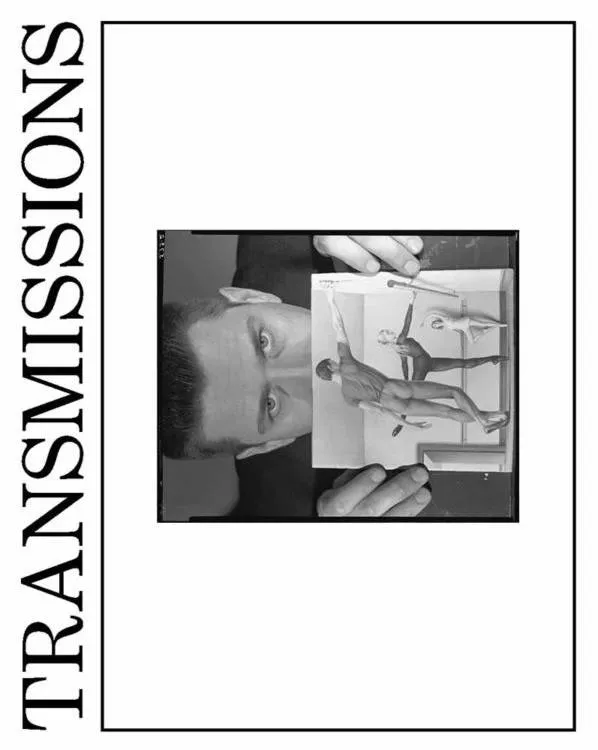
Transmissions

Nick Mauss

An aesthetic and social history of art and dance in mid-20th-century New York interpreted by contemporary artist Nick Mauss. 

Over the past decade, Nick Mauss (b. 1980) has pursued a hybrid mode of working that melds the roles of curator, artist, and scholar. This catalogue leans heavily into the scholarship side of his practice, building on his 2018 Whitney Museum exhibition with a closer look at the relationship between modernist ballet and the New York avant-garde. In the 1930s through 1950s, ballet was introduced to a popular audience in New York and was simultaneously influenced by developments in Europe in painting, photography, fashion, music, and poetry. Mauss reflects on this period of rich cross-media production and synergy, ultimately arguing for the inseparability of dance and art history.

Cover of Les Goddesses/Hemlock Forest

Dancing Foxes Press

Les Goddesses/Hemlock Forest

Moyra Davey

This book is based on two related projects that take form as text, photography and film. Les Goddesses (2011) collapses the lives of Davey and her five sisters with those of the daughters of Mary Wollstonecraft, the 18th-century feminist writer and activist. Hemlock Forest (2016) weaves references to Wollstonecraft, Chantal Akerman and Karl Ove Knausgaard with her own family stories. During the making of Hemlock Forest, Akerman took her own life. Her death soon engulfed Davey's awareness, prompting a broader exploration of Akerman's and her own biographies, amid more universal themes of compulsion, artistic production, life and its passing.

Texts by Moyra Davey and an introduction by Aveek Sen
Design by Filiep Tacq

Cover of Dance History(s): Imagination as a Form of Study

Dancing Foxes Press

Dance History(s): Imagination as a Form of Study

Annie-B Parson, Thomas F. DeFrantz

Authored by twelve diverse American dance artists in the form of twelve small booklets, Dance History(s): Imagination as a Form of Studyapproaches and celebrates dance history as a subjective, artistic inquiry. It reimagines and radicalizes our understanding of dance throughout human history through the voices of working choreographers. Simultaneously, the project is dedicated to the power of an artist-centric view of history itself, thus placing the dance history back into the body, where it began. Here, history occurs in vertical layers of time and space and moves into the street, the football field, the yard, the screen, the memory, the womb, the sky, and the future.

Text by mayfield brooks, thomas f. defrantz, maura nguyễn donohue, Keith Hennessy, Bebe Miller, Okwui Okpokwasili, Eiko Otake, Annie-B Parson, Javier Stell-Frésquez, Ogemdi Ude, Mariana Valencia, and Andros Zins-Browne

Cover of Essays

Essay Press

Essays

Dorothea Lasky

Poetry €18.00

Poetry as both a form and genre has many possibilities to exist within; however, poetry too often is burdened by the imperative to have an argument and a set of imagery and meanings that are preconceived and placed within the poem. In this way, poetry gets conflated with writing a thesis or project, and the poet simply the presenter of perfectly argued language. When poets attempt to bridge the gap between genres and write within the contemporary essay form, they are tasked to construct perfect arguments there as well and avoid the associative and aesthetic logic that makes poems important. The term essay itself was coined by Michel de Montaigne in the 1500s — it comes from the French word essai, which means to test or experiment with what one knows as a learning tool, and is in partial opposition to the terms we use to discuss the essay now

ESSAYS calls on thinkers and writers to move beyond this linear thinking into the realm of what an essay by someone like Montaigne might do. His essays do as they say they will—they test out ideas, they are unafraid to get messy in their execution, they are brave enough to go forward into the uncharted waters. In them, it’s completely beside the point to get back to where they started, let alone where they’d say they would go. They are simply beside the point. It’s true.

ESSAYS, edited by Dorothea Lasky, is a book of essays on the essay, which enact and query these directives. The volume collects essays by poets Ariel Goldberg, Ken Chen, Wayne Koestenbaum, Tracie Morris, Anaïs Duplan, Raquel Salas Rivera, Brandon Shimoda, Cecilia Vicuña, Fred Moten, and Mónica de la Torre.

Cover of Contextures

Primary Information

Contextures

Linda Goode Bryant, Marcy S. Philips

Contextures was originally published in 1978 by New York City’s legendary Just Above Midtown gallery. Edited by gallery founder Linda Goode Bryant and Marcy S. Philips, the publication provides an extensive history of Black artists working in abstraction from 1945 to 1978, while also articulating a newly-emerging movement of Black Conceptual Art in the 1970s.

The publication contains extensive writing by Goode Bryant and Philips drawn from interviews with the featured artists, as well as 58 black-and-white and 16 color images documenting the work of 25 artists: Banerjee, Frank Bowling, Donna Byars, Ed Clark, Houston Conwill, John Dowell, Mel Edwards, Wendy Ward Ehlers, Fred Eversley, Susan Fitzsimmons, Sam Gilliam, Gini Hamilton, David Hammons, Manuel Hughes, Suzanne Jackson, Noah Jemison, James Little, Al Loving, Senga Nengudi, Howardena Pindell, Betye Saar, Raymond Saunders, Sharon Sutton, Randy Williams, and William T. Williams. A newly commissioned afterword by Thomas (T.) Jean Lax, curator of the exhibition Just Above Midtown: Changing Spaces at the Museum of Modern Art, is also included.

Goode Bryant and Philips originally conceived Contextures to accompany The Afro-American Artists in the Abstract Continuum of American Art: 1945–1977. Functioning more like a textbook than a traditional catalog, the book nonetheless realizes a vital mission of their curatorial vision, placing Black artists within the still-prevalent, white-dominated canon of post-war abstract art. Despite its historical importance and visionary scholarship, Contextures was originally produced in a limited run of just a few hundred copies by the gallery and remains rare and largely unknown.

This new edition is produced in facsimile form and is a co-publication with Pacific.

Cover of Le Chauffage — Issue #2

Le Chauffage

Le Chauffage — Issue #2

Francesca Percival, Felix Rapp and 1 more

Le Chauffage (french for “The Heater”) is an artist-run publication based in Brussels and Vancouver. It is conceived as a cross-continental, community oriented platform. Le Chauffage brings together the work and writing of artists / friends from different cities with the  intent to spark discussion and fuel casual forms of critical discourse.

The second issue of Le Chauffage contains photographs and texts, photographs of text, photographs as text and vice versa. Loosely thinking through the format of The Photo Essay celebrated by John Szarkowski in an eponymously titled exhibition at MoMA in 1965, this issue considers some of the artistic possibilities that can be found in such an archaic and historically male-dominated form. 

Many of the contributions that make up this second issue are not photo essays per se. But each one of them considers the printed page as a space in its own right. The magazine becomes an interior where words and images entertain a malleable and distinctly porous relationship. At times, it is also a space where artists and writers from different cities were invited to meet and collaborate. And since interest in other people is also an interest in yourself, it is always unclear who is really transforming who?

Contributions by: Bob Cain & Linda Miller, Moyra Davey, Laurie Kang, Niklas Taleb, Madeleine Paré & Diane Severin Nguyen, Josephine Pryde, Slow Reading Club, Ken Lum, Isaac Thomas, Vijai Maia Patchineelam, Artun Alaska Arasli & Graeme Wahn, Stephen Waddell, Maya Beaudry & Chloe Chignell, Lisa Robertson, groana melendez, Victoria Antoinette Megens and Will Holder.

Editors: Emile Rubino and Felix Rapp
Co-Editor: Francesca Percival
Design: Francesca Percival and Felix Rapp
Cover Design: Francesca Percival
Printed by: Cassochrome, Belgium
Edition of 350

Cover of Marlie Mul

Distanz

Marlie Mul

Marlie Mul

Marlie Mul (b. 1980 in Utrecht, the Netherlands; lives and works in Brussels) is characterized by a strong material awareness, spatial thinking, and an ongoing engagement with conditions of labor, systems of value, and forms of collectivity. Her practice foregrounds a sustained interest in sculptural concerns, direct engagement with materials, and processes of layering, transformation, meaning and re-meaning across multiple levels of articulation. Central to this is a continuous process of familiarizing herself and working with new materials and practices, which are repeatedly extracted from their conventional contexts and expanded into new bodies of work. These are, in turn, accompanied and reframed by other materials as well as by more social formats of production and presentation. 

The first comprehensive monograph on Marlie Mul’s work is published on the occasion of her solo exhibition Das Budget (2025) at Kunsthaus Glarus. It offers a comprehensive chronological overview of key bodies of work from the early 2000s to the present and, through a richly illustrated index, unfolds a complex structure of contexts, collaborations, and modes of production. The publication includes new contributions by Annie Goodner, Lili Reynaud-Dewar and Frank Wasser, a dialogue between the artist and the editor, as well as numerous reprints of texts that have accompanied Mul’s work over the years, including writings by the artist herself.

Cover of If UR Reading This It's 2 Late

Argos Arts

If UR Reading This It's 2 Late

Tony Cokes

The first monograph on the work of artist Tony Cokes, creating a visual cartography of a body of moving image work that spans twenty years.

Tony Cokes's video works are eviscerating critiques and affective art works, bringing together color theory, sound, music, and texts, and quoting a polyphony of voices including Aretha Franklin, Mark Fisher, David Bowie, Public Enemy, and Donald Trump. Combining political and social commentary with cultural theory and a critique of capitalism, Cokes's works viscerally confront the social condition, particularly the prejudices and threats suffered by black subjects. This book is the first monograph on his practice, creating a visual cartography of a body of work that spans twenty years.

It features four critical pathways into Cokes's decades-long practice, with essays contributed by notable academics, and conversations between Cokes and artist Kerry Tribe. Cokes's work deals with mediation and distribution, and the book itself becomes another conduit for the dissemination of theory, critique, and counter-narrative—a process that Cokes so powerfully engages in as an artist.

This book accompanies Cokes's solo exhibition, If UR Reading This It's 2 Late: Vol. 1–3, across three international art institutions: Goldsmiths Centre for Contemporary Art, London; Carpenter Center for the Visual Arts, Harvard University; and ARGOS centre for audiovisual arts, Brussels.

Cover of sawing a plank is like going for a walk

Posture Editions

sawing a plank is like going for a walk

Kato Six

Monograph €30.00

With texts by Phillip Van den Bossche, Filarowska and a conversation between Eva Wittocx and the artist (NL/EN)


Nº 48 / October 2022

sawing a plank is like going for a walk by Kato Six (b. 1986) is published on the occasion of Kato’s solo exhibition at M Leuven this autumn. This book encapsulates 10 years of her quest as an artist.


The work of Kato Six (b. 1986) balances between abstract and figurative art. She works on different themes which she develops into series or ensembles. Architecture, design, domesticity and utensils all act as important references. Starting there, she uses recognisable and everyday materials such as MDF, stone, plastic or textiles.
Kato wants to question certain affinities and let the viewer look at familiar objects or images from a different perspective. As a viewer, you feel connected to the object or image but the actual meaning or function no longer applies.

Some of my works refer to the domestic, especially the most recent ones, such as ‘Carpet Beater Carpet’ and ‘Striped Knitwear’. The invisible work done by “housewives”, but also by workers or maintenance staff, is certainly one of the themes addressed in ‘Carpet Beater Carpet’. The above works are textile works, created with so-called “soft skills”. In the arts, these “soft skills” are often attributed to female artists — women often being assigned a certain medium.
Kato Six in conversation with Eva Wittocx in “sawing a plank is like going for a walk”