rile*books

Search books

Search books by title, author, publisher, keywords...

Cover of Verzamelde gedichten - Against the Forgetting

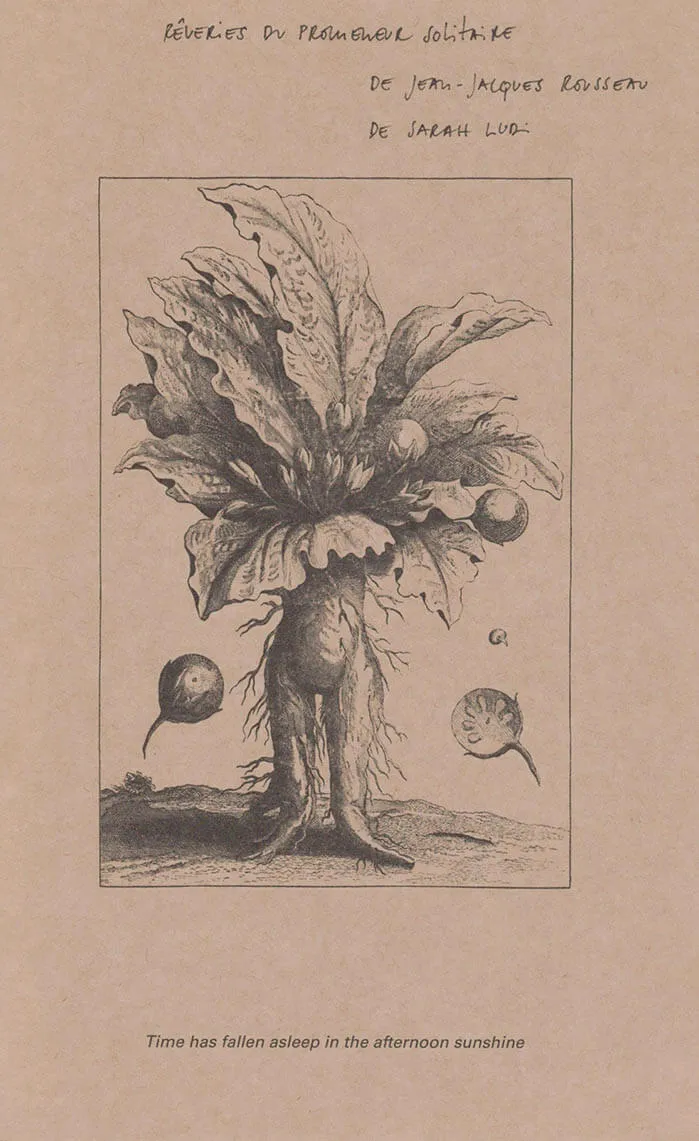
Time has fallen asleep in the afternoon sunshine

Verzamelde gedichten - Against the Forgetting

Bruno De Wachter

€12.00

For the project Time has fallen asleep in the afternoon sunshine a group of people/ performers memorize a book of their choice. Together they form a library collection consisting of living books. After years of learning by heart and reciting for readers, some of the books have now been written down from memory to create new editions, versions resulting from this process. This book is one of those books, chosen by one person, learned by heart and recited many times, and now written down again from memory. This edition is not a re-edition of the original text. It is a re-writing of the text after the process of reading, memorizing and reciting, with all the alterations that might have occured in the course of this process.

www.timehasfallenasleepintheafternoonsunshine.be

Language: English

recommendations

Cover of Appendix #3: Orality

Time has fallen asleep in the afternoon sunshine

Appendix #3: Orality

Victoria Pérez Royo, Léa Poiré and 1 more

Time has fallen asleep in the afternoon sunshine Appendix #3 Orality includes contributions by Simon Asencio, Bruno De Wachter, Peter Szendy, Clara Amaral, Itziar Okariz, Jude Joseph, Léa Poiré and Mette Edvardsen.

Time has The Appendixes #1–4 is an editorial series by Mette Edvardsen, Léa Poiré and Victoria Pérez Royo that developed out of the project Time has fallen asleep in the afternoon sunshine. For a two-year residency at Les Laboratoires d’Aubervilliers* (2022–23), they came together as a small work group, shaping the work process, hosting presentation formats and making this publication series on paper as four cahiers.

The cahiers comprise a collection of commissioned texts and contributions created for this context, selected documents and traces from work sessions and encounters organized during their residency, texts read together and republished for this occasion, a collection of references, notes in progress, unfinished thoughts and loose fragments – on paper, between pages.

The Appendixes are organized around four themes: (1) The gesture of writing, (2) How to organize a library, (3) Orality and (4) Translation. In addition to being published on paper, the editorial series also consisted of other formats of presentations, exchanges and meetings organized as workshops, fieldwork, performances, conferences, collective readings and oral publications, taking place during their residency at Les Laboratoires d’Aubervilliers and in the vicinity.

The Appendixes is the work that continues, material that adds on, some of it perhaps too long or too detailed, unfit or unfinished. The four themes that their research is formulated around originate in specific experiences and questions from the practices of Time has fallen asleep in the afternoon sunshine (2010 – ongoing), and also the large publication on the project ‘A book on reading, writing, memory and forgetting in a library of living books’ (2019). The research was both a means of exploring these themes in greater depth and also of bringing them into contact with other artists and researchers working on similar or related subjects. The Appendixes offered them both the contexts and the pretexts for things to happen (in time, in space, on paper).

The Appendixes #1–4, published in these cahiers, do not present an overview or a summary of all of the activities and presentations that took place during the two years at Les Laboratoires d’Aubervilliers. What these cahiers offer is a space in which to hold some thoughts together and to share them in this form. It is one more step along the way, extending the research and work already begun and that will now continue.

Cover of Een dag in 't jaar door Herman Gorter

Time has fallen asleep in the afternoon sunshine

Een dag in 't jaar door Herman Gorter

Johan Sonnenschein

For the project Time has fallen asleep in the afternoon sunshine a group of people/ performers memorize a book of their choice. Together they form a library collection consisting of living books. After years of learning by heart and reciting for readers, some of the books have now been written down from memory to create new editions, versions resulting from this process. This book is one of those books, chosen by one person, learned by heart and recited many times, and now written down again from memory. This edition is not a re-edition of the original text. It is a re-writing of the text after the process of reading, memorizing and reciting, with all the alterations that might have occured in the course of this process.

Cover of Appendix #1: The gesture of writing

Time has fallen asleep in the afternoon sunshine

Appendix #1: The gesture of writing

Victoria Pérez Royo, Léa Poiré and 1 more

Performance €15.00

The Appendixes #1-4 is an editorial series by Mette Edvardsen, Léa Poiré and Victoria Pérez Royo that came out of the project Time has fallen asleep in the afternoon sunshine. For a two-year residency at Les Laboratoires d'Aubervilliers (2022-23), they came together as a small work group, shaping the work process, hosting presentation formats and making the publication series on paper as four cahiers.

The cahiers comprise a collection of commissioned texts and contributions created for this context, selected documents and traces from work sessions and encounters organized during the residency, texts read together and republished for this occasion, a collection of references, notes in progress, unfinished thoughts and loose fragments - on paper, between pages.

p 5-7 Almost on my way to you
p 8-10 Presque en route vers toi
Laía Argüelles Folch

p 12-13 Exercise in translation of Breve ensayo sobre la carta (Brief essay on the letter) by Laía Argüelles Folch
p 14-15 Exercice de traduction de Breve ensayo sobre la carta (Bref essai sur la lettre) de Laía Argüelles Folch
Quim Pujol, Paula Caspão, Simon Asencio, Pascal Poyet, Mette Edvardsen, Léa Poiré, Victoria Pérez Royo & Laía Argüelles Folch

p 16-17 Like a dinosaur upon awakening
p 18-19 Comme un dinosaure au réveil
Pascal Poyet

p 20-23 Is she a translator?
p 24-27 Est-elle traductrice?
Olivia Fairweather

p 28-29 New edition revised by my author
p 30-31 Nouvelle édition revue par mon auteur
Léa Poiré

p 32 Notes from a translation in progress
p 33 Notes d'une traduction en cours
Kate Briggs

p 34-37 Mothers & tongues
p 38-41 Langues (maternelles)
Mette Edvardsen

p 42-43 Collective reading of Finnegans Wake by James Joyce
p 44-45 Lecture collective de Finnegans Wake de James Joyce
Dora García and readers, et les lecteur·rices

p 46-49 Notes for a talk that did not happen
p 50-53 Notes pour une conférence qui n'a pas eu lieu
Olivia Fairweather

p 54-65 Meticulous comparison of two books with their versions rewritten from memory, excerpts from a work document
Comparaison méticuleuse de deux livres avec leurs versions réécrites de mémoire, extraits d'un document de travail
Julián Pacomio & Ángela Millano

Cover of Ik ben Elias of het gevecht met de nachtegalen, door Maurice Gilliams

Time has fallen asleep in the afternoon sunshine

Ik ben Elias of het gevecht met de nachtegalen, door Maurice Gilliams

Wouter Krokaert

Performance €12.00

For the project Time has fallen asleep in the afternoon sunshine a group of people/ performers memorize a book of their choice. Together they form a library collection consisting of living books. After years of learning by heart and reciting for readers, some of the books have now been written down from memory to create new editions, versions resulting from this process. This book is one of those books, chosen by one person, learned by heart and recited many times, and now written down again from memory. This edition is not a re-edition of the original text. It is a re-writing of the text after the process of reading, memorizing and reciting, with all the alterations that might have occured in the course of this process.

Cover of Appendix #2 - How to organize a library

Time has fallen asleep in the afternoon sunshine

Appendix #2 - How to organize a library

Mette Edvardsen, Léa Poiré and 1 more

Performance €15.00

The Appendixes #1–4 is an editorial series by Mette Edvardsen, Léa Poiré and Victoria Pérez Royo that developed out of the project Time has fallen asleep in the afternoon sunshine. For a two-year residency at Les Laboratoires d’Aubervilliers* (2022–23), they came together as a small work group, shaping the work process, hosting presentation formats and making this publication series on paper as four cahiers.

The cahiers comprise a collection of commissioned texts and contributions created for this context, selected documents and traces from work sessions and encounters organized during their residency, texts read together and republished for this occasion, a collection of references, notes in progress, unfinished thoughts and loose fragments – on paper, between pages.

The Appendixes are organized around four themes: (1) The gesture of writing, (2) How to organize a library, (3) Orality and (4) Translation. In addition to being published on paper, the editorial series also consisted of other formats of presentations, exchanges and meetings organized as workshops, fieldwork, performances, conferences, collective readings and oral publications, taking place during their residency at Les Laboratoires d’Aubervilliers and in the vicinity.

Cover of For Chris Mann (Open Space Magazine #22)

Lingua Press

For Chris Mann (Open Space Magazine #22)

Dorota Czerner, Elaine Radoff Barkin

Special issue of this US magazine dedicated in its entirety to the late Australian artist/compositional linguist/raconteur Chris Mann, who died in 2018. The magazine contains tributes from Mann associates and admirers, including Warren Burt, Amanda Stewart, Pi-0, Ronald Robboy, Linda Kouvaras, Alvin Lucier, Ruark Lewis, Annea Lockwood, as well as Mann’s own writing and an interview with him by Philip Blackburn.

88 pages bound in soft-cover glossy colour cover by Brigid Burke.

Cover of PRESCRIPTIONS: A Collection for Many Evils of the Body and the Mind, Also for Witchcraft

Hildegard Press

PRESCRIPTIONS: A Collection for Many Evils of the Body and the Mind, Also for Witchcraft

Lyndl Hall

PRESCRIPTIONS is a transcription of a handwritten manuscript, dated to approximately 1650, containing a wide range of medicinal and magical remedies. Currently housed in the Cornell University Witchcraft Collection, it is assumed this practical handbook was a reference for healing, midwifery, and other medical/magical advice. Recipes and instruction cover various methods of purging, ointments for swellings, fevers, and pain reduction, lotions for venereal disease, advice for childbirth, and dilemmas such as “worms in the ear.” Accompanying these medicinal prescriptions are a series of magical prescriptions: charms, rituals, and spells recorded to fortify the ailing body, induce amorous desire, or seek revenge.

With its mix of Latin words, Early Modern English parlance, colloquial plant names, apothecary weights, and archaic medical terms, the recipes can at first appear opaque, but with sustained engagement one can begin to decipher the logics and structures within the writer(s)' shorthand. The original manuscript, in having its own detailed glossary, index, and citations, exhibits a meticulous cataloging of knowledge and resources, and reveals an earnest desire to hold onto the integrity and sanctity of the body in the face of 'many evils.'

The transcription is accompanied by a glossary of terms, an explanation of the various apothecary measurements used, and expanded citations of the medicinal/magical treatises that were abbreviated within the original text.

Cover of KAMERA CAHIER N° 10

Avarie Publishing

KAMERA CAHIER N° 10

Helga Fanderl

A special edition issue curated, designed and published by AVARIE, Paris and Labor Neunzehn, Berlin. It accompanies KAMERA SERIES, while it is an independent and valuable object to collect. The central idea that informs and directs the booklets’ montage is the interplay between the concepts of addition and subtraction. This is achieved by unveiling a missing image in the screening or an unreleased second from an artist's film, expanded to 24 pages. Additionally, each booklet contains a piece directly removed from the show.

The editing establishes a dialogue between film frames and performed writings derived from texts, scripts, storyboards, and notes. The KAMERA exhibition is consequently extended into a physical space—the book—allowing for its widespread dissemination, complementing and contrasting with its potential online occurrence.

KAMERA SERIES is a screening program of experimental films, video art works and printed matter taking place in a former GDR building in Berlin. Each event showcases a retrospective of selected films by an artist and a small exhibition of his/her publications or works on paper over a span of 4 days.

KAMERA centers on fostering a critical dialogue between different film formats and artists’ books. Through its regular occurrence, it aspires to create a space for community exchanges about contemporary image-making. KAMERA is a series conceived and curated by Labor Neunzehn and AVARIE.

Fascinated by the intersection of visual art and cinema, Helga Fanderl’s short poetic films evoke intense and sensitive experiences of the real world. Using a small hand-held super 8 camera, she creates filmic responses to her perceptions, weaving together imagery and emotions in dense, rhythmic patterns solely through in-camera editing. She presents silent films in the form of ‘compositions’, crafting unique programs for site-specific personal projections and transforming spaces into temporary cinemas.