rile*books

Search books

Search books by title, author, publisher, keywords...

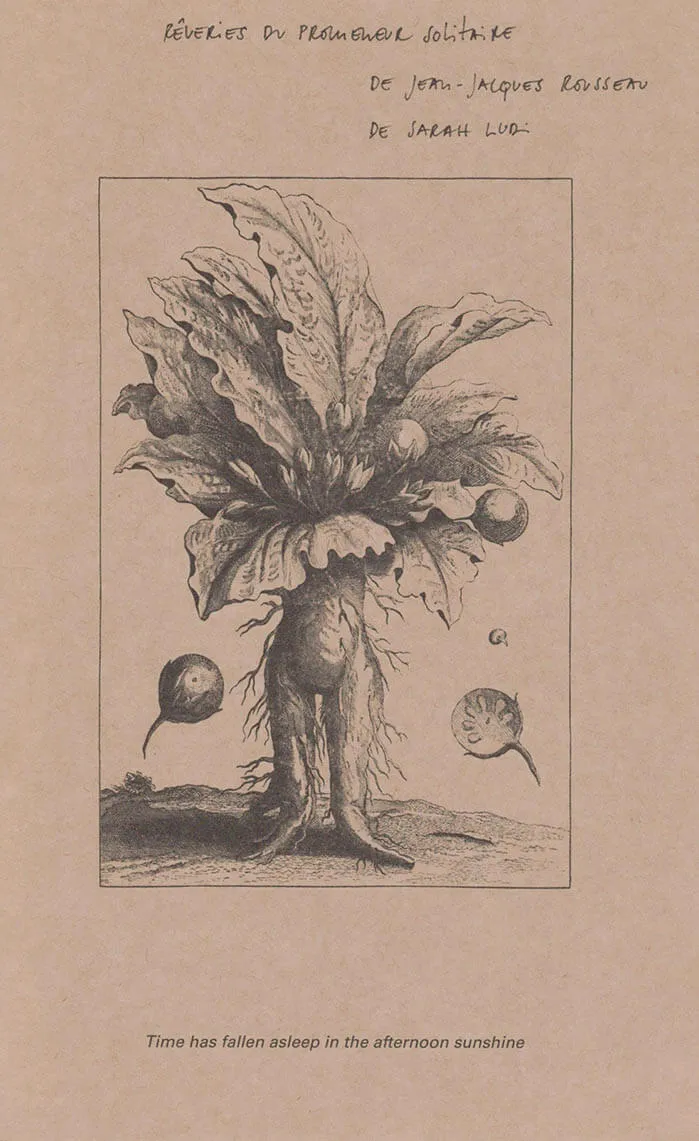
Cover of Rêveries du promeneur solitaire

Time has fallen asleep in the afternoon sunshine

Rêveries du promeneur solitaire

Sarah Ludi

€12.00

For the project Time has fallen asleep in the afternoon sunshine a group of people/ performers memorize a book of their choice. Together they form a library collection consisting of living books. After years of learning by heart and reciting for readers, some of the books have now been written down from memory to create new editions, versions resulting from this process. This book is one of those books, chosen by one person, learned by heart and recited many times, and now written down again from memory. This edition is not a re-edition of the original text. It is a re-writing of the text after the process of reading, memorizing and reciting, with all the alterations that might have occured in the course of this process.

Language: English

recommendations

Cover of Een dag in 't jaar door Herman Gorter

Time has fallen asleep in the afternoon sunshine

Een dag in 't jaar door Herman Gorter

Johan Sonnenschein

For the project Time has fallen asleep in the afternoon sunshine a group of people/ performers memorize a book of their choice. Together they form a library collection consisting of living books. After years of learning by heart and reciting for readers, some of the books have now been written down from memory to create new editions, versions resulting from this process. This book is one of those books, chosen by one person, learned by heart and recited many times, and now written down again from memory. This edition is not a re-edition of the original text. It is a re-writing of the text after the process of reading, memorizing and reciting, with all the alterations that might have occured in the course of this process.

Cover of Ik ben Elias of het gevecht met de nachtegalen, door Maurice Gilliams

Time has fallen asleep in the afternoon sunshine

Ik ben Elias of het gevecht met de nachtegalen, door Maurice Gilliams

Wouter Krokaert

Performance €12.00

For the project Time has fallen asleep in the afternoon sunshine a group of people/ performers memorize a book of their choice. Together they form a library collection consisting of living books. After years of learning by heart and reciting for readers, some of the books have now been written down from memory to create new editions, versions resulting from this process. This book is one of those books, chosen by one person, learned by heart and recited many times, and now written down again from memory. This edition is not a re-edition of the original text. It is a re-writing of the text after the process of reading, memorizing and reciting, with all the alterations that might have occured in the course of this process.

Cover of I am Four Quartets by T.S Elliot

Time has fallen asleep in the afternoon sunshine

I am Four Quartets by T.S Elliot

Sébastian Hendrickx

For the project Time has fallen asleep in the afternoon sunshine a group of people/ performers memorize a book of their choice. Together they form a library collection consisting of living books. After years of learning by heart and reciting for readers, some of the books have now been written down from memory to create new editions, versions resulting from this process. This book is one of those books, chosen by one person, learned by heart and recited many times, and now written down again from memory. This edition is not a re-edition of the original text. It is a re-writing of the text after the process of reading, memorizing and reciting, with all the alterations that might have occured in the course of this process.

www.timehasfallenasleepintheafternoonsunshine.be

Cover of Appendix #4: Translation / Traduction

Time has fallen asleep in the afternoon sunshine

Appendix #4: Translation / Traduction

Victoria Pérez Royo, Léa Poiré and 1 more

Performance €15.00

The Appendixes #1-4 is an editorial series by Mette Edvardsen, Léa Poiré and Victoria Pérez Royo that came out of the project Time has fallen asleep in the afternoon sunshine. For a two-year residency at Les Laboratoires d'Aubervilliers (2022-23), they came together as a small work group, shaping the work process, hosting presentation formats and making the publication series on paper as four cahiers.

The cahiers comprise a collection of commissioned texts and contributions created for this context, selected documents and traces from work sessions and encounters organized during the residency, texts read together and republished for this occasion, a collection of references, notes in progress, unfinished thoughts and loose fragments - on paper, between pages.

Cover of Seltsame Sterne starren zur Erde

Time has fallen asleep in the afternoon sunshine

Seltsame Sterne starren zur Erde

Sonia Si Ahmed

For the project Time has fallen asleep in the afternoon sunshine a group of people/ performers memorize a book of their choice. Together they form a library collection consisting of living books. After years of learning by heart and reciting for readers, some of the books have now been written down from memory to create new editions, versions resulting from this process. This book is one of those books, chosen by one person, learned by heart and recited many times, and now written down again from memory. This edition is not a re-edition of the original text. It is a re-writing of the text after the process of reading, memorizing and reciting, with all the alterations that might have occured in the course of this process.

Cover of DRINK DEEPLY AND DREAM

Killer Dentist

DRINK DEEPLY AND DREAM

Elspeth Walker

Drink Deeply and Dream by Elspeth Walker is an ethereal, offbeat short story about wannabe vampires with a Marxist bent and their search for salvation from capitalism via eternal bloodlust.

Paperback, Staple Bound and Offset Printed

Cover of Pasts, Futures, and Aftermaths: Revisiting the Black Dada Reader

DABA

Pasts, Futures, and Aftermaths: Revisiting the Black Dada Reader

Adam Pendleton

Essays €40.00

The sequel to Pendleton's acclaimed Black Dada Reader, compiling an anti-canon of radical experimentation and thought.

In 2011, artist Adam Pendleton (born 1984) assembled Black Dada Reader, a compendium of texts, documents and positions that elucidated a practice and ethos of Black Dada. Resembling a school course reader, the book was a spiral-bound series of photocopies and collages, originally intended only for personal reference, and eventually distributed informally to friends and colleagues. The contents - an unlikely mix of Hugo Ball, W.E.B. Du Bois, Adrian Piper, Gertrude Stein, Sun Ra, Stokely Carmichael, Gilles Deleuze -formed a kind of experimental canon, realized through what Pendleton calls radical juxtaposition. In 2017, Koenig Books published the Reader in a hardcover edition, with newly commissioned essays and additional writings by the artist. A decade later, Pendleton has composed another reader, building upon the constellation of writers, artists, filmmakers, philosophers and critics that emerged in the first volume.

Source texts by Sara Ahmed, Mikhail Bakhtin, Toni Cade Bambara, Amiri Baraka, Augusto de Campos, Hardoldo de Campos, and Décio Pignatari, Angela Davis, Gilles Deleuze, Julius Eastman, Adrienne Edwards, Clarice Lispector, Achille Mbembe, Philippe-Alain Michaud, Charles Mingus, Piet Mondrian, Leslie Scalapino, Leonard Schwartz and Michael Hardt, Juliana Spahr, Cecil Taylor and Malcolm X.

Cover of 24 European Ethnographic Museums

Roma Publications

24 European Ethnographic Museums

Sara Sejin Chang

With the series '24 European Ethnographic Museums' Van der Heide questions the construction and identity of the ethnographic museum today. Here, the project becomes a collection of artefacts in and upon itself and by recording the names of these institutions Van der Heide places the viewer in front of the dilemma: who is authorized to decide what is an artefact, and what should be collected and for what reason? In the 19th century, with the birth of the current European nations, museums openly referred to their colonial past. Today the museums bare more euphemistic names like: ‘Museum der Kulturen’ or ‘World Museum’ but still place the West as the self-acclaimed center of the world.  The existence of the ethnographic museum, which is intertwined with the complicated and loaded colonial past, has been subject to contemporary criticism. While some of the European ethnographic institutions have attempted to come to terms with the past of their collections and their heritage, Van der Heide focuses upon how language continues to reflect the political present of the institutions.