rile*books

Search books

Search books by title, author, publisher, keywords...

Cover of Girls Like Us #2 — Issue 2

Girls Like Us

Girls Like Us #2 — Issue 2

Marnie Slater ed., Katja Mater ed., Sara Kaaman ed., Jessica Geysel ed.

€8.00

The second issue of the Amsterdam lesbian arts quarterly with newly appointed co-editor Vela Arbutina at the helm.

Features include Vava Dudu and Theo Mercier, Tavi Gevinson and Diane Pernet, Keren Cytter and Dafna Maimon, Lauren Flax and Lauren Dillard, Kaisa Lassinaro, Matthew Lutz-Kinoy, Leilah Weinraub, Benjamin A. Huseby, Eline McGeorge, Janis Pönisch, Anie Stanley, Andrea Ferrer, Devrim Bayar.

Language: English

recommendations

Cover of Girls Like Us #6 - Secrets

Girls Like Us

Girls Like Us #6 - Secrets

Jessica Geysel, Sara Kaaman and 2 more

A secret can be a private space for self-creation – or a shared site of pleasure.

We explore secrets in a plethora of forms and contexts. From layered accounts of mediaeval ecstasy to the unexplored sensory experience of smell. From camouflaged play to queer readings of astrological charts and the hidden history of house music. From a very analog point of view to the outskirts of the internet.

Cover of A Book Knot Book

Body Text

A Book Knot Book

Sara Kaaman

A Book Knot Book is a 208 pages long performance, the first from the research and publishing initiative Body Text. In this study of language in action systems of meaning-making crash, sparkle and swoon. In a playful voice over A Book Knot Book self-reflects on the materialities and choreographies of publishing, reading and writing. With guest stars in fragments; Monique Wittig, Yvonne Rainer, Cristina Rivera Garza, Amiri Baraka, Will Rawls, David Abram, Thich Nhat Hanh and more. 

Edited and designed by Sara Kaaman. Published with the support of Stockholm University of the Arts.

Cover of Natural Enemies Of Books: A Messy History Of Women In Printing And Typography

Occasional Papers

Natural Enemies Of Books: A Messy History Of Women In Printing And Typography

Sara Kaaman, Maryam Fanni and 1 more

Natural Enemies of Books is a response to the groundbreaking 1937 publication 'Bookmaking on the Distaff Side', which brought together contributions by women printers, illustrators, authors, typographers, and typesetters, highlighting the print industry’s inequalities and proposing a takeover of the history of the book. Edited by feminist graphic design collective MMS, the publication includes newly commissioned essays and poems, conversations with former typesetters Inger Humlesjö, Ingegärd Waaranperä, Gail Cartmail, and Megan Downey, and reprints of the original book and other publications.

Cover of Fous Moi La Paix

Goswell Road

Fous Moi La Paix

Vava Dudu

Goswell Road presents Fous Moi La Paix a book of drawings by multidisciplinary artist Vava Dudu. Vava made 37 exclusive drawings for the publication, which launched at Paris Ass Book Fair 2024 at Palais de Tokyo. The drawings are offset with her texts, poems and several images of her iconic clothing and accessories.

"The multidisciplinary artist Vava Dudu refuses to follow convention: she draws and writes poetry, makes clothes and accessories, and builds furniture and guitars. She asserts her position as an outsider in contemporary art by stating that she “prefers extremes to the middle ground.” Her work as an independent stylist goes hand in hand with her activity as a singer in La Chatte, an electro-zouk punk new wave band founded in 2013 with Stéphane Argillet and Nicolas Jorio, aka “Nikolu.” Her underground artistic world, which joyously combines text and image, is expressed through various media.

Vava Dudu was born in 1970 in Paris, where she lives and works."

Text from Lafayette Anticipations website

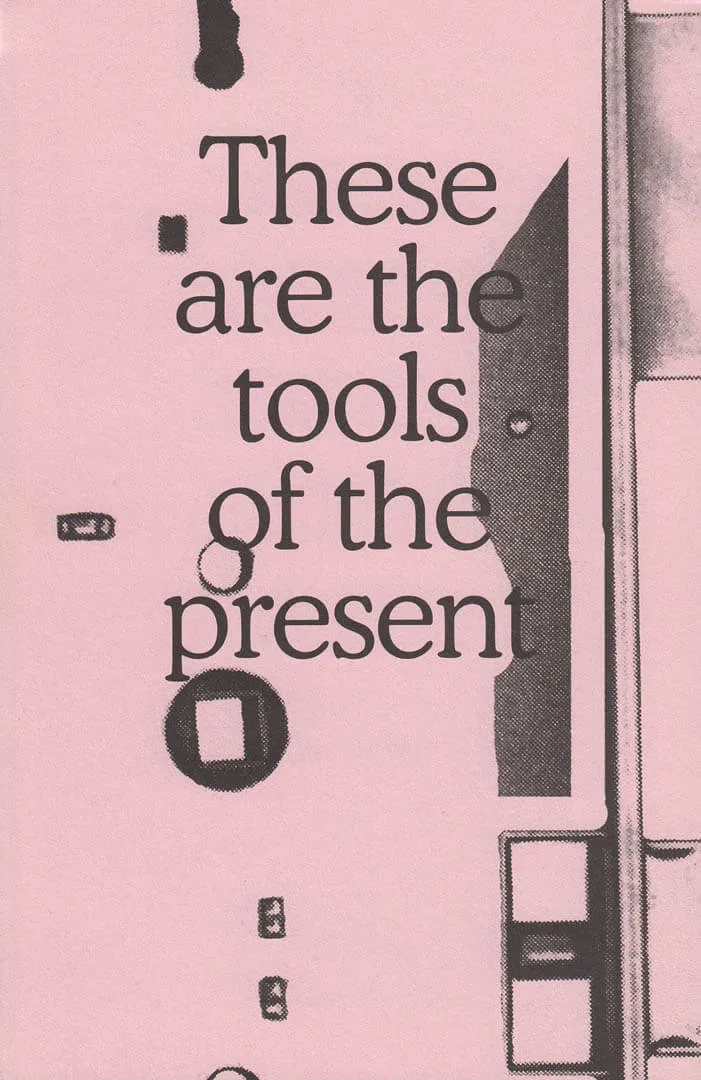
Cover of These are the tools of the present

Mophradat

These are the tools of the present

Mai Abu ElDahab, November Paynter and 1 more

This publication comprises a series of interviews with contemporary artists, musicians, and writers who are in dialogue with Beirut and Cairo. While not purporting to be an overview of the art scenes in these cities, this book begins to draw a picture of how artists think about what it means to be active in the contexts of these cities. It offers insight into the circumstances that structured these artists’ stories, and the often accidental influences that have shaped how their practices have developed.

Cover of Barking Up the Wrong Tree

How To Become

Barking Up the Wrong Tree

Sophie T. Lvoff

Poetry €6.00

How To Become est une maison d'édition autogérée basée à Paris. Nous publions les textes d'auteuces engagés dans des pratiques féministes et peu diffusés par le réseau des grandes maisons d'édition françaises.

Créée en 2016, elle est composée d'artistes et écrivaires en majorité gouines, HTB publie de la litterature expérimentale née d'influences post-post- sapphiques ainsi qu'un choix de tradu d'auteuices non traduites en langue française. HTB s'articule autour d'ateliers d'écriture: How to Become a Lesbian, et d'une revue annuelle publiant les choses issues de l'atelier.

Cover of Love in a F*cked-Up World

Algonquin Books

Love in a F*cked-Up World

Dean Spade

LGBTQI+ €20.00

Around the globe, people are faced with a spiraling succession of crises, from the pandemic and climate change-induced disasters to the ongoing horrors of mass incarceration, racist policing, endemic gender violence, and severe wealth inequality. Many of us feel mobilized to organize and collectively combat these issues on both a personal and political level, often dedicating our lives to the forwarding of progressive ideas and the daunting goal of trying to bend the world toward justice.

But even those of us who long for change seem to have trouble when it comes to interpersonal relationships. Too often we think of our political values as outward-facing positions again dominant systems of power. Rarely, if ever, do we pursue the same kind of justice close to home, in our personal connections. Many activist projects and resistance groups fall apart because people treat each other poorly, trying desperately to live out the cultural myths about dating and relationships that we are fed from an early age.

How do we divest from the idea that one romantic partner will be the solution to all our problems? How do we separate our expectations of love from the troubling dynamics left to us by our parents? How do we bring our best thinking about freedom and justice into step with our desires for healing and connection?

Lifelong activist and educator Dean Spade dares us to decide that our interpersonal actions are not separate from our politics of liberation and resistance. Love in a F*cked-Up World is a resounding call to action and a practical manifesto for how to combat cultural scripts and take our relationships into our own hands, preparing us for the work of changing the world.

Cover of Issue #52/53 - Sovereign Movements

Movement Research Performance Journal

Issue #52/53 - Sovereign Movements

Moriah Evans

Periodicals €10.00

Movement Research announces Issue 52/53 of its print publication, the Movement Research Performance Journal. For this issue, Sovereign Movements: Native Dance and Performance, guest editor, choreographer Rosy Simas invited writer, Ahimsa Timoteo Bodhrán, to work with her. Together they assembled contributors from Native and Indigenous communities to reflect upon their practices, the historical conditions out of which they operate as well as movement, performance, and choreography as a socio-political project. Just as it is important for physical institutions to acknowledge that they sit upon occupied land of Native and Indigenous people, so too must institutions of history, practice, and epistemology acknowledge their occupation of knowledge and memory.

Throughout this issue, dance and movement is posited as a powerful strategy against settler-colonial mindsets and as an effective tool against erasure of Native and Indigenous cultural traditions. These pages discuss the importance of Native sovereignty and analyze various histories of resistance to settler-colonialism. Artists in the issue propose alternative artistic models to probe the roles of art and artists in society towards a more expansive constellation that fundamentally critiques the Western reward system in culture as well as the often celebrated cult of authorship.