rile*books

Search books

Search books by title, author, publisher, keywords...

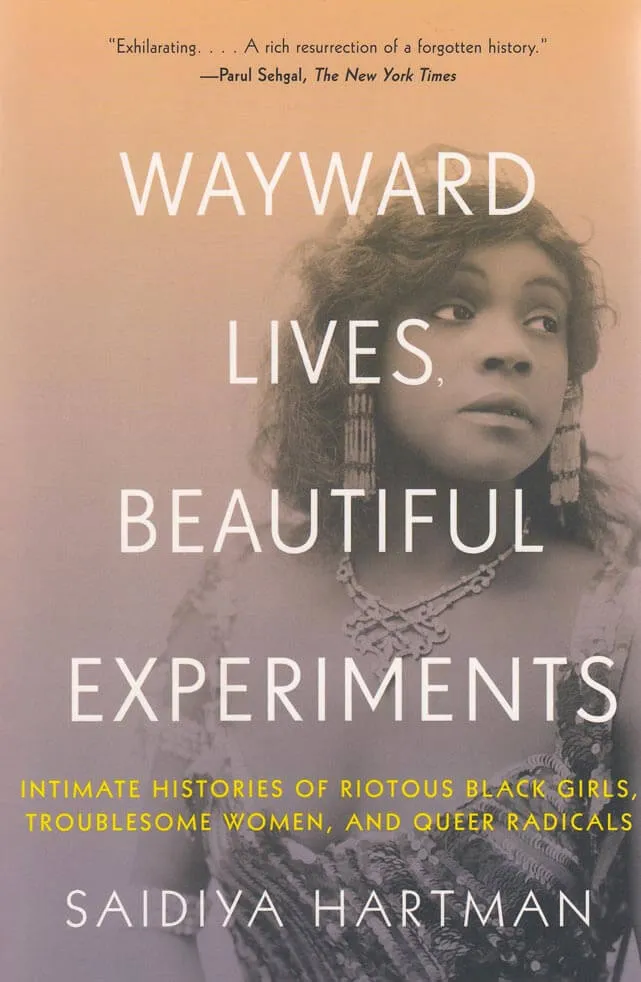
Cover of Wayward Lives, Beautiful Experiments

W. W. Norton & Company

Wayward Lives, Beautiful Experiments

Saidiya Hartman

€20.00

Wayward Lives, Beautiful Experiments examines the revolution of black intimate life that unfolded in Philadelphia and New York at the beginning of the twentieth century. In wrestling with the question of what a free life is, many young black women created forms of intimacy and kinship indifferent to the dictates of respectability and outside the bounds of law. They cleaved to and cast off lovers, exchanged sex to subsist, and revised the meaning of marriage. Longing and desire fueled their experiments in how to live. They refused to labor like slaves or to accept degrading conditions of work. Here, for the first time, these women are credited with shaping a cultural movement that transformed the urban landscape. Through a melding of history and literary imagination, Wayward Lives, Beautiful Experiments recovers these women's radical aspirations and insurgent desires.

Published in 2026 ┊ Language: English

recommendations

Cover of À perte de mère – Sur les routes atlantiques de l'esclavage

Brook

À perte de mère – Sur les routes atlantiques de l'esclavage

Saidiya Hartman

Saidiya Hartman traces the history of the Atlantic slave trade by recounting a journey she took along a slave route in Ghana. Following the trail of captives from the hinterland to the Atlantic coast, she reckons with the blank slate of her own genealogy and vividly dramatizes the effects of slavery on three centuries of African and African American history.

Saidiya Hartman, professor of English and comparative literature at Columbia University, is a scholar of African American literature and cultural history.

Preface by Maboula Soumahoro.

Translated from the English (American) by Maboula Soumahoro (original title: Lose Your Mother. A Journey Along The Atlantic Slave Route, Farrar, Straus and Giroux, 2007).

Cover of Diversity of Aesthetics

Common Notions

Diversity of Aesthetics

Jose Rosales, Andreas Petrossiants

Critical conversations and reflections about lessons learned at the intersection of social movements and artist production. 

Diversity of Aesthetics collects powerful and timely conversations among leading cultural critics, artists, and organizers to connect the threads between some of the most pressing social struggles and conflicts of our time: policing, war, borders and migration, economic crisis. 

Across three themes—infrastructure, migration, and riots—militant thinkers, artists, educators, and others discuss aesthetic production, forms of social organization, modes of struggle against gendered and racialized capitalism, and revolutionary theory. Common to all three conversations is a commitment to rethinking the relationship between forms of critique and forms of struggle undertaken by collective social practices, offering lessons for tactics, strategies, and practices.

With contributions by Claire Fontaine, Iman Ganji, Saidiya Hartman, Vicky Osterweil, Andreas Petrossiants, Christina Sharpe, Stevphen Shukaitis, Michael Rakowtiz, Shellyne Rodriguez, Jose Rosales, Rinaldo Walcott, Andreas Petrossiants, Jose Rosales

Andreas Petrossiants is a writer and associate editor of e-flux journal. His work has appeared in Historical Materialism, Social Text, New Inquiry, AJ+ Subtext, Frieze, Bookforum.com, Roar Magazine, the Verso blog, the Brooklyn Rail, Hyperallergic. He is a PhD candidate in performance studies at NYU where he is researching anti-eviction, squatting, and tenants’ movements as they relate to the production of social space.

Jose Rosales is an independent researcher and journalist based in Lisbon, Portugal. His work has appeared in e-flux notes, Lumpen: A Journal of Poor and Working Class Writers, and has contributed a chapter called “Communism As the Riddle Posed to History” in Double Binds of Neoliberalism (2022).
Cover of The Queer Arab Glossary

Saqi Books

The Queer Arab Glossary

Marwan Kaabour

LGBTQI+ €23.00

When conventional language does not equip us with the tools to speak about ourselves, we create our own. Slang expresses words and feelings that break down boundaries. It is a form of protest and fills in the gaps.

The Queer Arab Glossary is the first published collection of Arabic LGBTQ+ slang. This bold guide captures the lexicon of the queer Arab community in all its differences, quirks and felicities. Featuring fascinating facts and anecdotes, it contains more than 300 terms in both English and Arabic, ranging from the humorous to the harrowing, serious to tongue-in-cheek, pejorative to endearing. Here, leading queer Arab artists, academics, activists and writers offer insightful essays situating this groundbreaking glossary in a modern social and political context.

With beautiful, witty illustrations, The Queer Arab Glossary is a powerful response to pervasive myths and stereotypes around sexuality and an invitation to take a journey into queerness throughout the Arab world.

Contributors include Saqer Almarri, Nisrine Chaer, Sophie Chamas, Rana Issa, Adam HajYahia, Suneela Mubayi, Mejdulene Bernard Shomali, Hamed Sinno and Abdellah Taïa.

The Queer Arab Glossary was made possible with the generous support of the Arab Fund for Arts and Culture – AFAC, Mophradat, Bashar Assaf and Mohammed Fakhro.

Foreword by Rabih Alameddine

Cover of Brutalism

Duke University Press

Brutalism

Achille Mbembe

In Brutalism, eminent social and critical theorist Achille Mbembe invokes the architectural aesthetic of brutalism to describe our moment, caught up in the pathos of demolition and production on a planetary scale.

Just as brutalist architecture creates an affect of overwhelming weight and destruction, Mbembe contends that contemporary capitalism crushes and dominates all spheres of existence. In our digital, technologically focused era, capitalism has produced a becoming-artificial of humanity and the becoming-human of machines. This blurring of the natural and artificial presents a planetary existential threat in which contemporary society’s goal is to precipitate the mutation of the human species into a condition that is at once plastic and synthetic.

Mbembe argues that Afro-diasporic thought presents the only solution for breaking the totalizing logic of contemporary capitalism: repairing that which is broken, developing a new planetary consciousness, and reforming a community of humans in solidarity with all living things.

Cover of All That Beauty

Letter Machine Editions

All That Beauty

Fred Moten

Poetry €20.00

A pathbreaking new volume of poems from Fred Moten, All That Beauty combine's Moten's penchant for lyrical prosody, radical thought, and African American theory to produce writing unlike any other poetry in the world: "What is it to reside without settling? Is that is or is that ain't like being stuck in sweetness, held in life?"

"The line between Fred Moten’s theory and poetry is increasingly cloudy; the distinction almost seems (but isn’t quite) irrelevant. In All That Beauty, his new poetry collection, the poems come closer than ever before to the capacious, disorienting density of his prose writing: not just for their hairpin turns of speculative reasoning, or even their gleeful embrace of specialized academic terminology, but because they are strewn with names, citations and allusions that situate the text in a range of discourses – from Black studies to sound studies to the philosophy of maths." —Steven Zultanski

(Published 2019.)

Cover of The My Comrade Anthology

Boo-Hooray

The My Comrade Anthology

Linda Simpson

Periodicals €30.00

The My Comrade Anthology collects pages from past issues of My Comrade selected by Linda Simpson, printed in a substantial 256-page volume on newsprint.

My Comrade was an underground gay culture zine that set itself apart from the deluge of Xeroxed zines popping up in New York in the late 1980s and early 1990s. Through parody of both mainstream tabloid magazines and the self-serious gay press, a campy and ironic sensibility, and radical left sympathies and sloganeering, My Comrade captured the zeitgeist of the gay downtown scene. Publishing 11 issues between 1987 and 1994, and three issues since, My Comrade documents the last years of underground gay culture before marriage equality and representation at elite levels of American society became the primary drivers of gay politics and aesthetic production. My Comrade was briefly revived from 2004 to 2006, and again on the occasion of the exhibition “My Comrade Magazine: Happy 35th Gay Anniversary” at Howl! in 2022.

Cover of Unsex Me Here

Nightboat Books

Unsex Me Here

Aurora Mattia

Fiction €19.00

If Aurora Mattia is a switchboard operator, then Unsex Me Here is her call log. Please hold. There’s someone on the other line. A spider, a sibyl, an angel, a mermaid, a goddess, or an ex-girlfriend.

Unsex Me Here is a prayer book tied together by the strings of a corset. Glamorous ramblers, haunted by the sense of another world drawing near, wander in and out of its inexplicable twilight. From a West Texas town with a supernatural past to a stalactite cavern in the birthplace of Aphrodite, from hotel rooms to gardens to the far horizon of a thought, they seek the source of the disturbance in their minds. Heartbreak is not so far from rapture; holy babble is another kind of gossip. Every pilgrimage is as dense with symbolism as it is refined by desire.