Books
Books
published in 2024

hello, world?
Abandoned by their Dutch partner after giving up their home and their job to follow him to the Netherlands, humanities scholar Seasonal finds themself single in a strange place for the first time in a decade.
Dipping into the rabbit hole of digital eroticism, Seasonal soon meets László, a male sub who volleys back their cerebral sexts and is seeking a dominant guide. His dating-app profile—a photo of Foucault and the ingenuous greeting “Hello, World?”—thinly veils his desire to be annihilated. It's a desire that Seasonal senses they can fulfill. But to do this means crossing the frightening gap between their desires and capacities.
Seasonal and László embark on an experiment in remaking intimacy outside the Republic of Gender. But as it continues, the two realize they are staging separate confrontations with domination: Seasonal finds they must confront their own relation to the violence and anger that marked their upbringing in working-class, small-town Australia, while László stages his own confrontation with his decision to leave Viktor Orbán’s Hungary. As they attempt to improvise a theater of domination that opens up possibilities of reciprocity, the energies of their sexuality stalk this collaboration, threatening to give them exactly what they bargained or begged for.
A feminist paean to perversity in the tradition of Pauline Réage’s Story of O and Anaïs Nin's Delta of Venus, Anna Poletti's hello, world? dares to fully inhabit female power, and to fully face the violence, beauty, and uncharted territories of human sexuality.

Solidaires!!!
Solidaires est un syndicat de lutte et de transformation sociale qui défend les travailleuses et travailleurs de France.
Cet ouvrage réunit une sélection de plus de 70 visuels créés par la graphiste Anaïs Enjalbert et des militant·e·s pour l'Union syndicale Solidaires.
Ce livre est une archive sélective de visuels dont les slogans accompagnent des valeurs et des pratiques émancipatrices allant du féminisme à l’antiracisme, de l’internationalisme à l’anti fascisme, de la lutte contre les lgbtphobies à celle contre le validisme. Ils soutiennent la lutte contre le capitalisme et pour les services publics.
Format 14 x 19,5 cm
Conception graphique: Magali Brueder

Journal for Aesthetics & Protest Leipzig
Promiscuous Infrastructures, practicing care
The Promiscuous, Renée Turner and 3 more
How do we care for each other in our living, learning and working lives? The manual Promiscuous Infrastructures Practicing Care calls for an ethics of care and attentiveness to one another, re-imagines the making and the use of infrastructures, and situates care within a genealogy of artistic and social practice.
Promiscuous Infrastructures brings together more than twenty contributors - art and social practitioners, researchers, and educators - including the twelve core members of the Promiscuous Care Study Group, who have been researching and writing about caring infrastructures and promiscuous care for several years. This project takes seriously the urgent need to imagine diverse infrastructures of care at every scale of planetary existence. The resulting interdisciplinary publication comprises essays, visual schematics and scores, personal letters, recipes, and conversations, which emerge from the work of the study group, situated around the Willem de Kooning Academy in Rotterdam.
In society at large, the adjective “promiscuous” is commonly understood as a derogatory term, but it originally referred to people or things that “mingled confusedly or indiscriminately.”
The promiscuity the title explores is defined by a clear and collective refusal of efficiency, and favors generosity, care, love, and attention. Together, the group and their interlocutors situate their own collective care practice within a genealogy of artistic and general social practice. Adopting the UK-based Care Collective’s understanding of promiscuous, which aims toward multiplying and experimenting with caring practices beyond the shriveled forms that prevail today, Promiscuous Infrastructures addresses the following themes: institutional change, communal responsibility and accountability practices, mental health and collective care, hospitality and hosting, soil, counter-histories, intergenerational learning, joy and collective grief, and the poetics of imagining otherwise. These themes nurture a practice of multiplying and experimenting in diverse and expansive ways.
In this publication being promiscuous means taking agency within and beyond the shared context of structurally dispassionate cultural and educational institutions that require innovation, expediency, and measurable results above all.
Contributors: Carla Arcos, Jacquill Basdew, Selma Bellal, Seecum Cheung, Cooking Something Up, Yoeri Guépin, Marc Herbst, Czar Kristoff P., Pablo Lerma, Judith Leijdekkers, Carmen José, Edwin Mingard, Skye Maule-O’Brien, Lola Olufemi, Laurence Rassel, Vivian Sky Rehberg, Reading Room Rotterdam, Kari Robertson, Yusser al Obaidi, Michelle Teran, Renée Turner, and Julia Wilhelm.

MsHeresies 6 — A Manager
MsHeresies 6 publishes an edited chapter from Caren Beilin’s forthcoming novel Sea, Poison (New Directions, 2025). It is typeset together with reworked material from the archive of the Neapolitan feminist artist collective Le Nemesiache, active between 1969 and 1995.

Drafts
A weaving draft is a kind of notation for planning and sharing woven textil structures. The threading, along the top, shows how the warp is threaded through the heddles and frames; the treadling, along the right-hand side, show the order in which the treadles of the loom are to be pressed; and the tie-up, in the upper right-hand corner, shows how each treadle interacts with the loom’ frames. The drawdown, in the lower left, shows whether the warp or weft will be on top at any particular intersection of threads—thereby providing a “preview” of the completed textile. Often a draft diagram will indicate the intended color of the warp and weft threads, and the drawdown will show the completed textile’s color patterns. In “Drafts,” Allison uses letters instead of colors, melding digital weaving with writing.
WITHOUT THE E is a series of pamphlets responding to a presence or an absence felt in contemporary digital culture.

addictive no an adjective
A text on speaking, listening and being understood made in conversation with iOS speech-to-text software.

Ezio Gribaudo - The Weight of the Concrete
Lilou Vidal, Tom Engels and 1 more
The Weight of the Concrete explores the legacy of the Turinese artist and publisher Ezio Gribaudo (1929–2022), examining his multifaceted oeuvre at the confluence of image and language. This publication, named after Il Peso del Concreto (1968)—a seminal work that featured Gribaudo’s early graphic creations alongside an anthology of concrete poetry edited by the poet Adriano Spatola (1941–88)—places Gribaudo’s work in conversation with approximately forty artists and poets from different generations, all of whom similarly engage with explorations of text, form, and visual expression.
Reflecting the editorial premise of Il Peso del Concreto, The Weight of the Concrete revisits the influential anthology, including archive material that documents its production, and reimagines it, pairing Gribaudo’s graphic work with a new selection of historical and contemporary concrete and experimental poetry.
At the heart of the volume is Gribaudo’s emblematic Logogrifi series, developed from the 1960s onward. The Logogrifi reveal his deep engagement with the art of bookmaking and fascination with industrial printing processes, relief matrices, typefaces, and language games.
In this new edition, the editors take the opportunity to revisit Gribaudo’s pioneering work, examining previously overlooked dimensions—gendered, geographical, and technological—and exploring contemporary associations beyond the original context. The book also includes essays that elucidate the poetic and political interplay between image, language, and materiality.
This publication is released following Ezio Gribaudo – The Weight of the Concrete, an exhibition held at the Grazer Kunstverein in Graz, Austria (2023–24), and at the Museion—Museum of Modern and Contemporary Art in Bolzano-Bozen, Italy (2024).
Edited by Tom Engels and Lilou Vidal
Published by Axis Axis and Grazer Kunstverein
Contributions by Anni Albers, Mirella Bentivoglio, Tomaso Binga, Irma Blank, Al Cartio, Paula Claire, CAConrad, Natalie Czech, Betty Danon, Constance DeJong, Mirtha Dermisache, Johanna Drucker, Bryana Fritz, Ilse Garnier, Liliane Giraudon, Susan Howe, Alison Knowles, Katalin Ladik, Liliane Lijn, Hanne Lippard, Sara Magenheimer, Françoise Mairey, Nadia Marcus, Giulia Niccolai, Alice Notley, Ewa Partum, sadé powell, N. H. Pritchard, Cia Rinne, Neide Dias de Sá, Giovanna Sandri, Mary Ellen Solt, Alice Theobald, Colleen Thibaudeau, Patrizia Vicinelli, Pascal Vonlanthen, Hannah Weiner, and Ruth Wolf-Rehfeldt
Essays by Alex Balgiu, Tom Engels, Nadia Marcus, Luca Lo Pinto, Mónica de la Torre, and Lilou Vidal

Curtis Cuffie's New York City
Curtis Cuffie, Julie Peeters and 1 more
This publication coincides with Curtis Cuffie's New York City, an exhibition presenting Curtis Cuffie's work as captured in photographs by Katy Abel, Tom Warren, and Cuffie himself. Unlike the exhibition, this book exclusively features Cuffie's photographs. It is the eighth entry in a series of compact volumes featuring visual contributions, correspondence, responses, and conversations accompanying the Grazer Kunstverein exhibition program.
Curtis Cuffie (1955-2002) was an artist based in New York City's East Village. Originally from Hartsville, South Carolina, he moved to Brooklyn at the age of fifteen and eventually settled in Manhattan, first near Bryant Park and later around the Bowery where he lived unhoused for long stretches of his life. Cuffie was integral to a dynamic circle of artists and intellectuals, marking his place within New York's Black avant-garde.

Tot Zines #1
TOT ZINES collaborates with local artists in Antwerp, Belgium. Initiated by Sarah Stone in 2024, who invited digital creator Sarah Mayer to publish her set of paintings zing that she created in 2017. This is the first publication for TOT ZINES, RISO-printed by SO-RI in Antwerp.

Dreaming Water
Dreaming Water is the most thorough monograph dedicated to the work of Chilean artist Cecilia Vicuña to date. Vicuña coined the term “Arte Precario” in the mid-1960s as a new category for her works composed of debris and structures that disappear in the landscape, and which also include her quipus (“knot” in Quechua), envisioned as poems in space.
Dreaming Water brings together over 200 works—including paintings, drawings, screenprints, collages, textiles, videos, photographs, installations, poetry, artist books and performances—created throughout the artist’s remarkable career. It also features several stimulating texts—a lengthy epistolary piece by curator and editor Miguel A. López as well as new essays by anthropologist Elizabeth A. Povinelli, curator Catherine de Zegher and art historian José de Nordenflycht. Vicuña herself contributes two texts, reflecting on her drawings from the “Palabrarmas” project and the activism of the group Artists for Democracy, which she cofounded in 1974. A rousing conversation between Vicuña, anthropologist Marisol de la Cadena and curator Camila Marambio also figures in the book, blending the artist’s voice with those who are experts in fields pertinent to her practice.

Deer Book/Libro Venado
Inspired initially by Jerome Rothenberg’s translation Flower World Variations, which Cecilia Vicuña first encountered in 1985, Deer Book brings together nearly forty years of the artist’s poetry, “poethical” translations, and drawings related to cosmologies and mythologies surrounding the deer, and sacrificial dance in cultures around the world.
Woven like one of her quipu installations, Vicuña’s texts—which include original compositions in Spanish as well as English translations by Daniel Borzutzky—become meditations on translation, not just of the sacred nature of this animal but on how our understandings of ceremony and ritual are transformed, by this ongoing process. Taken as inspiration rather than conundrum, the impossibility of translation opens up poetic possibilities for Vicuña as she continues her lifelong exploration into the nature of communication across eras and distant lands, languages and shared symbols within Indigenous spiritualities.

BRICKS FROM THE KILN #7
Matthew Stuart, Harriet Moore and 1 more
Guest edited by artist Helen Marten and literary agent Harriet Moore with Matthew Stuart, this volume of the journal considers what it means for a publication to be an allegorical container. A simple box in which to gather multiple things, an economical set of permutations — rational in one sense, yet defiantly flexible to move. Contributors were approached with an open invitation; some explored the multiplicities of containing or containers, while others filled the printed vessel with their own ongoing preoccupations. The following pages perform as envelope, bag, shell, net, fold, alarm, letter and instruction. There are holes to disappear within; smoke to knot and wind; shadows to unfold — a context that takes in and binds, finding new kinships from unforeseen proximities.
THE FIRE FLOWERS AND THE FLOWER LIGHTS UP –
Lucy Mercer
(spine)
WE SHALL GREET THE MOON AGAIN
Walter Price
(front cover)
BACK PAGES OF ALGIERS DIARIES 2018
Lydia Ourahmane
(inside front & inside back cover)
AN INTRODUCTION TO / NOTES ON / INSTRUCTION FOR THE FRONT NOVEL
Eliza Barry Callahan
(pp.1–16)
SATURDAY MORNING
Kathryn Scanlan
(pp.25–29)
KILLDEER
Jason Schwartz
(pp.33–38)
ALARMS AND EXCURSIONS
Rosmarie Waldrop
(pp.45–61)
"THE BATHROOM"
Najwa Barakat
(pp.67–76)
ARMY ROLLS, A CIRCUMSCRIPTION
Roy Claire Potter
(pp.81–91)
CONCHOMANIA
Felix Bernstein
(pp.95–109)
O-POEM
Line-Gry Hørup
(pp.113–129)
THIS MUSCLE
Cally Spooner
(pp.133–153)
STERLING PARK IN THE DARK
Susan Howe
(pp.159–179)
COCONUTTERY
Mathelinda Nabugodi
(pp.183–193)
YOUR SELF CONFIDENT BABY
Aurelia Guo
(pp.197–206)
BIOGRAPHY OF A NET: HOLDING A VOLUME
Daisy Hildyard
(pp.211–225)
A GUIDE TO THE POETRY OF LI HO
Eliot Weinberger
(pp.229–235)
WOMEN SMOKING
Charline von Heyl
(throughout & p.239)
INFRATHIN
Marcel Duchamp
(throughout & p.239)
THE MAZED WORLD
Rachael Allen
(bookmark insert)
UNTITLED
Helen Marten
(back cover)

Prepositions
Prepositions enacts a distinction between what language says and what it does. A catalogue of exercises, interviews, essays and creative explorations, this workbook-compendium invites the reader to investigate how we practise empathy, understanding, and contact, by learning and teaching all at once. Building on the archive of Montez Press Radio show Tongue and Cheek, and featuring work from a stellar cast of previous participants in the broader project, Prepositions asks us what active and embodied participation really means, not just in teaching, but across a whole life.
This book will change your body—and your mind. Prepositions is a set of bite-sized propositions for being and thinking otherwise. Put it under your tongue and see what happens.
— Leah Pires
This compendium of witty exercises, moving personal reflections, curious propositions, and carefully selected graphics invites readers to explore what it means to inhabit a book. It is the product of many hands, a polyphonic choir, filled with immense care and a deep sense of friendship. As one feels its weight, moves around it, folds its pages, breaths with it, or reads it out aloud, one begins to wonder: what does the book need to be completed?
Prepositions—inscribed in the tradition of works as disparate as Robert Filliou’s Teaching and Learning as Performing Arts and CAConrad’s poetry rituals—is an exercise of radical pedagogy and readership. Everyone who enters this book becomes part of its contents.
— Alice Centamore

Headwaters And Other Short Fictions
Compiling works from nearly five decades, Headwaters (and Other Short Fictions) provides the first comprehensive overview of the narrative and experimental writing of Lucy R. Lippard. While she is best known for her pioneering work as an art writer and activist, Lippard’s fiction helps frame her broader impact on contemporary culture.
Headwaters anthologizes over fifty short works, many previously unpublished. These often experimental vignettes showcase the range of her literary voice while also challenging our understanding of her oeuvre. Sometimes speculative or fragmented, yet always compelling, these pieces range from short-form narrative stories and conceptual fiction to visual essays and political prose.
Included are excerpts from two never-released novels, as well as collaborations with artists Robert Barry, Sol LeWitt, and Jerry Kearns.
Lucy Lippard is author of thirty books on contemporary art and cultural criticism. She has curated some fifty exhibitions in the United States, Europe, and Latin America.
Edited by Jeff Khonsary

Confidences / Production
Acting like an academic endpoint, cuneiform everything.
Conlan Eliseu is a vampire and an out-of-vogue fashion stylist who takes a job as an advisor at the Gatlin Finishing School, a three-year vocational program for talented teens in a theatre town. Human teen Doeke Schreyer wants to be a star and isn’t afraid of hard work. He just can’t seem to get it. Will his corporeal charms help him exceed the curse on his name, inherited from his adoptive parents?
Confidences / Production deals with the process of keeping the past alive, whether as image or restaging. It is the fourth instalment in Ivan Cheng’s Confidences series, which uses the figure of the vampire as shorthand for cultural movement. Following Confidences / Baseline, Confidences / Majority, and Confidences / Oracle, this new episode contains excerpts or elements from scripts by the artist, as well as documents and reflections on the tradition and transmission of theatre.
Ivan Cheng (b. 1991, Sydney) produces films, objects, paintings and publications as anchors for the staging of complex and precarious spectacles. His background as a performer and musician form the basis for his using performance as a critical medium and questioning publics and accessibility. He holds an MFA in Critical Studies from Sandberg Instituut. His performances, works and writings have been recently presented at Hartwig Art Foundation, Amsterdam; Lafayette Anticipations, Paris; galerie Édouard Montassut, Paris; Villa Imperiale, Pesaro; OCTO, Marseille; Volksbühne Roter Salon, Berlin; gta Exhibitions, Zurich; and Mind Eater Festival, Oslo. In 2017 he initiated the project space bologna.cc in Amsterdam.
Confidences / Production is published in collaboration with Monash University Museum of Art | MUMA, Naarm/Melbourne, in conjunction with the presentation of the project, Ivan Cheng: NP in September 2024.

Mother issues and the birth of an image / Complexes de mère et la naissance d'une image
In this essay, written in English and French, Vilnius-based artist Anastasia Sosunova unfolds her research on the history of printing, from Daniel Hopfer’s etchings to underground printers from the Soviet era, and connected the printing “matrix” to the mother figure, referencing Ocean Vuong and Guadalupe Nettel.
Ocean Vuong writes, “I’m not a monster. I’m a mother”; Jeanette Winterson: “She was a monster but she was my monster.” And thus, the monster I refer to is the one that gives birth to the prints that shape the tongues, fears, and beliefs of vast groups of people. Books of marvels and beasts, now considered emblems of a dark age of ignorance and superstition, proliferated in the 15th and 16th centuries thanks to emergent printing technologies and the influential naturalists they helped create. In the illustrations of scientific explorations by Fortunio Liceti, Athanasius Kircher, or Ulisse Aldrovandi, the lines between fact and fiction were irrelevant as they were impossible to discern.
This chapbook is published as part of the project “Mi-Monstre Mi-Livre,” organised by After 8 Books, Ariel Ink, Publication Studio Paris and Six Chairs Books, during a residency at Aperto, Paris, in the framework of the Lithuanian Season in France.

Suzon: Selected Writings by Raimundas Malašauskas
Suzon — both a reprint of Raimundas Malašauskas sold-out book Paper Exhibitions from 2012 and a new collection of writings by the author that have happened since — offers a window onto Malasauskas' worldview, based on collective improvisation, congregation and continuous drift. It includes essays, exhibition guides, personal letters, song lyrics, an opening speech and a cocktail recipe offering a glimpse of what perhaps in a few years we will look back upon as L'esprit du temps.
The publication Suzon is printed on the reverse of the revised edition of Paper Exhibition, which was originally published in 2012 by Sternberg Press, Kunstverein Publishing, Sandberg Institute, and the Baltic Notebooks of Anthony Blunt (Baltish Arts Magazine).
Editors: Tom Engels, Yana Foqué & Krist Gruijthuijsen
Design: Goda Budvytytė
Copy-editor: Stuart Bertolotti-Bailey
Printer: Graphius, Ghent
Publishers: KW Institute for Contemporary Art (Berlin), Grazer Kunstverein (Graz), Kunstverein Publishing (Amsterdam), Baltish Arts Magazine (Vilnius) and Verlag der Buchhandlung Walther und Franz König (Köln).
ISBN: 978-3-7533-0767-1

Rave
‘Rave vertelt verhalen uit het leven in het diepst van de nacht.’ Er wordt gefeest, gedronken, drugs genomen. Er wordt gepraat over wil de ideeën en banaliteiten. Dansvloeren, nachtclub krochten, wc’s, parkings en achterafjes worden aangedaan in München, Berlijn, Ibiza. Er wordt gevreeën, op de dealer gewacht en bij ochtend krieken overlegd waar de afterparty voor de preparty voor de volgende party zal doorgaan. ‘Ieder uur sleept een van zo’n weekend in exces fataal verwoeste zich ergens over de heel normale dagdagelijkse mensenstraten f inaal afgemaakt voort.’ Daartussen samplet en mixt Goetz af en toe stemmen van bepaalde producers, tv en krantenredacteurs en andere mediaspelers die ook de realiteit van rave, een gesofisticeerd gecodeerd soort outsider kunst van allemaal insiders, denken te kunnen vatten. Voor lange scheldtirades is er, anders dan in Gestoord, geen plaats. Er moet immers gefeest worden. Rave: de zich steeds herhalende extase van het basale, rave als esthetische theorie en sociale praktijk, als radicale utopie, in de absoluut tegenwoordige tijd. ‘Kom hier, vallende ster.’
De Duitse cultauteur Rainald Goetz (1954) maakte naam als scherp zinnig waarnemer van media en popcultuur, in teksten waarin hij neo-expressionisme en sociaal realisme vermengt met de nerveuze schrijfsels van beat en popauteurs. Goetz is een van de belangrijkste en interessantste stemmen van de hedendaagse Duitse literatuur en ontving meerdere literaire prijzen, waaronder de Georg Büchner Preis 2015. Eerder verscheen bij het balanseer Gestoord, Sebastian Roths vertaling van Irre (1983).
Sebastian Roth (°1991) behaalde een bachelor Taal- en Letterkunde (Engels – Duits), een master Westerse Literatuur en een master Journalistiek. Hij schreef voor Knack Focus, vertaalde nieuwsartikels en reportages voor Knack en werkte mee aan Helblauw (2018), een vertaling van Hellblau (2001) van de Duitse auteur, dj en muzikant Thomas Meinecke door een vijftigkoppig vertaalcollectief.
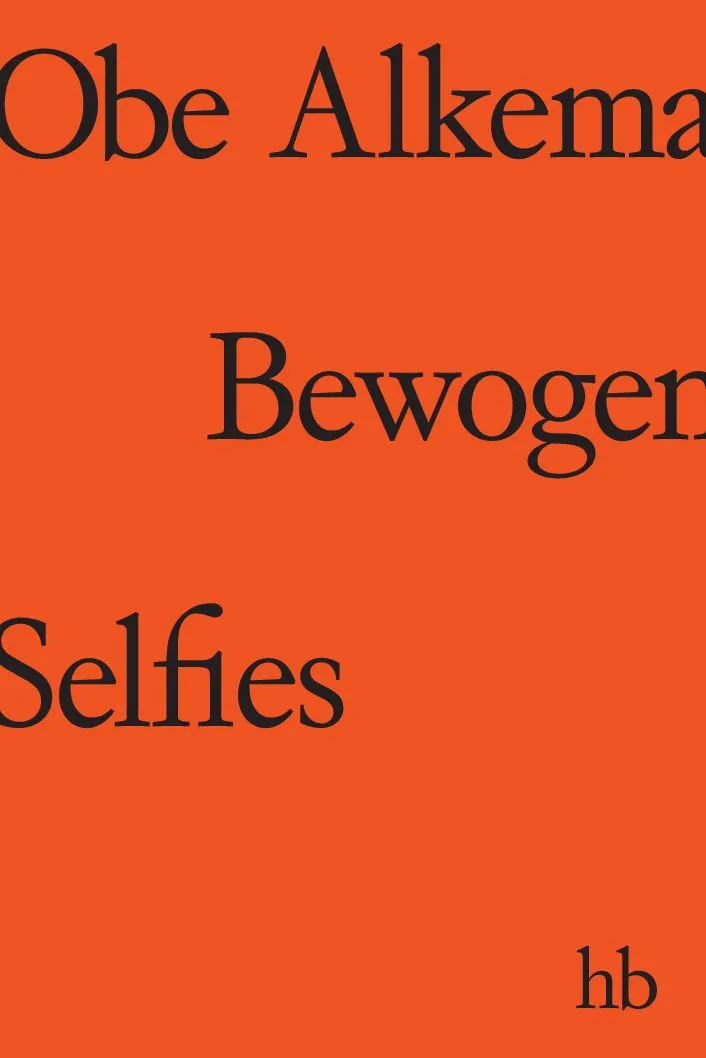
Bewogen selfies
In Bewogen selfies onderzoekt Obe Alkema de verhouding tussen landschap en herinnering. Wat treft hij aan bij terugkeer naar belangrijke plaatsen uit zijn geheugen? Wat herinnert hij zich niet, maar Google wel? Is er een gedenkschrift te puren uit zijn metadata?
Memoires, rechtstreeks verteld en met omwegen, uit eerste hand en van horen zeggen. Archieven en herinneringen eisen spreektijd, houden het niet meer droog of worden tot spreken gebracht. Wat hebben ze eigenlijk te melden? Ze lopen helemaal leeg, net als Alkema zelf. Een leven zoals zovele, poedelnaakt en geretoucheerd, vol zin en onzin.

Swab
For decades, Berlin has been celebrated as a place of sexual liberation, particularly within LGBTQ+ communities. Central to this narrative are the city's clubs, parties, and also darkrooms— booths enabling (often anonymous) sexual encounters in public spaces. With the arrival of the Covid pandemic, these spaces became inaccessible, giving rise to new spatial forms, such as testing and vaccination centers, which often repurposed existing venues like closed-down clubs and bars. The Covid and darkroom booths share an unexpected aura of mysticism and promiscuity. The book compares these spaces using photos and texts.
Texts by: Nils Philipp Dommert, Karl-Josef Pazzini, Jens Franke

Mourn Baby Mourn
Mourn Baby Mourn explore la question du deuil et de la lamentation, tant intime que collective, à travers les états qu’ils génèrent. En trois actes pulsatoires, l’autrice pose les mots, massifs comme des parpaings ou les expulse, offensifs et spontanés tels des projectiles. Ce monologue parcourt les désordres émotionnels caractéristiques des temps contemporains, marqués par la nostalgie de futurs perdus. Dans ce texte-vortex hanté par les imaginaires et les visions discordantes d’un devenir collectif, l’écriture de soi est une existence agissante, et une résistance.
Le texte est issu de la pièce chorégraphique éponyme de Katerina Andreou créée en 2022.
Conception graphique : Angeline Ostinelli
Édité avec le soutien de BARK, du CCN-Caen en Normandie dans le cadre du dispositif artiste associé et de Charleroi Danse.

Escape to Berlin: A Travel Memoir
A long-overdue English edition of Piper's memoir chronicling the story of her emigration from the US to Berlin.
In 2005 American artist and philosopher Adrian Piper (born 1948) secretly emigrated from the United States. Several months passed before anyone realized she had disappeared. She resurfaced in Berlin and has lived there ever since. Piper has consistently and firmly refused to return to the US or explain why she left. Many assume it was because she discovered her name on the Transportation Security Administration's Suspicious Travelers watchlist. Others point to Wellesley College's forcible termination of her tenured full professorship. Yet others speculate that George W. Bush's presidency, or American racism, or the invasion of Iraq compelled her to leave. All these conjectures are groundless. Escape to Berlin: A Travel Memoir is a gripping autobiographical narrative that provides a full account of the facts from the artist herself. Previously out of print, this essential memoir returns in English for fans of the beloved conceptualist to discover and enjoy anew.

Ripcord
A novel about escape and connection, class, sex, and queer intimacy in the American Midwest.
The oldest story: an insider pretends to be an outsider and receives praise for his empathy and imagination and intelligence. Maybe some asshole even says bravery. An outsider pretends to be an insider, is exposed as a fraud, a liar, and burned to the ground.
In Ripcord, Nate Lippens continues his meditations on escape and connection, class, sex, and intimacy. Stuck in Milwaukee, the narrator cobbles together a living by bartending and catering weddings, enmeshed in a semiaffair with a younger, married man. Cruising apps while tallying his youthful romantic failures, he fantasizes about disappearance but finds both solace and frustration in his friendships with Charlie, an aging punk who was prominent in the 1990s Chicago queercore scene, and Greer, a painter who never broke through but continues making work.

An Anarchist Playbook. Radical Translation Workshop
Cristina Viti, Jacob McGuinn and 2 more
The Conspiracy of Equals (1796) is often hailed as the first revolution against a revolutionary state. Even if the conspirators were soon found out and put on trial, their ideas of radical equality and liberty shaped future generations of revolutionaries worldwide. An Anarchist Playbook—the first publication in Tenement’s new imprint, No University Press—gathers together many of the key documents from their trial across a myriad forms, with a number of these texts appearing herein in their first English-language translation.
Assembled in the Playbook are the last words of Gracchus Babeuf, the leader of the conspiracy and a radical proponent of the abolition of private property, and of his fellow conspirator Augustin Darthé, as they faced the guillotine. We’ve a letter, written in the popular idiom of the sans-culottes, that urges the common soldier to rebel; the score and lyrics of a street song that names the new class enemy: the wealthy bourgeoisie who have profited from the revolution; a first-time English translation of ‘The Last Judgement of All Kings’—an extraordinary one-act play by Sylvain Maréchal, the unofficial poet of the Conspiracy, that was performed to considerable acclaim in Year II of the Revolution (and that the Workshop is in the process of adapting for contemporary audiences).
Many of these texts were never published in their own time, and form a part of the testament left behind by Philippe Buonarroti, a leading conspirator who inspired new generations of revolutionaries across Europe over the course of the nineteenth and early twentieth centuries. Among the best known works included is the Manifesto of Equals, long considered a founding text of social, communist and anarchist revolutions. The Playbook presents a translation of the Manifesto alongside other key texts by the conspirators, reconstructing the richness and variety of revolutionary communication that informs the editorship, shape, and scope of this volume.