Books
Books
published in 2026

The pedestrian
Emerging from the dark ecology between lullaby and ghost story, The pedestrian meanders down a labyrinth of divinatory time where crimes demand a more defective detective. To conjure the source of this text’s trauma, the poet becomes a ritual detective, tracing the wound by its shadow. Meaning emerges through distortion and echo—courting what cannot be seen head-on to create a haunted grammar of grief. An ill pastoral of displacement, The pedestrian turns domestic spaces into underworlds, the body of the exiled child into a prophetic threshold—it listens as much as it speaks, attuned to forces beyond itself.
The pedestrian is a map to a terrain of shards and shadows. While reading it, I felt lost only to the land of the normative, a lush fugitivity. I traveled far with, because of, and in this book. Hsiung trusts in the politics of decomposition, making syntaxes that have been distorted by grief, and thus sharpened to what cannot be colonially extracted. Writers like this know that grammar, vocabulary, and the sentence itself are haunted, so they write not to exorcise or cure this condition of its ghosts, but to make a place for them to live, a place they belong.
— Johanna Hedva

Movement Research Performance Journal
Issue #62 - We Exist in the Ambivalence of Those Motherfuckers
Anh Vo, maura nguyen-donohue and 1 more
What began as a project responding to the fiftieth anniversary of the ‘end’ of the Vietnam War became a project of inhabiting the Movement Research Performance Journal (MRPJ) from within the landscape of contemporary Vietnamese performance art. The result, Issue #62, is a window onto a community of insiders who reflect a set of concerns, questions, historical trajectories, and aesthetic legacies that differ from what has more often been foregrounded in our U.S./New York City-centric publication. Like other documents of this kind, which endeavor to portray a performance scene that will be foreign to many readers, the texts from this group of intergenerational, contemporary artists demonstrate a careful navigation of the dialectics of inside and outside, self and other, performer and audience, seeing and being seen, that informs every exchange across cultural difference.
The texts are also not monolithic, suggesting a range of relations to the Vietnam of the past and present, from within Vietnam’s national borders and among the diaspora. Especially for contributors living and working in Vietnam, writing has also been a practice of choreographing words within a political landscape where to speak publicly, in itself, is a performance of negotiated risk. Embracing the complexities of these differing positions has been the focus of our editorial process—one that has asked the editorial team to embrace the limits of our own knowledge, to recognize we will not be able to recognize all valences others may discover in these texts, and not to edit these layers out of the works that follows.

Discontent Issue 6
Reportage, photography, and art from Palestine and Lebanon. Contributors include Alaa Mansour, Fady Joudah, Farah Silvana-Kanaan, Fatima Joumaa, Fouad Elkoury, Hadi Afif, Islam Al-Khatib, Philippa Dahrouj, Rawad Wehbe, Sakir Khader, and Wassila Abboud.

Black Cine-Body Sonics: Racializing the Soundtrack
Black Cine-Body Sonics: Racializing the Soundtrack surveys how Black audiovisuality developed and thrives in films and television through importing and materializing the sonics of Black musical representation — from 'Blaxploitation' classics (Shaft and Truck Turner) to cine-auteurs (Melvin Van Peebles, Spike Lee and Jordan Peele) to music video performers (Michael Jackson, Beyoncé and Kendrick Lamar) to video artists (Arthur Jafa and Isaac Julien) to contemporary multi-genre explorations of race (Sinners, Lovecraft Country, Atlanta and Swarm). The book views Jazz Soul Funk Disco Hip Hop Techno and House not as 'source music' but as genetic origins in the transformation of movies and shows resulting in new cinematic and televisual formations — all of which foreground the body performance and musicality.
— Philip Brophy
This is the 4th publication in the Echoes of Dissent series, devoted to the politics of the soundtrack.

Slip-Syncs Collapse and Strange Unrealities in the films of Sogo/Gakuryu Ishii
You can talk about Ishii and music and you can talk about Ishii and sound. I want to talk about both. I want to talk about him as a node in a network of musicians and bands that starts with punk but spider webs out to ensnare post-punk industrial and ambient music with a brief free jazz cameo. I also want to talk about the way he uses sound rhythm and silence. This is not just about soundtrack. A soundtrack tends towards telling you something about what’s happening. Soundtracks tell you what to feel whether there is dread or romance or sadness in a scene. Not so for Ishii. For Ishii a soundtrack stands alone is a bed and is a moment but it doesn’t tell you how to feel. It is in Ishii's hands dislocation silencing or distortion of the cause-effect connection between the punch thrown and the punch landing between moving image and the sound that constructs the conceits of the cinema. "He attempted to find a visual equivalent to punk music," wrote critic Tom Mes. "A way to express the same philosophy and spirit with a camera instead of a guitar.”
— Jennifer Lucy Allan
This is the 3rd publication in the Echoes of Dissent series, devoted to the politics of the soundtrack.

Blank Stare
Blank Stare is the first publication in the CommonWealth series, published by Chillzone.
Compiled of graffiti written in the streets of Iran, combining the urgency of emotional expression amidst the political suffocation of people during the 2026 government-imposed internet blackout.

The Ultraviolet Catastrophe
Legal-high addict, gaming enthusiast, and principal shareholder of AstroLabs™, Lex Rameses, has recently discovered—and purchased—Proserpina: a planet with a near-identical ecosystem to Earth’s. Yet, although his humanistic, hipster pretensions mean that many people admire him, there is still one thing standing in the way of his space-colonization program: as of yet, there is no way to travel to Proserpina safely.
Enter a cast of mad scientists, Astro–Marxists, a neurorobotic AI hivemind, an extinction anxiety addict, the victims of an interrelated crypto-currency gaming scam, and a seemingly endless succession of ravers and gamers in search of the ultimate hallucinogenic, carcinogenic, neü-space-age high…
The Ultraviolet Catastrophe is raucous, hilarious, irreverent, and wildly smart, taking aim at techno-salvation fantasies, startup culture, and the eternal humiliation of having a body under the ridiculous conditions of late capitalism. Finlay's new novel is as unexpected and unique as all of her work. Read it now.
— Elvia Wilk, author of Oval and Death by Landscape

Abstract Coloring Book
A coloring book conceived as an artist book. Coumba Samba’s publication prompts you to explore geometric forms and structures with a small set of colored pencils. Using those simple materials one realises how interaction and experimentation challenge again and again the relationship between color, abstraction and internalised form systems.
Published in connection with the exhibitions deutschland at Kunstverein in Hamburg and Coumba Samba at MauMaus in Lisbon.

The Gangsters
Hervé Guibert’s novel The Gangsters opens at the front door of a Paris townhouse inhabited by the narrator’s elderly great-aunts, Suzanne and Louise. The narrator, distracted by a health crisis and his pursuit of an ambivalent lover, arrives to find suspicious renovation work taking place. But even after the great-aunts confess to being intimidated and extorted, neither he nor the incompetent police can stop the ongoing larceny.
Readers of Guibert’s writing may already recognize the narrator (also named Hervé) and his great-aunts from the groundbreaking photo-novel Suzanne and Louise. As Guibert explained in a 1988 interview, “I started The Gangsters three days after discovering the events of which my great-aunts were victims, and I wrote the book in ten days. The story continued while I was writing and after I had finished.”
Like his other books, The Gangsters is a work of autofiction. Here, he uses the crime-novel format to explore universal motifs, such as cruelty, desire, and mortality. “When I disappear,” Guibert continued, “I will have said it all. I will have striven to reduce this distance between the truths of experience and writing.”

Wet
Finn Brown, Lucie Arnoux and 1 more
Wet is an anthology of queer and trans writing about water.
Our contributors swim pools, lakes and oceans, visit islands, coasts and hottubs. The water they describe is soft and hard, it erodes old rocks and old gender, it is a place to fall in wet love, it hides witches.
Contributors: Arlo Kean, Clara Davis, Eliot Walloschek, Finn Brown, Isabella Redmayne, Lizzie Rose, Lucie Arnoux, So Mayer, Tadhg Haran, Tallulah Griffith, Troy Cabida

Land Keepers
EcoRove’s Land Keepers Reader brings together writers, activists, journalists, farmers, and ecologists from across Bilad al-Sham — Lebanon, Syria, and Palestine — to tell stories of green resistance in the Jabal al-Sheikh ecological zone. Spanning South Lebanon, the occupied Jawlan, and the occupied Galilee, this landscape faces ongoing ecocide, defined as the deliberate destruction of land and ecologies used by the settler-colonial regime to erode livelihoods, cultures, and environments. The Reader highlights these struggles through essays, research and testimonies that show how native communities remain rooted in place, resisting colonial environmental orientalism, greenwashing, and scorched-earth tactics. As part of a wider body of work that includes a documentary film, tapestries, and sculptural pieces, the Reader amplifies indigenous ecological knowledge and envisions regenerative futures for threatened landscapes.
with contributions by Mahdi Sabbagh, Hamza Hamouchene, Public Works, Hussein Chaabane, Hisham Younes, Nadine El-Khoury, Michelle Eid, and Munira Khayyat
From the intro by Ecorove:
"Return, Al’Awda in Arabic, signals the right of return to homeland, a central tenet of the Palestinian struggle. Al’Awda affirms the fundamental historical, legal, collective, and individual right of Palestinians to return to their homeland. But how do we return to the earth after it has been damaged and scorched? In landscapes marked by war, ruins, rubbles, and ecological destruction, can Al’Awda take another form? Can generations of Palestinian diaspora exercise Al’Awda differently? At a time when international legal systems and institutions have failed to secure justice, can return to land be understood beyond legal definitions alone? In times of mass displacement and ecological devastation, Al’Awda may therefore exceed juridical meaning, and live through those who remain on the land and their acts of love, labour, and agriculture."
Each book comes with a 2-color, double-sided risograph-printed bookmark.
Ecorove is Iyad Abou Gaida and Jumanah Abbas.

The Literary Workshop
A bold, revelatory argument for the power of language by leading radical lesbian feminist and author of The Straight Mind.
The Literary Workshop takes readers inside Monique Wittig’s creative process, unlocking the practice of writing both in material and political terms. Wittig provides her most complete account of how literature and politics work together. Part of the generation that revolutionized French literature, Wittig reveals the secret of her craft: that the work a writer does with language is itself a form of resistance.
Born and raised in France, Monique Wittig (1935–2003) was a driving force in second-wave feminism and one of the most brilliant authors of her generation. A provocative thinker, she famously declared that lesbians are not women and introduced women into a materialist framework by treating them as a class. Wittig is the author of, among other titles, The Straight Mind, Les Guérillères, and The Lesbian Body. Her debut novel, The Opoponax, won Le Prix Medicis.

Time Also Will Make It Interesting: Selected Journals
The selected journals of trans, mixed-race artist and dyke erotica writer Red Jordan Arobateau.
Best known for his erotic lesbian fiction, Red Jordan Arobateau was also a prolific painter who maintained and self-published a journal for roughly twenty years, documenting his experiences at the “abject bottom” of life in the US. Edited and introduced by poet and scholar Cameron Awkward-Rich with a foreword by Michelle Tea and paintings by Arobateau, Time Also Will Make It Interesting captures Arobateau’s life as a young dyke in the criminalized cultures of 1950s-60s gay bars of Chicago and New York; his transition from dyke to trans man in late 1990s San Francisco; and his return to painting and an unfolding spirituality within that rapidly gentrifying city.
Queerly messy, ornery, and stuffed with Arobateau’s wisdom, this volume is what he might have called, “a novel combined with a journal—da novel/journal! Taking all the liberty in the world! A domain where verse can be inserted, dreams recorded, my everyday political rants printed out, combined with my forté—fiction! All under one binding & title!”
Foreword by Michelle Tea.

Devour Me, Again: Collected Poems
A landmark collection of poems by Bambi Lake, the beloved (and bad-mouthed) icon of San Francisco’s counterculture.
Bambi Lake was a trans chanteuse, performer, provocateur, and countercultural darling of the ’70s, and subsequent decades. “The Glamorous Life follows me around,” she sang in her ballad “The Golden Age of Hustlers” (later popularized by Justin Vivian Bond). Her life in San Francisco—including being on the fringes of the Cockettes, and a member of the adjacent Angels of Light—was “sort of legendary,” sort of “sweet, sticky, nasty,” and always precarious, lived in spite of addiction, homelessness, and the horrors that came from chasing and surviving her own desires.
Here are her poems, long out of print, that wear “burgundy velvet jezebel bras” to seduce “fatally hetero” men, detailing the cabaret of desire amidst social, cultural, and political change. “I am Beauty,” she writes, “and the world dissolves.”
The collection includes a series of interviews by August Bernadicou and a foreword by Brontez Purnell.

Close Writing: Kathy Acker, Cookie Mueller & Love-in-Pieces
In Close Writing, Alice Butler reflects on the diaries, letters, publications, performances, lives, and afterlives of her most beloved queer feminist writers: Kathy Acker and Cookie Mueller. While the transgressive avant-garde writer Kathy Acker has developed a cult following in the decades since her death in the late-90s, the actress and writer Cookie Mueller has remained relatively obscure. In this creative-critical study, Butler participates and responds to the lives and writings of her shared “beloved," reimagining the scene of the archive as a scene of triangulated and bittersweet love that traverses the boundaries of life and death. She draws on the autofictional strategies that Acker and Mueller pioneered in their own experimental writings and performances, encountering the women in intimate theoretical spaces of sensuality, sexuality, and sickness that slip between life and text. By encountering Acker and Mueller as transgressors and innovators, but also as beloved figures in her writing life whom she addresses in love letters, Butler brings readers to new, reparative textures of understanding, embodiment, and affection through close writing.

The fruitfull sence
Titus Lucretius Carus, Lucy Hutchinson
The fruitfull sence is an excerpt from Lucretius’s masterwork De rerum natura, in which the poet marvels at the sensory world. Optical illusions, the drift of smell, the juicy mechanics of taste. All animated by Lucy Hutchinson’s gorgeous 1640 translation, which renders the original Latin into bouncy English pentameter. The first publication in our new series, Sensory Dispatches.

Selected Poems
Pat Parker, SaraEllen Strongman
'Her Black Woman’s voice rings true and deep and gentle, with an iron echo. It is merciless and vulnerable and far ranging.' —Audre Lorde
Alongside her invaluable contributions to social justice, Pat Parker (1944-1989) wrote five collections of poetry during her lifetime and is widely recognised as one of the leading African-American, lesbian-feminist voices of the 20th Century.
Selected Poems collects her most loved works into an accessible volume, introducing new readers to Parker's fire for justice, tenderness, and vision for the world.
This is the first time Pat Parker's poetry has been published in the United Kingdom.
Readers interested in Pat Parker’s life may also enjoy The Letters of Audre Lorde and Pat Parker 1974–1989, an archival work documenting their intimate friendship and important work as activist-poets.

BOMB 176 / Summer 2026
INTERVIEWS Dave Eggers by Jim James Jun Kaneko by Mark Mack Lotus L. Kang by Lara Mimosa Montes Reverend Joyce McDonald by Katherine Cheairs Rodney McMillian by Dave McKenzie Ruth Ozeki by Hannah Tinti Samora Pinderhughes by Jason Moran Debra Priestly by Nancy Grossman Elaine Reichek by Sabrina Gschwandtner
FICTION Isabelle Fang, Yuri Herrera, Claire Vaye Watkins
NONFICTION Shaan Sachdev
POETRY Adedayo Agarau, Elena Alexander, Kelsey Day
PORTFOLIO Shraddha Ramani and William Villalongo
COMIC Margaret Barry
EDITOR’S CHOICE Reflections on new works from Horse Lords, Valeria Luiselli, Nicolás Pereda, Julian Radlmaier, and Paul Yoon and a monograph on Theresa Hak Kyung Cha
On the cover: Detail of Rodney McMillian, shaft, 2021–22, latex, acrylic, Flashe, ink, and paper on canvas, six panels, 80 × 4 feet diameter. Photo by Jason Mandella. Courtesy of the artist, Vielmetter Los Angeles, and Petzel, New York City.
BOMB Magazine is a quarterly of artists in conversation begun in 1981 in New York. BOMB publishes interviews across disciplines like visual art, literature, performance, music, dance, film, and is founded on mission of delivering the artist's voice. Publishing print seasonally, BOMB also publishes interviews, flash fiction, studio visits, excerpts, and essays five times a week on our website.

The Book of Advice
The Book of Advice, an experiment in self-translation, stems from the andarznameh tradition of classical Persian literature, a form that moves between verse and prose as it engages invented or familiar sayings and folktales. Originally written in Persian between 2018-2020, the book now speaks in both English and Persian, opening at once from the back and the front, in a voice both distanced and familiar. The vicissitudes of the everyday preoccupy its intimately impersonal speaker as she wrestles with the inadequacy and mobility of language.
Ghazal Mosadeq is a poet, editor and translator. She is the founder of Pamenar Press, an independent publisher of poetry, translation, hybrid and critical writing. Her own work has been published by Sheirsman, Fence, Arc Poetry, Fiddlehead, Asymptote, Modern Poetry In Translation and Words Without Borders, among others. She is a member of the editorial advisory board for the Journal of British and Irish Innovative Poetry.
The Book of Advice knows 'we didn’t have to break the flower stem/ to let the/ light pass through,' even as it knows we have already broken everything we could. Here, no one knows our names, nor the name of our horse, though someone did once ask. From the sliver between a face and its forgettable name, from the sliver between what’s been said and what’s yet to be said, slightly but exactly differently, Ghazal Mosadeq offers a chasm. The floor is deep, but, when you land, very tender. No one hails us, but the well wishes, oh, open your mouth for the well wishes." —Farid Matuk

Person with the last name Universe
This book has been self-published for Latvian artist and poet Jelena Glazova's solo exhibition “Person with the last name Universe” at Riga contemporary art space (July - August 2026). The exhibition is the artist’s act of feminist guerrilla resistance within the symbolic territory of contemporary phallocracy. The source and central figure of the post-gender universe conjured by Glazova is the Person with the last name Universe, whose creative strategy the artist unpretentiously calls Glazovism.
Jelena Glazova (Belgium/Latvia) is a poet and multimedia artist who combines visual elements, experimental sound, installation and poetic text in her projects. As an artist, she has participated in international festivals and projects in Latvia, Estonia, Lithuania, Sweden, Austria, Belgium, Germany, the Netherlands, Turkey and other countries. Among the most notable exhibitions are "Identification of a Woman" at the Latvian Museum of Photography (2010) and "Elements of a Puzzle" at the Latvian Centre for Contemporary Art (2011). She is the author of four poetry collections. Glazova's poetry has been translated into 12 languages. Since 2012, she has given more than 200 performances in 18 countries. She is the co-founder of two poetry festivals in Riga: "Blood of a Poet" (2014–2016) and "Poetry without Borders" (2017–2022). https://www.jelena-glazova.com/
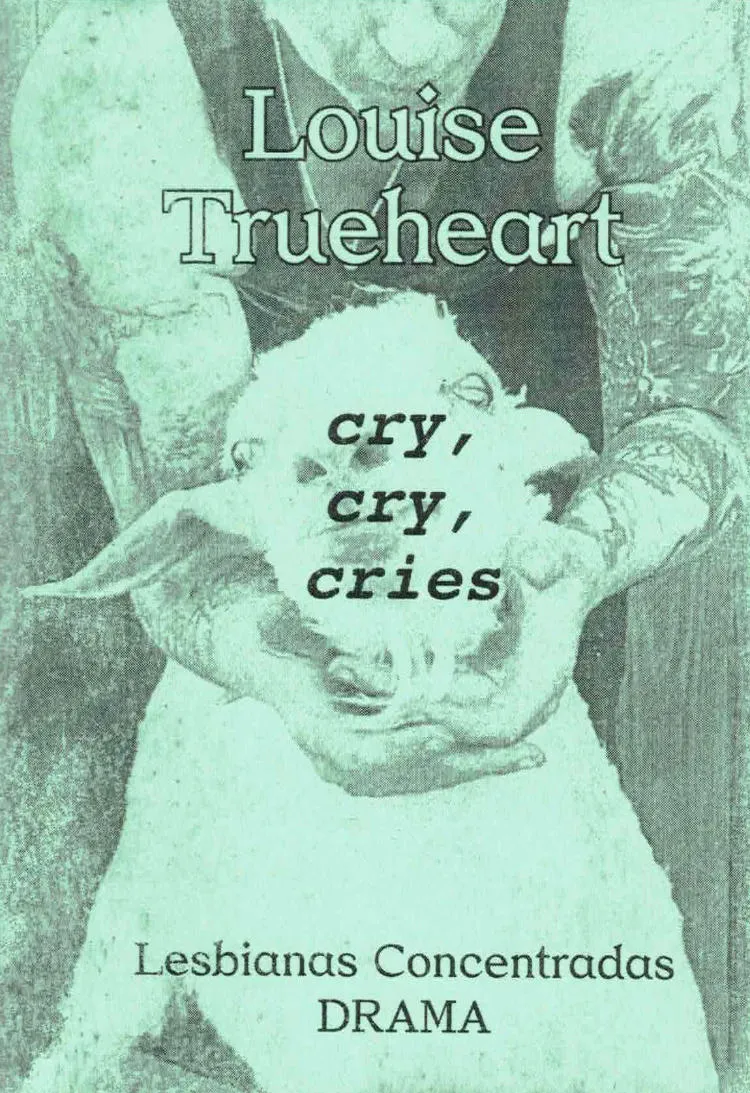
Cry, cry cries
The text is a chapter of a work in progress novel called Lamb. It weaves together the idea of sacrifice in the Bible and pop culture through ‘the liquid gist of sincerity itself’: crying.
Is the third publication of the series " Lesbianas Concentradas DRAMA".
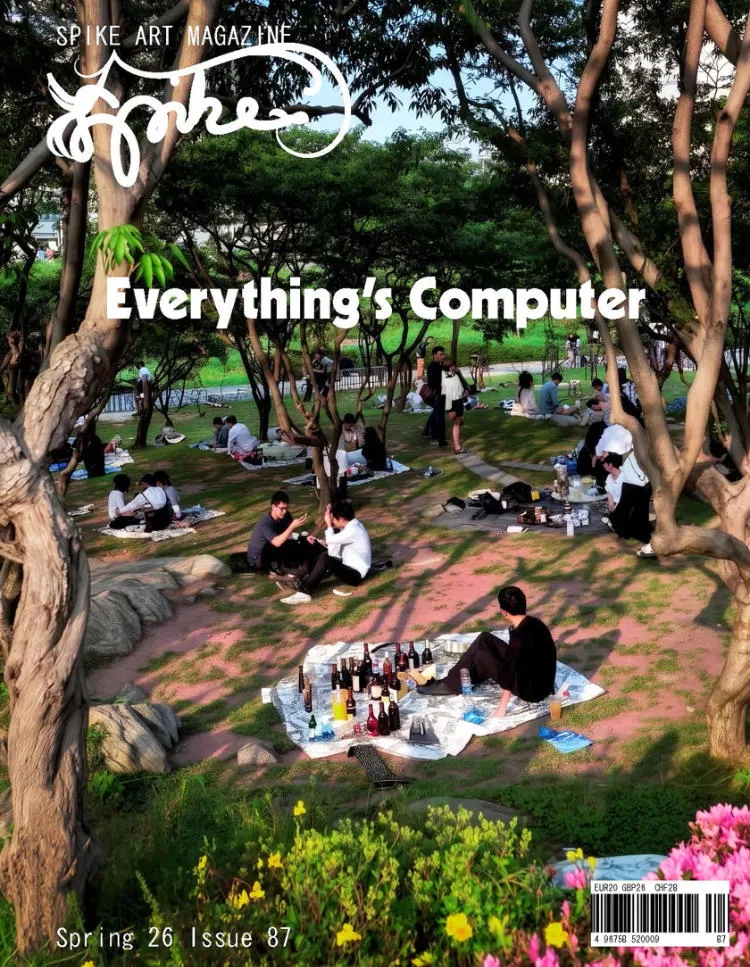
Spike #87 – Everything's Computer
Art in the digital age.
Go on, admit it. There's no longer a meaningful distinction between "real life" and life online, up to and including sitting around in the park. So why shouldn't art reflect the furious, melancholic, psychedelic sensation that, even when we make our screens dark, we've all been permanently logged on? A new era deserves new aesthetics, but also fables, values, and protocols. Everything is interwoven. Everything's computer.
Featuring Brian Droitcour on lore and NFTs; Marek Poliks & Roberto Alonso Trillo on exocapitalism; the godmother of internet girlhood, Ann Hirsch; locating the tech-feminist to tech-fascist spectrum with Anan Fries; Anika Meier on the post-artist; a visual essay by Ruba Al-Sweel & Al Hassan Elwan (POSTPOSTPOST); a defense of useless images by Gideon Jacobs; the second life of memes by Dena Yago; a prophecy of a neo-oral age by Günseli Yalcinkaya; a primer on internet cinema with Dana Dawud; Gary Zhexi Zhang's guide to Shenzhen, "China's Silicon Valley"; and the never-miss backpage from Tea Hačić-Vlahović: "Underground communities prevail against odds. Like rats and nuclear bombs." Plus! Our new lifestyle section, LIFEMAXXING.
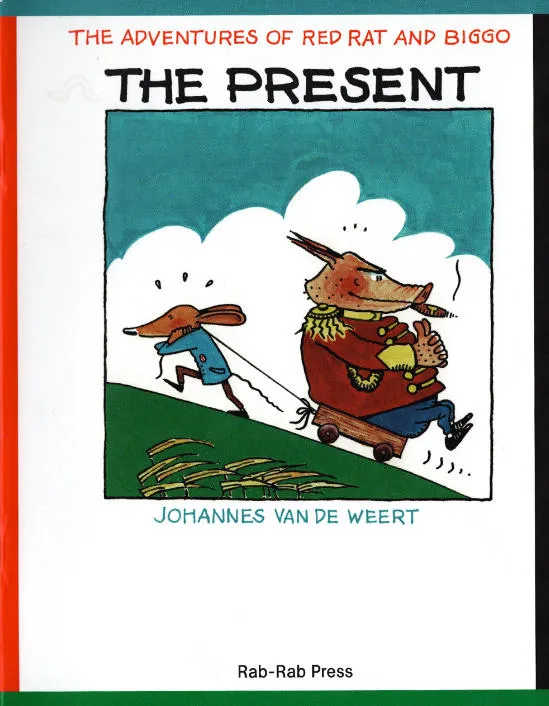
The Adventures of Red Rat and BIGGO – The Present
A children's book by Johannes van de Weert, a veteran of the punk underground (Rondos, The Ex, Red Rat, Raket).
The Adventures of Red Rat and BIGGO – The Present is a remake of Bram konijn en Piet de muis [Bram the Rabbit and Piet the Mouse], a 1982 children's book by Johannes van de Weert, a veteran of the Dutch punk underground who played with Rondos and The Ex, and who was the force behind Red Rat and Raket editions.
The Present is a 2010 remake telling the story of a bully pig who terrifies a poor rat on a daily basis. After a while, the rat falls ill with fear and has to stay in bed. The lonely, evil pig has no one to play with and becomes depressed. The pig gives the rat a present—a bunch of beautiful flowers—and all is well. Now the two can play together.
The 2010 remake, featuring different characters and intended for a North Korean audience, was never published. The 2025 English version opens with an introduction by Van de Weert, telling a bizarre story of a failed political career and an absurd vaudeville class struggle behind the seemingly harmless educational children's book.
Johannes van de Weert was a cartoonist active in the Rotterdam punk and squatter's movements of the 1980s. He was a singer with the punk band De Rondos and he started self-publishing small comic booklets in the late 1970s. He created his character "Redrat" for the fanzine Raket in 1980. The character soon became an icon for the squatter's movement.

CROSSLWORD #2
Lesbica Enigmistica is a queer-centered crossword by TOMBOYS DON'T CRY built by the queer community, for the queer community.