Books
Books
published in 2020
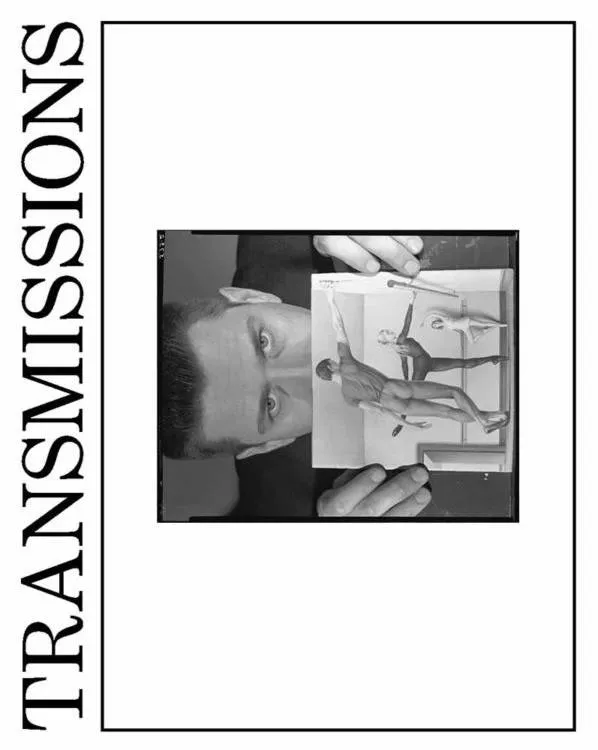
Transmissions
An aesthetic and social history of art and dance in mid-20th-century New York interpreted by contemporary artist Nick Mauss.
Over the past decade, Nick Mauss (b. 1980) has pursued a hybrid mode of working that melds the roles of curator, artist, and scholar. This catalogue leans heavily into the scholarship side of his practice, building on his 2018 Whitney Museum exhibition with a closer look at the relationship between modernist ballet and the New York avant-garde. In the 1930s through 1950s, ballet was introduced to a popular audience in New York and was simultaneously influenced by developments in Europe in painting, photography, fashion, music, and poetry. Mauss reflects on this period of rich cross-media production and synergy, ultimately arguing for the inseparability of dance and art history.

The Book of Sleep
Haytham El-Wardany, Robin Moger
What is sleep? How can this most unproductive of human states—metaphorically called death's shadow or considered the very pinnacle of indolence—be envisioned as action and agency? And what do we become in sleep? What happens to the waking selves we understand ourselves to be?
Written in the spring of 2013, as the Egyptian government of President Mohammed Morsi was unraveling in the face of widespread protests, The Book of Sleep is a landmark in contemporary Arabic literature. Drawing on the devices and forms of poetry, philosophical reflection, political analysis, and storytelling, this genre-defying work presents us with an assemblage of fragments that combine and recombine, circling around their central theme but refusing to fall into its gravity.
"My concern was not to create a literary product in the conventional sense, but to try and use literature as a methodology for thinking," El Wardany explains. In this volume, sleep shapes sentences and distorts conventions. Its protean instability throws out memoir and memory, dreams and hallucinatory reverie, Sufi fables and capitalist parables, in the quest to shape a question. The Book of Sleep is a generous and generative attempt to reimagine possibility and hope in a world of stifling dualities and constrictions.

A Certain Amount of Clarity
Emmanuel Van der Auwera, Harlan Levey and 1 more
Eponymously titled with his award winning 2014 film, “A Certain Amount of Clarity” is the first monograph dedicated to the artistic practice of Emmanuel Van der Auwera, whose work describes our experience of digitized life operating at intersections of documentary, reconstruction and fiction.
His practice is one that demonstrates the impact of emerging technologies on perception and civic dialogue, building platforms for marginalized actors and engaging with technicians and scientists to explore the balance of ethics and aesthetics in new media. Through filmmaking, video sculpture, theatre, printmaking, and other media, Van der Auwera sets up encounters with found images that provoke a questioning of our visual literacy: How do images of contemporary mass media operate on various publics, and to what end?
With the formal rigor of a logician, Van der Auwera dissects how images are engineered, mastering specialized industry techniques and intervening on their protocol. In so doing, Van der Auwera brings us no closer to a monolithic truth, but constructs new paradigms for reading images and understanding our relationships with them.

God Is a Bitch Too
María Paz Guerrero, Camilo Roldán
God Is a Bitch Too is the accelerated and acidic English-language debut of Colombian poet María Paz Guerrero. In this chapbook, god is needy, Latin American, and an overweight woman. No one asks god to dance. Someone speaks, someone tries: “One is the measure of their body.”
God Is a Bitch Too is #13 in the Señal series for contemporary Latin American poetry in bilingual editions.

Ch'ixinakax Utxiwa: On Decolonising Practices and Discourses
The Bolivian scholar and activist Silvia Rivera Cusicanqui is a pre-eminent Latin American intellectual, world renowned for her work in postcolonial and subaltern studies. She has long maintained that we must acknowledge how colonial structures of domination continue to affect indigenous identities and cultures. Even in contexts where diversity and the value of indigenous cultures have been officially recognized, “internal colonialism” operates as a structure that shapes mental categories and social practices.
This book considers this persistent colonial structure by examining artistic and popular practices of apprehending and resisting it, arguing that in Andean cultures there is a sustained practice of insubordinate image production and use. Combining this visual history with other instances of political resistance, the book offers an alternative narrative to the history of Latin American decolonisation. This narrative challenges the common conception that mestizaje (race-mixing) and hybridity are liberatory formations, offering instead a new theorisation of the complex racial configurations produced by colonialism and its afterlives.
Given Rivera Cusicanqui’s vital contribution to critical epistemologies, this book will be of great interest to students and scholars throughout the humanities and social sciences and to everyone concerned with the key questions of critical theory today.

Tripwire 16 - Performance/Writing
A special issue focused on performance writing, with work by Tanya Lukin Linklater (with Michael Nardone), Jibade-Khalil Huffman & Simone White, Jean-Thomas Tremblay, Claudina Domingo (trans. Ryan Greene), Kim Rosenfield, Nathan Walker, Liz Knox, Rona Lorimer, Léo Richard, & Hector Uniacke, Mohamed A. Gawad & Dalia Neis, Mei-mei Berssenbrugge & Teddy Yoshikami, interviewed by Michelle N. Huang, Kyoo Lee and Jocelyn Saidenberg, Adriana Garriga-López, Gabrielle Civil, plus a Kevin Killian Tribute, with Eileen Myles * Scott Hewicker * Cliff Hengst * Karla Milosevich * Craig Goodman * Michelle Rollman * Anne McGuire * Wayne Smith * Tanya Hollis * Steve Orth * Lindsey Boldt * Maxe Crandall * Arnold J. Kemp * Carla Harryman, Lee Ann Brown & Tony Torn * Susan Gevirtz * Laynie Browne * Patrick Durgin * Norma Cole * Jo Giardini. & reviews: Jessica Lopez Lyman & Jocelyn E. Marshall on Gabrielle Civil, alex cruse on Merce Cunningham, Rob Stanton on Anne Boyer, Jack Chelgren on Miyó Vestrini, David Grundy on Stephen Jonas, Virginia Konchan on Sarah Vap.

Oracular Transmissions
Oracular Transmissions weaves together three of the most recent collaborative projects Etel Adnan and Lynn Marie Kirby have completed through processes of exchange and translation: Back, Back Again to Paris (2013), The Alhambra (2016), and Transmissions (2017).
The book also includes poems by Denise Newman, a friend to both Adnan and Kirby, and an introduction by Kadist Foundation curator Jordan Stein presenting their works and performances.

T (poem)
T is a long poem in multiple parts and its author's second book. “The two genders are YES and NO, so you stutter or else shut up forever”.
From the Afterword: "Between 2017-2018 I was involved in a trial with a group of TERFs after a scuffle emerged during a counter protest against a ‘debate’ about sex-based rights in light of proposed reforms to the Gender Recognition Act which would have made trans people’s lives marginally easier. Luckily I wasn’t actually in the dock, but I appeared to give evidence, and for everyone involved it was a humiliating ordeal as we were doxxed, harrassed online and in real life, while the relentless media campaign which ensued took a toll on the entire trans community. The caricaturesque reduction of a complex interrelation of political positions, epistemologies, traumas and personal grievances into two ‘sides’ ultimately worked to further the persecution of trans people, but nevertheless highlighted a social logic on whose terms the so called debate was forced to appear: sex was pitted against gender (or more revealingly ‘gender identity’), objective biology against subjective ‘self-identification’, nature against culture, or perhaps, first nature against second nature."
What does a poet say (what does anyone say), when placed on the stand, how answer the binary logics forced like a cage in the legally-grounded violence which splittingly interrogates solidarity, the splitting invocation of law? In answer, T spreads across the page as if desperately finding a form for speech acts forced into a garrotted tick-box, a witness stand, video evidence, Nature’s originary disguise as history or vice versa, wrapped inside ‘common sense’ as a pronominal shroud, in the policing of body, speech, and every fungible fibre of being. The author writes: “I want the whole text to be a kind of horrific inorganic body with awkward parts, both to replay at the level of form some of the critiques of organicist thinking with reference to nature that the poem tries to articulate, and also, more glibly, to be somewhat like a trans body, awkwardly fitting together with some parts undercutting others”. An extended enquiry into Materialism and its material (fleshed) stakes, driven through the heart and to the heart of things, T sees lyric poem shudder to line-broken essay to fragment of play to citational drop; in tight compression sprawling, a poem whose argument is necessary and necessarily incomplete, poetry can do thinking, this thinking we do outside and within it, sprung trap, open and closing door.

Death Industrial Complex
Candice Wuehle’s Death Industrial Complex is a meditation on the cultural obsession with the bodies of dead women and an occult invocation of the artist Francesca Woodman. Like Woodman’s photographs with their long exposures and blurred lenses, this book is haunted and haunting, hazy yet devastatingly precise. These are poems as possessions, gothic ekphrases, dialogues with the dead, biography and anti-biography, a stunning act of “cryptobeauty.”

Passage to the Plaza
In Bab Al-Saha, a quarter of Nablus, Palestine, sits a house of ill repute. In it lives Nuzha, a young woman ostracized from and shamed by her community. When the Intifada breaks out, Nuzha’s abode unexpectedly becomes a sanctuary for those in the quarter: Hussam, an injured resistance fighter; Samar, a university researcher exploring the impact of the Intifada on women’s lives; and Sitt Zakia, the pious midwife.
In the furnace of conflict at the heart of the 1987 Intifada, notions of freedom, love, respectability, nationhood, the rights of women, and Palestinian identity—both among the reluctant residents of the house and the inhabitants of the quarter at large—will be melted and re-forged. Vividly recounted through the eyes of its female protagonists, Passage to the Plaza is a groundbreaking story that shatters the myth of a uniform gendered experience of conflict.

DMZ Colony
Woven from poems, prose, photographs, and drawings, Don Mee Choi's DMZ Colony is a tour de force of personal and political reckoning set over eight acts. Evincing the power of translation as a poetic device to navigate historical and linguistic borders, it explores Edward Said's notion of "the intertwined and overlapping histories" in regards to South Korea and the United States through innovative deployments of voice, story, and poetics. Like its sister book, Hardly War, it holds history accountable, its very presence a resistance to empire and a hope in humankind.

The Haitian Chronicles
The Haitian Chronicles is a graphic and brutal history of the Haitian Revolution told across three plays. It is the final work by the influential and groundbreaking playwright Douglas Turner Ward (1930-2021) and the first play of his to be published in several decades. Though much of his earlier work has been short one-act satires, The Haitian Chronicles takes place across three long plays: The Rise of Toussaint L'Ouverture, The Fall of Toussaint L'Ouverture, and the one-man drama, Dessalines.
The Haitian Chronicles is an example of Ward's political commitment to satirizing, dramatizing, and revealing the structures of white supremacy throughout the history of this so-called civilization. His first play, Star of Liberty, written at 19 years of age, was based the life of Nat Turner and the slave revolt he led. With The Haitian Chronicles, Ward returns to armed Black rebellion, taking as its subject matter the first and only slave revolt to successfully establish a free state. It is a self-consciously ambitious work of astounding narrative and theatrical scope, featuring over 80 speaking roles and logistically demanding production design. The narrative onslaught chronicling the disgusting brutality of colonial French society and the bloody force it took to overthrow it overwhelms the reader and challenges one to question the structures on which society is built and the violence it continues to perpetuate.
Ward was one of the central, driving forces of the Black Theater movement in the United States. After moving to New York in 1948, he became immersed in the radical political scene in Harlem, writing for The Daily Worker, and studying as an actor. He served as understudy to Sidney Poitier in A Raisin in the Sun, and began a long friendship with fellow actor Robert Hooks. In 1966, Hooks helped produce Ward’s double bill Happy Ending / Day of Absence. Following the success of these plays, Ward was asked to write an editorial for the New York Times in 1966. His article, titled "American Theatre: For Whites Only?", surveyed the ubiquitous, stifling racism of the American theatre and was widely circulated, earning Ward further recognition for his political and theatrical work. With funding from the Ford Foundation, Ward and Hooks, together with Gerald Krone, founded the Negro Ensemble Company (NEC) in 1967. Writing and directing for the NEC over the next several decades, Ward worked with icons such as Paul Carter Harrison, Gus Edwards, Leslie Lee, Errol Hill, Charles Fuller, Derek Walcott and Wole Soyinka. He directed dozens of plays throughout his career including Song of the Lusitanian Bogey, The River Niger and Pulitzer Prize-winning A Soldier’s Play. Ward continued to write until his death in 2021– The Haitian Chronicles is the result of over four decades of work, a superb series of plays by an inimitable writer and artist.
Boo-Hooray proudly placed the Douglas Turner Ward Archive at Emory University’s Stuart A. Rose Manuscript, Archives and Rare Book Library in 2017. The Archive includes many working drafts of the numerous plays Ward directed and wrote, manuscript materials, and correspondence with other icons of the Black Arts.
The Haitian Chronicles was a winner of the AIGA 50 Books & 50 Cover Award for the work of book designer Martha Ormiston.

Otherwise Worlds
Andrea Smith, Jenell Navarro and 1 more
The contributors to Otherwise Worlds investigate the complex relationships between settler colonialism and anti-Blackness to explore the political possibilities that emerge from such inquiries. Pointing out that presumptions of solidarity, antagonism, or incommensurability between Black and Native communities are insufficient to understand the relationships between the groups, the volume's scholars, artists, and activists look to articulate new modes of living and organizing in the service of creating new futures. Among other topics, they examine the ontological status of Blackness and Indigeneity, possible forms of relationality between Black and Native communities, perspectives on Black and Indigenous sociality, and freeing the flesh from the constraints of violence and settler colonialism.
Throughout the volume's essays, art, and interviews, the contributors carefully attend to alternative kinds of relationships between Black and Native communities that can lead toward liberation. In so doing, they critically point to the importance of Black and Indigenous conversations for formulating otherwise worlds.
Contributors. Maile Arvin, Marcus Briggs-Cloud, J. Kameron Carter, Ashon Crawley, Denise Ferreira da Silva, Chris Finley, Hotvlkuce Harjo, Sandra Harvey, Chad B. Infante, Tiffany Lethabo King, Jenell Navarro, Lindsay Nixon, Kimberly Robertson, Jared Sexton, Andrea Smith, Cedric Sunray, Se’mana Thompson, Frank B. Wilderson

The Illusion of a Crowd
Publication including the films Transformation Scenario, 70.001, and Faux Terrain, as well as a visual essay, a glossary and texts by Heike Geißler, Fanni Fetzer, and Franciska Zólyom.
“When I visited the Elias Canetti archive at the Zentralbibliothek Zurich, I was looking for manuscripts and sketches for his major work Crowds and Power (1960). I imagined that Canetti must have made drawings, as the behaviour of the various crowd types he identified was described in such detail. I hoped that these drawings would help me transfer the group behaviour he describes to virtual figures in an animated film.
The archive of manuscripts, arranged by Elias Canetti himself, was handed over to the Zurich library and contains the notes and sketches he completed during the development of Crowds and Power, a period of almost forty years. However, in this context I found no drawings—Canetti had only made graphic lists on various themes. So where did Canetti's precise descriptions of the scenes come from?”
Clemens von Wedemeyer (born 1974 in Göttingen, lives and works in Berlin) creates films, videos and media installations poised between reality and fiction, reflecting power structures in social relations, history and architecture.
Edited by Fanni Fetzer and Franciska Zólyom.
Texts by Heike Geißler, Fanni Fetzer, Franciska Zólyom.

Spectres #02 – Resonances
Bartolomé Sanson, François Bonnet
The second issue of Spectres is devoted to the concept of resonances, with contributions by Maryanne Amacher, Chris Corsano, Ellen Fullman, Christina Kubisch, Okkyung Lee, Pali Meursault, Jean-Luc Nancy, David Rosenboom, Tomoko Sauvage, The Caretaker, David Toop, and Christian Zanési.
To resonate: re-sonare. To sound again—with the immediate implication of a doubling. Sound and its double: sent back to us, reflected by surfaces, diffracted by edges and corners. Sound amplified, swathed in an acoustics that transforms it. Sound enhanced by its passing through a certain site, a certain milieu. Sound propagated, reaching out into the distance. But to resonate is also to vibrate with sound, in unison, in synchronous oscillation. To marry with its shape, amplifying a common destiny. To join forces with it. And then again, to resonate is to remember, to evoke the past and to bring it back. Or to plunge into the spectrum of sound, to shape it around a certain frequency, to bring out sonic or electric peaks from the becoming of signals.

Family Picture
An essay in the form of painting studies - including persons, dogs, a frog, a hoofed animal, fish, hare, trees and plants.

VNOUJE 4
Cécile Bouffard, Roxanne Maillet and 1 more
4ème numéro de l'épopée lesbienne en épisodes par la collective Fusion, ce recueil d'aventures se lit dans n'importe quel ordre.

Thievery and Songs
Publication accompanying the exhibition Gernot Wieland (08.02.-05.07.2020).
One can summarize Gernot Wieland and his work as an intertwining of the man, the artist, and the artwork. With Gernot, we experience in his artwork and in his presence more of a quiet, constant fascination with what is around him and what has affected or influenced or indeed shaped him sinde his childhood. These impressions - whether quirky memories or indeed tragic experiences and the non-stop grappliing with what has happened - arise in his artwork or in his conversation, whether directly or not. Alongside self-analysis and presentation through his artwork is an analysis of societal norms and indeed repressed aspects of society as it expresses itself, even violently, in hegemonic structures - in the classroom and upon children, for example. From his sketches or film narratives we catch a powerful glimpse upon a concentration of trauma, repression, and guilt placed upon his generation, an Austrian condition manifesting itself in obscene and absurd ways.

The Close Chaplet
Long out of print, The Close Chaplet is Laura Riding's first book, originally published in 1926. Riding deliberately ceased writing poems after 1940, when she came to see poetry as irrevocably flawed as a means of expression. These poems demonstrate Riding's early desire to depart from the close and well-tilled ground of traditional lyric poetry. According to her biographer, Elizabeth Friedman, many of the poems for THE CLOSE CHAPLET were brought in typescript from New York, a few were added in Egypt, and the entire text was carefully edited by Robert Graves.
In his introduction, Mark Jacobs writes that Riding was identifying herself with the pre-moment, the 'what-was-there' before Creation. How did the world, the universe, come to exist, why does it exist, why does it die, why do we? From these questions, Riding begins to develop a theory about the role of women as the origin of all human beings, the only animals with written language. This edition also includes Riding's essay A Prophecy or a Plea, a statement of her poetics initially published in 1926.
Laura Riding was a poet, novelist, short-story writer, essayist, and publisher. While primarily known for the critical works that she co-authored with Robert Graves — A Pamphlet Against Anthologies and A Survey of Modernist Poetry — Riding also left behind an incredibly powerful body of poetry and prose works that, regrettably, remain little read today. These include THE CLOSE CHAPLET (Ugly Duckling Press, 2020), EXPERTS ARE PUZZLED (Ugly Duckling Presse, 2018), CONVALESCENT CONVERSATIONS (Ugly Duckling Presse, 2018), The Lives of Wives, and The Progress of Stories. Famously rejecting poetry early in her career, she spent the last decades of her life co-writing a theoretical work on linguistics, Rational Meaning, with her husband Schuyler Jackson. She was awarded the Bollingen Prize in 1991, the very same year she died.

Hopelessness
"The brilliant Verity Spott has a new book out, called Hopelessness and published by the 87 Press. The work defies categorisation: Verity is a poet, and this book is certainly poetry, but large parts are in prose form and towards the end it even takes on the structure of an absurdist play. There seems to be a loose narrative, and even recurring character voices, so I’m tempted to call it a short experimental novel, in the vein of Kenneth Patchen’s The Journal Of Albion Moonlight (a personal favourite). Ultimately though I’d just call it a book; one full of words that are profound, moving, silly, sad, challenging and beautiful in equal measure. Even though it’s still a boldly experimental piece, in some ways Hopelessness feels like the most accessible thing Verity’s done. Without wanting to sound condescending, it’s also the most mature. You don’t get much more universal than death, love and loss, and these seem to be the main themes explored here. Another is language itself, the way it defines and limits our experience, and the way that we’re constantly at the mercy of words and phrases as they’re deployed by the authorities, the media, and eventually our own thought processes. Dissenting voices continually talk over one another throughout Hopelessness, often sampled from outside sources, or parodies thereof: Sappho, MR James, traditional hymns and folk songs, Hollywood movies, talk radio, tabloid newspapers, dreams and demagogues. Through it all there’s a painful lesson about how loss can make us bitter and hard, and how by refusing to move forward we become empty caricatures mouthing meaningless clichés to wound and hurt. But grief and loss can also teach us about love, if we let them, and there is so much grief and love in this book. Verity continually rearranges reality (that is, language) as if searching desperately for a way out, but in the end, as always, there is just life, love, and death. Hopelessness is a bravura performance, wholeheartedly recommended." — Ben Graham
Verity Spott is a poet from Brighton. Verity is the author of several books including Hopelessness (the 87 Press), Click Away Close Door Say (Contraband Books), We Will Bury You (Veer Books) and Poems of Sappho (in translation, Face Press). From 2018 to 2019 Verity was Poet in Residence at the University of Surrey. Verity teaches poetry in Brighton with The Creative Writing Programme and (alongside Kat Addis) with the Hollingdean Wednesdays project where they hold a poetry reading and writing group in Hollingdean Community Centre. Verity's poems have been translated into Greek, Spanish, Portuguese, Dutch and German and their book Hopelessness has been translated into French and published by Même pas l'hiver. Verity plays cello in the improvised tune duo Benzo Fury and the free jazz trio In Threads. Since 2006 Verity has run the monthly poetry, performance and music event Horseplay.

’Est Pas Une
By way of archiving, digital translation and reproduction, Philip Poppek extracts from Magritte’s word paintings twenty-six letters; segmental symbols of a textual system form an alphabet of a, with a familiar apple punctuating a provisional end to the sequence. A poetic correspondence with the letter a speculates on the prehistory of this alphabet, as though searching for some indication as to how we may have come to where we are now, in this ‘post-factual moment’.
Maybe at some point we fell into the foxes’ den, only to re-surface in a landscape of ruins. This book poses a number of necessary questions, perhaps beginning with: ‘Which feminine noun trails after the title script ‘est pas une?
Pomme? Pipe? Histoire? Communauté?

Hack 'N' Slash
Kamil Bouzoubaa-Grivel réalise au printemps 2020 la série de dessins Hack’n’slash.
Ces collages sont faits à partir d’aplats de couleur autocollants Letrafilm Color/Tint Overlay, que l’on pourrait traduire par Couleur/Teinte Superposition, permettant ainsi de nommer l’importance des jeux de profondeur qui s’y trouvent.
L’artiste se calque là-dessus et joue alors avec la confrontation entre le hack: détournement et réemploi d’outils techniques (trames numériques, encres d’imprimante, dessin manuel) – et le slash: le fait de trancher/juxtaposer les formes venant de différentes dimensions pour composer ses dessins.
Chaque édition a une couverture unique sérigraphiée sur du papier Pantone Letraset par l’Atelier PPP et un texte critique-fiction de Mia Brion.

Thirty-Odd Functions of Voice in the Poetry of Alice Notley
Alice Notley has consistently peopled her poetry with the voices of those around her: kids, friends, husbands, strangers, and the dead. Thirty-Odd Functions of Voice in the Poetry of Alice Notley offers an array of interpretations of this technique. While not aspiring to completeness, and limiting its attention to one formal aspect of a single author's work, this poem-essay sketches relationships between intimate speech and literary language.

Information Activism: A Queer History of Lesbian Media Technologies
Cait McKinney traces how lesbian feminist activists in the United States and Canada between the 1970s and the present developed communication networks, databases, and digital archives to use as a foundation for their feminist, antiracist, and trans-inclusive work.
For decades, lesbian feminists across the United States and Canada have created information to build movements and survive in a world that doesn't want them.
In Information Activism Cait McKinney traces how these women developed communication networks, databases, and digital archives that formed the foundation for their work. Often learning on the fly and using everything from index cards to computers, these activists brought people and their visions of justice together to organize, store, and provide access to information.
Focusing on the transition from paper to digital-based archival techniques from the 1970s to the present, McKinney shows how media technologies animate the collective and unspectacular labor that sustains social movements, including their antiracist and trans-inclusive endeavors. By bringing sexuality studies to bear on media history, McKinney demonstrates how groups with precarious access to control over information create their own innovative and resourceful techniques for generating and sharing knowledge.