Books
Books
published in 2026

The World After Rain
In her signature epic vision, Canisia Lubrin distils a radiant elegy for her mother along an interwoven and unresolvable axis of astonishment, belonging as much to history as to today. Grief, tender and searing, is the channel through which the poet refracts the realm of contemporary life to reveal the paradox of its private and public entanglements. This is poetry of haunting gravity and resonance, with meditations on love, time, and loss, at once meticulously far-seeing, interior and inexpressible.
‘How incandescent the language is, each line emitting light through the membrane of time and anticipated grief. The work has a rigorousness, the poet pushing through the ache of experience from the first to the last word.’ – Dionne Brand

Tendrils: Ecopoetics of Community and Justice
Tendrils threads through grief, joy and solidarity toward futures shaped by collaboration and care. Reaching through ecological crises, these poems seek new ways of living kinship in the more-than-human world.
This anthology gathers international voices that entangle, illuminate and resist: a collective turn to the future with renewal and possibility.
Edited and introduced by fieldnotes collective: Pratyusha, Jessica J. Lee, Alycia Pirmohamed and Nina Mingya Powles.
With contributions by Shasta Hanif Ali, Hala Alyan, Hana Pera Aoake, Polly Atkin, Kara Barlow, Khairani Barokka, Kat Benedict, Ahimsa Timoteo Bodhrán, Corinna Board, Jody Chan, Supriya Kaur Dhaliwal, Kerri ní Dochartaigh, Carlina Duan, Chloe Elliott, Zoë Fay-Stindt, Sophie Hoyle, Petero Kalulé (petals), Bhanu Kapil, Jayant Kashyap, Maija Makela, Lola Olufemi, Carl Phillips, Nat Raha, Shumin Tan, Dženana Vucic and Alice Willitts.

Vehicle: a verse novel
In a time when looking into the past has become a socially unacceptable and illegal act in the Nation, a group of scholars are offered an attractive residency to allow them to pursue their projects. When the residency transpires to be a devastating trick, these Researchers go on the run, and soon discover that their projects all relate to one major event: the Isletese Disaster – the decline and subsequent devastation fifty years earlier of a long-forgotten roaming archipelago called The Islets.
One figure emerges as central to all of their work: Hester Heller, a reformed cult musiker turned student recruited from the Institute for Transmission as an agent of the state and tasked with gathering reconnaissance on the Disaster by using her old band Vehicle as a cover. Heller is the key to the Researchers collective story, which they try to piece together while evading their pursuers.
Compiled from the Researchers’ disparate documentation, recollections, and even their imaginations, Vehicle is a metafictional work of literary speculative fiction, and a timely and daring exploration of xenophobia, exploitation, the writing of histories and legacies, and the politics of translation.

This Poor Book
For decades, Fanny Howe has been the great poet of spirit and conscience, dislocation and bewilderment. In This Poor Book, completed just before her death, she assembled a selection of her writing from the last thirty years into a single, astonishing work.
Fanny Howe is a titan. Absolutely nobody writes like her. Nobody sounds like her. This Poor Book is a miracle she left for us. —Kaveh Akbar
This Poor Book is revelatory and casts Howe’s poetry in a new light, and for those who don’t know her work already, this is a perfect introduction. Fanny Howe is an essential poet. —Rae Armantrout
Fanny Howe spoke about “the difficulty of reconciling multiple registers of consciousness and language. Soul and sticky atoms.” In This Poor Book she delineates and shifts between these layers to conjure a bewildering yet ultimately galvanizing evocation of the human psyche. We are being warned every day that robots and software will soon replace us. Howe’s poetry makes clear that such a notion is based upon a very limited conception of what it is to be a human. We are complex. We are mysterious. We don’t make sense. We do make sense. You will lose and you will find yourself in her words. — Claire-Louise Bennett
This Poor Book is a testament to Fanny Howe’s life and writing. In it, she wields her powers of perception for a long poem that turns inward on the self and out at the world and in every other direction the poet can imagine with lines that speak directly and always suggest more than they say: “There is a little trouble in my eye.” The irony and beauty of its final line—“There was no more reason to die”—will be with me for as long as my memory of Fanny Howe herself. — Jericho Brown
In her final act of literary alchemy, Fanny Howe gathers the scattered constellations of her astonishing life work and forges them into a single unwavering spiritual reckoning. At the dynamic center of the poem, a live beating heart moves through a fractured world—haunted by power, estranged from institutions, yet fiercely open to mystery. There’s a radical humility here, paired with a radiant understanding—that doubt can be a form of faith, and that hope, when unflinching, is the most defiant music of all. This Poor Book is for the ages. — Peter Gizzi
This Poor Book is an astonishing document by an irreplaceable poet. A palimpsest of decades’ worth of writing, assembled here into a long poem as fractured and multitudinous as life itself, Fanny Howe’s last work captures the brutality and beauty of the modern world better than almost anything else I’ve read: “The structure failed to cohere at the end of the struggle. / It had some music in it.” — Maggie Millner
Through Fanny Howe's eyes we look at life differently. She makes us understand that we are part of a mysterious and complex world; one which we urgently need to be receptive to. Beauty appears in unexpectedness, as in “flowers attract scissors” and “why does an eye evolve in the dark?” Who else could turn things upside down with such a sleight of hand? This Poor Book reads like the testament of a newly discovered life-form, offering vital messages from the past and into the future. — Celia Paul
At once evocative and subtly incisive Howe’s writing seems almost like a new language, a language that has been in hiding. She can make the familiar haunting and the ordinary a provocation. — Adam Phillips
This gorgeous final statement by one of our most perceptual writers is a work of accrued understanding. ... Fanny Howe leaves us with profound investigations into the capacity of words, of juxtaposition, what a line, a page, and a book can give. — Sarah Schulman

This Reasonable Habit
Rainer Diana Hamilton, Violet Spurlock
Violet and Rainer, over the course of a long phone call, become hosts of an imaginary literary summit where attendees spar over casualwear, animal metaphors, fascist art, bodily autonomy, and other problems of the everyday. A collaborative work of friendship as much as the occasion for philosophical scholarship, where one can find the answers to burning questions like: What makes sex good? What constitutes a good reason to dislike someone? What does my nipple piercing mean for your nipples? And how have you been, lately?

The Hungering Years
Utterly magnetic, Summer Farah’s debut poetry collection The Hungering Years is a rush of breathless song, voicing confessions so often left unsung amidst personal and collective crisis. “I am afraid of asking the right questions,” Farah admits. But through intimate conversations with fellow Arab-American writer and literary ancestor Etel Adnan, this work finds the courage to ask: What is art? An escape? A reflection? Another unhealthy attachment? Though the answers are elusive, what steps into the light is a collective of friends whose genuine care and companionship anchor these poems through their spiraling search.
“I am always looking for Palestine, and yes, I am always looking for love,” these poems croon, holding so much of the world even as they trace an inheritance of displacement. The Hungering Years conjures startling landscapes where we may also experience what it is to be consumed by obsession, echoing with songs by Mitski, iconic scenes from Supernatural, and the sound of the Mediterranean Sea. But as Lena Khalaf Tuffaha writes in her introduction, Farah’s repetitions “are more than echo. They are a vernacular of this unspeakable era,” anchored in “questions that keep us reaching toward life,” and questions toward each other.
Building glass structures from her questions, Farah pushes their architecture almost to breaking. Then breaking, the spirit—luminous, actualized—reveals itself through the cracks. Through the landscapes of California, Palestine, and all of the distances in between, there emerges a new sense of devotion to what is possible which might thrust us, together, “off the edge, / in love, towards God.”
With an introduction by poet, essayist, and translator Lena Khalaf Tuffaha.
Summer Farah’s debut collection The Hungering Years bubbles with language, is desirous, sensitive, and hysterically (ferociously) human. “I” is I, is mother, is the guiding wisdom of Etel Adnan, is Palestine, is the work that writes Palestine into the future, is the epistolary thread of love that holds this daring young poet’s work together. “i am an enemy of dust i am an amalgamation of everyone i have ever loved …” writes Farah, enlisting us in this vital poetry against the death cult, lush with solidarity, teeming with the futurity we need. — Wendy Xu, author of The Past
What I most adore about Summer Farah's work, and what most comes alive in The Hungering Years is that there is no such thing as an unworthy affection, nothing unworthy of close and careful attention, nothing unworthy of being pressed up against the undeserving world and becoming something greater. This is a gift and a delight, and through that gift, these poems are richly and generously populated, and teeming with beauty. — Hanif Abdurraqib, author of There’s Always This Year
Summer Farah's words ease me, compel me, motivate me. Her work is agile and brilliant, her mind potent and illustrious—like air, a song, rhythmic and concise. These poems move me to my core, rupturing something deep inside of me about place, Palestine and Etel Adnan. "I memorize no language/but their voices," she writes as I memorize her words again and again, uttering gratitude that I get to be alive and read Summer's words. This book is both a spell and an oracle. — Fariha Róisín, author of Survival Takes a Wild Imagination

Éclairages : 12 entretiens et analyses sur les violences d’État
Filippo Ortona, Francesco Sebregondi
Depuis 2020, l’ONG d’investigation Index mène des contre-enquêtes sur les violences policières en France. De la mort d’Adama Traoré à celle de Nahel Merzouk, ses rapports ont pour objectof d’établir les faits dans des affaires où le déni est la norme.
Ce livre rassemble des entretiens et analyses publiés par Index entre 2024 et 2025, pour exposer l’arrière-plan des affaires qu’elle documente. En donnant la parole à des sociologues, juristes, chercheur·euses, journalistes et militant·es, l’ensemble explore différentes fomes de violences institutionnelles, les logiques discriminatoires qui les traversent, ainsi que les espaces où elles s’intensifient : des quartiers populaires aux outre-mer ou encore aux zones de frontières de territoire.
Éclairages se veut une ressource pour comprendre les conditions s’exercice des violences d’État aujourd’hui.
Contributions de Nour Abuzaid (Forensic Architecture), Matteo Bonaglia, Magda Boutros & Aline Daillère, Rémi Garayol, Thomas Chambon (Utopia 56), Groupe Retrace, Gwenola Ricordeau, Mathieu Rigouste, Sebastian Roché.

Paces the Cage
S*an D. Henry-Smith’s second full-length book of poems, PACES THE CAGE, lifts off from their previous book, Wild Peach (2020), by expanding an already-queered language to near breaking point. Through the complexities of Henry-Smith’s personal experiences and the use of a poetically fragmented voice, the literal and metaphorical are here remixed in real time. Henry-Smith’s occasional inclusion of ambient sounds and a musical language and tone used throughout the book helps to build a rich auditory landscape that enhances the immersive quality of the poems, creating a deep and evocative collection by this adventurous and endlessly exciting artist. As if it were an improvised performance itself, PACES THE CAGE actively tunes personal and historical narratives of oppression and adversity with the act of speaking, and what it means to be truly heard by a community of one’s fellow creators and collaborators.
PACES THE CAGE extends S*an D. Henry-Smith’s interdisciplinary, improvisational listening into a poetics of “fissure and measure,” where silence and the sonic converge in boundless motion. Tuning language toward the frequencies of breath, pulse, and sociality, Henry-Smith's poems transport us from natural worlds to communal forms to Bill Gunn’s STOP, recovering wayward images and utterances to compose a surround sound of loss and renewal. What emerges is both reckoning and remedy—a lush sensitivity to the ways language becomes live, as in now, as in “eyes open, full of rage.”
S*an D. Henry-Smith’s reverberant propositions seek the music of mutual renewal, constantly and impatiently approaching the present. This is a field of spiraling, alliterative song, the wild signature of Henry-Smith’s lyric, that renews commitments to militancy by naming and knowing its enemies as doubtlessly as it names and knows it lovers. PACES THE CAGE considers a set of conditions—technical, material phenomena—that produce collective and contradictory imaginations and gives words to the song that makes the gathering last, “all in for all…” PACES THE CAGE is a beautiful rehearsal of attentiveness, a rigorous and generous correspondence with the edges of the frame.
– dove, Christine Kirubi
S*an's PACES THE CAGE recalls to me Akilah Oliver’s 2004 An Arriving Guard of Angels, Thusly Coming to Greet. A lyrical unleashing into the many selves, the author here plays conduit for many beautiful bodies; for those souls wandering at daybreak; for the pudgy greased cheeks and those that murmur in the dew of twilight uncloaked. It is as if the poet has extracted from the marsh, the runoff, roundup and peat to stockpile and make lush a new yet familiar world. S*an has created a collection of diamonds from the salty mines of turtle tears. The divorced defanged possessive absent its apostrophe, left to the mud puddle for butterfly nuptials throughout, tells the reader: How you know me Now will be Different from how you knew me. These buoyant poems that are S*an’s latest songs have not missed the train this time. Make certain that you don’t. I’m in awe.
–LaTasha N. Nevada Diggs
S*an D. Henry-Smith is a poet and photographer, working by extension in sound, performance, and publishing.

Issue № 6 - Winter–Spring 2026 / SENSING BODIES
Coming back to the body is rarely tranquil. Often it is turbulent, interrupting dominant narratives and entrenched meanings. It is the upset of being alive, and awake to it.
The fourteen texts in this new issue do not shy away from that turbulence. There is joy and there is pleasure, there is shame, pain, and liberation... Each text addresses this dense experience from a singular perspective, yet together they explore what emerges and becomes possible when sense-making and making sense(s) are re-anchored in the sensing practices of the body.
With texts by Valérie Hug, Marco Antonini, cassiane c. pfund, Elodie Olson-Coons, Ines Marita Schärer, Bernadette Kolonko, Jo Bahdo, Lotta Beckers, Melanie Jame Wolf, Samuel Brzeski, Madeleine Kaye, Nora Longatti, Rosanna Puyol Boralevi, Larissa Clement-Belhacel
editorial team: Delphine Chapuis Schmitz, Nicole Bachmann, Robert Steinberger, and Shelby Lee Stuart as invited editor

I Speak Radio
Anna Bromley, Achim Lengerer and 1 more
Publishing a selection of her radiophonic essays here for the first time, I Speak Radio reflects Anne Bromley's collaborative radio practice.
Since 2010, Anna Bromley has been inviting artists, activists and cultural researchers into the radio studio to explore language and voice together, in the context of sound, politics and everyday life. What began as an artists' radio research format has developed over the years into a series of exhibition pieces focusing on radio and its visible and invisible transmission bodies.
Publishing a selection of her radiophonic essays here for the first time, I Speak Radio reflects Bromley's collaborative radio practice. The publication also provides insight into the corresponding exhibition formats of these projects, including cooperations with a large number of artists, activists, radio makers and theorists. An index of images and texts on Bromley's other artistic works is inserted into the book.
I Speak Radio opens with Bromley's eponymous multimedia essay on the feminist appropriation of early radio technology in the 1920s. A Voice Exists in Voicing, the series of radio essays and sonic portraits with which Bromley opened the Manifesta Radio in Prishtina in the summer of 2022, comprises the core of the book. The accompanying visual element to this section is a series of drawings by Michael Fesca. Contextualizing texts by Catherine Nichols and Hedwig Fijen provide an introduction to A Voice Exists in Voicing. Finally, Bromley talks to media activist Diana McCarty about the politics of persistent radio voices and considers critical perspectives on radio as a medium within art exhibitions.
The reader series Scriptings: Political Scenarios publishes carefully selected scripts and texts by artists that refer neither to academic forms nor to purely literary forms of writing, but rather embed "text" as a fully integral part of contemporary political and visual art practice.
Contributions by Anna Bromley, Diana McCarty, Hedwig Fijen, Catherine Nichols, Tetsuo Kogawa, Alla Mitrofanova, JD Zazie.

Estonian Academy of Arts / EKA GD MA
to flaunt, really
“… Ever since its inception as a profession, graphic design has exhibited its necessity to make information public. Its urge to expand and to reproduce reflects its capitalist inheritance. This desire however isn’t always shared by all stories molded and articulated by the discipline.
Publishing is preceded by a series of labours, but the act itself consists just of a very instant. It is one loud shriek from the top of a hill. A toppling-over. From then on a story will tumble downhill—distribute and disseminate. However that happens, and who it reaches is an unpredictable process. Thereafter publishing enables, and sets in motion, all its future readings and retellings.
Wondering the many contradictory sensibilities contained in this process, we attempt to grasp their whys, their hows and their ifs. The following essays— written by Sunny Lei, Haron Barashed, Agathe Mathel, Alina Scharnhorst, Villem Sarapuu, Gal Šnajder, Seppe-Hazel Laeremans, Fernanda Saval and Eva Claycomb—stretch and curl in between these various registers of opening up and closing in.
Unraveling the movements, strategies, forms and intentions of publishing, this book attempts to unfold their utterances, platforms, languidities, reinterpretations, identities, tactilities, ambiguities, characters and audiences.”
—from the introduction by Seppe-Hazel Laeremans and Agathe Mathel.

Otherhow: Essays and Documents on Art and Disability 1985–2024
Otherhow brings together four decades of writings, lectures, interviews, and documentation of work by the artist Joseph Grigely. Deaf since the age of ten, his art and writing have long questioned and made use of various modes of communication—photographs, handwritten notes, lipreading, newspaper headlines, paintings, and TV captions—to examine and scrutinize the ableism embedded in cultural and media production. From his brilliant series of postcards addressed to Sophie Calle, where he began to formulate a theory on the intersection of disability and art, to his epic lecture “On Failure,” which brings together the poet Keats, “the first woman of fly tying” Helen Shaw, and the filmmaker Andrei Tarkovsky to the same table for a conversation on beauty, Grigely’s writing is erudite, but clear; righteous with fury, but dryly humorous.
An underlying theme throughout are modes of access and how issues of accessibility and their resolution provide a benefit to everyone, not just the disabled. Chapters devoted to art, access, and advocacy underpin the interconnected nature of these issues in a maddening, but ultimately enlightening manner. Letters of complaint, faxes and emails, unpublished op-eds, exhibition proposals, statements on equality and access; each provide a glimpse into how Grigely’s work has been shaped by—or constructed from—the “tangled process” of opening access.
Joseph Grigely, artist, educator, and activist, is currently a Professor of Visual and Critical Studies at the School of the Art Institute of Chicago. He holds a Doctorate in Philosophy from Oxford in English literature and has taught at Gallaudet University, Stanford University, and the University of Michigan. Exhibiting widely in the US and Europe, his most recent show In What Way Wham? was presented at MASS MoCA in 2023–24. His work is in the collections of the Museum of Modern Art (NY), the Whitney Museum of American Art, the Tate Modern, and the Stedelijk Museum, among others.

Nothing at All
An atmospheric rumination on gendered violence, cosmic collapse, and colonialism.
From deep inside a black hole, comes Nothing at All—the space where everything collapses: form, genre, gender, and being. Olivia Tapiero’s poetic and essayistic fragments overflow with lyric beauty as they explore how colonialism, illness, and desire intertwine amidst personal and collective suffering. Generations, geographies, and desires mingle, contaminating one another in these anarchic, insubordinate texts. Here, the written word disrupts foundations and nations, claiming its own survival.
Olivia Tapiero is a writer, translator and musician. She is the author Les murs (Robert-Cliche Award, Prix Senghor finalist), Espaces (2012), Chairs (2019), Phototaxie / Phototaxis (Nightboat Books, 2017 / 2021, Lambda Literary Awards finalist), and Rien du tout (2021, Grand Prix du livre de Montréal Finalist, Governor General’s Literary Awards finalist). She is editor-in-chief for the literary magazine Moebius, and has contributed poems and essays to various publications in Canada, France, and Korea. She has also translated works of contemporary authors such as Roxane Gay, Anne Boyer and Billy-Ray Belcourt. She lives between Marseille and Montréal.
Foreword by Anne Boyer.

Prompt Thinking
Prompt Thinking explores how artificial intelligence is fundamentally transforming the nature of thought. In the age of generative AI, prompting becomes more than a technical instruction: it emerges as a philosophical practice.
This book arises from an experiment with AI in which the fictional philosopher Jianwei Xun sparked global debate by publishing a book about power and perception in the digital age. That book, Hypnocracy: Trump, Musk, and the New Architecture of Reality, was written with the assistance of AI. Rather than casting AI as either savior or threat, Prompt Thinking proposes a third way: conscious dialogue with artificial intelligence as a means to expand critical awareness. The book shows how critical philosophical engagement with AI can produce unexpected insights while preserving intellectual autonomy.
Part theoretical framework, part methodological provocation, Prompt Thinking offers tools for navigating cognitive transformation. It proposes an ethics of the threshold, neither rejecting technological change nor surrendering to it.
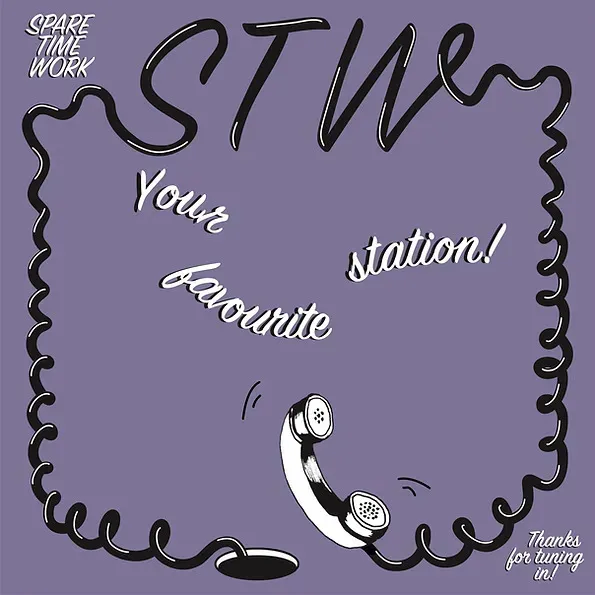
STW, your favourite station!
STW, your favourite station! functioneert als een radioprogramma. Een boek dat lyrisch proza uitzendt van We make stuff up for a living (een CV medley) tot COMPUTER_SONG, een ceremoniële quiz met Adult Hood & Young als protagonisten, een grillige anekdote van iemand die zich ergert aan een Call Service, en meer! Thanks for tuning in!

Unbidden Tongues #10: Professional Agitator
From the beginning, Unbidden Tongues has claimed to publish 'previously produced yet relatively uncirculated work by cultural practitioners busy with questions surrounding civility and civic life-particularly in relation to language and its administration.' However, over the course of the first nine issues, the 'civic' aspect has been relatively less pronounced, though undeniably subtextual. As such, Professional Agitator-a publication that includes two landmark feminist articles by Jo Freeman-is an attempt to bring civic responsibility more overtly to the surface. While first penned in the 1970s, the articles have a timely relevance, not only because, shockingly, many of the issues on the bill for the women's movement at Freeman's time of writing-employment discrimination, affordable childcare, reproductive rights and sexuality- are back on the table in the U.S. and elsewhere with full force, but also because, in thinking intersectionally as the movement taught me to do, we find ourselves in a moment of necessary and urgent mobilisation for Palestine; with speaking up and out being reprimanded with various forms of organised silencing.
(From the foreword)

Clipping 2: Sum, Parts
Clipping 2: Sum, Parts brings together transcripts, commissioned texts, studies, and personal reflections that explore how transformation is central to building archives that remain alive through time. Clipping, in sonic terms, signals distortion—moments when excess pushes beyond clarity and opens new spaces of possibility.
The issue features contributions by Monique Todd, Andrea Zarza Canova, Cleo Tsw, Zahra Malkani, meLê yamomo, Melisa Cenik, Golnoosh Heshmati, Voice as Landscape (Alec Mateo and Lorenzo García-Andrade Llamas), Atiyyah Khan, Ibelisse Guardia Ferragutti, Femke Dekker, and Alice Twemlow. It is edited by Federica Notari and Cleo Tsw, designed by Catherine Hu and Cleo Tsw, and printed and bound by No Kiss.

Nothing About Interior Architecture
Javier Fernández Contreras, Youri Kravtchenko and 1 more
Often dissident, sometimes adherent, Nothing About is, in essence, indefinable because it is adaptive and fluid. Speculative or hands-on, this discipline – if we can call it that – displays all the ambivalences of our contemporary lifestyles: superficial and profound, profane and divine, present everywhere and nowhere, and often regarded as futile, even though it could nonetheless destroy the most beautiful of insides. This book brings together a variety of intellectual tools and insights – polysemic and ambiguous, bespoke and improvised, ornamental and criminal, spanning media, technology, the arts and other, often undefined fields – that analyze the impact of the discipline on contemporary design. In the end, what makes Nothing About charming is that this inside – insofar as it is still defined as such – has only the humble ambition of accompanying beings, both animate and inanimate, within their environment, like a friend who is never far away.
Introduction by Javier Fernández Contreras. Text contributions by Daniel Zamarbide, Line Fontana & David Fagart, Valentin Dubois & Bertrand Van Dorp, Camille Bagnoud & Ahmed Belkhodja, Javier F. Contreras & Roberto Zancan, Paule Perron, Philippe Rahm, Youri Kravtchenko, Leonid Slonimskiy, Simon Husslein, Vera Sacchetti, Jan Dominik Geipel, Valentina De Luigi, Jean-Pierre Greff.

Mousse #94
Petrit Halilaj and Danh Vo in conversation; Forensic Architecture (Eyal Weizman, Nour Abuzaid, and Elizabeth Breiner); Gabrielle Goliath; Edward W. Said; Shumon Basar; Dani Blanga Gubbay; Yvonne Rainer; Thomas Eggerer and Jochen Klein; Tobias Pils; Travis Jeppesen...
Collective intelligence (along with its wildly popular counterpart, brain rot) is a recurring subject of late. This issue is woven together through reflections on methodologies of the collective, larger-than-ourselves dynamics and "what goes unuttered (of, perhaps, what is painfully unutterable)," as Zoé Samudzi writes about Gabrielle Goliath—whose project for the South African pavilion at the upcoming Venice Biennale has been cancelled by the Arts and Culture Minister of her country for being "divisive." We stand in solidarity with the artist. Forensic Architecture's Eyal Weizman speaks of new ways of detecting "hyper-relations" as strategies to confront systemic violence. Edward W. Said, in his crucial 1993 essay "Speaking Truth to Power" (reprinted here), argues that "the intellectual's voice is lonely, but it has resonance because it associates itself freely with [. . .] the common pursuit of a shared ideal." And in our Curators section, Shumon Basar memetically reaffirms that now more than ever, "Comment is king."
Let's not shy away from commenting.
This issue comes with different covers, randomly distributed.

Plastic: A Poem
Set during a single twelve-hour night shift in an injection molding factory, plastic is a book-length poem exploring the life of the industrial worker turned poet.
Bringing together memoir, ekphrasis, and satire, plastic is based on Matthew Rice’s experience working in a plastic molding factory for ten years. Illustrating alienated twenty-first-century Irish labor in poetic form, plastic engages with the inflictions and implications of a “post-industrial,” “post-Troubles” society, all while weaving in depictions of factory work from literature, film, and the visual arts.
Time-stamped to highlight the claustrophobia of the worker’s experience, Rice meditates on masculinity, sectarianism, and intergenerational trauma. But at its core is a poem about feeling a calling while being submerged in the world of menial labor—making plastic airplane parts by night, making poetry by day.
Invoking the brevity of Seamus Heaney, plastic is an expansive and imaginative poem that offers the working class a grace, dignity, and truth not often found in contemporary literature.
MATTHEW RICE was born in Belfast. He holds an MA in poetry from Queen’s University Belfast and is currently undertaking a PhD at the Seamus Heaney Centre at Queen’s. His debut collection, The Last Weather Observer, was published in 2021 to critical acclaim, highly commended for the Forward Prize for Best First Collection, and included in the Arts Council of Northern Ireland’s top ten books of the year.

The Collected Writings (1991–2024) of a Mortal to Death
No Place Press is collaborating with Jalal Toufic on an ambitious publishing project: The Collected Writings (1991–2024) of a Mortal to Death: Jalal Toufic. Spanning three volumes of more than six hundred pages each, the series gathers re-edited versions of his earlier works alongside two newly written books, arranged and organized by the author himself. For new readers, the volumes provide an introduction to Toufic’s central concepts—including the withdrawal of tradition past a surpassing disaster, radical closure, silence-over, the 180-degree over-turn, and the dancer’s two bodies—while for longtime readers they offer a comprehensive view of more than three decades of thought, presented in their most rigorous and fully articulated form. Yet, in keeping with Toufic’s practice—which participates in untimely collaboration (including with future filmmakers, thinkers, and artists) and abides in the suspension of the avenir of messianism/Mahdism—some of these works remain forthcoming even after their inclusion in the Collected Writings.
Volume 1 (2025) includes newly revised editions of Toufic’s first three books—Distracted (1991/2003); (Vampires): An Uneasy Essay on the Undead in Film (1993/2003); and Over-Sensitivity (1996/2009)—together with the script Jouissance in Postwar Beirut (2014) and, new, The Unreviewed Writings of a Peerless Thinker (2024).

Spike #86 – Salad Days!
Spike #86 is turning to the wild season of youth – life’s Salad Days.
Forget all the Boomer panic about a generational crisis; the kids are alright, living out our hyperconnected present to its strangest limits. New kinds of aesthetics, of activism, of entrepreneurship; new images as much as new perspectives on what images are; and, above all, a new, very quantum attitude towards fact and fiction, history and the future: young people are modeling how to be in our very confused times – and producing some of the most interesting forms of culture we’ve ever seen.
Featuring a Zoomer’s guide to the Slopgeneration; an essay of on being young at art in the Instagram age; a rundown of contemporary art’s nepo babies; reality checks on culture’s obsessions with youth and dying young; portraits of couture-sculptor Tenant of Culture, Turner Prize-nominated photographer Rene Matić, e-waste sculptor Brian Oakes, and Austrian painter Lukas Posch; send-ups of teenage fiction’s ecstatic weirdness and youth-quakers’ political promise; a critique from Silicon Valley of the industrialization of young risk-taking; art’s perfect Los Angeles metaphor; and a splash of back-page advice: “You shouldn’t be fun at twenty-one. You should be tortured.”

Black Ark
The point of departure for the book «Black Ark» with Lee “Scratch” Perry (1936–2021), a Jamaican musical and visual artist who was based in Switzerland, is a detailed inventory of photographs and writings (Spring 2021) from the Black Ark Studios in Kingston, Jamaica, where Lee produced his music from 1973 on. He was a seminal pioneer of dub, an electronic subgenre of reggae that uses sampling, looping, remixing, reverb and echoes to create new songs as well as rework and appropriate pre-recorded songs and tracks.
Black Ark Studios was one of the cradles of dub. It’s also where Lee “Scratch” Perry’s musical approach found an enduring visual counterpart in the form of continuously evolving mural paintings and drawings as well as shape-shifting assemblages of records, instruments, found objects, posters, newspaper and magazine clippings, and appropriated books. The artworks form actual layers upon layers that are rhizomatically intertwined with the studio building itself as well as with the furniture inside—and with Perry’s biography and persona.
Perry created his very own, dense and eclectic world—a world that is documented in «Black Ark», before it disappears for good: the premises have recently been sold. The photographic documentation of the studio was supplemented by efforts to secure and preserve Perry’s cultural objects as part of a joint project with various cultural institutions.
«Black Ark» which reflects the rhythm and layering effects of collage both in its content and the materials used to craft the book. Perry was involved in the conception of the book in its early stages. It also interweaves various media and chronologies. The new photographs of the Black Ark Studios will be juxtaposed with stills from old documentaries and archival photos.
The idea of a “house” serves as both a working hypothesis and a metaphor. It will be the starting point and endpoint of various thematic strands, both visual and textual: for example, the book will explore the Black Ark as a “spiritual yard” in the context of African diaspora, as well as looking into archeomusicological aspects. Furthermore, extended captions by Perry’s biographer will provide the backdrop for a kaleidoscopic panorama of Perry’s eclectic and ingenious work.

Insula
Insula est un roman d’anticipation aussi intime que spéculatif qui mêle autofiction, confession intime, esthétique queer, jeu vidéo, et une formidable vision apocalyptique du monde contemporain. Insula (île, en latin), c’est d’abord le nom d’un jeu clandestin de réalité augmentée d’un nouveau genre : il suffit d’ingérer une pilule stupéfiante et illégale pour accéder à la simulation. Théo, le narrateur, en apprend l’existence lors d’une fête de cruising queer, au sommet d’un immeuble désaffecté du centre de Londres, dans une atmosphère d’apocalypse. Un garçon s’effondre à ses pieds quelques minutes après avoir consommé la substance, et pleure des larmes de sperme. Mais Théo doit tout interrompre pour se rendre au chevet de son père mourant, dans un hôpital parisien. C’est le moment de la dernière nuit, du dernier souffle et des derniers aveux. Le mot insula revient, cette fois dans la bouche des médecins, pour désigner une partie flottante du cerveau ravagée par la maladie, comme une île qu’on a dans la tête. Alors que les médias annoncent la disparition de plusieurs personnes qui auraient pris une pilule d’insula, l’étau se resserre sur Théo qui se résout à son tour à prendre un cachet prohibé avec l’intuition que les avatars ne sont que des fantômes, et qu’il pourra ainsi retrouver son père dans l’autre monde.
Ce roman aux accents dantesques (vision d’un enfer digital qui n’est que le double du monde réel), entre vertige technologique et exploration du désir, est marqué par la pensée critique du réel et la pop culture (Final Fantasy, Kanye West). Il ouvre un univers parallèle pour raconter l’histoire d’une traversée intime, convoquer des époques, des territoires et des identités multiples, dans une seule et même histoire qui navigue entre témoignage et fantasme. Dystopie, histoire d’amour et de fantômes, enquête et cauchemar, Insula est un portail entre plusieurs dimensions, le vrai et le faux, le réel et le digital, la vie et la mort.