Books
Books
published in 2020

Women in Concrete Poetry: 1959-1979
Mónica de la Torre, Alex Balgiu
An expansive anthology focused on concrete poetry written by women in the groundbreaking movement’s early history. It features 50 writers and artists from Europe, Japan, Latin America, and the United States selected by editors Alex Balgiu and Mónica de la Torre.
Women in Concrete Poetry: 1959-1979 takes as its point of departure Materializzazione del linguaggio—the groundbreaking exhibition of visual and concrete poetry by women curated by Italian feminist artist Mirella Bentivoglio for the Venice Biennale in 1978. Through this exhibition and others she curated, Bentivoglio traced constellations of women artists working at the intersection of the verbal and visual who sought to “reactivate the atrophied tools of communication” and liberate words from the conventions of genre, gender, and the strictures of the patriarchy and normative syntax.
The works in this volume evolved from previous manifestations of concrete poetry as defined in foundational manifestos by Öyvind Fahlström, Eugen Gomringer, and the Brazilian Noigandres Group. While some works are easily recognized as concrete poetry, as documented in canonical anthologies edited by Mary Ellen Solt and Emmett Williams in the late ’60s, it also features expansive, serial works that are overtly feminist and often trouble legibility. Women in Concrete Poetry: 1959-1979 revisits the figures in Bentivoglio’s orbit and includes works by women practicing in other milieus in the United States, Eastern Europe, and South America who were similarly concerned with activating the visual and sonic properties of language and experimenting with poetry’s spatial syntax.
Artists and writers include Lenora de Barros, Ana Bella Geiger, and Mira Schendel from Brazil; Mirella Bentivoglio, Tomaso Binga, Liliana Landi, Anna Oberto, and Giovanna Sandri from Italy; Amanda Berenguer from Uruguay; Suzanne Bernard and Ilse Garnier from France; Blanca Calparsoro from Spain; Paula Claire and Jennifer Pike from the UK; Betty Danon from Turkey; Mirtha Dermisache from Argentina; Bohumila Grögerová from the Czech Republic; Ana Hatherly and Salette Tavares from Portugal; Madeline Gins, Mary Ellen Solt, Susan Howe, Liliane Lijn, and Rosmarie Waldrop from the US; Irma Blank and Ruth Wolf-Rehfeldt from Germany; Chima Sunada from Japan; and Katalin Ladik and Bogdanka Poznanović from the former Yugoslavia.

Homophone Dictionary
Homophone Dictionary was originally a file that is compiled by the now 96-year-old former schoolteacher Susan Nixon. She has build up many collections throughout her life, almost all of them exist out of objects, except one: after her retirement she compiled a word document that by now exist out of almost 1000 homophones; two, or more words that you pronounce similar but have a different meaning, often the spelling is also different.
The document is structured as a dictionary and the homophones are illustrated with examples that are based on autobiographical information. The structure of Homophone Dictionary also refers to speech therapy exercises and concrete poetry.
“As a student nurse learning medical terminology, I became fascinated with understanding the roots of words. When I had a young family, words were a principal source of entertainment: it was not unusual for one of the children to slip from their chair at the dinner table and fetch a dictionary in order to settle a dispute or satisfy someone’s curiosity. Then I became a teacher and brought this love of words into the classroom. My habit of word collecting became the children’s habit – my pupils became ‘word-lovers’ and ‘list-makers.’
I casually collected homophones for years. When introducing homophones into the classroom, the kids found definitions dull; the typical reaction was, ‘Yes, but give me a sentence using the word!’ and this idea emerged: a book of sentences demonstrating the meanings of homophone pairs or sets.”
Offset print
20,4 × 12,4 cm
edition of 500

one long continuous line or a thought that dissolves into the distance
A short text or a long line written by Mette Edvardsen for Etcetera magazine (June 2018) on an invitation to elaborate on her approach to text, writing and speech from a choreographic point of view. Held by a cardboard cover, the text is here published on its own as a very slim book.

Moments Before The Wind
Moments Before the Wind is a heterogeneous collection of notes on scenography that offers a glimpse into the poetics and artistic practice of Jozef Wouters. These reflections on space, scenography, art making and institutional critique have developed over the years as they were written out loud in various contexts. Now settling on the page among built and unbuilt spaces, they’re an invitation to the reader to think along or against, and think up space for oneself. Edited by Jeroen Peeters; graphic design by Filiep Tacq.
Jozef Wouters is a scenographer and theatre maker based in Brussels, who develops work in collaboration with his Decoratelier. Decoratelier is also a workplace for set designers and artists, and provides room for cross-disciplinary ventures and social experiment.

Le Chauffage — Issue #1
Le Chauffage (french for “The Heater”) is an artist-run publication based in Brussels. It is conceived as a cross-continental, community oriented platform. Bringing together the work and writing of artists / friends from different cities, Le Chauffage intends to spark discussions and fuel casual forms of critical discourse.

If UR Reading This It's 2 Late
The first monograph on the work of artist Tony Cokes, creating a visual cartography of a body of moving image work that spans twenty years.
Tony Cokes's video works are eviscerating critiques and affective art works, bringing together color theory, sound, music, and texts, and quoting a polyphony of voices including Aretha Franklin, Mark Fisher, David Bowie, Public Enemy, and Donald Trump. Combining political and social commentary with cultural theory and a critique of capitalism, Cokes's works viscerally confront the social condition, particularly the prejudices and threats suffered by black subjects. This book is the first monograph on his practice, creating a visual cartography of a body of work that spans twenty years.
It features four critical pathways into Cokes's decades-long practice, with essays contributed by notable academics, and conversations between Cokes and artist Kerry Tribe. Cokes's work deals with mediation and distribution, and the book itself becomes another conduit for the dissemination of theory, critique, and counter-narrative—a process that Cokes so powerfully engages in as an artist.
This book accompanies Cokes's solo exhibition, If UR Reading This It's 2 Late: Vol. 1–3, across three international art institutions: Goldsmiths Centre for Contemporary Art, London; Carpenter Center for the Visual Arts, Harvard University; and ARGOS centre for audiovisual arts, Brussels.

When My Body Was A Clinched Fist
"Back in the day when KRS-One intoned —The Bridge is over!— he did not prefigure a poet from Queens of the fierce attitude and intellectual magnitude of Enzo Silon Surin. WHEN MY BODY WAS A CLINCHED FIST gives the Heisman to such a refrain with lyrical power-packing poetics that settles the score with a succinct— Not! No the Bridge is not over, for Surin's Queens is alive and well and under the gaze of a master observer who eulogizes lives that though at times are battered have always mattered.
Enzo Silon Surin's poems get you caught up in the deeply personal experiences of growing and visceral all-encompassing knowing from an acute witness of every breath and follicle of Black life from palm trees, sand and sea to street corner projects, suburban houses and fistfuls of black water. Surin writes about the confused and disconnected, trigger happy wannabes trapped by outdated notions of masculinity, the cracked head crackheads all held in the clutch of society's clinched fist through which the trauma that comes with being of color, addicted, broke, lost and tossed, is itself a clinched fist of black bodies caught in the Russian nesting doll America's clinched fists make.
WHEN MY BODY WAS A CLINCHED FIST is an elegy for 'the premature exits.' It is a blues for the black-on-black black and blue. Surin yields his pen like a microscopic scalpel whereby an autopsy of possibility is performed to un-clinch the remarkable bone gristle poetry in these unflinching heart-wrenching pages."—Tony Medina
Enzo Silon Surin, Haitian-born poet, educator, speaker, publisher and social advocate, is the author of two chapbooks, A Letter of Resignation: An American Libretto (2017) and Higher Ground. He is the recipient of a Brother Thomas Fellowship from The Boston Foundation and is a PEN New England Celebrated New Voice in Poetry. Surin's work gives voice to experiences that take place in what he calls "broken spaces" and his poems have appeared in numerous publications including Crab Orchard Review, Origins, Transition Magazine/Jalada, Interviewing the Caribbean, jubilat, Soundings East, The BreakBeat Poets: New American Poetry in the Age of Hip-Hop, and sx salon. Surin holds an MFA in Creative Writing from Lesley University and is currently Professor of English at Bunker Hill Community College and founding editor and publisher at Central Square Press. His debut full-length poetry collection is WHEN MY BODY WAS A CLINCHED FIST (Black Lawrence Press, 2020).

Salvage 8: Comrades, this is madness
The Salvage Editorial Collective on the Covid-19 crisis.
Including: ‘Mothering Against the World' by Sophie Lewis on ‘Momrades’, ‘The Bushes’ a new fiction by China Miéville, ‘Hookers and Other Angels’ photography from Juno Mac, ‘Prepared for the Worst’ by Richard Seymour on Disaster Nationalism, ‘Welfare State Populism and the “Left-Behind Left”’ by Kevin Ochieng Okoth, ‘A Glimmer of a Shell of a Husk’ by Maya Osborne; ‘The Phallic Road to Socialism’ by Sebastian Budgen; A newly translated interview with Daniel Guérin, ‘Nationalism After Coronavirus’ by Sivamohan Valluvan, ‘Striking in Striking Times: Capitalism’s Coronavirus Crisis’ by Gregor Gall, ‘Getting Dressed for a Pandemic’ by Camila Valle, ‘Out of the Iron Lung: A Miasma Theory of Coronavirus’ by Matthew Broomfield.
Poetry by Nisha Ramayya, this issue’s featured poet, and an interview with her conducted by Salvage poetry editor, Caitlín Doherty. Plus the return of the Salvage Editorial Collective perspectives pamphlet, and a postcard.
Salvage is a bi-annual journal of revolutionary arts and letters. Salvage is written by and for the desolated Left, by and for those sick of capitalism and its planetary death-drive, implacably opposed to the fascist reflux and all ‘national’ solutions to our crisis, committed to radical change, guarded against the encroachments of ‘woke’ capitalism and its sadistic dramaphagy, and impatient with the Left’s bad faith and bullshit.

Malibongwe: Poems from the Struggle by ANC Women
In the late 1970s, Lindiwe Mabuza, a.k.a. Sono Molefe, sent out a call for poems written by women in anc camps and offices throughout Africa and the world. The book that resulted, published and distributed in Europe in the early 1980s, was banned by the apartheid regime.
Authorised by the editor, this re-issue of Malibongwe re-establishes a place for women artists in the history of South Africa's liberation. These are the struggles within the Struggle: a book that records the hopes and fears, the drives and disappointments, and the motivation and resilience of women at the front lines of the battle against apartheid. Here we see the evidence, too often airbrushed out of the narratives of national liberation, of a deep and unrelenting radicalism within women; of a dream of a South Africa in which not only freedom reigned, but justice too.

Beauty Kit
BEAUTY KIT – AN ECO-EROGENOUS ART PROJECT by Isabel Burr Raty with contributions by Kristin Rogghe, Elke Van Campenhout, Gosie Vervloessem, Pablo Diartinez and Tim Vets, is an experimental catalog summarizing Isabel Burr Raty’s research on conceptualizing and manufacturing eco-erogenous para-pharmaceutical products. It tells the story of the BKFF, a mobile farm where she and other females harvest their orgasmic juices to produce beauty bio-products, used for treatments in the BK Spa, critically discussed in the BK Focus Group and moving forward into becoming a village, where every-body harvests each other. The catalog comes with contributing text, “Harvesting bodies – The Farm as Paradox” by Elle/Elke Van Campenhout, and other reflections on the project.
Isabel Burr Raty is a Belgian-Chilean artist, filmmaker, and Media Art History teacher in ERG (École de Recherche Graphique), living between Brussels and Amsterdam. She is currently developing her second feature film, about the colonial impact on Easter Island, and creating live art and new media installations that queer production understandings, such as the Beauty Kit Project. Her works have been shown internationally.

O Fortuna
In 2015, Jacob finds himself wandering the streets, swamps and cemeteries of New Orleans. Through his search for a man named Ignatius, 'O Fortuna' tells the story of his attempt to make a film. We discover the city’s unique atmosphere and meet a bizarre cast of characters who assist Jacob with his uncertain attempts at shooting scenes of DAT LIKWID LAND.

Piles of Bricks / Piles de briques
‘Piles of Bricks / Piles de briques’ by Bie Michels presents the working proces of her project ‘Bricks in Madagascar’. This project consists of two films, ‘La couleur de la brique’ and ‘Ingahy Kama’, the installation ‘Circular construction versus human body—referring to Toshikatsu Endo’, which she showed in Madagascar (October 2017) and Argos Brussels (May 2018), and the performance ‘Piles of bricks (working process)’, on which she will work 8 weeks before the book presentation and which will be performed at that moment.
Besides images and stills, five writers deliver a contribution in their own working field related to the project: Hobisoa Raininoro (Art assistent and former director of CRAAM (Centre de Ressources des Arts Actuels de Madagascar, MG), Rafolo Andrianaivoarivony (Professor History University of Antanarivo, MG), Petra Van Brabandt (Doctor philosophy Sint Lucas Antwerp, B), Gwyn Campbell (Professor History Mc Gill University, CA) and Nanne op ‘t Ende (writer, NL)
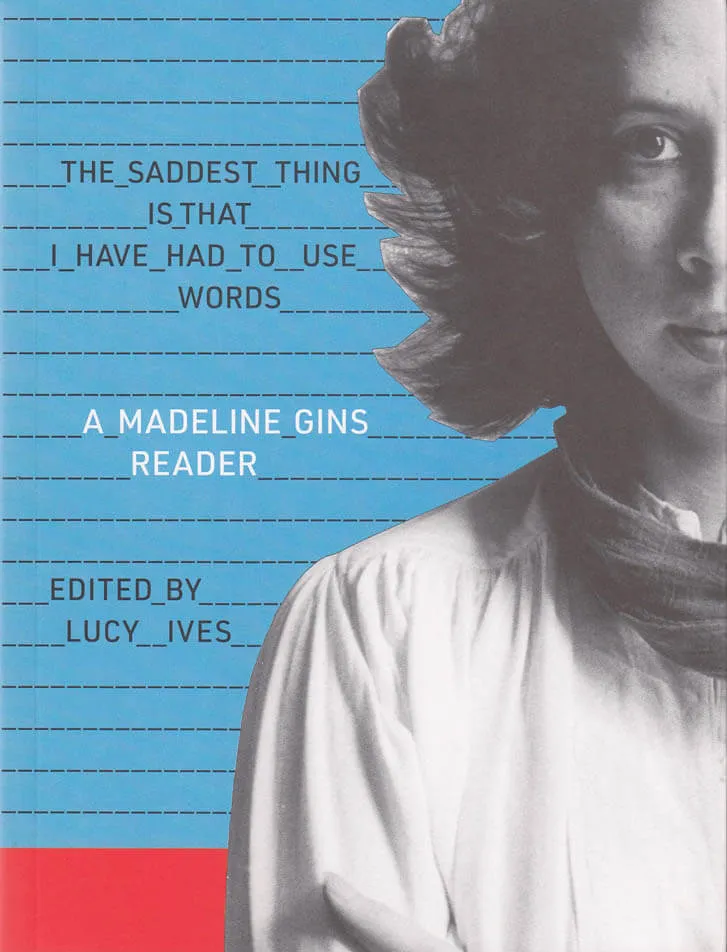
The Saddest Thing Is That I Have Had to Use Words: A Madeline Gins Reader
Poet, philosopher, speculative architect and transdisciplinary artist, Madeline Gins is well known for her collaborations with her husband, the artist Arakawa, on the experimental architectural project Reversible Destiny, in which they sought to arrest mortality by transforming the built environment. Yet, her own writings — in the form of poetry, essays, experimental prose and philosophical inquiries — represent her most visionary and transformative work. Like Gertrude Stein before her, Gins transfigures grammar and liberates words. Like her contemporaries in conceptual art, her writing is attuned to the energized, collaborative space between reader and page.
The Saddest Thing Is That I Have Had to Use Words: A Madeline Gins Reader is a revelatory anthology, edited and with an introduction by the writer and critic Lucy Ives. It brings never-before-published poems and essays together with a complete facsimile reproduction of Gins' 1969 masterpiece, WORD RAIN (or A Discursive Introduction to the Intimate Philosophical Investigations of G, R, E, T, A, G, A, R, B, O, It Says), along with substantial excerpts from her two later books What the President Will Say and Do!! (1984) and Helen Keller or Arakawa (1994). Long out of print or unpublished, Gins' poems and prose form a powerful corpus of experimental literature, one which is sure to upend existing narratives of American poetics at the close of the 20th century.
Edited by Lucy Ives.
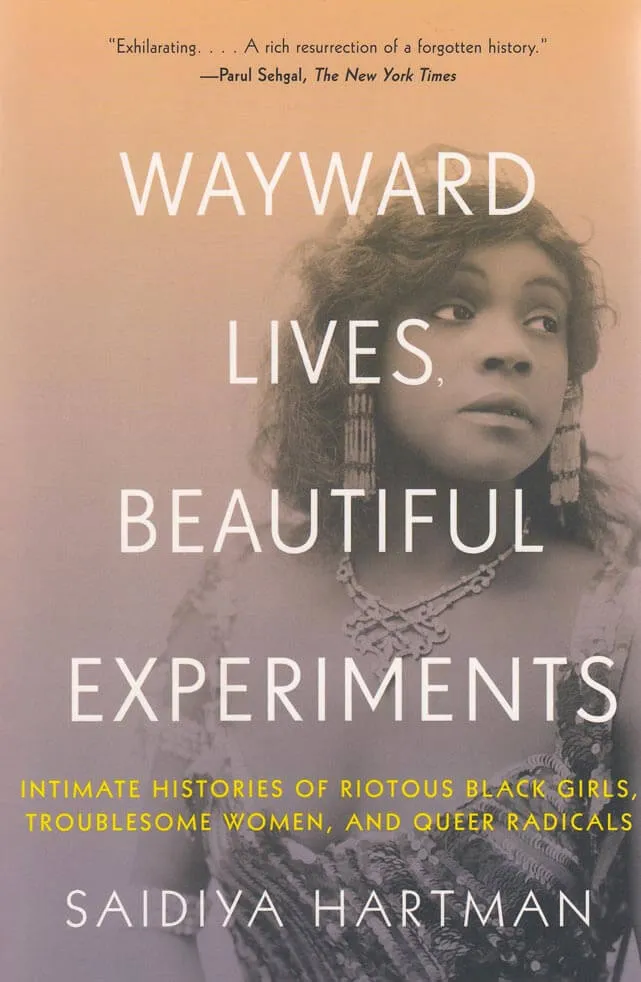
Wayward Lives, Beautiful Experiments
Wayward Lives, Beautiful Experiments examines the revolution of black intimate life that unfolded in Philadelphia and New York at the beginning of the twentieth century. In wrestling with the question of what a free life is, many young black women created forms of intimacy and kinship indifferent to the dictates of respectability and outside the bounds of law. They cleaved to and cast off lovers, exchanged sex to subsist, and revised the meaning of marriage. Longing and desire fueled their experiments in how to live. They refused to labor like slaves or to accept degrading conditions of work. Here, for the first time, these women are credited with shaping a cultural movement that transformed the urban landscape. Through a melding of history and literary imagination, Wayward Lives, Beautiful Experiments recovers these women's radical aspirations and insurgent desires.
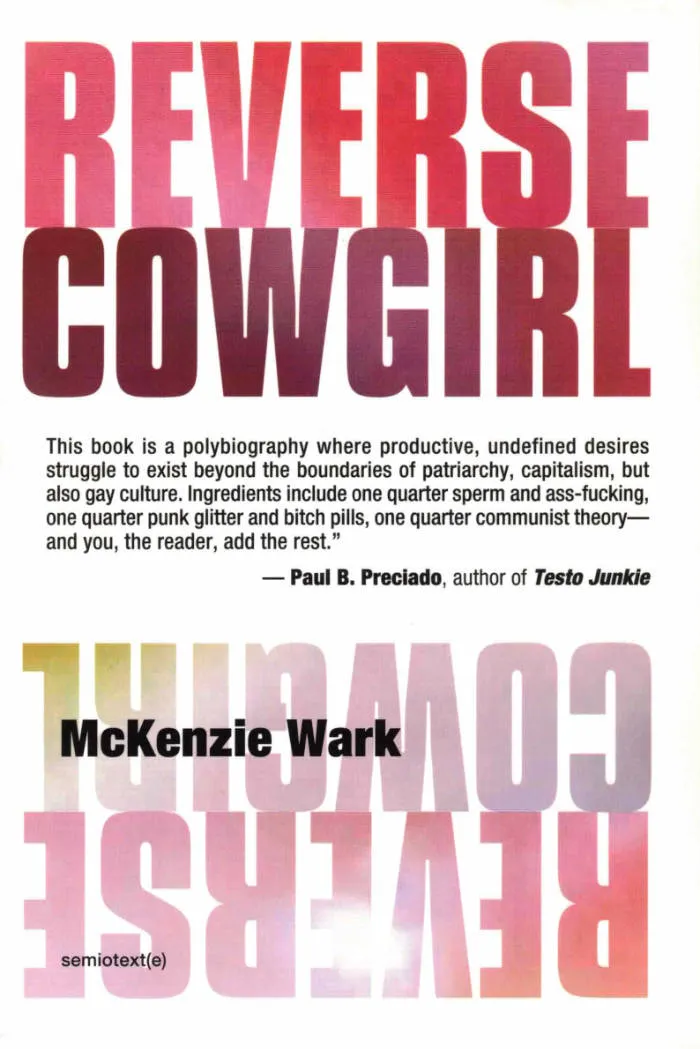
Reverse Cowgirl
McKenzie Wark invents a new genre for another gender: not a memoir but an auto-ethnography of the opacity of the self.
Another genre for another gender.
What if you were trans and didn't know it? What if there were some hole in your life and you didn't even know it was there? What if you went through life not knowing why you only felt at home in your body at peak moments of drugs and sex? What if you expended your days avoiding an absence, a hole in being? Reverse Cowgirl is not exactly a memoir. The author doesn't, in the end, have any answers as to who she really is or was, although maybe she figures out what she could become.
Traveling from Sydney in the 1980s to New York today, Reverse Cowgirl is a comedy of errors, chronicling the author's failed attempts at being gay and at being straight across the shifting political and media landscapes of the late twentieth century. Finding that the established narratives of being transgender don't seem to apply to her, Wark borrows from the genres of autofiction, fictocriticism, and new narrative to create a writing practice that can discover the form of a life outside existing accounts of trans experience: an auto-ethnography of the opacity of the self.

Matters of Feminist Practice
Matters of Feminist Practice, edited by Poupeh Missaghi and Karla Kelsey, brings together scholars, writers, poets, and artists of different identities and backgrounds to confer on the urgent topic of “feminist practice” through seven topics: the body, the quotidian, hybridity, language, documentation, environment, and conflict.
In the twenty-five scholarly and creative-critical pieces included in our introductory volume, each contributor brings unique visions, insights, approaches, voices, and forms to launch the conversation, which will continue to unfold online at mfpjournal.com.
Contributors to the inaugural issue include: Alexis Almeida, Mary-Kim Arnold, Mildred Barya, Teresa Carmody, Julie Carr, Serena Chopra, Caroline Crumpacker, Lynne DeSilva-Johnson, Marcella Durand, Jennifer Firestone, Yanara Friedland, Carla Harryman, Madhu Kaza, Petra Kuppers, Jean Lee, Rachel Levitsky, Megan Madden, Saretta Morgan, Lida Nosrati, Adrienne Perry, Frances Richard, Kat Savino, Celina Su, and Rachael Guynn Wilson.

Forms Of Life Of Forms
FORMS OF LIFE OF FORMS brings artistic research into form – not merely as an aesthetic question but as a social and political one. Indeed, there are no politics without form! With Forms of Life, Rob Ritzen curated several “Moments” that assembled works, collective readings, and other references into a single installation. This publication reshuffles documentation of these “Moments” as a visual reflection of the trajectory of this research.
Rob Ritzen works as a curator with a background in philosophy. His curatorial practice is focusing on self-organized and cooperative formats. Consciously positioned at the margins of established institutions and outside of market-oriented spaces, his practice is placed in close association with communities of cultural practitioners. His initiatives are attempts to reconfigure the politics of making art and alternative forms of production and presentation.

ROT
ROT is a publication reflecting the research “Wicked technology/Wild fermentation,” by Sara Manente that focuses on forms and practice of fermentation as ways to rethink bodies and their making. This glossy magazine performs research, aiming to infect the reader, and questioning how to spread, publish, and help the work survive.
Sara Manente is a performance artist, dance maker and researcher born in Italy and living in Brussels. She is interested in narrowing the distance between the performer, the audience, and the work. Her research starts from a dance practice that problematizes perception, translation, and ways of doing. Her work comes out in hybrid forms: book launch, 3Dfilm, written text, interview, choreographic piece, workshop, telepathic experience, collaboration, et al.

The Interjection Calendar 005
Emily Pope, Christiane Blattmann
For the Interjection Calendar each month Montez Press invites an artist, a writer, a poet or a doer of some sorts to say things. All 12 pieces have introspection and reflection in common. They are a subjective overview of writing in the expanded field of contemporary art and writing in the year 2019. This is the Interjection Calendar 2019, the fifth collection in this series.
With contributions by sabrina soyer, Lisa Robertson, Hatty Nestor, Adrianna Whittingham, Sondria, Claudia Pagès, Laetitia Paviani, Bella Milroy, Georgina Tyson, Son Kit, Alix Jean Vollum, Rene Matic and bleubaglife.
Find the last 12 PDF's on montezpress.com.

Night Philosophy
Night Philosophy is collected around the figure of the child, the figure of the child not just as a little person under the tutelage of adults, but also the submerged one, who knows, who is without power, who doesn’t matter. The book proposes a minor politics that disperses all concentrations of power. Fanny Howe chronicles the weak and persistent, those who never assimilate at the cost of having another group to dominate. She explores the dynamics of the child as victim in a desensitized era, when transgression is the zeitgeist and the victim–perpetrator model controls citizens.
With an afterword by Chris Kraus.

A Sand Book
Deadpan, epic, and searingly charismatic, A Sand Book is at once relatable and out-of-this-world. In poems tracking climate change, bystanderism, state murder, sexual trauma, shopping, ghosting, love, and the transcendent shock of prophecy, A Sand Book chronicles new dimensions of consciousness for our strange and desperate times. What does the destruction of our soil have to do with the weather in the human soul? From sand in the gizzards of birds to the iridescence on the surface of spilt oil, from sand storms on Mars to our internet-addicted present, from the desertifying mountains of Haiti to Sandy Hook to Hurricane Sandy to Sandra Bland, A Sand Book is both a travelogue and a book of mourning.