Fiction
Fiction

Artificial Gut Feeling
If winning can only occur in a competition between equal opponents, someone who isn’t equal will need to adopt a different strategy and let go of the promise, or the curse, of victory. Anna Zett takes up the challenge in this collection of personal science fiction, registering the traces systems of power leave in the body, in its locomotory, nervous and digestive systems. Zett’s voice appears in several textual guises, addressing authority, resistance, trauma and the physicality of language. Dedicated to the feminist revolution, the post-socialist subject of Artificial Gut Feeling questions logocentric and capitalist beliefs about the economy of meaning. This book gathers together fists, guts and brains to gain a deeper understanding of the non-verbal roots of dialogue.
"This being is able to transform movement into speech. It winds itself about inside me like a thick snake and I have to use all my strength to let it spin and do what it does. When I wilfully try to stop it, it begins to whisper words to me and that is even more unpleasant. If I were to associate this gut feeling with an emotion, I would say disgust. But this disgust is not directly linked to your name."—Anna Zett

Drones and Dresses

Retrospective
Retrospective is a comedy-science-fiction novelette about “faggotry” and the art world; depicting a retour-au-passé in contemporary painting and waving to some of the most beautiful homosexuals on Earth. Flaunting otherness, the alert reader can follow a clerk of The Land of Sculptures whilst he encounters the pretty faces of The Painter, The Foreign Painter, The Tyrolese Painter and other people doing art and drugs.
Retrospective includes “Thumbs-Up”, a superficial analysis of the normalisation of gayness; “Why Homos Are Better”, a masterpiece of investigative journalism in two parts, that originally appeared in Agony 2 (circa 1988–93), a zine edited by B. Boofy and William Bonifay; a drawing by Jurgen Ots; a photograph by César Segarra; and a poem by Lars Laumann.
Alberto García del Castillo writes genre fiction and nonfiction about communities and queer, performs his own and other people's writings, and collaborates in multiple configurations. He has published his writing in Girls Like Us, co-edited Midpoint (Théophile's Papers, 2016) and his two novels Merman (2017) and Retrospective (2014) were published by Shelter Press. Alongside Marnie Slater, is co-curator of Buenos Tiempos, Int.

Le Large
This light, pocketbook format publication by After 8 Books gathers works by French artist Julie Beaufils, and three short stories commissioned for the occasion, dealing altogether with social tensions and emotional explosions.
The ink drawings by Julie Beaufils that form the core of the book, follow a logic of editing, accumulation and narrative incompleteness: the figures come from memories of films or TV series, as sediments of mass culture, or sometimes from personal observations and experiences crystallized in images. Shapes and figures develop as an ambivalent collection, informed by the weight and the vibration of lines and strokes.
This book aims at triggering the interpretation of these works, and at making their “reading” more complex, more playful too. Graphic designer Scott Ponik composed a visual story close to a manga, part abstraction, part emotion. The narrative and affective potential of the drawings is further activated by their free association with three short stories by Michael Van den Abeele, Buck Ellison, and Reba Maybury. Van den Abeele tells about the inner thoughts of a donor at the sperm bank; Buck Ellison’s story follows a few hours in the life of some girls in the San Francisco area, dealing with the cruelty and the naïvety of their relationships; while Reba Maybury proposes an erotic analysis of the connection between desire and capitalism.

Frozen Tears III
Texts By: Kristen Alvanson, Stuart Bailey, Stephen Barber, Mark & Steve Beasley, Karla Black, Marianna Botey, Jesse Bransford & Casey Mckinney, Charles Bronson, Paul Buck, David Burrows & Simon O'sullivan, Bonnie Camplin, Lisa Castagner, Ccru/Orphan Drift, Dennis Cooper, Michael Corris, Esther Planas, Karen Cunningham, Kim Coleman & Jenny Hogarth, Michael Cross/ M Satai, John Cussans, Enrico David, Anthony Davies, Lorenzo De Los Angeles Iii, Madeline Djerjian, Peter Donaldson, Ross Downes, Electric Six, Patricia Ellis, John Espinosa, Dick Evans, Keith Farquhar, Dan Fox, Luca Frei, Barnaby Furnas & Ivette Zieghelboim, Tony Garifalakis, Babak Ghazi, Ilana Halperin, Mark Harris, Iain Hetherington, Damien Hirst, Klara Hobza, Stewart Home, Rachel Howe, Mark Hulson, Andy Hunt, Andrew Hughes, Gareth Jones, Kevin Killian, Kool Keith, Steve Klee, The Knockouts, Pete Lewis, Cedar Lewisohn, Fiona Lumbers, Patricia Macormack, Andrea Mason, Natt Mellors, Anna Mitchell, N.R.K Mohammad/ Sos Newsrod/ Dan Thurwen, Gean Moreno, Hv Morton, Donal Mosher, Neil Mulholland, Patrick Mullins, Yuki Muruyama, Reza Negarestani, No Bra, Paul Noble, Bernard Noel, David Osbaldeston/Joe Devlin, Arthur Ou, Mike Pare, Chloe Piene, Esther Planas, Elizabeth Price, Adam Putnam, Harry Pye, Hillary Raphael, The Rebel, Steve Rushton/Hubert Czerepok, Amelia Saul/Jo-Ey Tang, Kenji Siratori, Craig Slee, Alison Smith, Emma Stark, John Strutton, Francis Summers, Rebecca Taylor, Simon Thompson, Mark Tichner, Ian Titus, Dan Torop, Jeffrey Vallance, Harlan D Wilson, Benny Zadik.

Frozen Tears II
Texts By: Kathy Acker, Mireille Andrès, Antonin Artaud, Dominique Auch, Ned Baldwin, Stephen Barber, Georges Bataille, Baudelaire, John Beagles, Mark Beasley, Dodie Bellamy, Alissa Bennett, Simon Bill, Jesse Bransford, R.A.Bransford Jr Esq, Paul Buck, Bonnie Camplin, Aline Bouvy/John Gillis, Dennis Cooper, John Cussans, Trinie Dalton, Sue De Beer, Brock Enright, Felix Ensslin, Dan Fox, Robert Garnett, Paul Green, Matthew Greene, Fernando Guerreiro, Pierre Guyotat, Ilana Halperin, Glen Helfand, Jacques Henric, Rachel Howe, Ben Kaleb Brantley, Seth Kelly, Kevin Killian, Christopher Knowles, Jennifer Krasinski, Cedar Lewisohn, Lorenzo De Los Angeles Iii, Rachel Lowther, Dave Martin, Karl Marx, Casey Mckinney, Gean Moreno, J.P. Munro, Paulina Olowska, Simon O¹Sullivan, Arthur Ou, Damon Packard, Mike Paré, Graham Parker, Wotjek Puslowski, Adam Putnam, Ian Rafael Titus, Eugène Savitzkaya, Eric Schnell, Amy Sillman, Allison Smith, Joanne Tatham/ Tom O'sullivan, Daniel Torop, Genya Turovsky, Banks Violette, Benjamin Weissman, Ivan Witenstein, Thom Wolf

Frozen Tears I
Texts By: Art & Language, Fabienne Audéoud, Dave Beech, David Burrows, Ccru, Jake Chapman, John Cussans, Johnny Golding, Inventory, Martin Mcgeown, Lucy Mckenzie, Esther Planas, Graham Ramsay, John Russell, Clara Ursitti, Andrew Williamson.

Head
Mo-Leeza Robert's novel Head describes the desperate future that clusters around Head Gallery like cockroaches swarming over a pig's head. It is at once critical and complicit, deluded and envious. Jerry-rigging saccharine sci-fi, with a leavened mush of curatorial artspeak, artists, collectors, hanger-ons and other art world actors explode in ecstasy, pain, or self-induced eradication – all, according to the whims of the Head Gallery, which remains an anonymous and inviolate force, the overseer of events and a selfless accumulator of prestige and wealth. Familiar contemporary artists are reanimated for the future, giving the events described an unsettling familiarity. Any reader familiar with the art world should feel both seduced, and infected. It is like Dickens but with laughs induced by our approaching extinction, and like Salò, written, directed and starred in by Barbara Gladstone.


Lover
A landmark work of lesbian literature, Lover was first published in 1972 by the now-defunct feminist press, Daughters, to tremendous critical acclaim. Emerging out of the women's and gay liberation movement alongside the early work of such writers as Rita Mae Brown and Jill Johnston, the novel features fictional and historical characters who run the gamut from saint to poor white trash, and who are by turn vulnerable and strong. One of the finest examples of early post-Stonewall lesbian fiction, Lover is poised to entice a new generation of readers.

The Faggots and Their Friends Between Revolutions
The Faggots and Their Friends Between Revolutions is a beloved queer utopian text written by Larry Mitchell with lush illustrations by Ned Asta, published by Calamus Press in 1977. Part-fable, part-manifesto, the book takes place in Ramrod, an empire in decline, and introduces us to the communities of the faggots, the women, the queens, the queer men, and the women who love women who are surviving the ways and world of men.
This new edition will feature essays from performance artist Morgan Bassichis, who adapted the book to music with TM Davy in 2017 for a performance at the New Museum, and activist filmmaker Tourmaline.

Quicksand
QUICKSAND was written to be an opera libretto. But it was written in the form of a novel....I am devoted to "mystery" stories. I read them one after another, mostly two or three times. Some of the best writers today are writing in this form. So, I thought that I would try to make an opera libretto from a mystery story, told verbatim. That is, the libretto and the novel would be the same: no scenes moved around or actions adapted to the proportions of a libretto, just tell the story the way it's told in the novel. But first I needed a novel....So that meant I had to write a mystery novel. Where do you start? The answer is: I always need a 'location' to be inspired to tell a story. Everything in the novel is true, except for a lot of the facts.

XYZT
Based on the author's experiences of living as an American in Iran, Kristen Alvanson's XYZT is a wildly imaginative dramatization of the idea of a "dialogue of civilizations" and its potentially outlandish ramifications. As part of an advanced technological test program, volunteers are shuttled back and forth between the US and Iran, hidden from the watchful eyes of immigration police and state bureaucracies. Each is given a single opportunity to be received by a local host and to have a brief authentic experience of what it means to live as “them” before being transported back home.
But far from heralding the bliss of mutual recognition, the experiment unleashes a series of displacements so disorienting that the fabric of reality begins to fray. Ordinary people become entangled in extraordinary situations, and everyday life bleeds into mythological encounters, alternate universes and dark psychedelic journeys in alien lands where the real and the imaginary are indistinguishable.
A treasury of tales told from multiple perspectives and in a multiplicity of styles, XYZT is an audacious cross-genre experiment, a firsthand memoir of what it means to see what "they" see, and a science-fictional, nonstandard engagement with anthropology in which cross-cultural encounters take on all the unpredictable features of a contemporary fairy tale.

Mother Reader
'My aim for Mother Reader has been to bring together examples of the best writing on motherhood of the last sixty years, writing that tells firsthand of the mother's experience.
Many of the writings in Mother Reader comment on and interpolate one another, in citations, in footnotes, in direct homage. As I was assembling this collection one text would lead to one another, treasure-hunt fashion, the clue provided by an acknowledgement or bibliography. And just as often the writing circles back.
In Mother Reader chapters are excerpted from autobiographies, memoirs, and novels; entries are lifted from diaries; essays and stories are culled from collections, anthologies, and periodicals. My project has been to assemble a compendium or sampler of these ''kindred spirit'' works on motherhood, so that readers, and especially mothers with limited time on their hands, can access in one volume the best literature on the subject and know where turn to continue reading." [Moyra Davey in the introduction]
Writings by Margaret Atwood, Susan Bee, Rosellen Brown, Myrel Chernick, Lydia Davis, Buchi Emeta, Annie Ernaux, Mary Gaitskill, Susan Griffin, Nancy Hutson, Mary Kelly, Jane Lazarre, Ursula K. Le Guin, Doris Lessing, Ellen McMahon, Margaret Mead, Vivian Montgomery, Toni Morrison, Tillie Olsen, Alicia Ostrker, Grace Paley, Sylvia Plath, Adrienne Rich, Sara Ruddick, Lynda Schor, Mira Schor, Dena Schottenkirk, Mona Simpson, Elizabeth Smart, Joan Snyder, Elke Solomon, Susan Rubin Suleiman, Alice Walker, Joy Williams, Martha Wilson, Barbara Zucker.
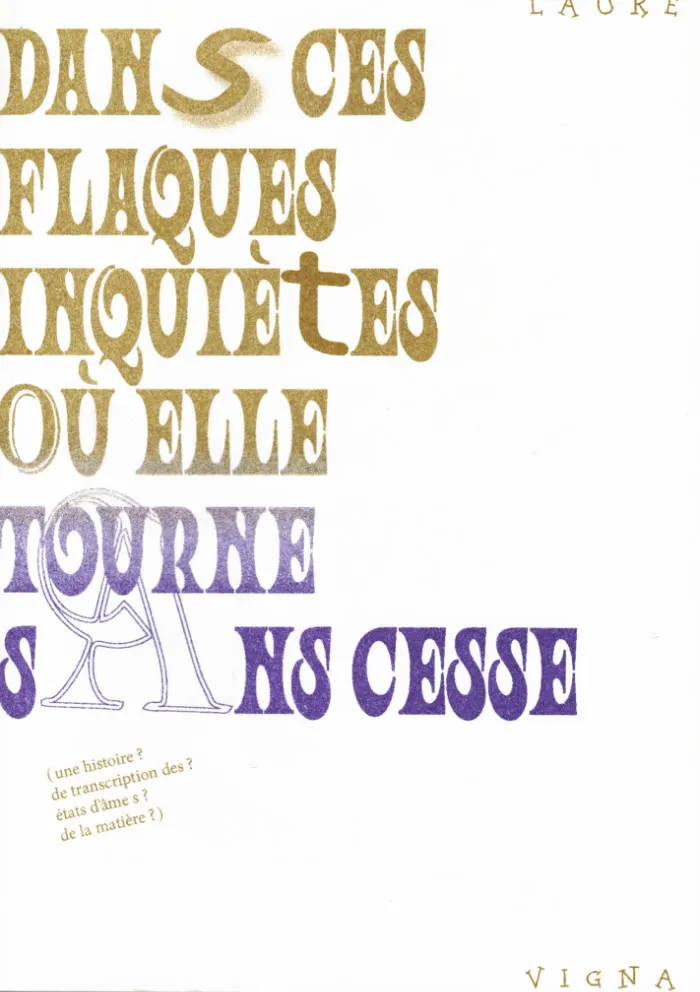
In These Worried Puddles / Dans ces flaques inquiètes
This bilingual edition in two booklets (French/English) brings together short texts and narratives by Laure Vigna, accompanied by notes from news media and scientific articles. Several narrators, with more or less abstract identities alternately representing materials, sculptural forms, or the author, seem to speak under the effect of their emotional states.
Sharing the same spaces of action and words, they merge throughout the text, forming only one physical body at the end. In a collaborative effort between Laure Vigna and graphic designer Roxanne Maillet, the publication reveals research conducted on typography and letters as body, receptacles, and spaces.
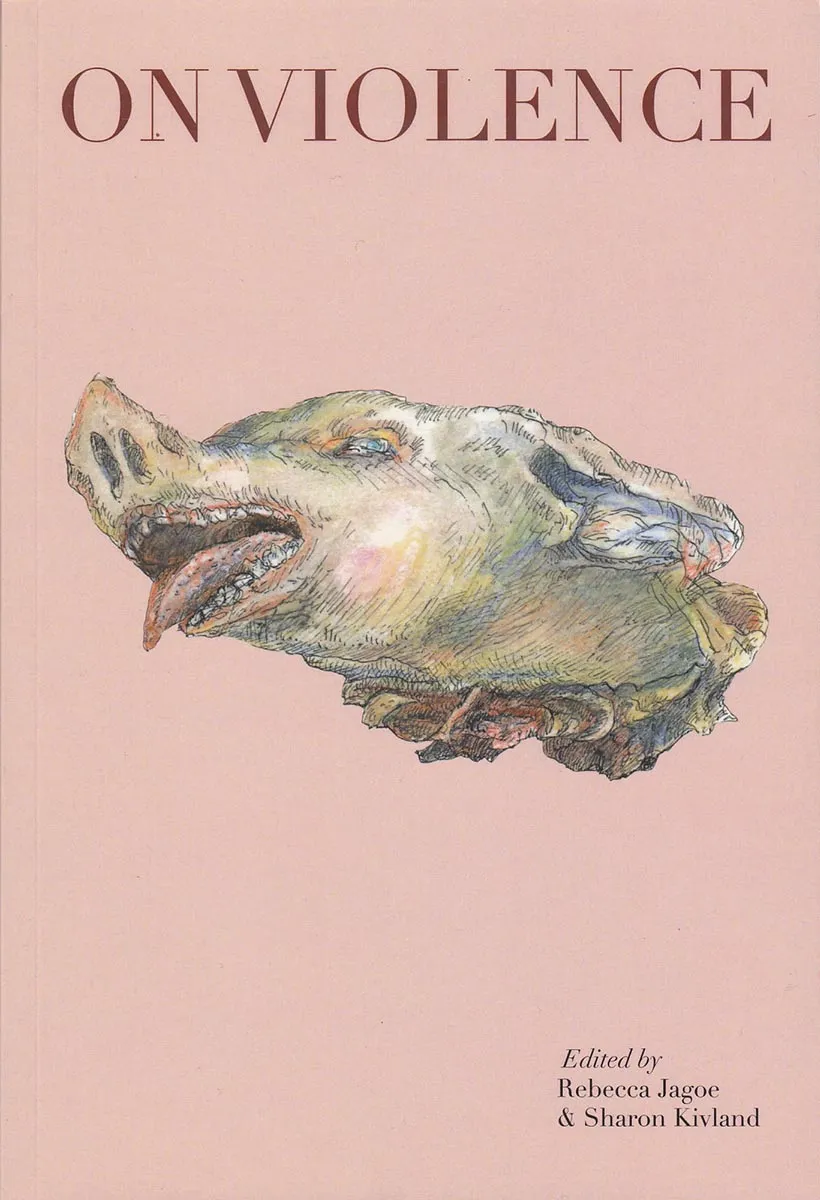
On Violence
Violence is in language and violence is language. The violence of language stratifies voices into those that matter and those that do not, using ideas of appropriate form and structure as its weaponry. It claims propriety and politeness are the correct mode of address, when urgency and anger are what is needed. Where languages intersect, hierarchies of language become means for domination and colonization, for othering, suppression, negation, and obliteration. The demand for a correctness of grammar, the refusal to see what is seen as incorrect, the dismissal of vernacular in favour of the homogenised tongue: all are violent. The narrative of history is a narrative of violence. The contributions herein refuse this narrative. They explore how violence permeates and performs in language, how language may be seized, taken back to be used against the overwhelming force of structural and institutional violence that passes as acceptable or normal. Violence may be a force for rupture, for refusal, for dissent, for the herstories that refuse to cohere into a dominant narrative.
Contributors: Travis Alabanza, Katherine Angel, Skye Arundhati-Thomas, Mieke Bal, Janani Balasubramanian, Elena Bajo, Jordan Baseman, Emma Bolland, Pavel Büchler, Paul Buck,Kirsten Cooke, Jih-Fie Cheng, John Cunningham, Andy Fisher, Caspar Heinemann, Jakob Kolding, Candice Lin, Rudy Loewe, Nick Mwaluko, Vanessa Place, Katharina Poos, Tai Shani, Linda Stupart, Benjamin Swaim, Jonathan Trayner, Jala Wahid, Isobel Wohl, Sarah Wood

Native Tongue
Originally published in 1984, this classic dystopian trilogy is a testament to the power of language and women's collective action.
In 2205, the Nineteenth Amendment has long been repealed and women are only valued for their utility. The Earth's economy depends on an insular group of linguists who "breed" women to be perfect interstellar translators until they are sent to the Barren House to await death. But instead, these women are slowly creating a language of their own to make resistance possible. Ignorant to this brewing revolution, Nazareth, a brilliant linguist, and Michaela, a servant, both seek emancipation in their own ways. But their personal rebellions risk exposing the secret language, and threaten the possibility of freedom for all.

Trouble on Triton
In a story as exciting as any science fiction adventure written, Samuel R. Delany's 1976 SF novel, originally published as Triton, takes us on a tour of a utopian society at war with our own Earth. High wit in this future comedy of manners allows Delany to question gender roles and sexual expectations at a level that, 20 years after it was written, still make it a coruscating portrait of "the happily reasonable man", Bron Helstrom - an immigrant to the embattled world of Triton, whose troubles become more and more complex, till there is nothing left for him to do but become a woman.
Against a background of high adventure, this minuet of a novel dances from the farthest limits of the solar system to Earth's own Outer Mongolia. Alternately funny and moving, it is a wide-ranging tale in which character after character turns out not to be what he - or she - seems.

CCRU writings 1997-2003
From before the beginning (which was also, according to them, already the end), the adepts of the Architectonic Order of the Eschaton have worked tirelessly to secure the past, present, and future against the incursions of Neolemurian time-sorcery, eliminating all polytemporal activity, stitching up the future, sealing every breach and covering every track. According to the AOE, the Ccru ‘does not, has not, and will never exist’. And yet….
The texts collected here document the Ccru’s perilous efforts to catalogue the traces of Lemurian occulture, bringing together the scattered accounts of those who had stumbled upon lagooned relics of nonhuman intelligence—a project that led ultimately to the recovery of the Numogram and the reconstruction of the principles of Lemurian time-sorcery—before disintegrating into collective schizophrenia and two decades of absolute obscurity.
Meshing together fiction, number theory, voodoo, philosophy, anthropology, palate tectonics, information science, semiotics, geotraumatics, occultism, and other nameless knowledges, in these pages the incomplete evidence gathered by explorers including Burroughs, Blavatsky, Lovecraft, Jung, Barker, J.G. Ballard, William Gibson, and Octavia Butler, but also the testimony of more obscure luminaries such as Echidna Stillwell, Oskar Sarkon, and Madame Centauri, are clarified and subjected to systematic investigation, comparison, and assessment so as to gauge the real stakes of the Time-War still raging behind the collapsing façade of reality.
One of the most compelling and unnerving collective research enterprises to have surfaced in the twentieth century, the real pertinence of the Ccru’s work is only now beginning to reveal itself to an unbelieving world. To plunge into the tangled mesh of these conspiracies, weird tales, numerical plagues, and suggestive coincidences is to test your sense of reality beyond the limits of reasonable tolerance—to enter the sphere of unbelief, where demonic currents prowl, where fictions make themselves real. Hyperstition.
Cybernetic Culture Research Unit was a name on a door in the Philosophy Department of Warwick University, UK, during the late 1990s. It was a rogue unit, blurring the borders between traditional scholarship, cyberpunk sci-fi, and music journalism. Its frenzied interdisciplinary activity, including the Virtual Futures and Virotechnology conferences and the journal Abstract Culture, disturbed Warwick's Philosophy Department, resulting in the termination of the unit.

Sad Sack
Sad Sack is a book of collected writing by Sophia Al-Maria, taking feminist inspiration from Ursula K. Le Guin’s 1986 essay ‘The Carrier Bag Theory of Fiction’; opposing ‘the linear, progressive, Time’s-(killing)-arrow mode of the Techno-Heroic.’ Encompassing more than a decade of work, Sad Sack tracks Al-Maria’s speculative journey as a writer, from the first seed of her ‘premature’ memoir, through the coining and subsequent critique of ‘Gulf Futurism’, towards experiments in gathering, containing, welling up and sucking dry.
For me this book is a bag... Like any single-use carrier bag – I disapprove. It shouldn’t exist, it contributes to pollution, it should be banned... And yet, in spite of the fact I know this book may be a waste product... I’m still writing, redacting, expanding... I’m still waiting, wasting, wanting. According to Ursula, ‘It is a human thing to do to put something you want, because it’s useful, edible, or beautiful, into a bag.' – Sophia Al-Maria

All the Stories
They recite all the stories of the world in a loud voice. When they're done, all the stories, all time and all places will have passed through their lips...’ With the minimum of instructions and a restricted format of four lines, Dora García’s collaborative and participatory project has now collected over 2,500 stories. Ranging from mundane to the extraordinary, these four line vignettes reveal the shared fears and fantasies of the contributors, the pervasiveness of popular culture and the possibilities of the imagination.

A Lover's Discourse

Reading Nana

The Debutante and Other Stories
A debutante frees a hyena from the zoo so that it might take her place at her coming-out ball; an artist paints a portrait of a man’s dead wife, but finds she has painted herself instead; a woman makes love to a boar underneath a mountain of cats; a chicken is roasted with the brains and livers of thrushes, truffles, crushed sweet almonds, rose conserve and drops of divine liqueur; two noble sisters wonder whether anybody can be ‘a person of quality if they wash away their ghosts with common sense’; a psychoanalyst must decide what to do with the gift of a team of Russian rats trained to operate on humans. In this first complete edition of Leonora Carrington’s short stories, written throughout her life from her early years in Surrealist Paris to her late period in Dirty War-era Mexico City, the world is by turns subversive, funny, sly, wise and disarming.