Artists' Writing
Artists' Writing

Vava Dudu
The first anthology of poetry by fashion designer, musician, painter, and Paris icon Vava Dudu. Vava’s poems are culled from language she prints and publishes on garments, as well as song lyrics from her electro-punk band La Chatte. Here her texts are translated from French to English by New York artist, musician and educator Geo Wyeth, and edited by Castilian writer and curator Alberto García del Castillo.
The book was completed in residency at the Centre for Fine Arts, Brussels (BOZAR), as part of the public program accompanying a retrospective exhibition of Keith Haring.
The edition comes in both blue and black prints.

Speech Choke
Speech Choke is a collection of flash fiction written by Helena Grande. It includes letters to imaginary lovers, speculations, absurd official events, digital ghosts, social fears, anxiety, theatrical interludes, and odes to kissing. Speech Choke expresses a feeling of categorical displacement, a state of being unable to communicate verbally and reach the outside world. Speech Choke is an experiment in the interplay between desire and the failed attempts to fulfil it.
Format Paperback | 80 pages
Dimensions 125 x 190 mm
March 2020

A Piece of Work
Mixing live performance with algorithms and interfaces, A Piece of Work is the second project in Annie Dorsen’s “algorithmic theater” series. A digital Hamlet for a post-humanist age, A Piece of Work deploys a set of ingeniously designed computer algorithms to generate real-time adaptations of Shakespeare’s original play. New scenes, songs, scores and visuals emerge from an intricate web of technology. With an introduction by Dorsen, and screen-shots of the system as it runs, this book elaborates both the technological and the poetic procedures of algorithmic theater.
Annie Dorsen is a director and writer, whose works explore the intersection of algorithms and live performance.

Hotel #5
Jon Auman, Thomas Chadwick and 1 more
Established in 2016, Hotel is a magazine for new approaches to fiction, non fiction & poetry. Hotel features work from established & emerging talent.Hotel provides the space for experimental reflection on literature’s status as art & cultural mediator.

Detour/Détours (Hotel Cordel No. 1)
Cécile Menon, Dominic Jaeckle and 1 more
Detour/Détours imagines debt as a language game: as a broken pun; a break in a journey; a play on value and the meaning of money as it changes hands. Or in terms of Guy Debord’s détournement — as a debt reimagined through the integration of old works into something new.
The word debtor owes etymologically to the old French deteur. But — moving into English — its first appearance dates back to the early 13th century and — sounded out as dettur, dettour or detour — debt can be read as an elaboration on the mottled intimations of a detour with a little poetic license. A detour is a deviation, a digression; a play on our various senses of direction. Exploring the will, want or need to take the long way around — and seeking to bastardize and scrutinize our relationship with (and conceptualization of) a statement of debt — here we have a set of searching works that critique all our methods of repayment. Participating authors were given free rein to produce a piece of writing in response to these ideas, and the works included herein — five first English-language translations and five original texts — wind their way around the weight of the word ‘debt’ in ten attempts to reroute its meaning.
Questions of Worth by Noémi Lefebvre, translated by Natascha Lasorak and Sophie Lewis
Silent B by Lauren Elkin
A Problem of the Greek Type by Mathieu Larnaudie, translated by Adrian Nathan West
Emotional Debt/Speed of Recovery Matrix by Selma Dabbagh
Debt Night by Preti Taneja
The Pastoral Calculation by Sandra Lucbert, translated by Jessica Spivey
The Debt Collector by Jen Calleja
Unknown Soldier by Nicolas Bouyssi, translated by Amanda DeMarco
Good Relations by Joanna Walsh
Out of Debt by Thomas Clerc, translated by Jeffrey Zuckerman
Edited by Emmanuel Bouju, Dominic Jaeckle & Cécile Menon
Limited Edition of 300 copies
180 x 120, paperback, 78 pages

Agatha Bauer
Maru Mushtrieva, Romy Kießling and 1 more
The title of publication series ‘Agathe Bauer’ stands for a broadly misheard hook “I’ve got the power” from a German 1990 Eurodance hit ‘The Power’ by the band Snap! The hook that turned the song into a hit, came from Jocelyn Brown’s track ‘Love's Gonna Get You’, but neither her name nor the track appears in the credits. And, here is where Agathe Bauer comes in - a mysterious being who acquires agency through the homophonic misinterpretation of the main hook “I’ve got the power”.
In ‘Issue Zero: Picking Up Promises’ Agathe has an agenda. Nothing could be as it would have been, but she is here to trace the sources of how it has become. Agathe Bauer is here to analyze the capacity of misinterpretation to unveil asymmetric power structures in knowledge systems and by tuning into the social-political, cultural and aesthetic dimension of it.
‘Issue Zero: Picking Up Promises’ features contributions by: Gabriela Acha, [{“CIBELLE”(CAVALLI}BASTOS)], Lynn Hershman Leeson, Romy Kießling, Markues, Luzie Meyer, Maru Mushtrieva, Claudia Pagès, Ruth Wolf-Rehfeldt, Miriam Stoney, Christine Sun Kim, Eric Winkler, Miriam Yammad, Anna Zett.
Conceptualized and edited by Gabriela Acha, Romy Kießling, Maru Mushtrieva.
Designed by Timur Akhmetov.

F.R. David - Very Good
F.R.DAVID is a typographical journal, dealing with the organisation of reading and writing in contemporary art practises. The 19th issue, “very good*” is edited with Paul Abbott. Like music, the issue’s “theme” is better off unaccounted for, and up in the air, like a flock of birds (creatures who feature heavily), circling around performance, listening bodies, given time, and loving relations.
The nineteenth issue of ‘F.R.DAVID’ is edited by Will Holder and Paula Abbott, and will serve as a reader for “We can still see the horizon (and it’s curved)”, a summer residency in Scotland led by the editors. It includes a surprising array of contributions from writer Jorge Luis Borges, journalist and writer Italo Calvino, composer Hugo Cole, literary critic and theorist Barbara Herrnstein Smith, percussionist Milford Graves, philosopher Michel Serres, novelist and essayist Wilson Harris, poet Bernadette Mayer, composer and music theorist Harry Partch, pianist and poet Cecil Taylor, and several others.

queer city, a reader
A collection of essays, artistic contributions, and two inserted zines, Queer City, A Reader was developed as part of an 18-month inquiry in São Paulo. Initiated by Lanchonete.org and ArtsEverywhere/Musagetes, the Queer City program was a broad collective inquiry into how can we understand the contemporary city through a queer, intersectional, non-normative lens. The program included a series of encounters, dinners, residencies and performances, and Queer City, A Reader reconfigures these moments into a new form, extending the inquiry trans-nationally.
With contributions by Todd Lanier Lester, Shawn Van Sluys, Jota Mombaça, Bruno Mendonça and Nat Cout, João Marcelo and Claudio Bueno, Juliana Santos, Thiago Carrapatoso, Bibi Abigail, Carué Contreiras, Bruno Puccinelli, Vitor Grunvald, Kadija, Regis Mikail, Sabrina Duran, Jean-François Prost, Niki Singleton, Thiago Hersan, Ternura Radical and the Queer Graphics Laboratory. Edited by Júlia Ayerbe and designed by Laura Davinas of Edições Aurora/Publication Studio São Paulo. The English version of this book was published by Publication Studio Guelph. It is available in Portugese from Publication Studio São Paulo. Printed by Publication Studio Rotterdam for rile*.

Best Book Don't Care Or, Poor Form From Fringe Areas
An essay on the forms or purposes of writing, books and libraries. Or as Quinn Latimer wrote: 'There is a relatively well-known workshop at Werkplaats Typografie, the school for design in Arnhem, Netherlands, called 'Best Books'. This past year the school asked the artist Sophie Nys to lead this course. In due time, Nys wrote König and asked if she might bring her students from the workshop to Cologne to discuss his work with books in the space of his own bookstore. She added that since he likely didn’t have enough chairs for all of her students, they would bring their own. König agreed. Then she asked her students to each pick their favorite book. They did so. Then she asked these students to design a chair inspired by that volume. An inspired idea. Strange—and useful. Thus 16 pieces of furniture suggested and elliptically inspired by specific books were built, a kind of living library of booklike creations, as another Walter might put it. The students went to see Herr König, stools in hand, their library entering his. I heard from Sophie in our email correspondence and singular Skype conversation that it was a wonderful visit. I even saw some pictures from that day. After the students returned to Arnhem, and for the final part of the project, they decided to make a publication. This is where I—and the text you are reading now—enter the picture, as they say.'

O Fortuna
In 2015, Jacob finds himself wandering the streets, swamps and cemeteries of New Orleans. Through his search for a man named Ignatius, 'O Fortuna' tells the story of his attempt to make a film. We discover the city’s unique atmosphere and meet a bizarre cast of characters who assist Jacob with his uncertain attempts at shooting scenes of DAT LIKWID LAND.

Index Cards: Selected Essays
In these essays, the acclaimed artist, photographer, writer, and filmmaker Moyra Davey often begins with a daily encounter, with a photograph, a memory, or a passage from a book, and links that subject to others, drawing fascinating and unlikely connections, until you can almost feel the texture of her thinking.
While thinking and writing, she weaves together disparate writers and artists, Mary Wollstonecraft, Jean Genet, Virginia Woolf, Janet Malcolm, Chantal Akerman, and Roland Barthes, among many others, in a way that is both elliptical and direct, clearheaded and personal, prismatic and self-examining, layering narratives to reveal the thorny but nourishing relationship between art and life.
Published May 2020.

What The Fire Sees
A collection of anti-capitalist poetry, philosophy, cultural analysis, legal studies, manifesto and critique spanning 1996 to the present by Alenka Zupančič, Alexander Kluge, Amy Ireland, Anne Boyer, Aurelia Guo, Bini Adamczak, Carolyn Lazard, Chi Chi Shi, Denis Ekpo, Feminist Judgments Project, Gili Tal, Houria Bouteldja, Huw Lemmey, Keziah Craven, Marina Vishmidt, Nat Raha, Sarah Lamble, Teflon and Vanessa Place.
Divided we fall, but where do we land? This collection explores some of the grounds on which thinking and writing can begin again.
– Sadie Plant

Letters to Jill
The reprint of Pati Hill's 1979 book, composed of images and texts by Hill through which she intended to contextualize and explain her working methodology to Jill Kornblee, her New York gallerist.
Published on occasion of Pati Hill's first posthumous solo exhibition at Kunstverein München in 2020.
Pati Hill (1921, Ashland, Kentucky – 2014, Sens, France) left behind an artistic output spanning roughly 60 years and encompassing various disciplines. Untrained as an artist, she began to use the photocopier as an artistic tool in the early 1970s and continued to do so until her death, leaving behind an extensive oeuvre that explores the relationship between image and text. In addition to this comprehensive body of xerographic work, she published four novels, a memoir, several short stories, artists books, and poetry. Drawing also became an essential part of her practice.
By using the copier—a machine that was stereotypically linked to secretarial work and thus to feminized labor—to trace everyday objects such as a comb, a carefully folded pair of men's trousers, or a child's toy, Hill developed an artistic practice that programmatically translated invisible domestic labor into a visual and public language. Through her use of this reproductive apparatus, she created a model of artistic production that critically opposes the convention of individual expression as well as the supposed neutrality of technologically produced images.

Oliver Reed
In Hannah Regel’s brilliant collection, Oliver Reed, the figure of the horse becomes an object for language’s brutality and the all too familiar subjugation of women’s voices, bodies, and labour. An impressive hyperbolic pastiche of pleasurable misbehavior guides a girl named Sorry through her own undoing while naming new tools for calculated resistance. ‘Kill the language. Kill it. Get the shovel. We’re making a belt.’ I would gladly do whatever she tells me to do and wouldn’t think of doing otherwise. Regel creates a new order for the ecstatic wreckage of obedience.
– Cassandra Troyan, author of Blacken Me Blacken Me, Growled
Regel doesn’t really sound like anyone. Oliver Reed introduces a poetic sensibility that seems as at odds with convention as it is equal to the moment: fully formed, virtuosic, kind of lethal. These are pitiless, discomforting poems that explore our own creatureliness with a deadly curiosity. Each is a transformation: the actor becomes a strange muse and guiding presence, to ‘smoulder a mobile furnace’; the horse, another of the book’s recurring figures, becomes more than an emblem of eros, labour and suffering; the young girl’s bratty insolence turns defiant and stricken. The voice wills these changes into being even as she ‘wills herself barren’. As much as they trouble and seduce, the poems are also watchful, vigilant – they seem to offer a means of protection. Oliver Reed is an astonishing, masterful first book.
– Sam Riviere, author of 81 Austerities

Ferrara Deux (Faits Divers)
faits divers are the various reports in a news bulletin, miscellaneous human interest stories, theorised by Roland Barthes as ‘total’ and ‘immanent’ information.
ferrara deux (faits divers) scrolls around the discovered corpse of a talented street musician named Landau, mangled and sealed into vacuum bags in the walk-in of a modern Italian-American restaurant. Street performance is content for an attention economy, playing on authenticities and profiting from recognition.
In this debut novel, artist Ivan Cheng reconfigures recent performance texts into an approximation of a murder mystery.
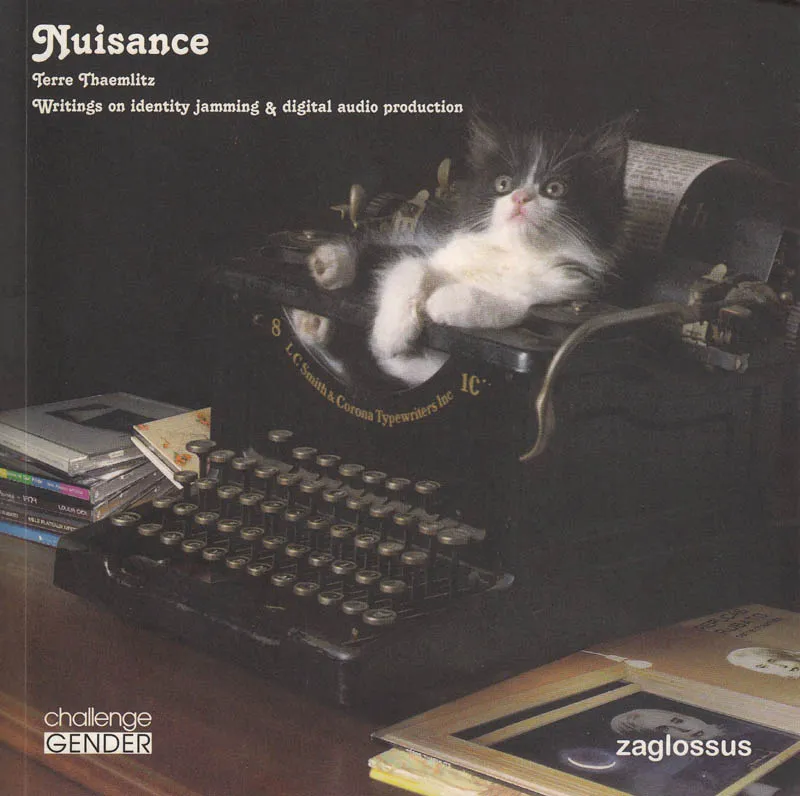
Nuisance
Nuisance compiles articles, essays, lecture transcripts, album annotations and other texts written by queer audio producer and writer Terre Thaemlitz between 1996 and 2015.
The overall theme uniting the texts is a defense of pessimism and a critical rejection of the incessant optimism lurking at the core of virtually all media – even in the “critical fields” themselves, where it reflects our conformity to those First World humanist and capitalist practices we wish to critique.
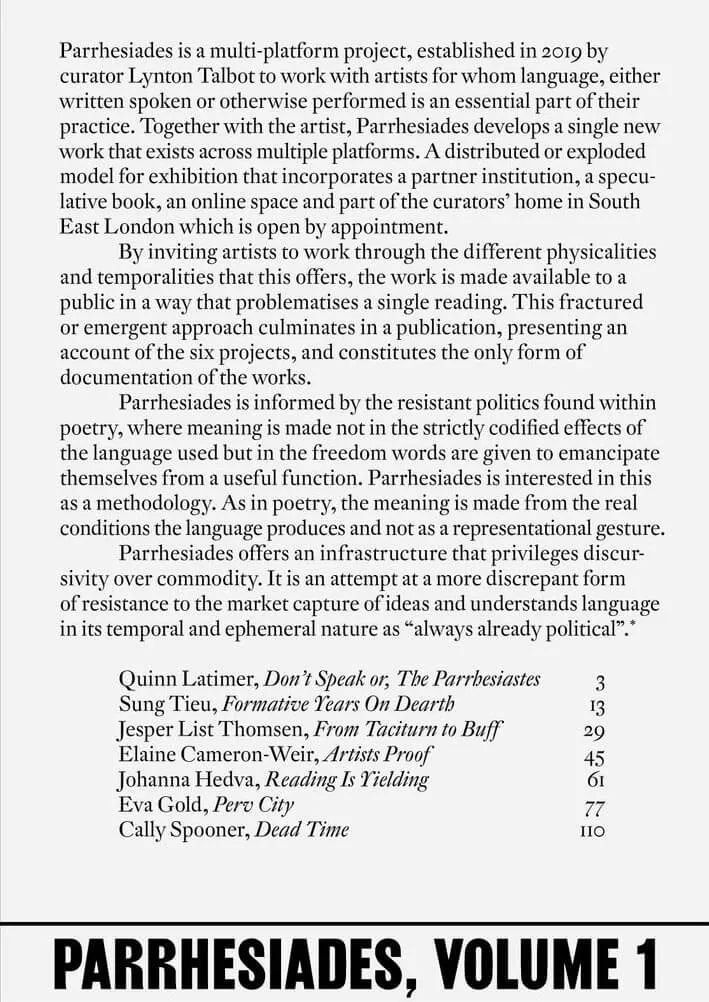
Parrhesiades Vol. 1
Parrhesiades is a multi-platform project, established in 2019 by curator Lynton Talbot to work with artists for whom language, either written spoken or otherwise performed is an essential part of their practice. Together with the artist, parrhesiades develops a single new work that exists across multiple platforms. With contributions by Quinn Latimer, Sung Tieu, Jesper List Thomsen, Elaine Cameron-Weir, Johanna Hedva, Eva Gold and Cally Spooner.

Zoological Vandalism
ZOOLOGICAL VANDALISM by Sina Seifee in collaboration with editor Renan Lauran and designer Foad Farahani, is immersion in the compiling and composing of Seifee’s notes on medieval bestiaries, and placing them in sequential order. It is the first chapter of a series that creates context and opens small descriptive steps towards (what Latour might call) “knowing interestingly” about bestiaries. It is a speculative adventure in bio-techno tales and old styles of knowing. As an “ecology of obligation” with Iranian sensuality and its ardent materiality, somewhere in the menagerie of found and feral animal videos on Whatsapp and Telegram, is Seifee’s undisciplined grounding in visual crafts.
Sina Seifee researches as an artist in the fields of narrative, performance, and knowledge production. He has been working on the question of technology and storytelling in the arts and sciences of the middle ages and the past-present of material reading practices in collective life. He studied Applied Mathematics in Tehran, received his MA in Media Arts in KHM Cologne. In 2017 he finished an advanced research program in performance studies in a.pass.

Beige Persuit
A character called X journeys through a present that is neither here nor there, but feels oddly proximate. She moves through landscapes of words, ever-shifting to host the groundless present, a place and time driven by her motivated, yet contextless pursuit. Narrative is always under construction. The preferred medium for X's peregrinations: a sentence, as capacious as a three-second video, a ten-year nap, or an unexplored hard drive. In this suspended world, X's sensorium is curious and alert, but also anguished, hesitant, and precarious: she feels around for sympathetic energies and familiar faces along the way. Along what way? A book like a body might be a room for waiting, a machine for memory, a sensuous thing, an image quickly glimpsed...
Working across a range of media including video, sound, performance, sculpture, collage, and installation, New York-based artist Sara Magenheimer disrupts, manipulates, and defamiliarizes language with bold combinations of image and text. Her videos incorporate traditional filmic editing techniques alongside those inspired by music and collage.

The Interjection Calendar 002
With contributions by: Rebecca Jagoe, Erin Eck, Skye Arundhati Thomas, Samuel Kenswil, Daniella Valz-Gen, Alex Margo Arden, Artun Alaska Arasli, Stacy Skolnik, Laura Morrison, Benjamin Edwin Slinger, Harman Bains and Audry B.

The Interjection Calendar 003
With contributions by: Georgia Patience Anderson, Hans-Christian Dany, Ruth Angel Edwards, Liv Fontaine, Sarah Gail, Adam Gallagher, Penny Goring, Harmony Grunge, Tiziana La Melia, Aaron Lehman and Thomas Laprade, James Loop, Rosanna McNamara.

The Interjection Calendar 004
The Interjection Calendar is an on and offline project, devised and hosted by Montez Press. Each month an artist or writer is commissioned to produce a new piece of work for release on our website. The PDF can be downloaded for free and there are 12 releases per year. At the end of the year the collection is published, demonstrating a diverse range of collaborations and experimental works, mapping the year in contemporary art writing, with equal space held for the emerging and the established. The Calendar reflects the current importance of online content media, pushing the relationship between image and text in this domain.
Contributors: Kerry Campbell is a freelance curator and producer. She currently works as the Public Programmes Curator for Bloc Projects gallery (Sheffield) and is the founder and curator of TMT Projects - a contemporary arts platform based in Luton Town.
vei darling is a first generation Liberian-American multidisciplinary artist and activist, who grew up in the D(M)V. vei moved to New York City when she was 17, and began an intense path of spiritual reconfiguration. vei positions herself within social justice and humanitarianism, whilst being infused with magick and spirituality. Her ultimate desire is to subvert the current paradigm in lieu of one that respects and reflects life, love, and the pursuit of happiness.
Caspar Heinemann is a writer, artist and poet. Their interests include critical occultism, gay biosemiotics and countercultural mythologies. Some of the time they teach and read things at institutions, a lot of the time they cook potatoes in different shapes and listen to Alan Watts lectures. They were born in London, UK, roughly 2.5 months after the release of Green Day’s seminal album Dookie.
Douglas Kearney has published six books, most recently, Buck Studies (Fence Books, 2016), winner of the Theodore Roethke Memorial Poetry Prize, the CLMP Firecracker Award for Poetry and silver medalist for the California Book Award (Poetry). His work has been exhibited at the American Jazz Museum, Temple Contemporary, Los Angeles Contemporary Exhibitions, and The Visitor’s Welcome Center (Los Angeles). He studied at Howard University, Cave Canem, and California Institute of the Arts. Raised in Altadena, CA, he lives with his family just west of Minneapolis and teaches Creative Writing at the University of Minnesota–Twin Cities. Douglaskearney.com
Cara Levine - with: Khadija Tarver, Christine Wong Yap, Eliza Myrie, Greg Boyle, Rodney Lu- cas, Lukaza Branfman-Verissimo, Ashley Stull Meyers, Sidony O’neal, Kambui Olujimi Jadelynn Stahl, Amanda Eicher, Jessica Angima, Faye Gleisser, Quenton Baker, Sam Aranke, Jade Thacker, Ekaette Ekong, Christopher Johnson, Marvin K White, Kemi Adeyemi, Constance Hockaday, Kate Johnson, Bayete Ross-Smith, Leila Weefur, Kirat Randhawa, Angela Hennessy, Elizabeth Dorbad, Prophet Walker, Shamell Bell, Emilia Shaffer-Del Valle and Ann Lewis. Cara Levine lives in Los Angeles, CA and is an artist exploring the intersections of the physical, metaphysical, traumatic and illusionary through sculpture, video and socially engaged practice.
Daisy Parris was born in Kent, 1993, and graduated from Goldsmiths in 2014. She currently lives and works in South London. Daisy Parris’ work raises questions about identity politics as well as the limits of what it means to be human. By using various formats such as portraiture, roomscapes and text, Parris focuses on identity struggles as well as the worry, guilt, numbness and the violent encounters of everyday existence.
Porpentine Charity Heartscape is a writer, game designer, and dead swamp milf in Oakland. Her work includes xeno-femme sci /fantasy, cursed video games, and globe-spanning sentient slime molds. She has exhibited at the 2017 Whitney Biennial, EMP Museum, and the National Gallery of Denmark, and has been commissioned by Vice and Rhizome.
James Lawrence Slattery is an artist, critic and academic living and working in London. They hold an undergraduate degree in Fine Art from Goldsmiths, University of London and a masters in Film Aesthetics from St Anne’s College, University of Oxford.
Gjergji Shkurti is a New York based author. His writing explores architecture as fiction and incorporates a filmic imagination. The writing stems from a yearning to push history forward.
Chanel Vegas is an artist who works in London. She writes poetry, makes paintings, and regularly performs as part of her work. Chanel graduated from Goldsmiths in 2017 and was the first student to be the recipient of the university’s Artist Award.
Punch Viratmalee currently lives and works in Bangkok, Thailand. Viratmalee graduated Chulalongkorn University in 2015 with a BA in Communication Design. She previously worked at a commercial gallery in Bangkok and is now working as a curatorial assistant for the first Thailand Biennale. She also writes.
The White Pube is the collaborative identity of Zarina Muhammad and Gabrielle de la Puente under which they write criticism an occasionally curate. The White Pube is based at thewhitepube. com and on Twitter and Instagram as @thewhitepube.

Pfeil Magazine #9 – Error
The meaning of the word ‘error’, in its origin, is neutral. In Latin ‘errare’ means both ‘to wander freely’ and ‘to wander from the right path’. After the seventeenth century, however, the word ‘error’ lost its ambiguity within English usage and became clearly understood as wrongdoing, as defect, as a way of missing a desired effect. The ninth issue of Pfeil Magazine focuses on the potential of erroneous processes to redefine the meaning of malfunction and takes a look at movements that are aimless or non-productive. Through this reflection, ‘error’ is introduced once again as the possibility of wandering freely.
Contributions by: Mitchell Anderson, Christiane Blattmann, Adam Christensen, Tyler Coburn, Hans-Christian Dany, Michael Dean, Gina Fischli, Flaka Haliti, Laëtitia Badaut Haussmann, Lina Hermsdorf, Judith Hopf, Karl Larsson, Clare Molloy, Susan Morgan and Thomas Lawson, Mense Reents, Stacy Skolnik, Paul Spengemann, Ramaya Tegegne
Editors: Anja Dietmann, Nadine Droste

Pfeil Magazine #10 – Mainstream
Within the format of a magazine, each page of Pfeil represents the floor, walls, or ceiling which together create an imagined room displaying a printed exhibition. Each issue is dedicated to a specific word, and artists are invited and given space to work on and with this term, and to construct or deconstruct the architecture around it. Combined, the contributions transform into an organic display surrounding the leitmotif.
The tenth issue is dedicated to Mainstream, this volume questions exercised motions of majorities, practiced over long or short distances and timeframes, that can become patterns, sometimes taken for granted, sometimes followed unconsciously, automatically, or even mechanically.
Contributions by: Alice Creischer, Annette Kelm, Charlotte Simon, Dodo Voelkel, Emily Pope, Hans-Christian Dany, Harry Gamboa Jr., Heike-Karin Föll, Holly White, Jan Matthé, Jannis Marwitz, Karl Holmqvist, Kevin Gallagher, Lars Bang Larsen, Magdalena Los, Marina Pinsky, Merle Radtke, Nicola Gördes, Pablo Schlumberger, Penny Goring and Stella Rossié.
Editor: Anja Dietmann