Art
Art

Scent is Present
Michaela Cagáňová, Marta Lopes Santos and 1 more
Scent is Present is an experimental publication exploring the ephemeral notion of olfaction. Through essays, exercises, and artistic contributions, it challenges the limits of language, inviting readers to engage with scent as a non-linear, sensory, and embodied phenomenon. Contributors including olfactory artists, scent designers, and sound artists share their practices and reflections that foreground smell in political and ecological contexts.
The publication stems from a workshop by the same name, carried out in Petrohradská kolektiv in the summer of 2025 by Sleepy Press and Michaela Cagáňová. The workshop accompanied holo-collective’s exhibition ‘AUTOCHORA’ at Jeden Dva Tři Gallery in Prague.
Workshop Participants: Magdalena Škerenčák, Nela Pietrová, Eva Fajčíková, Františka Blažková, Jasmína Horváthová, Karolína Kučerová Dunja, Varya Starodubova, Ondrej Trhoň, sof, Gabriele Sláma, Kristýna Šuleková, Iman, K, Lucy, Maëlle Magnin-Feysot.
Independent Contributors: Romana Klementis, Lila Tesla, Elektra Stampoulou, Maria Ilieva, Lucia Holásková, Michaela Cagáňová
In collaboration with holo-collective and Petrohradská Kolektiv
Designed by Markéta Skalková and Kamila Valešová

Pina #3
Exhibitions by American Artist and CB Evans, conversations with Che Gossett and Dean Spade, and short stories by Lola Olufemi and Orion J Facey.
Pina is a printed, portable exhibition space. We function as a commissioning platform, collaborating with artists to create exhibitions existing solely within the pages of a magazine.

Negative Landscape
Sinkholes are geological accidents that indicate the emptying of underground aquifers, places where the earth collapses and caves in, yielding to gravity and creating cavities of varying depths. Although they can occur for natural reasons, they are mostly the result of human activity: changes in river courses, intensive exploitation of water resources, mining activity and abandonment of mining sites. Over the last few decades, their number has increased considerably on the Iranian plateau.
This book presents Kimia Kamvari’s exploration of these cavities between 2019 and 2021. It showcases the core of the work, consisting of a careful and methodical series of photographs, accompanied by cartographic sheets and texts that help to understand the artist’s perspective on the phenomenon and stimulate the reader’s own.
Kimia Kamvari (Cologne, 1986) has a degree in painting from the Azad University of Art and Architecture in Tehran and a master’s degree in Art Research and Creation from the UPV-EHU. Since 2015 she has been living and working in Astigarreta, a small town in the interior of Gipuzkoa. His works go from figurative painting to an increasingly conceptual look that explores new formats and materials. Proof of this are his latest exhibitions Apeiron (Dastan Gallery, 2018), Nature Change (Fundación Cristina Enea, 2019), Event Horizon (Dastan Gallery, 2019) Alef (San Telmo Museoa, 2022) and Larruak eta Izurrak (Tabakalera, 2024)

The Horror
The Horror is an artist publication by Marieke Peeters that explores horror not simply as a genre, but as a narrative strategy—one capable of revealing the deepest anxieties and hidden structures within culture. Published before her residency on Ojika Island (Nagasaki Prefecture, JP), the book lays the conceptual groundwork for her later immersive works.
The first half of the book presents a personal selection of Japanese horror films—particularly within the kaiki eiga tradition (ghost and mystery cinema)—that have deeply influenced Peeters' artistic approach. The second half features images and short descriptions of her past projects, tracing a practice grounded in spatial storytelling, emotional intensity, and participatory encounters.
During her time on Ojika Island as part of the Artist in Island program, Marieke Peeters engaged with the island's tradition of ghost stories—particularly the legend of Shiomi, a mysterious outsider who sacrificed himself for the island. This tale became the foundation for The Forgotten Sacrifice, a site-specific haunted house experience staged in Konishitei, a local akiya (abandoned home). Collaborating with local participants and Studio The Future, Peeters transformed the space into an obake yashiki (Japanese-style haunted attraction), inviting visitors to reimagine Ojika Island's history through the lens of horror—revealing how fear can also create connection, memory, and reflection.

Pedagogies of the Art Proximate
Pedagogies of the Art-Proximate reflects on the changing landscape of contemporary art’s relationship to formal education, through tracing a history of theories, practices and protests across the twentieth century. In a context of educational funding crises, cuts, and changes, and within a wider frame of shifting understandings of how we know things and who or what we learn from, what can learning mean and in what ways can it happen?
Going beyond a simple chronology of art schools, this book considers the many ways in which art and education meet: how museums learn from those they invite in, how art objects become pedagogical tools, and what happens when a school is an artwork (or vice versa). The book proposes art-proximate practices as a new term for an increasingly blurry realm of practices that include socially engaged art, relational art, and activist art, as well as ‘non art’ forms. Weaving together auto-ethnographic, art historical and educational studies, Pedagogies of the Art-Proximate is about what art puts us in the way of learning – and why that might be politically, socially, and critically urgent today.

OEI #106–107 Lettrists & Photography
This issue of OEI proposes the first large-scale synthesis of Lettrist photography as a precise “system” – going through the Lettrist movement’s engagement with photography from the 1950s up until 2013. It reproduces around 430 photographic works and documents, and also includes English translations of texts by and interviews with Isidore Isou, Maurice Lemaître and Frédérique Devaux.
The first phase was to call photography into question. Through scratches and tears, the surface of the image was worked on, transformed within itself. This is the chiselling stage. Then we propose Lettrist photography, which transforms the old object into a letter or sign, redefining it as a simple particle in a system of elements that has become the alphabet of a new script. Hypergraphic photography goes even further, using any sign or graphic design to create a poly-writing system resulting in billions of characters, existing, artificial or new. Going even further, in 1956 our movement introduced infinitesimal photography, creating works composed of elements that exist only insofar as they allow us to imagine other elements, non-existent or possible. Each element must make us think of other elements. Infinitesimal photography is made up of billions of pieces of virtual data! Then, in 1960, the Lettrist movement unveiled a new dimension: supertemporal photography. With supertemporal photography, I offer a framework within which each viewer can act in his or her own way. Far superior to today’s happenings it has no time limit. The image is forever open to new amateurs who erase or continue what has already been done on the photograph by previous amateurs. It’s a work that has been going on for centuries! This is our creation in photography. […] We amuse ourselves at the level at which things are done, and we see them twenty years ahead of time. To say that Lettrist photography doesn’t exist is to say that no photograph exists …
—Isidore Isou, 1973

OEI #102–103 Photography on Edge
Cecilia Grönberg, Jonas J. Magnusson
Photography on Edge – 25 visual dossiers compiled and introduced by Geoffrey Batchen + ”Wanting more” – on and from the work of Australian artist Justine Varga + translations of a selection of Geoffrey Batchen’s essays into Swedish
”The published history of photography has long been motivated by a number of key principles: innovation and originality, authorship and nationality, chronology and medium specificity, technical excellence and aesthetic achievement. The folios [in OEI #102–103] offer an alternative way to regard this history. They comprise a series of repetitious fragments drawn more or less arbitrarily from across various photographic practices and genres. In every case, these folios present a photography on edge: tense, nervous, unsure of itself—at least when compared to the self-certainty we encounter in most histories of this medium.
A photography on edge is a photography that escapes the usual definitions. […] One thing is for sure: if they are to be included in future histories of photography, then we will need to set aside our prejudices and presumptions and learn to say what we see, and not just see what we already know how to say.”
— Geoffrey Batchen in Photography on Edge

Give Piss A Chance
A collection of notes, pictures, social media posts, about the legendary “Piss Goblin” who is / was (?) active in the Berghain bathrooms. This edition – handmade by Cutt Press – beautifully + playfully embodies its subject, as orange plasticky sheets are interspersed in between the text pages, and marble paper half-covers shimmer, in an evocation of golden torrents . . .
Give Piss a Chance. A Williing Suspension of Consequences was first published in the context of the For Real exhibition at DAADGalerie, Berlin, in 2025.

Wages For Wages Against – Volume 4 – Be There When and Where – Art and Anti-ableism
The fourth volume of a new series of publications by the collective Wages For Wages Against, acting for better work conditions in the visual arts and against all forms of discrimination, on the topics of accessibility in the arts and ableism.
Wages For Wages Against has been doing pioneering work for the fair remuneration of artists in Switzerland since 2017. It is committed to social and economic justice for all artists. This volume brings together texts by artists who create spaces—fields of possibility. Texts that seek to amplify moments of struggle and negotiation. Texts that speak of interdependence, trauma and adaptations. Texts driven by a desire and a sense of urgency to address the accessibility of spaces where art is created and experienced.
Wages For Wages Against (WFWA, wfwa.ch) is a a militant collective and a campaign for the fair remuneration of artists in Switzerland, better work conditions, and an alternative economy of the arts.
Edited by Wages For Wages Against.
Contributions by Michaëla Danjé, Quiplash, Park MacArthur, Lari Medawar & Ostensible, Sabrina Röthlisberger Belkacem.

toi, moi, la pluie
toi, moi, la pluie is a sequence of cards that can be assembled into three-dimensional configurations. The cards present two sides of the same moment: rain falling outdoors, and an art exhibition taking place indoors.
With humour and a sense of casual abandon, Sara Graça reduces the exhibition space to a dry place offering shelter from the rain. Despite a moment of intense intimacy—a passionate kiss—the space is largely inhabited by figures who do not seem to know one another, or to get along. The same kiss takes place outdoors; lovers, after all, do not care about the weather. Drawn in a caricatural style, recalling Ad Reinhardt’s How to Look series, these characters speak English, French, and Portuguese. We cannot tell whether they are visiting or staying; we do not know where they are.
The cards are accompanied by a small cut-out horse that can also be assembled and added. A memory of a past life, a lingering presence, a sense of “other”, the horse becomes the final piece of the puzzle. It acts as an exclamation point to these otherwise trivial human exchanges—cutting across inside and outside, shelter and rain, intimacy, cohabitation, and distance.
The publication is disguised as a book, revealing its playful nature only once opened, and inviting the reader to assemble, rearrange, and make choices of their own.
Sara Graça (Lisbon, 1993) lives in London and works in interdisciplinary ways, mainly using sculpture, drawing, photography and video. Her practice often questions ideas of value, authenticity and impermanence.
All copies are numbered & signed.

Suzanne and Louise
Suzanne and Louise tells the story of two sisters, one widowed, the other never married, recluses in a hôtel particulier in Paris’s 15th arrondissement. Suzanne, the older one, controls the finances. Louise, a former Carmelite, serves as her humble, tyrannical maid.
The author, who is also their great nephew, is one of the few who visits them. Mixing his writing with his photos, Hervé Guibert crafted a unique “photo novel,” reissued here for the first time with a full English translation by Christine Pichini, a new introduction by artist and writer Moyra Davey, and an account of the book’s origins by Thomas Simmonet.

Aesthetical Relations
Aesthetical Relations is a constellation of essays on art, fashion, cancer, comedy, Los Angeles, and your mom. Martinez whips elements of fiction and stand up material into bits and pieces addressing such concerns as: how many times you may kiss an art-world acquaintance, the theoretical stakes of sexting, and why German performance art is like French clowning. Aesthetical Relations is titled after Martinez’s ongoing conceptual comedy talk show of the same name. This new revised and expanded third edition includes new essays written from 2020-2025.
Christina Catherine Martinez (Mexican American, b. Bellflower, CA) lives and works between Los Angeles, Mexico City, and New England. She was named both a Comedian You Should Know by Vulture and a Comic to Watch by TimeOutLA, and is a recipient of an Andy Warhol Foundation Arts Writers Grant for her varied approaches to art criticism, published in platforms such as The Los Angeles Times, Aperture, Frieze, Artforum, Bookforum, e-flux criticism, DOCUMENT Journal, Dirt.fyi and Texte Zur Kunst.

That Figures. Selected Writings
Gathering 13 amazing essays by artist and writer Dena Yago, co-founder of K-HOLE, That Figures retraces more than a decade of reflections on the creative industry—digging into topics such as Sporespace, Billie Eilish, LARPing, corporate cafeterias, ketamine, precarity, poetry, and the internet’s lures and failures. Yago exposes the contradictions of living amidst the sugarcoated deals of the attention economy, and further proposes a new lexicon to address the numbing and disorienting effects of late stage capitalism. Absorbing but refusing to metabolize the language of commercial culture, she opens a space where critical thinking can still happen.
That Figures also features a selection of artworks by Yago, in which the combination of conceptual legacies with pop cultural elements creates new poetical arrangements.

a slight cast down at the edges of the lips
“a slight cast down at the edges of the lips brings together work from the last decade of Katherine Hubbard’s prolific practice, which intertwines analogue photography, writing, and live performance. Reproductions of exhibited prints, a selection of new photographs, and images created from within her performances are gathered here, along with four of the artist’s original written works. This publication marks the first occasion for Hubbard’s photographs and writings-for-performance to exist on the same scale, that of the book.”
— co-editor, Corrine Fitzpatrick
The book is accompanied by a poster with a full-scale detail reproduction of Katherine Hubbard's rip stop weave artwork, printed on glossy tissue paper.
Additional contributions by Zoe Leonard, Mónica de la Torre, Elisabeth Sherman, and Lynne Tillman. Edited by Corrine Fitzpatrick and Lara Mimosa Montes.

Art Monsters: Unruly Bodies in Feminist Art
In this dazzlingly original reassessment of women’s stories, bodies, and art, Lauren Elkin—the celebrated author of Flâneuse—explores the ways in which feminist artists have taken up the challenge of their work and how they not only react against the patriarchy but redefine their own aesthetic aims. How do we tell the truth about our experiences as bodies? What is the language, what are the materials, that we need to transcribe them? And what are the unique questions facing those engaged with female bodies, queer bodies, sick bodies, racialized bodies?
Encompassing a rich genealogy of work across the literary and artistic landscape, Elkin makes daring links between disparate points of reference—among them Julia Margaret Cameron’s photography, Kara Walker’s silhouettes, Vanessa Bell’s portraits, Eva Hesse’s rope sculptures, Carolee Schneemann’s body art, Theresa Hak Kyung Cha’s trilingual masterpiece DICTEE—and steps into the tradition of cultural criticism established by Susan Sontag, Hélène Cixous, and Maggie Nelson.
An erudite, potent examination of beauty and excess, sentiment and touch, the personal and the political, the ambiguous and the opaque, Art Monsters is a radical intervention that forces us to consider how the idea of the art monster might transform the way we imagine—and enact—our lives.
Destined to become a new classic . . . Elkin shatters the truisms that have evolved around feminist thought.
—Chris Kraus

La locataire
The Tenant is a monographic critical essay by Marie Canet. It is the first text to directly address the connections between McKenzie’s work, pornography, and special effects. The title refers to the way the artist moves through different periods and aesthetic spaces, appropriating their codes in order to construct new visual fictions. The book is infused with post-#MeToo feminist thinking, alternative uses of biography, reflections on the art world, and contemporary debates surrounding appropriation, embodiment, and the status of the artwork.
McKenzie and Canet worked with each other for over eight years, on projects like Atelier E.B: Passer-by catalogue, published on the occasion of the Fondation Galeries Lafayette exhibition, or the book Pervert or Detective, a conversation between Lucy McKenzie and artist Reba Maybury. This collaboration now culminated in an exhibition and a book: Plastic Newspaper (presented at CRAC Sète in March 2026) and Lucy McKenzie, The Tenant.
Texts by Marie Canet and Lucy McKenzie
Translations: Catherine Petit & Paul Buck (Marie Canet), Juliette Desorgues (Lucy McKenzie)
Published in connection with the exhibition Lucy McKenzie, Plastic Newspaper, at Crac Occitanie, Centre régional d‘art contemporain Occitanie/Pyrénées-Méditerranée à Sète, 21.03.-06.09.26

The Tenant
The Tenant is a monographic critical essay by Marie Canet. It is the first text to directly address the connections between McKenzie’s work, pornography, and special effects. The title refers to the way the artist moves through different periods and aesthetic spaces, appropriating their codes in order to construct new visual fictions. The book is infused with post-#MeToo feminist thinking, alternative uses of biography, reflections on the art world, and contemporary debates surrounding appropriation, embodiment, and the status of the artwork.
McKenzie and Canet worked with each other for over eight years, on projects like Atelier E.B: Passer-by catalogue, published on the occasion of the Fondation Galeries Lafayette exhibition, or the book Pervert or Detective, a conversation between Lucy McKenzie and artist Reba Maybury. This collaboration now culminated in an exhibition and a book: Plastic Newspaper (presented at CRAC Sète in March 2026) and Lucy McKenzie, The Tenant.
Texts by Marie Canet and Lucy McKenzie
Translations: Catherine Petit & Paul Buck (Marie Canet), Juliette Desorgues (Lucy McKenzie)
Published in connection with the exhibition Lucy McKenzie, Plastic Newspaper, at Crac Occitanie, Centre régional d‘art contemporain Occitanie/Pyrénées-Méditerranée à Sète, 21.03.-06.09.26

Spike #88 – Spirituality
For our Summer 2026 issue, amid the latest revival of SPIRITUALITY in culture, Spike asked: what are people reaching for beyond what can be measured? The answers are eclectic, emphatic, and most of all personal: Johanna Hedva’s essay about the human voice’s part in the divine; portraits of mystic artists Lee “Scratch” Perry, Natasha Tontey, and Santiago Yahuarcani by Isis Semaj-Hall, Riar Rizaldi, and Miguel A. López; Jamieson Webster’s psychoanalytic look at Renaissance painting’s body of Christ; a spiritual history of perfumes by Élisabeth de Feydeau; Patrick McGraw’s soulful reading of America’s (perhaps) greatest living author, Joy Williams; queries of Gen Z’s search for God by Lamorna Ash, the disappearance of atheism by Steven Phillips-Horst, and a new form of contemplation by Aodhan Madden; and LIFEMAXXING recommendations to purge the soul, sometimes devilishly. Plus, some backpage words of wisdom from Tea Hačić-Vlahović: “Devotion and humiliation are holy.”

Abstract Coloring Book
A coloring book conceived as an artist book. Coumba Samba’s publication prompts you to explore geometric forms and structures with a small set of colored pencils. Using those simple materials one realises how interaction and experimentation challenge again and again the relationship between color, abstraction and internalised form systems.
Published in connection with the exhibitions deutschland at Kunstverein in Hamburg and Coumba Samba at MauMaus in Lisbon.

WatchPeopleDie.TV: Trans Death and Embodiment
In a time of widespread conservatism, watchpeople die.TV: Trans Death and Embodiment is not only unapologetically trans but challenges and transcends transphobic vitriol to create urgent and powerful work.
“This written portion was made from performing an erasure poem on the text of the sourced transphobic comments and then commenting on the erased words. The text is intended as a performance text. What this means is that I think of the text as not just a documentation of a performance but a performance itself.”
watchpeopledie.tv contains writing from watchpeopledie.TV (2025), performed as part of the 2025 VCUarts MFA Thesis exhibition that was on view April 11, 2025, to May 11, 2025, at The Anderson Gallery in Richmond, VA.

Person with the last name Universe
This book has been self-published for Latvian artist and poet Jelena Glazova's solo exhibition “Person with the last name Universe” at Riga contemporary art space (July - August 2026). The exhibition is the artist’s act of feminist guerrilla resistance within the symbolic territory of contemporary phallocracy. The source and central figure of the post-gender universe conjured by Glazova is the Person with the last name Universe, whose creative strategy the artist unpretentiously calls Glazovism.
Jelena Glazova (Belgium/Latvia) is a poet and multimedia artist who combines visual elements, experimental sound, installation and poetic text in her projects. As an artist, she has participated in international festivals and projects in Latvia, Estonia, Lithuania, Sweden, Austria, Belgium, Germany, the Netherlands, Turkey and other countries. Among the most notable exhibitions are "Identification of a Woman" at the Latvian Museum of Photography (2010) and "Elements of a Puzzle" at the Latvian Centre for Contemporary Art (2011). She is the author of four poetry collections. Glazova's poetry has been translated into 12 languages. Since 2012, she has given more than 200 performances in 18 countries. She is the co-founder of two poetry festivals in Riga: "Blood of a Poet" (2014–2016) and "Poetry without Borders" (2017–2022). https://www.jelena-glazova.com/
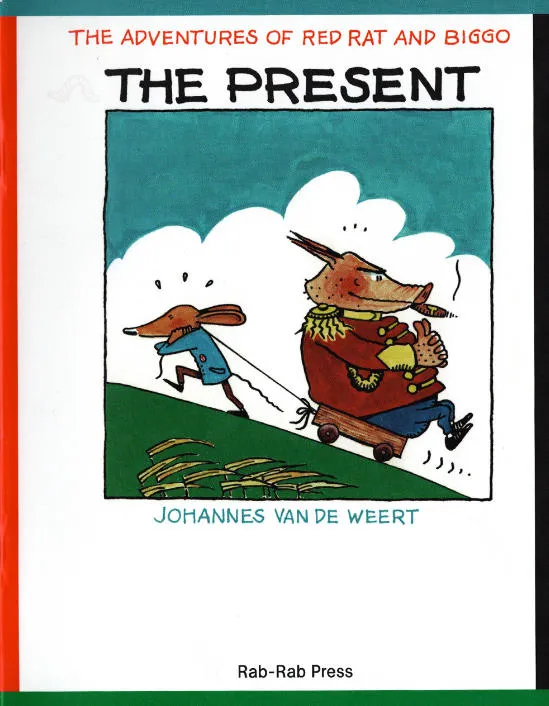
The Adventures of Red Rat and BIGGO – The Present
A children's book by Johannes van de Weert, a veteran of the punk underground (Rondos, The Ex, Red Rat, Raket).
The Adventures of Red Rat and BIGGO – The Present is a remake of Bram konijn en Piet de muis [Bram the Rabbit and Piet the Mouse], a 1982 children's book by Johannes van de Weert, a veteran of the Dutch punk underground who played with Rondos and The Ex, and who was the force behind Red Rat and Raket editions.
The Present is a 2010 remake telling the story of a bully pig who terrifies a poor rat on a daily basis. After a while, the rat falls ill with fear and has to stay in bed. The lonely, evil pig has no one to play with and becomes depressed. The pig gives the rat a present—a bunch of beautiful flowers—and all is well. Now the two can play together.
The 2010 remake, featuring different characters and intended for a North Korean audience, was never published. The 2025 English version opens with an introduction by Van de Weert, telling a bizarre story of a failed political career and an absurd vaudeville class struggle behind the seemingly harmless educational children's book.
Johannes van de Weert was a cartoonist active in the Rotterdam punk and squatter's movements of the 1980s. He was a singer with the punk band De Rondos and he started self-publishing small comic booklets in the late 1970s. He created his character "Redrat" for the fanzine Raket in 1980. The character soon became an icon for the squatter's movement.
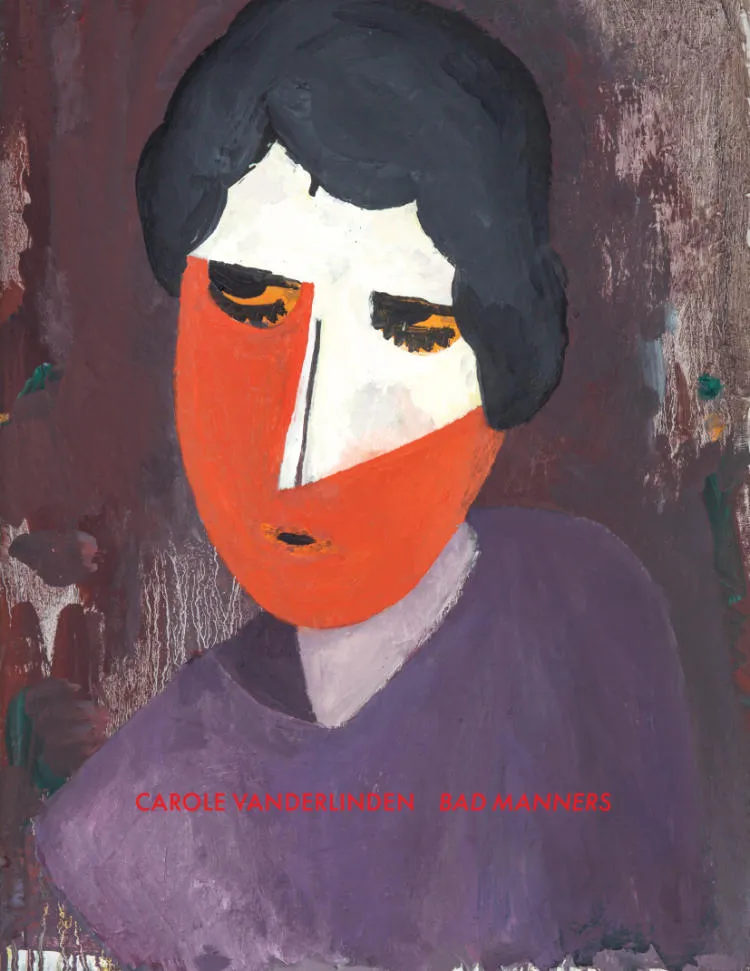
Bad Manners
Carole Vanderlinden's first monograp covers over a decade of the artist's practice. It gathers close to 200 paintings and works on paper, alongside texts by Belgian novelist Jean-Philippe Toussaint, essays by curators Ann Hoste, Ory Dessau, and Hans den Hartog Jager, as well as a conversation between musician and composer Joëlle Léandre and Vanderlinden.
Born 1973 in Brussels, Carole Vanderlinden has been developing a highly improvisational, rich artistic practice since the mid-1990s. While her work is primarily focused on painting (often using thick, hand-mixed oil paints), it regularly encompasses drawing, watercolor, collage, and small objects. Vanderlinden's practice is famously unhampered by the constraints of a single style. Her work nimbly blurs the line between figuration and abstraction, reacting intuitively to the rhythm, color, and possibilities of her medium rather than adhering to a single signature aesthetic.
In the Belly of the Beast – Art & Language New York Project 1972-1978
Edited by Michael Corris, the expanded edition of In the Belly of the Beast: Art & Language New York Project 1972-1978 is a survey of the tumultuous years of the political Conceptualism in the mid-seventies New York.
Artists have always experimented with politics, either by organizing themselves or uniting in support of a broader political movement. Today, "activist art" is taught in universities, supported by foundations, and featured in museums and international exhibitions. Is this the only possible way?
In the Belly of the Beast tells a different story, of the work of politically engaged artists and the conflicts they experienced. It is the history of artists wishing to continue working within the boundaries of the artworld and those who were intent on establishing new ideological and class relationships with activists to build a political party.
During the 1970s in New York, the Art & Language collective pioneered institutional critique; published a Marxist-influenced journal; agitated against racism and sexism in museums; challenged the cultural imperialism of international exhibitions; and forged a framework for a socialist organization of artists. This new edition includes previously unpublished documents illuminating the contradictions and disputes that lay at the center of the organization and practices of Art & Language and left-wing groups, such as the Anti-Imperialist Cultural Union and the Artists' Meeting for Cultural Change, mobilizing artists in New York at the time.
The new and expanded edition of In the Belly of the Beast features an extensive interview with Michael Corris, who annotated a collection of previously unavailable documents from the period, including manuscripts, pamphlets, transcripts, and letters.
Art & Language is the name of a group of English artists who choose to work collectively, and the title of a magazine that they founded in 1968. Proposing a critical analysis of the relations between art, society, and politics, Art & Language marks, even in its name, the importance of the “textual turning point” in the 1960s.
Since 1976, Art & Language's project has continued, through Mel Ramsden and Michael Baldwin, with the literary and theoretical collaboration of Charles Harrison. Working with very varied mediums, from painting to rock, these co-founders of Conceptual art remain, even today, attached to observing the consequences of what they themselves call the “depressing collapse of modernism.”