rile*books

Search books

Search books by title, author, publisher, keywords...

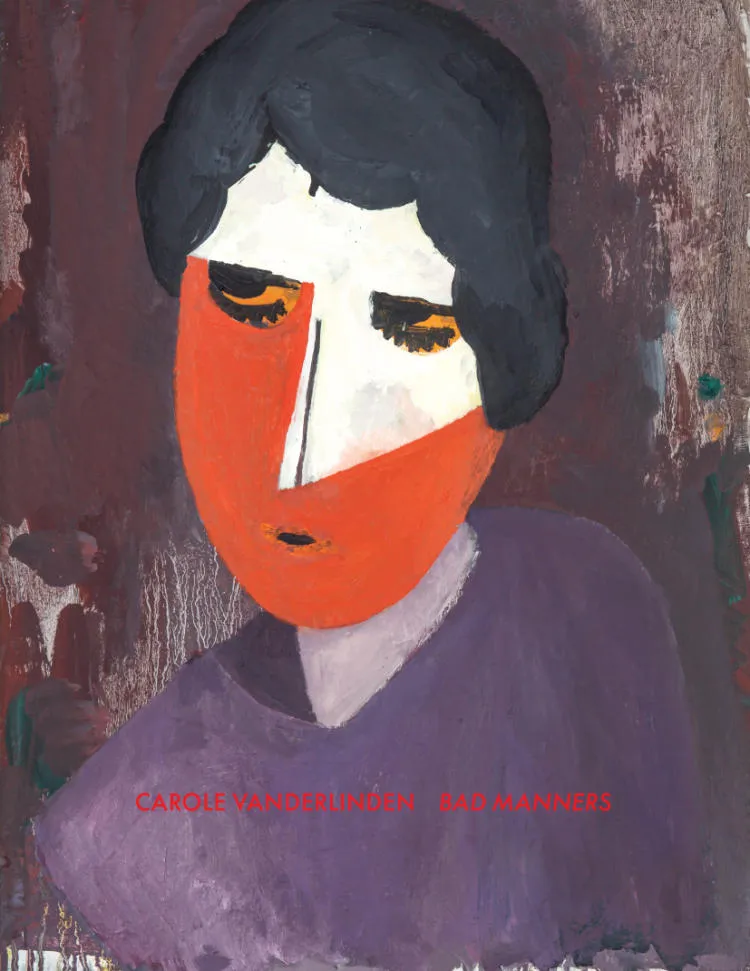
Cover of Bad Manners

Zolo Press

Bad Manners

Carole Vanderlinden

€43.00

Carole Vanderlinden's first monograp covers over a decade of the artist's practice. It gathers close to 200 paintings and works on paper, alongside texts by Belgian novelist Jean-Philippe Toussaint, essays by curators Ann Hoste, Ory Dessau, and Hans den Hartog Jager, as well as a conversation between musician and composer Joëlle Léandre and Vanderlinden.

Born 1973 in Brussels, Carole Vanderlinden has been developing a highly improvisational, rich artistic practice since the mid-1990s. While her work is primarily focused on painting (often using thick, hand-mixed oil paints), it regularly encompasses drawing, watercolor, collage, and small objects. Vanderlinden's practice is famously unhampered by the constraints of a single style. Her work nimbly blurs the line between figuration and abstraction, reacting intuitively to the rhythm, color, and possibilities of her medium rather than adhering to a single signature aesthetic.

Published in 2026 ┊ 320 pages ┊ Language: English

recommendations

Cover of Local Warming

Zolo Press

Local Warming

Sebastian Black

Painting €45.00

For Sebastian Black, 2020 was a year like no other: a pandemic; three exhibitions; a move to Los Angeles; a presidential election; a baby, too. Local Warming is Black's tale of it all, as recorded in his diary.

One million years ago, when I started making the paintings compiled here, I was listening to lots of audiobooks and recorded philosophy lectures. It was the winter of 2019, my paintings were about this and about that, and every brushstroke drifted safely over a net of ideas. I was gathering a list of things that I knew to be true because I was sick of having nothing to say when people asked me to explain myself. Then a professor, who to me is now a holy exegete, said that difference precedes identity as the substance of reality. I'd been eavesdropping on YouTube as he taught a continuing-ed class on Deleuze for a claque of narrative therapists. Difference before identity. I couldn't grasp the idea— only touch it. That's okay, said the professor, as though speaking directly to me, the point of thinking isn't to grasp things that are true but rather to prod things that are interesting. — Sebastian Black

Sebastian Black is an artist/writer. He was born in New York City in 1985. He lives and works in Los Angeles. 

Cover of One Big Bang

Zolo Press

One Big Bang

Adel Abdessemed

One Big Bang brings together 78 charcoal and pastel drawings from Adel Abdessemed's recent series Nature Morte and Politics of Drawing, where everyday objects, animals, and flowers are subtly charged with tension. Through these works, Abdessemed explores the intersections of beauty, fragility, and unrest. With texts by Hélène Cixous and David Elliott, One Big Bang offers a thoughtful entry into an artist's visual language shaped by memory, myth, and political urgency.

Published following the eponymous exhibition at Projeckt Brussels in 2024.

Adel Abdessemed (born 1971 in Constantine, Algeria, lives and works in Paris and Berlin) deconstructs identity codes, tackling head-on the tensions that permeate our society. His works, with their typical simplicity—sculptural installations, drawings, photographs, videos and performances—echo precise facts and familiar situations, but go beyond narrative commentary and militant criticism. Adel Abdessemed questions, among other things, the social and economic status of the artist in a system where his foothold is slight, by shrewdly keeping a distance in a gesture of subversive and committed resignation.

Abdessemed refuses to be limited to a single ideology. In his early works he passionately tackled religious, sexual, and taboos subjects and his later exhibitions have often focused on the theme of global violence. In an interview with Elisabeth Lebovici he stated, "I do not live between two cultures. I am not a postcolonial artist. I am not working on the scar and am not mending anything. I am just a detector … In the public sphere, I use passion and rage. Nothing else. I don't do illusions."

Sometimes reduced to a simple word, as in "Mohammedkarlpolpot" (1999), a condensation of names evoking totalitarism and religion, and sometimes complex and monumental installations such as "Habibi" (2004), a suspended skeleton of 17 meters propelled by a jet engine, Abdessemed's practice belongs to a new generation of artists who appeared recently on the French art scene, looking to offer another perspective on culture and identity.

Cover of Birthday

Zolo Press

Birthday

Bridget Mullen

Bridget Mullen is the ruler of an unruly roost. Between 2021 and 2023, she gave birth to forty-seven paintings, each twelve-by-nine inches: kin ugly and cute, monstrous, fleshy, repulsive, droopy-eyed, and sneering as they cross the universal threshold into the no less frightening world that awaits. Birthday reunites Mullen's uncanny litter alongside a conversation between the artist and Lucas Blalock.

The paintings in New York-based artist Bridget Mullen's Birthday series utilize two distinct parameters to guide the creation of the iterative works: a vertical orientation at an intimate scale of 12 x 9 inches and a visualization of perhaps the ultimate creative act—the moment of birth. Through this consistent scale and thematic hyper focus, the artist employs endless formal variations in composition, color, and paint application. The result is a series of paintings that share a common structure yet champion individuality.

Contrasting colors provoke a visible tension, one that is at times compressed and, in other moments, elastic. Suddenly, abstract shapes come into focus as human anatomies, capable of expressing emotion. Undulating lines of various thicknesses and layered colors squeeze together, revealing peculiar faces and gestures that emerge from a central point. The repetition of thin lines creates a visual stutter of pigment, alluding to the passage of time or rapid movement.
The works in Birthday build on Mullen's practice, combining color, decisive mark-making, intuition, and experimentation to conjure psychedelic configurations. Sculptural dimensionality and flatness, representation and abstraction, and solidity and fluidity, serve not as dichotomies within these works, but as two complementary halves of a whole. Together, the forms and figures of the Birthday series are imbued with a sense of life, pregnant with agency and potential.

Cover of Slipping on Fragmented Shapes

Mousse Publishing

Slipping on Fragmented Shapes

Hoda Kashiha

Painting €27.00

First monograph devoted to the playful, explosive and colorful paintings of the Iranian artist, featuring extensive illustrations along with a selection of drawings and preparatory studies that reveal the methods behind Hoda Kashiha's compositions, which are often constructed like collages, in which multiple layers intersect, cut-out shapes emerge, and images evolve through a combination of hand-drawing and digital manipulation.

Published following the exhibition I'm Here, I'm Not Here at Passerelle Centre d'Art Contemporain, Brest, in 2022, Hoda Kashiha's first solo public exhibition in Europe.

Developing a distinctive form of pop painting that moves freely between uninhibited Cubism and a cartoon-like visual language, Iranian artist Hoda Kashiha (born 1986 in Tehran) produces works that appear playful at first glance but reveal darker, more enigmatic, and deeply symbolic layers upon closer examination. Humour is a recurring strategy in her practice—one that fosters intimacy with viewers while enabling her to address serious and sensitive questions rooted in the social context and political climate of her home country. Her paintings also engage universal concerns, including gender relations and the place of women in society. For Kashiha, her protagonists become activists without ever speaking: they assert their differences openly and remain steadfastly optimistic. With her exuberant use of forms and colour, Kashiha creates an explosive blend of genres in which Picasso seems to drift into the world of Minecraft, joyfully dismantling the conventions of the past.

Text by Lilian Davis; conversation between Loïc Le Gall and Hoda Kashiha.

Cover of Adagio For Color Fields

Goswell Road

Adagio For Color Fields

Chris Korda

Painting €35.00

Chris Korda (b.1962) is an American antinatalist activist, techno musician, software developer, multimedia artist and founder of the Church of Euthanasia. For the past 30 years, her work has spanned avant-garde performance, happenings, culture- jamming, photography, video, audio and so much more - though her work as an engineer, coder and software developer remains less known to the general public.

This book posits that her software and coding work are linked to her more well-known activist and music work, informing and reforming each other for over 30 years, inhabiting up until now parallel timelines that have been closening over the decades, honing in on a common creative goal: to reveal her as she should be revered, as an Inventor-Artist.

“Any outcome is inevitably shaped by the tools used to achieve it. In industrial civilization, most people use the same standardized tools and therefore achieve similarly standardized outcomes. But imagine discovering a tool for making tools. The outcomes are now limited only by toolmaking skills. This is how computer programming changed my life.”

She refers to her generative artworks, audio and visual, as kinetic sculptures. Working in collaboration with her algorithms, she does not use the machine as a ‘servant’ but rather:

“I invite them into the creative space as equals. They have abilities that I don’t have, and I also have abilities that they don’t have, so we complement each other. They supply speed and precision, I supply desire and intuition, and what emerges is greater than the sum of the parts.”

Thus, on the occasion of the exhibition of the same name, we dedicate this book to Korda’s generative audio-visual synesthetic work 'Adagio For Color Fields' (2023) - a piece that breaks the silence - using it as a lens to bring into focus Korda’s work as an innovative Inventor-Artist.

Cover of That's Me!

Goswell Road

That's Me!

David Hoyle

Monograph €35.00

David Hoyle (b.1962, Blackpool, United Kingdom) is a performance and visual artist. His work over the last 30+ years has referenced gender, politics, identity, mental health issues and the ongoing fight for equality.

Hoyle came to prominence in the ‘90s as The Divine David, a kind of anti-drag queen whose lacerating social commentary – targeting both bourgeois Britain and the materialistic-hedonistic gay scene, which he called, “the biggest suicide cult in history” – was offset by breathtaking instances of self-recrimination and even self-harm. Following a couple of outré late-night Channel 4 TV shows and a part in the movie Velvet Goldmine, directed by Todd Haynes, Hoyle killed off The Divine David, during a spectacular show at the Streatham International Ice Arena in 2000 and retreated to Manchester for “a period of reflection”.

He returned to television screens in 2005 in Chris Morris’ Nathan Barley, then began performing live again, under his own name. Hoyle’s biting satire, bravura costumes, wicked comic timing, and compelling charisma remained intact.

Hoyle is also a prolific painter often painting in his live shows. His paintings are deeply personal, and tackle the same themes as his performances, incorporating domestic waste, flyers, newspapers, magazines, wrapping paper, and more, which reinforce his disdain for the ruling-class bourgeoisie.

This is the first book dedicated to Hoyle’s paintings, offering an edited selection of works made between 2010 and 2022. At Hoyle’s request, all of the works are published undated: thus, emphasising their timelessness, timeliness, relevance, and urgency to the desperate age in which we now find ourselves!

Cover of Art Notes, Art

CARA Center for Art, Research and Alliances

Art Notes, Art

Cynthia Hawkins

Since the 1970s, Cynthia Hawkins has investigated the potentials of abstract painting. While often beginning a work or series with a predetermined concept or strategy, Hawkins’s process-oriented practice simultaneously embraces the improvisational to create a systemized space for her continually evolving vocabulary. From 1979 to 1981, important early years in the elaboration of her work, Hawkins documented these developments in a journal. A record of routine and the everyday, the journal also gathers sketches, notes for new and in-progress works, and responses to contemporary art and criticism, bringing the artist’s process, experimentation, and reflections on materials, formalism, abstraction, and figuration into relief. 

Art Notes, Art also offers a picture of the burgeoning Black-owned gallery scene in 1970s and ‘80s New York that Hawkins was an important participant in—including Cinque Gallery, Kenkeleba Gallery, and Just Above Midtown, where she had her first solo exhibition in 1981–as well as the women artists’ circle she was an active member of, which hosted weekly shares, critiques, exchange, and amplification of each others’ work. An important glimpse into Hawkins’s creative process and artistic community, Art Notes, Art is richly illustrated with works by the artist produced during this key period–some of which are now lost–photographs and ephemera, and a visual archive of contemporaneous work by her peers.

Editor: Ananth Shastri
Managing Editor: Rachel Valinsky