Books
Books
in random order

HOOT nr. 3 — Kamilé Krasauskaité
Gufo, Clément Faydit and 1 more
Last year, on a summer night in Marseille, someone, within all the hungry people I am meeting during my dinners, specifically set her attention on my projects. Later during the fall I received a call from Austė ZDANČIŪTĖ, the cultural attache at the Lithuanian embassy in France, who introduced me to Kamilè Krasauskaitè. Since that fall, we kept on exchanging and making future plans in France where she would have a residency. The more we chatted, the closest we began. Kamilè is a almost-thirty-years-old Lithuanian artist that has been including sourdough bread in her work and builds a poetic and mesmerising world around that dimension of food, fermentation, senses, environment, rituals...Through our communication I decided to share that encounter that we managed to welcome in Marseille. We kneaded some bread together, shared it in a forest of Marseillais sunflowers, walked the streets, met people, questioned and compared artists' lives in Europe. This issue might be an excerpt of all the long conversations we had, it was hot and sunny in Marseille, it was in June.

Greer Lankton: Sketchbook, September 1977
A fascinating account of Lankton's inquisitive, sociological and emotional ruminations in advance of her gender-affirming surgery.
This is one of the earliest of Greer Lankton's (1958-96) journals, sketchbooks and daybooks to appear in the artist's archives, and the first to be published in facsimile form. Written during her time as an art student at the School of the Art Institute of Chicago, the journal offers key insights into Lankton's mind at work before her career-defining move to New York in 1978, where she would become an important figure of the East Village art scene in the 1980s and early '90s with her lifelike dolls and theatrical sets.
Containing drawings, behavioral diagrams and aspirational, occasionally confessional writing, the journal is a record of imagining the body and mind reconciled through transformation. In these pages, the 19-year-old turns an inquisitive, sociological eye toward the emotional landscape and somatic effects of the days recorded here; days leading up to her decision to undergo hormone treatment and gender-affirming surgery in 1979. Lankton reflects with raw vulnerability and keen self-awareness on critical questions of self-image, social perception, gender normativity and human behavior.

Dreams of a Dreamless Night
The publication is the first institutional monograph on the multimedia practice of artist and director Ali Cherri. It aims to highlight the constellation of ideas, themes, and formal concerns running through his most recent, highly significant projects.
Edited by Alessandro Rabottini and Leonardo Bigazzi, with Bianca Stoppani, this book provides an overview of the artist's output over the past three years, teasing out both new strands for interpretation and formal links between his films, videos, sculptures, drawings, and installations.
Texts by: Cecilia Alemani, Erika Balsom, Étienne Bernard, Leonardo Bigazzi, Ali Cherri, Lorenzo Giusti, Stefanie Hessler, Priyesh Mistry, Alessandro Rabottini, Stefan Tarnowski.
Video and visual artist Ali Cherri (born 1976 in Beirut, lives and works in Paris and Beirut) received a BA in graphic design from the American University in Beirut in 2000, and an MA in performing arts from DasArts, Amsterdam, in 2005. His current project looks at the place of the archaeological object in the construction of historical narratives.

Eros the Bittersweet: An Essay
Anne Carson's remarkable first book about the paradoxical nature of romantic love. Since it was first published, Eros the Bittersweet, Anne Carson's lyrical meditation on love in ancient Greek literature and philosophy, has established itself as a favorite among an unusually broad audience, including classicists, essayists, poets, and general readers.
Beginning with the poet Sappho's invention of the word "bittersweet" to describe Eros, Carson's original and beautifully written book is a wide-ranging reflection on the conflicted nature of romantic love, which is both "miserable" and "one of the greatest pleasures we have."

This Is Not My Signature
A journey through the artist's work and life.
William Anastasi is the author of a prolific body of work. A major figure in conceptualism and in many respects one of its initiators, his trajectory cannot be solely confined to this chapter in the history of contemporary art. The book revisits, through the prism of multiple voices, the various aspects of an approach that unfolded with the use of complementary mediums. Drawing coexists with photography and "new" technologies, alongside objects, paintings, and installations. Within this corpus to be (re)discovered, sounds, images, and language, as well as artifacts, protocols, and processes, convey inquiries related to space and time, representation, and perception. With contributions from Dove Bradshaw, Chiara Costa, Béatrice Gross, Valérie Mavridorakis, Hélène Meisel, Sébastien Pluot, Julia Robinson, Robert Storr, and Erik Verhagen.
Edited by Erik Verhagen.
Texts by Dove Bradshaw, Chiara Costa, Béatrice Gross, Valérie Mavridorakis, Hélène Meisel, Sébastien Pluot, Julia Robinson, Robert Storr, Erik Verhagen.

Rip It Up
Rip It Up is the first ever English translation of Kou Machida's award-winning novel, an undertaking over five years in the making and the inaugural title of Inpatient Press's new translation imprint Mercurial Editions.
Set in a kaleidoscopic hyperreal Japan circa Y2K, Rip It Up catalogues the misdeeds and misgivings of a down-and-out wannabe debonair who ekes out a meager living at the fringes of the art world, wracked by jealousy at his friend's success and despondency of his own creative (and moral) bankruptcy. In turn hilarious and also horrifying, Machida's pyrotechnic prose plumbs the discursive depths of the creative spirit, a head-spinning survey of degeneration and self-sabotage.
Kou Machida is a punk singer, actor, and author, who turned to poetry and fiction after releasing one of the seminal Japanese punk albums with his band INU, 1981’s Meshi kuuna! (Fuck Eating!). He has won the Akutagawa and Tanizaki prizes among many others, and his 2005 novel Kokuhaku (Confession) was named one of the three best books of the last thirty years by the Asahi Newspaper.
Daniel Joseph is a translator, editor, and musician who spent his salad days shouting in dank basements before getting a master’s degree in medieval Japanese literature. Recent translation projects include contributions to Terminal Boredom (Verso, 2021), a collection of stories by science fiction pioneer Izumi Suzuki; and the memoir Try Saying You’re Alive! (Blank Forms, 2021) by outsider folk maniac Kazuki Tomokawa.
Winner of the 2000 Akutagawa Prize for Fiction

Howdunnit 2 - Panorama
Navina Sundaram is sitting in the editing room in Hamburg. She has managed to reduce the complexity of the Kemal Altun case to the required 2 minutes and 40 seconds for the political magazine; a journalistic feat considering the legal terminology and the international political situation, which must be presented in simple terms. She places her interview with the judge at the back. The audience therefore first gets an impression of perhaps the best-known deportation prisoner of the republic on trial here. The phone rings. I imagine she is displeased about the disturbance. It’s the day of the broadcast; the report still needs to be approved. It rings again. She answers. Peter Boultwood is on the phone and says, “Did you hear? Kemal jumped out of the window in the courtroom. He’s dead.”
Merle Kröger lives in Berlin where she works as a novelist, screenwriter and dramaturg. She was a member of the Berlin film collective dog film (1992–1999) and founded pong lm in 2001. Kröger is the co-author of Philip Scheffner’s internationally awarded films Revision (2012), Havarie (2016) and Europe (2022). Kröger has published five novels to date, including Grenzfall (2012), Havarie/ Collision (2015) and Die Experten/ The Experts (2021). Her novels have received numerous awards, including Best Crime Novel of the Year, the Radio Bremen Prize for Crime Fiction and the German Crime Fiction Prize.
Translated by Rubaica Jaliwala

Sex Goblin
A weird, wild ride across non-narrative vignettes and dryly funny aphorisms exploring the shared intensity of violence and the erotic.
As if hauled up squirming from the bowels of the internet, Sex Goblin metabolizes sex writing, popular culture, and autofiction to present the real and the imagined as equally surreal possibilities. In the narrator’s childlike voice, all things become both mundane and strange—a child and their dog fused after a car accident, moments of tenderness amidst frat hazing, witches, and hiking accidents. At turns charming and bizarre, Cook’s work channels sexual violence through the lens of the absurd to alchemize shame and abuse into something that registers differently than trauma. Sex Goblin is a barely factual but deeply felt field guide to relationships and relatability.
Lauren Cook is a transsexual naturalist and the author of I Love Shopping (Glo Worm Press, 2019). He is from upstate New York.

It's Too Late. Do It Anyway!
Cassie Thornton, Magdalena Jadwiga Härtelova
Hey culture worker! Are you feeling alone and afraid while the world burns? It’s Too Late. Do It Anyway! is two books in one, created for cultural workers who want to get off the racial capitalist high-speed-train-to-nowhere and start structuring revolution through collective care.
It’s Too Late. Do It Anyway! offers two routes into a fractal support network designed to shed absurd, useless forms of artworld prestige in favor of collectively producing a world organized to support caregivers. It’s Too Late tells the true story of an exhibition about care that exposed the difference between making symbolic gestures and actually doing something. Do It Anyway! serves as a manual for The Hologram, a prism-shaped collective care protocol conceptualized by artist Cassie Thornton, inspired by the Social Solidarity Clinic of Thessaloniki in Greece, and now practiced by people all over the world.
In It’s Too Late. Do It Anyway! multiple voices weave The Hologram into the present, the past, and the future all at once, ultimately putting the story and the tools it describes into each reader’s life-wizened hands. This is not really a book; it’s a pathway out of the tough spot we are all in right now. Anyone can make use of it, even you.

The Book of Disappearance
Alaa is haunted by his grandmother’s memories of being displaced from Jaffa and becoming a refugee in her homeland after the Nakba. Ariel, Alaa’s neighbour and friend, is a liberal Zionist, critical of the military occupation of the West Bank and Gaza yet faithful to the project of Israel. When he wakes up one morning to find that all Palestinians have suddenly vanished, Ariel begins searching for clues to the secret of their collective disappearance.
That search, and Ariel’s reactions to it, intimately reveal the fissures at the heart of the Palestinian question. Between the stories of Alaa and Ariel are the people of Jaffa and Tel Aviv – café patrons, radio commentators, flower-cutters – against whose ordinary lives these fissures and questions play out.
Critically acclaimed in Arabic, spare yet evocative, intensely intelligent in its interplay of perspectives, The Book of Disappearance is an unforgettable glimpse into contemporary Palestine as it grapples with both the memory of loss and the loss of memory.

Empire of the Senseless
Originally published in 1988, Empire of the Senseless marked a turning point in Acker's wild, inimitable style. Considered one of her more accessible works, here Acker candidly addresses her lifelong obsessions: childhood and trauma, language and sexuality, criminality and corruption, oppression and rebellion.
Abhor (part human, part robot) and her lover Thivai (a pirate) traverse Paris in a dystopian future, in search of a mysterious drug that Thivai needs in order to maintain his ability to love. Navigating the chaotic city, they encounter mad doctors, prisoners, bikers, sailors, tattooists, terrorists, and prostitutes, while a band of Algerian revolutionaries take over, and the C.I.A. plots to thwart them all.
Sexually explicit, graphically violent, Empire of the Senseless resists the desensitizing of cultural consciousness and the disintegration of interpersonal communication. A timeless, prescient parable, it speaks profoundly to our social and political history as well as our present reality.

Tehran North
Published on the occasion of her exhibition at the Palais de l'Athénée, Geneva (September 18–October 18, 2025) following her Prix de la Société des Arts de Genève award in 2025, this new artist's book by Shirana Shahbazi is fully dedicated to her "Displacement" series (2023–2025). To describe it, she states: "I use multiple exposure and overlapping to create an independent experience of time and space. The simultaneity of different realities is relevant to many of us. I think a lot about how to depict these complex realities."
Designed by Norm, Zurich, this publication is itself an inquiry into space and time, and our relationship to them. Each alternate page is trimmed short, creating new perceptions. The artist adds: "I enjoy deconstructing rooms, creating new ways of experiencing them. Sharpening the awareness while you see the works." The latest book in a series of acclaimed photography publications, this volume is characteristic of Shahbazi's distinctive and conceptually rigorous approach to photography in which light, vibrant color field, and layering play key roles. Flipping through the pages of An Exciting Opportunity Lies Ahead of You is a dream-like journey through architecture and senses.
Born in Tehran in 1974, Shirana Shahbazi moved to Germany at the age of 11. She studied photography in Dortmund and Zurich, where she lives and works today. Her practice has been dedicated to generating a hybrid visual language that defies simple categorization and can be experienced on multiple levels. It challenges the translation and the transcultural construction of meaning. The physical presence of her work is just as important as its semantic underpinnings.

Translation is a Mode = Translation is an Anti-neocolonial Mode
Don Mee Choi is the author of three books of poetry and hybrid essays, and an award-winning translator of contemporary Korean women’s poetry. In this pamphlet, Translation is a Mode=Translation is an Anti-neocolonial Mode, she explores translation and language in the context of US imperialism—through the eyes of a “foreigner;” a translator; a child in Timoka, the made-up city of Ingmar Bergman’s The Silence; a child from a neocolony.
This pamphlet is part of UDP’s 2020 Pamphlet Series: twenty commissioned essays on collective work, translation, performance, pedagogy, poetics, and small press publishing. Each offers a different approach to the pamphlet as a form of working in the present, an engagement at once sustained and ephemeral.

F.R. David - With Love
F.R.DAVID is a typographical journal, dealing with the organisation of reading and writing in contemporary art practises.
“With Love,” takes correspondence and calligraphy—or letter-writing—as model for information theory, and adaptive, cybernetic relations.

Imperfect Solidarities
Art, empathy and political solidarity.
Can empathy deliver political change? Does art that elicits emotional identification with others take us where we need to go? In Imperfect Solidarities, writer and art historian Aruna D'Souza offers observations pulled from current events as well as contemporary art that suggest that a feeling of understanding or closeness based on emotion is an imperfect ground for solidarity. Empathy—and its correlate, love—is a distraction from the hard work that needs to be done to achieve justice. Rather, D'Souza contends, we need to imagine a form of political solidarity that is not based on empathy, but on the much more difficult obligation of care. When we can respect the unknowability of the other and still care for and with them, without translating ourselves into their terms, perhaps we will fare better at building political bridges.
Aruna D'Souza is a writer and critic based in New York. She is a regular contributor to The New York Times and 4Columns.org, where she is a member of the editorial advisory board. Her writing has also appeared in The Wall Street Journal, CNN.com, Bookforum, Frieze, Momus, and Art in America, among other places. Her book, Whitewalling: Art, Race, and Protest in 3 Acts (Badlands Unlimited), was named one of the best art books of 2018 by The New York Times. She is the recipient of the 2021 Rabkin Prize for art journalism and a 2019 Andy Warhol Foundation Art Writers Grant.

A book with a hole in it
Kamelya Omayma Youssef’s A book with a hole in it uses the poetry of the fragment and the language of everyday survival to gesture towards the fallibility of language at the juncture of the multiple, intersecting wars on women, on "terror," on the non-White body, and on people and language in diaspora. Drawn from a set of journals written over a four-month period, A book with a hole in it throws the formal, official work of poetry into relief, asking what knowledge exists beyond knowledge, which silences are too deep to be surfaced on the page, and how to pierce through trauma and violence to approach a politics of redemption.

Studying Hunger Journals
In 1972 Bernadette Mayer began this project as an aid to psychological counseling, writing in parallel journals so that, as she wrote in one (in bed, on subways, at parties, etc.), her psychiatrist read the other. Using colored pens to “color-code emotions,” she recorded dreams, events, memories, and reflections in a language at once free-ranging and precise—a work that creates its own poetics. She sought “a workable code, or shorthand, for the transcription of every event, every motion, every transition” of her own mind and to “perform this process of translation” on herself in the interest of evolving an innovative, inquiring language. STUDYING HUNGER JOURNALS registers this intention within a body of poetry John Ashbery has called “magnificent.”

Pleasure Erased: The Clitoris Unthought
The clitoris was absent in anatomy books, in paintings and sculptures, absent in spirit and even body; it has long been the organ of erased pleasure. We assume that this oversight has been repaired in our times: today, the clitoris is not forgotten but honoured. Conferences, books, manifestos, works of art are all devoted to it. The autonomy of clitoral jouissance is recognized. The boundaries of feminism have also moved: queer, intersex and trans approaches claim that the clitoris is perhaps no longer the exclusive preserve of the woman. And yet, there remains a wounded space. Because genital mutilation is still common practice. Because millions of women are still denied pleasure.
The clitoris continues to mark the enigmatic space of the feminine. Constrained by the extreme difficulty and the extreme urgency of returning to this scorched earth, it is time to give voice to an organ of pleasure which has still not become an organ of thought.
“A project whose glaring absence has been hiding in plain sight, clitoral pleasure has finally found its philosopher. Malabou tells us what we can do with our clitoral brain, uncloaking its agency and anarchic politics. Essential reading for anyone interested in interpreting sex otherwise than phallic and in relation to philosophy’s power to shape the soma.” - Emily Apter, New York University

Appendix Project
Written in the course of the year following the publication of Book of Mutter, and inspired by the lectures of Roland Barthes, Anne Carson, and Jorge Luis Borges, Appendix Project collects eleven talks and essays. These surprising and moving performances, underscored by the sleeplessness of the first year of their child’s life, contain their dazzling thinking through the work of On Kawara, Roland Barthes, W.G. Sebald, Bhanu Kapil, Walter Benjamin, Theresa Hak Kyung Cha, Marguerite Duras, Marlene Dumas, Louise Bourgeois, Doris Salcedo, Jenny Holzer, and more.

Mud … and the Earth System
Mud … and the Earth System explores groundbreaking research in Earth system sciences and highlights the challenges of communicating these findings to the public.
As once-stable “mudscapes” transform, they become both symptoms and symbols of a rapidly warming planet. This book delves into humanity’s connection to these changes through the study of ancient organic and inorganic compounds that have come alive after millennia. It poses essential questions about what these evolving ‘mud’ compounds reveal about Earth’s deep past and our imminent future.
Born from collaborative research led by artist Rikke Luther at the Interdisciplinary Research of Ocean, Climate and Society (ROCS) at the University of Copenhagen in collaboration with Earth scientist, Professor Katherine Richardson, this publication showcases how artistic practices – such as image-making, conceptual mapping, and filmmaking – enhance scientific representation.
Mud… and the Earth System features commissioned essays from experts in Earth Science, Political Aesthetics, and Molecular Geobiology. The book pairs their insights with compelling artwork, including large-scale maps of emerging ‘mudscapes’ in Svalbard, Iceland, Greenland, and Gotland.
The essays give perspectives on the DNA that is collected and stored in mud, which connects life across timescales as an evolutionary resource framing the interactions of human societies with the extreme complexities of the Earth system. Esther Leslie’s “Mud Crystal and Polar Thinking” sets the scene, followed by Karina K. Sand’s “Death and Life: in Mud: Two Million Years in a Split Second,” and Earth scientist Katherine Richardson’s contribution “A Muddy Diary.”
As Richardson sums up, “Mud is an important medium for storing the archives that describe the history of both life and climate on Earth, and we are only just beginning to understand the fantastic stories that mud can tell.”
Contributions by Esther Leslie, Rikke Luther, Katherine Richardson, Karina Sand

Les Diaboliques Parlures
Les Diaboliques Parlures rassemble trois textes qui nous font découvrir une voix contemporaine majeure de la poésie et du théâtre queer. Ces œuvres, à la croisée du poétique, du politique et de l’intime, explorent le désir, la vulnérabilité, la marginalité et l’identité masculine et queer.
L’Ardeur déploie une langue brûlante pour interroger le désir, la passion et la communauté des outsiders, transformant l’ardeur en force vitale et émancipatrice.
One Night at the Golden Bar offre une écriture intimiste où le romantisme kitsch devient vecteur de poésie et de réflexion sur la vulnérabilité, l’amour et la monstruosité de l’humain.
Analphabet, quant à lui, questionne le langage, l’expression et les limites de la communication, confrontant le lecteur à la puissance de la langue et à sa capacité à révéler l’identité.

How to Sleep Faster 2
How to Sleep Faster 2 is the second of our biannually published journals that form the backbone of Arcadia Missa’ critical collaborative discourse on participation, post-digital visual-production and institutional subjectivity.This issue explores moments of collapse, shift and potential in a cultural moment framed by economic, political and societal disturbance.
Arcadia Missa Publication; eds Rozsa Farkas, Tom Clark et al.

Raving
McKenzie Wark takes readers into the undisclosed locations of New York's thriving queer rave scene, showing how raving to techno is an art and technique at which queer and trans bodies might be particularly adept, but which is for anyone who lets the beat seduce them.
Contents
1. Rave as Practice
2. Xeno-euphoria
3. Ketamine Femmunism
4. Enlustment
5. Resonant Abstraction
6. Excessive Machine
"How to write a book about raving as a practice that practices rave? From k-nights spent on Brooklyn's and Berlin's junkspace dance floors, McKenzie Wark abstracts a life practice of ressociation in a dance of autoconceptualization and allotheorization. In crossing toward the stranger's gift of 'letting go of ourselves as private property, ' Raving is nothing less than Wark's femmunist manifesto, her tractatus on techno's blackness, her treatise for a twenty-first-century trans ethics."—Kodwo Eshun
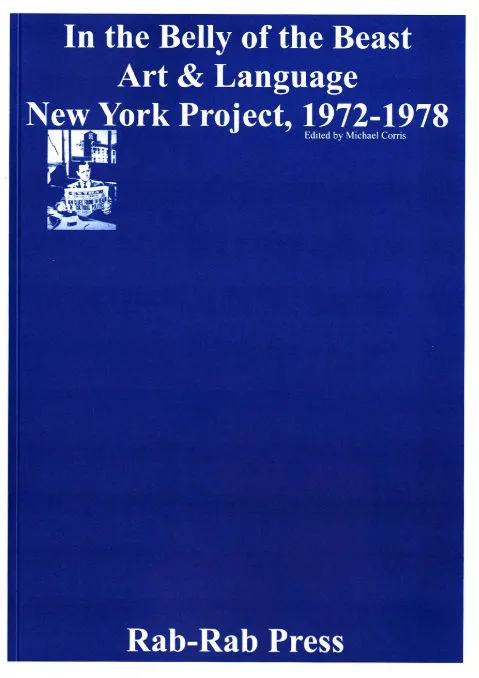
In the Belly of the Beast – Art & Language New York Project 1972-1978
Edited by Michael Corris, the expanded edition of In the Belly of the Beast: Art & Language New York Project 1972-1978 is a survey of the tumultuous years of the political Conceptualism in the mid-seventies New York.
Artists have always experimented with politics, either by organizing themselves or uniting in support of a broader political movement. Today, "activist art" is taught in universities, supported by foundations, and featured in museums and international exhibitions. Is this the only possible way?
In the Belly of the Beast tells a different story, of the work of politically engaged artists and the conflicts they experienced. It is the history of artists wishing to continue working within the boundaries of the artworld and those who were intent on establishing new ideological and class relationships with activists to build a political party.
During the 1970s in New York, the Art & Language collective pioneered institutional critique; published a Marxist-influenced journal; agitated against racism and sexism in museums; challenged the cultural imperialism of international exhibitions; and forged a framework for a socialist organization of artists. This new edition includes previously unpublished documents illuminating the contradictions and disputes that lay at the center of the organization and practices of Art & Language and left-wing groups, such as the Anti-Imperialist Cultural Union and the Artists' Meeting for Cultural Change, mobilizing artists in New York at the time.
The new and expanded edition of In the Belly of the Beast features an extensive interview with Michael Corris, who annotated a collection of previously unavailable documents from the period, including manuscripts, pamphlets, transcripts, and letters.
Art & Language is the name of a group of English artists who choose to work collectively, and the title of a magazine that they founded in 1968. Proposing a critical analysis of the relations between art, society, and politics, Art & Language marks, even in its name, the importance of the “textual turning point” in the 1960s.
Since 1976, Art & Language's project has continued, through Mel Ramsden and Michael Baldwin, with the literary and theoretical collaboration of Charles Harrison. Working with very varied mediums, from painting to rock, these co-founders of Conceptual art remain, even today, attached to observing the consequences of what they themselves call the “depressing collapse of modernism.”