rile*books

Search books

Search books by title, author, publisher, keywords...

Cover of Girls Like Us #6 - Secrets

Girls Like Us

Girls Like Us #6 - Secrets

Jessica Geysel ed., Sara Kaaman ed., Katja Mater ed., Marnie Slater ed.

€8.00

A secret can be a private space for self-creation – or a shared site of pleasure.

We explore secrets in a plethora of forms and contexts. From layered accounts of mediaeval ecstasy to the unexplored sensory experience of smell. From camouflaged play to queer readings of astrological charts and the hidden history of house music. From a very analog point of view to the outskirts of the internet.

Language: English

recommendations

Cover of A Book Knot Book

Body Text

A Book Knot Book

Sara Kaaman

Performance €20.00

A Book Knot Book is a 208 pages long performance, the first from the research and publishing initiative Body Text. In this study of language in action systems of meaning-making crash, sparkle and swoon. In a playful voice over A Book Knot Book self-reflects on the materialities and choreographies of publishing, reading and writing. With guest stars in fragments; Monique Wittig, Yvonne Rainer, Cristina Rivera Garza, Amiri Baraka, Will Rawls, David Abram, Thich Nhat Hanh and more. 

Edited and designed by Sara Kaaman. Published with the support of Stockholm University of the Arts.

Cover of Natural Enemies Of Books: A Messy History Of Women In Printing And Typography

Occasional Papers

Natural Enemies Of Books: A Messy History Of Women In Printing And Typography

Sara Kaaman, Maryam Fanni and 1 more

Natural Enemies of Books is a response to the groundbreaking 1937 publication 'Bookmaking on the Distaff Side', which brought together contributions by women printers, illustrators, authors, typographers, and typesetters, highlighting the print industry’s inequalities and proposing a takeover of the history of the book. Edited by feminist graphic design collective MMS, the publication includes newly commissioned essays and poems, conversations with former typesetters Inger Humlesjö, Ingegärd Waaranperä, Gail Cartmail, and Megan Downey, and reprints of the original book and other publications.

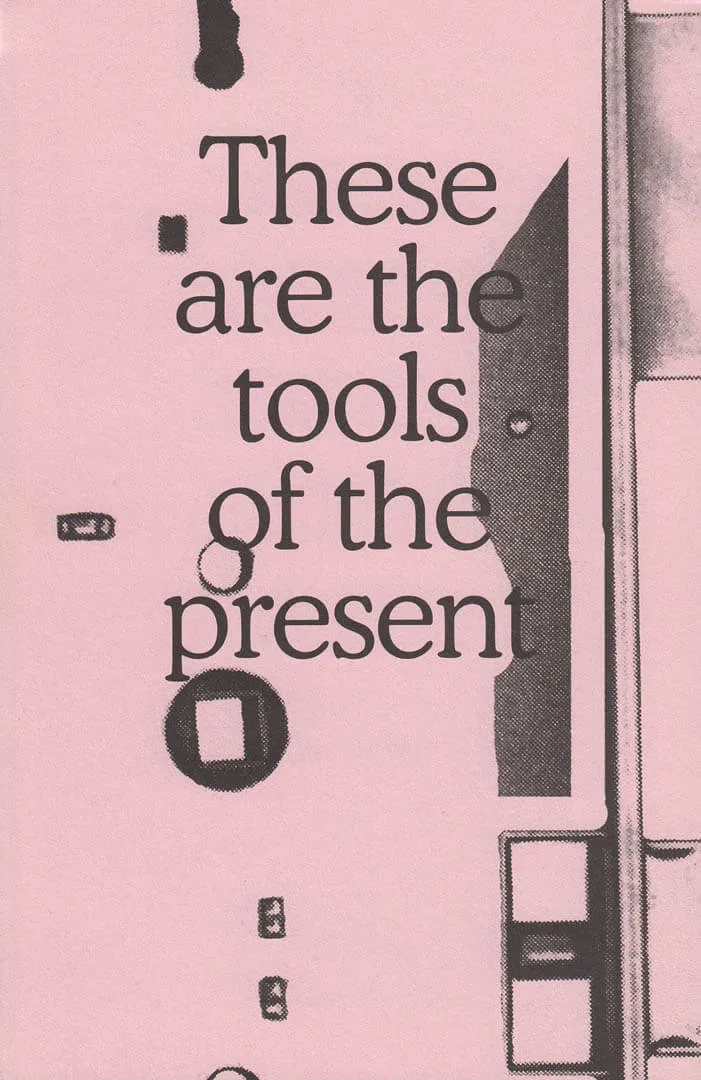
Cover of These are the tools of the present

Mophradat

These are the tools of the present

Mai Abu ElDahab, November Paynter and 1 more

This publication comprises a series of interviews with contemporary artists, musicians, and writers who are in dialogue with Beirut and Cairo. While not purporting to be an overview of the art scenes in these cities, this book begins to draw a picture of how artists think about what it means to be active in the contexts of these cities. It offers insight into the circumstances that structured these artists’ stories, and the often accidental influences that have shaped how their practices have developed.

Cover of Chesil Cliff House and other failures

Sticky Fingers Publishing

Chesil Cliff House and other failures

Sam Moore

Orbiting around the saddest house in the history of Grand Designs, Sam Moore’s Chesil Cliff House and other failures takes us to North Devon where, standing at the cliff’s edge, we meet Edward Short: a man with a Fred Perry shirt and a dream. Amongst a chorus of characters including Kevin Mcloud as Father Time, Moore by means of Short leads us into a study of creative failure, gender, and, ultimately, the desire to keep writing.

"I struggle to see anyone living here. It feels like a distorted wonder of the world, a cautionary tale. Something that could never have been lived in, but that had to be made."

About the author:
Sam is a writer, artist, and editor. They are the author of All my teachers died of AIDS (Pilot Press), Long live the new flesh (Polari Press), and Search history (Queer Street Press). They are one of the co-curators of TISSUE, a trans reading and publishing initiative based in London.

About A Series of Attempts:
This new series published by Sticky Fingers Publishing explores the essay form through the etymological root of essay: to try, trial or attempt. In 1508, French theorist Michel de Montaigne published a collection of 107 texts called Essais, described by his contemporaries as ‘self-indulgent and embarrassingly confessional.’ It is through these roots we find the attitude and intentions at the heart of this series; that through thinking together, through trying to figure it out on the page, we can reach new and increasingly nuanced ways to understand each other and the worlds we inhabit.

Cover of Woman Journal Vol. 6: Back in Shape

Woman Cave Collective

Woman Journal Vol. 6: Back in Shape

Do we always have to be nice, kind and communicate respectfully? Wouldn't it sometimes be better to change our tone, to use force or even violence? We often want to act in a spirit of “care” and benevolence, but how do we know if we're really being altruistic and sympathetic? Vol.5 asks the question: Nice?

With contributions from :
Muf architecture/art, Mélanie Mazet, Bui Quy Son, Paul-Antoine Lucas, Armelle Breuil, Annabelle Vaillant, Napsugár Trömböczky, Alessandro Di Egidio,
Elsa Muller, Clara Lenoir, Léo Jacqmin, Clem Koren, Pola Noury, Grève cœur and Cassiane C. Pfund

This publication is edited by the Woman Cave collective founded by Leticia Chanliau and Chloé Macary-Carney.

318 black & white pages, brown cover
Micro edition of 700, printed in Aubervilliers by Isiprint.

Cover of Issue #9: Companions

Errant Journal

Issue #9: Companions

Irene de Craen, Katia Krupennikova

Periodicals €20.00

The editorial/imaginative centre of the ninth issue of Errant Journal is located in the regions that have experienced Russian imperial aggression from where it makes connections across times, geographies, and ontologies to explore the radical potential of companionship. Companionship is understood not as agreement, but as a shared responsibility across unequal histories. It means not being full without the other. While forms of imperial and colonial violence might differ in places and through times, the issue recognizes how colonial mechanisms are sustained, how they present themselves as if they were past while shapeshifting and continuing in new forms and places in the present. By bringing these contexts in relation, this issue aims to show how certain borders, biases, clichés, and power structures travel, mutate, and shape both human and non-human lives and landscapes. Ultimately, companionship is about prioritizing life and about insisting that no oppression is singular.

This issue is a concept by and co-edited with Katia Krupennikova.

Contributors: Adriana Arroyo, Keto Gorgadze, Andreas Kalkun, Chung Kai Lee, Samira Makki, Ana Mikadze, Petrică Mogoș, Fabienne Rachmadiev, Vaim Sarv, Victoria Soyan Peemot, Czyka Tumaliuan, Iryna Zamuruieva, Irene de Craen, Katia Krupennikova

Cover of Viscose 02: Clothes

Viscose Journal

Viscose 02: Clothes

Jeppe Ugelvig

Design €35.00

Issue 2 inverts issue 1’s focus on the immaterial notion of style to instead explore the most material of fashion’s building blocks: clothes Clothes are literally everywhere and cite complicated systems of production, distribution, and exchange on their paths around the world. Still, they never fully reveal their journey or destination, and may often signify little else than their own commodity status, the total genericness of the fashion product.

Bringing together a wide range of artists, thinkers, and writers, the issue sets out to explore clothes as a signifier at once empty and over-burdened: as expressions of desires, people and places, as palimpsests for capitalist production cycles and histories of dressed bodies, and even, as nondescript material debris. While not necessarily foregoing an analysis of the fashion system, we hope to develop a form of fashion criticism that begins – and perhaps ends – with the single garment, that takes the everyday use of clothing objects as an intellectual starting point.

What knowledge can we gather from the studying of fashion objects, be they material or immaterial? What is the difference between clothes and fashion? And to which extent is even “fashion” ever successfully signified by things?

with contributions by:
Shanzhai Lyric, David Lieske, Bakri Bakhit, Dena Yago, Matthew Linde, Burke Battelle & Ada O’Higgins, Davide Stucchi, Taylore Scarabelli, Mahoro Seward, Jordan Richman, Giorgi Gago Gagoshidze, Hito Steyerl, & Milos Trakilović, Laura Gardner, Avena Gallagher, Alex Esculapio, Elise by Olsen and Jeppe Ugelvig

Cover of OEI #86/87 Publishing Practices, Publishing Poetics

OEI editör

OEI #86/87 Publishing Practices, Publishing Poetics

Tobi Maier, Cecilia Grönberg and 1 more

Periodicals €40.00

Once more, an astonishing issue of OEI – a thrilling, compelling, stimulating feast of ideas regarding publishing and the book: the perfect big companion to read and hug in bed while the virus spreads outside.

Bringing together contributions from circa 130 publishing structures, publishing communities, magazines, small press endeavors, artists, poets, writers, editors, theoreticians, curators, scholars, and art bookstores, OEI # 86–87 reflects upon the challenges, pressures and possibilities of publishing and creating publics in different contexts and places in a time of far-reaching – economical, medial, political, social, technological – transformations.

The potential and the versatility of publishing open it to a diversity of practices and approaches in the arts, but as an eminently social form of art, a collective or micro-collective work with shared responsibilities, it is also a never-ending process of “crafting a variegated approach to how you create, publish, distribute, and build a social ecosystem around your efforts”, of trying to “build up and strengthen the community around these printed forms” (Temporary Services).

It is the conviction of OEI #86–87 that print has the power to play an important part in the construction of social spaces, of a social world. As Benjamin Thorel puts it in one of the essays in the issue, “conceiving of the dynamics of publishing as making publics as well as making things public is not a pun – insofar as the artists/publishers encompass, beyond the book itself, its possible ‘lives’, imagining the different spaces, and the different people, amongst whom a publication will circulate.” This is what Michael Warner has called “a public [as] poetic worldmaking”, implying “that all discourse or performance addressed to a public must characterize the world in which it attempts to circulate, projecting for that world a concrete and livable shape, and attempting to realize that world through address.”

This is also, as stressed by Annette Gilbert and others, what can make publishing such an active force, a force co-constituting texts and publications and publics. Indeed, with Michalis Pichler, it is tempting to say that in publishing as practice – perhaps more than in any other art field – “artists have been able to assert the aesthetic value of their own socio-politically informed concerns and to engage, often under precarious conditions, in cultural activities fully aligned with their political values.”

OEI #86–87 also includes sections on and with contemporary poetry from Canada; Fluxus publishing; Krister Brandt/Astrid Gogglesworth; Kalas på BORD (Öyvind Fahlström); Lars Fredrikson; Claude Royet-Journoud’s poetry magazines; Carl Einstein; Gail Scott; Ållebergshändelser; OEI #79: edit/publish/distribute!; “det offentligas försvinnande” and many many other things. [publisher’s note]

Design by Konst & Teknik