Books
Books
in random order

On the Benefits of Friendship
Isabelle Graw reflects on the purposes and struggles of friendship in competitive social milieus.
By focusing on her own social milieu—the art world—Graw demonstrates how friendships are neither totally disinterested nor reduceable to their use. Written in the intimate form of a fictional diary, this book laments useful friendships while praising true friendship in all its forms. For Graw, friendship is an existential necessity—if only because it points to how we relate to and depend on others. Friendship, she finds, is as important as the air we breathe—with it, we are able to fully live.
"On the Benefits of Friendship strangely calls to mind the fictional schoolboy-diary format Robert Walser staged to deliver his first novel. Aware of its own performance while successfully assuming its desired voice, Graw's diaristic story is a clever vehicle for social critique of utility friendships."
— Stephanie LaCava, author of I Fear My Pain Interests You
"Isabelle Graw has written the Elective Affinities for the twenty-first century, as a feminist novel and a dysfunctional family portrait set in the contemporary art world."
— Violaine Huisman, author of The Book of Mother
Isabelle Graw is Professor for Art Theory and Art History at Staatliche Hochschule für Bildende Künste (Städelschule), Frankfurt am Main, where she co-founded the Institute of Art Criticism. She is an art critic and co-founder ofTexte zur Kunst in Berlin.

Comeback Death
Comeback Death, Jennifer Soong's third book, weaves its registers of what Soong names as "dread, gender, sarcasm, sublimation of pain, fruit, ambition, and fecundity" through an English which is not only polyvocal but uncannily porous. Its languages (English, Russian, German, ancient Greek) underscore a perverse pastoral range that somehow bridges Oxford, New Jersey, and Lesbos. With a ferocity both musical and analytic, Soong's third book offers an unprecedented set of tonalities for immense architectures of feeling.
"In Comeback Death, Jennifer Soong dramatizes one of the key problems of our time, and indeed any time, which is how to reorganize the (negative) affects structuring intersubjectivity and thus conditioning our capacity to act in a common interest among others."—Thom Donovan

Pivot
Pivot is an experimental, book-length poem exploring the profound act of "turning", with the Haitian Revolution as its cornerstone.
Pivot moves beyond historical narrative, scrutinizing this epochal event through its pivotal moments—critical junctures of rupture and radical reorientation. Mason Jordan masterfully employs repetition, metaphor, and other minimalist abstractions of language to delve into the visceral and conceptual mechanics of turning: a turning away from colonial subjugation, a turning towards new vocabularies of freedom, and the cyclical turning of memory. Through linguistic architectures and etymology, akin to the likes of Fred Moten, N. H. Pritchard, and M. NourbeSe Philip, Pivot examines international revolt, revolutionary fervor, and the development of Black Marxism(s) through a critical reflection on Haitian revolutionary history.

La Redoutable
La Redoutable compile les archives lesbiennes de trois provenances distinctes mais complémentaires. Aux abords de l’ARCL (Archives Recherches Culture Lesbiennes) se rencontre Caroline Drieu, Roxanne Maillet et Suzette Robichon. Elles se racontent des mots imprimés sur des t-shirts et des gapettes. Ces slogans, fruits de détournements, plagiats et jeux de mots sont en plus d’être revendicateurs, des signes distinctifs pour un réseau de lesbiennes absolument occupées à incarner les attitudes qui les définissent. Ces viragos peuvent se connaître ou non, mais un jour, ielles se retrouveront certainement dans des jardins partagés, à des groupes de lecture, des barbecues ou des karaokés.

Papillon de verre
Raphaëlle Milone's first novel, a dive into the heart of desires, acclaimed by Simon Liberati as well as by Jean-Luc Nancy.
Raphaëlle Milone (born 1991 in Riom) is a French writer.

Celebrating the Michigan Womyn's Music Festival
Sinister Wisdom 103: Celebrating the Michigan Womyn's Music Festival honors the forty-year legacy of the Michigan Womyn’s Music Festival (1976–2015). Sinister Wisdom 103: Celebrating the Michigan Womyn's Music Festival celebrates this embodiment of radical feminist separatist collaboration, transformational self-defined autonomous spaces, a commitment to sisterhood and matriarchal culture, and a musical city sprung from the earth for one week in the woods.
A collective of five womyn each with a deep connection to Fest operated by consensus to create this issue. Striving to represent a range of womyn’s voices, values, traditions, and experiences of Fest, the collective highlighted what Fest has meant to generations of womyn, documented its chronology, and bore witness to the power of this community. Sinister Wisdom 103: Celebrating the Michigan Womyn's Music Festival includes womyn from multiple races, geographies, sexualities, generations, and gender and other social identities. Just as Fest brought together womyn from various backgrounds, our collection includes a range of artistic experience, from seasoned authors and photographers to those womyn new to publishing.
Sinister Wisdom 103: Celebrating the Michigan Womyn's Music Festival remembers the transformations, possibilities, and hopes for spaces cultivating the ongoing empowerment of womyn.

Midwinter Day
Midwinter Day, as Alice Notley noted, is an epic poem about a daily routine. A poem in six parts, Midwinter Day takes us from awakening and emerging from dreams through the whole day-morning, afternoon, evening, night-to dreams again:...
a plain introduction to modes of love and reason/ Then to end I guess with love, a method to this winter season/ Now I've said this love it's all I can remember/ Of Midwinter Day the twenty-second of December// Welcome sun, at last with thy softer light/ That takes the bite from winter weather/ And weaves the random cloth of life together/ And drives away the long black night!
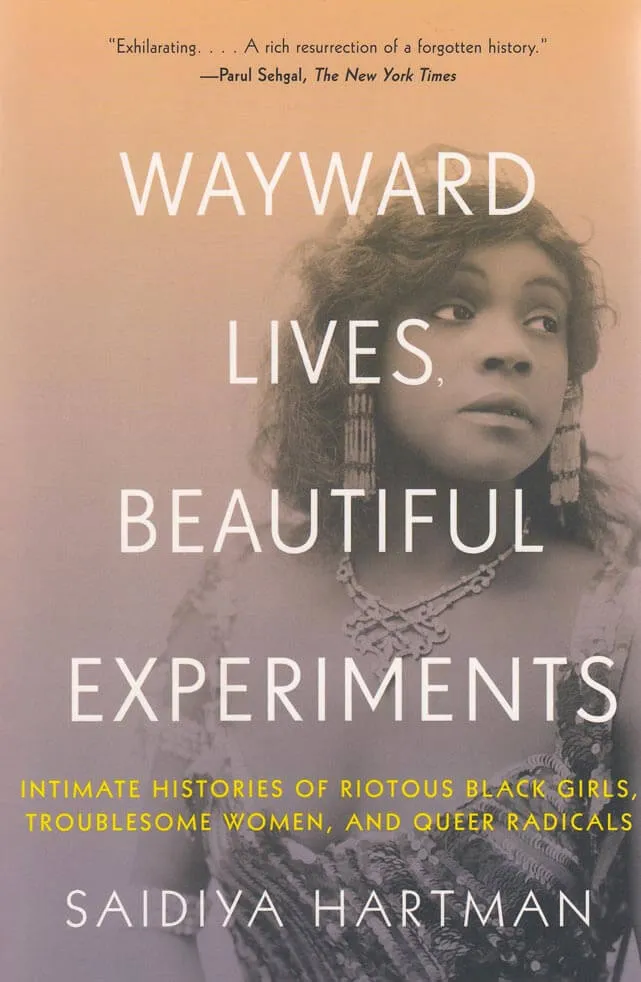
Wayward Lives, Beautiful Experiments
Wayward Lives, Beautiful Experiments examines the revolution of black intimate life that unfolded in Philadelphia and New York at the beginning of the twentieth century. In wrestling with the question of what a free life is, many young black women created forms of intimacy and kinship indifferent to the dictates of respectability and outside the bounds of law. They cleaved to and cast off lovers, exchanged sex to subsist, and revised the meaning of marriage. Longing and desire fueled their experiments in how to live. They refused to labor like slaves or to accept degrading conditions of work. Here, for the first time, these women are credited with shaping a cultural movement that transformed the urban landscape. Through a melding of history and literary imagination, Wayward Lives, Beautiful Experiments recovers these women's radical aspirations and insurgent desires.

How to Leave the World
Everyone is asking about his identity. Gay? Muslim? French? Moroccan? Instead of choosing a side, he writes a book. A book about the forest and the city, Paris and Tangiers, shame and forgiveness, dating apps and spiritual discovery. A book about growing up as a diaspora kid in rural France, with desires that want to emerge at any cost. Told in mesmerising prose, How to Leave the World is a beautiful non-answer.
A rare book that depicts the isolation and poetry of rural life. — Annie Ernaux
What it takes to imagine social and physical freedom is what it meant to keep reading this incredible book. — Bhanu Kapil
Marouane Bakhti is a writer and arts journalist. Born in Nantes, France to a Moroccan father and a French mother, he studied history and journalism at the Sorbonne. He writes criticism for Mouvement magazine and lives in Paris. How to Leave the World is his first novel.
Lara Vergnaud is a literary translator of French and has translated over a dozen novels, including works by Zahia Rahmani, Fatima Daas, Mohamed Leftah and Mohamed Mbougar Sarr. Lara was born in Tunisia, grew up in the United States and currently lives in southern France.
978-1-7395161-3-0
21.6 x 13.9 cm
112 pp, paperback
September 2024

Discontent Issue 6
Reportage, photography, and art from Palestine and Lebanon. Contributors include Alaa Mansour, Fady Joudah, Farah Silvana-Kanaan, Fatima Joumaa, Fouad Elkoury, Hadi Afif, Islam Al-Khatib, Philippa Dahrouj, Rawad Wehbe, Sakir Khader, and Wassila Abboud.

Bodies of Extraction
Lydia Xynogala, Lorena Vicini and 1 more
What does it mean to drill deep and interfere with the configuration of tectonic plates? What does it mean to hollow out and alienate islandic undergrounds? How is wealth extracted and exploited from the ground, crumbled into fragments, transformed into matter, pieces of power, moved away to be represented elsewhere? Whose lungs and souls are capitalized upon and hidden under the suffocating dust in mining shafts? To whom do the surface of the land and its underground belong?
This book takes proto-industrial mining in the Aegean island of Serifos as an entry point for disclosing historical and contemporary consequences of politics of the soil through land extraction, and looks at how mineral evidence was historically produced, disseminated, and capitalized upon in the Aegean region and beyond.
Contents:
Mineral Travels:
Fragments of Geographies on the Move
by Lydia Xynogala
The Evil in the Surface
by Lorena Vicini
Consuming Land at Serifos
by Asli Özdoyuran
and David Bergé
Letter from Frikas Fortress
by Constantinos Speras
Iron Lungs
by Milica Ivic
Walking on Marble: Materialized Histories
by Anna Run Tryggvadottir

The Letters of Rosemary & Bernadette Mayer, 1976-1980
Bernadette Mayer, Rosemary Mayer
This collection of the correspondence between artist Rosemary Mayer (1943-2014) and poet Bernadette Mayer (born 1945) occurs between the years of 1976 and 1980, a period of rich creativity in New York's artistic avant-garde, and one which includes the development of major bodies of work by the two women.
Rosemary Mayer was creating sculptures, watercolors, books and temporary monuments from weather balloons and snow, while Bernadette Mayer was working on some of her best-known publications, including the book-length poem Midwinter Day and the poetry collection The Golden Book of Words.
Spanning the worlds of Conceptual art, Postminimalism, feminism, the New York School, Language poetry and more, these letters elucidate the bonds of sisterhood through intimate exchanges about art, relationships and everyday life.

Love, Leda
Newly discovered in the author’s archives and published for the first time in the UK in 2023, this portrait of queer, working class London drifts from coffee shop to house party, in search of the next tryst.
Leda is lost. He spends his days steeped in ennui, watching the hours pass, waiting for the night to arrive. Trysts in the rubble of a bombsite follow hours spent in bed with near strangers, as Leda seeks out intimacy in unlikely places. Semi-homeless and estranged from his family of origin, he relies on the support of his chosen one: a community of older gay men and divorced women who feed and clothe him, gently encouraging him to find a foothold in a society which excludes him at every turn. And then there is Daniel, a buttoned-up man of the Lord, for whom Leda nurses an unrequited obsession—one which sends him spiraling into self-destruction. Pre-dating the British Sexual Offences Act of 1967, Love, Leda was first published in 2023 in the UK. This long lost novel is a portrait of London’s Soho that is now lost, an important document of queer working-class life from a voice long overlooked.

Unfit
Ariana Harwicz, Jessie Mendez Sayer
A bracing novel that asks how far we would go for the ones we love—and what we would do to destroy the ones we hate.
Lisa has lost custody of her young twin boys. Caught between the French legal system’s sluggish bureaucracy and her sinister, scheming in-laws, she’s alone and lost, an Argentine migrant in rural France picking grapes for a pittance, only allowed to see her children in supervised visits once a month. Scapegoated and outcast, destitute and desperate, Lisa decides to take radical action: early one morning, she sneaks into her in-laws’ farmhouse, takes back her children, sets the barn ablaze, and makes her escape.
What follows is a white-knuckled road trip that explores human beings pushed to the edge. Clearly, Lisa is not in her right mind, and as Harwicz deftly mingles a chorus of contradictory voices into her very unreliable narration, the reader comes to regard the protagonist with an unsettling mixture of sympathy and suspicion. Written in savage, chiseled prose, Unfit shoots off, a gripping chase that questions all our assumptions—and points out our hypocrisies— about motherhood, custody rights, love, violence, anti-semitism, and migration. The latest novel by the acclaimed author of Die, My Love (soon to be adapted to a film starring Jennifer Lawrence), Unfit is addictively terrifying, savagely sophisticated, and shockingly brilliant.
Translated from Spanish by Jessie Mendez Sayer

Toxicité coloniale: Documenter le Paysage Radioactif
Toxicité coloniale revient sur les programmes nucléaires français menés entre 1960 et 1966 dans le Sahara algérien. Ce programme secret, qui s’est déroulé pendant et après la guerre d’indépendance algérienne (1954-1962), a permis au régime colonial français de mettre à feu quatre bombes atomiques atmosphériques, treize souterraines et de mener d’autres expériences nucléaires dans le désert. Alors que la grande majorité des documents d’archives sont toujours classés secret aujourd’hui, Toxicité coloniale rassemble une variété de sources permettant de documenter l’histoire violente des activités de la France en Algérie. Le livre constitue un corpus de choix à l’intersection de la justice spatiale, sociale et environnementale pour ceux et celles qui s’intéressent à l’architecture, au paysage et aux pratiques d’archivage dans une démarche décoloniale.
Alors que ces bombes ont eu des conséquences durables pour les populations et les environnements locaux ainsi que pour les vétérans français, le manque de contrôle des explosions, les lacunes de sécurité et l’utilisation des Algériens comme main- d’œuvre sur des chantiers particulièrement dangereux apparaissent comme des faits coloniaux d’une importance majeure.

Moon Mirrored Indivisible
Multilayered lyric poems that resist systems of power and foster intimacy.
An inheritor of lineages marked by colonial and gendered violence, Farid Matuk approaches the musical capacities of verse not as mere excitation or decoration, but as forms that reclaim pleasure and presence. Entering the sonic constellations of Moon Mirrored Indivisible, the reader finds relief from nesting layers of containment that systems of power impose on our bodies and imaginations. In this hall of historical mirrors, fictions of identity are refracted, reflected, and multiplied into a vast field of possibilities. Matuk’s meditations on place and power offer experiments in self-understanding, moving through expansive conversations between a lyric “I” and others, including poets, the speaker’s partner, ancestors, and the reader, and creating spaces for strange intimacy. Each of the book’s four sections of poems builds on the other to ask how we might form a collective—a people—not founded in orthodoxies of originality but in the mutual work of mirroring one another.

The Essential June Jordan
The Essential June Jordan honors the enduring legacy of a poet fiercely dedicated to building a better world. In this definitive volume, featuring an afterword by Pulitzer Prize-winner Jericho Brown, June Jordan’s generous body of poetry is distilled and curated to represent the very best of her works.
Written over the span of several decades―from Some Changes in 1971 to Last Poems in 2001―Jordan’s poems are at once of their era and tragically current, with subject matter including racist police brutality, violence against women, and the opportunity for global solidarity amongst people who are marginalized or outside of the norm. In these poems of great immediacy and radical kindness, humor and embodied candor, readers will (re)discover a voice that has inspired generations of contemporary poets to write their truths. June Jordan is a powerful voice of the time-honored movement for justice, a poet for the ages.

MAKAN #2 / Manufacturing Narratives
In its second issue, Manufacturing Narratives, Makan focuses on how interrogating narrativity can provoke fundamental questions about how societies define or choose to accept societal or historical truths in today’s world. Spanning across [and beyond] the Mashreq and Maghreb, the various contributions reflect a shared space of inquiry that bridges geographies and fosters emergent dialogues across shifting territorialities. This issue invited contributors to right (as much as write) narratives: to question authorship and its social collectivities, to retell alternative public histories, to explore gender roles, and to unsettle the exoticism, folklorization, and political textures of fiction as a practice of indiscipline. Together, these contributions re-articulate the genealogies of our present through the pluralities of the past, offering tools to imagine and manufacture alternative futures, and realities otherwise.
With contributions by Ala Younis, Bari Abbassi, George Bajalia, Karim Kattan, Karima Kadaoui, Tamkeen, Kenza Sefrioui, Lahbib El Moumi, Laila Hida, Maureen Mougin, Mohamed Amer Meziane, Monica Basbous, Nadia Tazi, Sénamé Koffi Agbodjinou, Salma Barmani, Sonia Terrab, Soufiane Hennani, Yto Barrada.

The Romance of Happy Workers
The Romance of Happy Workers swaggers through a world of cowboys, conquistadors, comrades, and housewives with mock-Russian lyric sequences and Keatsian swoon. Political and iconoclastic, Anne Boyer’s poems dally in pastoral camp and a dizzying, delightful array of sights and sounds born from the dust of the Kansas plains where dinner for two is cooked in Fire King and served on depression ware, and where bawdy instructions for a modern “Home on the Range” read:
"Mix a drink of stock lot:
vermouth and the water table.
And the bar will smell of IBP.
And you will lick my Laura Ingalls."
In Boyer’s heartland, “Surfaces should be worn. Lamps should smolder. / Dahlias do bloom like tumors. The birds do rise like bombs.” And the once bright and now crumbling populism of Marxists, poets, and folksingers springs vividly back to life as realism, idealism, and nostalgia do battle amongst the silos and ditchweed.

Civilization #7
Richard Turley, Lucas Mascatello
The occasionally-published broadsheet Civilization was founded in New York in 2018 by Richard Turley, Lucas Mascatello, and Mia Kerin. Its origin was as a response to New York City life, but has now transformed into an art project that gathers language, overheard conversations, secret recordings transcribed by rapid-capture software to produce a dense, rhythmic assemblage of texts from both public and private spaces alike. As a result, Civilization’s design texture has found fans in the fashion world, leading to collaborations with Calvin Klein and Junya Watanabe.
The publication has also enjoyed contributions from a wide array of artists, writers and personalities including: Aaron Maine, Alis Atwell, Amos Poe, Amalia Ulman, Aria Dean, Alicia Novella Vasquez, Bill Drummond, Biz Sherbert, Babak Radboy, Carly Busta, Darcie Wilder, Echo Wu, Ella Plevin, Eric Johnson, Honor Levy, Iris Luz, Mel Ottenberg, Isabelle Rea, Joey LaBeija, Jordan Barse, Lovefoxx, Maddie Quinn, Patrick McMullan, Rachel Rabbit White, Sybil Prentice, Thom Bettridge, and Zans Brady Krohn.

First Meeting
Santiago de Paoli, Martina Panelli
First Meeting is the first monograph on Argentinian artist Santiago de Paoli. Covering de Paoli’s oeuvre from his early, experimental projects to his most recent explorations, the book delves into his innovative approach of painting on unconventional materials, from plaster to bread, felt to canvas, aluminum to wool, and socks to fur. It features newly commissioned essays by Fernanda Brenner, and Mariano Mayer, as well as a conversation between Christian Rattemeyer and the artist.

Tony Cokes Edition
On the occasion of Tony Cokes' solo-exhibition, ARGOS produced a unique purple t-shirt with silver lettering. 100% cotton; 180 grams. Silkscreen by Bootlegz in Brussels.
Available in XL (XS, S, M and L are sold out)
Edition of 100

Distributed Art Publishers (DAP)
Teenagers in Their Bedrooms
The new edition of Salinger's ever-relevant series of 1980s and '90s teenagers in their bedrooms.
Bedrooms contain the past, the present and the future; they are sites of continual transformation. Popular culture and fashion continually change and recycle. While specific objects of decor change over time, teenagers' bedrooms are still private sanctuaries: spaces for safely experimenting during a time in life when one is forming and expressing ever-evolving identities.
Upon its release in 1995, Adrienne Salinger's book In My Room was an immediate success, selling nearly 24,000 copies in its first few years. The continued popularity of this work made in the '80s and '90s is curious. However, over the nearly 30 years since, and especially in the most recent decade of social media, the work's appeal has grown tremendously. In some cases, the work evokes nostalgia, but not primarily so. Adrienne Salinger hears from current teenagers often; many send her pictures of their bedrooms today. Social media encourages users to endlessly "rebrand" their identities, creating idealized fantasies, striving for perfection. These photographs are not about perfection. They give voice to the contradictions of our identities.
Hundreds of print and online articles, interviews and features on In My Room have been published and the work has been exhibited at museums all around the world. Long out of print and now considered a classic, with only a rare few available on the secondary market, the book returns in a new expanded edition as Teenagers in Their Bedrooms. With 26 additional photographs, this treasure is made available once more to new audiences.
Adrienne Salinger has published three photobooks: In My Room (1995), Living Solo (1999) and Middle Aged Men (2007). She is Regents Professor Emerita at the University of New Mexico.

You Must Believe in Spring
Twenty years after she first chanted in Tahrir, Hanan’s son is living under military rule in Egypt. Though he is both a disciple of the national Sufi institute and a swimmer representing the Armed Forces, proximity to power cannot undo his revolutionary birthright: like his mother and grandmother before him, Shahed is an undercover rebel.
When a general arrives at the Sufi institute looking for help with a military assignment, Shahed accepts, all while concealing his own plans for resistance. The mission takes him behind the walls of a prison town, inside a secret army barracks in the Sinai desert, and deep into the murky waters of the past.
As he wades through his mother’s repressed memories and the state’s repressed histories, Shahed grapples with the traumas of the revolution and the weight of authoritarian rule, searching for new ways to revolt for freedom.
Mohamed Tonsy is a queer Egyptian writer and ceramicist. Formerly an architect and a triathlete representing the Egyptian Triathlon Federation, he completed a PhD in Creative Writing at the University of Edinburgh. His writing has appeared in Mizna and Epoch Press and was shortlisted in MFest’s 2021 Short Story Competition. You Must Believe in Spring is his first book.