Books
Books
in random order

Selected Writings of Gertrude Stein
This collection, a retrospective exhibit of the work of a woman who created a unique place for herself in the world of letters, contains a sample of practically every period and every manner in Gertrude Stein’s career. It includes The Autobiography of Alice B. Toklas in its entirety; selected passages from The Making of Americans; "Melanctha"from Three Lives; portraits of the painters Cezanne, Matisse, and Picasso; Tender Buttons; the opera Four Saints in Three Acts; and poem, plays, lectures, articles, sketches, and a generous portion of her famous book on the Occupation of France, Wars I Have Seen.

Tips of the sung
Tips of the Sung is a collection of interdisciplinary texts from Samuel Brzeski composed over the five years whilst he was Associate Artist at Lydgalleriet. The collection brings together performance scripts for voice and video with newly composed texts for the page. Centring on the vibrations of the voice, the texts exist somewhere between signification and delirium, at times making more sound than sense.
The texts are full of bumbling mumbles, meandering hums, homophones, inner voices, affirmations, motivations, subvocalisations, resolutions, errors in speech production, peach seduction, car maintenance manuals, self-help fallacies, roomy echo chambers, overheard language lessons, morning meditations, and other forms of verbal rehearsal at the limits of language.

Thirty-Odd Functions of Voice in the Poetry of Alice Notley
Alice Notley has consistently peopled her poetry with the voices of those around her: kids, friends, husbands, strangers, and the dead. Thirty-Odd Functions of Voice in the Poetry of Alice Notley offers an array of interpretations of this technique. While not aspiring to completeness, and limiting its attention to one formal aspect of a single author's work, this poem-essay sketches relationships between intimate speech and literary language.

Sounds Naughty
In this psychoanalytic pamphlet, Croatian philosopher Karlo Pavlović analyses the perversions of the day. Considering the topic of ASMR, a key example of what he calls the generalised deployment of subtle pornography, of depictions of sexuality "in gloves", he argues that society today should be understood through the blue balls phenomenon. This concept, developed playfully by Pavlović, explains that we are all perverts taking the logic of the drive to its extreme; if the whole point of the drive is not to attain its object, but rather, to circle around it, the perverse subject (as the subject of the present times) has, in fact, no problems with this whatsoever.
Karlo Pavlović is completing his PhD in Philosophy at The University of Ljubljana, supervised by Alenka Zupančič.

Americón
Nico Vela Page’s Americón is a collection of poems in Spanglish that weaves a space for the queer, trans body to know the land, and itself, as extensions of each other. The land is the desert of Northern New Mexico, the forgotten Pan-American Highway, the space between our thighs, the quaking cordillera of Chile, the moans of elk, and the ripe fruit waiting to be picked. Through archive, attention, and erotic ecopoetics, Page’s debut collection of poems extends far across the page, the gender binary, language, and the Americas to find out who we are by asking where we are.

A Seed Under Our Tongue
Set in various Uzbek landscapes spanning time and place, Ismailova's films weave a storied tapestry of ancestral folklore, traditional craft and colonial resistance. By Saodat Ismailova, with Roberta Tenconi, Erika Balsom, Marcella Lista, Dilda Ramazan and Rolando Vázquez.
Uzbek artist Saodat Ismailova (born 1981) is part of the first generation of Central Asian filmmakers following the collapse of the Soviet Union. Her films emphasize long shots that evoke the aesthetics of slow cinema, often combined with archival footage and installed within textile sculptural elements drawn from vernacular traditions, as in the exhibition at Pirelli Hangar Bicocca in Milan, which this volume refers to. Exploring the collective memories of her home region, Ismailova interweaves myths with personal dreams to address social issues such as women's emancipation, identity and the colonial past.

Tis of Thee
With figures X, Y, and Z, Fanny Howe constructs "a repressed but emotional history" of encounters and unions between races, classes, genders, and epochs. Considering race as "the most random quality assigned to a soul," Howe has undertaken an (American) history of a racially mixed population. The work bears evidence to many creative unions as well: with Ben Watkins, who provided the photographs; with graphic artist Maceo Senna, who illustrated the text; with Nya Patrinos, set designer, video artist, and director of the original production; as well as with composers Miles Anderson and Erica Sharp, whose score adds another voice to the spoken three. The book includes a link to an audio recording of the work, originally performed at the Porter Troupe gallery in San Diego, 1997, with Paul Miles (X), Stephanie French (Y), and Andre Canty (Z). "So whiteness is what is dependent on a witness. / The moon's opaque and egg-like sheen is the kind of zero / that wants to be more than air and negativity."

Can We Rule It Out? Collective Ideas for keeping sexual abuse out of art spaces
Habiba Effat, Naira Antoun and 1 more
“With this collection of texts, reflections, questions, documents, we invite our readers, colleagues, and peer organizations to engage in difficult, often fraught, discussions about sexual abuse in art spaces. We do not want these conversations to always start at zero, as if a lot of work around sexual abuse hasn’t been done already. There is copious activism, scholarship, and creativity on this topic, if one wants to find it. What this publication would like to do is contribute to the work that has already been done and to be a waypost toward what remains to be done.”
Commissioned and edited by: Karim Kattan and Mai Abu ElDahab
Contributors are Adam HajYahia, Habiba Effat, Karim Kattan, Mai Abu ElDahab, Marnie Slater, Naira Antoun, and Salma El Tarzi
Notes compiled and written by Ahmed Medhat, Marina Samir, Nana Abuelsoud, and Salma El Tarzi, with edits and comments by Sahar Mandour
Translation from Egyptian Arabic of “Notes on Justice” by Yasmine Haj
Copyedited and proofread by Jenifer Evans
Designed by Loraine Furter and Naïma Ben Ayed

Chile Chico et le quartier Versailles
Chile Chico et le quartier Versailles, c'est une exploration qui inventorie, interroge et révèle les mémoires invisibles en listes et en collections. Une mémoire qui ne soffre pas en bloc, qui résiste, se fragmente, se transforme. A travers cette archive collaborative, nous avons voulu capter ces va-et-vient ď'un passé qui dialogue avec le présent, des images qui oscillent entre Vintime et le collectif.
Le point de départ de cette fabrique visuelle, c'est lexil des Chilien.nes, débarqué.es dans les années 70, qui se tissent une nouvelle vie sur le sol de Neder-Over-Heembeek, dans le quartier Versailles à Bruxelles. Ces trajectoires, arrachées à un ailleurs, s'ancrent dans des espaces rêvés comme de transit pour devenir des lieux d 'appartenance, où lexil se mue et les racines finissent par se déployer. A ces récits se greffent d'autres histoires, d'autres trajectoires. Un quartier comme un carrefour, ou les individualités se rencontrent, où les vies se croisent et s'allient.

Koreografi
Koreografi / Choreography is a magazine initiated and edited by Solveig Styve Holte, Runa Borch Skolseg and Ann-Christin Berg Kongsness. The magazine consists of texts written by Nordic artists within the field of dance and choreography.

Birthday
Bridget Mullen is the ruler of an unruly roost. Between 2021 and 2023, she gave birth to forty-seven paintings, each twelve-by-nine inches: kin ugly and cute, monstrous, fleshy, repulsive, droopy-eyed, and sneering as they cross the universal threshold into the no less frightening world that awaits. Birthday reunites Mullen's uncanny litter alongside a conversation between the artist and Lucas Blalock.
The paintings in New York-based artist Bridget Mullen's Birthday series utilize two distinct parameters to guide the creation of the iterative works: a vertical orientation at an intimate scale of 12 x 9 inches and a visualization of perhaps the ultimate creative act—the moment of birth. Through this consistent scale and thematic hyper focus, the artist employs endless formal variations in composition, color, and paint application. The result is a series of paintings that share a common structure yet champion individuality.
Contrasting colors provoke a visible tension, one that is at times compressed and, in other moments, elastic. Suddenly, abstract shapes come into focus as human anatomies, capable of expressing emotion. Undulating lines of various thicknesses and layered colors squeeze together, revealing peculiar faces and gestures that emerge from a central point. The repetition of thin lines creates a visual stutter of pigment, alluding to the passage of time or rapid movement.
The works in Birthday build on Mullen's practice, combining color, decisive mark-making, intuition, and experimentation to conjure psychedelic configurations. Sculptural dimensionality and flatness, representation and abstraction, and solidity and fluidity, serve not as dichotomies within these works, but as two complementary halves of a whole. Together, the forms and figures of the Birthday series are imbued with a sense of life, pregnant with agency and potential.

Fugue
Aaron Amar Bhamra, Céline Mathieu
Fugue is published on the occasion of the eponymous duo exhibition by artists Aaron Amar Bhamra and Céline Mathieu, presented at Jester in Genk, Belgium. The title, derived from the Latin fuga (flight), evokes both its musical and psychological meanings: a contrapuntal compositional technique and a state of dissociation. These dual connotations—aural and mental—resonate throughout the exhibition and this accompanying publication.
Céline Mathieu's work moves between the sensory and the conceptual, integrating multiple media to explore the circulation of thoughts and materials in relation to specific sites. Aaron Amar Bhamra's practice draws on recurring forms and materials to construct evolving personal and social archives, often reactivating exhibition spaces by engaging with their historical contexts.
In addition to documenting the exhibition, the publication features an introduction by Jester's artistic director Koi Persyn, a visual score of a sound composition by Charlie Usher, written contributions by Céline Mathieu, curator Eloise Sweetman, and researcher Johanna Schindler, as well as a series of analog photographs by Aaron Amar Bhamra.
Contributions by Koi Persyn, Céline Mathieu, Charlie Usher, Eloise Sweetman, Johanna Schindler, Aaron Amar Bhamra.
Austrian artist Aaron Amar Bhamra (born 1992) often procures exhibition spaces that subtly expose their systematics and physical experience by incorporating imprints reminiscent of other spaces or past exhibitions. He occasionally uses recurring forms and materials, weaving a site of shifting personal and social archives.
Céline Mathieu (born 1989) is a Belgian artist and writer. Her practice is often site and condition specific, using sound, scent, sculpture, performance, text and different materials in performative installations. The work is both sensory and conceptual. Her work looks into the circulation of thoughts and materials. Material and economic cycles merge with hyper-personal items, resulting in fluid work that cannot quite be pinned down.

Between the Teeth
Produced on the occasion of the exhibition Unbidden Tongues #5: Theresa Hak Kyung Cha: Between the Teeth at Manifold Books, Amsterdam, November 28, 2021 – January 22, 2022.
Drawing on artist, poet and filmmaker Theresa Hak Kyung Cha’s extensive and largely unexhibited archive of ‘work on paper’, Unbidden Tongues #5: Between the Teeth is a publication-turned-exhibition and the fifth title in the series. From never-realised film scripts to concrete poetry and artists statements written intimately in the first person, the collection of material selected for this occasion presents the varying ways with which Cha drew on her personal and familial experience as an immigrant to conceptually grapple with language and its mediation and suppression, particularly, in this case, in its written form.

Entangled – Texts On Textiles
What does it mean to be a curator who writes, and, more specifically, how can curators write about textiles? This publication steps outside the framework of the typical exhibition catalogue to occupy "the space between literature and criticism".
The Community of writers was set up to create time and space to retreat from these outside opinions and demands and to let curiosity and the joy of writing be the driving forces of the writing process. This book has been realised under the auspice of Interweaving Structures: Fabric as Material, Method, and Message, and specifically through collaboration between the Faculty of Fine Art, Music and Design at the University of Bergen and the Central Museum of Textiles in Łódź. The two partners have strong positions of specialisation—the museum acts as a caretaker of material textile traditions and art in Poland, and the faculty has a strong textile art tradition and offers the only education programme for curators in Norway.
Edited by Anne Szefer Karlsen.
Contributions by Andreas Hoffmann, Heather Jones, Martina Petrelli, Anne Szefer Karlsen, Lea Vene, Johanna Zanon.

Tony Cokes Edition
On the occasion of Tony Cokes' solo-exhibition, ARGOS produced a unique purple t-shirt with silver lettering. 100% cotton; 180 grams. Silkscreen by Bootlegz in Brussels.
Available in XL (XS, S, M and L are sold out)
Edition of 100

Snaturamenti
A workbook by Flatform on displacement, conceived and curated by Giuliana Prucca.
The book is published under four different covers and with four different layouts, randomly distributed.
Founded in 2006 and based in Berlin and Milan, Flatform is a video and media arts collective, at the border between experimental cinema and contemporary art, that creates time-based works, film events, and installations, most of which revolve around landscape and biopolitics. Distributed by Light Cone in Paris and by Video Data Bank in Chicago, works by Flatform have competed in major film festivals including Cannes, Rotterdam, Venice, Toronto, and have been shown worldwide in art venues such as Centre Pompidou, Haus der Kulturen der Welt, Hirshhorn Museum, MAXXI Museum, Eye Filmmuseum, Wexner Center for the Arts and Garage Center for the Arts.
Co-published by Light Cone and Avarie.

The Queer Art of Failure
The Queer Art of Failure is about finding alternatives—to conventional understandings of success in a heteronormative, capitalist society; to academic disciplines that confirm what is already known according to approved methods of knowing; and to cultural criticism that claims to break new ground but cleaves to conventional archives.
Jack Halberstam proposes “low theory” as a mode of thinking and writing that operates at many different levels at once. Low theory is derived from eccentric archives. It runs the risk of not being taken seriously. It entails a willingness to fail and to lose one’s way, to pursue difficult questions about complicity, and to find counterintuitive forms of resistance.
Tacking back and forth between high theory and low theory, high culture and low culture, Halberstam looks for the unexpected and subversive in popular culture, avant-garde performance, and queer art. Halberstam pays particular attention to animated children’s films, revealing narratives filled with unexpected encounters between the childish, the transformative, and the queer. Failure sometimes offers more creative, cooperative, and surprising ways of being in the world, even as it forces us to face the dark side of life, love, and libido.

Carroll Dunham: Drawing Sculpture
Drawing has long been foundational to American painter Carroll Dunham's (born 1949) practice. In this collection of recent, never-before-shown works, we witness Dunham thinking about sculpture through a series of drawings produced over the course of a year. A sampling of his drawings across time offers a chart of his artistic evolution; the 80 drawings presented here are distinctive to a new page within that history. Spurred by a desire to explore the saggy, open-frame cubic boxes that he found himself doodling along the edges of a new series of paintings, Dunham began drawing fantasies of sculpture as a respite whenever he needed a break from working on the paintings. This turned into an ongoing practice that lasted until it unexpectedly segued into a material investigation with the making of sculpture in real space. Offering intimate access to Dunham's process, this book is the first to document his thinking about spatial relationships, presentation and materials for sculptures that don't exist.
Carroll Dunham has developed an extensive oeuvre since the late 1970s in painting, drawing, and printmaking. His work has been the subject of numerous solo exhibitions, most recently a drawing retrospective at the Art Institute of Chicago (2026), and presented in group exhibitions at institutions in the United States and abroad. He lives and works in Connecticut.

toi, moi, la pluie
toi, moi, la pluie is a sequence of cards that can be assembled into three-dimensional configurations. The cards present two sides of the same moment: rain falling outdoors, and an art exhibition taking place indoors.
With humour and a sense of casual abandon, Sara Graça reduces the exhibition space to a dry place offering shelter from the rain. Despite a moment of intense intimacy—a passionate kiss—the space is largely inhabited by figures who do not seem to know one another, or to get along. The same kiss takes place outdoors; lovers, after all, do not care about the weather. Drawn in a caricatural style, recalling Ad Reinhardt’s How to Look series, these characters speak English, French, and Portuguese. We cannot tell whether they are visiting or staying; we do not know where they are.
The cards are accompanied by a small cut-out horse that can also be assembled and added. A memory of a past life, a lingering presence, a sense of “other”, the horse becomes the final piece of the puzzle. It acts as an exclamation point to these otherwise trivial human exchanges—cutting across inside and outside, shelter and rain, intimacy, cohabitation, and distance.
The publication is disguised as a book, revealing its playful nature only once opened, and inviting the reader to assemble, rearrange, and make choices of their own.
Sara Graça (Lisbon, 1993) lives in London and works in interdisciplinary ways, mainly using sculpture, drawing, photography and video. Her practice often questions ideas of value, authenticity and impermanence.
All copies are numbered & signed.

Foam
I am still transitioning, but I am unsure into what.
Who are all these Evas? They puncture and disrupt the domestic space and equilibrium of the narrator, who alternately relies upon them or administers their care. Foam is the latest boundary-blurring, genre-resistant, strange and speculative new fiction from Kate Zambreno, the inimitable and relentless literary stylist and conceptualist. Inspired by the absurdities of Eva Hesse and other soft sculpture, these are speculative art essays and textures, a document of precarity and slippery time—mischievous, moody, estranged—a masterwork of tone and atmosphere.

Stalled Death Train
A dark-humored poet’s novel of cruising, contempt, and database crawling, Stalled Death Train rumbles through the death of David Bowie in 2016 to shake apart its narrator’s sense of self. Nick, a burned out office worker and late-Bowie fanatic, spends his days mourning his fallen star, left to decipher the legacy and lyrics of a singular pop icon whose excesses did not cease, even after his greatest moments had passed. Meanwhile, Nick must solve the mystery of why his boyfriend has begun to self-amputate as a form of autonomously upgrading his dimensions—or at least call tech support before he uploads himself to the cloud.
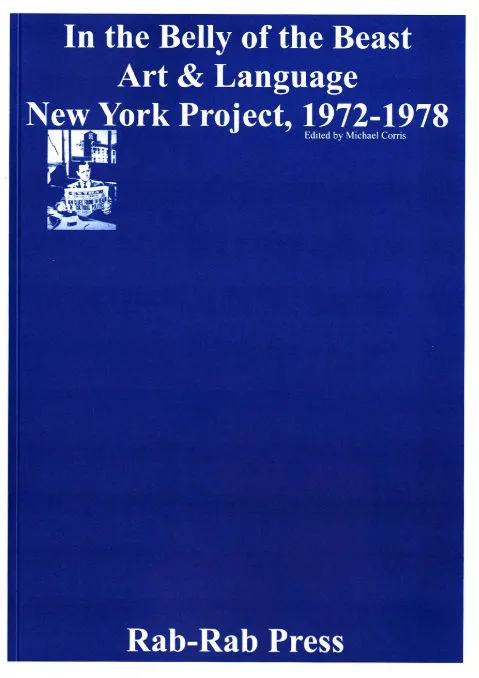
In the Belly of the Beast – Art & Language New York Project 1972-1978
Edited by Michael Corris, the expanded edition of In the Belly of the Beast: Art & Language New York Project 1972-1978 is a survey of the tumultuous years of the political Conceptualism in the mid-seventies New York.
Artists have always experimented with politics, either by organizing themselves or uniting in support of a broader political movement. Today, "activist art" is taught in universities, supported by foundations, and featured in museums and international exhibitions. Is this the only possible way?
In the Belly of the Beast tells a different story, of the work of politically engaged artists and the conflicts they experienced. It is the history of artists wishing to continue working within the boundaries of the artworld and those who were intent on establishing new ideological and class relationships with activists to build a political party.
During the 1970s in New York, the Art & Language collective pioneered institutional critique; published a Marxist-influenced journal; agitated against racism and sexism in museums; challenged the cultural imperialism of international exhibitions; and forged a framework for a socialist organization of artists. This new edition includes previously unpublished documents illuminating the contradictions and disputes that lay at the center of the organization and practices of Art & Language and left-wing groups, such as the Anti-Imperialist Cultural Union and the Artists' Meeting for Cultural Change, mobilizing artists in New York at the time.
The new and expanded edition of In the Belly of the Beast features an extensive interview with Michael Corris, who annotated a collection of previously unavailable documents from the period, including manuscripts, pamphlets, transcripts, and letters.
Art & Language is the name of a group of English artists who choose to work collectively, and the title of a magazine that they founded in 1968. Proposing a critical analysis of the relations between art, society, and politics, Art & Language marks, even in its name, the importance of the “textual turning point” in the 1960s.
Since 1976, Art & Language's project has continued, through Mel Ramsden and Michael Baldwin, with the literary and theoretical collaboration of Charles Harrison. Working with very varied mediums, from painting to rock, these co-founders of Conceptual art remain, even today, attached to observing the consequences of what they themselves call the “depressing collapse of modernism.”

For a Time
Published in conjunction with the exhibition For a Time Light Must Be Called Darkness. Lina Selander in collaboration with Oscar Mangione held at Argos, Centre for Art & Media, Brussels, 24.09.2017 - 17.12.2017.
About the exhibition:
For a Time Light Must Be Called Darkness features six video installations, most of them made in collaboration with Oscar Mangione. These works take us to Bredäng (a suburb in south-west Stockholm), Berlin, the West Bank, Pripyat and Chernobyl. All of these places are the occasion and the starting point for broader reflections about our present in relation to historical facts. Selander visits these sites and like an archaeologist digs in their past, their monuments, museums and archives. She looks for visual documents, focuses on details and analytically sketches new hypothesis. In this way, she tries to retrace hidden links between distant imageries, correspondences and analogies, in order to create new narratives. In her essayistic approach, Selander combines her own texts and footage along with still images, quotes and archive material. In this way a constant tension springs within these multiple-layered audiovisual works and reminds us that seeing is never an innocent act.

Miss Nobody Knows
The first English translation of Leslie Kaplan's crystalline novella Miss Nobody Knows, about the lived aftermath of May '68: its hopes and failures and how they continue to resonate today.
“Ostensibly about the May '68 strike and a man who cannot deal with its aftermath, but really a love story to these moments when suddenly the utopian comes into view and no longer feels impossible. It’s a book to read right now so as to remember that there have been moments when people come together in the name of possibility, rather than in rage.” —Juliana Spahr
“Thank you for sending Leslie Kaplan's book, so strong and graceful, so… so… so… as if the novel were suspended between the animal and the human.” —Jean-Luc Godard, letter to Paul Otchakovsky-Laurens
“One thought he understood it all, the other wanted to see it all. Through two opposing characters, Leslie Kaplan brings to life something of May '68 … This novel breaks an opening out of the infinitely mad universe that was captured by Leslie Kaplan's first book, Excess-The Factory.” —Claire Devarrieux, Libération