Books
Books
in random order

The First Jasmines
East Pakistan, 1971. On their way to visit their mother, two sisters, Lucky and Jamila, are captured by Pakistani soldiers and thrown into a world of horror.
Locked in a room in an unknown village-turned-camp by the river, the women look through a lone barred window onto white jasmines blooming day and night. Meanwhile, around the camp, deadly guerrilla fighters from the Bengali Mukti Bahini gather to take back territory from the Pakistan Army.
As Bangladesh crowns painfully into the world, Lucky and Jamila must choose between heartbreak and secrecy to return from an unspoken violence.
Saima Begum is a British-Bangladeshi writer based in North London. She won the MFest Short Story Competition in 2021. The First Jasmines is her first novel.

And most of all I would miss
Picture a pencil curved, implausibly, parabolically. An implement bending back on itself (core straining) so as to be drawing the surest line, even as its eraser-end is simultaneously rubbing that graphite out. What remains almost never was: mark as memorial to foreclosure. Examined from a certain angle, the un-line flickers in and out of thereness. On registration, it lives, it goes forth. Sub rosa, it knows never to clear its throat. It has learnt to calibrate its signature; it can evade infra-red. Propelling itself through the narrowest channels, it proceeds with resolve, flayingly. Mattar’s And most of all I would miss the shadows of the tree’s own leaves cast upon its trunk by the orange streetlight in the sweet blue darks of spring is taut as writing can be. The tone she makes sound is singular and desperately (gloriously) intent.
- Sarah Hayden
Piercing and lucid in its exposition of atmospheric violence and total erasure, Mira Mattar gets to the grain of how the languages of selfhood, mediated but also inhibited by the force of the ‘un-universal’, become complicit in forming the sovereign imperative to self-determination, ‘oh arrogant ambition / to transform / you & keep myself / plumed’, through the reproduction of a ‘contested field / of meaning’, one both marked by the lure and ruse of psychic stability as the real fantasy of occupation, and immanent to concrete, unknown modes of personal resistance and collective recovery thread like a ‘rope / in a knot in a line / of knots’, an inherited ‘excess of memory / mostly portal.’ Mattar carefully gleans in its undecidability, given over to moments of precarious decision without ties or duplicity.
- James Goodwin

Terminal Boundaries and A natural water course diverted reduced or displaced
Made in 1969 but never published, Terminal Boundaries is an artist book by Lawrence Weiner, a sculptor whose medium was language. The manuscript for the publication, which was recently brought to light, contains two related bodies of work represented as typewritten statements on paper that Weiner pasted to the pages of a small composition notebook. The book’s absence from Weiner’s oeuvre plagued him as it marked a terminus of his relationship to the physical construction of his artworks, and illustrated the principle of “specific” and “general” which he applied to his art.
Created from a standard notebook purchased in a stationery store, the manuscript is two books in one: Terminal Boundaries and A natural watercourse diverted reduced or displaced. A tête-bêche with two front covers, the book can begin from either cover by turning it upside down.
Weiner was a traveler by nature and the materials he refers to in these works are those that one can encounter on a road trip. The artist was traveling across Europe when this manuscript was composed. Struck by the tumultuous times and the critical illuminations about the climate from the Club of Rome discussions, the works in this book are in Weiner’s words, “concerned with the relationship of natural resources in relation to human beings.” Distinct from his contemporaries associated with the Land Art movement, in Terminal Boundaries and A natural water course diverted reduced or displaced, Weiner constructs his landscape interventions in language—the specific and/or general act and the location are stated—offering the reader/viewer the opportunity to consider each work’s existence, to build it in their mind’s eye. One can only wonder what Weiner did to divert, reduce, or displace a natural water course in Saltsrumen, Norway, the location of the world’s strongest maelstrom, or in nearby Bodø at the site of Svartisen glacier. A work in Terminal Boundaries titled The joining of France Germany and Switzerland by rope demonstrates the geopolitical perspective of Weiner’s land art. Requiring physical and mental borders to be transgressed in performing this work; how and where could this happen?
Terminal Boundaries finds Weiner just off the cusp of his decision to make art that lived centered in language, emphasizing the viewer’s responsibility to engage with it to make it whole. The book marks a crucial inflection point in the artist’s practice, defining his direction to make work that “attempts to present something to people that is not just about me,” but about materials and the world we find ourselves in here and now.

slow emergency siren, ongoing: Accessing Handsworth Songs
A unique limited edition accessible publication documenting a project to make Black Audio Film Collective’s seminal 1986 film Handsworth Songs more, and differently, accessible. Designed by Daly & Lyon it presents a new commissioned annotated audio description script from Elaine Lillian Joseph and new creative captions commissioned from the Care-fuffle Working Group alongside new essays by Clive Nwonka and Sarah Hayden.
The publication was produced in collaboration with Voices in the Gallery and with the support and advice of the UK Association for Accessible Formats and financial support from AHRC. The publication is also available in website form designed by An Endless Supply at slowemergencysiren.org.uk

Rip It Up
Rip It Up is the first ever English translation of Kou Machida's award-winning novel, an undertaking over five years in the making and the inaugural title of Inpatient Press's new translation imprint Mercurial Editions.
Set in a kaleidoscopic hyperreal Japan circa Y2K, Rip It Up catalogues the misdeeds and misgivings of a down-and-out wannabe debonair who ekes out a meager living at the fringes of the art world, wracked by jealousy at his friend's success and despondency of his own creative (and moral) bankruptcy. In turn hilarious and also horrifying, Machida's pyrotechnic prose plumbs the discursive depths of the creative spirit, a head-spinning survey of degeneration and self-sabotage.
Kou Machida is a punk singer, actor, and author, who turned to poetry and fiction after releasing one of the seminal Japanese punk albums with his band INU, 1981’s Meshi kuuna! (Fuck Eating!). He has won the Akutagawa and Tanizaki prizes among many others, and his 2005 novel Kokuhaku (Confession) was named one of the three best books of the last thirty years by the Asahi Newspaper.
Daniel Joseph is a translator, editor, and musician who spent his salad days shouting in dank basements before getting a master’s degree in medieval Japanese literature. Recent translation projects include contributions to Terminal Boredom (Verso, 2021), a collection of stories by science fiction pioneer Izumi Suzuki; and the memoir Try Saying You’re Alive! (Blank Forms, 2021) by outsider folk maniac Kazuki Tomokawa.
Winner of the 2000 Akutagawa Prize for Fiction

Time has fallen asleep in the afternoon sunshine
Appendix #3: Orality
Victoria Pérez Royo, Léa Poiré and 1 more
Time has fallen asleep in the afternoon sunshine Appendix #3 Orality includes contributions by Simon Asencio, Bruno De Wachter, Peter Szendy, Clara Amaral, Itziar Okariz, Jude Joseph, Léa Poiré and Mette Edvardsen.
Time has The Appendixes #1–4 is an editorial series by Mette Edvardsen, Léa Poiré and Victoria Pérez Royo that developed out of the project Time has fallen asleep in the afternoon sunshine. For a two-year residency at Les Laboratoires d’Aubervilliers* (2022–23), they came together as a small work group, shaping the work process, hosting presentation formats and making this publication series on paper as four cahiers.
The cahiers comprise a collection of commissioned texts and contributions created for this context, selected documents and traces from work sessions and encounters organized during their residency, texts read together and republished for this occasion, a collection of references, notes in progress, unfinished thoughts and loose fragments – on paper, between pages.
The Appendixes are organized around four themes: (1) The gesture of writing, (2) How to organize a library, (3) Orality and (4) Translation. In addition to being published on paper, the editorial series also consisted of other formats of presentations, exchanges and meetings organized as workshops, fieldwork, performances, conferences, collective readings and oral publications, taking place during their residency at Les Laboratoires d’Aubervilliers and in the vicinity.
The Appendixes is the work that continues, material that adds on, some of it perhaps too long or too detailed, unfit or unfinished. The four themes that their research is formulated around originate in specific experiences and questions from the practices of Time has fallen asleep in the afternoon sunshine (2010 – ongoing), and also the large publication on the project ‘A book on reading, writing, memory and forgetting in a library of living books’ (2019). The research was both a means of exploring these themes in greater depth and also of bringing them into contact with other artists and researchers working on similar or related subjects. The Appendixes offered them both the contexts and the pretexts for things to happen (in time, in space, on paper).
The Appendixes #1–4, published in these cahiers, do not present an overview or a summary of all of the activities and presentations that took place during the two years at Les Laboratoires d’Aubervilliers. What these cahiers offer is a space in which to hold some thoughts together and to share them in this form. It is one more step along the way, extending the research and work already begun and that will now continue.

Gaza, un génocide annoncé
La nouvelle catastrophe subie par le peuple palestinien est pire que la Nakba de 1948. C'est le premier génocide perpétré par un État industriel avancé depuis 1945, avec la participation des États-Unis et la soutien de l'Occident, France incluse. Chercheur franco-libanais spécialiste du Moyen-Orient, auteur de nombreux ouvrages traduit en vingt langues et contributeur régulier au Monde diplomatique, Gilbert Achcar dévoile le processus historique qui a mené à ce génocide et mène une réflexion rigoureuse et documentée sur ses conséquences pour le peuple palestinien, les peuples de la région et pour l'ensemble des relations internationales.

When My Body Was A Clinched Fist
"Back in the day when KRS-One intoned —The Bridge is over!— he did not prefigure a poet from Queens of the fierce attitude and intellectual magnitude of Enzo Silon Surin. WHEN MY BODY WAS A CLINCHED FIST gives the Heisman to such a refrain with lyrical power-packing poetics that settles the score with a succinct— Not! No the Bridge is not over, for Surin's Queens is alive and well and under the gaze of a master observer who eulogizes lives that though at times are battered have always mattered.
Enzo Silon Surin's poems get you caught up in the deeply personal experiences of growing and visceral all-encompassing knowing from an acute witness of every breath and follicle of Black life from palm trees, sand and sea to street corner projects, suburban houses and fistfuls of black water. Surin writes about the confused and disconnected, trigger happy wannabes trapped by outdated notions of masculinity, the cracked head crackheads all held in the clutch of society's clinched fist through which the trauma that comes with being of color, addicted, broke, lost and tossed, is itself a clinched fist of black bodies caught in the Russian nesting doll America's clinched fists make.
WHEN MY BODY WAS A CLINCHED FIST is an elegy for 'the premature exits.' It is a blues for the black-on-black black and blue. Surin yields his pen like a microscopic scalpel whereby an autopsy of possibility is performed to un-clinch the remarkable bone gristle poetry in these unflinching heart-wrenching pages."—Tony Medina
Enzo Silon Surin, Haitian-born poet, educator, speaker, publisher and social advocate, is the author of two chapbooks, A Letter of Resignation: An American Libretto (2017) and Higher Ground. He is the recipient of a Brother Thomas Fellowship from The Boston Foundation and is a PEN New England Celebrated New Voice in Poetry. Surin's work gives voice to experiences that take place in what he calls "broken spaces" and his poems have appeared in numerous publications including Crab Orchard Review, Origins, Transition Magazine/Jalada, Interviewing the Caribbean, jubilat, Soundings East, The BreakBeat Poets: New American Poetry in the Age of Hip-Hop, and sx salon. Surin holds an MFA in Creative Writing from Lesley University and is currently Professor of English at Bunker Hill Community College and founding editor and publisher at Central Square Press. His debut full-length poetry collection is WHEN MY BODY WAS A CLINCHED FIST (Black Lawrence Press, 2020).

The Premise of a Better Life
An artist's book by New York-based author and artist Sam Pulitzer (born 1984), The Premise of a Better Life combines photographs with ethical and existential questions addressed to the viewer, in an allegory of the contemporary condition. These photographs of everyday things, ambiguous details, nondescript landscapes and cityscapes were mostly taken in New York, although the city appears as the pale reflection of a model city.
Each picture is accompanied by a question: "Can you afford yourself?" "Are you waiting for a moment that just won't come?" "If you knew then what you know now, would it make a difference?" "Do you trust happiness?" The montages offer a complex, personal, at times satirical image of the present age.
An original essay by Pulitzer unfolds the project's philosophical and political issues, notably discussing a key reference for the project, Ernst Bloch's The Principle of Hope.

Theory for Moving Houses
You are asking me where I live and it’s making me think all these things about space, where I start and end in space and where space starts and ends in me and when, in space, I am a body and when I’m a book, in space.
So begins Renee Gladman's Theory for Moving Houses, and with these lines we are invited into a liminal space of imagination and investigation, as Gladman guides us through the architectures of her poetics. Foundational here is a sense of fluidity, a slippage of time, a devotion to “non-linear and hyper gestural movement,” a communal spirit. Gladman’s inquiry into her intersecting practices of writing and drawing reveals a deep commitment to uncertainty and “fictional knowing.” Yet again, Gladman upends traditional expectations of prose, as she leads us through landscape of her Ravicka series novels, ultimately surprising us with a novel within nonfiction. The latest volume in Wave’s Bagley Wright Lecture Series, Theory for Moving Houses is not only visionary in its contemplations but also is a virtuosic example of the ways in which language can shape utopian sites of possibility.

ODD / GARİP
"[…] this new poetry will not serve the taste of the prosperous class. which only represents a minority. The people who populate this earth find the right to live at the end of a constant struggle. Like everything else, they also have a right to poetry, and it will appeal to their taste."
Three friends —Orhan Veli Kanik, Melih Cevdet Anday and Oktay Rifat— followed this principle as they were composing their "odd" poems. Their aim was to write poetry for everyone, about everyone.
This books gathers the poems Orhan Veli published with his friends in Odd (1941), the manifesto he wrote for this new poetry, and the foreword he wrote for the 1945 re-edition.

Tony Cokes Edition
On the occasion of Tony Cokes' solo-exhibition, ARGOS produced a unique purple t-shirt with silver lettering. 100% cotton; 180 grams. Silkscreen by Bootlegz in Brussels.
Available in XL (XS, S, M and L are sold out)
Edition of 100

Ana Patova Crosses a Bridge
“Ana Patova Crosses a Bridge is the third volume of Renee Gladman’s magnificent, melancholy series about the city-state of Ravicka, or about the architectures of its absence. It is tempting to read the Ravickian books as an extended allegory—of architecture itself, perhaps, except that architecture is already half-allegorical, its every element raised to prefigure whatever meanings can make their way to them. If any can. In Ravicka, meanings—indeed most contact of any kind—remain in abeyance, building, in absentia, the constitutive negative spaces of the narrative. There is a plot; it lays out zones of sheer ambience. Experiences, of which there are many, unfold as a redolent lingering in the structures of immateriality, the radical realities of the insubstantial. Gladman is a philosopher of architecture, though not that of buildings. Rather, she thinks (and writes) the drifts, partitions, and immobilities of identity, affect, communication, the very possibility of being human. Profound, compelling—haunting, even—the story of Ravicka is astonishingly ours.” - Lyn Hejinian

Unfit
Ariana Harwicz, Jessie Mendez Sayer
A bracing novel that asks how far we would go for the ones we love—and what we would do to destroy the ones we hate.
Lisa has lost custody of her young twin boys. Caught between the French legal system’s sluggish bureaucracy and her sinister, scheming in-laws, she’s alone and lost, an Argentine migrant in rural France picking grapes for a pittance, only allowed to see her children in supervised visits once a month. Scapegoated and outcast, destitute and desperate, Lisa decides to take radical action: early one morning, she sneaks into her in-laws’ farmhouse, takes back her children, sets the barn ablaze, and makes her escape.
What follows is a white-knuckled road trip that explores human beings pushed to the edge. Clearly, Lisa is not in her right mind, and as Harwicz deftly mingles a chorus of contradictory voices into her very unreliable narration, the reader comes to regard the protagonist with an unsettling mixture of sympathy and suspicion. Written in savage, chiseled prose, Unfit shoots off, a gripping chase that questions all our assumptions—and points out our hypocrisies— about motherhood, custody rights, love, violence, anti-semitism, and migration. The latest novel by the acclaimed author of Die, My Love (soon to be adapted to a film starring Jennifer Lawrence), Unfit is addictively terrifying, savagely sophisticated, and shockingly brilliant.
Translated from Spanish by Jessie Mendez Sayer

SIXFINGERAFTERWARDS
William Rowe, the poet, and eminent translator of Latin American poetry from Vallejo to Raul Zurita & others presents his latest book of poems, Sixfingersafterwards, in six sections. The title word ‘afterwards’, which refers to a large part of the first section of poems takes inspiration from an Ayahuasca session. According to Freud, Afterwardness or Nachtraglichkeit as originally harmless memory can later be re-experienced as traumatic through the lens of new mature understanding. The Marxists view the capitalist state as inherently connected to a ‘death culture’ where the pursuit of profit overrides the human life, turning the system into a form of a vampirism that consumes the living labour. All the sections are written with a deep commitment, elaborating a painful truth in a remarkable open poetic sensitivity. Our language ravaged by ‘vampirism’ where ‘Language itself seemed to form death communiques.’ Other sections are about love, ‘when my daughter says she loves me very much.’ Or a section of Quechua poems translated by Rowe, which shed light on the extensive range of his writing and interconnectedness of his creativity. The poems in this collection leave nothing out of the traumatic pain from capitalism nor its ‘dark dark shine of money.
I dreamt of Rowe, reading these poems to the track called Walking on the ceiling, by the late Chicago blues guitarist, who played with six fingers. I renamed it to Walking the ceiling toward eternity, to honour the Sixfingersafterwards. A must-read!
- Ulli Freer

Tripwire 19 - Sean Bonney Tribute Issue
Sean Bonney Tribute Issue
Don’t say “Rest in Peace,” say Fuck the Police: A Sean Bonney Tribute Portfolio, featuring: Katharina Ludwig, Lama El Khatib & Haytham El Wardany, Anahid Nersessian, Vicky Sparrow, Koshka Duff, Max Henninger, Joshua Clover, Jasper Bernes, D.S. Marriott, Fran Lock, Joey Frances, Mathilda Cullen, Nicholas Komodore, David Lau, Eve Richens, Sacha Kahir, Uwe Möllhusen & Marie Schubenz, Kashif Sharma-Patel, Linda Kemp, Daniel Eltringham & Fred Carter, Hugo García Manríquez, Jèssica Pujol Duran & Macarena Urzúa Opazo. With additional work by Belén Roca, translated by Noah Mazer, Adelaide Ivánova, translated by Chris Daniels, stevie redwood, Cait O’Kane, Mau Baiocco, Peter Bouscheljong, translated by Jonathan Styles. Zheng Xiaoqiong, translated by Zhou Xiaojing, Mayamor, translated by Eric Abalajon, Afrizal Malna, translated by Daniel Owen, Jorge Carlos Fonseca, translated by Shook, James Goodwin, Amalia Tenuta. Plus Engagements: Anne Boyer interviewed by Eduardo Rabassa, Gail Scott interviewed by Michael Nardone, Noah Ross on David Melnick, Guillermo Rebollo Gil on Pedro Pietri, Coco Fitterman on Ennio Moltedo, Sam Moore on Aaron Shurin, David Grundy on Lorenzo Thomas

Sick issue 7
Writing on navigating the workplace as an ambulatory wheelchair user, how sex work can be a means of survival, re-imagining 'Christina's World', the boundaries of our bodies, an interview with Caren Beilin, poetry, artwork, book recommendations, and much more.
Essays, features, poetry, art, interviews & more from Laura Baliman, Caren Beilin, Amy Berkowitz, Leah M. Bowie, Kaitlin D'Avella, Lindsy Davis, Katherine DeCoste, Yining Fang, Emily Freeman, Maria Gray, Bec Mackenzie, Ariana Martinez, Chloe McGreal, Ryann McKinney, Iyla Owens, Emily Pinkerton, Marin Scarlett, Maya-Gawonii Shabazz-Saleh, Anna Stiles, Maeve Sweeney, & J Min Wang.
SICK is an independent, thoughtful magazine exploring illness and disability, founded & edited by Olivia Spring and designed by Kaiya Waerea. Founded in Norwich, UK in 2019, we are currently based in Maine, USA and London, UK. We typically publish one issue per year.

Chapel Road
Louis Paul Boon, Adrienne Dixon
A meta-textual matryoshka doll of a novel from a renowned voice in Flemish literature.
The twisting narrative of Louis Paul Boon's 1953 masterpiece follows a young girl named Ondine and her brother Valeer, born into poverty at the turn of the century in the industrial city of Aalst, Belgium. Ondine's coming of age is interwoven with a reworking of the medieval fable of Reynard the Fox, as well as a metanarrative in which an author named Louis Paul Boon and his colorful group of friends discuss the writing of a novel named Chapel Road, debating how best to present Ondine's story.
Groundbreaking among post-war Dutch literature for its postmodern structure and irreverent, dialect-studded use of language, Boon's allegory of the rise and fall of socialism in Flanders presents his theory of the novel as a type of "illegal writing" where digressions are far more important than a carefully constructed plot.
Introduction by Chad W. Post
Louis Paul Boon (1912-1979) started out as a house painter but went on to become the author of a large and rich oeuvre spanning several genres: from the compelling historical epics he composed later in life to his sharp, witty work as a newspaper columnist and his tongue-in-cheek, scabrous novels. Boon is one of the most important writers of Flemish literature in the twentieth century, a keen observer of society, the individual and the interplay between them.
Adrienne Dixon is a translator of Dutch and Flemish literature.
Chad W. Post is the founder and publisher of Open Letter Books. He is also the editorial director of Dalkey Archive Press, where he was formerly the associate director. Over the course of his career, he founded the Translation Database, the Best Translated Book Awards, multiple literary podcasts (Two Month Review, Three Percent), the Three Percent website, and currently writes two newsletters: The Three Percent Problem, and Mining the Dalkey Archive. He is also the author of The Three Percent Problem: Rants and Responses on Publishing, Translation, and the Future of Reading. His articles and book reviews have appeared in a range of publications. In 2018 he received the Words Without Borders Ottaway Award for the Promotion of International Literature.

The Subtle Rules The Dense
Moulded from clay, between 2021 and 2023, The subtle rules the dense is a series of ceramic chest plates, by the artist Phoebe Collings-James. Inspired by Makonde and Yoruba body masks and Roman muscle cuirasses, the sculptures explore the interplay between ritualistic objects’ violent histories and their contemporary presentation as fetishistic ornaments. This publication brings together responses to the series from artists SERAFINE1369 and Rehana Zaman and geographer Professor Kathryn Yusoff; exploring layered references to tarot, Shakespeare and post-colonial theory; probing the materiality and extractive politics of geology; and reflecting the plural multifaceted nature of Collings-James’ practice.
A series by Phoebe Collings-James
With Texts by Serafine1369, Rehana Zaman, Kathryn Yussof.

Art Monsters: Unruly Bodies in Feminist Art
In this dazzlingly original reassessment of women’s stories, bodies, and art, Lauren Elkin—the celebrated author of Flâneuse—explores the ways in which feminist artists have taken up the challenge of their work and how they not only react against the patriarchy but redefine their own aesthetic aims. How do we tell the truth about our experiences as bodies? What is the language, what are the materials, that we need to transcribe them? And what are the unique questions facing those engaged with female bodies, queer bodies, sick bodies, racialized bodies?
Encompassing a rich genealogy of work across the literary and artistic landscape, Elkin makes daring links between disparate points of reference—among them Julia Margaret Cameron’s photography, Kara Walker’s silhouettes, Vanessa Bell’s portraits, Eva Hesse’s rope sculptures, Carolee Schneemann’s body art, Theresa Hak Kyung Cha’s trilingual masterpiece DICTEE—and steps into the tradition of cultural criticism established by Susan Sontag, Hélène Cixous, and Maggie Nelson.
An erudite, potent examination of beauty and excess, sentiment and touch, the personal and the political, the ambiguous and the opaque, Art Monsters is a radical intervention that forces us to consider how the idea of the art monster might transform the way we imagine—and enact—our lives.
Destined to become a new classic . . . Elkin shatters the truisms that have evolved around feminist thought.
—Chris Kraus

Harmless Medicine
Fiercely devoted to the margins of life in the generation after the devastating first wave of the AIDS epidemic, this cathartic collection of poems explores illness, travel, contagion, the meaning of home, identity, tainted purity, and the bits of life that contain them and hold them together in spite of the harsh exigency of daily life. In more than 40 pieces, Chin fearlessly delivers everything from his first exposure to science (Magnified) to a mail order fantasy experience (I Buy Sea Monkeys); from backroads travel in Asia (Little Everest in Your Palm) to the plight of immigrants in America (The Men's Restroom at the INS Building). Chin's brutal honesty and sharp humor frame a profound and original collection.
Justin Chin is the author of two collections of poetry, Harmless Medicine and Bite Hard (Manic D Press), and two collections of essays, Burden of Ashes (Alyson Press) and Mongrel: Essays, Diatribes and Pranks (St. Martin's Press). In the 1990's, as a performance artist, he created several performance works that were presented nationally and abroad.

Letterpress Revolution
While the stock image of the anarchist as a masked bomber or brick thrower prevails in the public eye, a more representative figure should be a printer at a printing press. In Letterpress Revolution, Kathy E. Ferguson explores the importance of printers, whose materials galvanized anarchist movements across the United States and Great Britain from the late nineteenth century to the 1940s. Ferguson shows how printers—whether working at presses in homes, offices, or community centers—arranged text, ink, images, graphic markers, and blank space within the architecture of the page. Printers' extensive correspondence with fellow anarchists and the radical ideas they published created dynamic and entangled networks that brought the decentralized anarchist movements together. Printers and presses did more than report on the movement; they were constitutive of it, and their vitality in anarchist communities helps explain anarchism’s remarkable persistence in the face of continuous harassment, arrest, assault, deportation, and exile. By inquiring into the political, material, and aesthetic practices of anarchist print culture, Ferguson points to possible methods for cultivating contemporary political resistance.

nnn2. - no no no celestial journal
published commonly, no no no expounds an experimental poetic offering, both text & art.
each issue features a limited edition artwork. which can be tacked or framed or stored in a drawer.
celestial in nature, no no no takes the form required, and necessary.
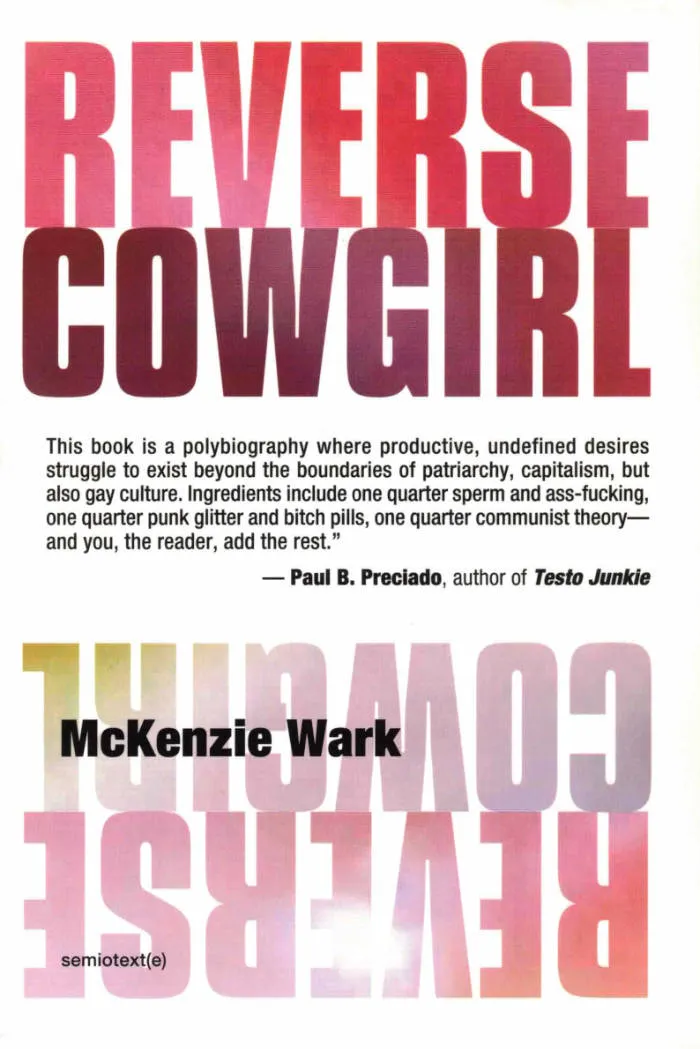
Reverse Cowgirl
McKenzie Wark invents a new genre for another gender: not a memoir but an auto-ethnography of the opacity of the self.
Another genre for another gender.
What if you were trans and didn't know it? What if there were some hole in your life and you didn't even know it was there? What if you went through life not knowing why you only felt at home in your body at peak moments of drugs and sex? What if you expended your days avoiding an absence, a hole in being? Reverse Cowgirl is not exactly a memoir. The author doesn't, in the end, have any answers as to who she really is or was, although maybe she figures out what she could become.
Traveling from Sydney in the 1980s to New York today, Reverse Cowgirl is a comedy of errors, chronicling the author's failed attempts at being gay and at being straight across the shifting political and media landscapes of the late twentieth century. Finding that the established narratives of being transgender don't seem to apply to her, Wark borrows from the genres of autofiction, fictocriticism, and new narrative to create a writing practice that can discover the form of a life outside existing accounts of trans experience: an auto-ethnography of the opacity of the self.