Books
Books
in random order

The Complete C Comics
In the mid-1960s, legendary artist and writer Joe Brainard (I Remember) teamed with poets such as John Ashbery, Frank O’Hara, Barbara Guest, Ron Padgett, Kenneth Koch, Ted Berrigan, and many more for these pioneering collaborative comic strips—unavailable for decades and collected here for the first time.
“PEOPLE OF THE WORLD… RELAX!”
In the creative hotbed of 1960s New York, Joe Brainard was a whirlwind. He was a maker of paintings, assemblages, collages, book covers, poetry-reading flyers, and more. But some of his most exciting work was done with his friends. In 1964, the twenty-two-year-old Brainard turned his talents to rewiring the lowly comic book form into something new and surprising. He invited his friends Frank O’Hara, Ted Berrigan, John Ashbery, Kenneth Koch, Peter Schjeldahl, Barbara Guest, Ron Padgett, and others—all of them New York School poets—to collaborate with him on comics that they would write and he would draw.
The results were unlike any comics seen before. Previously available only on the rare-book market (at very high prices) but available here under one cover for the first time, the two issues of C Comics still feel as fresh as when the first page rolled off the mimeograph machine more than sixty years ago. Brainard’s energetic line and joyful humor charge across every page, illustrating O’Hara’s recasting of a cowboy as a mash-note-writing lover, Padgett’s experiments with traditional cartoon sound effects (ROAR! GRRR! SKREE!), cameos by Ernie Bushmiller’s Nancy, and heaps of Dadaesque delights.
This edition includes a foreword from Padgett and an essay by comics historian Bill Kartalopolous, who details the creation (and creators) of C Comics. A masterpiece of collaboration and spontaneity, C Comics is a testament to the vastness of Brainard’s creativity and his ability to push any artistic form in a new and powerful direction.
Foreword by Ron Padgett
Contributions by Bill Kartalopoulos

Issue 8: Garden Tools
More than a mere extension of the hands, the garden tool is what helps the gardener materialise their vision. Much like the painter’s brush and the sculptor’s chisel – without it, one would be helpless. This issue of Pleasant Place dives into the world of garden tools, the essential, the practical, and the beautiful.
Including:
Instruments of Care – An introduction by Norbert Peeters with some philosophical remarks on garden tools.
Wardens of Good – A visual essay of the wonderful objects of Garden and Wood, a business selling vintage garden tools and ephemera.
Trusted Tools – Gardeners like Piet Oudolf and Jonny Bruce talk about their favourite tools that are illustrated in detail by artist Floris Tilanus.
Passing the Trowel – A visit to Sneeboer, the Netherlands most famous garden tool company, where the trowel has been passed down for four generations.
Toolmorrow – Artists are challenged to create new types of garden tools, for lazy gardening, stylish gardening and collective gardening.
Cover by Lou-Lou van Staaveren
Inside cover by José Quintanar
Centrefold miniatures by Zilan Zhao
Graphic design is by fanfare
Concept and editing by Guus Kaandorp, Floor Kortman and Lou-Lou van Staaveren

Vrai travail
Le Collectif Occasionnel a organisé en Suisse deux expositions qui présentaient les oeuvres de personnes à la fois artistes et travailleureuses du sexe. Cet ouvrage prolonge leur travail en proposant des textes et des entretiens avec des Tds ou des alliéxes. Permettant l’auto-représentation des personnes interrogées, les entretiens mettent en lumière la pluralité des pratique du travail du sexe, mais aussi l’importance de construire des solidarités travailleuses, des outils pour défaire les stigmates et des perspectives de luttes intersectionnelles.

Suckcess Magazine 1 — Winter 2021-22
Drama, careers, sabotage, compromises... The first issue of Suckcess Magazine begins with a selection of poems by the flamboyant Rene Ricard, edited with the help of Editions Lutanie, and continues with contributions from Miriam Laura Leonardi, Fabienne Audéoud, Camille Aleña, Gabi Losoncy, David Lieske, Sylvie Fanchon, Won Jin Choi, Estelle Hoy, and Bunny Rogers. Cartoons and tennis players are also on the program.

Family Lexicon
Natalia Ginzburg, Jenny McPhee
An Italian family, sizable, with its routines and rituals, crazes, pet phrases, and stories, doubtful, comical, indispensable, comes to life in the pages of Natalia Ginzburg’s Family Lexicon. Giuseppe Levi, the father, is a scientist, consumed by his work and a mania for hiking—when he isn’t provoked into angry remonstration by someone misspeaking or misbehaving or wearing the wrong thing. Giuseppe is Jewish, married to Lidia, a Catholic, though neither is religious; they live in the industrial city of Turin where, as the years pass, their children find ways of their own to medicine, marriage, literature, politics. It is all very ordinary, except that the background to the story is Mussolini’s Italy in its steady downward descent to race law and world war. The Levis are, among other things, unshakeable anti-fascists. That will complicate their lives.
Family Lexicon is about a family and language—and about storytelling not only as a form of survival but also as an instrument of deception and domination. The book takes the shape of a novel, yet everything is true. “Every time that I have found myself inventing something in accordance with my old habits as a novelist, I have felt impelled at once to destroy [it],” Ginzburg tells us at the start. “The places, events, and people are all real.”

Sphinx
Sphinx is the remarkable debut novel, originally published in 1986, by the incredibly talented and inventive French author Anne Garréta, one of the few female members of Oulipo, the influential and exclusive French experimental literary group whose mission is to create literature based on mathematical and linguistic restraints, and whose ranks include Georges Perec and Italo Calvino, among others.
A beautiful and complex love story between two characters, the narrator, "I," and their lover, A***, written without using any gender markers to refer to the main characters, Sphinx is a remarkable linguistic feat and paragon of experimental literature that has never been accomplished before or since in the strictly-gendered French language.
Sphinx is a landmark text in the feminist and LGBT literary canon appearing in English for the first time.
Anne Garréta (b. 1962) is a lecturer at the University of Rennes II and research professor of literature and Romance studies at Duke University. She joined the Oulipo in 2000, becoming the first member to join born after the Oulipo was founded. Garréta won France's prestigious Prix Médicis in 2002, awarded each year to an author whose "fame does not yet match their talent," for her novel Pas un jour.
Emma Ramadan is a graduate of Brown University and received her master's in literary translation from the American University of Paris. Her translation of Anne Parian's Monospace is forthcoming from La Presse. She is currently on a Fulbright Fellowship for literary translation in Morocco.

Greer Lankton: Sketchbook, September 1977
A fascinating account of Lankton's inquisitive, sociological and emotional ruminations in advance of her gender-affirming surgery.
This is one of the earliest of Greer Lankton's (1958-96) journals, sketchbooks and daybooks to appear in the artist's archives, and the first to be published in facsimile form. Written during her time as an art student at the School of the Art Institute of Chicago, the journal offers key insights into Lankton's mind at work before her career-defining move to New York in 1978, where she would become an important figure of the East Village art scene in the 1980s and early '90s with her lifelike dolls and theatrical sets.
Containing drawings, behavioral diagrams and aspirational, occasionally confessional writing, the journal is a record of imagining the body and mind reconciled through transformation. In these pages, the 19-year-old turns an inquisitive, sociological eye toward the emotional landscape and somatic effects of the days recorded here; days leading up to her decision to undergo hormone treatment and gender-affirming surgery in 1979. Lankton reflects with raw vulnerability and keen self-awareness on critical questions of self-image, social perception, gender normativity and human behavior.

fierce pussy
This eponymously titled publication by fierce pussy brings together thirty-nine of the legendary art collective’s posters, from works made in the urgent early days of the AIDS crisis to present-day advocacy for Queer and Trans rights. In keeping with fierce pussy’s activism in public spaces, the publication is designed to allow readers to tear out any of the posters to share, wheatpaste, scan, photocopy, and distribute or to easily open the book to any page to hang it on a wall. Combining calls for political and social action, proud reclamations of derogatory language, and pointed questions, the posters in fierce pussy address pressing sociopolitical issues in the group’s distinctive voice.
Emerging during a decade steeped in the AIDS crisis and LGBTQ+ activism, fierce pussy brought Queer identity directly into the streets in a manner characterized by the urgency of those years. In recent years they have expanded to also present their work in galleries and museums, while continuing to intervene in the public space, always working with an economy of means and a collective ethos of inclusion and solidarity.
This publication was originally published by Printed Matter in 2008 to coincide with a retrospective exhibition of the collective’s work. This new expanded edition includes twenty-five additional posters.
fierce pussy is an art collective formed in New York City in 1991. Originally composed of a fluid and often-shifting cadre of dykes, the collective was active through 1994. In 2008, the four core founding members Nancy Brooks Brody (1962–2023), Joy Episalla, Zoe Leonard, and Carrie Yamaoka began working together again. Adamantly low-tech and low-budget, fierce pussy has always relied on modest resources: old typewriters, found photographs, and their own baby pictures. In the early days, much of the work was produced using materials and resources they had on hand and the equipment at their day jobs. This publication exemplifies the ethos of the group—to share their work and messaging with the masses.
Managing Editor: Jules Spector
Designers: Garrick Gott and Bryce Wilner

Discomania
A young woman discovers that dancers at a local discotheque are being driven to acts of insane violence.
“The place was full of swarming, pugnacious, dangerous missellneous reptile's… Teenager's everywhere pounded their way on top of each other crazily strangling, biting and slashing each other's with broken glass, smashed records or sharpened blades… ”
16-year-old Jennifer Gibbons (1963–1993) wrote Discomania in 1980, alongside her twin sister June-Alison, who was also writing her own novel, The Pepsi Cola Addict, in the bedroom that they shared.
Jennifer offered Discomania to the same English vanity press who would publish June-Alison's book, but Discomania was turned down for being “too violent, too sexual, and too futuristic.”
Long thought to have been lost or destroyed, June-Alison had in fact preserved the typescript of this unique, furious, funny, and strange novel, which we present with her blessing, alongside additional texts from June-Alison, and editors David Tibet and Ania Goszczyńska.

The Soft Layer
A performance text by Jozef Wouters, The Soft Layer traces and proposes visions and words that enfold the historic building of Dar Bairam Turki in Tunis like a cloak. How can we imagine possible futures for such a place and the community inhabiting it, beyond nostalgia and the spectres of the past? Several voices muse in three languages (Tunisian, French and English) on renovation and history, destruction and cleansing, the limits of science-fiction and the soothing quality of aloe vera.
Published by Varamo Press in the essay series Gestures
First edition May 2022
48 pages, 11.0 x 16.5 cm, sewn perfect binding
ISBN 978-82-691492-4-1

Cunt Norton
In CUNT NORTON, the sequel to her unforgettable CUNT UPS, Dodie Bellamy "cunts" The Norton Anthology of Poetry (1975 edition), setting her text-ravenous cut-ups loose to devour the canonical voices of English literature. The texts that emerge from this sexual-linguistic encounter are monstrous, beautiful, unashamed: 33 erotic love poems ("the greatest fuck poem in the English language," according to Ariana Reines) that lust after the very aesthetic they resist. "These patriarchal voices that threatened to erase me—of course I love them as well," Bellamy writes. Even as CUNT NORTON dismembers the history of English poetry, "cunting" Chaucer and Shakespeare, Emerson and Lowell, it simultaneously allows new sexual members to arise and fill in the gaps, transforming the secret into the explicit, the classically beautiful into the wonderfully grotesque. Bellamy's cunted texts breathe life into literary "masters" with joy, honesty, hilarity, and insatiable passion.

LllOovVee - Forbid me my love
It is right and necessary to be speaking with strangers. There are islands, backroads and cliffs of wet inked worded sea ridgelines where aodán McCardle’s work emerges concrete and lyric as a chant of delicately provoking permutations. forbid me my love, the first part of this beautiful book, is poetry as poiesis or making. By means of a series of concrete meditations, McCardle takes us where he, or perhaps the words themselves, unknit, erase, appear and disappear. Wor(l)ds of the size of terrorist and bomb are subject to a system of alterations that end up shooting lovebombs from the page as if love could become an error in the system. The second part of the book, LllOovVee, starts closer to verse. Reading it, one can almost hear aodán’s delicate Irish voice, but any easy reading gets explosively interrupted by the scanned handwritten, scribbled and scratched lines that open another set of permutations, one about what is behind us, how to be there here and what is it to be there then now, in the making, in the ear and in the eye with this revealing poetry.
- Martín Gubbins
Aodán McCardle is a performance poet, artist, & tattooist. In this book he combines all three artistic expressions into a performance. These poems are audacious. A poetic trajectory worthy of reading aloud.

Crue
L’Île-de-France a été engloutie. Submergée par de l’eau liquide. C’est à peu près tout ce que l’on sait. Crue est un long poème construit sur un rythme ternaire, une suite de tercets libres entrecoupés de symboles typographiques étranges dont la signification exacte semble avoir été perdue dans l’inondation. Il y a dans le va-et-vient soutenu du texte comme dans celui de la mer, ses gestes répétés, toujours successifs, quelque chose de l’automation ; l’acceptation sans révolte d’une nouvelle nature sous-marine hybride, plus uniquement humaine, à la langue noyée, gorgée de néologismes, méthodique, néanmoins sentimentale. Car ici la cruauté sinistre de la nature fait écho aux émotions du narrateur. Le paysage-état d’âme est désolé, apocalyptique mais comme résigné, nu. Crue sonde les abysses de la civilisation et des comportements humains. Peut-être un des textes les plus personnels de Théo Robine-Langlois.

OEI #82-83 Art in the Age of Kleptomania
Tobi Maier, Cecilia Grönberg and 1 more
Aeron Bergman and Alejandra Salinas, co-editors at INCA Press (along with Irena Borić), are the guest-editors of this issue of OEI: it contains essays, artworks, and archival materials by 21 artists, theorists, writers, and artist-run spaces (mostly from the Americas).
The subject of the issue is art and neoliberalism, and it encompasses essays, images and other works by Dorothée Dupuis, Max Jorge Hindered Cruz, Luciano Concheiro, Yvonne Osei, Diego Bruno, John Riepenhoff, Suhail Malik, Good Weather, The Luminary, Bikini Wax, Beta-Local and more.

Essay
Cow time meets clerical time meets poet time in Stacy Szymaszek’s gently thrilling Essay. These luminous poem-essays flow with the churning propulsion of dailiness: a roving record of the poet’s ruminations alongside the many cows and calves she befriends. Seeking to honor life beyond usefulness, Szymaszek has given us a large-hearted, gorgeous, and wholly riveting meditation on aging queer life and interspecies friendship on the farm and under capitalism. In Essay, the poet notices, marvels, aches, searches, and wants more for all of us. — Megan Milks
Stacy Szymaszek has long been a poet attentive to work, and this attention is of course animated by place – whether the urban quotidian and attendant human dramas of previous books, or her present workplace on a dairy farm in upstate New York. In Essay’s conversational, immediate, vulnerable, affecting and affected poems, Szymaszek turns to cows and to the cow-like exhaustion of humans who labor in service of capital’s voracity. Essay is bent to the workday but not beaten down by it. We are offered a visionary form, boldly attendant to the present, to prolong survival without denying death.“The heart of the matter is to be able to keep / loving in the face of cow-sorrow unspeakable brevity / unpredictability and contradictions.” In Essay, Szymaszek has built a bed of hay where we can break from our labors and daydream about the “livelihood where we can all work / a single day and have enough for the year and the work / of the cows can be ended.” — Alli Warren

Economy as Intimacy (vol.1)
A series of choreopoems by Eric Peter. Published at the occasion of 'Assemblages of Intimacy' a group exhibition in a Tale of a Tub, Rotterdam in 2018.

Green Agents in Time
The 71 storyboards in this publication are the result of a collaborative process between G.C. Heemskerk and Bernice Nauta, and function as the foundation for their short film The Plantiarchy (2025). The project proposes a parallel reality in which the relation between plants and humans are drastically transformed. In this proposed universe, the plant is the protagonist: it playfully and critically tells a story of colonial expansion, botany, more-than-human eroticism and speculative plant-sentience, flipping the historicised script of control and dependency.
The Plantiarchy comprises a residency period at Hotel Maria Kapel (Hoorn, NL) and various exhibitions including Museum de Lakenhal (Leiden, NL), IKOB Museum (Eupen, BE) and Marres (Maastricht, NL), followed by the short film which premiered at Go Short (Nijmegen, NL) in 2025.
Introduction by Annosh Urbanke
Edited by Jan-Pieter ‘t Hart
Designed by Tjobo Kho with Lucas M. Franco & Vlad Omelianenko

Inner Tube
Inner Tube is a darkly comic, hallucinatory novel about one man’s descent through grief, cultural detritus, and the electromagnetic haze of late 20th century America. After his mother kills herself by ramming her head through the family television, the narrator quits his job cataloging old TV shows and embarks on a surreal, unmoored journey westward. Through a landscape of rundown motels, desert isolation, and fleeting encounters, he strips away the trappings of civilization, regressing into a feral, posthuman state. The book is both a savage critique of media-saturated culture and a philosophical meditation on alienation and survival, written with poetic precision and biting wit.
Inner Tube was completed under extraordinary circumstances. After undergoing spinal surgery that left him paralyzed from the neck down, Hob Broun wrote the novel using a breath-activated computer system—a device that converted puffs of air into keystrokes. He finished the book just before his untimely death in 1987 at the age of 37.
First published by Alfred A. Knopf in 1985, and reprinted in 1987 by McGraw-Hill, Inner Tube has been out of print ever since.

Goblinhood - en mode gobelin !
Enfin la traduction en français du best-seller de Jen Calleja, qui sera présente pour une lecture croisée. Repassez vos capes et astiquez vos chaînettes.
La figure du gobelin est espiègle, marginale, répugnante et fascinante et le mode gobelin peut être envisagé comme un mode de vie à part entière.
Jen Calleja, depuis son obsession pour les objets verts et les marionettes, ses souvenirs familiaux, son rapport au corps et au dégoût de soi, au chagrin, au sexe et au deuil, propose avec malice une pensée hybride entre essai, auto-fiction, poésie et théorie de la gobelinité.
En chacunx de nous, suggère-t-elle, sommeille un gobelin qu’il est temps de libérer.
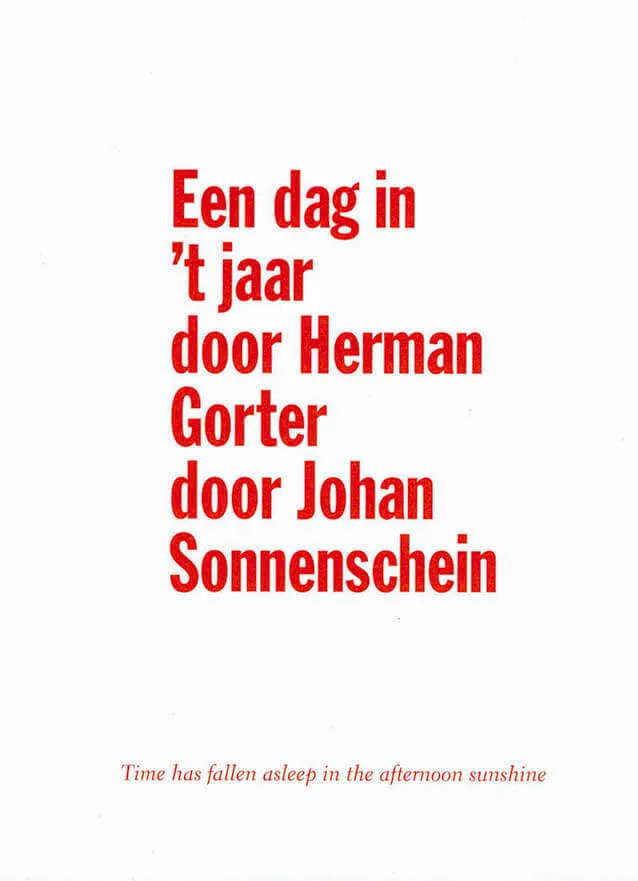
Time has fallen asleep in the afternoon sunshine
Een dag in 't jaar door Herman Gorter
For the project Time has fallen asleep in the afternoon sunshine a group of people/ performers memorize a book of their choice. Together they form a library collection consisting of living books. After years of learning by heart and reciting for readers, some of the books have now been written down from memory to create new editions, versions resulting from this process. This book is one of those books, chosen by one person, learned by heart and recited many times, and now written down again from memory. This edition is not a re-edition of the original text. It is a re-writing of the text after the process of reading, memorizing and reciting, with all the alterations that might have occured in the course of this process.

Whitney Museum of American Art
Edges of Ailey
Alvin Ailey is one of the most celebrated choreographers of the twentieth century. The creator of iconic works such as Blues Suite, Revelations, and Cry, he is widely recognized for the dance company he founded in 1958 when he was just twenty-seven years old. Ailey imagined and cultivated a platform for modern dance through his innovative repertoire, interdisciplinary sensibility, and support of dancers and choreographers. This expansive volume situates Ailey within a broader social, creative, and cultural context, looking at the artists who influenced and collaborated with him, the spaces and scenes he frequented, the dynamic themes within his dances, and how his vision and work changed contemporary dance.
Essays by artists, scholars, and critics cover topics ranging from the Black church, the South, and the Great Migration to nightclubs, musical influences, and queerness. With more than four hundred images including photographs of works Ailey choreographed, archival materials such as notebooks, sketches, letters, and never-before-published behind-the-scenes photos, and conversations about the legacy of the company with Sylvia Waters, Judith Jamison, and Masazumi Chaya as well as several contemporary dancers and scholars, this study offers an unprecedented full picture of one of the twentieth century’s leading artists and the way his work continues to inspire today’s generation of dancers.
Contributions by Horace D. Ballard, Harmony Bench, Kate Elswit, Aimee Meredith Cox, Thomas F. DeFrantz, Malik Gaines, Jasmine Johnson, Joshua Lubin-Levy, Uri McMillan, Ariel Osterweis, J Wortham, CJ Salapare, Kyle Abraham, Claire Bishop, Masazumi Chaya, Brenda Dixon-Gottschild, Jennifer Homans, Judith Jamison, Sylvia Waters, Jamila Wignot and Jawole Willa Jo Zollar

She Tries Her Tongue; Her Silence Softly Breaks
Brilliant, lyrical, and passionate, this collection from the acclaimed poet m. nourbeSe philip is an extended jazz riff running along the themes of language, racism, colonialism, and exile. In this groundbreaking collection, philip defiantly challenges and resoundingly overthrows the silencing of black women through appropriation of language, offering no less than superb poetry resonant with beauty and strength.
She Tries Her Tongue; Her Silence Softly Breaks was originally published in 1989 and won the Casa de Las Americas Prize. This new edition includes an introduction by Katherine McKittrick.
m. nourbeSe philip is a renowned poet, essayist, and playwright, and practiced law for seven years before becoming a writer. She received the 2020 PEN/Nabokov Award for Achievement in International Literature, as well as the 2021 Molson Prize, the Canada Council for the Arts’ lifetime achievement award, for her “invaluable contributions to literature.” Born in Tobago, she lives in Toronto.
Katherine McKittrick is Professor of Gender Studies and Canada Research Chair in Black Studies at Queen’s University in Kingston, Canada. She authored Dear Science and Other Stories (DUP, 2021), and Demonic Grounds: Black Women and the Cartographies of Struggle (UMP, 2006). She also edited and contributed to Sylvia Wynter: On Being Human as Praxis (DUP, 2015) and Heartbreak and Other Geographies (UMP, 2026). Recent collaborative projects include the limited-edition boxset Trick Not Telos (2023), the limited-edition hand-made book Twenty Dreams (2024), and the installation A Smile Split by the Stars honouring nourbeSe philip (2025).

This is NOT what i want to tell you
In This is NOT what I want to tell you: she looks at the many attacks carried out by teenagers in Palestine in 2015 and 2016. The teens, all children aged between 10 and 15, were shot dead or sentenced to years in prison. The series of almost daily knife attacks by these lone wolves reflected the hopelessness and despair among the young people of Palestine. They wanted to send a message to the world, but were unable to convey this in ordinary language.
In Two Ladybugs the fates of three characters, a Belgian woman, a Palestinian girl and an Israeli soldier, are closely intertwined. The players don't feel comfortable in this new, strange world and they don't hide that from the public.
Broken Shapes: A young woman in a city that has been occupied for decades, on the day of her father’s funeral, discovers his architectural drawings. Overcome with grief, she slips into the dream worlds and imagined places that he created.
Rimah Jabr Rimah Jabr (Nablus, Palestine, 1980) is a theatre director, playwright, screenwriter and Ph.D. candidate in Theatre and Performance Studies at York University. She completed a master’s degree in theatre-making from the RITCS in Brussels. She wrote and directed several plays produced in Belgium, Canada, and Palestine. She actively collaborates with visual artists to craft unique performances. Her doctoral research is a performance ethnography research-creation with Palestinian Designers from Hebron, examining the impact of confinement on the creative process involved in set design. Broken Shapes is a collaborative project co-created by Toronto-based theatremaker Rimah Jabr and Brussels-based visual artist Dareen Abbas.

Biography of a Fiction
Biography of a Fiction collects poems written between 2020 to 2025. These poems were written in a diaristic way, mostly in short form, while working on larger pieces, some of which also collected here or elsewhere. What started, seemingly, as notes on reproductive desire, gender, and sexuality soon matured into a meditation on the role of fiction in the exercise of writing (and idealizing) a biography, including the thorny aspect of artistic license and the uses of one’s own life and of others.