Books
Books
in random order

Nine Ways to Cry
Cecilia Pavón, Jacob Steinberg
Cecilia Pavón has been a defining figure of the Argentine cultural scene since the 1990s. She is the author of over 10 volumes of poetry, 3 short story collections, and an anthology of blog posts, and was co-founder of the legendary art gallery and publishing press Belleza y Felicidad. Nine Ways to Cry collects Cecilia Pavón’s complete poetry published from 1999 to 2012 in one bilingual volume for the first time, including A Hotel With My Name, Licorice Candies, and other beloved classics.
Prefaced by a loving foreword from contemporary US poet Dorothea Lasky, this collection serves as the definitive introduction to the poetry of a living legend. She currently lives in Buenos Aires.

Art et production
Art et production de Boris Arvatov fait partie des classiques oubliés des avant-gardes qui se sont épanouies durant la Révolution russe. Publié à Moscou en 1926, il vient porter le fer dans les débats qui agitent l’école constructiviste : que doit être le statut de l’art après la révolution, ses liens avec les techniques industrielles de reproduction, avec la critique de la vie quotidienne, comment doit-il entrer dans l’usine ? Autant d’interrogations radicales, témoignages d’une séquence politico-sociale bouillonnante. Une nouvelle conception de l’art émerge, qui laissera une empreinte indélibile sur une tradition de critiques matérialistes de la culture, de Walter Benjamin à Peter Bürger, en passant par Fredric Jameson, celle qui posera la question de l’articulation entre pratique artistique et logiques propres à la sphère de la production. Un document exceptionnel enrichi d’illustrations, paraissant en français pour la première fois, une porte prviliégiée sur un moment-clé de la modernité exthétique du XXe siècle.
Boris Arvatov (1896–1940) est un artiste et critique d’art russe. Il est notamment connu comme théoricien du productivisme, un mouvement d’avant-garde post-révolutionnaire lié au constructivisme.

Self-portrait
Allison Grimaldi Donahue, Carla Lonzi and 1 more
Recorded and transcribed throughout the 1960s, Carla Lonzi’s Self-portrait ruptures the narration of post-war modern art in Italy and beyond. Artmaking struck Lonzi as an invitation to be together in a ‘humanly satisfying way’, and this experiment in art-historical writing is a testament to her belief. Lonzi abolishes the role of the critic, her own, seeking change over self-preservation by theorising against the act of theorising.
The life and work of Carla Lonzi (1931–1982) is inseparable from the cultural, political, and social history of Italy in the decades following the Second World War; she occupies a singular position, which today merits reevaluation. A reputed art critic of the 1960s artistic scene, both friend and collaborator of such figures as Carla Accardi, Luciano Fabro, Giulio Paolini, and Jannis Kounellis, she wrote “Autoportrait” in 1969, a “love letter” to the artists and to creation, but also a farewell chorus to art criticism and the art world. The following year she founded Rivolta Femminile, an active feminist collective, thus becoming the central figure of Italian feminism.
Interviews with Carla Accardi, Getulio Alviani, Enrico Castellani, Pietro Consagra, Luciano Fabro, Lucio Fontana, Jannis Kounellis, Mario Nigro, Guilio Paolini, Pino Pascali, Mimmo Rotella, Salvatore Scarpita, Guilio Turcato, Cy Twombly.
Afterword by Claire Fontaine.
Translated by Allison Grimaldi Donahue.
978-1916425088
105 b&w illustrations
21.6 x 13.9 cm
364 p.
Paperback
November 2021

Local Woman
A pulpy, mytho-poetic dispatch from an “anarchist jurisdiction” that explores the liberatory possibilities of community and womanhood.
Enter: Local Woman, an archetypal figure, fresh from the forest into the streets of Portland, Oregon. She is a Black trans woman, seeking survival and satisfaction, giving seduction, disenfranchisement, and the contradictions of femme womanhood a face, body, and soul. In sensual, evocative lyrics, Jzl Jmz documents Local Woman’s movement through natural disaster, anti-fascist protest, romantic engagements, and an expanding sense of personal autonomy.

Profusione
A comprehensive overview of the unique work of the Italian artist born in 1931 and "discovered" late on the international scene, with numerous texts and an interview.
Published after the eponymous exhibition at Consortium Museum, Dijon, April 26th – September 8th 2024.
Born in Naples, Italy, in 1931, Isabella Ducrot is a young artist with a young career. Like many women of her generation, she moved into art after raising her children. Her formative years were marked by continuous travels with her late husband, during which they amassed hundreds of Persian miniatures and rare antique textiles of many kinds.
Contributions by Franck Gautherot & Seungduk Kim, Verena Lueken, Tobias Pils, Tschabalala Self, Andrea Viliani, Miranda Fengyuan Zhang.

You Only Bend Once with a Spoonful of Mercury
Do you feel it? I'm holding your hand. Come with me. Look! There's a mirror, many mirrors! They are watching us, but we don't have to care. This night belongs to us. This infinity. Come! ... World! Just watch us...as we prowl the arcades of fallen memory...

This Poor Book
For decades, Fanny Howe has been the great poet of spirit and conscience, dislocation and bewilderment. In This Poor Book, completed just before her death, she assembled a selection of her writing from the last thirty years into a single, astonishing work.
Fanny Howe is a titan. Absolutely nobody writes like her. Nobody sounds like her. This Poor Book is a miracle she left for us. —Kaveh Akbar
This Poor Book is revelatory and casts Howe’s poetry in a new light, and for those who don’t know her work already, this is a perfect introduction. Fanny Howe is an essential poet. —Rae Armantrout
Fanny Howe spoke about “the difficulty of reconciling multiple registers of consciousness and language. Soul and sticky atoms.” In This Poor Book she delineates and shifts between these layers to conjure a bewildering yet ultimately galvanizing evocation of the human psyche. We are being warned every day that robots and software will soon replace us. Howe’s poetry makes clear that such a notion is based upon a very limited conception of what it is to be a human. We are complex. We are mysterious. We don’t make sense. We do make sense. You will lose and you will find yourself in her words. — Claire-Louise Bennett
This Poor Book is a testament to Fanny Howe’s life and writing. In it, she wields her powers of perception for a long poem that turns inward on the self and out at the world and in every other direction the poet can imagine with lines that speak directly and always suggest more than they say: “There is a little trouble in my eye.” The irony and beauty of its final line—“There was no more reason to die”—will be with me for as long as my memory of Fanny Howe herself. — Jericho Brown
In her final act of literary alchemy, Fanny Howe gathers the scattered constellations of her astonishing life work and forges them into a single unwavering spiritual reckoning. At the dynamic center of the poem, a live beating heart moves through a fractured world—haunted by power, estranged from institutions, yet fiercely open to mystery. There’s a radical humility here, paired with a radiant understanding—that doubt can be a form of faith, and that hope, when unflinching, is the most defiant music of all. This Poor Book is for the ages. — Peter Gizzi
This Poor Book is an astonishing document by an irreplaceable poet. A palimpsest of decades’ worth of writing, assembled here into a long poem as fractured and multitudinous as life itself, Fanny Howe’s last work captures the brutality and beauty of the modern world better than almost anything else I’ve read: “The structure failed to cohere at the end of the struggle. / It had some music in it.” — Maggie Millner
Through Fanny Howe's eyes we look at life differently. She makes us understand that we are part of a mysterious and complex world; one which we urgently need to be receptive to. Beauty appears in unexpectedness, as in “flowers attract scissors” and “why does an eye evolve in the dark?” Who else could turn things upside down with such a sleight of hand? This Poor Book reads like the testament of a newly discovered life-form, offering vital messages from the past and into the future. — Celia Paul
At once evocative and subtly incisive Howe’s writing seems almost like a new language, a language that has been in hiding. She can make the familiar haunting and the ordinary a provocation. — Adam Phillips
This gorgeous final statement by one of our most perceptual writers is a work of accrued understanding. ... Fanny Howe leaves us with profound investigations into the capacity of words, of juxtaposition, what a line, a page, and a book can give. — Sarah Schulman

Flower Engine
the second poetry collection from Natalie Briggs titled ‘FLOWER ENGINE’. This collection of cinched, bright free-verse explores the passing locations of love and the slow, private operations of pain’s knocking counterweight. The book extends Briggs’ relay of concise universal suggestions, translating them through brief, intimate utility.

Elke dag is een tentoonstelling
Special edition: 100 out of 300 books are reworked by making cutouts in the book.

Still Life 4
STILL LIFE is an online and printed zine about relationships and configurations in which one person is still while others are not. Or where one person is passive and others are active. It’s about how we put ourselves in other people’s hands. Or how we are put in other people’s hands. It’s about care and power and vulnerability and agency. And other things not so clearly named. It’s about the different kinds of knowledge that people have about their own and other people’s bodies. And the kind of philosophical and political understandings woven into that knowledge.

Of Enemies & Venison: First Materials for an Aztec Cosmotechnic
A new future for Mexico depends upon unearthing what colonialism has buried below the ground.
Situated deep within the ontological turn, this book brings together the philosophical anthropology of Descola and Viveiros de Castro, with the discourse that runs, through Heidegger, towards the world-building technics of Yuk Hui. Through a detailed study of the sacrificial and symbolic practices of Warfare & Hunting, Lou Manuel Arsenault uses these philosophies as tools to uncover a Cosmotechnic of the Aztecs.
In the cosmology and way of life of Nahuatl-speaking populations of the Valley of Mexico and the surrounding regions during the post-classical period, Warfare & Hunting were inseparable ritual practices within which the distinction between beings—Human, Jaguar, and Deer, or Aztec, Mimixcoa, or Mother and Enemy—became blurred. Articulated here as an Aztec Cosmo-Technique of identification, it is argued that these ritual practices enacted a world with its own destiny, one which was trampled by colonial violence. Yet this destiny—Batalla’s “Deep Mexico”—lies dormant, buried underground, buried in the literature, and in the archaeological record; this book works to unearth it.

The New Television: Video After Television
Rachel Churner, Rebecca Cleman and 1 more
On the rich history of video art and its enduring relevance to today's artistic and critical practices.
The New Television delves into the rich history of video art, reexamining the pivotal Open Circuits conference held at MoMA in 1974 and exploring its enduring relevance to today's artistic and critical practices. Open Circuits was an important event in establishing video art in American museums and articulated a range of conflicting teloses for the medium, some which materialized (like local cable television) and others that remain unrealized. The conference proceedings were published in 1977 as The New Television: A Public/Private Art, and the radical design of the book reflected the conference's utopian aims.
This two-part publication includes a facsimile of the long-out-of-print conference proceedings and new essays and discussions by over a dozen scholars and artists. The new scholarly texts and previously unpublished archival documents in The New Television illuminate the network of institutional histories of video art, consider global televisual contexts and alternative critical approaches, and examine contemporary video art and its continued relevance from new perspectives.
Rachel Churner is the director of the Carolee Schneemann Foundation. She is also an art critic and editor, whose writings have appeared in Artforum and October magazine, among other publications. She was a recipient of the 2018 Creative Capital/Andy Warhol Foundation Arts Writers Grant and is the editor of multiple books, including Jacqueline Humphries: jHΩ1:) (2022); Yvonne Rainer: Revisions (no place press, 2020), Hans Haacke (MIT Press, 2015), and two volumes of writings by film historian Annette Michelson (MIT Press, 2017 and 2020). Churner is a faculty member at Eugene Lang College at The New School, New York.
Rebecca Cleman is Executive Director of Electronic Arts Intermix (EAI) and a writer. She has programmed screenings and special projects for such venues as the International House Philadelphia; the Museum of Art and Design, Anthology Film Archives, and Andrea Rosen Gallery, New York City; and the Julia Stoschek Collection, Germany; and organized or co-organized many events for EAI, including a panel discussion on the films of David Wojnarowicz and a conversation between Hilton Als and The Wooster Group's director and co-founder Elizabeth LeCompte.
Tyler Maxin is curator at Blank Forms. He was previously the Communications and Special Projects Associate at Electronic Arts Intermix (EAI). His writing has appeared in publications including Artforum, BOMB, and Film Comment.

My Dead Book: A Novel
My Dead Book is a novel composed of nonlinear vignettes and fragments about a queer man approaching his fiftieth birthday who is haunted by insomnia and his past. In the dead of night, he remembers his friends who died in the late 1980s and 1990s, his years as a teenage throwaway and sex worker, and ruminates on working class survival, queer aging, AIDS, and whether he has outlived his place in the world.
“What a blistering book—with My Dead Book, Nate Lippens has created something truly fucking great. It's as if the storied stars of Lou Reed's 'Walk on the Wild Side' overshot Manhattan and wound up in Wisconsin, broke and blue with cold and depressed beyond belief by the thought that this nowhere is now home. It's a bitter pill, but I love bitterness, and who doesn't love pills?”— Derek McCormack, author of Castle Faggot
“There’s no doubt to this book. You’d think that was a flaw but it’s been burned away. My Dead Book is not short though it is brief. It’s loving, bittersweet, and actually courageous because it tells a story that is slightly unbearable because it’s all secret, awful hard bad secrets and funny as hell. Nate’s balancing act works because the heart of it (this novel) is true even though it’s often heartless. It’s simple. He knows what things are worth. When you need the sea or a bird they’re there like they never were before.”
— Eileen Myles, author of Afterglow

I of Song
"Between the 8th and the 10th of January in the year of 2019, we became Na Castelloza, she who in Auvergne at the beginning of the 13th century composed a cycle of cansos about—finding—unrequited love. If there exists a lyric subject, we are of her heritage."

Up Your Ass
Valerie Solanas's rarely published, legendary play, Up Your Ass, explodes social and sexual mores and the hypocritical, patriarchal culture that produces them through her signature irreverence and wit, incisiveness and camp.
The play, whose full title is Up Your Ass Or From the Cradle to the Boat Or The Big Suck Or Up from the Slime, marches out a cast of screwy stereotypes: the unknowing john, the frothy career girl, the boring male narcissist, two catty drag queens, the sex-depraved housewife, and a pair of racialized pickup artists, among others. At the center is protagonist Bongi Perez—a thinly veiled Solanas—a sardonic, gender-bending hustler who escorts us through the back alleys of her street life. The fictionalized predecessor to SCUM Manifesto, the play shares the same grand, subversive, implicative language, equally spitting and winking, embracing the margins, the scum, and selling a trick along the way.
Valerie Solanas (1936-1988) is an American radical feminist intellectual, known for her SCUM Manifesto—a pamphlet with which she declares the power of women and imagines a political future through the margin—, and for having tried to assassinate Andy Warhol.
Edited by Leah Whitman-Salkin.
With a contribution by Paul B. Preciado.
Graphic design: Roxanne Maillet.

The Book of Na
In The Book of Na, translation acts at the edge of perception. Tracing across projects in film, video, and performance, Na Mira reflects on the violent fragmentation of bodies while refusing the containment of geographic and corporeal borders. In 1977, a name is cut at an immigration office. This gap turns into an intergenerational score for becoming heat, hexagram, hologram. Using oracular and glitching technologies, Mira witnesses what escapes data: doppelgängers, dreams, endangered tigers, tesseracts, A. Turiyasangitananda Coltrane's stairs, Theresa Hak Kyung Cha in a theater, Korean shamanism, frozen ligaments, wildfires, borderlands, subatomic particles, and pink. Syncing to a clock with neither face nor hands, Mira’s hauntological permutations in time, death, and relation travel outside the symbolic order and draw energy from the void.
Na Mira’s autobody rites have been presented at sites including Seoul Museum of Art; Museum of Contemporary Art, Los Angeles; Portland Institute of Contemporary Art; Participant Inc., New York; and Whitney Museum of American Art, New York. She earned an MFA from the University of California, Los Angeles. She grew up between the US and East Asia and teaches outside.

The Letters of Mina Harker
In Dodie Bellamy's imagined "sequel" to Bram Stoker's fin de siècle masterpiece Dracula, Van Helsing's plain Jane secretarial adjunct, Mina Harker, is recast as a sexual, independent woman living in San Francisco in the 1980s. The vampire Mina Harker, who possesses the body of author Dodie Bellamy, confesses the most intimate details of her relationships with four vastly different men through past letters. Simultaneously, a plague is let loose in San Francisco-the plague of AIDS.
Bigger-than-life, half goddess, half Bette Davis, Mina sends letter after letter to friends and co-conspirators, holding her reader captive through a display of illusion and longing. Juggling quivering vulnerability on one hand and gossip on the other, Mina spoofs and consumes and spews back up demented reembodiments of trash media and high theory alike. It's all fodder for her ravenous libido and "a messy ambiguous place where pathology meets pleasure." Sensuous and captivating, The Letters of Mina Harker describes one woman's struggles finding the right words to explain her desires and fears without confining herself to one identity.

Under The Sea
Taking the shape of an accordion-folded A3 poster, “Under The Sea” investigates the political economy of global internet infrastructures, whose material reality has temporarily become visible during fibre optic network expansion works in The Hague and other Dutch cities.
As internet users, we spend a lot of time underwater. Contrary to popular belief, satellites play a negligible role in beaming our intimate messages, cat footage and work emails across the globe.
99% of all intercontinental internet traffic travels through one of over 550 fibre optic cables criss-crossing our oceans. Despite its scale, complexity and many interlinkages with global systems of power, this network of cables and landing points commonly remains invisible.
Printing: Risograph, Stencilwerck Den Haag; English text and Photography: Livio Liechti; Dutch translation: Minke Havelaar; Design: Apsara Flury.
Edition of 250. Co-funded by Oxfam Novib.

Russian Colonialism 101
For years, Ukrainian journalist Maksym Eristavi has been mainstreaming the global awareness about the legacy of Russian colonialism. A few days before Russia launched a full-scale invasion of Ukraine, he started a Twitter thread listing all Russian colonial invasions over the last century and highlighting one specific pattern that they all went by. The post has gone viral and is now dubbed the "mother of all Russian colonialism tweets". Together with a group of Ukrainian artists, Eristavi transformed it into an illustrated pocket guide to the 48 most recent invasions of Russian colonialism — to bring everyone’s attention to a pattern of serial behavior by the largest colonial empire.
Publication is prepared with the support of the MOCA NGO and the Ukrainian Emergency Art Fund in collaboration with the Sigrid Rausing Trust. Some illustrations created during the illustrative workshop for the book Russian Colonialism 101 have been donated to the Ukrainian Museum of Contemporary Art (UMCA).

Movement Research Performance Journal
Issue #60 - Gender Disarray
Kay Gabriel, Amalle Dublon and 2 more
Under the direction of four contributing editors—Amalle Dublon, Kay Gabriel, Keioui Keijaun Thomas, and Anh Vo— we’ve assembled a new body of work by mostly trans and queer artists reflecting on the keyword “gender” and its relation to contemporary performance. Their work moves across multiple genres of writing, from analytic essays to poetry to performance scripts.
“Read My Lips” is a phrase that will be familiar to longtime readers of the Movement Research Performance Journal—so familiar that the mere reference will bring to mind an image posted by the artist collective GANG, an image that lies at the heart of one of the journal’s most spectacular moments. Issue #3, with its focus “Gender Performance,” was published in 1991 amid that era’s Culture Wars, receiving almost immediately negative reception from government officials (the NEA threatened to withdraw funding from Movement Research) and many members of the dance community (who considered Issue #3 to be deliberately provoking the so-called “war,” intentionally taking a political position that some worried might comprise future funding of the field). In the thirty-three years since its publication, Issue #3 has developed a patina familiar to many artist-activist histories that are looked upon with romance and nostalgia, often by those for whom that history is only a fantasy (rather than a lived experience).
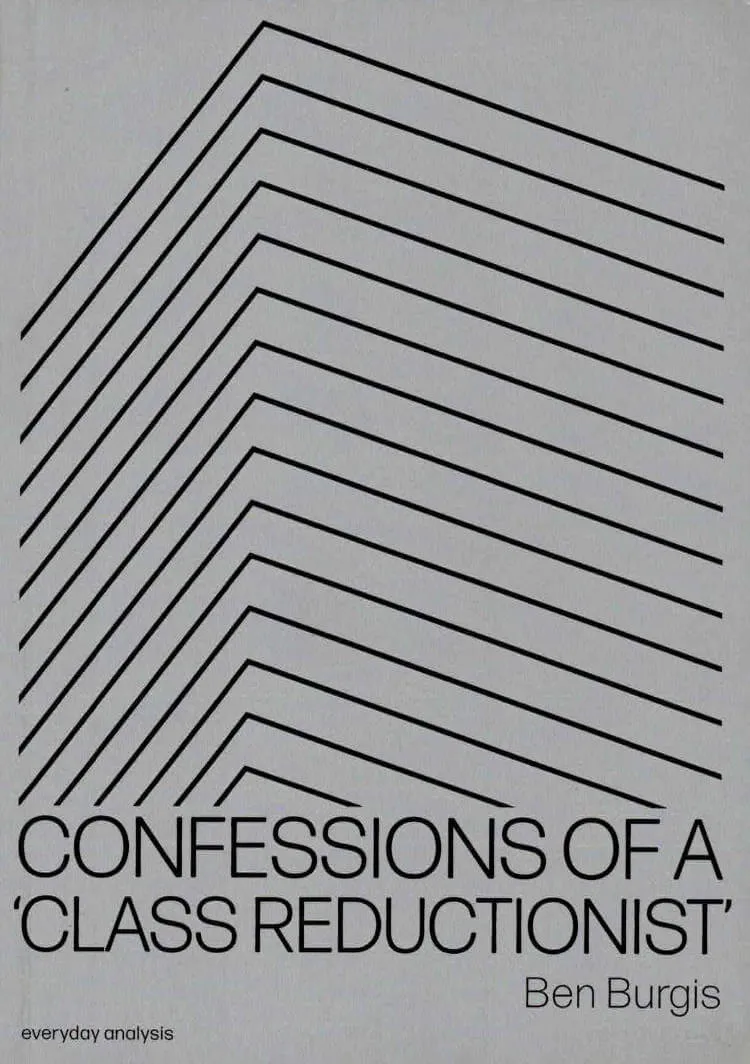
Confessions Of A Class Reductionist
In these essays, Ben Burgis criticizes fashionable radical-liberal identity politics and makes the case for universalism about rights and an unabashedly “class-first” approach to socialist political strategy. This may sound to some ears like a call for abandoning marginalized people. On the contrary, he argues, focusing on economic inequality empowers the victims of bigotry and retrograde social practices the resources and material security to stand up for themselves far more effectively than any diversity trainer or “anti-racism” consultant could represent their interests. As we face a rising tide of reactionary authoritarianism, it’s more important than ever to ditch the identitarian pieties of the recent past and think hard about how the Left can actually win.

Jill Johnston in Motion
Performer, activist, and writer Jill Johnston was a major queer presence in the history of dance and 1970s feminism. She was the first critic to identify postmodernism’s arrival in American dance and was a fierce advocate for the importance of lesbians within feminism. In Jill Johnston in Motion, Clare Croft tracks Johnston’s entwined innovations and contributions to dance and art criticism and activism. She examines Johnston’s journalism and criticism—in particular her Village Voice columns published between 1960 and 1980—and her books of memoir and biography. At the same time, Croft attends to Johnston’s appearances as both dancer and audience member and her physical and often spectacular participation at feminist protests. By bringing together Johnston’s criticism and activism, her writing and her physicality, Croft emphasizes the effect that the arts, particularly dance, had on Johnston’s feminist thinking in the 1970s and traces lesbian feminism’s roots in avant-garde art practice.

God Is a Bitch Too
María Paz Guerrero, Camilo Roldán
God Is a Bitch Too is the accelerated and acidic English-language debut of Colombian poet María Paz Guerrero. In this chapbook, god is needy, Latin American, and an overweight woman. No one asks god to dance. Someone speaks, someone tries: “One is the measure of their body.”
God Is a Bitch Too is #13 in the Señal series for contemporary Latin American poetry in bilingual editions.

Twenty Bookmarks
Twenty Bookmarks is a result of Production & Workflow class of Graphic Design Department at the Royal Academy of Fine Arts Antwerp, Ba1 Class of 2026.