Books
Books
in random order

Holy Smoke
Why they said, “Your real name is Anon,” I’ll never know ... But now that I have a name, I know I must write ... I’m scared, but feel it is time to be really bad.
Republished for the first time since its 1979 release, in a new revised edition, Holy Smoke is an account of the frenzy and paranoia of United States politics refracted through one individual’s psyche. With her theme of a child disappeared – and all that that phrase carries with it – Howe captures the chaos of reality in her salient mix of poetry and prose. Readers will find it hard to believe that this book, which gives fresh sense to the demand for universal human rights, was written in the last century.
At once evocative and subtly incisive, Howe’s writing seems almost like a new language, a language that has been in hiding. She can make the familiar haunting and the ordinary a provocation. She has written some of the remarkable books of her time. —Adam Phillips
A wonder of acid wit and Americana, Holy Smoke turns grief into a game and chaos into canticles. Bricolage at its best: incisive, inventive and intimate. It’s the exact work I needed in my life. —Navid Sinaki

Destination: Tashkent – Experiences of Cinematic Internationalism
The legacy and posterity of the Tashkent Festival for Asian, African and Latin American Cinema, which was held between 1968 and 1988 in Uzbekistan.
Between 1968 and 1988, the Tashkent Festival of Asian, African, and — from 1976 onwards — Latin American Cinema was held in Tashkent, Uzbekistan. As an exercise in soft power and a response to anti-colonial movements and the socio-political upheaval of the late 1960s, the festival grew into a unique gathering for film professionals and became an important platform for South-South solidarity that went beyond the cinema halls of Tashkent. In essays and conversations by researchers, film-makers, and organizers of contemporary film festivals, the Destination: Tashkent Reader reappraises the original festival's programming, while also looking critically at its legacy. From the vantage point of Berlin-based diasporas of Asia, Africa, and Latin America, the reader also investigates how such practices of encounters and collaboration resonate within the film scenes of these three continents today.
Contributions by Cana Bilir-Meier, Souleymane Cissé, Pascale Fakhry, Zach Ramon Fitzpatrick, Sophie Genske, Timur Karpov, Ali Khamraev, Valeriya Kim, Carlos Kong, Bonaventure Soh Bejeng Ndikung, Maren Niemeyer Jacqueline Nsiah, Furqat Palvan-Zade, Marie Helene Pereira, Elena Razlogova, Aykan Safoğlu, Masha Salazkina, Alex Moussa Sawadogo, Can Sungu, Echo Xuedan Tang, Sarnt Utamachote.

The Tenant
The Tenant is a monographic critical essay by Marie Canet. It is the first text to directly address the connections between McKenzie’s work, pornography, and special effects. The title refers to the way the artist moves through different periods and aesthetic spaces, appropriating their codes in order to construct new visual fictions. The book is infused with post-#MeToo feminist thinking, alternative uses of biography, reflections on the art world, and contemporary debates surrounding appropriation, embodiment, and the status of the artwork.
McKenzie and Canet worked with each other for over eight years, on projects like Atelier E.B: Passer-by catalogue, published on the occasion of the Fondation Galeries Lafayette exhibition, or the book Pervert or Detective, a conversation between Lucy McKenzie and artist Reba Maybury. This collaboration now culminated in an exhibition and a book: Plastic Newspaper (presented at CRAC Sète in March 2026) and Lucy McKenzie, The Tenant.
Texts by Marie Canet and Lucy McKenzie
Translations: Catherine Petit & Paul Buck (Marie Canet), Juliette Desorgues (Lucy McKenzie)
Published in connection with the exhibition Lucy McKenzie, Plastic Newspaper, at Crac Occitanie, Centre régional d‘art contemporain Occitanie/Pyrénées-Méditerranée à Sète, 21.03.-06.09.26

CARA Center for Art, Research and Alliances
Art Notes, Art
Since the 1970s, Cynthia Hawkins has investigated the potentials of abstract painting. While often beginning a work or series with a predetermined concept or strategy, Hawkins’s process-oriented practice simultaneously embraces the improvisational to create a systemized space for her continually evolving vocabulary. From 1979 to 1981, important early years in the elaboration of her work, Hawkins documented these developments in a journal. A record of routine and the everyday, the journal also gathers sketches, notes for new and in-progress works, and responses to contemporary art and criticism, bringing the artist’s process, experimentation, and reflections on materials, formalism, abstraction, and figuration into relief.
Art Notes, Art also offers a picture of the burgeoning Black-owned gallery scene in 1970s and ‘80s New York that Hawkins was an important participant in—including Cinque Gallery, Kenkeleba Gallery, and Just Above Midtown, where she had her first solo exhibition in 1981–as well as the women artists’ circle she was an active member of, which hosted weekly shares, critiques, exchange, and amplification of each others’ work. An important glimpse into Hawkins’s creative process and artistic community, Art Notes, Art is richly illustrated with works by the artist produced during this key period–some of which are now lost–photographs and ephemera, and a visual archive of contemporaneous work by her peers.
Editor: Ananth Shastri
Managing Editor: Rachel Valinsky

The pedestrian
Emerging from the dark ecology between lullaby and ghost story, The pedestrian meanders down a labyrinth of divinatory time where crimes demand a more defective detective. To conjure the source of this text’s trauma, the poet becomes a ritual detective, tracing the wound by its shadow. Meaning emerges through distortion and echo—courting what cannot be seen head-on to create a haunted grammar of grief. An ill pastoral of displacement, The pedestrian turns domestic spaces into underworlds, the body of the exiled child into a prophetic threshold—it listens as much as it speaks, attuned to forces beyond itself.
The pedestrian is a map to a terrain of shards and shadows. While reading it, I felt lost only to the land of the normative, a lush fugitivity. I traveled far with, because of, and in this book. Hsiung trusts in the politics of decomposition, making syntaxes that have been distorted by grief, and thus sharpened to what cannot be colonially extracted. Writers like this know that grammar, vocabulary, and the sentence itself are haunted, so they write not to exorcise or cure this condition of its ghosts, but to make a place for them to live, a place they belong.
— Johanna Hedva

Abattre les arbres, boucher les fontaines, renverser les pierres
Abattre les arbres, boucher les fontaines, renverser les pierres réunit les 4 tomes d’un conte épisodique initialement paru en auto-édition tout au long de l’année 2021.
”Abattre les arbres, boucher les fontaines, renverser les pierres” sont les mots d’une archéologue s’exprimant à la radio au sujet des intentions des premiers chrétiens arrivant en Grande Bretagne. Cette formule a attendu de longues années dans mes notes avant de devenir un récit d’images.

Tricyclist
The love child of The L Word and Brontez Purnell’s 100 Boyfriends, with a disaffected flair all its own.
It’s San Francisco in the early aughts, and Howie Song is floundering. His failed projects—as a professional ballet dancer, as a boyfriend, as a friend—have left him forever the “third wheel.” But maybe he likes it that way? Leaping wildly between lovers, centuries, and an ever-changing cultural landscape, Howie might just feel most himself in the fracture.
Delicious, poetic, and delightfully pornographic, Tricyclist is an ode to the “abnormal angles” of people and art. As Howie overcomes his own ambivalences—in large part thanks to two suitors, and a circle of supporters who happen to be lesbians—Joon Oluchi Lee portrays, with his signature flamboyance, all of life’s joys, pitfalls, and pirouettes.
Joon Oluchi Lee is one of my favorite writers. A quick-change artist with a blazing intellect, he startles with his wicked wit and mix of rawness and sophistication. In Tricyclist, vexed, sexed, and indexed types orbit the narrator Howie Song, offering all kinds of distractions and attractions. Identity is a flipbook of possibilities, malleable in a way that excites and also threatens dissolution (which is maybe a relief). Raunch, philosophical asides, and a scavenger hunt for connection and love are all propelled by Lee’s masterful maverick style and brilliant humor. - Nate Lippens
Across lush hangouts with friends and hookups with lovers, Joon Oluchi Lee’s Tricyclist paints shimmering portraits of the most beautiful blouses and bars and bodies laid bare alongside our hopelessly alluring narrator. Through Howie’s careening sex drives and death drives, sensuality is everything, and with Lee’s keen attunement to life’s viscera, Tricyclist aches gorgeously. What a rhapsodic balm to my 2026. - Benedict Nguyễn
Tricyclist is a sex-forward, strikingly original story of queer life in San Francisco that feels so fresh it left my fingers wet. Joon Oluchi Lee’s eye is as sharp as his prose, rendering characters and scenarios with gossipy frankness. Kinetic and true and hyper-alive. - Michelle Tea

GABOR
Told through contradicting, unreliable narrators and almost entirely in dialogue, Seyed Qader Hedayati's GABOR fuses the experimentation of George Saunders with the absurdist satire of Joseph Heller to deliver a seldom explored portrait of friendship and boyhood under the anarchy of occupation.
In a Kurdish village under military occupation, a group of boys scrape together their savings and buy a hand-stitched football to prove they aren't losers to the other kids. When it lands inside the opposing military base, Karim sneaks in and takes it back—only for the soldiers to burn the neighborhood to the ground looking for it. Streets are bombed, homes are raided, snipers take aim at pedestrians, residents are dragged off and imprisoned. As the casualty rate skyrockets, Karim and his friends retaliate by firing junkyard scraps from their slingshots while raging bulls escape slaughterhouses to stampede into warfare.

Wretched Strangers
In response to surges of violent British nationalism and political paranoia around borders, and to related social and ethical crises, JT Welsch and Ágnes Lehóczky have assembled an anthology to mark the vital contribution of non-UK-born writers to this country’s poetry culture. Wretched Strangers brings together innovative writing from around the globe, celebrating the irreducible diversity such work brings to ‘British’ poetry. While documenting the challenges faced by writers from elsewhere, these pieces offer hopeful re-conceptions of ‘shared foreignness’ as Lila Matsumoto describes it, and the ‘peculiar state of exiled human,’ in Fawzi Karim’s words.
The book is published by Boiler House Press to commemorate the anniversary of the June 2016 EU Referendum and in solidarity through struggles ongoing and to come. Proceeds will be donated to charities fighting for the rights of refugees.
Alireza Abiz • Astrid Alben • Tim Atkins • Andre Bagoo • Veronica Barnsley • Khairani Barokka • Leire Barrera-Medrano • Katherine E. Bash • Áine Belton • Caroline Bergvall • Sujata Bhatt • Rachel Blau DuPlessis • Fióna Bolger • Ben Borek • Andrea Brady • Serena Braida • Wilson Bueno • James Byrne • Kimberly Campanello • J.R. Carpenter • Mary Jean Chan • che • Matthew Cheeseman • Iris Colomb • Giovanna Coppola • Anne Laure Coxam • Sara Crangle • Emily Critchley • Ailbhe Darcy • Nia Davies • Tim Dooley • Benjamin Dorey • Angelina D’Roza • Katherine Ebury • Dan Eltringham • Ruth Fainlight • Kit Fan • León Felipe • Alicia Fernández • Veronica Fibisan • Steven J Fowler • Livia Franchini • Ulli Freer • Anastasia Freygang • Kit Fryatt • Monika Genova • Geoff Gilbert • Peter Gizzi • Chris Gutkind • Cory Hanafin • Edmund Hardy • David Herd • Jeff Hilson • Áilbhe Hines • Alex Houen • Anthony Howell • Nasser Hussain • Zainab Ismail • Maria Jastrzębska • Lisa Jeschke • Evan Jones • Loma Sylvana Jones • Maria Kardel • Fawzi Karim • Kapka Kassabova • Özgecan Kesici • Mimi Khalvati • Robert Kiely • Michael Kindellan • Igor Klikovac • Ágnes Lehóczky • Éireann Lorsung • Patrick Loughnane • John McAuliffe • Aodán McCardle • Niall McDevitt • Luke McMullan • Christodoulos Makris • Ethel Maqeda • Lila Matsumoto • Luna Montenegro • Stephen Mooney • Ghazal Mosadeq • Erín Moure • Vivek Narayanan • Cristina Navazo-Eguía Newton • Alice Notley • Terry O’Connor • Wanda O’Connor • Gizem Okulu • Claire Orchard • Daniele Pantano • Astra Papachristodoulou • Fani Papageorgiou • Richard Parker • Sandeep Parmar • Albert Pellicer • Pascale Petit • Adam Piette • Jèssica Pujol Duran • Alonso Quesada • Ariadne Radi Cor • Nat Raha • Nisha Ramayya • Peter Robinson • William Rowe • Lisa Samuels • Jaya Savige • Ana Seferovic • Sophie Seita • Seni Seneviratne • Timea Sipos • Zoë Skoulding • Irene Solà • Samuel Solomon • Agnieszka Studzinska • James Sutherland-Smith • George Szirtes • Rebecca Tamás • Harriet Tarlo • Shirin Teifouri • Virna Teixeira • David Toms • Sara Torres • Kinga Toth • Claire Trévien • David Troupes • Arto Vaun • Juha Virtanen • J. T. Welsch • David Wheatley • Elżbieta Wójcik-Leese • Jennifer Wong • Isaac Xubín • Jane Yeh

CUNY Center for the Humanities
Lost & Found: The CUNY Poetics Document Initiative, Series IV
From a never before seen manuscript of poems by Harlem Renaissance poet Helene Johnson to a treasure trove of Adrienne Rich's teaching materials from City College, this new series overturns all expectations. We have brought you facsimile reproductions and variorum editions, notes, storyboards, memos, screenplays, letters and of course, poetry from all around America. Building cultural history from the ground up, Series IV provides a completely different vantage point from which to further explore our literary heritage. LOST & FOUND: THE CUNY POETICS DOCUMENT INITIATIVE SERIES IV consists of eight beautifully printed chapbooks (600 pages in all), featuring rare and unpublished texts, including late work by Harlem Renaissance poet Helene Johnson, Adrienne Rich's teaching materials, a newly discovered film script by Edward Dorn, the formative correspondence of Pauline Kael & Robert Duncan, and a facsimile reproduction of Vincent Ferrini's 1946 Tidal Wave: Poems of the Great Strikes.
SERIES IV includes:
Edward Dorn: Abilene! Abilene! (Parts I & II) (ed. Kyle Waugh)
Vincent Ferrini: Before Gloucester (eds. Ammiel Alcalay & Kate Tarlow Morgan)
Helene Johnson: After the Harlem Renaissance (ed. Emily Rosamond Claman)
Pauline Kael & Robert Duncan: Selected Letters 1945-1946 (PARTS I & II) (ed. Bradley Lubin)
Adrienne Rich: Teaching at CUNY, 1968-1974 (Parts I & II) (eds. Iemanjá Brown, Stefania Heim, erica kaufman, Kristin Moriah, Conor Tomás Reed, Talia Shalev & Wendy Tronrud)

I Want
I Want reviews the eponymous duo's double-projection film installation examining issues of gender, sexuality and performativity—and inspired by the words of punk poetess Kathy Acker and convicted whistle-blower Chelsea Manning. This publication documents the major film installation I Want (2015) by collaborative artists Pauline Boudry and Renate Lorenz, which was presented at their 2015 solo exhibitions at Kunsthalle Zürich and Nottingham Contemporary.
The double-projection film installation is based on a script that borrows texts from American punk-poet Kathy Acker (1947-1997), as well as chats and materials by convicted whistle-blower Chelsea Manning that speak of her reasons for revealing nearly one million secret military and diplomatic documents through WikiLeaks, at the same time exposing her transgender identity to her superiors.
Through poetic gestures of appropriation and recombination, Boudry and Lorenz examine issues around gender, sexuality, the performance of identity, and the nature of collaboration. Alongside generous color documentation, written contributions by Gregg Bordowitz, Laura Guy, Dean Spade, and Craig Willse unpack and reflect upon both the historical context and contemporary significance of this multivalent work.

Reclaiming Mythological Rituals
The first monograph dedicated to the Neapolitan feminist and pacifist artists' collective: unpublished documents, images, photographs, and manifestos are accompanied by new creative, political, and historical contributions, evoking the collective joy of Le Nemesiache's history so as to bring a sense of myth back into the world, rewriting and embodying it anew.
Nemesiache is an informal feminist group co-founded in Naples in 1970 by the multidisciplinary and visionary artist and writer Lina Mangiacapre (1946-2002). The collective, which included up to twelve women (centered around Claudia Aglione, Fausta Base, Silvana Campese, Consuelo Campone, Conni Capobianco, Bruna Felletti, Anna Grieco, and Teresa Mangiacapre), fostered an experimental artistic practice and a way of being in the world rooted in feminism, mythology, folktales, sci-fi, and radical imagination, while also introducing "transfeminism" in the early '80s.
Throughout their long-lasting practice spanning several decades, the group retrieved an androgynous mythosophy to transcend art as mere representation and challenge the feminine as a modern identity category. Their distinct transformative approach within both Italian and Western feminist art history led not only to the emergence of an interdisciplinary practice—encompassing film, performance, writing, rituals, poetry, music, collage, costumes, protests, and conferences—but also the creation of a new political language, grounded in cosmological creativity and justice through mythological rituals.
Edited by Sonia D'Alto.
Texts by Chiara Bottici, Federica Bueti, Cairo Clarke, Sonia D'Alto, Giulia Damiani, Giusi Palomba, Imma Tralli & Roberto Pontecorvo, Elvira Vannini, Giovanna Zapperi, Arnisa Zeqo.

Morceaux choisis – A Monograph
Morceaux choisis is the first seminal overview of Saâdane Afif's artistic practices. The publication features 48 exhibitions or performances organized in 28 separate sections, covering a period of 14 years.
Starting with Melancholic Beat at Museum Folkwang, Essen in 2004 and leading up to the recent exhibition Musiques pour tuyauterie, at mor charpentier, Paris in 2018, the monograph considers the format of the exhibition as Saâdane Afif's medium, through which his work takes form and can be read.
Each one of the figuring exhibitions form an individual booklet: the pages with full color reproductions of the individual works and installation views are inserted within four additional pages providing the exhibition's title, description, details and captions.
These 28 booklets form the body of the publication. The exhibition texts have been written by Lily Matras and Yasmine d'O. They are accompanied by an interview of Saâdane Afif by Lili Reynaud-Dewar, two critical texts by Zoë Gray and Jörn Schafaff, an index of the exhibited works and an index of Afif 's released books and records.
Saâdane Afif (born 1970 in Vendôme, France) creates installations made up of unexpected encounters between objects. These creations, of uncertain status, oscillate between function and symbol, between art and design, and provoke shifts of meaning that engage a reflection on today's industrial society.

Labour of Tongues
Labour of Tongues is a document of poetry that records, but saves nothing. It asks, how to stay with pain?
This archive is build out of two channels, two voices running parallel to one another. In one an elder speaks, in the other a knot of generational fabulation.
Here, the poem and flesh serve as ushers for pain. Through imitation and declaration this archive becomes a container for disorganised storytelling, disorder, grief, translation, the loss of language, and affection.
I do
nothing I need
no one
I loose my keys
they were on the door
outside

Paradis catalogue
Contributions by: Nicole-Antonia Spagnola, Georgia Sagri, John Kelsey, Matthew Pang, Cathy Wilkes, Sarah Rapson, Nick Irvin, Gene Beery, Anne Dressen, Anne Pontégnie, Jacqueline Mesmaeker, Sara Deraedt, Anne Rorimer, Kari Rittenbach, Olga Balema, Maria Nordman, Louise Lawler, Julie Ault, Martin Beck, Adrian Morris, Matt Browning, John Miller, Envers Hadzijaj, Enzo Shalom, Bedros Yeretzian, Morag Keil, Helmut Draxler, Gianna Surangkanjanajai, Steve Cannon, Rae Armentrout, Zoe Hitzig, Pierre Guyotat, Lola Sinreich, Fanny Howe, Hélène Fauquet, Marie Angeletti, Richard Hawkins, Andy Robert, Alexander García Düttmann, Daniel Horn, El Hadji Sy, Henrik Olesen, Aurélien Potier, Richard John Jones, Stéphane Barbier Bouvet, Nora Schultz, Peter Fend, Megan Francis Sullivan, Jill Johnston, Sturtevant, Tonio Kröner, Bernard Bazile, Pierre Bal-Blanc, Jérome Pantalacci, Gérard Traquandi, Gladys Clover, Maria Wutz, Jimmie Durham, Richard Sides, Camilla Wills, Michael Callies, Steven Warwick, Matthew Langan-Peck, Dan Graham, Nina Könnemann, Hans Christian Dany, Valérie Knoll, Win McCarthy, Eleanor Ivory Weber, Anna Rubin, Heji Shin, Michèle Graf & Selina Grüter, Inka Meißner, Simone Forti, Morgan O’Hara, Angharad Williams, Ye Xe, Lily van der Stokker, Yuki Kimura, Peter Wächtler, Eva Steinmetz, Michael Van den Abeele, Marc Kokopeli, Bradley Kronz, Robert Grosvenor, Samuel Jeffery, Charlotte Houette, Adam Martin, Wade Guyton, Chloe Truong-Jones.
Edited by Marie Angeletti with Gianmaria Andreetta and Camilla Wills.

Document
Amelia Rosselli, Roberta Antognini and 1 more
The pivotal 1976 work of one of Italy's most significant post-war voices asks how poetry can document lived experience while dialoguing with the Petrarchan sonnet tradition. Long fascinated by the classical sonnet as an ideal model, Rosselli took on the Petrarchan structure of a canzoniere—a text in which meaning is generated by sequence—to contain the flood of 175 poems for her third collection. Speaking of Document, Rosselli said: “It was hard work; those who do not write poetry cannot imagine to what lengths poets go in order to compose, even if they barely scrape by, and even if it’s still the case that poetry is either inspired or worthless.” This “hard work” conveyed the pain, intensity, and turmoil of her existence and of our own violent chaotic times. Originally published in 1976, Document is the last of her major collections to be translated into English.
I think the great anti-fascist poet Amelia Rosselli has always been in a "lockdown" mode of existence. Document documents Rosselli's internal well, an echo chamber-she orchestrates the signals of global turmoil of war, violence, class struggle, religion, consumerism, financial capitalism. Nothing goes amiss inside her chamber. Rosselli’s oblique, taut, and mocking entries pile up relentlessly—they make up an anti-fascist soliloquy that also echoes the "lockdown" of our current troubled era. — DON MEE CHOI
Amelia Rosselli is one of the towering poets of the twentieth century, so we owe immense gratitude to Roberta Antognini & Deborah Woodard for bringing Documento, Rosselli’s third book, to an anglophone public in full for the first time, in a sharp translation with helpful notes. Less overtly biting and difficult than Rosselli’s previous work-at least at first-these barbed lyrics will initiate new readers into her mind-bending oeuvre. As she writes at the start, "in the end I wrote beautiful things, all of them / for you." Yes: that means you. — BARRY SCHWABSKY

Impossible Princess
Impossible Princess is the third collection of gay short fiction by PEN Award–winning San Francisco–based author Kevin Killian. A member of the “new narrative” circle including Dennis Cooper and Kathy Acker, Killian is a master short story writer, crafting campy and edgy tales that explore the humor and darkness of desire. A former director of Small Press Traffic and a co-editor of Mirage/Periodical, Killian co-wrote Jack Spicer’s biography, Poet Be Like God, and co-edited three Spicer books, including My Vocabulary Did This To Me: Collected Poems. His latest book, Action Kylie, is a collection of poems devoted to Kylie Minogue.

bruit
Edition of 265 copies. A deluxe edition, accompanied by an original work numbered n/508 (oil pastel on paper A3), has been produced in 35 copies signed and numbered by the artist.
Hardcover, offset printing, 508 p., 31.8 x 25 cm. Printed by Cultura, Gent.

Sex Goblin
A weird, wild ride across non-narrative vignettes and dryly funny aphorisms exploring the shared intensity of violence and the erotic.
As if hauled up squirming from the bowels of the internet, Sex Goblin metabolizes sex writing, popular culture, and autofiction to present the real and the imagined as equally surreal possibilities. In the narrator’s childlike voice, all things become both mundane and strange—a child and their dog fused after a car accident, moments of tenderness amidst frat hazing, witches, and hiking accidents. At turns charming and bizarre, Cook’s work channels sexual violence through the lens of the absurd to alchemize shame and abuse into something that registers differently than trauma. Sex Goblin is a barely factual but deeply felt field guide to relationships and relatability.
Lauren Cook is a transsexual naturalist and the author of I Love Shopping (Glo Worm Press, 2019). He is from upstate New York.

Angst
In 1942, butcher Heinrich Angst started to set up his own business in Zurich. Today, Angst AG operates the municipal abattoir and supplies catering businesses and butchers throughout the canton. Angst is a book documenting an installation with 50 used and framed sausage wrapping papers presented at Fondation Fernet Branca in Saint Louis, France. On the other hand the book is gathering 50 systemically relevant poems surrounding writing, everyday life as a dance with obligation and panic, a society without children, fear as a fundamental quality of life and hopefulness to bury fear together.

The Descent of Alette
The Decent Of Alette is a rich odyssey of transformation in the tradition of The Inferno. Alice Notley presents a feminist epic: a bold journey into the deeper realms. Alette, the narrator, finds herself underground, deep beneath the city, where spirits and people ride endlessly on subways, not allowed to live in the world above. Traveling deeper and deeper, she is on a journey of continual transformation, encountering a series of figures and undergoing fragmentations and metamorphoses as she seeks to confront the Tyrant and heal the world. Using a new measure, with rhythmic units indicated by quotations marks, Notley has created a spoken text, a rich and mesmerizing work of imagination, mystery, and power.
Alice Notley is a poet whose twenty previous titles include The Descent of Alette, Beginning with a Stain, Homer's Art, and Selected Poems. She wrote the introduction for her late first husband Ted Berrigan's Selected Poems. She lives in Paris.
Published 1996.

One Big Bang
One Big Bang brings together 78 charcoal and pastel drawings from Adel Abdessemed's recent series Nature Morte and Politics of Drawing, where everyday objects, animals, and flowers are subtly charged with tension. Through these works, Abdessemed explores the intersections of beauty, fragility, and unrest. With texts by Hélène Cixous and David Elliott, One Big Bang offers a thoughtful entry into an artist's visual language shaped by memory, myth, and political urgency.
Published following the eponymous exhibition at Projeckt Brussels in 2024.
Adel Abdessemed (born 1971 in Constantine, Algeria, lives and works in Paris and Berlin) deconstructs identity codes, tackling head-on the tensions that permeate our society. His works, with their typical simplicity—sculptural installations, drawings, photographs, videos and performances—echo precise facts and familiar situations, but go beyond narrative commentary and militant criticism. Adel Abdessemed questions, among other things, the social and economic status of the artist in a system where his foothold is slight, by shrewdly keeping a distance in a gesture of subversive and committed resignation.
Abdessemed refuses to be limited to a single ideology. In his early works he passionately tackled religious, sexual, and taboos subjects and his later exhibitions have often focused on the theme of global violence. In an interview with Elisabeth Lebovici he stated, "I do not live between two cultures. I am not a postcolonial artist. I am not working on the scar and am not mending anything. I am just a detector … In the public sphere, I use passion and rage. Nothing else. I don't do illusions."
Sometimes reduced to a simple word, as in "Mohammedkarlpolpot" (1999), a condensation of names evoking totalitarism and religion, and sometimes complex and monumental installations such as "Habibi" (2004), a suspended skeleton of 17 meters propelled by a jet engine, Abdessemed's practice belongs to a new generation of artists who appeared recently on the French art scene, looking to offer another perspective on culture and identity.
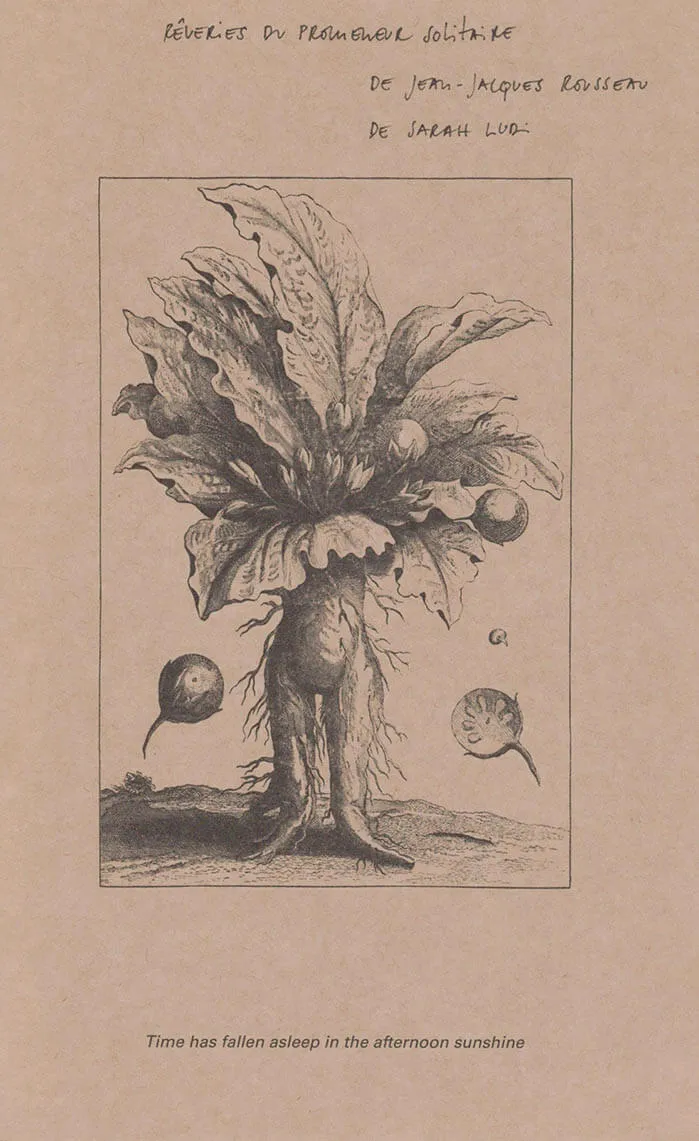
Time has fallen asleep in the afternoon sunshine
Rêveries du promeneur solitaire
For the project Time has fallen asleep in the afternoon sunshine a group of people/ performers memorize a book of their choice. Together they form a library collection consisting of living books. After years of learning by heart and reciting for readers, some of the books have now been written down from memory to create new editions, versions resulting from this process. This book is one of those books, chosen by one person, learned by heart and recited many times, and now written down again from memory. This edition is not a re-edition of the original text. It is a re-writing of the text after the process of reading, memorizing and reciting, with all the alterations that might have occured in the course of this process.

Slow Mania
Nazareth Hassan’s devastatingly brilliant Slow mania is a powerful document of senses and sense-making where estrangement and ugliness meets longing and beauty. The artist begins with a photographic sequence: two white-blue sky panels; a shattered glass storefront window; a street gutter clutching leaves, smashed straw sleeves and plastic lids; then snow holding a disassembled red stained chest of drawers. These are the writer’s plinths where form as waste is configured: “smoggy breath thru burnt-edged holes tracking acid mucous inside your home.” Slow mania provokes through enumerative structures, for instance, “screening bodies” who keep a sex club’s gates open only to some: “…197 mmm maybe lemme think / 151 yes / 162 yes / 197 ok yes, but keep your shirt on.” The poet deftly folds human intimacy into interspecies metaphor: “The rat torso twitches in agreement. Across / the street, the flies continue to starve,” where “…you’re lost in your own hole: what did you find?” Hassan attends to this painful search, bearing witness to the disturbingly exultant, offering a radical state of being, in and out of which the stunning and timely Slow mania lives and thrives. — Ronaldo V. Wilson
Slow mania is resistance to resolution, it’s pointillistic magic, it’s Seurat in Bed-Stuy: the tighter you zoom, the more undifferentiated beauty you encounter. It’s kinky (the kinked-up curls of somebody’s greased-up chops). It’s tender (bruised and brown, like the overripe fruit that haunts your summer kitchen waiting to be crumbled into a crumble). The colors are blurry, the edges are soft, the stakes are high, and everything—everything!—shimmers in the space between life and afterlife. Hassan’s gaze is a hot summer steam that sneaks into the skinniest, stinkiest crevices; the grimiest seams, the most miraculous cracks. Breathe into the abyss, that’s the invitation. Take it in, let it in. Be a wit(h)ness to every single being. — Steffani Jemison
This amazing book reads like a synesthetic performance, the only thing missing is the smell of sweat, of streets, of loss. A book of choreographed pages, scores, movements, image blur, hand-scribbles. The bleak, unsparing texts hidden among the materials turn out to be the record of sudden eruptions, violent street scenes, pick-up scenes, unclear dialogues, insults, self-debasing verbal injuries on repeat. The performers are racialized, sexualized, anonymized “persons,” “meats,” numbers, lovers, passers-by, all caught up in these dangerous yet desperately emotional and triggering dances at the limit. It will leave you raw, spaced-out, both roused and alarmed as though coming out of an intoxicating show, and wanting more. — Caroline Bergvall