Books
Books
in random order

Pirate Care: Acts Against the Criminalization of Solidarity
Tomislav Medak, Marcell Mars and 1 more
In many places around the world, the freedom to simply care for one another is under attack by the powerful, and acts of solidarity are being made illegal. In a moment of struggle defined by the rollback of social welfare programs, the criminalisation of migration, and the right-wing clampdown on bodily autonomy, radical networks of care are fighting back.
From volunteer rescue boats in the Mediterranean to underground labs for preparing gender-affirming hormones, from the sharing of copyrighted health knowledge to the provision of abortion and contraception, people are reclaiming the means to care for one another in defiance of a system that devalues and exploits the labour of care.
Against atomised despair, Pirate Care shows that fighting back isn't only about legal and legislative changes but also about organizing, direct action, and disobedient care.

Constructing Worlds Otherwise
Raúl Zibechi, George Ygarza Quispe
A new collection from one of Latin America's most dynamic radical thinkers—in the tradition of Frantz Fanon and Eduardo Galeano.
Through a survey of the most marginalized voices across Latin America—feminists, the Indigenous, people of African descent, and inhabitants of urban favelas and rural towns—Zibechi introduces the Anglo world to a range of critical perspectives and new forms of struggle in Peru, Mexico, Brazil, Colombia, and Bolivia. His book contributes to global geographies of autonomous and anti-state thinking, including that of the revolutionaries in Rojava and Abdullah Öcalan, ideological theorist of Kurdish resistance, for a rich and dynamic survey of movements of nonstate power. Constructing Worlds Otherwise comes at a time when the global left—struggling to expand its vision in an era of climate chaos and rising authoritarianism—finds itself at an impasse, desperate to animate and renew its critical imaginary.

Twenty Bookmarks
Twenty Bookmarks is a result of Production & Workflow class of Graphic Design Department at the Royal Academy of Fine Arts Antwerp, Ba1 Class of 2026.

The Men
The Men explores a territory between the poet and a lyric lineage among men. Following a tradition that includes Petrarch's Sonnets, Dante's work on the vernacular, Montaigne, and even Kant, Robertson is compelled towards the construction of the textual subjectivity these authors convey-a subjectivity that honors all the ambivalence, doubt and tenderness of the human. Yet she remains angered by the structure of gender these works advance, and it is this troubled texture of identity that she examines in The Men.

exit ambition
Exit Ambition is a catalogue of practices, documents, videos, and other projects - virtual & actual. The book operates as an incomplete index of a series of installations, instructions, anti-plays, performance scores, descriptions, etc.
Jake Reber lives and works in Buffalo, NY, where he co-curates hystericallyreal.com.

Basta Now (Expanded Edition)
Basta Now - Women, Trans & Non-binary in Experimental Music is a non-academic essay by French poet, novelist and music enthusiast Fanny Chiarello. It’s also the first book to be published by Permanent Draft, an all-female record label and micro-press founded by Chiarello & musician Valentina Magaletti, dedicated to promoting contemporary female, non-binary and transgender artists.
Basta Now is essentially a huge (yet admittedly not definitive) overview of 3867 womxn in the global experimental sound & music scene. It’s been written in playful and compelling prose and stylishly presented with photos, illustrations, and discographies.
Now in its expanded edition, the book includes 80 more pages and an additional 1496 names than the first edition, extended lists and discographies, and updated chapters – especially Wild Things, All-Stars and Madame Bricolage. “This book has nothing against men, it’s just not about them” (Fanny Chiarello)

Disobedience
Published to accompany the artist's retrospective at the Kunstmuseum St. Gallen (September 2025–March 2026), this comprehensive monograph offers a detailed overview of the work of Dutch artist Jacqueline de Jong. Designed by Sabo Day and edited by Melanie Bühler, curator of the exhibition, this publication spans De Jong's entire artistic journey of from her editorial activities and bold figurative paintings of the 1960s to her "Billiards" series in the 1970s, and her latest series of the 2020s that reflect the current state of the world.
It features new essays by Karen Kurczynski (Professor of History of Art and Architecture at the University of Massachusetts Amherst), Emily LaBarge (writer and critic), Tiana Reid (Assistant Professor of English at York University), Paul Bernard (Director of Kunsthaus Biel), as well as an as-yet-unpublished conversation with the artist and McKenzie Wark (writer and theoretician).
Organized through six sections entitled "Disobedience," "Publishing," "Chaos," "Pop," "Play," and "Politics," all lavishly illustrated, it underlines the challenging approach to art and life developed by De Jong formally, visually, and conceptually from the early 1960s until 2024.
Edited by Melanie Bühler
Texts by Emily LaBarge, Gianni Jetzer, Jacqueline de Jong, Karen Kurczynski, McKenzie Wark, Melanie Bühler, Paul Bernard, Tiana Reid.

Something Medieval
James Kirtland Randall (1929 - ) was born in Cleveland, Ohio. He studied at the Cleveland Institute of Music from 1934 to 1947, and subsequently attended Columbia University (B.A., 1955), Harvard (M.A., 1956) and Princeton (M.F.A., 1958). He studied piano with Leonard Shure and composition with Herbert Elwell, Thad Jones, Roger Sessions and Milton Babbitt. From 1958 to 1991 he taught at Princeton, where he was professor of music. He was a founding member of the American Society of University Composers and has written articles on composing and music theory for several journals, notably Perspectives of New Music (some of these were collected in the monograph Compose Yourself: A Manual for the Young (Open Space, 1995)). He also collaborated with Benjamin Boretz on the book Being About Music: Textworks 1960-2003 (Open Space, 2003).
From the early 1960s into the 1970s, Randall engaged principally in computer synthesis of sound and, with Godfrey Winham, developed facilities for this at Princeton University. His tape compositions were generated by the MUSIC IV B program, a version of MUSIC IV introduced at Princeton. He designed his own software "instruments," which enabled him to specify every aspect of every sound and structure developments within single notes in ways that reflect principles of development used in whole compositions as, for example in Lyric Variations for Violin and Computer (1966-1968).
In 1980 he turned his attention to improvised musical performance and began a series of explorations of spontaneous group performance, or "real-time co-creation," involving many kinds of musicians and other artists (painters, dancers) as well. The ongoing efforts, preserved on hundreds of sound recordings and videotapes (under the project name Inter/Play), document the emergence of idiosyncratic group styles and performing conventions. Randall is himself a regular participant in these performances. In 1990, Randall, along with Elaine Barkin and Benjamin Boretz, started the publications series Open Space.

Love Belongs to Those Who Do the Feeling: New & Selected Poems (1966-2006)
An exciting collection of new and selected poetry by Judy Grahn. The book contains selections from Judy's entire body of poetic work from The Work of a Common Woman, The Queen of Wands and The Queen of Swords, to new poems written between 1997 and 2008.
Judy's poetry is rangy and provocative. It has been written at the heart of so many of the important social movements of the last forty years that the proper word is foundational.

Entangled – Texts On Textiles
What does it mean to be a curator who writes, and, more specifically, how can curators write about textiles? This publication steps outside the framework of the typical exhibition catalogue to occupy "the space between literature and criticism".
The Community of writers was set up to create time and space to retreat from these outside opinions and demands and to let curiosity and the joy of writing be the driving forces of the writing process. This book has been realised under the auspice of Interweaving Structures: Fabric as Material, Method, and Message, and specifically through collaboration between the Faculty of Fine Art, Music and Design at the University of Bergen and the Central Museum of Textiles in Łódź. The two partners have strong positions of specialisation—the museum acts as a caretaker of material textile traditions and art in Poland, and the faculty has a strong textile art tradition and offers the only education programme for curators in Norway.
Edited by Anne Szefer Karlsen.
Contributions by Andreas Hoffmann, Heather Jones, Martina Petrelli, Anne Szefer Karlsen, Lea Vene, Johanna Zanon.

Close Writing: Kathy Acker, Cookie Mueller & Love-in-Pieces
In Close Writing, Alice Butler reflects on the diaries, letters, publications, performances, lives, and afterlives of her most beloved queer feminist writers: Kathy Acker and Cookie Mueller. While the transgressive avant-garde writer Kathy Acker has developed a cult following in the decades since her death in the late-90s, the actress and writer Cookie Mueller has remained relatively obscure. In this creative-critical study, Butler participates and responds to the lives and writings of her shared “beloved," reimagining the scene of the archive as a scene of triangulated and bittersweet love that traverses the boundaries of life and death. She draws on the autofictional strategies that Acker and Mueller pioneered in their own experimental writings and performances, encountering the women in intimate theoretical spaces of sensuality, sexuality, and sickness that slip between life and text. By encountering Acker and Mueller as transgressors and innovators, but also as beloved figures in her writing life whom she addresses in love letters, Butler brings readers to new, reparative textures of understanding, embodiment, and affection through close writing.
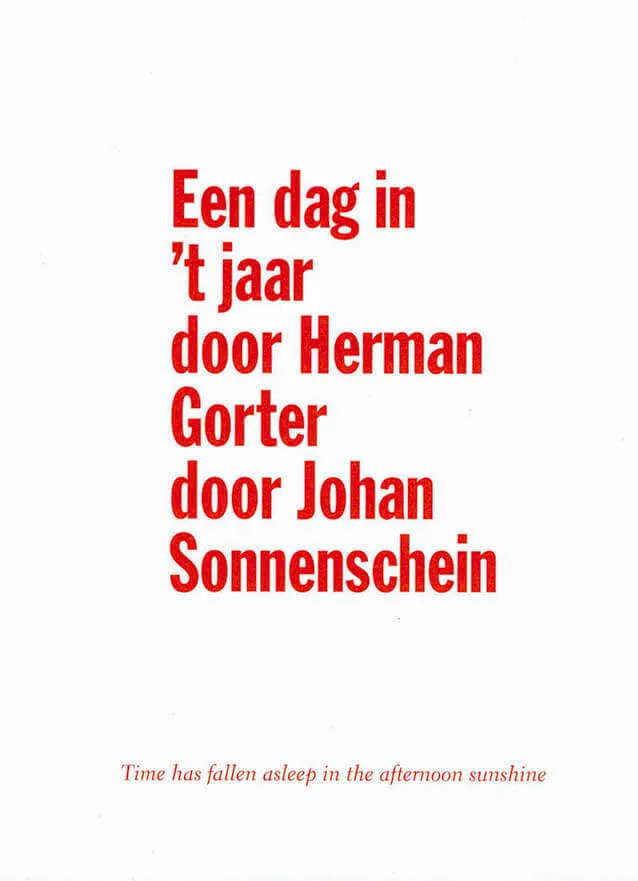
Time has fallen asleep in the afternoon sunshine
Een dag in 't jaar door Herman Gorter
For the project Time has fallen asleep in the afternoon sunshine a group of people/ performers memorize a book of their choice. Together they form a library collection consisting of living books. After years of learning by heart and reciting for readers, some of the books have now been written down from memory to create new editions, versions resulting from this process. This book is one of those books, chosen by one person, learned by heart and recited many times, and now written down again from memory. This edition is not a re-edition of the original text. It is a re-writing of the text after the process of reading, memorizing and reciting, with all the alterations that might have occured in the course of this process.

Elika Hedayat
First monograph of the Franco-Iranian artist.
This monographic catalogue looks back over the first 15 years of work by Iranian artist Elika Hedayat through more than 110 reproductions. Two of these are on a 1:1 scale, and a detailed set offers a comparison of the dimensions of the works in relation to each other.
Françoise Docquiert introduces the issues at stake in her practice with an essay, complemented by an interview with Joana P.R. Neves.
"Elika is a Parisian-Iranian artist. This cultural blend is slightly ironic though very significant, as it nourishes her artistic work and practice. Inspired by her childhood, her life, and the violence in her native country, she makes films, videos, and drawings always filled with beauty, scathing humour and cruelty." - Annette Messager
Born 1979 in Tehran, Elika Hedayat lives and works between Paris and Tehran. Arriving in France in 2004, she was admitted to the École Nationale Supérieure des Beaux-Arts in Paris in Annette Messager's studio, from wich she graduated with the Jury's congratulations in 2008.
For her works, Elika Hedyat often uses testimonies and experimental documentaries stage in a dreamlike and imaginary universe. Her stories are contemporary and her characters are real. All of her works revisits historical references, transferring them to the field of personnal experience, mainly using the various possibilities of her repertoire as a narrative document and memory retrieval tool. Reality, memory and imagination come together in a personal story under different forms : drawing, video, documentary, painting and performance.
Text by Françoise Docquiert.
Interview with Elika Hedayat by Joana P. R. Neves.

A Map of Absence: An Anthology of Palestinian Writing on the Nakba
A Map of Absence presents the finest poetry and prose by Palestinian writers over the last seventy years. Featuring writers in the diaspora and those living under occupation, these striking entries pay testament to one of the most pivotal events in modern history – the 1948 Nakba.
This unique, landmark anthology includes translated excerpts of works by major authors such as Mahmoud Darwish, Ghassan Kanafani and Fadwa Tuqan alongside those of emerging writers, published here in English for the first time. Depicting the varied aspects of Palestinian life both before and after 1948, their writings highlight the ongoing resonances of the Nakba.
An intimate companion for all lovers of world literature, A Map of Absence reveals the depth and breadth of Palestinian writing.

Michigan State University Press
Citizens of Beauty: Poems of Jean Sénac
This stunning collection of poems by the Algerian poet Jean Sénac (1926–1973) was originally published when he was forty-one. Sénac represented the hope of the new generation of Algerians who were celebrating their independence from France after 130 years of colonialism, and in the tradition of René Char and the early Albert Camus, he portrayed an Algeria whose land and people would finally sing with their own voice.
Sénac celebrates revolution, love, and the body, beginning with the resonant verses: “And now we’ll sing love / for there’s no Revolution without love.” He sang, as well, of beauty: “No morning without smiling. / Beauty on our lips is one continuous fruit.”
Translated by Jack Hirschman

touxs mes queers sont des poéte·sses
Car archiver nos écrits et nos paroles n'a jamais été aussi important, car il faut rendre compte de nos existences, de ce moment, pour nous et pour les futurs queers en recherche de repères oui, nous avons écrit, donc oui vous pourrez écrire aussi ! oui, nous avons existé, donc oui, vous existerez aussi ! car oui, nous sommes toustes poéte·sses ! car nos vies sont des poèmes et être queer est de la poésie car touxs mes queers sont des poéte·sses!
Because preserving our writings and our words has never been more important, because we must bear witness to our lives, to this moment, for ourselves and for future queers in search of guidance yes, we have written, so yes, you can write too! yes, we have existed, so yes, you will exist too! because yes, we are all poets! because our lives are poems and being queer is poetry because all my queers are poets!

Ruins and Resilience: The Longevity of Experimental Film
Experimental film practice from an international and transdisciplinary perspective.
Karel Doing is an experimental filmmaker and researcher who has worked across the globe with fellow artists and filmmakers, creating a body of work that is difficult to pinpoint with a simple catchphrase. In Ruins and Resilience he weaves autobiographical elements and critical reviews together with his wide ranging interdisciplinary approach, reflecting on his own practice by positioning key works within the context of a vibrant experimental film scene in Europe, North and South America, and Asia. Doing demonstrates how experimental filmmakers have continued to renew their practice despite the almost total demise of analog motion picture film and the constant neglect of this art form by institutions and critics. Written in a fluent and accessible style, the book looks into the connections between the work of groundbreaking artists within the field and subjects such as transgression, improvisation, collectivity, materiality, phenomenology, and perception. Specifically, intersections with music and sound are investigated, appealing to the idea of the cross-modal brain, the ability to perceive sounds and images in an integrated way. Instead of looking again at the "golden era" of experimental film, the book starts in the 1980s, showing how this art form has never ceased to surprise and inspire. The author's hands-on engagement with the medium is formational for his more theoretical approach and writing, making the book a highly original contribution in the field that is informative and inspiring for academic and practitioners alike.

Parapraxis 07: Romance
It is a particularly unlovely time to be thinking about romance. The heart can be fickle, indulgent, its matters distracting, impractical. But in the heavy boots of our undesirable present, seized by colliding catastrophes, we ask: how do we get out of here? Can the simple math of desire plus futurity break us free? Or is this just a barely veiled expression of our longing for avoidance? When we declare that love is the answer, we often forget the ambivalence of which psychoanalysis warns: love emerges in tandem with hate. It is neither the antidote to aggression nor the basis of a coherent social order.
As a narrative structure, romance insists on the future. Whether it's with a new lover hoping to break the repetition of bad patterns, in emotional growth born of the analytic couple, or inside the tremulous energy of an insurgent crowd that makes yesterday seem historically distinct from tomorrow, romance threads time with the texture of meaning. Perhaps delusional, perhaps heroic in this audacious promise, romance must also always be a fantasy, an imagined structure that has not yet met its match in the present. While this fantasy is vital to our attachment to the world and each other, it can also provide the fuel for self-serving denial and disavowal. When we say that the youth are not fucking and that they don’t care about politics, these separate charges obscure the nature of their common cause. As the world attempts to disavow the death of the earth and the removal of its peoples, our sense of continuity flees; the receding horizon is not an open road, but a vanishing point. Whither romance?
Dependent. Detached. Trauma Bonded. The Incest Lobby. Revolution Against Romance. Reading for Love and Labor. Surrealist Bedfellows. Mad Love. Essays by Nadia Bou Ali, hannah baer, Moon Charania, Davey Davis, Kaleem Hawa, Anna Kornbluh, Thomas Ogden, and more.

Secret Poetics
Hélio Oiticica (1937-80) is widely considered one of Brazil's most significant artists, and his influence is felt across a range of disciplines including painting, film, installation and participatory art. He is well known as a key founder of the interdisciplinary movement known as Neoconcretismo, launched in Rio de Janeiro in 1959 with the collaboration of artists and writers including Lygia Clark, Lygia Pape and Ferreira Gullar.
Between 1964 and 1966, moving out of his Neoconcretist period, Oiticica wrote a series of lyrical poems entitled Poâetica Secreta (Secret Poetics), and he reflected in a private notebook on their significance for his wider practice as an artist. Despite Oiticica's global fame, his "secret" poems are almost unknown and have never been published as a collection.
This bilingual edition, with accompanying essays by translator Rebecca Kosick and critic Pedro Erber, uncovers the significance of poetry for Oititica's art and shows its importance to his thinking on participation, sensation and memory

Contextures
Linda Goode Bryant, Marcy S. Philips
Contextures was originally published in 1978 by New York City’s legendary Just Above Midtown gallery. Edited by gallery founder Linda Goode Bryant and Marcy S. Philips, the publication provides an extensive history of Black artists working in abstraction from 1945 to 1978, while also articulating a newly-emerging movement of Black Conceptual Art in the 1970s.
The publication contains extensive writing by Goode Bryant and Philips drawn from interviews with the featured artists, as well as 58 black-and-white and 16 color images documenting the work of 25 artists: Banerjee, Frank Bowling, Donna Byars, Ed Clark, Houston Conwill, John Dowell, Mel Edwards, Wendy Ward Ehlers, Fred Eversley, Susan Fitzsimmons, Sam Gilliam, Gini Hamilton, David Hammons, Manuel Hughes, Suzanne Jackson, Noah Jemison, James Little, Al Loving, Senga Nengudi, Howardena Pindell, Betye Saar, Raymond Saunders, Sharon Sutton, Randy Williams, and William T. Williams. A newly commissioned afterword by Thomas (T.) Jean Lax, curator of the exhibition Just Above Midtown: Changing Spaces at the Museum of Modern Art, is also included.
Goode Bryant and Philips originally conceived Contextures to accompany The Afro-American Artists in the Abstract Continuum of American Art: 1945–1977. Functioning more like a textbook than a traditional catalog, the book nonetheless realizes a vital mission of their curatorial vision, placing Black artists within the still-prevalent, white-dominated canon of post-war abstract art. Despite its historical importance and visionary scholarship, Contextures was originally produced in a limited run of just a few hundred copies by the gallery and remains rare and largely unknown.
This new edition is produced in facsimile form and is a co-publication with Pacific.

A book with a hole in it
Kamelya Omayma Youssef’s A book with a hole in it uses the poetry of the fragment and the language of everyday survival to gesture towards the fallibility of language at the juncture of the multiple, intersecting wars on women, on "terror," on the non-White body, and on people and language in diaspora. Drawn from a set of journals written over a four-month period, A book with a hole in it throws the formal, official work of poetry into relief, asking what knowledge exists beyond knowledge, which silences are too deep to be surfaced on the page, and how to pierce through trauma and violence to approach a politics of redemption.

Under The Sea
Taking the shape of an accordion-folded A3 poster, “Under The Sea” investigates the political economy of global internet infrastructures, whose material reality has temporarily become visible during fibre optic network expansion works in The Hague and other Dutch cities.
As internet users, we spend a lot of time underwater. Contrary to popular belief, satellites play a negligible role in beaming our intimate messages, cat footage and work emails across the globe.
99% of all intercontinental internet traffic travels through one of over 550 fibre optic cables criss-crossing our oceans. Despite its scale, complexity and many interlinkages with global systems of power, this network of cables and landing points commonly remains invisible.
Printing: Risograph, Stencilwerck Den Haag; English text and Photography: Livio Liechti; Dutch translation: Minke Havelaar; Design: Apsara Flury.
Edition of 250. Co-funded by Oxfam Novib.

Água Viva
In Água Viva Clarice Lispector aims to 'capture the present'. Her direct, confessional and unfiltered meditations on everything from life and time to perfume and sleep are strange and hypnotic in their emotional power and have been a huge influence on many artists and writers, including one Brazilian musician who read it one hundred and eleven times. Despite its apparent spontaneity, this is a masterly work of art, which rearranges language and plays in the gaps between reality and fiction.
Clarice Lispector (December 10, 1920 – December 9, 1977) was a Brazilian writer acclaimed internationally for her innovative novels and short stories. Born to a Jewish family in Podolia in Western Ukraine, as an infant she moved to Brazil with her family, amidst the disasters engulfing her native land following the First World War.

Publiek Park
Jef Declercq, Anna Laganovska and 2 more
The third Publiek Park publication – Walking Guide – combines essays, archival fragments, and artistic voices to trace both the exhibition route at Plantentuin Meise and the historical path that led from the creation of the Jardin Botanique in the heart of Brussels to its relocation outside the city. Following the logic of a quilt, layering different perspectives, textures, and timelines, the book connects artistic narratives with history and reflections on urban gardens, public space, and botanical imaginaries. Just like the exhibition, the publication offers not merely a portrait of a place, but a reflection on the multiplicity that defines it.
Alongside documentation of the exhibition and contributions from the participating artists, this year’s Walking Guide features writings by Nikolaos Akritidis, Denis Diagre-Vanderpelen, Koen Es, Lana Jones, François Makanga, Noam Youngrak Son, and Jean Watt. The two parks are portrayed in photographs by Michiel de Cleene, with book design by Victor Verhelst and Corbin Mahieu bringing all of these elements together.
This publication is made with the generous support of Plantentuin Meise and all partners.